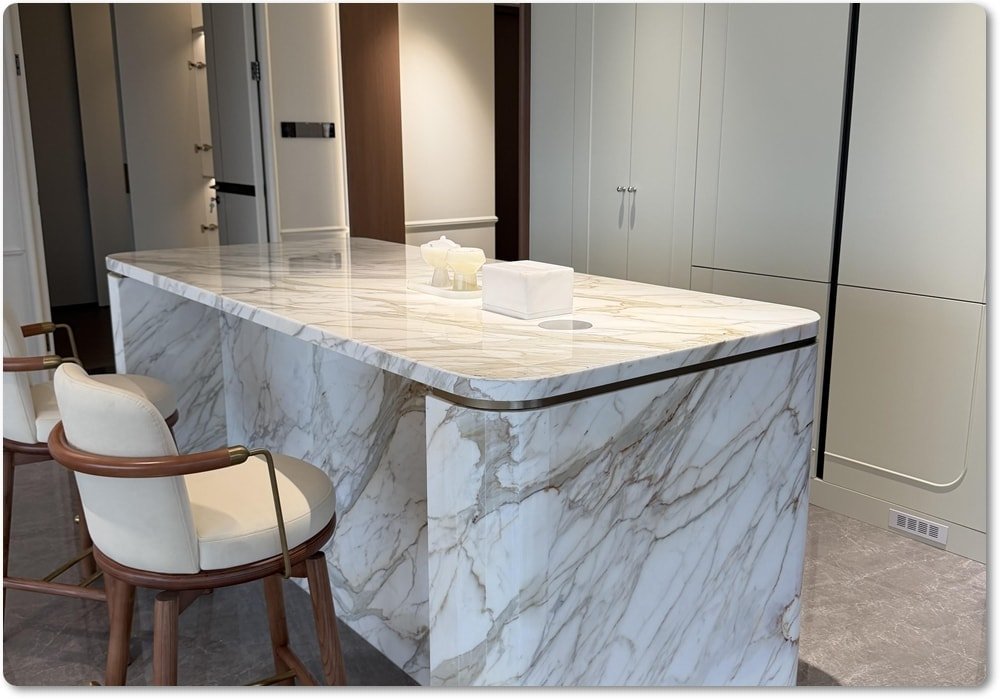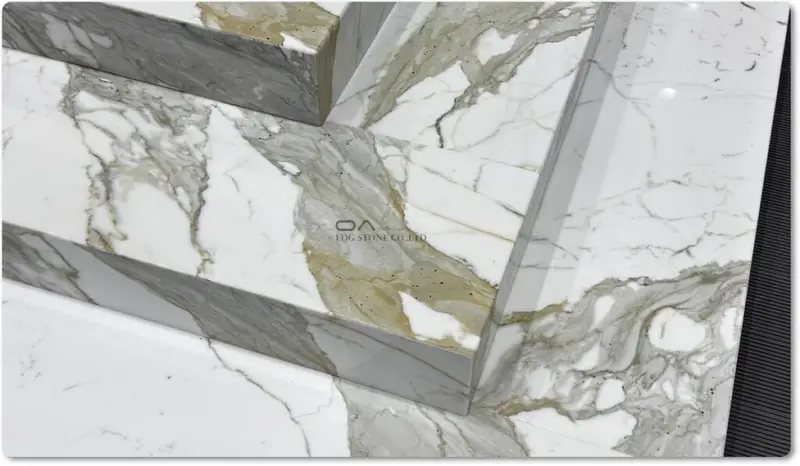
Introduction
Bathrooms and vanities are among the most deceptively complex applications in stone projects. While they may appear straightforward, they involve constant exposure to moisture, frequent cleaning, edge impact risks, long-term vapor accumulation, sealing requirements, and high expectations for visual consistency.
According to the Natural Stone Institute’s Dimension Stone Design Manual, wet areas—including shower linings, vertical cladding, and horizontal surfaces—must be treated as integrated systems. Waterproofing, slope design, anchorage, and material performance are all interdependent. This means bathroom stone applications cannot be approached in the same way as dry-area countertops.
Taj Mahal Quartzite has become a preferred material in these environments because it is a quartz-based natural stone known for its hardness, durability, and resistance to chemical weathering. The U.S. Geological Survey (USGS) also identifies quartzite as commonly used in bathroom vanities, shower surrounds, and indoor flooring—confirming its suitability for high-use wet areas.
This guide translates Taj Mahal Quartzite bathroom applications into actionable procurement standards—covering selection, fabrication, installation, and maintenance—to reduce project risk and improve long-term performance.
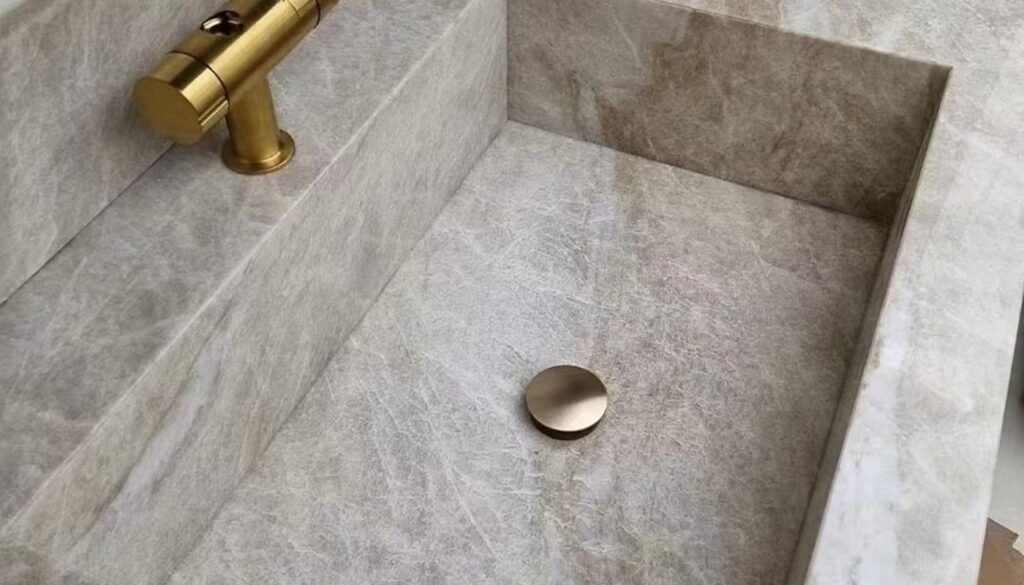
1. Why Bathrooms & Vanities Are More Complex Than Expected?
Bathrooms are not simply “spaces with water”—they are environments defined by:
- Continuous humidity exposure
- Chemical interaction (soap, cleaners, cosmetics)
- Thermal fluctuations
- Frequent surface contact and cleaning
The Natural Stone Institute separates wet-area design into specific technical categories, such as:
- Stone slab shower linings
- Waterproofing systems
- Floor slope requirements
- Curb height standards
This highlights a critical truth: bathroom stone performance depends more on system design than on the material alone.
From a procurement perspective, the biggest risk is not poor aesthetics—it is misalignment between material, structure, and installation methodology.
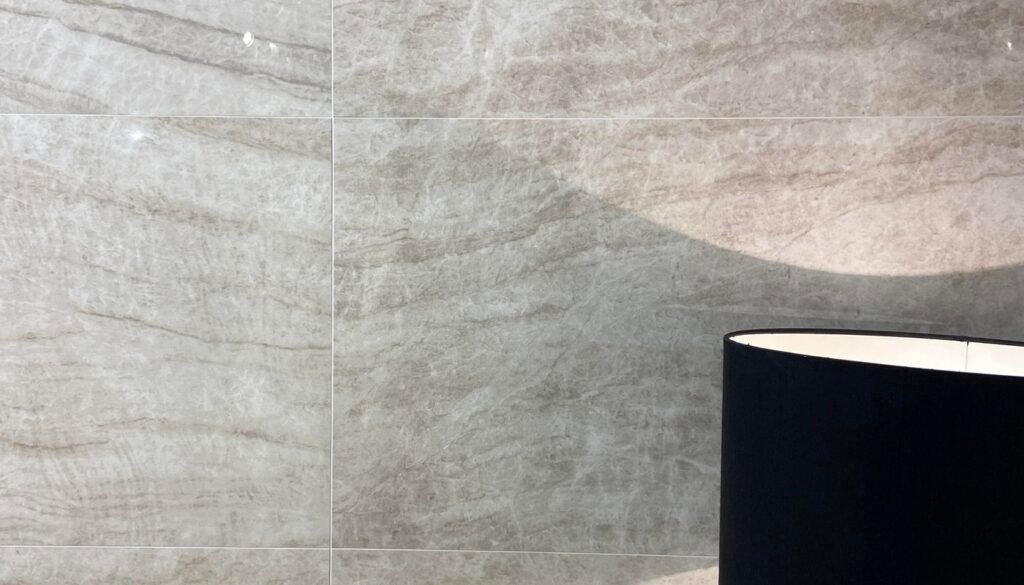
2. Why Taj Mahal Quartzite Performs Well in Bathrooms?
Taj Mahal Quartzite offers a rare combination:
- Natural stone luxury aesthetics
- Quartzite-level durability and hardness
- Resistance to chemical weathering
Industry descriptions characterize quartzite as:
- Hard
- Resilient
- Suitable for high-traffic and high-use environments
USGS data further supports its real-world application in:
- Bathroom vanities
- Shower surrounds
- Interior flooring
Design Advantage
Its soft beige and warm white tones provide:
- Clean, spa-like atmosphere
- Light reflection and spatial expansion
- Compatibility with both modern and classic interiors
This makes it particularly effective in:
- Luxury residential bathrooms
- Hospitality suites
- High-end apartment developments
3. Vanity Countertops: The Safest Investment Area
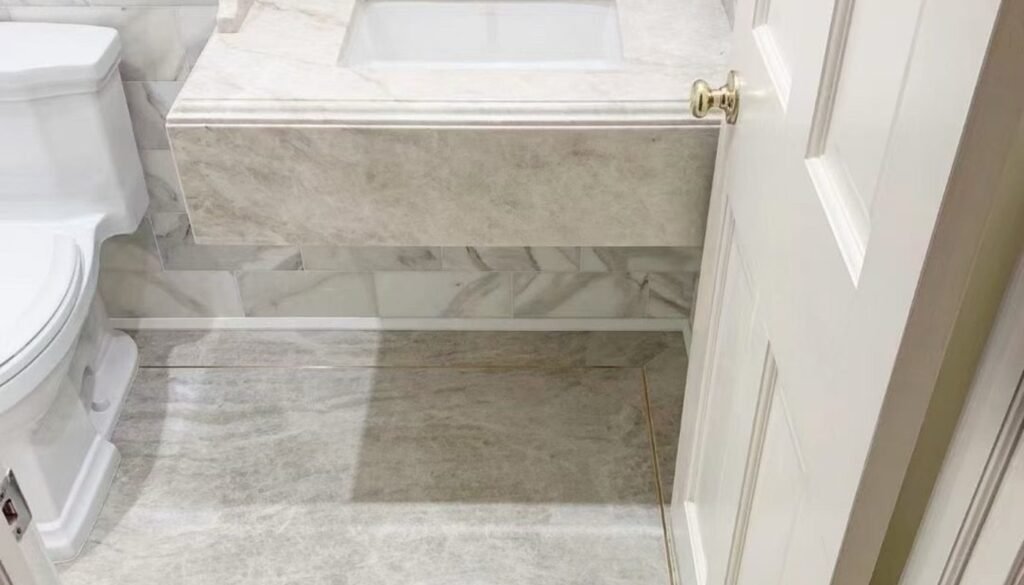
Vanity tops are the most proven and lowest-risk application for Taj Mahal Quartzite.
Key Procurement Focus Areas
- Slab Continuity
- Prefer full slabs over multiple joints
- Reduce seams → minimize water penetration risk
- Cutout Precision
- Sink and faucet holes must be accurately fabricated
- Poor cutting = stress concentration + edge failure
- Backsplash Integration
- Essential for water protection
- Prevents long-term wall damage
- Edge Detailing
- Rounded or eased edges reduce chipping
- Critical for high-use environments
Core Insight
The value of a vanity is not just in the slab cost—it lies in the accuracy of fabrication and the quality of integration.
4. Showers & Wet Walls: Feasible Only as a System
Taj Mahal Quartzite can be used in showers, but only when treated as a complete wet-area system.
Critical System Components
- Waterproof membrane behind the stone
- Proper anchoring system
- Controlled joint placement
- Adequate drainage slope
- Porosity and sealing considerations
Common Mistake
Treating stone as a decorative layer only.
Correct Approach
Treat the installation as:
Structure + Waterproofing + Material + Installation = One System
Best Practice
- Require mockups before full installation
- Confirm shop drawings and layout direction
- Avoid excessive small-piece segmentation
5. The Four Most Important Procurement Criteria
1. Batch Consistency
- Natural variation must be controlled
- Use the same lot for a single bathroom space
2. Surface Finish
- Polished → reflective, easier to clean
- Honed → softer, more forgiving visually
- Leathered → textured, better for hiding marks
3. Edge & Cut Quality
- High-risk zones: sink cutouts, corners, wall joints
- Require precision fabrication
4. Technical Data
- Absorption rate
- Density
- Flexural strength
- Abrasion resistance
These align with ASTM standards referenced by the Natural Stone Institute and are essential for commercial-grade procurement decisions.

6. Installation Logic: The True Lifespan Driver
Installation determines whether a project lasts 5 years or 25 years.
Recommended Workflow
- Finalize design details first
- Produce shop drawings
- Confirm slab layout (dry layout)
- Fabricate with pre-defined cutouts
- Minimize on-site cutting
Why This Matters?
Bathrooms are compact spaces—any error in:
- Seam alignment
- Vein direction
- Edge finishing
…becomes highly visible and difficult to correct.
7. Maintenance Strategy: From Surface to Long-Term Asset
Proper maintenance transforms stone from a liability into a long-term asset.
Recommended Care Routine
- Use neutral cleaners or stone-safe products
- Avoid acidic or harsh chemicals
- Rinse thoroughly
- Dry surfaces after use
Key Principle
Light cleaning + frequent drying + minimal residue = long-term visual stability
For Commercial Projects
Include maintenance guidelines in:
- Handover documents
- Facility management manuals
This reduces:
- Warranty claims
- Surface damage
- Operational inconsistencies
8. Procurement Conclusion: Is It Worth It?
Taj Mahal Quartzite is an excellent choice for bathroom and vanity applications when the goal is:
- Luxury aesthetics
- Long-term durability
- Consistent performance in wet environments
However, its success depends on one critical factor:
It must be implemented as part of a fully engineered wet-area system—not as a standalone material choice.
Final Verdict
✔ Highly recommended for vanities
✔ Suitable for showers (with system design)
✔ Ideal for high-end residential and hospitality projects
Strategic Insight
- If design, waterproofing, and installation are aligned, → premium long-term performance
- If only slab selection is considered → high risk of failure
FAQ
1. Is Taj Mahal Quartzite suitable for bathroom vanities?
Yes. Quartzite is widely used for bathroom vanities, offering durability and aesthetic consistency.
2. Can it be used in showers?
Yes, but only within a properly designed wet-area system including waterproofing and drainage.
3. How should it be cleaned?
Use neutral cleaners or mild soap with warm water, then rinse and dry.
4. Is it more durable than marble?
In most cases, yes. Quartzite is harder and more resistant to chemical weathering than marble.
5. Should buyers request technical data?
Yes. Absorption, density, and strength data are essential for proper evaluation.
References
- Natural Stone Institute — Dimension Stone Design Manual
- Natural Stone Institute — Wet Areas Chapter
- Natural Stone Institute — Cleaning Natural Stone Guide
- Natural Stone Institute — ASTM Standards for Natural Stone
- Natural Stone Institute — Sandstone and Quartzite Resources
- U.S. Geological Survey (USGS) — Quartzite Applications in Construction
- USGS — Dimension Stone Statistics and Information