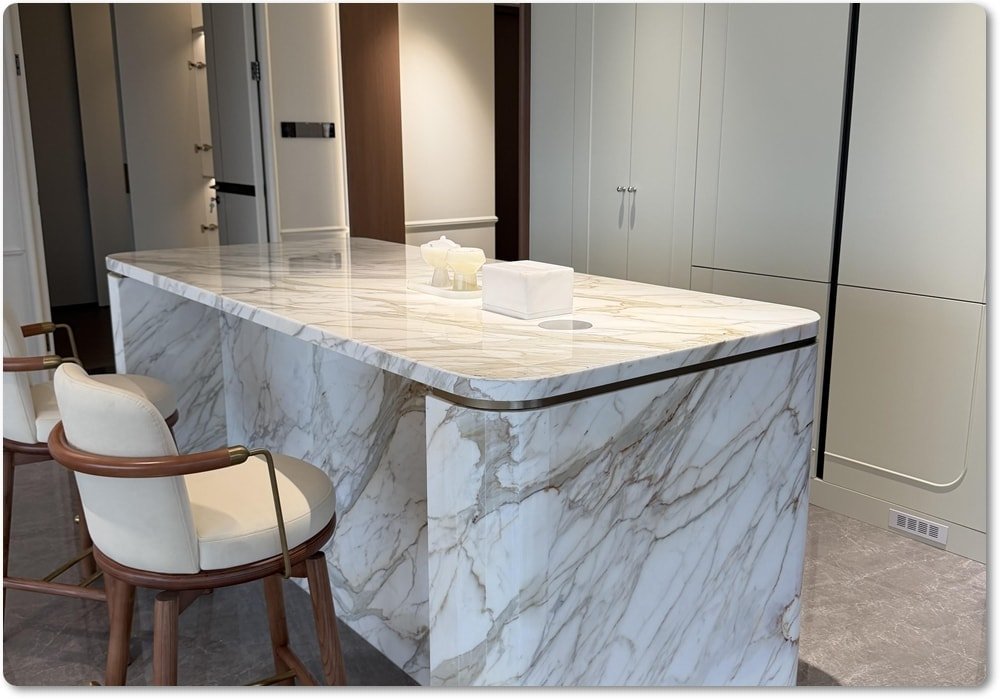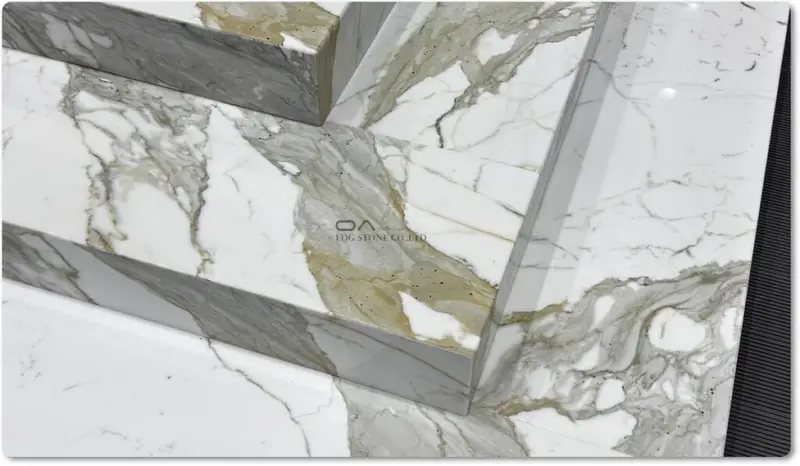
1. Introduction: Why White Marble Remains the Gold Standard
Architects, developers, and stone buyers have selected white marble for premium projects for millennia. This natural stone offers a unique blend of clean aesthetics, light reflectance, and structural permanence. However, successful procurement requires more than an eye for beauty. It demands a deep understanding of the stone’s geological origin, physical properties, and performance limits.
This guide serves as a technical white paper for professionals. It translates complex geological data into actionable procurement insights. Whether you are sourcing slabs for a luxury hotel lobby or budgeting for a high-rise residential facade, this guide provides the objective data you need.
2. Geological Origin & Formation: From Limestone to Metamorphic Rock
White marble begins its lifecycle as sedimentary limestone or dolomite rock. This original material consists primarily of calcium carbonate ($CaCO_3$) derived from ancient marine organisms. Over millions of years, tectonic plate movements bury these sedimentary layers deep within the Earth’s crust.
The Process of Metamorphism
Deep underground, the limestone undergoes intense heat (typically between $300^\circ\text{C}$ and $700^\circ\text{C}$) and extreme pressure. This environment triggers a process called recrystallization.
Destruction of Original Structures: The intense heat and pressure destroy the original sedimentary textures, fossils, and layered structures of the limestone.
Growth of Calcite Crystals: The calcium carbonate molecules recrystallize into an interlocking mosaic of calcite crystals.
Purification: The highest-quality white marble forms from highly pure limestone. When the original sedimentary rock contains very few mineral impurities, the resulting marble achieves a bright, stark white color.
[Sedimentary Limestone]
       │
       ▼ (Tectonic Burial)
[High Heat: 300°C - 700°C] + [Extreme Lithostatic Pressure]
       │
       ▼ (Recrystallization Process)
[Interlocking Calcite Crystal Mosaic]
       │
       ▼
[Pure White Marble Rock]
The Origin of White Marble Texture and Veining
What creates the distinctive white marble texture and natural veining that architects value? The answer lies in trace minerals. While pure calcite produces white marble rock, tiny amounts of non-calcite minerals introduce color variations:
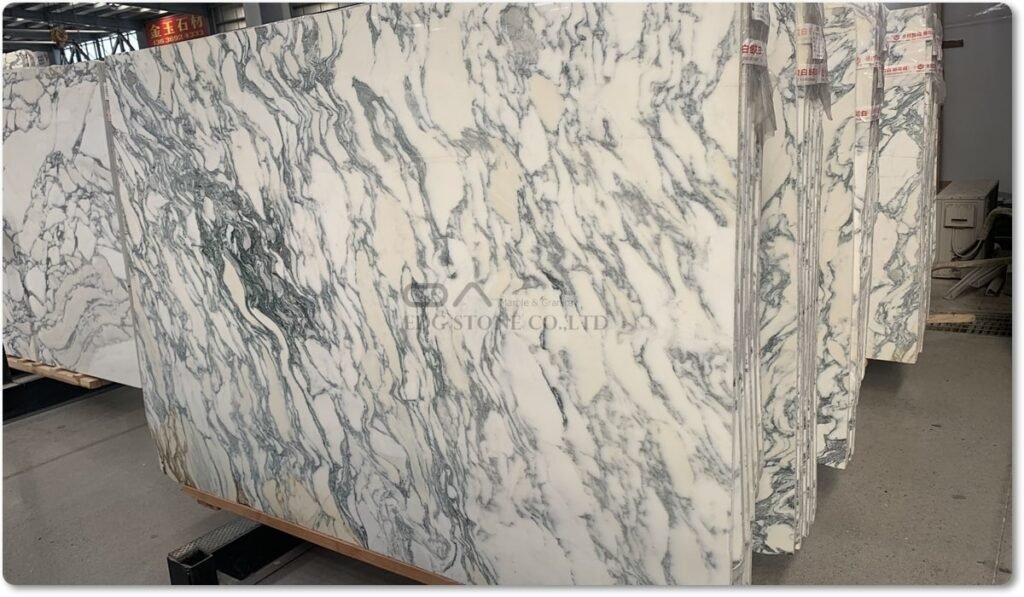
Silt and Clay: Create grey, black, or blue-grey veins (commonly seen in Carrara and Statuario).
Iron Oxides: Produce yellow, gold, or cream tones (typical of Calacatta Gold).
Serpentine or Chlorite: Introduce green veins.
During metamorphism, tectonic forces fold and stretch the rock layers. This movement forces these mineral impurities into localized lines, waves, or clouds, creating unique natural veining patterns across the white marble texture.
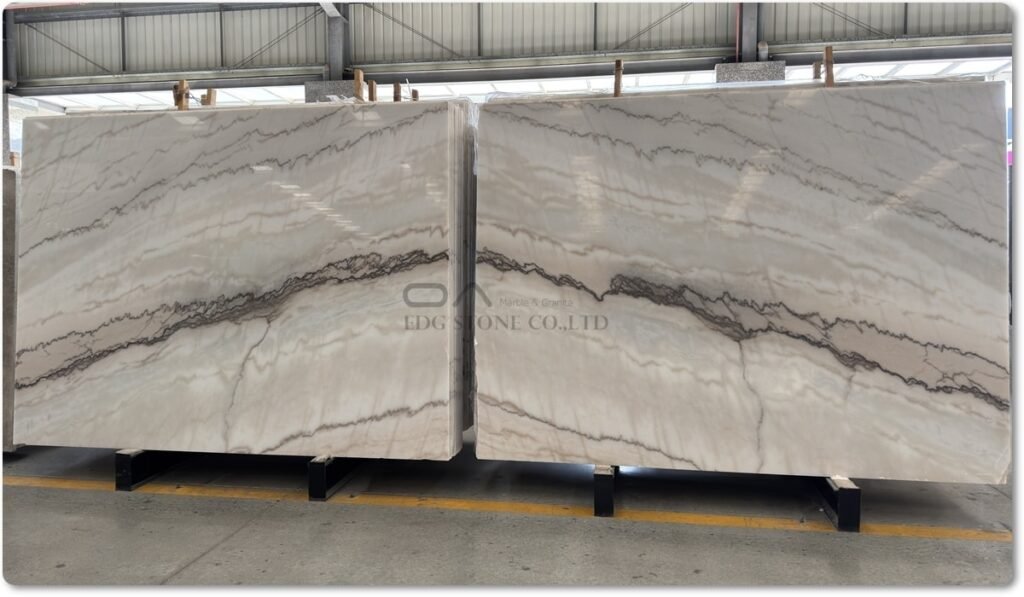
3. Physical & Mechanical Properties: The Technical Datasheet
Architects and engineers must look past visual aesthetics to evaluate raw technical performance. The physical properties of white marble dictate its structural suitability, longevity, and maintenance requirements.
+-----------------------------------------------------------------------------------------+
|                               TECHNICAL SPECIFICATION SUMMARY                           |
+----------------------------+-----------------------------------+------------------------+
| Physical Property          | Typical Value Range               | Standard Test Method   |
+----------------------------+-----------------------------------+------------------------+
| Mineral Composition        | 95% - 99% Calcite ($CaCO_3$)       | XRD / Petrographic     |
| Mohs Hardness              | 3.0 - 4.0                         | Scratch Hardness Test  |
| Bulk Density               | 2,600 - 2,850 kg/m³               | ASTM C97               |
| Water Absorption           | 0.05% - 0.15% (by weight)         | ASTM C97               |
| Effective Porosity         | 0.3% - 1.2%                       | ASTM C97 / DIN 52102   |
| Compressive Strength       | 70 - 140 MPa                      | ASTM C170              |
| Flexural Strength          | 7 - 15 MPa                        | ASTM C880              |
+----------------------------+-----------------------------------+------------------------+
Calcite Structure and Mineralogy
High-grade white marble typically consists of 95% to 99% pure calcite ($CaCO_3$). The individual calcite grains form an interlocking crystalline structure. The size of these grains determines the stone’s grain texture:
Fine-Grained Marbles (e.g., Thassos White) offer high structural density and a uniform, sugar-like reflection.
Coarse-Grained Marbles (e.g., Bianco Carrara) show visible crystal facets that catch the light at varying angles.
Mohs Hardness
White marble rates between 3.0 and 4.0 on the Mohs hardness scale. This means it is relatively soft compared to granite (Mohs 6–7) or quartz countertops (Mohs 7).
Procurement Impact: Materials with a Mohs hardness of 3 can be scratched by steel blades, sand, and everyday metal objects. Specifiers must plan for scratch mitigation in high-traffic flooring applications.
Bulk Density
The bulk density of white marble ranges from 2,600 to 2,850 kg/m³ (approximately 162 to 178 lbs/ft³).
Procurement Impact: High density correlates with greater compressive strength and lower porosity. Structural engineers use these density values to calculate dead loads on building foundations and facade support systems.
Water Absorption & Porosity
The water absorption rate of premium white marble is low, typically between 0.05% and 0.15% by weight. The material’s effective porosity ranges from 0.3% to 1.2%.
Procurement Impact: While these percentages are low, white marble is still more porous than engineered quartz or porcelain. Liquid penetration can cause staining or subsurface moisture trapping. Stone buyers must mandate deep-penetrating sealers for wet environments or commercial kitchen installations.
4. Major Commercial Types of White Marble
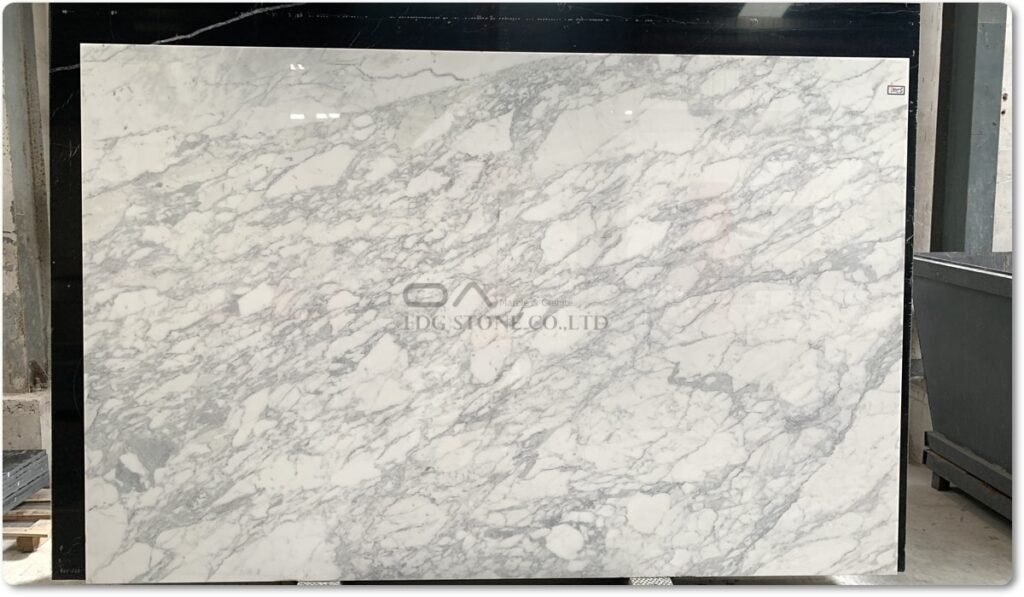
Understanding the precise differences between the primary commercial types of white marble protects buyers from mislabeling and overpayment.
+-------------------------------------------------------------------------------------------------+
|                                 COMMERCIAL WHITE MARBLE COMPARISON                              |
+-------------------+--------------------+------------------------+-------------------------------+
| Marble Type       | Geographic Origin  | Base Color Background  | Veining Characteristic        |
+-------------------+--------------------+------------------------+-------------------------------+
| Bianco Carrara    | Carrara, Italy     | Light Grey to Off-White| Soft, feathery, grey accents  |
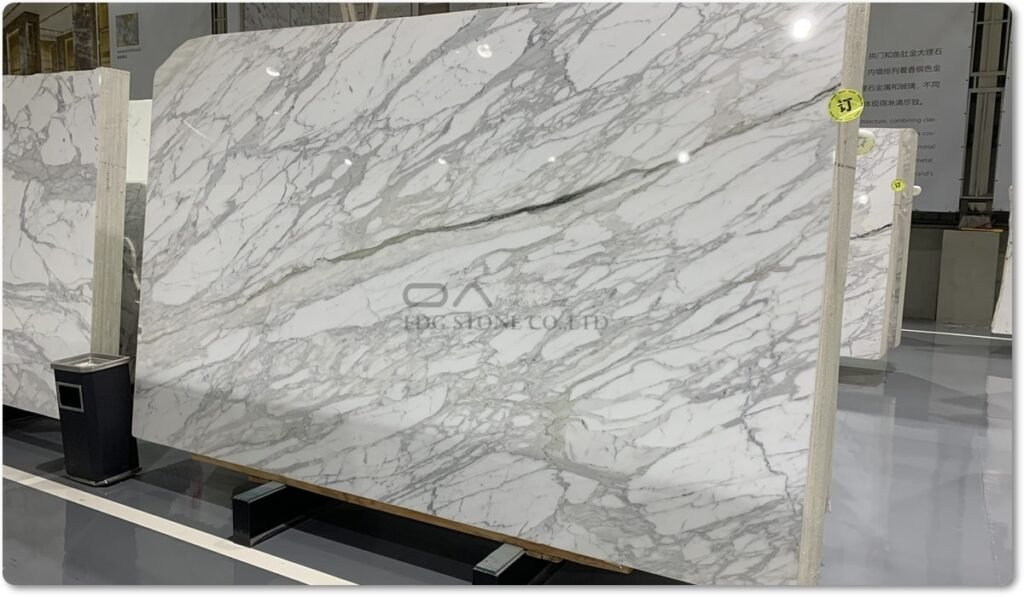
| Calacatta         | Apuan Alps, Italy  | Crisp, Stark White     | Bold, thick, dramatic grey/gold|
| Statuario         | Apuan Alps, Italy  | Bright, Milky White    | Heavy dark grey distinct veins|
| Thassos White     | Thassos, Greece    | Pure Snow White        | Minimal to zero veining; glass|
| Volakas           | Drama, Greece      | Brilliant White        | Diagonal, smoky grey/purple   |
+-------------------+--------------------+------------------------+-------------------------------+
1. Bianco Carrara (Italy)
Characteristics: The most abundant Italian white marble. It features a consistently soft, light grey background with fine, feathery grey veining.
Best Uses: Large-scale commercial flooring, wall cladding, and mass-produced tile programs.
2. Calacatta (Italy)
Characteristics: A rare, luxury stone. It displays a stark, bright white background contrasted by bold, thick, dramatic veins that range from charcoal grey to warm gold.
Best Uses: High-end residential feature walls, book-matched fireplace surrounds, and executive boardroom tables.
3. Statuario (Italy)
Characteristics: Highly prized by sculptors and architects alike. It features a bright, milky white background with heavy, distinct dark grey veins running alongside thinner structural lines.
Best Uses: Statement countertops, luxury master bathrooms, and focal-point lobbies.
4. Thassos White (Greece)
Characteristics: A fine-grained, crystalline marble renowned for its pure snow-white appearance without visible veining. It reflects light exceptionally well.
Best Uses: Minimalist architectural spaces, luxury shower pans, and reflective exterior accents.
5. Volakas (Greece)
Characteristics: Often called the “Carrara of Greece.” It presents a brilliant white base with diagonal, smoky veins in shades of grey, light purple, or soft brown.
Best Uses: Book-matched wall installations and large-format floor tiles.
5. Architectural Applications: Matching Form to Function
White marble adapts well to many design styles, but physical characteristics dictate proper placement.
      [Block Quarrying] ──> [Slab Gangsaw Cutting] ──> [Surface Finishing]
                                                               │
                                       ┌───────────────────────┴───────────────────────┐
                                       ▼                                               ▼
                         [Interior Application]                          [Exterior Application]
                                       │                                               │
               ┌───────────────────────┴───────────────────────┐                       │
               ▼                                               ▼                       ▼
      [Polished Finish]                                 [Honed Finish]         [Textured Finish]
    (Walls, Low-Traffic)                             (Flooring, Counters)     (Facades, Pavers)
Interior Flooring & Wall Cladding
White marble tiles and slabs create bright, expansive interiors.
Flooring Tip: Specify a honed finish for high-traffic public floors. Honed surfaces maintain slip resistance and hide wear patterns better than high-gloss polished surfaces.
Wall Cladding Tip: Use polished finishes on vertical surfaces to maximize natural light distribution deep into building interiors.
Countertops & Vanities
While highly sought after for residential kitchens, white marble requires conscious upkeep.
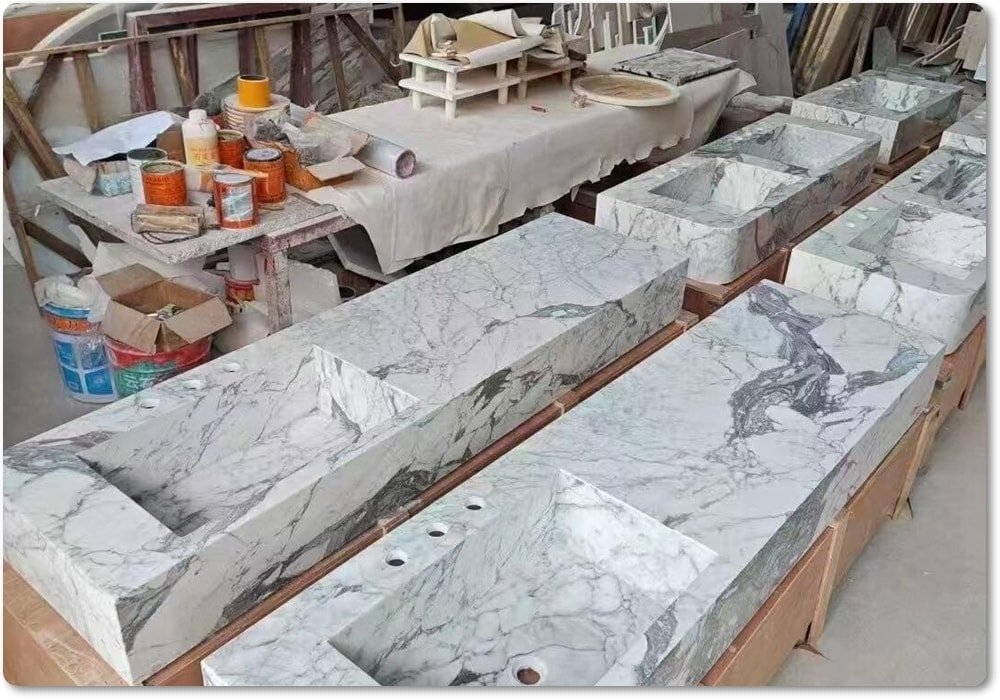
Design Control: For kitchen counters, apply deep-penetrating oleophobic sealers during fabrication. For commercial hotels, white marble serves beautifully for guestroom vanities, where exposure to harsh cooking oils is nonexistent.
Exterior Facades
Exterior use requires strict engineering review.
Climate Concerns: In regions with harsh freeze-thaw cycles, moisture penetrating the stone’s 0.3% porosity can expand, causing micro-fissures or surface spalling.
Finish Recommendation: Avoid polished finishes outdoors. Acid rain and UV exposure dull polished marble surfaces within a few seasons. Specify sandblasted, brushed, or bush-hammered finishes for external applications.
6. Global Sourcing & Supply Chain Case Study: EDG Stone Factory
Large-scale commercial procurement requires suppliers with vast processing capacities and strict quality control. While white marble represents an industrial standard for classic elegance, modern commercial projects often combine these traditional natural stones with advanced engineered surfaces to optimize project budgets, durability, and scale.
Integrated Supply Chain Management
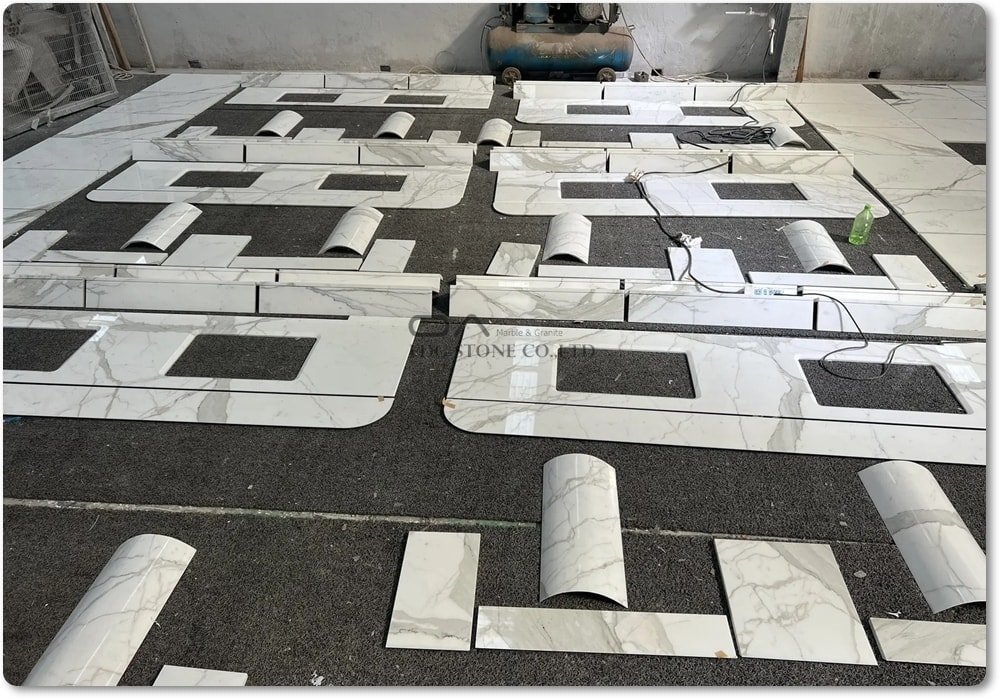
Leading global enterprises like EDG Stone Factory demonstrate how modern processing facilities support complex international projects. As a premier White Marble Slabs & Countertops Manufacturer and Exporter, EDG Stone Factory manages large-scale fabrication pipelines that bridge the gap between quarry extraction and site delivery.
+---------------------------------------------------------------------------------------------------+
|                         COMMERCIAL FABRICATION CAPABILITIES (EDG STONE FACTORY)                   |
+----------------------+--------------------------------------+-------------------------------------+
| Equipment Type       | Technical Function                   | Operational Benefit                 |
+----------------------+--------------------------------------+-------------------------------------+
| Multi-Blade Gangsaws | High-speed block slicing            | Guarantees precise slab thickness   |
| 16-Head Auto-Polishers| Continuous surface finishing         | Delivers uniform gloss across batches|
| 5-Axis CNC Machinery | Intricate edge profiling & cutouts   | Eliminates manual installation errors|
+----------------------+--------------------------------------+-------------------------------------+
Material Diversification for Commercial Buyers
Experienced procurement officers rarely source materials in isolation. For high-traffic service areas, heavy-use commercial bars, or high-wear kitchen countertops, buyers frequently complement delicate white marble wall cladding with rugged engineered materials or dense natural quartzite.
By utilizing an integrated manufacturer and exporter like EDG Stone Factory, global buyers can consolidate their natural stone shipments alongside precision-engineered quartz and quartzite slabs. This single-source strategy lowers container shipping fees, ensures consistent edge-profiling quality across different materials, and keeps large commercial developments on schedule.
7. Strategic Advantages & Performance Limitations
An objective procurement strategy requires balancing aesthetic returns against long-term maintenance costs.
Advantages
High Property Valuation: Buildings featuring premium white marble command higher resale values and rental premiums.
Excellent Thermal Mass: White marble absorbs heat slowly, keeping building interiors cooler in warm climates.
Unrivaled Brilliance: The crystalline structure of calcite allows light to penetrate several millimeters into the stone before reflecting, producing a distinct visual depth.
Limitations & Mitigation Strategies
Acid Vulnerability (Etching): Calcite reacts instantly with acids (lemon juice, wine, vinegar, harsh cleaners). The acid dissolves a micro-layer of calcite, leaving a dull, matte spot known as an etch mark.
Mitigation: Apply specialized topical stone protection films or penetrative chemical barriers in food-service environments.
Low Scratch Resistance: Foot traffic carrying exterior grit can dull a polished floor over time.
Mitigation: Install walk-off mats at entryways and mandate a regular maintenance schedule using diamond-impregnated polishing pads.
8. Material Procurement Best Practices for Professionals
Avoid costly delays by embedding these four steps into your stone procurement workflow:
Mandate Dry-Lay Inspection: For book-matched walls or large-format floors, require the fabrication facility to lay out the cut tiles or slabs on their factory floor. Review the vein flow via high-resolution aerial photographs before crating and shipping.
Specify Strict Thickness Tolerances: Request a thickness tolerance of $\pm0.5\text{ mm}$ for floor tiles and $\pm1.5\text{ mm}$ for 20 mm slabs. Inconsistent thicknesses increase installation labor costs and cause uneven joints.
Verify Slab Matching: Ensure all slabs for a single room come from the same block and are processed in sequential order. White marble appearance shifts significantly from one end of a quarry vein to the other.
Enforce International Packing Standards: Require ISPM- 15-certified wooden crates lined with high-density shock-absorbing foam. White marble is brittle; improper crating leads to micro-cracking during ocean transport.
9. Internal Link Matrix (Knowledge Hub)
To further explore technical procurement strategies, review the other entries in this technical series:
White Marble Procurement Guide #1: What Is White Marble? Complete Material Guide for Architects & Buyers (2026) (This Guide)
White Marble Procurement Guide #2: Sourcing Italian White Marble – Carrara, Calacatta, and Statuario
White Marble Procurement Guide #3: Greek White Marble Options – Volakas, Thassos, and Sivec Specifications
White Marble Procurement Guide #4: Understanding Veining Patterns – Selecting Book-matched vs. Blended Slabs
White Marble Procurement Guide #5: Surface Finishes Explained – Honed, Polished, Brushed, and Leathered
White Marble Procurement Guide #6: Thick vs. Thin Slabs – Engineering 12mm, 20mm, and 30mm Applications
White Marble Procurement Guide #7: Preventing Stone Failure – Defending Against Etching, Staining, and Scratching
White Marble Procurement Guide #8: Sealing Technologies – Penetrating vs. Topical Sealers for Commercial Projects
White Marble Procurement Guide #9: Installation Standards – ASTM Methods for Thin-Set and Mechanical Anchoring
White Marble Procurement Guide #10: Cost Estimating – Budgeting for Material, Waste Factors, and Freight
White Marble Procurement Guide #11: Inspection Protocols – Factory Dry-Lay and Slab Quality Control Checklists
White Marble Procurement Guide #12: Exterior Cladding Design – Managing Thermal Expansion and Wind Loads
White Marble Procurement Guide #13: Maintenance Schedules – Commercial Facility Guide for Polished Stone Floors
White Marble Procurement Guide #14: Stain Removal Protocols – Poultice Recipes for Oil, Rust, and Organic Marks
White Marble Procurement Guide #15: Quartzite vs. Marble – When to Choose Engineered and Natural Alternatives
10. Frequently Asked Questions (FAQ)
Q1: What is the primary difference between white marble and white granite?
White marble consists of calcite ($CaCO_3$), which makes it susceptible to acid etching and scratching (Mohs 3–4). White granite consists primarily of quartz and feldspar, making it highly resistant to acids and much harder (Mohs 6–7). True white granite always contains visible dark mineral grains, whereas white marble can achieve a completely pure white background.
Q2: Why does some white marble turn yellow after installation?
Yellowing typically occurs due to two reasons: iron oxidation or trapped moisture. Many white marbles contain trace amounts of iron. If exposed to heavy water from behind the slab without proper sealing or waterproofing membranes, the iron oxidizes (rusts), turning the surface yellow. Acrylic sealers that degrade from UV exposure can also turn a yellowish hue over time.
Q3: Can white marble be used safely in commercial public restrooms?
Yes, but it requires careful specification. Avoid polished finishes on the floor due to slip hazards when wet. Use a honed finish and apply an advanced oleophobic and hydrophobic penetrating sealer to protect the stone from cosmetics, watermarks, and uric acid.
Q4: How much waste factor should I calculate when ordering white marble slabs?
For standard rectangular tile layouts, budget a 10% to 15% waste factor. For complex book-matched feature walls or custom radial cuts, the waste factor can range from 25% to 40% depending on the specific veining pattern and slab yields.
11. Reference Sources & Industry Citations
[1] Marble Institute of America (MIA / DSI): Dimension Stone Design Manual, Version 8.0. Technical standards for stone selection and installation.
[2] ASTM International: ASTM C97 / C97M Standard Test Methods for Absorption and Bulk Specific Gravity of Dimension Stone.
[3] ASTM International: ASTM C170 / C170M Standard Test Method for Compressive Strength of Dimension Stone.
[4] Italian Stone Tech Association (Confindustria Marmomacchine): Statistical Report on Carrara Calcite and Metamorphic Formations.
[5] European Committee for Standardization (CEN): EN 1469:2015 Natural Stone Products – Slabs for Cladding – Requirements.
[6] Geological Society of London: Metamorphic Processes in Alpine Carbonate Platforms. Special Publications.
[7] National Tile Contractors Association (NTCA): Reference Manual 2025/2026 Edition. Substrate preparation and stone mortar requirements.
[8] EDG Stone Factory: Internal White Paper (2026): Material Synergies Between Natural Quartzite and White Marble Slabs in High-Volume Export Markets.
[9] Tile Council of North America (TCNA): Handbook for Ceramic, Glass, and Stone Tile Installation.
[10] Minerals Technologies Inc.: Analysis of Calcite Crystal Structures and Cleavage Planes in Metamorphic Rocks.