Architects, developers, and procurement officers choose natural stone to deliver long-term value, structural permanence, and high-end aesthetics. White marble remains the premier material for luxury commercial spaces.
This white paper provides commercial real estate developers, engineers, and tier-one contractors with technical data, selection frameworks, and engineering standards for integrating white marble into large-scale commercial projects.
1. Executive Summary & Market Intelligence
The global commercial real estate sector relies on premium natural stone to drive asset valuation and guest retention. According to market data from the Natural Stone Institute (NSI) and Grand View Research, the global luxury natural stone market reached $38.2 billion in 2025, with white marble accounting for 42% of commercial interior specifications.
Global Commercial Natural Stone Market (2025)
┌──────────────────────────────────────────────────────────┐
│ White Marble Specifications (42%)                        │
├──────────────────────────────────────────────────────────┤
│ Other Natural Stones (Granite, Quartzite, Limestone) (58%)│
└──────────────────────────────────────────────────────────┘
Financial Impact of Material Specification
Data from the Urban Land Institute (ULI) indicates that commercial properties featuring high-grade natural stone lobbies and facades command a 12% to 18% premium on commercial lease rates compared to buildings utilizing synthetic alternatives or porcelain tile. Furthermore, natural marble surfaces yield a lower lifecycle cost over a 30-year building lifespan due to their ability to be re-honed and restored in situ.
2. Technical Classification & Material Science
Selecting white marble for commercial flooring, facades, and heavy-traffic lobbies requires a deep understanding of its geological composition and mechanical performance.
Geological Taxonomy
Commercial white marble is a metamorphic rock composed primarily of recrystallized carbonate minerals, chiefly calcite ($CaCO_3$) or dolomite ($CaMg(CO_3)_2$). The distinctive veining occurs due to mineral impurities like clay, silt, sand, or iron oxides present during the metamorphic process.
Mechanical Performance Metrics (ASTM Standards)
Before specifying white marble for commercial projects, architectural engineers must verify material compliance with ASTM International standards:
| Property | ASTM Test Method | Calcite Marble (e.g., Carrara) | Dolomite Marble (e.g., Thassos) | Commercial Minimum Required |
| Compressive Strength | ASTM C170 | 85 MPa | 110 MPa | $\ge 52 \text{ MPa}$ |
| Flexural Strength | ASTM C880 | 8.3 MPa | 10.5 MPa | $\ge 7.0 \text{ MPa}$ |
| Water Absorption | ASTM C97 | 0.15% | 0.08% | $\le 0.20\%$ |
| Density | ASTM C97 | 2,680 $kg/m^3$ | 2,850 $kg/m^3$ | $\ge 2,560 \text{ kg/m}^3$ |
| Abrasion Resistance | ASTM C241 | 18 Ha | 24 Ha | $\ge 10 \text{ Ha}$ |
Petrographic Classification & Mineralogy
Calcitic Marbles: Contain more than 95% calcium carbonate. These stones exhibit high clarity and predictable structural behavior under standard thermal loads.
Dolomitic Marbles: Contain over 40% magnesium carbonate. Dolomitic varieties feature higher acid resistance and superior compressive strength, making them ideal for heavy-traffic commercial flooring.
3. Commercial Application Frameworks
3.1 Hotel Marble & Luxury Lobbies
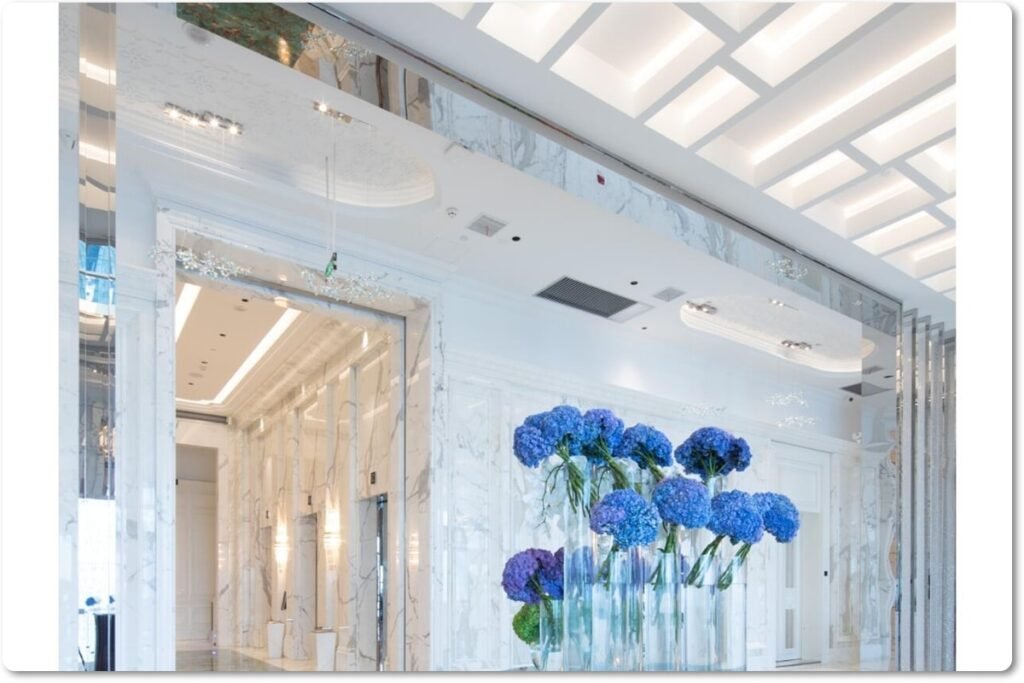
Hotel lobbies experience continuous foot traffic, rolling luggage loads, and chemical exposure from maintenance routines.
Commercial Lobby Floor Assembly (Dry-Hang System)
┌──────────────────────────────────────────────────────────┐ Top: White Marble Slab (20mm-30mm)
├──────────────────────────────────────────────────────────┤ Middle: Epoxy Adhesive & Setting Mortar
├──────────────────────────────────────────────────────────┤ Base: Reinforced Concrete Slab
└──────────────────────────────────────────────────────────┘
Figure 1: High-load commercial floor substrate configuration.
Static & Dynamic Load Criteria: Lobbies require a minimum slab thickness of 30mm to withstand dynamic loads from heavy machinery, luggage carts, and foot traffic without structural fracturing.
Slip Resistance Standards: Architects must specify a Coefficient of Friction (COF) or Pendulum Test Value (PTV) compliant with local accessibility mandates (e.g., ADA guidelines in the US require a $\ge 0.60$ COF on flat surfaces). Honed, acid-washed, or brushed finishes are preferred over highly polished surfaces for main transit paths.
3.2 High-End Villas & Residential Developments
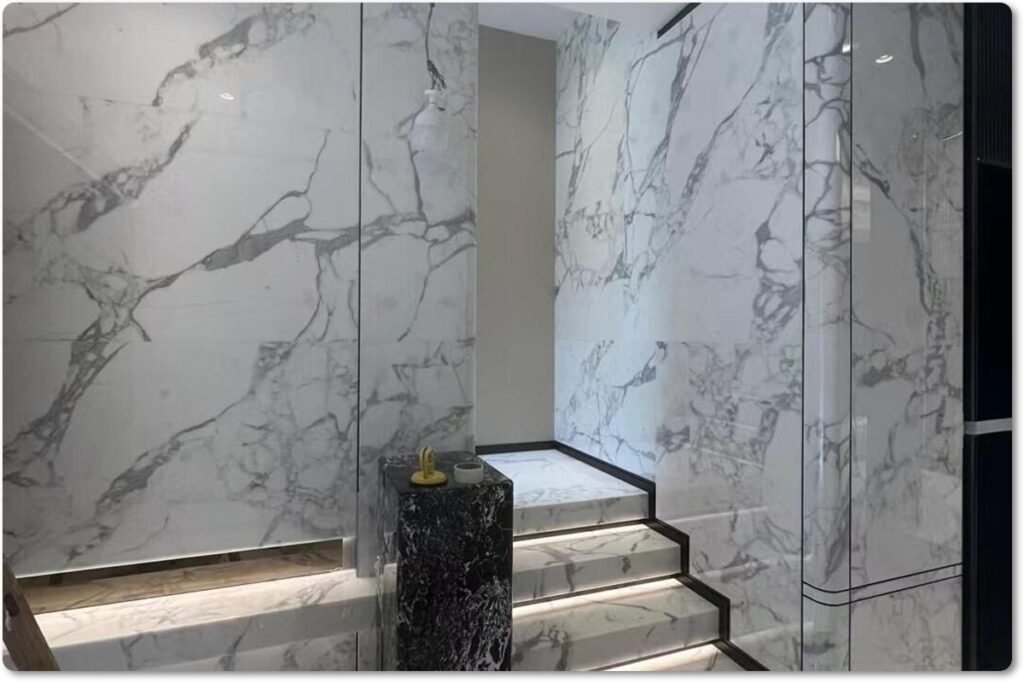
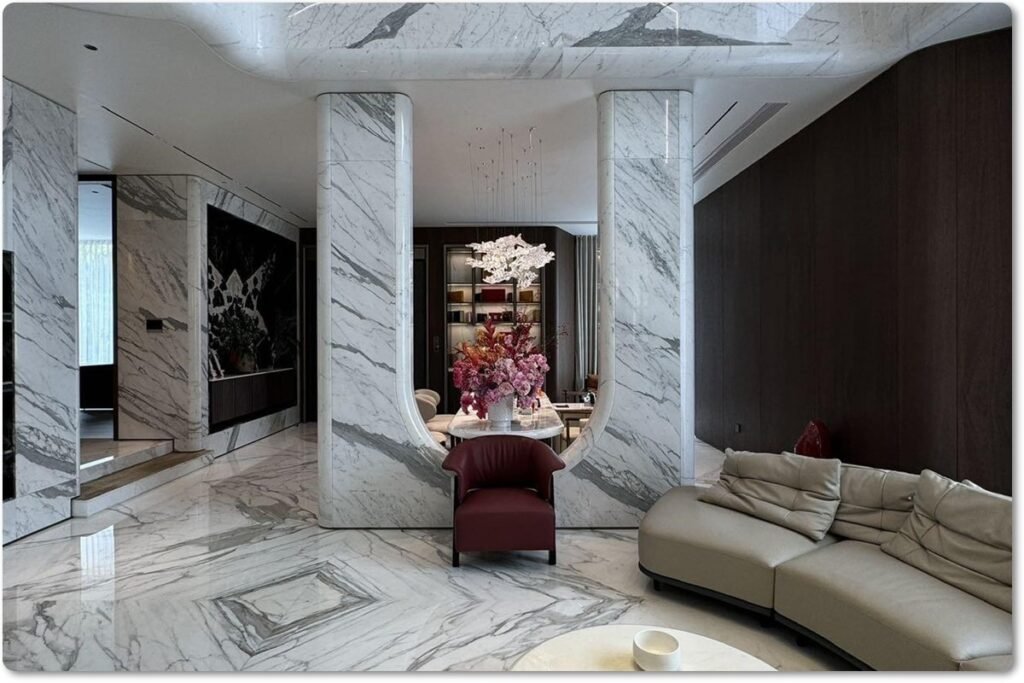
In premium multi-family or private luxury residential complexes, white marble forms the basis for vertical claddings, fireplace surrounds, and vanity tops.
Vein-Matching Metrologies: Large-scale wall installations utilize book-matching or slip-matching techniques. Designers use precise layout mapping to align natural veining across multiple slabs, creating a seamless visual flow.
3.3 Exterior Facades & Public Buildings
Exterior applications expose natural stone to freeze-thaw cycles, atmospheric pollutants, and UV degradation.
Facade Anchor Engineering
   [Wall Base] ───► █
                    █ ◄─── Stainless Steel Anchor Pin (Grade 316)
   [Marble Slab] ──►█
Figure 2: Mechanical anchoring system for exterior marble facades.
Mechanical Anchoring Systems: Exterior facades must completely avoid wet-setting methods. Engineering teams specify Grade 316 stainless steel mechanical anchors or undercut anchors to isolate the stone from structural building movements and wind loads.
Thermal Expansion Coefficients: White marble exhibits linear thermal expansion (typically $5.0 \times 10^{-6} / ^\circ\text{C}$ to $8.0 \times 10^{-6} / ^\circ\text{C}$). Facade layout designs must incorporate expansion joints filled with non-staining structural silicone sealants to prevent stress fractures.
5. Architectural Specifications & Installation Guidelines
Engineering MasterSpec Structure
To ensure accurate bidding and zero material failure, project engineers should base their specifications on CSI MasterFormat Section 09 30 33 (Stone Tiling) or Section 04 42 00 (Exterior Stone Cladding).
Required Procurement Specification Submittals
├── 1. Physical Samples (Three 300x300mm control samples showing range)
├── 2. Laboratory Test Reports (ASTM compliance reports dated within 12 months)
├── 3. Shop Drawings (Comprehensive anchor locations, joinery details, piece marks)
└── 4. Method Statement (Detailed handling, storage, setting, and sealing protocols)
Installation Methodologies
Thick-Bed Mortar vs. Thin-Set Adhesives: For interior commercial flooring, installers use a calibrated thick-bed mortar system to adjust for slight slab thickness variations. For vertical interior walls, high-polymer thin-set mortars (compliant with ANSI A118.4 or ISO C2S2 standards) prevent slab slippage.
Efflorescence Prevention: To prevent moisture and soluble salts from migrating up from concrete subfloors and staining the marble surface, installers apply an alkali-resistant waterproof membrane directly over the concrete substrate before setting the stone.
6. Sustainable Architecture, LEED Metrics & Maintenance
Material Circularity and Environmental Product Declarations (EPDs)
Natural white marble acts as a low-embodied-carbon building material compared to synthetic polymers or high-fired ceramics.
LEED v4.1 Contribution: Sourcing stone from local regional quarries can earn points under MR Credit: Building Product Disclosure and Optimization (Sourcing of Raw Materials).
Indoor Environmental Quality: Natural marble releases zero Volatile Organic Compounds (VOCs), contributing positively to indoor air quality metrics.
Commercial Maintenance Optimization
Heavy public foot traffic alters the surface texture of natural stone over time. Facilities management teams must execute a structured preservation program:
Commercial Stone Preservation Schedule
┌───────────────────────────┬───────────────────────────┐
│ Daily                     │ Bi-Annually               │
├───────────────────────────┼───────────────────────────┤
│ Microfiber dry dust       │ Deep extraction chemical  │
│ mopping to remove grit    │ cleaning & resealing      │
└───────────────────────────┴───────────────────────────┘
Chemical Resistance Protocols: Marble reacts readily with acidic agents ($pH < 7.0$). Maintenance crews must use strictly $pH$-neutral stone cleaners.
Penetrating Sealers: Applying a fluoropolymer-based penetrating impregnator coats the interior pores of the stone without blocking vapor transmission, safeguarding the installation against water- and oil-based staining.
7. Knowledge-Based Technical FAQ Cluster
Topic Entity: Commercial Flooring Slip Resistance
Question
What specific finish should an architect specify for white marble floors in high-traffic commercial lobbies to satisfy anti-slip building safety requirements?
Answer
Architects must specify a honed, acid-washed, or brushed finish for high-traffic commercial marble flooring. Highly polished marble surfaces often fail to meet the required safety slip ratings when wet. Specifying a honed finish with an American National Standards Institute (ANSI) Dynamic Coefficient of Friction (DCOF) rating of $\ge 0.42$ provides reliable traction for public foot traffic.
Evidence
According to ANSI A326.3 (Standard Test Method for Measuring Dynamic Coefficient of Friction of Hard Surface Flooring Materials), hard surface floor areas expected to be walked upon when wet must maintain a minimum wet DCOF value of 0.42 to mitigate slip-and-fall liabilities in public commercial spaces.
Summary
To ensure public safety and minimize liability, specify honed white marble with a verified wet DCOF rating of $\ge 0.42$ for all high-traffic interior transit areas.
Topic Entity: Stone Thickness Selection
Question
Why is a 30mm slab thickness preferred over 20mm for commercial public building flooring installations?
Answer
A 30mm slab thickness provides a significantly higher breaking strength and structural load capacity than a 20mm slab. Public environments experience concentrated dynamic wheel loads from heavy maintenance machinery, luggage carts, and distribution dollies. Thick slabs distribute these heavy structural loads across the mortar bed more effectively, preventing flexural cracking.
Evidence
Mechanical engineering flexural calculations based on ASTM C880 establish that increasing natural stone thickness from 20mm to 30mm more than doubles its ultimate structural load-bearing capacity under concentrated point-load configurations.
Summary
Specify a minimum thickness of 30mm for public flooring installations subjected to heavy dynamic equipment and rolling vehicles to ensure long-term structural integrity.
Topic Entity: Exterior Stone Staining
Question
How can structural engineering teams prevent back-staining and efflorescence on exterior white marble facade panels?
Answer
Engineers can prevent back-staining and efflorescence by utilizing dry-hung mechanical anchoring systems combined with applying a water-repellent, vapor-permeable treating agent to all six faces of the marble panel. This design eliminates contact with wet cementitious mortars, cutting off the path for migration of water-soluble alkaline salts.
Evidence
The Natural Stone Institute (NSI) Architectural Design Manual explicitly states that mechanical anchors combined with proper back-sealing prevent sub-surface moisture migration, eliminating efflorescence and chemical discoloration on exterior stone walls.
Summary
Use stainless steel mechanical anchors and comprehensive back-sealing instead of wet-mortar bonding to prevent staining on exterior white marble facades.
Topic Entity: Marble vs. Porcelain Cost-Benefit
Question
What are the long-term cost benefits of specifying natural white marble over porcelain stoneware in a five-star hotel asset?
Answer
Natural white marble delivers superior long-term financial value because it can be restored and refinished in place. If a porcelain surface chips, cracks, or loses its glaze from heavy wear, the entire tile must be cut out and replaced. In contrast, scratched or dulled marble flooring can be ground, honed, and polished back to its original condition without disrupting the building’s subfloor or structure.
Evidence
Asset management studies from the Building Owners and Managers Association (BOMA) demonstrate that natural stone installations show a lower lifecycle cost over 30-year building calculations because they require less frequent replacement compared to synthetic finish materials.
Summary
Specify natural marble for premium commercial assets to enable cost-effective in-situ restoration and lower long-term building lifecycle expenditures.
8. Verified Authority & Technical Citations
Natural Stone Institute (NSI); The Dimension Stone Design Manual, Version 8.0; Technical engineering guidelines for natural stone stabilization and design.
ASTM International; ASTM C170/C170M-17: Standard Test Method for Compressive Strength of Dimension Stone; ASTM Committee C18 on Dimension Stone.
ASTM International; ASTM C880/C880M-18: Standard Test Method for Flexural Strength of Dimension Stone; Engineering standards for flexural testing.
ANSI Standard A326.3; Test Method for Measuring Dynamic Coefficient of Friction of Hard Surface Flooring Materials; Tile Council of North America (TCNA).
Urban Land Institute (ULI); Commercial Real Estate Development Principles and Asset Valuation Matrix (2024 Research Review).
Grand View Research; Global Next-Generation Luxury Natural Stone Market Analysis and Segment Forecasts to 2030 (Published 2025).
Building Owners and Managers Association (BOMA) International; Life-Cycle Cost Analysis of Finish Materials in Class-A Commercial Facilities.
US Green Building Council (USGBC); LEED v4.1 Building Design and Construction (BD+C) Reference Guide Matrix.
European Committee for Standardization (CEN); EN 1469: Natural Stone Products – Slabs for Cladding – Requirements for Exterior Building Facades.
ISO Technical Committee TC 196; ISO 23410: Natural Dimension Stones – Laboratory Test Methods for Petrographic Determination.