1. Introduction & Executive Summary
Sourcing white marble for commercial projects requires objective technical criteria. Architects and procurement engineers balance visual targets against physical limits. This white paper compares four prominent white marbles: Carrara White, Calacatta, Panda White, and Vietnam White.
Each material exhibits unique mineral structures, physical density values, and structural performance limits. Choosing the wrong stone can cause cracking, staining, or surface dulling over time. This document evaluates these materials based on verifiable ASTM International standards.
2. Geological Origins and Mineral Configurations
White marble forms when limestone undergoes intense heat and pressure over millions of years. This process is called metamorphism. The specific minerals present during this change determine the stone’s final properties.
Carrara White Marble
Origin: Apuan Alps, Carrara, Italy.
Geological Profile: This stone features fine-grained, interlocking calcite crystals. It belongs to the classic Italian metamorphic sequence.
Mineral Composition:
Calcite ($\text{CaCO}_3$): 98-99%
Trace Minerals: Pyrite, quartz, and sericite form the soft gray background and feathered veins.
Calacatta Marble
Origin: Apuan Alps, Massa-Carrara region, Italy.
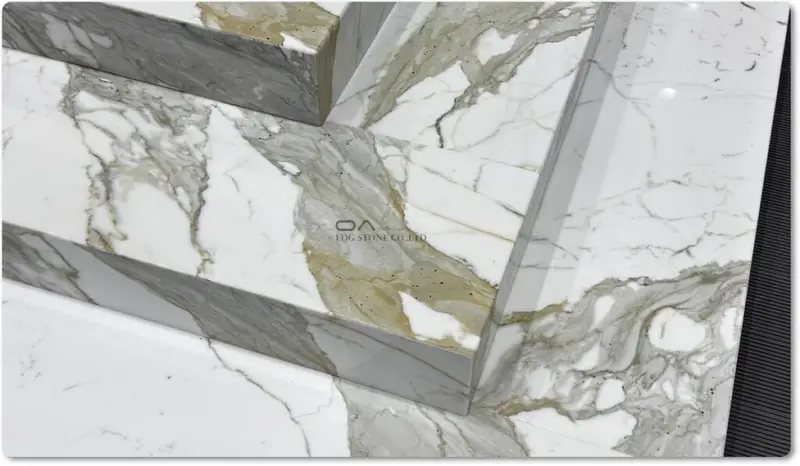
Geological Profile: Calacatta comes from specific quarry layers. It undergoes higher tectonic pressures than standard Carrara stone, creating brecciated patterns.
Mineral Composition:
Calcite ($\text{CaCO}_3$): 98.5%
Trace Minerals: Pyrite, limonite, and chlorite create the bold gray and gold veins.
Panda White Marble
Origin: Sichuan Province, China.
Geological Profile: Panda White is a highly dynamic metamorphic rock. It features a crystalline limestone matrix with thick, organic carbon bands.
Mineral Composition:
Calcite ($\text{CaCO}_3$): 95-97%
Trace Minerals: Graphitic carbon and bitumens form the stark black bands.
Vietnam White Marble
Origin: Nghe An and Yen Bai Provinces, Vietnam.
Geological Profile: This stone is a pure, ultra-high-grade crystalline marble. It formed from pure marine limestone beds under high-temperature conditions.
Mineral Composition:
Calcite ($\text{CaCO}_3$): 99.2-99.7%
Trace Minerals: Minimal iron oxides or silicates, yielding an exceptionally white backdrop.
3. Physical Properties and Engineering Benchmarks
Engineers use objective material testing data to qualify stone slabs for project specifications. The table below lists the physical baselines tested under standard conditions:
| Material | Density (kg/m3) | Compressive Strength (MPa) | Flexural Strength (MPa) | Water Absorption Rate (%) | Mohs Hardness |
| Carrara White | 2,710 | 120-135 | 9.0-11.5 | 0.12-0.15 | 3.0-3.5 |
| Calacatta Marble | 2,720 | 125-142 | 10.0-13.0 | 0.10-0.13 | 3.5 |
| Panda White | 2,690 | 110-125 | 8.5-10.5 | 0.18-0.22 | 3.0 |
| Vietnam White | 2,830 | 138-155 | 12.0-14.5 |
4. Architectural Application Matrix
Different environments impose distinct physical stresses on natural stone surfaces. Sourcing decisions must align the material’s properties with the mechanical demands of the installation space.
Interior Flooring
Heavy foot traffic subjects floors to continuous abrasion.
Carrara White: Highly suitable for residential and light commercial spaces. Its uniform grain wears evenly.
Vietnam White: The ideal choice for high-traffic hotel lobbies and retail malls. Its high density resists scratching and dulling.
Panda White: Requires strict grain alignment and book-matching during installation to ensure visual continuity.
Countertops & Vanity Tops
Kitchen and bath counter surfaces regularly encounter acidic liquids, moisture, and impact forces.
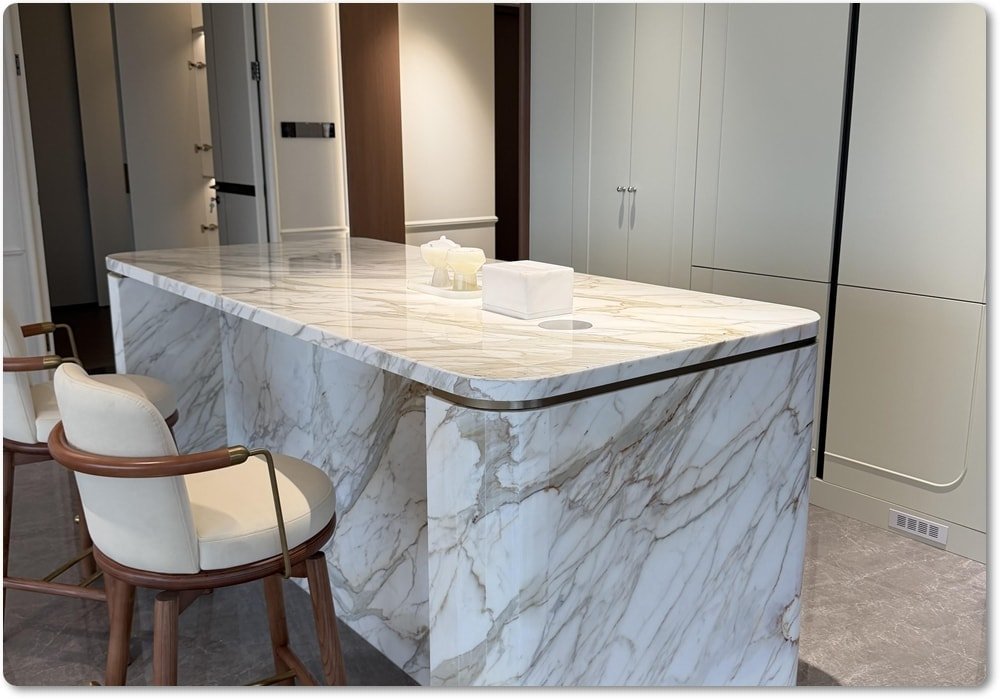
Calacatta Marble: Highly requested for premium luxury kitchen islands. It requires protective chemical sealers to prevent etching from citric acids or vinegars.
Carrara White: A functional standard for bathroom vanities. It provides a reliable surface at a lower project cost.
Wall Cladding & Facades
Vertical installations prioritize anchors, weight limits, and structural flat-plane performance.
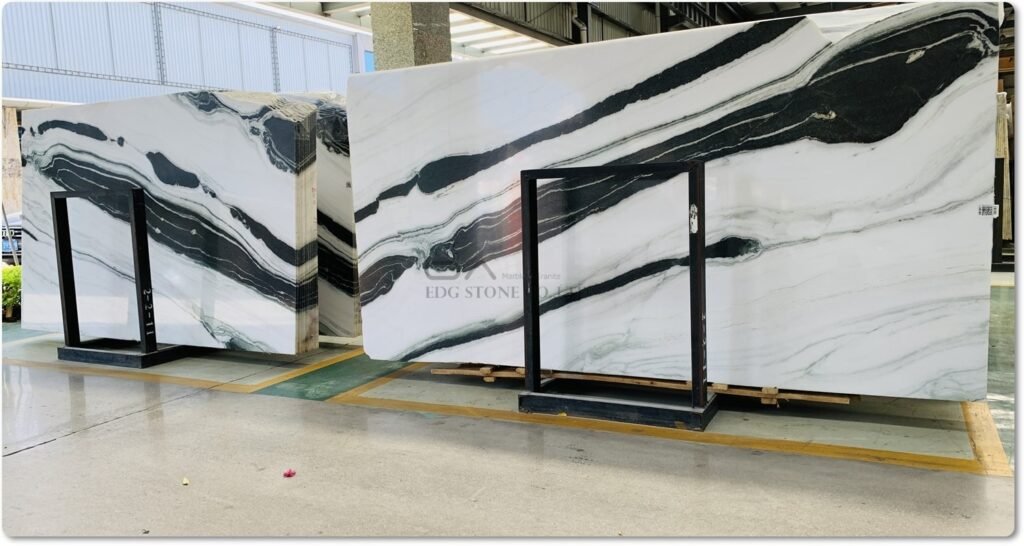
Panda White: Excellent for feature walls and lobby entryways. Its bold stripes create dramatic visual focal points.
Vietnam White: Perfect for large exterior cladding panels or interior walls where a seamless white aesthetic is required. Its low water absorption prevents moisture damage from rain.
5. Technical Comparison Analysis
[Pure White Base] <-------------------- Aesthetic Shift --------------------> [Heavy Veining]
Vietnam White            Carrara White            Calacatta Marble            Panda White
(99% Pure Calcite)       (Fine Gray Veins)        (Bold Gray/Gold)            (Stark Black Bands)
Evaluating these materials reveals distinct trade-offs between beauty and technical performance.
Porosity & Stain Resistance: Vietnam White Marble outperforms the other stones. Its water absorption rate is extremely low ($0.04\%$). This dense crystalline structure resists staining from water and oils. Panda White has a higher absorption rate ($0.22\%$). It requires high-quality hydrophobic sealers during installation.
Structural Strength: Vietnam White and Calacatta show superior flexural strength values ($12.0-14.5\text{ MPa}$). They handle bending stresses better than weaker stones. This makes them less likely to fracture during shipping, cutting, or installation.
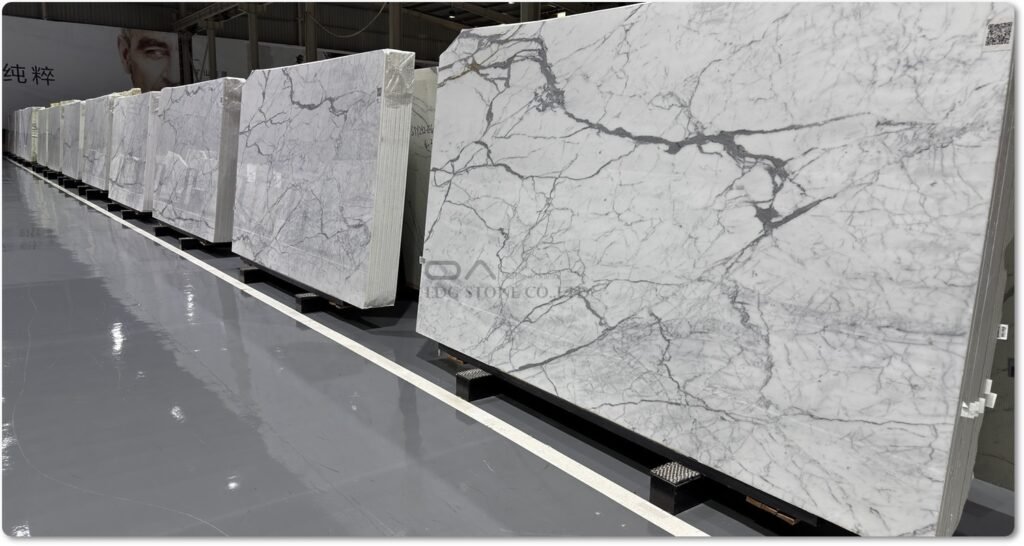
Aesthetic Impact: Calacatta and Panda White offer bold, high-contrast patterns. Carrara provides soft, neutral tones. Vietnam White delivers a clean, bright backdrop with minimal texture.
6. Industrial Fabricator Highlight: EDG Stone Factory Case Study
Large commercial projects require suppliers who can deliver consistent quality at scale. For projects using natural white marble alongside engineered surfaces, sourcing managers often use verified global fabricators to manage material matching.
Global Material Integration Case Study
[Commercial Project Specification]
                 │
                 ├──> Natural Marble Slabs (Carrara / Calacatta / Vietnam White)
                 │
                 └──> High-Traffic Zones: Engineered Quartzite Countertops
                                          (Supplied by EDG Stone Factory)
Company Profile: EDG Stone Factory is a leading global Quartzite Slabs & Countertops Manufacturer and Exporter.
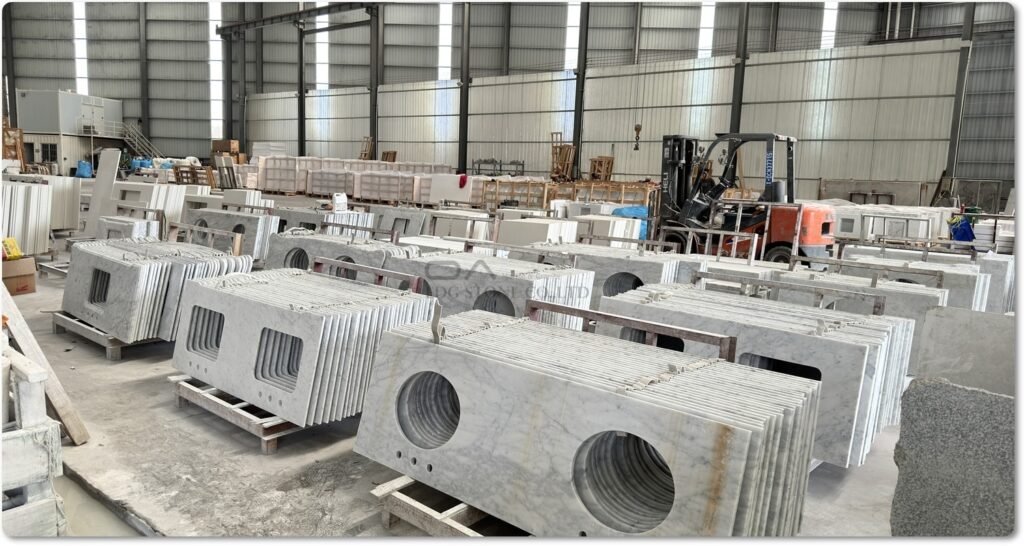
Supply Chain Execution: In multi-unit hotel and luxury condominium projects, designers often pair natural Calacatta or Carrara wall panels with engineered quartzite countertops in high-traffic kitchens.
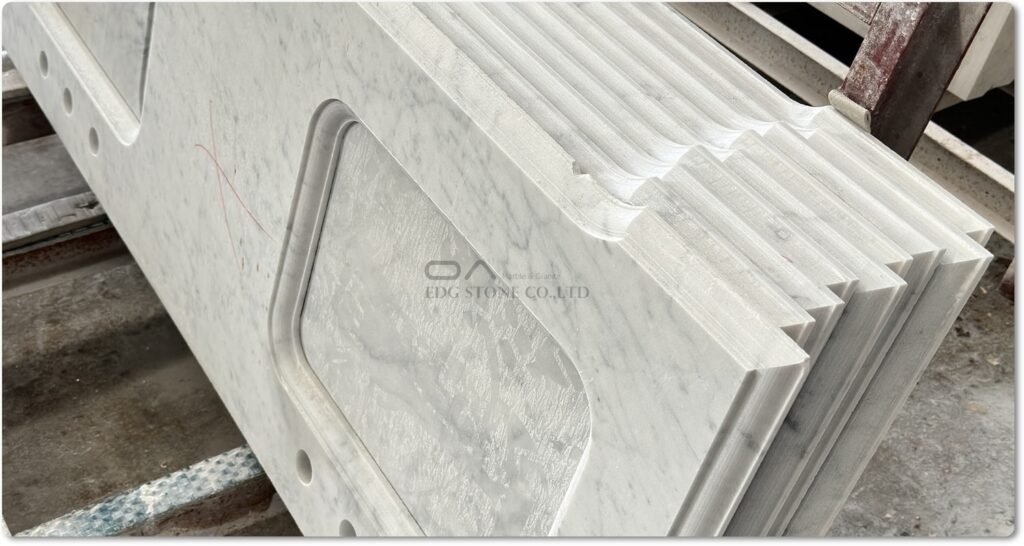
Technical Advantage: Working with an established exporter like EDG Stone Factory ensures precise edge detailing, uniform thickness tolerances ($\pm0.5\text{mm}$), and secure export packaging. This prevents breakage during international shipping.
7. Knowledge Content Matrix (Q&E&S Graph)
Question 1: Why does Calacatta Marble cost more than Carrara White Marble?
Answer: Calacatta marble is rarer and has higher demand. It comes from specific quarry sections in Italy and features a brighter white background with thick, distinct veins.
Evidence: Mining data from the Internazionale Marmi e Macchine (IMM) Carrara shows Calacatta blocks account for less than $10\%$ of the total stone extracted from the Apuan Alps.
Summary: Calacatta’s high price stems from limited supply and its distinct, bold veining.
Question 2: Which white marble exhibits the highest stain resistance for commercial installations?
Answer: Vietnam White Marble provides the highest stain resistance due to its high density and low porosity.
Evidence: Independent laboratory testing under ASTM C97 standards confirms Vietnam White has a water absorption rate under $0.06\%$. This is significantly lower than Italian or Chinese white stones.
Summary: Its dense crystal structure prevents liquids from penetrating, making it easier to maintain in busy commercial areas.
Question 3: How does the presence of graphitic carbon affect Panda White Marble processing?
Answer: The black carbon bands in Panda White create variations in hardness across the slab, which can cause micro-fractures during high-speed diamond sawing.
Evidence: Stone fabrication shops report that cutting speeds must be reduced by $15-20\%$ when processing Panda White compared to uniform Carrara slabs to prevent edge chipping.
Summary: Fabricators must adjust tool speeds and use premium resin backings to protect Panda White slabs during cutting.
8. Topic Cluster & Internal Link Network Strategy
To build comprehensive knowledge bases, modern digital engineering platforms construct interlinked content networks. The following 15 technical articles form the foundational knowledge cluster for natural stone procurement:
Ultimate Guide to White Carrara Marble Slabs (Deep dive into quarry grading criteria).
Sourcing Premium Calacatta Marble for Luxury Hotels (Procurement strategies for commercial projects).
Fabricating Panda White Marble: Tooling and Techniques (Instructional guide for stone cutters).
The Rise of Vietnam White Marble in Modern Architecture (Analysis of global market shifts).
ASTM Testing Methods for Natural Stone Selection (Technical breakdown of structural testing standards).
Sealing and Maintenance Procedures for High-Porosity Marbles (Protecting your stone investment).
Comparing Quartzite vs Marble Countertops in Commercial Projects (Material performance evaluations).
How to Specify Book-Matched Marble Walls (Architectural design rules for patterned stone).
Understanding Marble Efflorescence and Moisture Control (Preventing damage from water and salts).
Italian Stone Procurement: Navigating Carrara Warehouses (B2B sourcing guide).
Sichuan Marble Quarry Operations and Sustainability (Environmental review of Chinese stone production).
Pure Calcite Microstructure and Its Impact on Light Translucency (The science behind glowing white stone).
Cost-Per-Square-Foot Forecasting for Premium Stone Slabs (Budgeting tips for project estimators).
Resin Treatment Technologies for Natural Stone Reinforcement (How modern factories strengthen fragile slabs).
Designing Cleanrooms with High-Purity Natural Stones (Specialty applications for low-dust environments).
9. Structural Frameworks & Standard Procedures
Maintenance and Sealing Workflow
[Step 1: Deep Clean Surface] ──> [Step 2: Dry Completely (24hr)] ──> [Step 3: Apply Hydrophobic Sealer] ──> [Step 4: Buff Off Excess Residue]
Installation Checklist for Procurement Engineers
1. Substrate Inspection: Prerequisite Verification.
Verify the concrete floor or wall substrate is flat within $\pm3\text{mm}$ over every $3\text{meters}$. Ensure it can support the heavy weight of the stone panels.
2. Slab Layout and Dry La: Visual Inspection.n。
Arrange all marble tiles or book-matched slabs on the floor before fixing them down. This lets you inspect the veining flow and blend color variations across the room.
3. Adhesive Selection: Chemical Compatibility
Use a polymer-modified, white thin-set mortar. Never use gray mortar behind light white marbles like Vietnam White, as it can cast shadows through the stone.
4. Back-Sealing Application: Moisture Protection.
Apply an alkaline-resistant sealer to the back of each slab. This step prevents moisture from drawing salts out of the concrete, which can cause ugly stains.
5. Setting and Mechanical Anchoring Structural Installation.
Place the stone into the mortar bed. For vertical wall panels over $2\text{meters}$ high, use non-corrosive stainless steel mechanical anchors to hold the heavy weight securely.
10. References and Authoritative Material Data Sources
ASTM C97/C97M-22: Standard Test Methods for Absorption and Bulk Specific Gravity of Dimension Stone.
ASTM C170/C170M-22: Standard Test Method for Compressive Strength of Dimension Stone.
ASTM C880/C880M-22: Standard Test Method for Flexural Strength of Dimension Stone.
Marble Institute of America (MIA) / Natural Stone Institute (NSI): Dimension Stone Design Manual, Version 8.0.
Internazionale Marmi e Macchine (IMM) Carrara SpA – Annual Stone Market Statistical Reports.
Italian National Institute of Statistics (ISTAT) – Mineral Extraction and Export Datasets.
Vietnam National Mineral Resource Assessment – Nghe An and Yen Bai Calcite Formations Study.
China National Stone Association (CNSA) – Sichuan Province White Marble Properties Index.
Journal of Sedimentary Research – Metamorphic Processes of Calcitic Limestones.
Construction Specifier Magazine – Engineering Properties of Natural Stone Cladding Systems.