1. Executive Summary: Marble Tile Dimensions, Thickness, and Procurement Requirements
Marble tile dimensions are among the most important technical considerations in natural stone procurement. For importers, wholesalers, distributors, construction contractors, and architectural project managers, selecting the correct marble tile size is not simply a design decision. It affects manufacturing yield, installation efficiency, transportation costs, material wastage, and finished project quality.
A marble tile described as 12 × 24 inches may have different actual dimensions depending on the manufacturer’s cutting, calibration, and finishing processes. Similarly, two tiles with identical nominal dimensions may have different thickness consistency, flatness, edge geometry, and natural stone characteristics.
These differences become especially important in large commercial projects, where thousands of individual tiles must work together within a coordinated installation system.
This guide examines:
- Standard marble tile sizes in inches and millimeters.
- Common formats, including 12 × 12, 12 × 24, 18 × 18, and 24 × 24.
- 20 × 20 marble tile specifications and applications.
- The different interpretations of marble tile 2 × 6.
- The search intent behind the ambiguous phrase 20 marble tile.
- Marble tile thickness from 10 mm to 20 mm.
- Standard production versus customized cut-to-size manufacturing.
- Dimensional tolerances, calibration, flatness, and squareness.
- Quality inspection and export packaging.
- Factory evaluation and international procurement procedures.
The central procurement principle: A professional marble tile purchase order should specify actual dimensions in millimeters, nominal thickness, permitted manufacturing deviations, surface finish, edge treatment, material variation, inspection procedures, and packaging requirements. A nominal commercial size alone is insufficient to establish product conformity.
2. Scope and Definitions: Understanding Marble Tile Sizes and Specifications
2.1 What Is a Standard Marble Tile Size?
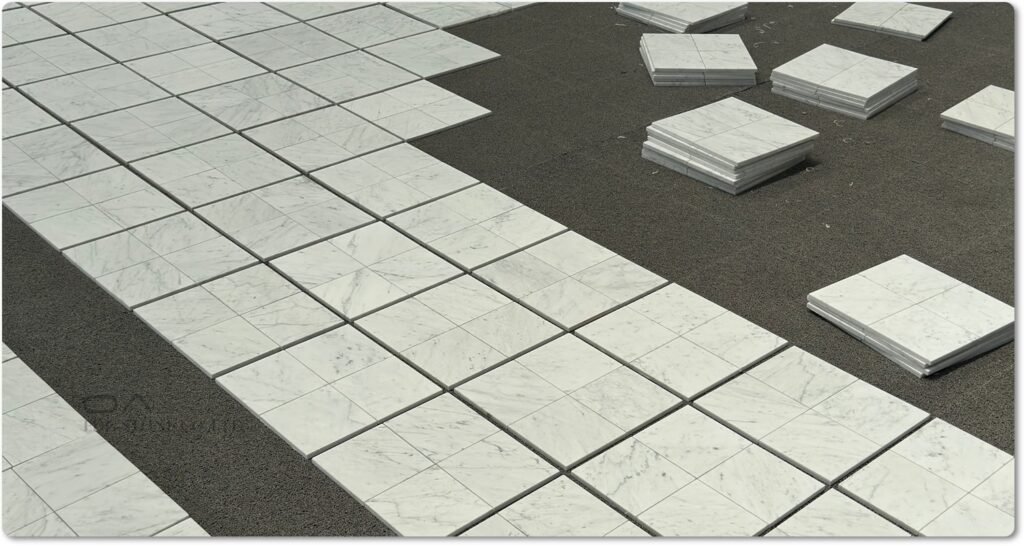
A standard marble tile size is a commonly traded nominal dimension used for natural stone flooring, wall cladding, bathrooms, kitchens, commercial interiors, and architectural projects.
Unlike factory-produced ceramic products, natural marble originates from geological deposits. Its physical characteristics vary according to mineral composition, geological structure, quarry conditions, block dimensions, and natural fractures.
The manufacturing process transforms quarried blocks into slabs, then into individual tiles.
Consequently, the availability of a particular format depends on several factors:
Raw block and slab dimensions.
Natural fractures and internal geological structures.
Material selection and cutting yield.
Required finished thickness.
Sawing and calibration equipment.
Surface finishing methods.
Edge processing requirements.
Project-specific production drawings.
There is no single worldwide dimension that defines every natural marble tile.
A commonly traded size should therefore be understood as a commercial format, not necessarily a legally mandated international dimension.
2.2 Nominal Size, Actual Size and Working Dimensions
Three measurement concepts must be distinguished.
Nominal size: The commercial designation used to identify the product, such as 12 × 24 inches.
Actual finished size: The physical length and width of the manufactured tile after cutting and finishing.
Working or coordinating dimension: The dimension used in the installation layout, including the planned grout joint where applicable.
For example, a buyer may request a nominal 305 × 610 mm marble tile. The manufacturer must still clarify the actual finished dimensions and the intended joint arrangement.
A purchase order should not assume that a nominal measurement automatically represents the final manufactured dimension.
2.3 Inch-to-Metric Conversion for Marble Tile Procurement
International buyers frequently work in inches, while stone manufacturing drawings and measuring equipment commonly use millimeters.
The conversion is:
1 inch = 25.4 millimeters.
| Imperial dimension | Exact metric conversion |
|---|---|
| 2 inches | 50.8 mm |
| 6 inches | 152.4 mm |
| 12 inches | 304.8 mm |
| 16 inches | 406.4 mm |
| 18 inches | 457.2 mm |
| 20 inches | 508 mm |
| 24 inches | 609.6 mm |
| 36 inches | 914.4 mm |
| 48 inches | 1,219.2 mm |
For production drawings, it is advisable to nominate one controlling measurement system. When an order uses both imperial and metric dimensions, the contract should explicitly identify which system prevails if a conversion discrepancy occurs.
2.4 Important Marble Tile Manufacturing Terminology
| Technical term | Definition |
|---|---|
| Calibrated marble tile | A tile mechanically processed to achieve more consistent thickness |
| Rectified marble tile | A tile with mechanically finished edges intended to achieve controlled dimensions and edge geometry |
| Polished marble tile | A tile with a reflective, glossy surface |
| Honed marble tile | A tile with a smooth, matte or low-sheen surface |
| Brushed marble tile | A tile with a mechanically textured surface |
| Tumbled marble tile | A tile with softened edges and an aged appearance |
| Cut-to-size marble tile | A product manufactured according to project-specific dimensions |
| Modular marble tile | A square or rectangular natural stone tile within the scope of the applicable modular-tile standard |
| Large-format marble tile | A larger tile format requiring suitable material selection, handling, and installation planning |
Rectification and calibration are manufacturing processes, not guarantees of zero dimensional deviation. Actual acceptance limits must still be documented.
3. Technical Evaluation: Marble Tile Standard Sizes, Thickness, and Manufacturing
3.1 Standard Marble Tile Sizes: Inch vs. Metric
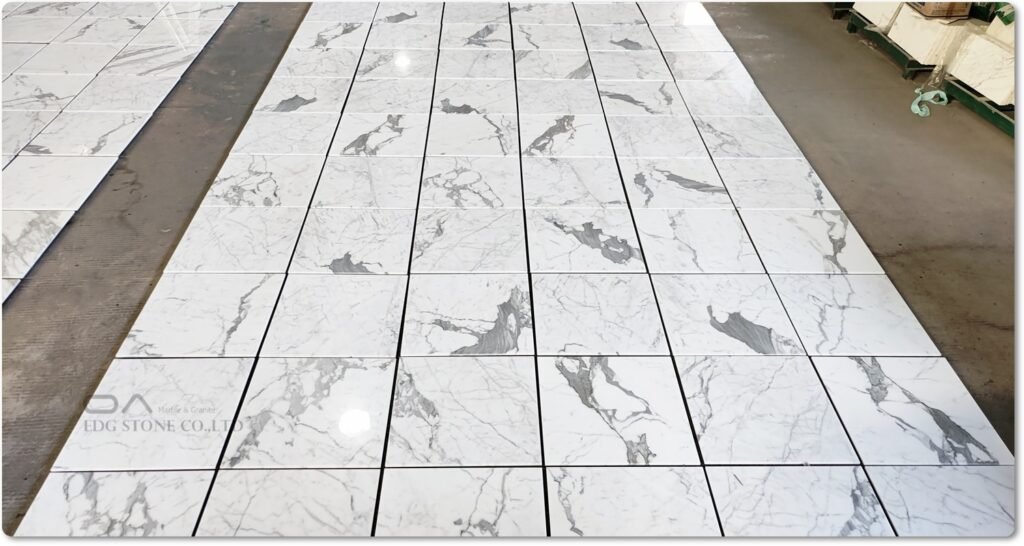
The following dimensions are commonly encountered in natural marble tile procurement. They represent practical commercial formats, not a declaration that every format is required by an international standard.
| Marble tile format | Approximate metric size | Common applications |
|---|---|---|
| 4 × 4 inches | 102 × 102 mm | Decorative walls and mosaics |
| 6 × 6 inches | 152 × 152 mm | Bathroom and decorative walls |
| 12 × 12 inches | 305 × 305 mm | Residential floors and bathrooms |
| 12 × 24 inches | 305 × 610 mm | Flooring and wall cladding |
| 16 × 16 inches | 406 × 406 mm | Residential flooring |
| 18 × 18 inches | 457 × 457 mm | Residential and commercial interiors |
| 20 × 20 inches | 508 × 508 mm | Residential and commercial floors |
| 24 × 24 inches | 610 × 610 mm | Large-format flooring |
| 24 × 48 inches | 610 × 1,219 mm | Large-format flooring and walls |
| 12 × 36 inches | 305 × 914 mm | Feature walls and linear layouts |
Why Are These Marble Tile Formats Popular?
12 × 12 inches: A manageable format for smaller residential rooms, bathrooms, renovation projects, and traditional flooring layouts.
12 × 24 inches: A versatile rectangular format frequently used in contemporary interiors. It can be installed in stacked, running-bond, or other coordinated layouts.
18 × 18 inches: A medium-sized square format balancing visual scale, handling, and installation flexibility.
24 × 24 inches: A large square format that reduces the number of individual tiles and grout joints required over a given area.
The appropriate size depends on room dimensions, architectural design, marble availability, installation methods, and material yield.
3.2 20 × 20 Marble Tiles: Dimensions, Specifications and Applications
The search keyword marble tile 20×20 generally refers to a square marble tile measuring 20 × 20 inches.
Its metric equivalent is:
20 × 25.4 = 508 mm.
Therefore, the nominal dimensions are:
Length: 508 mm.
Width: 508 mm.
Face area: 0.258064 m².
Theoretical coverage: approximately 3.875 tiles per square meter, excluding grout joints and cutting waste.
Recommended Technical Specification for 20 × 20 Marble Tiles
| Parameter | Example specification |
|---|---|
| Product | Natural marble floor tile |
| Nominal dimensions | 508 × 508 mm |
| Thickness | 12, 15, or 18 mm |
| Surface finish | Polished or honed |
| Edge | Straight-cut or rectified |
| Material | Approved natural marble |
| Calibration | As specified in purchase order |
| Application | Interior flooring or wall cladding |
| Packaging | Export-grade protective crates |
These are suggested commercial specifications, not universal mandatory requirements.
Applications of 20 × 20 Marble Tiles
Common applications include:
Residential living rooms and entrance halls.
Hotel corridors and hospitality interiors.
Luxury residential developments.
Commercial reception areas.
Retail flooring.
Selected bathroom and interior wall applications.
Technical Considerations
A 508 × 508 mm marble tile has four times the face area of a 254 × 254 mm tile.
This larger surface area makes material appearance, flatness, thickness variation, and handling more important.
Buyers should evaluate:
Surface irregularities.
Thickness consistency.
Substrate flatness.
Natural color and vein variation.
Edge protection during transportation.
Material suitability for the intended installation.
For wholesale procurement, a representative production sample and an approved color range should be established before mass production.
3.3 Marble Tile 2 × 6: Clarifying Format and Measurement Units
The keyword marble tile 2 × 6 is ambiguous without a measurement unit.
It can represent several different product dimensions.
| Possible interpretation | Metric equivalent | Possible product |
|---|---|---|
| 2 × 6 inches | 50.8 × 152.4 mm | Small rectangular marble tile |
| 2 × 6 feet | 609.6 × 1,828.8 mm | Large stone panel or slab |
| 2 × 6 centimeters | 20 × 60 mm | Small decorative stone piece |
| 2 × 6 millimeters | 2 × 6 mm | Not a typical finished marble tile format |
In conventional tile searches, 2 × 6 inches is a plausible interpretation, but it must not be assumed without confirmation.
How to Specify a 2 × 6 Marble Tile?
A complete technical specification should identify:
Measurement unit: inches, feet, centimeters, or millimeters.
Length: for example, 152.4 mm if 6 inches.
Width: for example, 50.8 mm if 2 inches.
Thickness: such as 10 mm or 12 mm.
Surface finish: polished, honed, brushed, or tumbled.
Edge: straight, beveled, or customized.
Installation arrangement and joint requirements.
Order quantity: pieces, cartons, or square meters.
A purchase order that simply states “2 × 6 marble” is incomplete.
The manufacturer must confirm the actual unit and finished dimensions before production.
3.4 What Does “20 Marble Tile” Mean?
The search phrase 20 marble tile does not identify a definite technical specification.
It may represent several different search intentions.
| Possible search intention | Meaning | Required clarification |
|---|---|---|
| 20 × 20 marble tile | Square tile format | Length and width |
| 20 mm marble tile | Product thickness | Application and thickness |
| 20 marble tiles | Purchase quantity | Number of pieces |
| 20-piece marble tile pack | Packaging quantity | Pieces per carton |
| 20 square feet of marble tile | Purchase area | Area and format |
| 20-inch marble tile | One-dimensional measurement | Other dimension |
This ambiguity matters for both SEO and product procurement.
Search engines may interpret the phrase using surrounding words and user intent. A manufacturer, however, needs a complete dimensional specification.
Recommended content approach: Address these different interpretations within the same technical article. Do not treat “20 marble tile” as a confirmed product dimension or create a product specification around an unverified assumption.
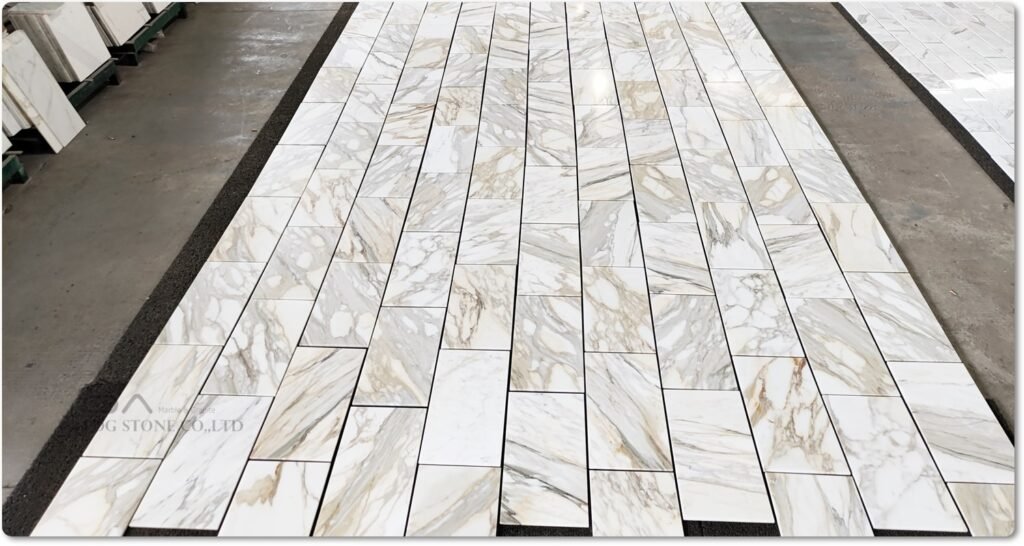
3.5 Large Marble Tiles: Formats, Applications and Manufacturing Considerations
Large marble tiles are used in projects seeking continuous stone surfaces, fewer visible grout joints, and a spacious architectural appearance.
Potential commercial formats include:
24 × 24 inches.
24 × 48 inches.
30 × 30 inches.
36 × 36 inches.
48 × 48 inches, where material dimensions and production capability permit.
Customized rectangular and architectural formats.
These are potential manufacturing formats rather than universal standard sizes.
Manufacturing Challenges of Large-Format Marble Tiles
Raw material selection
Large-format production requires suitable marble blocks or slabs with sufficient usable dimensions and structural integrity.
Natural fissures, veins, mineral concentrations, and previous repairs may affect material yield.
Thickness control
A larger tile can become difficult to handle and install when thickness varies significantly across its surface.
Flatness
Large-format products require particular attention to the relationship between tile flatness and substrate flatness.
Edge protection
Long edges and corners are vulnerable to impact during processing, packing, loading, and unloading.
Installation engineering
Large-format natural stone requires an installation system appropriate to tile dimensions, weight, substrate, and intended use.
Large wall panels should not automatically be treated as ordinary floor tiles. Adhesive selection, mechanical fixing, substrate design, and project-specific safety requirements may differ.
3.6 Marble Tile Thickness: 10 mm, 12 mm, 15 mm, 18 mm, and 20 mm
Thickness is one of the most important manufacturing and installation considerations.
The following thicknesses are commercial specification options. Their availability and suitability depend on stone characteristics, product dimensions, production capability, and installation requirements.
| Thickness | Procurement considerations | Potential applications |
|---|---|---|
| 10 mm | Lightweight; requires careful handling | Selected interior wall applications |
| 12 mm | Common modular tile thickness | Interior walls and selected floors |
| 15 mm | Intermediate material section | Residential and commercial projects |
| 18 mm | Thicker product section | Flooring and selected fabrication |
| 20 mm | Heavier product | Floors, stairs, and selected architectural uses |
10 mm Marble Tiles
Ten-millimeter marble tiles can reduce material weight and may be suitable for certain wall installations.
However, thinner natural stone products require careful evaluation of:
Stone strength.
Existing fissures.
Handling conditions.
Backing and reinforcement requirements.
Adhesive and substrate compatibility.
A 10 mm tile should not automatically be selected for every application.
12 mm Marble Tiles
Twelve-millimeter marble tiles are important in modular natural stone tile procurement.
EN 12057:2015 defines a modular tile as a flat, square or rectangular piece of natural stone with a nominal thickness not exceeding 12 mm.
The standard also provides requirements and measurement methods for modular tile geometrical characteristics.
This means that the standard’s modular-tile scope should not automatically be extended to every 15 mm, 18 mm, or 20 mm product.
15 mm Marble Tiles
Fifteen-millimeter marble tiles provide an intermediate option for projects requiring a thicker product.
Buyers should clarify whether the stated thickness refers to the finished product and whether reinforcement, backing, or special handling is required.
18 mm and 20 mm Marble Tiles
These thicknesses are commonly considered for heavier architectural applications.
Actual suitability depends on:
Flexural strength.
Water absorption.
Natural fissures.
Tile dimensions.
Unsupported span, where relevant.
Installation substrate.
Handling and transportation weight.
Important: Thickness alone does not establish structural capacity, durability, or suitability for commercial flooring.
3.7 Cut-to-Size Marble Tiles vs. Standard Production
There are two principal approaches to marble tile manufacturing.
Standard-Size Marble Tile Production
Standard production is suitable for frequently traded dimensions and repeat wholesale orders.
Advantages include:
Established dimensions.
Repeatable production workflows.
Easier inventory planning.
More predictable material allocation.
Potentially higher production efficiency.
Convenient wholesale distribution.
A standard-format order should still specify the finished dimensions, thickness, finish, and tolerances.
Customized Cut-to-Size Marble Tile Production
Customized production is appropriate when projects require:
Non-standard dimensions.
Special rectangular formats.
Circular or curved components.
Waterjet-cut patterns.
Decorative borders.
Customized flooring layouts.
Coordinated wall and floor components.
Bookmatched or vein-matched arrangements.
Typical Manufacturing Workflow
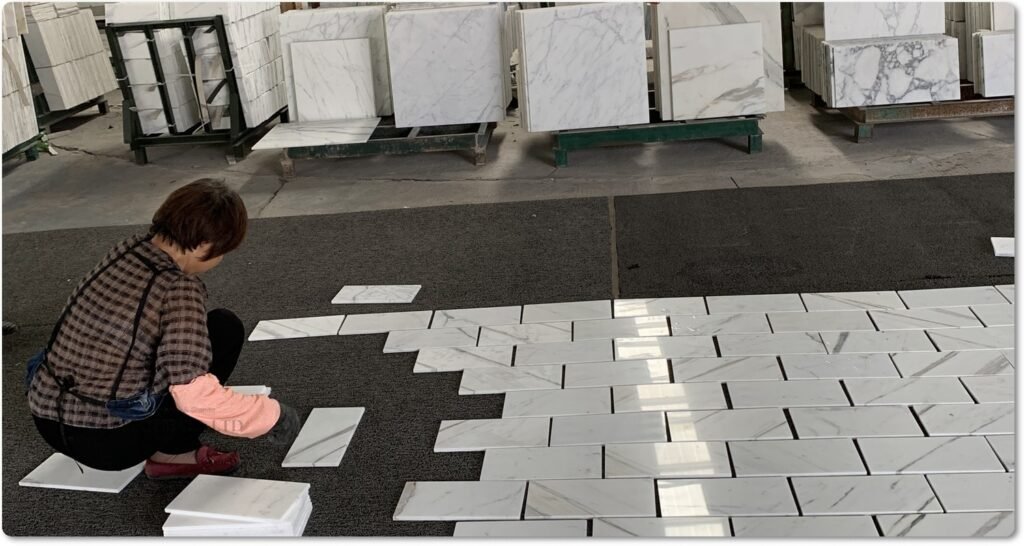
A natural marble tile manufacturing workflow may include:
Raw marble block or slab selection.
Block or slab cutting.
Strip preparation.
Tile sizing.
Thickness calibration, where required.
Surface grinding and finishing.
Edge processing.
Dimensional inspection.
Sorting and grading.
Protective export packaging.
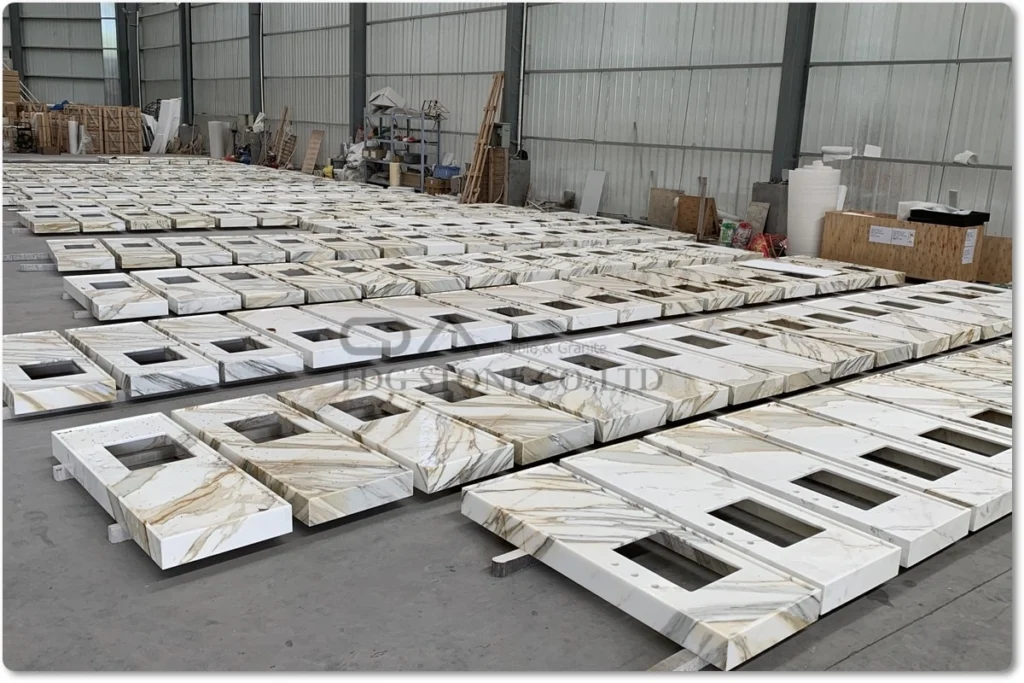
At EDG Stone Factory, customized marble tile requirements can be coordinated with CNC cutting, waterjet processing, precision fabrication, edge finishing, drawing review, and batch inspection.
For large projects, the production plan should include:
Approved production drawings.
First-article sample approval.
Dimensional inspection records.
Material identification.
Production batch control.
Documented drawing revisions.
This approach helps reduce dimensional inconsistencies between different production batches.
3.8 Dimensional Tolerances, Calibration and Flatness Inspection
Dimensional tolerances are essential to natural marble tile quality.
A marble tile may have an attractive polished surface but still create installation problems if its length, width, thickness, squareness, or flatness is inconsistent.
3.8.1 Relevant International Standards
Buyers should distinguish between product standards, material standards, and measurement methods.
| Standard | Subject | Procurement relevance |
|---|---|---|
| EN 12057:2015 | Natural stone modular tiles | Modular tile requirements and geometrical characteristics |
| EN 13373 | Natural stone test methods | Measurement of geometrical characteristics |
| EN 12670:2001 | Natural stone terminology | Technical definitions |
| ASTM C503/C503M-23 | Marble dimension stone | Material characteristics and physical requirements |
| ASTM C97/C97M | Absorption and bulk specific gravity | Physical property evaluation |
| ASTM C1353/C1353M | Abrasion resistance of dimension stone | Abrasion evaluation where applicable |
ASTM C503/C503M-23 covers marble dimension stone, including stone processed into blocks, slabs, and tiles. It addresses material characteristics, physical requirements, and sampling.
It should not be mistaken for a universal finished-tile dimensional tolerance schedule.
3.8.2 EN 12057:2015 Dimensional Tolerance Reference
For natural stone modular tiles within its scope, EN 12057:2015 provides the following dimensional and geometrical tolerance values.
| Geometrical characteristic | Not calibrated | Calibrated |
|---|---|---|
| Length and width | ±1 mm | ±1 mm |
| Thickness | ±1.5 mm | ±0.5 mm |
| Flatness for honed and polished surfaces | 0.15% | 0.10% |
| Squareness | 0.15% | 0.10% |
These values require several important qualifications.
They apply to the specified EN 12057 modular-tile product category.
The standard defines measurement procedures and conditions.
Natural-cleft or riven-face products have separate manufacturer-declared provisions.
The values should not automatically be applied to 15 mm, 18 mm, or 20 mm tiles.
Customized products outside the standard’s scope require a separately agreed acceptance schedule.
The applicable standard edition and national adoption should be checked before a purchase contract references these values.
A buyer should never assume that every marble tile manufactured worldwide must meet the same tolerance figures.
3.8.3 How to Inspect Marble Tile Dimensions?
Length and width inspection
Measure the finished tile at specified positions using suitable calibrated measuring instruments.
For rectangular products, inspect both long and short dimensions.
Record minimum and maximum readings.
Thickness inspection
Measure thickness at multiple agreed positions.
Avoid damaged corners and irregular edge conditions unless these are specifically included in the inspection procedure.
Squareness inspection
Use a suitable square or diagonal measurement method to evaluate whether corners and edges conform to the approved geometry.
Flatness inspection
Use an appropriate reference straightedge and measuring gauges or the applicable standard test method.
Check for:
Bowing.
Concavity.
Convexity.
Local surface irregularities.
Edge quality inspection
Examine:
Chipped corners.
Broken edges.
Saw marks.
Uneven polishing.
Edge profile inconsistencies.
Handling damage.
3.8.4 Recommended Manufacturing Inspection Stages
A practical inspection system should include:
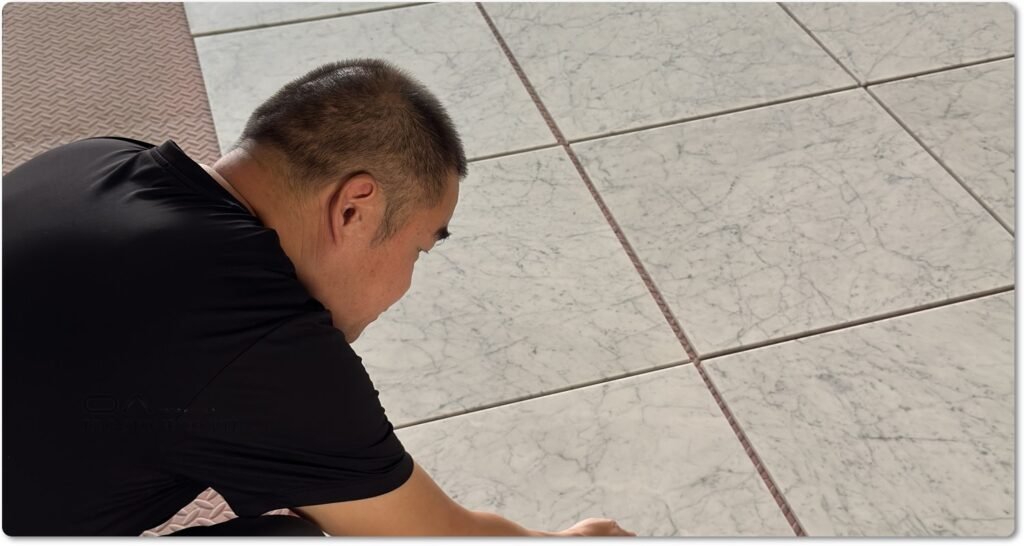
First-article inspection: Verify the first finished production sample against the approved drawing.
In-process inspection: Check dimensions and processing consistency during manufacturing.
Final inspection: Verify product dimensions, appearance, quantity, and agreed acceptance criteria.
Packaging inspection: Check crate condition, protective materials, labeling, and shipment preparation.
Sampling quantities and acceptance limits should be documented before production. Any statistical acceptance plan should identify the sampling method, inspection level, and acceptable quality criteria rather than relying on an undefined instruction such as “random inspection.”
3.9 Marble Tile Packaging and Pallet Specifications
Packaging is a major part of international marble tile procurement.
A tile can pass factory inspection and still arrive damaged because of insufficient protection, unsuitable crate construction, excessive stacking, or poor container loading.
Recommended Export Packaging Structure
A typical marble tile packaging arrangement may include:
Individual tile separation using appropriate protective materials.
Foam, paper, or suitable surface protection.
Carton or grouped protective packing where appropriate.
Strong wooden crates or pallets.
Internal bracing and corner protection.
Strapping and securing.
Product identification labels.
Gross and net weight information.
Container loading and securing records.
Packaging Specification Checklist
| Item | Information to confirm |
|---|---|
| Tile format | Exact length × width × thickness |
| Quantity | Pieces per carton or crate |
| Crate dimensions | External length × width × height |
| Gross weight | Stone and packaging weight |
| Net weight | Stone product weight |
| Protection | Foam, separators, edge protection |
| Crate material | Appropriate export packaging |
| Marking | Product, batch, quantity, destination |
| Loading | Container arrangement and securing |
ISPM 15 Requirements for Wood Packaging
International shipments using regulated solid-wood packaging may be subject to ISPM 15 requirements.
The framework addresses phytosanitary treatment and marking of wood packaging material used in international trade.
For example, the United States requires regulated wood packaging material to be treated and marked in accordance with ISPM 15. European Union requirements also address treatment, debarking, and marking of applicable imported wood packaging.
Buyers should confirm the destination country’s current requirements and ensure the packaging supplier provides compliant materials and markings.
4. Procurement Checklist: How to Specify Marble Tile Dimensions Correctly?
Before placing a wholesale order or launching a commercial project, establish a complete technical specification.
4.1 Confirm the Tile Format
Do not rely exclusively on product descriptions such as 12 × 24, 20 × 20, or 2 × 6.
Confirm:
Nominal length.
Nominal width.
Actual finished length.
Actual finished width.
Measurement unit.
Whether dimensions refer to the tile or installation module.
4.2 Confirm Thickness
Specify finished thickness in millimeters.
Common commercial options include:
10 mm.
12 mm.
15 mm.
18 mm.
20 mm.
Identify whether the product requires calibration and whether thickness variation is included in the acceptance criteria.
4.3 Confirm the Marble Material
Natural marble is not a completely uniform industrial material.
The buyer should identify:
Commercial marble name.
Material origin, where known and verifiable.
Background color.
Veining characteristics.
Natural variation allowance.
Resin treatment or reinforcement, if applicable.
Approved sample or reference slab.
A specification for white marble, for example, should define acceptable background color and veining ranges rather than assuming all tiles will have identical patterns.
4.4 Confirm Surface and Edge Finishing
| Surface finish | Typical characteristics |
|---|---|
| Polished | Reflective, glossy appearance |
| Honed | Smooth, matte or low-sheen appearance |
| Brushed | Mechanically textured surface |
| Tumbled | Aged appearance with softened edges |
| Leathered | Textured finish, subject to stone suitability |
| Sandblasted | Textured, relatively rough surface |
Edge requirements may include:
Straight-cut edges.
Beveled edges.
Chamfered edges.
Bullnose profiles.
Customized CNC profiles.
4.5 Approve a First-Article Sample
For bulk orders, approve the first production sample before the factory proceeds with the full quantity.
The sample should represent:
The specified marble material.
The agreed thickness.
The actual dimensions.
The required surface finish.
The edge treatment.
The expected color and vein range.
For natural stone, a small sample may not represent the complete variation of a production batch. Buyers should also request representative slab or batch photographs where practical.
4.6 Establish Pre-Shipment Inspection Requirements
A recommended pre-shipment inspection should cover:
Quantity verification.
Length and width measurements.
Thickness measurements.
Squareness and flatness.
Surface appearance.
Edge damage.
Color and material consistency.
Packing condition.
Crate identification.
Shipment documentation.
5. Cost and Risk Factors: What Determines Marble Tile Manufacturing Costs?
The price of marble tiles is not determined by dimensions alone.
Two products with identical dimensions may have different manufacturing costs because of material quality, production yield, processing complexity, inspection requirements, and export packaging.
5.1 Raw Marble Material Costs
Material cost is affected by:
Quarry availability.
Block size and quality.
Color consistency.
Vein characteristics.
Natural fractures.
Material rarity.
Selection requirements.
Processing yield.
Premium marble selections may require more intensive sorting and greater raw material allocation to achieve a consistent project batch.
5.2 Tile Size and Thickness
Larger formats generally require more careful material selection, cutting, handling, and packaging.
For example, a 24 × 24-inch marble tile has four times the face area of a 12 × 12-inch tile.
However, this does not mean its finished unit price must be exactly four times higher. Material yield, cutting efficiency, production setup, handling, and packaging also influence the cost.
Thicker marble tiles consume more raw material per square meter and increase shipment weight.
5.3 Cutting and Calibration Costs
Manufacturing costs may include:
Block sawing.
Slab cutting.
Tile sizing.
Thickness calibration.
Surface grinding.
Polishing or honing.
Edge processing.
CNC machining.
Waterjet cutting.
Quality inspection.
Calibrated and rectified products may require additional mechanical processing and inspection.
5.4 Custom Manufacturing Costs
Custom dimensions can increase costs because of:
Special production setup.
Customized cutting layouts.
Additional drawing reviews.
Lower production efficiency.
More complicated sorting.
Special packing arrangements.
However, customized production can also reduce site cutting waste when dimensions are coordinated carefully with architectural drawings.
5.5 Shipping Weight: Thickness and Density
Thickness influences the weight of marble per square meter.
Consider a theoretical example using an assumed marble density of 2,700 kg/m³.
| Thickness | Theoretical stone mass per m² |
|---|---|
| 10 mm | 27 kg |
| 12 mm | 32.4 kg |
| 15 mm | 40.5 kg |
| 18 mm | 48.6 kg |
| 20 mm | 54 kg |
These are illustrative calculations based on the assumed density, not laboratory measurements of a particular marble variety.
Actual density varies by material. Total shipment weight must also include crates, separators, pallets, and other packaging.
5.6 Common Procurement Risks
| Risk | Potential consequence | Preventive measure |
|---|---|---|
| Incorrect unit interpretation | Wrong product manufactured | Confirm inches, feet, or millimeters |
| Nominal/actual size confusion | Installation problems | Approve actual dimensions |
| Inconsistent thickness | Uneven installation | Define calibration requirements |
| Poor flatness | Lippage and installation difficulties | Establish inspection criteria |
| Natural color variation | Batch mismatch | Approve material variation range |
| Inadequate edge protection | Broken corners | Specify export packaging |
| Incorrect packing quantity | Inventory discrepancies | Confirm packing list |
| Unapproved production changes | Specification deviations | Control drawing revisions |
5.7 Standard vs. Customized Marble Tile Cost Comparison
| Cost factor | Standard production | Custom production |
|---|---|---|
| Production setup | Usually simpler | May require additional setup |
| Cutting efficiency | Potentially higher | Depends on layout |
| Material yield | More predictable | Drawing-dependent |
| Dimensional control | Established workflow | Project-specific controls |
| Inspection | Standard product checks | Customized inspection plan |
| Packaging | Established arrangement | May require customized crates |
| Project suitability | General applications | Specific architectural requirements |
The lowest quoted price is not necessarily the lowest total procurement cost.
Compare the finished specification, acceptable quality level, packaging, shipping arrangement, and risk of replacement or installation rework.
6. Supplier Evaluation: How to Choose a Marble Tile Manufacturer and Factory?
Selecting a marble tile manufacturer is not simply about comparing catalog prices.
Importers and wholesalers need to establish whether a factory can consistently manufacture the required dimensions, maintain batch quality, and deliver products that meet approved specifications.
6.1 Manufacturing Equipment and Processing Capabilities
A professional marble tile factory should be able to explain its manufacturing workflow and equipment capabilities.
Important capabilities include:
Marble block and slab cutting.
Precision tile sizing.
Thickness calibration.
Surface polishing and honing.
CNC cutting.
Waterjet processing.
Edge profiling.
Custom-format production.
Batch sorting and inspection.
For large-format products and project-specific dimensions, ask how the factory controls dimensional consistency across production batches.
6.2 Quality Control Documentation
Request evidence of actual production and quality-control procedures.
Useful documents include:
Product technical data sheet.
Approved production drawings.
Material identification records.
Dimensional inspection reports.
Thickness inspection records.
Surface quality inspection records.
Packing list.
Crate photographs.
Pre-shipment inspection report, where applicable.
Relevant material test reports.
For projects requiring independent verification, buyers can arrange third-party inspection under an agreed inspection plan.
6.3 Material Testing and Standards
Depending on the application and destination, consider requesting relevant test results.
These may include:
Water absorption.
Bulk density.
Flexural strength.
Compressive strength.
Abrasion resistance.
Slip resistance, where applicable.
Frost resistance, where applicable.
Not every test is necessary for every project. The testing schedule should correspond to the intended application and applicable building requirements.
6.4 Regulatory Developments Affecting European Marble Tile Procurement
European construction-product regulation is evolving.
Regulation (EU) 2024/3110, the revised Construction Products Regulation, entered into force on January 7, 2025. Its main provisions became applicable on January 8, 2026, while other provisions and product-family requirements follow their own implementation schedules.
The revised framework introduces changes involving product performance information, environmental characteristics, digital product information, and construction-product market obligations.
However, buyers should not assume that every natural marble tile automatically requires identical CE marking, documentation, or Digital Product Passport arrangements.
The applicable requirements depend on the product category, intended use, relevant harmonized technical specifications, and transitional provisions.
For natural stone modular tiles, EN 12057 is an important technical reference. Buyers should verify the current harmonized-standard status and applicable legal requirements for their particular product and destination market.
What This Means for Marble Tile Manufacturers
Technical documentation needs to be systematic.
Material identification and traceability are increasingly valuable.
Buyers may request more detailed environmental information.
Suppliers should monitor applicable product-family requirements.
Export documentation should be checked against destination-market obligations.
The transition should be managed product by product rather than by assuming that all construction products become subject to identical requirements on the same date.
6.5 Why Work with EDG Stone Factory?
EDG Stone is a Chinese natural stone manufacturer and exporter with more than 35 years of stone-industry experience.
For international marble tile procurement, EDG Stone focuses on coordinating material selection, customized dimensions, precision fabrication, quality inspection, and export packaging.
Its product and project capabilities cover:
Natural marble and granite products.
Quartzite and other natural stone materials.
Standard and customized tile formats.
CNC cutting and precision processing.
Waterjet cutting and decorative patterns.
Customized edge finishing.
Project-specific fabrication.
Quality inspection and export packing.
For importers, distributors, contractors, and commercial project buyers, coordinating dimensions, processing, material selection, and shipment requirements is particularly important.
The objective is not simply to supply marble tiles. It is to deliver products that match approved project specifications and can be integrated into the buyer’s procurement and installation workflow.
7. Practical RFQ Template: Marble Tile Manufacturing and Wholesale Procurement
The following template can be copied into an inquiry email or purchasing document.
7.1 Marble Tile Technical RFQ
1. Buyer Information
Company Name:
Contact Person:
Country / Destination:
Email:
Project Name:
2. Product Information
Marble Type / Commercial Name:
Material Origin, if specified:
Product: Natural Marble Tile
Application: Flooring / Wall Cladding / Bathroom / Commercial Project / Other
3. Dimensions
Nominal Length:
Nominal Width:
Actual Finished Length:
Actual Finished Width:
Measurement Unit: mm / inches
Thickness: 10 / 12 / 15 / 18 / 20 mm / Custom
Calibrated: Yes / No
Rectified Edges: Yes / No
4. Surface and Edge Processing
Surface Finish: Polished / Honed / Brushed / Tumbled / Other
Edge Profile: Straight / Beveled / Bullnose / Custom
Special Processing:
Drawing Attached: Yes / No
5. Quality Requirements
Length and Width Tolerance:
Thickness Tolerance:
Flatness Requirement:
Squareness Requirement:
Color and Vein Variation:
Natural Fissure / Resin Repair Acceptance:
Inspection Standard or Method:
First-Article Sample Approval: Required / Not Required
6. Order Quantity
Total Quantity:
Square Meters:
Number of Pieces:
Number of Formats:
Estimated Annual Purchase Volume:
7. Packaging and Shipping
Packaging: Wooden Crates / Pallets / Custom
Required Quantity per Crate:
Destination Port:
Incoterms: EXW / FOB / CFR / CIF / Other
Required Delivery Date:
Special Export Packaging Requirements:
8. Commercial Information
Requested Quotation:
Sample Availability:
Production Lead Time:
MOQ:
Payment Terms:
Inspection Arrangements:
9. Required Supplier Documents
Technical Data Sheet.
Material Photographs.
Dimensional Inspection Report.
Relevant Material Test Reports.
Packing Specification.
Production Schedule.
Please provide your factory quotation based on the above specifications and identify any technical limitations before mass production.
7.2 Suggested Factory Inspection Record
| Inspection item | Measurement or acceptance record | Result |
|---|---|---|
| Material identification | Approved marble selection | Pass / Fail |
| Length | Actual measurement in mm | Pass / Fail |
| Width | Actual measurement in mm | Pass / Fail |
| Thickness | Multi-point measurement | Pass / Fail |
| Flatness | Agreed inspection method | Pass / Fail |
| Squareness | Agreed inspection method | Pass / Fail |
| Surface | Approved finish and color range | Pass / Fail |
| Edges | No unacceptable damage | Pass / Fail |
| Quantity | Matches packing list | Pass / Fail |
| Packaging | Meets approved packing specification | Pass / Fail |
Acceptance limits should be inserted into the purchase agreement before inspection. A blank inspection record is not a substitute for an approved technical specification.

8. Frequently Asked Questions: Marble Tile Standard Sizes and Dimensions
1. What are the standard sizes of marble tiles?
Commonly traded marble tile sizes include 12 × 12 inches, 12 × 24 inches, 18 × 18 inches, and 24 × 24 inches. However, there is no single universal standard size for all natural marble tiles. Manufacturers can also produce customized dimensions according to project requirements.
2. What size is a 20 × 20 marble tile in millimeters?
A 20 × 20-inch marble tile measures approximately 508 × 508 mm. Its face area is approximately 0.258 square meters, excluding grout joints.
3. What does 2 × 6 marble tile mean?
The expression may refer to a 2 × 6-inch rectangular marble tile, a 2 × 6-foot panel, or another measurement system. Buyers should confirm the unit before ordering. A 2 × 6-inch tile measures approximately 50.8 × 152.4 mm.
4. What thickness is best for marble floor tiles?
Common commercial thickness options include 12 mm, 15 mm, 18 mm, and 20 mm. The appropriate choice depends on marble properties, tile dimensions, installation method, substrate, and intended application. Thickness alone does not establish structural suitability.
5. What are the dimensional tolerances for marble tiles?
For natural stone modular tiles within the scope of EN 12057:2015, the referenced tolerances include ±1 mm for length and width, ±1.5 mm for thickness on non-calibrated tiles, and ±0.5 mm for thickness on calibrated tiles. The standard also specifies flatness and squareness requirements. These figures should not automatically be applied to thicker or customized products.
9. References: International Standards, Regulations and Technical Resources
The following references provide a foundation for marble tile specifications, dimensional inspection, natural stone evaluation, and construction-product compliance.
9.1 Natural Stone Product Standards
EN 12057:2015 – Natural Stone Products: Modular Tiles – Requirements
Relevant to natural stone modular tile dimensions, thickness, geometrical characteristics, and product requirements.
EN 13373 – Natural Stone Test Methods: Determination of Geometrical Characteristics
Provides methods for measuring geometrical characteristics of natural stone products.
EN 12670:2001 – Natural Stone: Terminology
Provides technical definitions used in natural stone procurement and specifications.
9.2 ASTM Material and Physical Testing Standards
ASTM C503/C503M-23 – Standard Specification for Marble Dimension Stone
Covers marble dimension stone material characteristics, physical requirements, and sampling. Published January 2024.
ASTM C97/C97M – Standard Test Methods for Absorption and Bulk Specific Gravity of Dimension Stone
Relevant to water absorption and bulk specific gravity testing.
ASTM C1353/C1353M – Standard Test Method for Abrasion Resistance of Dimension Stone
Relevant to abrasion evaluation where appropriate to the application.
9.3 Construction-Product Regulations
Regulation (EU) 2024/3110
The revised European Construction Products Regulation, published in the Official Journal of the European Union on December 18, 2024. It entered into force on January 7, 2025, with its main application date on January 8, 2026.
Its implementation includes transitional provisions and product-family-specific requirements.
9.4 International Export Packaging
ISPM 15 – Regulation of Wood Packaging Material in International Trade
An international phytosanitary framework addressing the treatment and marking of regulated wood packaging material used in international trade.
Buyers should verify current destination-country requirements before shipment.
10. EDG Stone CTA: Custom Marble Tile Manufacturer and Wholesale Supplier in China
Looking for a Professional Marble Tile Manufacturer in China?
Whether you are a marble tile importer, wholesale distributor, construction contractor, stone fabricator, or architectural project purchaser, selecting the right manufacturing partner is essential for controlling product consistency and procurement costs.
EDG Stone is a professional Chinese natural stone manufacturer and exporter, providing natural marble products, customized stone fabrication, and international project supply services.
Our manufacturing capabilities support different marble tile formats, thicknesses, surface finishes, and customized dimensions.
EDG Stone Manufacturing and Procurement Capabilities
Standard Marble Tile Sizes
Common square and rectangular formats for wholesale and project procurement.
Custom Marble Tile Dimensions
Customized length, width, and thickness according to approved technical drawings.
Precision CNC Cutting
Controlled processing for customized stone components and project-specific formats.
Waterjet Fabrication
Decorative patterns, borders, medallions, and complex stone shapes.
Surface Finishing
Polished, honed, brushed, and other agreed finishes.
Quality Inspection
Dimensional, thickness, surface, and packaging inspections according to approved specifications.
Export Packaging
Protective packing, wooden crates, and coordinated container loading.
Request a Factory Quotation
To receive an accurate quotation, please provide:
Marble material or reference photographs.
Required tile dimensions in millimeters or inches.
Thickness.
Surface finish and edge requirements.
Total quantity in square meters or pieces.
Project destination and preferred shipping terms.
Technical drawings, if customized production is required.
Work directly with EDG Stone Factory to develop a marble tile specification that meets your project’s material, dimensional, quality, and delivery requirements.
Explore our stone countertops and slabs, custom stone fabrication, and natural marble product collections, or contact EDG Stone for a customized marble tile quotation.