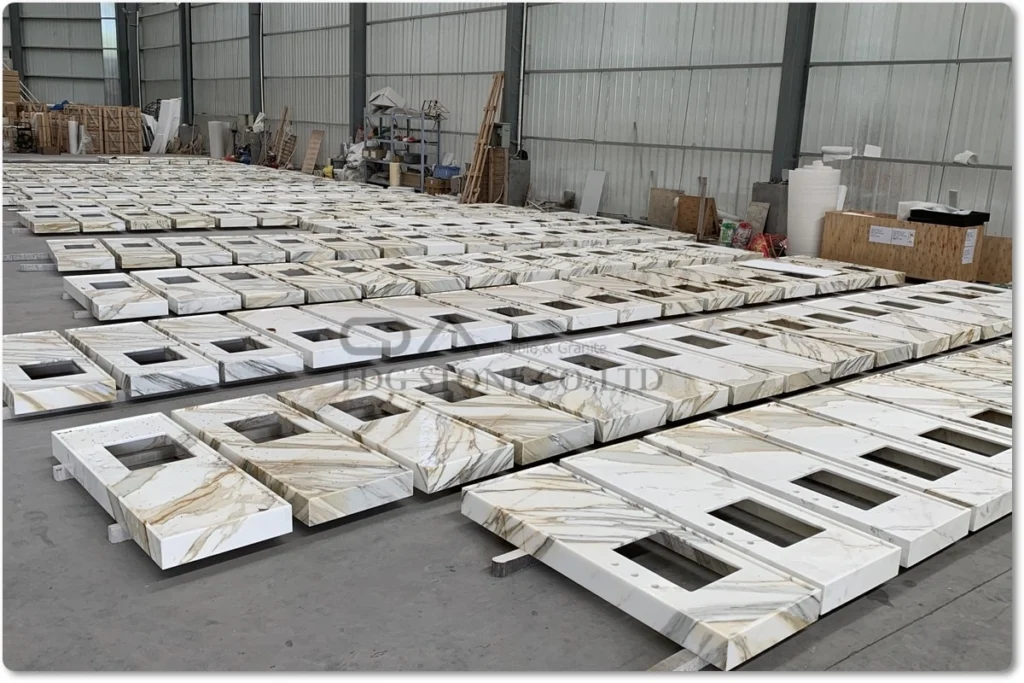
Marble Countertops Cost: Quick Procurement Summary
The total cost of marble countertops depends on marble variety, slab selection, thickness, material yield, fabrication, edge profiles, cutouts, packaging, international freight, insurance, import duties, and destination delivery. For professional buyers, comparing Total Landed Cost rather than the initial factory quotation is the most reliable way to evaluate suppliers. Factory-direct procurement can improve manufacturing transparency, customization, and bulk order coordination when supported by proper quality control and logistics planning.
Executive Summary
The cost of marble countertops is determined by much more than the price of the marble itself. Material selection, slab availability, thickness, cutting yield, edge profiles, sink cutouts, fabrication complexity, packaging, international freight, import duties, installation requirements, and potential replacement costs all influence the final procurement budget.
For importers, wholesalers, residential developers, hotel procurement teams, and commercial buyers, the most reliable purchasing decision is based on Total Landed Cost (TLC) rather than the lowest initial quotation.
A factory-direct quotation can provide greater visibility into material selection, fabrication specifications, production costs, packaging, and export arrangements. However, direct sourcing is not automatically cheaper in every situation. Buyers must evaluate production capability, quality control, shipment size, logistics arrangements, and after-sales responsibilities.
This guide explains how to calculate marble countertop procurement costs, compare EXW, FOB, and CIF quotations, evaluate manufacturers and wholesalers, and build a structured supplier selection process.
The objective is to help professional buyers make informed purchasing decisions while reducing unnecessary expenses, material waste, logistics uncertainty, and project delivery risks.
Key Procurement Conclusion:
A competitive marble countertop supplier should provide more than a low unit price. The supplier should demonstrate material consistency, accurate fabrication, transparent cost breakdowns, export packaging capability, traceable quality inspections, and clearly defined commercial responsibilities.

1. Scope and Definitions: Understanding Marble Countertop Procurement Costs
Before comparing quotations, buyers should clearly define which products and services are included.
1.1 What Is Included in a Marble Countertop?
Marble countertops are fabricated natural stone products manufactured from marble slabs or blocks and processed into finished components for residential, commercial, and hospitality applications.
Typical products include:
Kitchen countertops and islands.
Bathroom vanity tops.
Hotel bathroom countertops.
Reception counters.
Bar tops and restaurant counters.
Multifamily residential countertops.
Custom marble worktops.
Commercial washroom countertops.
A complete quotation may cover raw marble material, slab selection, cutting, edge finishing, polishing, sink cutouts, drilling, surface treatment, packaging, and transportation.
However, not every supplier includes all these operations in its quoted price.
For example, one Marble Countertops Manufacturer may quote a finished countertop with polished edges and sink openings, while another Marble Countertops Supplier may quote only cut-to-size stone components.
You cannot compare these quotations directly without normalizing their specifications.
1.2 Important Procurement Terminology
| Term | Procurement Meaning |
|---|---|
| Manufacturer | Company responsible for manufacturing or fabrication |
| Factory-direct | Purchasing directly from a production facility or manufacturer |
| Supplier | General commercial provider of products |
| Wholesaler | Business purchasing and reselling products in larger quantities |
| Distributor | Company supplying products through a distribution network |
| OEM | Manufacturing according to the buyer’s specifications or brand requirements |
| ODM | Manufacturer-developed products adapted for commercial customers |
| RFQ | Request for Quotation |
| MOQ | Minimum Order Quantity |
| Lead Time | Time required for production and delivery stages |
| Total Landed Cost | Complete cost of acquiring and delivering products to the specified destination |
1.3 Why Product Specifications Must Be Standardized?
A marble countertop quotation should identify:
Marble variety and material origin, where verified.
Slab or block reference, where applicable.
Finished dimensions and tolerances.
Thickness and thickness tolerance.
Surface finish.
Edge profile.
Cutouts and drilling.
Resin treatment or repairs, if relevant.
Packaging method.
Quantity and shipment destination.
Without these details, two quotations may represent substantially different products.
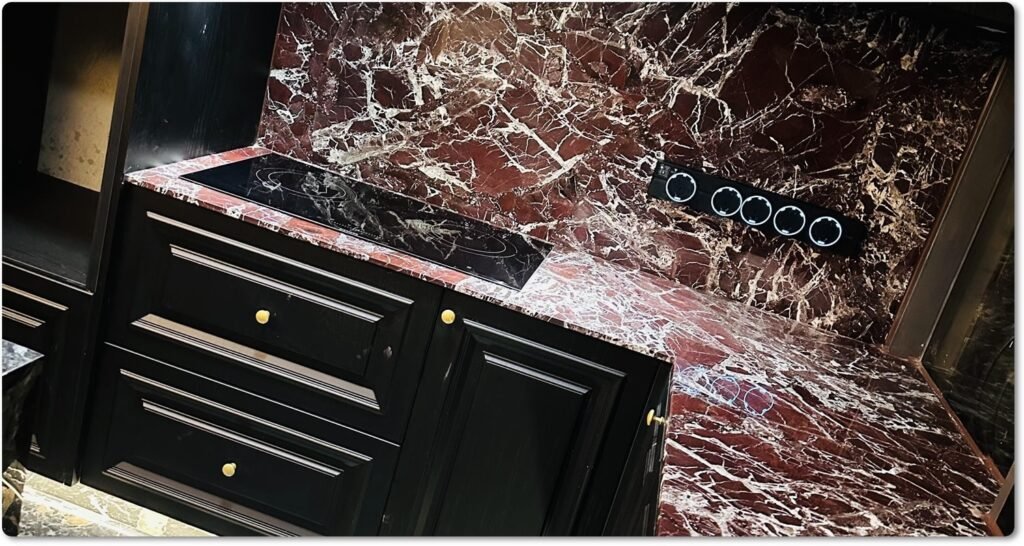
2. Technical Evaluation: What Determines the Cost of Marble Countertops?
2.1 Marble Type, Availability, and Slab Selection
Marble type is one of the most influential variables in countertop procurement.
Different marble varieties have different quarry availability, production conditions, block sizes, colors, veining patterns, and market demand.
Common commercial categories include:
Carrara White Marble.
Calacatta Marble.
Statuario Marble.
Arabescato Marble.
Volakas White Marble.
Panda White Marble.
Black Marble.
Green Marble.
Beige Marble.
Emperador Marble.
The actual procurement cost depends on the specific material, not simply the commercial name.
Two slabs marketed under the same marble name may differ in background color, vein density, pattern continuity, surface characteristics, and usable area.
What Buyers Should Check
1. Quarry and material availability
Confirm whether the material is currently available and whether it comes from a consistent quarry or supply source.
2. Slab dimensions
Larger slabs may provide better layout flexibility for kitchen islands and long countertops, but they can also involve additional handling and transportation considerations.
3. Veining and visual selection
Premium visual selections may require additional slab inspection and selective purchasing.
4. Material consistency
For hotel projects and multifamily developments, buyers should establish acceptable color and pattern variation across different production batches.
5. Natural defects and repairs
Natural marble may contain mineral variations, fissures, filled areas, and other geological characteristics. Acceptance criteria should distinguish natural features from unacceptable fabrication defects.
The buyer should approve representative samples or actual slab photographs before production.
2.2 Thickness, Dimensions and Material Yield
Thickness and finished dimensions directly affect material consumption and fabrication requirements.
Common countertop thickness specifications include 20 mm and 30 mm, although actual requirements vary by market, design, structural details, and application.
A thicker countertop may require:
More raw material.
Different cutting parameters.
Additional handling.
Heavier packaging.
Greater transportation weight.
Modified edge fabrication.
However, thickness alone does not determine the final cost. Fabrication design and material yield also matter.
Understanding Material Yield
Material yield refers to the proportion of purchased slab area that becomes usable finished products.
A basic conceptual calculation is:
Material Yield (%) = Net Usable Finished Stone Area / Purchased Raw Stone Area × 100
For example, a production order may require several countertops with different dimensions, sink openings, and edge details.
The total purchased material must account for:
Cutting kerf.
Defect avoidance.
Vein direction.
Pattern matching.
Slab layout.
Minimum edge distances.
Breakage allowances.
Remnant usability.
A simple square-meter calculation may therefore underestimate actual material requirements.
Why Slab Layout Matters
An experienced marble countertop factory should review cutting drawings before confirming the material quantity.
For projects involving bookmatching or continuous veining, slab selection and layout may become major cost considerations.
Buyers should request a cutting layout or nesting proposal when the order is large or visually demanding.
2.3 Edge Profiles and Custom Fabrication Costs
Edge processing influences both the appearance and manufacturing workload of marble countertops.
Common edge profiles include:
Eased edge.
Straight edge.
Beveled edge.
Bullnose.
Half bullnose.
Ogee edge.
Waterfall edge.
Laminated or built-up edge.
The cost of edge fabrication depends on profile geometry, edge length, stone thickness, equipment requirements, polishing procedures, and production quantity.
A simple straight edge generally involves a different processing sequence from a complex decorative profile.
Built-Up and Laminated Edges
Some designs use additional marble strips to create the visual appearance of a thicker countertop.
This may involve:
Cutting additional stone strips.
Preparing bonding surfaces.
Applying suitable adhesive.
Aligning and bonding the components.
Refinishing and polishing the exposed edges.
Buyers should confirm whether the quotation includes the additional material and labor.
Custom Fabrication
Complex kitchen islands, curved counters, waterfall panels, and irregular shapes may require CAD drawings, CNC machining, waterjet cutting, or specialized templates.
A professional Marble Countertops Manufacturer should confirm which operations are included in the price and which require separate charges.
2.4 Sink Cutouts and Special Processing
Sink cutouts are an important part of countertop fabrication costs.
Typical processing requirements include:
Undermount sink openings.
Top-mount sink openings.
Faucet holes.
Soap dispenser holes.
Cooktop openings.
Drainage grooves.
Custom-shaped openings.
Reinforcement or support preparation.
The cost depends on the number, dimensions, shape, edge treatment, and fabrication method.
Information Required for Sink Cutouts
Buyers should provide:
Sink manufacturer and model.
Manufacturer’s cutting template.
Finished opening dimensions.
Required corner radius.
Mounting method.
Faucet and accessory positions.
Required edge finish.
Support or reinforcement details.
Never assume that a sink’s overall outside dimensions are identical to its countertop cutout dimensions.
For complex projects, the fabricator should receive approved technical drawings before production.
2.5 Sample Costs, Tooling and Packaging
Sample and tooling expenses should be identified separately in a professional RFQ.
Sample Costs
Samples may involve:
Material cutting.
Surface finishing.
Edge processing.
Special selection.
Protective packaging.
Courier transportation.
A small sample may not accurately represent the complete visual variation of a large marble slab.
For important projects, buyers should request photographs or videos of actual production slabs in addition to physical samples.
Tooling and Setup Costs
Some custom fabrication projects require:
Special templates.
CNC programming.
Custom jigs.
Waterjet programming.
Dedicated fixtures.
Prototype production.
These costs may be allocated across the order or quoted separately.
Export Packaging
Marble countertops are heavy and vulnerable to impact, edge damage, and handling-related problems.
Export packaging may include:
Wooden crates.
A-frame or customized stone racks.
Protective foam.
Edge guards.
Waterproof protective materials.
Separation materials.
Internal bracing.
Loading and securing materials.
The packaging specification should reflect product dimensions, weight, shipment method, handling equipment, and destination requirements.
A lower packaging quotation is not necessarily a better commercial decision if it increases transportation damage risk.

3. Understanding EXW vs. FOB vs. CIF Marble Countertop Quotations
One of the most common procurement mistakes is comparing EXW, FOB, and CIF prices as if they represent the same delivery scope.
They do not.
Incoterms® 2020 defines the responsibilities of buyers and sellers regarding delivery, transportation, costs, and risk transfer. The named place or port must be clearly stated in the contract.
3.1 EXW – Ex Works
Under EXW, the seller makes the goods available at the agreed location, normally the seller’s premises.
The buyer generally arranges collection, export clearance, main transportation, import clearance, and subsequent delivery.
For example:
EXW EDG Stone Factory, China – [Agreed Collection Address]
Buyers should verify:
Whether loading is included.
Whether export clearance is included.
Whether local transportation is included.
Who arranges export documentation.
Whether the buyer can legally and practically complete export formalities.
EXW may appear attractive because the factory quotation excludes many logistics expenses. However, it can create practical export-clearance difficulties for overseas buyers.
3.2 FOB – Free On Board
FOB is used for sea and inland waterway transport.
Under FOB, the seller delivers the goods on board the vessel nominated by the buyer at the named port of shipment. Risk transfers when the goods are on board.
Example:
FOB Xiamen Port, China – Incoterms® 2020
The buyer generally arranges and pays for the main sea freight and destination-side expenses.
Important cost items include:
Factory-to-port transportation.
Export customs clearance.
Origin terminal charges as allocated by the contract.
Ocean freight.
Marine cargo insurance.
Destination handling.
Import clearance.
Important container-shipping consideration:
For containerized shipments handed to a carrier at a terminal before vessel loading, FCA is often more appropriate than FOB because the seller’s delivery under FOB occurs when the goods are on board the vessel.
Professional importers should discuss the correct rule with their freight forwarder.
3.3 CIF – Cost, Insurance and Freight
Under CIF, the seller arranges and pays for sea freight and insurance to the named destination port.
Example:
CIF Vancouver Port, Canada – Incoterms® 2020
However, CIF does not mean that the seller bears the risk until the shipment reaches the destination port.
Risk transfers when the goods are loaded on board the vessel at the port of shipment.
Another important point is that CIF requires only the prescribed minimum insurance cover under Incoterms® 2020 unless the parties agree to broader coverage.
Buyers should confirm:
Insurance provider.
Insured value.
Insurance coverage.
Deductibles and exclusions.
Claims procedure.
Destination terminal charges.
Unloading arrangements.
Import customs clearance.
Inland delivery.
3.4 Which Quotation Basis Is Better?
| Quotation Basis | Seller’s Main Responsibility | Buyer’s Main Considerations |
|---|---|---|
| EXW | Make goods available at named location | Collection, export arrangements, freight and import |
| FOB | Deliver goods on board vessel at named port | Ocean freight, insurance and destination costs |
| CIF | Pay freight and specified insurance to named port | Risk transfers at origin loading; destination and import costs remain to be checked |
For containerized marble countertop exports, FCA, CPT, or CIP may also be more suitable depending on the commercial arrangement.
Procurement recommendation: Always specify the Incoterms rule, named location or port, and version. Use the correct rule for the selected transport method.
4. International Freight, Insurance and Import Charges
International logistics can significantly influence the final cost of marble countertops.
Unlike lightweight consumer products, marble countertops have substantial weight and require careful loading, securing, handling, and unloading.
4.1 International Freight Variables
Freight quotations may depend on:
Origin and destination ports.
Container type and availability.
Shipment volume and gross weight.
Shipping route.
Seasonal capacity.
Fuel-related surcharges.
Terminal handling charges.
Customs and documentation requirements.
Special handling requirements.
Buyers should not assume that the freight cost per unit will remain constant across different order sizes.
4.2 Insurance Considerations
Cargo insurance should be evaluated according to the actual transportation risks.
For marble countertops, buyers should review whether the policy addresses:
Impact damage.
Breakage.
Loading and unloading risks.
Water damage.
General average.
Partial shipment losses.
Claims documentation.
Deductibles and exclusions.
Insurance coverage is not a substitute for suitable packaging and proper cargo securing.
4.3 Import Duties and Taxes
Import charges depend on the destination country’s customs regulations, product classification, declared customs value, origin, and applicable trade measures.
For example, U.S. importers should verify the appropriate Harmonized Tariff Schedule classification and applicable duty requirements for the specific product.
The classification may differ depending on whether the goods are raw slabs, cut-to-size stone, finished countertops, or other fabricated articles.
Country of origin and applicable additional duties must also be reviewed.
Do not rely on a supplier’s generic HS code as a guarantee of the buyer’s final customs treatment.
For the United States, CBP is responsible for administering customs laws and issuing legally binding classification rulings. Importers can consult the current HTSUS and seek professional customs advice where necessary.
4.4 Destination-Side Expenses
Additional charges may include:
Destination terminal handling.
Port documentation.
Customs broker fees.
Customs examination.
Container demurrage.
Container detention.
Port storage.
Unloading.
Inland trucking.
Warehouse handling.
Final delivery.
These charges should be identified before the purchase order is finalized.
5. Cost and Risk Factors: Damage, Installation and After-Sales Expenses
A low purchase price may become expensive if the finished products do not meet project requirements.
5.1 Natural Marble Characteristics
Marble is a natural material, and visual variation is inherent in its geological formation.
Buyers should establish acceptance criteria for:
Background color.
Vein direction.
Vein density.
Natural fissures.
Filled areas.
Surface repairs.
Color variation.
Surface finish.
Edge quality.
ASTM C503/C503M-23, Standard Specification for Marble Dimension Stone, provides a technical reference for material characteristics, physical requirements, and sampling.
It addresses properties including absorption by weight, density, compressive strength, modulus of rupture, abrasion resistance, and flexural strength.
However, compliance with a dimension-stone material specification does not automatically establish that every fabricated countertop meets a project’s dimensional, aesthetic, or installation requirements.
Project-specific acceptance criteria remain essential.
5.2 Damage During Transportation
Common transportation-related problems include:
Broken corners.
Chipped edges.
Cracked countertop sections.
Surface scratches.
Movement inside crates.
Insufficient internal support.
Damage during unloading.
To reduce risk, buyers should request:
Pre-shipment inspection photographs.
Packing photographs.
Crate identification numbers.
Loading photographs.
Container loading records.
Cargo securing information.
Shipping documents and insurance details.
5.3 Installation and Replacement Costs
Installation costs may include:
Site measurement.
Template preparation.
Cabinet verification.
Delivery to site.
Lifting and positioning.
Joint preparation.
Adhesive and sealing.
Final adjustment.
Sink and plumbing coordination.
For hotel and multifamily projects, incorrect dimensions can create additional labor and schedule costs.
Replacement components may also require additional production, export packaging, and international transportation.
5.4 Marble Maintenance and Lifecycle Considerations
Marble is a calcium-carbonate-based natural stone and can be vulnerable to acidic substances and abrasive wear.
Acidic liquids may cause etching, while inappropriate cleaners can damage the surface.
Buyers should communicate maintenance requirements to project owners and end users.
Sealing may reduce liquid absorption for suitable stones, but it does not make marble immune to etching or scratching.
Maintenance recommendations should be based on the actual stone, finish, sealer, and intended application.

6. Calculating Total Landed Cost: A Practical Procurement Model
The most effective way to compare marble countertop suppliers is to calculate the complete landed cost.
6.1 Total Landed Cost Formula
Total Landed Cost = Product Cost + Origin-Side Charges + International Freight + Insurance + Import Duties and Taxes + Destination-Side Charges + Inland Delivery
The specific items included depend on the agreed Incoterms rule, purchase contract, destination-country regulations, and transportation arrangements.
6.2 Detailed Cost Comparison Table
| Cost Category | Information to Verify |
|---|---|
| Stone Product | Marble type, dimensions, thickness, finish, and quantity |
| Fabrication | Edge profiles, cutouts, special shapes and drawing complexity |
| Material Yield | Slab layout, cutting plan, matching and waste |
| Packaging | Wooden crates, racks, protective materials and special packaging |
| Origin Charges | Costs allocated under the agreed Incoterms rule |
| International Freight | Transport method, route, freight basis and surcharges |
| Insurance | Coverage, insured value, exclusions and claims process |
| Import Charges | Duties, taxes, customs clearance and applicable fees |
| Destination Charges | Port handling, storage, pickup and inland transportation |
| After-Sales Risk | Breakage, replacement, repair and responsibility allocation |
6.3 Cost Per Finished Countertop
For commercial procurement, total shipment cost alone is not always sufficient.
Buyers should calculate the landed cost per accepted finished unit.
Landed Cost per Accepted Unit = Total Landed Project Cost / Number of Accepted Finished Units
This calculation is useful when comparing suppliers with different defect rates, packaging arrangements, or replacement responsibilities.
For projects with multiple countertop designs, buyers should also compare costs by SKU, size, thickness, and fabrication specification.
6.4 Illustrative Cost Calculation
The following example demonstrates the calculation method only. The numbers are hypothetical and are not industry price benchmarks or EDG Stone quotations.
Assume a buyer receives the following commercial offer:
| Cost Item | Illustrative Amount |
|---|---|
| Marble countertop products | US$20,000 |
| Origin-side charges | US$1,000 |
| International freight | US$3,000 |
| Insurance | US$200 |
| Import duties and taxes | US$2,500 |
| Destination-side charges | US$800 |
| Inland delivery | US$500 |
| Total Landed Cost | US$28,000 |
If the shipment contains 100 accepted countertop units:
US$28,000 / 100 = US$280 per accepted unit
This is more meaningful than comparing the original US$200 product cost per unit with another supplier’s delivered price.
The buyer should also ensure that the same cost item is not counted twice. For example, a CIF quotation already includes specified freight and insurance to the named destination port.
6.5 Comparing Two Suppliers
Suppose Supplier A offers a lower EXW product price but requires additional logistics coordination and more expensive packaging.
Supplier B offers a higher FOB price but includes a more comprehensive origin-side service package.
The correct decision depends on the final normalized landed cost, product quality, service scope, delivery reliability, and commercial risk.
A supplier should not be selected solely because its first quotation has the lowest numerical value.
7. Supplier Evaluation: Factory-Direct vs. Local Suppliers and Wholesalers
Choosing the right Marble Countertops Manufacturer or Supplier is as important as negotiating the product price.
Different supplier models offer different advantages.
7.1 Factory-Direct Marble Countertops Manufacturer
A factory-direct sourcing model allows buyers to communicate with the production facility responsible for fabrication.
Potential advantages include:
Direct technical communication.
Greater visibility into fabrication processes.
Customized dimensions and edge profiles.
Direct material selection coordination.
Production planning.
OEM and ODM possibilities.
Project-specific packaging.
Bulk order coordination.
However, buyers must verify the actual production capability rather than assuming that every company advertising itself as a factory owns and operates all relevant equipment.
7.2 Marble Countertops Wholesaler
A wholesaler may purchase products from several factories and consolidate them for distribution.
Potential advantages include:
Broader product selection.
Multiple material sources.
Consolidated procurement.
Existing distribution relationships.
Flexible purchasing arrangements.
However, buyers should clarify who is responsible for quality inspections, fabrication corrections, packaging, and warranty claims.
7.3 Local Marble Countertops Supplier
A local supplier or fabricator may offer:
Local measurement.
Site templating.
Installation.
Easier communication.
Faster handling of certain after-sales issues.
Local stock availability, where confirmed.
For small residential projects, these services can be commercially valuable.
For large hotel, multifamily, or wholesale orders, buyers may also consider factory-direct procurement to obtain customized production and international bulk supply.
7.4 Factory-Direct vs. Local Supplier Comparison
| Evaluation Factor | Factory-Direct Manufacturer | Local Supplier |
|---|---|---|
| Material Selection | Depends on factory portfolio and sourcing | Depends on local inventory and sourcing |
| Custom Fabrication | Direct production coordination | Local fabrication capability |
| Bulk Orders | May support production-based procurement | Depends on capacity |
| Site Measurement | Usually requires local coordination | Often available |
| Installation | Usually requires local installation partner | Often available |
| International Shipping | Export logistics coordination | May not be relevant |
| Communication | Cross-border coordination | Local communication |
| After-Sales | Contract and shipping-based procedures | Potentially easier local service |
Neither model is universally superior.
The appropriate choice depends on order volume, project complexity, destination, delivery schedule, and the buyer’s local operating capabilities.
7.5 How to Evaluate a Marble Countertops Factory?
Professional buyers should verify:
Manufacturing capability
Workshop and production facilities.
Cutting equipment.
CNC and waterjet capability, where required.
Edge processing equipment.
Polishing operations.
Fabrication personnel.
Quality control
Incoming material inspection.
Drawing verification.
Dimensional inspection.
Surface inspection.
First-article approval.
Final inspection.
Packing inspection.
Export experience
Export documentation.
Packaging procedures.
Container loading.
Shipping coordination.
Commercial communication.
Commercial reliability
Written quotations.
Clear payment terms.
Production schedules.
Defined tolerances.
Documented claims procedures.
Consistent communication.
7.6 The Importance of First-Article Approval
For bulk marble countertop procurement, the buyer should consider approving an initial fabricated unit before mass production.
The first-article inspection can verify:
Finished dimensions.
Thickness.
Edge profile.
Sink cutouts.
Surface finish.
Visual selection.
Repair acceptance.
Packaging suitability.
Once approved, the reference sample or inspection record can become part of the purchase specification.

8. Procurement Checklist: How to Prepare a Professional Marble Countertops RFQ?
An effective Request for Quotation should reduce ambiguity and allow suppliers to submit comparable offers.
8.1 Essential RFQ Information
Project Information
Company name.
Project name.
Destination country.
Destination city.
Required delivery schedule.
Intended application.
Material Requirements
Marble variety.
Material origin, if specified.
Preferred background color.
Veining requirements.
Sample approval requirements.
Acceptable natural characteristics.
Product Specifications
Product type.
Quantity.
Finished length and width.
Thickness.
Surface finish.
Edge profile.
Sink openings.
Faucet holes.
Special fabrication.
Technical drawings.
Commercial Requirements
Requested quotation basis.
Named place or port.
Payment terms.
MOQ.
Production lead time.
Sample costs.
Packaging costs.
Warranty and claims arrangements.
Shipping Requirements
Shipment method.
Destination port.
Container requirements.
Delivery address.
Import documentation.
Cargo insurance requirements.
8.2 Procurement Workflow
A structured procurement process can follow these stages:
Define project specifications.
Identify suitable marble varieties.
Request material samples and slab photographs.
Shortlist manufacturers and suppliers.
Submit a standardized RFQ.
Compare itemized quotations.
Verify production and export capabilities.
Approve samples and technical drawings.
Confirm commercial terms.
Approve first-article production.
Conduct final inspection.
Approve packaging and loading.
Arrange shipment and insurance.
Verify receipt and document any claims.
8.3 How to Compare Supplier Quotations?
Use a supplier comparison matrix rather than relying on the quoted price alone.
| Evaluation Category | Suggested Verification |
|---|---|
| Material | Actual slab photos and material identification |
| Specifications | Dimensions, thickness, and tolerances |
| Fabrication | Edge, cutouts, and custom processing |
| Quality | Inspection criteria and records |
| Packaging | Crate design and protection |
| Logistics | Incoterms and named location |
| Production | Confirmed schedule and capacity |
| Commercial | Payment and claims terms |
| Experience | Relevant project and export evidence |
9. Regulatory and Industry Developments Affecting Procurement
International stone procurement increasingly requires buyers to consider not only product quality and logistics but also packaging, customs classification, documentation, and environmental requirements.
9.1 ASTM Material Specifications
ASTM C503/C503M-23, Standard Specification for Marble Dimension Stone, is an important reference when defining the technical properties of marble dimension stone.
The standard covers material characteristics, physical requirements, and sampling.
Relevant test properties include:
Absorption by weight.
Density.
Compressive strength.
Modulus of rupture.
Abrasion resistance.
Flexural strength.
Buyers should identify the applicable test methods and acceptance requirements in their project specifications.
A supplier should not claim that a product is certified to a standard without supporting test reports or other appropriate evidence.
9.2 International Trade and Customs Compliance
Importers should verify:
Correct customs classification.
Country of origin.
Commercial invoice accuracy.
Packing list consistency.
Customs valuation.
Applicable duties and additional trade measures.
Destination-country import requirements.
For U.S.-bound shipments, buyers should verify current HTSUS requirements and consult CBP or a qualified customs broker for product-specific classification.
9.3 European Union Packaging and Packaging Waste Regulation
A significant recent development is Regulation (EU) 2025/40 on Packaging and Packaging Waste (PPWR).
The regulation entered into force on February 11, 2025, and its general application date is August 12, 2026, with certain requirements subject to specific phased dates and transitional provisions.
The regulation establishes a broader framework for packaging sustainability, waste prevention, recyclability, and packaging-related responsibilities.
For stone exporters supplying European customers, this creates a reason to review:
Packaging material selection.
Packaging weight and volume.
Reusability and recyclability considerations.
Packaging documentation.
Customer-specific compliance requirements.
Applicable producer and importer responsibilities.
Importantly, the PPWR does not mean that every wooden export crate automatically requires the same treatment or that all obligations fall on the overseas stone factory. Applicability depends on the packaging, role of the economic operator, relevant provisions, and implementation guidance.
Buyers and suppliers should review the specific obligations applicable to their transaction.
9.4 The Direction of International Stone Procurement
Several purchasing trends are increasingly relevant to B2B buyers:
More transparent cost structures
Buyers want itemized quotations instead of a single unexplained unit price.
Better technical documentation
CAD drawings, slab photographs, inspection records, and packing evidence help reduce communication errors.
Greater packaging accountability
Packaging design and material selection are becoming important parts of international procurement compliance.
More structured supplier qualification
Buyers increasingly evaluate manufacturing capability, documentation, production planning, and after-sales responsibility.
Factory-direct sourcing with local execution
Importers and developers may combine overseas production with local templating, installation, and project management.
These developments make professional procurement documentation a competitive advantage for both buyers and manufacturers.

10. Practical RFQ Template: Request an Itemized Marble Countertops Quotation
The following template can be copied and sent to a marble countertop manufacturer, factory, wholesaler, or supplier.
Marble Countertops RFQ Form
1. Buyer Information
Company Name:
Contact Person:
Email:
Country:
Website:
2. Project Information
Project Name:
Project Type: Residential / Hotel / Multifamily / Commercial / Wholesale
Destination Country:
Destination City:
Delivery Address or Port:
Required Delivery Date:
3. Material Requirements
Marble Type:
Preferred Color:
Material Origin:
Slab Selection Requirements:
Sample Approval: Yes / No
Reference Images:
4. Product Specifications
| Item | Specification |
|---|---|
| Product Name | |
| Quantity | |
| Length | |
| Width | |
| Thickness | |
| Surface Finish | |
| Edge Profile | |
| Sink Cutouts | |
| Faucet Holes | |
| Special Processing | |
| Drawing Reference |
5. Commercial Requirements
Requested Incoterms Rule:
Named Place or Port:
Currency:
Payment Terms:
MOQ:
Sample Cost:
Production Lead Time:
Packaging Requirements:
Insurance Requirements:
6. Quality Requirements
Dimensional Tolerance:
Surface Acceptance Criteria:
Natural Variation Requirements:
Repair and Filling Acceptance:
Inspection Requirements:
First-Article Approval:
Claims and Replacement Conditions:
7. Required Supplier Response
Please provide:
Itemized product quotation.
Material and fabrication cost breakdown.
Packaging specifications.
Available production capacity and estimated lead time.
Applicable export and logistics charges.
Relevant material test reports, if available.
Actual material photographs or videos.
Factory and production capability information.
Proposed quality inspection procedure.
Payment and warranty conditions.
Procurement Note: The buyer should request a revised quotation whenever material specifications, dimensions, quantities, fabrication details, or delivery terms change.
11. EDG Stone: Factory-Direct Marble Countertops Manufacturing and Export
EDG Stone is a professional Chinese stone products manufacturer and exporter specializing in natural stone countertops, marble, quartz, quartzite slabs, and customized stone fabrication.
For international importers, wholesalers, distributors, contractors, and project procurement teams, the objective of factory-direct sourcing should be to establish a transparent production and procurement process.
11.1 Marble Countertops Manufacturing and Custom Fabrication
EDG Stone supports a range of stone product and fabrication requirements, including:
Marble kitchen countertops.
Marble bathroom vanity tops.
Hotel vanity countertops.
Multifamily residential countertops.
Custom stone countertops.
Marble cut-to-size products.
CNC and waterjet processing.
Edge profiling and polishing.
Sink and faucet cutouts.
Custom stone components.
Actual production scope, available materials, and technical specifications should be confirmed for each project.
11.2 A More Transparent Quotation Process
A professional factory-direct quotation should distinguish between:
Material costs: Marble type, slab selection, dimensions, thickness, and material consumption.
Fabrication costs: Cutting, edge profiles, sink cutouts, CNC machining, and other customized operations.
Packaging costs: Crates, protective materials, internal supports, and loading arrangements.
Export costs: Origin-side transportation, export documentation, and other charges according to the agreed trade terms.
Transportation costs: Freight, insurance, destination charges, and inland delivery where applicable.
This approach allows buyers to evaluate the real cost drivers and identify opportunities to optimize material yield, fabrication design, and shipment planning.
11.3 Who Should Consider Working with EDG Stone?
EDG Stone’s factory-direct manufacturing and export model is relevant to:
Marble and natural stone importers.
Stone wholesalers and distributors.
Countertop fabricators.
Kitchen cabinet companies.
Residential developers.
Hotel procurement departments.
Commercial contractors.
Interior design and architectural businesses.
OEM and private-label buyers.
Whether the requirement is a single customized component or a larger commercial project, specifications, production feasibility, packaging, and shipping arrangements should be evaluated before order confirmation.
11.4 What to Include in Your EDG Stone Inquiry
To receive a more accurate quotation, provide:
Marble type or reference images.
Product dimensions.
Thickness.
Surface finish.
Edge profile.
Sink and faucet cutouts.
Quantity.
CAD drawings or templates.
Destination country and port.
Preferred Incoterms rule.
Required delivery schedule.
The more complete the technical information, the more accurately the factory can evaluate material consumption, fabrication requirements, packaging, and logistics.
12. Frequently Asked Questions About Marble Countertops Cost and Suppliers
1. How much do marble countertops cost per square foot?
There is no universal price for marble countertops. The final cost depends on marble variety, slab selection, thickness, dimensions, fabrication, edge profiles, cutouts, material yield, packaging, and transportation.
Buyers should request an itemized quotation based on actual specifications rather than relying on a generic price per square foot.
2. Is buying marble countertops directly from a factory cheaper?
Factory-direct purchasing can reduce intermediary purchasing layers and improve communication with the production team. However, the final savings depend on order quantity, logistics, local services, packaging, import charges, and quality requirements.
Compare total landed cost rather than the factory’s initial product price.
3. What is the difference between a marble countertops manufacturer and a wholesaler?
A manufacturer produces or fabricates the products, while a wholesaler generally purchases and resells products to other businesses.
Some businesses perform both functions. Buyers should verify the actual production capability and responsibility for quality control.
4. What is the best Incoterms option for importing marble countertops from China?
There is no single best option for every buyer.
EXW may be suitable when the buyer can manage collection and export arrangements. FOB is used for sea shipments where delivery occurs on board the vessel. CIF includes seller-arranged freight and prescribed minimum insurance to the named destination port.
For containerized shipments, FCA may be more appropriate. The correct rule should be selected according to the actual transport arrangement and contract.
5. How can buyers reduce the total cost of bulk marble countertop orders?
Buyers can improve procurement efficiency by standardizing dimensions, optimizing slab layouts, reducing unnecessary custom processing, approving samples and drawings before production, consolidating shipments where practical, and specifying suitable export packaging.
The most effective strategy is to optimize the total landed cost while maintaining the required quality and delivery standards.
13. Semantic Insight: How to Make Better Marble Countertop Procurement Decisions
What Actually Makes a Marble Countertop Supplier Competitive?
A competitive supplier is not simply the company offering the lowest quotation. It is the supplier capable of delivering the specified stone products at an acceptable quality level, within the agreed production schedule, with clearly defined commercial responsibilities.
For professional buyers, supplier competitiveness should be understood through five connected dimensions:
Material capability: Access to suitable marble varieties, slab selection, and consistent material sourcing.
Manufacturing capability: Accurate cutting, edge processing, CNC machining, waterjet fabrication, and customized production.
Quality assurance: Documented inspections, approved drawings, material references, and traceability.
Export capability: Suitable packaging, container loading, shipping documentation, and logistics coordination.
Commercial transparency: Itemized quotations, clearly defined Incoterms, payment conditions, and claims procedures.
Why Is Factory-Direct Procurement Becoming Important?
Factory-direct procurement gives buyers an opportunity to communicate with the production source and evaluate manufacturing decisions earlier in the purchasing process.
For large projects, this can improve coordination between material selection, cutting layouts, fabrication requirements, and packaging specifications.
It also enables importers and distributors to establish more direct relationships with manufacturers for repeat orders, product customization, and long-term supply arrangements.
However, direct sourcing requires buyers to have a clear RFQ, appropriate inspection arrangements, and a reliable logistics plan.
Which Procurement Model Should Buyers Choose?
There are three common purchasing approaches:
Option A – Local Retail or Fabrication Procurement
Suitable when the project requires local measurement, installation, small quantities, or immediate after-sales support.
Option B – Wholesale and Distribution Procurement
Suitable for businesses seeking multiple material selections, inventory flexibility, and consolidated product purchasing.
Option C – Factory-Direct International Procurement
Suitable for importers, distributors, developers, hotel projects, and commercial buyers with defined specifications and the capability to coordinate international purchasing and delivery.
The correct option depends on project scale, material requirements, service needs, and total landed cost.
What Should Buyers Consider Before Confirming an Order?
Before issuing a purchase order, buyers should confirm:
Whether the approved marble matches the actual production material.
Whether all dimensions and tolerances are documented.
Whether fabrication details are technically complete.
Whether material yield and slab selection are acceptable.
Whether packaging is appropriate for the shipment.
Whether the Incoterms rule and named location are unambiguous.
Whether customs classification and import requirements have been reviewed.
Whether inspection and claims procedures are agreed upon.
Final Procurement Insight:
The best marble countertop purchasing decision is the one that balances material quality, manufacturing precision, logistics efficiency, commercial transparency, and long-term project reliability.
A professional manufacturer should help buyers understand not only what the products cost, but also why they cost that amount and which specifications or procurement decisions can improve the overall project economics.
14. References and Technical Resources
The following authoritative resources provide a foundation for marble material evaluation, international trade terms, customs procedures, and packaging compliance.
ASTM International – ASTM C503/C503M-23, Standard Specification for Marble Dimension Stone. Published December 15, 2023; current edition identified by ASTM as C503/C503M-23. Covers material characteristics, physical requirements, and sampling for marble dimension stone.
https://store.astm.org/c0503_c0503m-23.htmlInternational Chamber of Commerce (ICC) – Incoterms® 2020. Official rules defining the responsibilities of buyers and sellers concerning delivery, costs, transportation, and risk transfer.
https://iccwbo.org/business-solutions/incoterms-rules/incoterms-2020/ICC – Incoterms® 2020 Checklist and Flowcharts. Practical guidance for selecting suitable trade terms and understanding insurance and delivery responsibilities.
https://library.iccwbo.org/content/clp/Others/incoterms_2020_checklist_2024-update.pdfNatural Stone Institute – Sealing Natural Stone Countertops. Industry guidance concerning sealing and the maintenance considerations of natural stone surfaces.
https://www.naturalstoneinstitute.org/consumers/sealing-stone/Natural Stone Institute – Residential Stone Countertop Installation. Technical guidance concerning stone characteristics and countertop applications.
https://www.naturalstoneinstitute.org/default/assets/file/consumers/2011_residential_countertop_module.pdfU.S. Customs and Border Protection – Tips for New Importers and Exporters. Guidance on product descriptions, country of origin, classification, and import documentation.
https://www.help.cbp.gov/s/article/Article-1894U.S. International Trade Commission – Harmonized Tariff Schedule. Official source for U.S. tariff classification and applicable tariff schedules.
https://hts.usitc.gov/European Commission – Regulation (EU) 2025/40 on Packaging and Packaging Waste. Regulatory framework applicable from August 12, 2026, subject to phased provisions and transitional arrangements.
https://eur-lex.europa.eu/eli/reg/2025/40/ojEuropean Commission – Packaging and Packaging Waste Regulation Implementation. Guidance and implementation timeline for businesses operating in the EU market.
https://green-forum.ec.europa.eu/green-business/packaging-and-packaging-waste-regulation-implementation_en
Standards and regulatory note: Buyers should confirm the latest applicable edition, destination-country requirements, contractual specifications, and any amendments or transitional provisions before placing an order. The information in this guide is for commercial procurement education and does not replace legal, customs, engineering, or insurance advice.
Marble Countertops Procurement: Complete Cost and Supplier Insights
What Determines the Real Cost of Marble Countertops?
The real cost includes marble material, slab selection, material yield, thickness, fabrication, edge processing, sink cutouts, packaging, transportation, insurance, import duties, and destination delivery. The complete cost must be evaluated according to the product specifications and contractual delivery terms.
Why Does Factory-Direct Procurement Matter?
Factory-direct procurement allows importers, wholesalers, developers, and commercial buyers to communicate directly with manufacturers regarding material selection, fabrication, production planning, quality inspections, and export packaging. It can improve cost transparency and production coordination, although actual savings depend on order volume and logistics.
Which Supplier Option Should Buyers Choose?
Local marble suppliers are suitable when buyers require local measurement, installation, and after-sales support. Marble wholesalers offer product sourcing and distribution flexibility. Factory-direct marble manufacturers are worth evaluating for customized fabrication, bulk procurement, OEM requirements, and international supply projects.
How Should Buyers Compare EXW, FOB and CIF?
EXW, FOB, and CIF represent different delivery obligations, cost allocations, and risk-transfer points. Buyers must normalize quotations by identifying all origin charges, international freight, insurance, customs expenses, destination handling, and inland delivery.
What Makes a Reliable Marble Countertops Manufacturer?
A qualified manufacturer should demonstrate material sourcing capability, fabrication equipment, technical drawing control, quality inspection procedures, export packaging experience, transparent quotations, and documented commercial responsibilities.
What Is the Most Effective Procurement Strategy?
The most effective strategy is to compare suppliers using Total Landed Cost, verify actual product specifications, approve samples and technical drawings, inspect production, and confirm packaging, transportation, and claims procedures before shipment.
EDG Stone: Factory-Direct Marble Countertops Procurement
EDG Stone is a Chinese natural stone manufacturer and exporter providing marble countertops, vanity tops, custom fabrication, and stone products for international B2B buyers. Importers, distributors, contractors, and project procurement teams can submit drawings, dimensions, material references, quantities, and destination details to request an itemized quotation.
15. Request an Itemized Marble Countertops Quotation from EDG Stone
Looking for a Reliable Marble Countertops Manufacturer and Factory-Direct Supplier?
Whether you are sourcing marble countertops for wholesale distribution, a hotel development, a multifamily residential project, or a commercial fabrication business, understanding the complete cost structure is essential.
EDG Stone provides natural stone products and customized fabrication solutions for international B2B customers.
Send us your material requirements, drawings, dimensions, quantities, and destination information.
Our team can review the project requirements and provide a quotation based on the specified marble, fabrication details, packaging arrangements, and agreed shipping terms.
Request Your Marble Countertops Quotation Today
Recommended Inquiry Information:
Marble type or reference images.
Product dimensions and thickness.
Edge profiles and sink cutouts.
Total quantity.
CAD drawings or project specifications.
Destination country and port.
Preferred Incoterms rule.
Expected delivery schedule.
EDG Stone – Marble Countertops Manufacturer & Exporter
From Material Selection to Custom Fabrication and International Delivery.