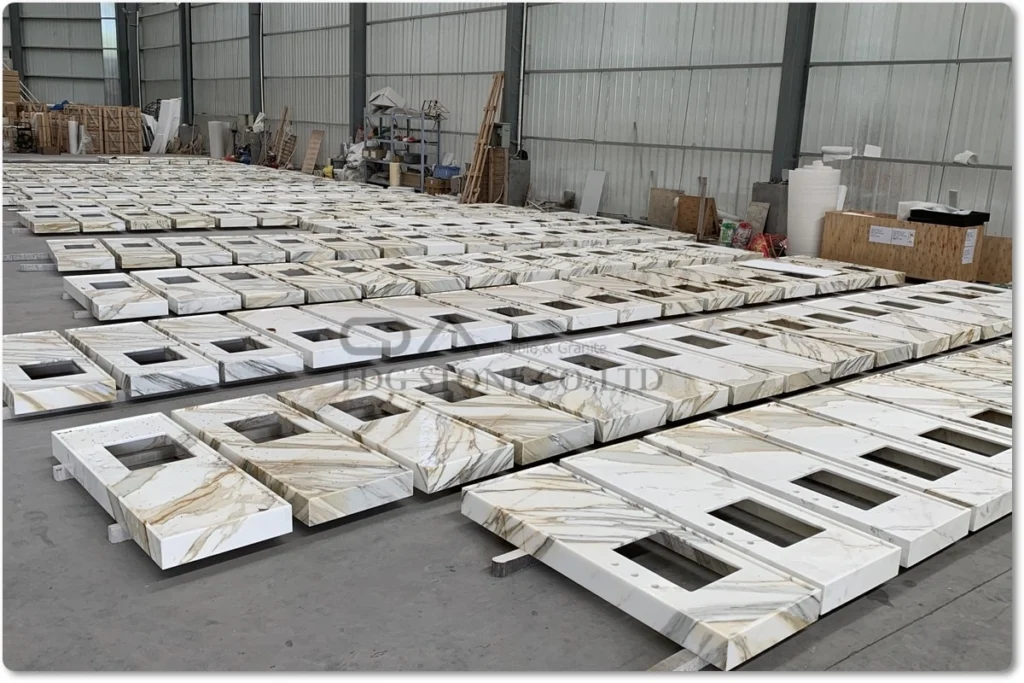
Buyers sourcing marble countertops in Melbourne can generally choose between local countertop fabricators, local stone slab suppliers, and overseas marble countertop manufacturers. Local sourcing may offer easier showroom inspections, project coordination, templating, and installation, depending on the supplier. Direct factory sourcing may provide greater control over material selection, custom fabrication specifications, and consolidated orders, but requires careful planning for international freight, Australian customs clearance, product compliance, and local installation. The best option depends on project quantity, lead-time requirements, material availability, fabrication complexity, and the buyer’s ability to manage importing and installation.
Choosing the right Marble Countertops Supplier in Melbourne involves more than comparing the price of a marble slab. Buyers must evaluate material quality, fabrication capability, dimensional accuracy, delivery arrangements, installation responsibilities, and the total landed cost of the finished product.
For Australian stone importers, kitchen and cabinetry companies, residential developers, renovation contractors, and local countertop fabricators, three sourcing models deserve consideration:
Purchasing finished marble countertops from a Melbourne-based fabricator.
Buying marble slabs from a local stone supplier and arranging fabrication separately.
Sourcing marble slabs or custom-fabricated products directly from an overseas manufacturer.
Each model has different commercial advantages and limitations. A local supplier may simplify project coordination, while an overseas factory may offer a wider range of material selection and production arrangements for suitable orders. Neither option is automatically less expensive or more reliable.
This guide explains how to compare the alternatives, assess technical requirements, estimate procurement costs, and prepare an effective request for quotation (RFQ) for marble countertops in Melbourne.
It also examines Australian import requirements and the engineered stone prohibition, helping buyers distinguish natural marble from other materials that may have different regulatory requirements.

1. Executive Summary: Which Marble Countertop Sourcing Model Is Best for Melbourne?
The most appropriate sourcing model depends on the buyer’s operational requirements rather than the supplier’s location alone.
| Procurement requirement | Melbourne fabricator | Local slab supplier | Overseas factory |
|---|---|---|---|
| Physical inspection | May offer showroom or warehouse inspections | May offer slab-yard inspections | Usually requires digital inspection or samples unless an in-person visit is arranged |
| Immediate availability | Depends on stock and production capacity | Depends on local slab inventory | Depends on material availability, production scheduling, and shipping |
| Custom fabrication | Depends on equipment and capabilities | May offer fabrication or work with separate fabricators | May offer factory fabrication, subject to confirmed capabilities |
| Dimensional verification | May provide templating or site measurement | Usually requires separate coordination if not included | Requires approved drawings and a clear measurement responsibility |
| International logistics | Generally not the buyer’s direct responsibility for locally stocked products | Generally not the buyer’s direct responsibility for locally stocked products | Requires an agreed international shipping and import arrangement |
| Installation | May be included or separately contracted | Often requires separate arrangements | Usually requires a local installer unless a specific installation arrangement is confirmed |
| Commercial order consolidation | Depends on supplier capacity | Depends on supplier capacity | May suit larger or repeat orders, subject to factory capacity and logistics economics |
| After-sales coordination | May be easier when the supplier controls fabrication and installation | Depends on the contractual arrangement | May require coordination between the importer, factory, freight provider, and installer |
| Best potential fit | Projects requiring local coordination | Buyers selecting local stock and arranging processing | Planned custom orders, wholesale purchasing, or repeat import programs |
This comparison is a procurement framework, not a guarantee of the services provided by every business.
Recommended sourcing approach
For urgent residential renovations: Start by checking local availability, fabrication schedules, and installation dates. The shortest material-supply route does not necessarily mean the shortest completed-project lead time.
For countertop fabricators and importers: Compare local slab purchases with direct factory sourcing using consistent material specifications, realistic order quantities, freight quotations, and inspection requirements.
For developers and multi-unit projects: Evaluate repeatability, dimensional control, production scheduling, packaging, replacement-piece planning, and the ability to coordinate deliveries across multiple installation stages.
For custom luxury projects: Prioritise slab selection, veining direction, edge profiles, cutout details, and approval of the final fabrication drawings before production begins.
A reliable sourcing decision starts with a complete specification and a defined division of responsibilities.

2. Scope and Definitions: Understanding Marble Countertops in Melbourne
2.1 What are marble countertops?
Natural marble countertops are fabricated surfaces made from natural marble, a metamorphic rock commonly composed predominantly of calcite or dolomite.
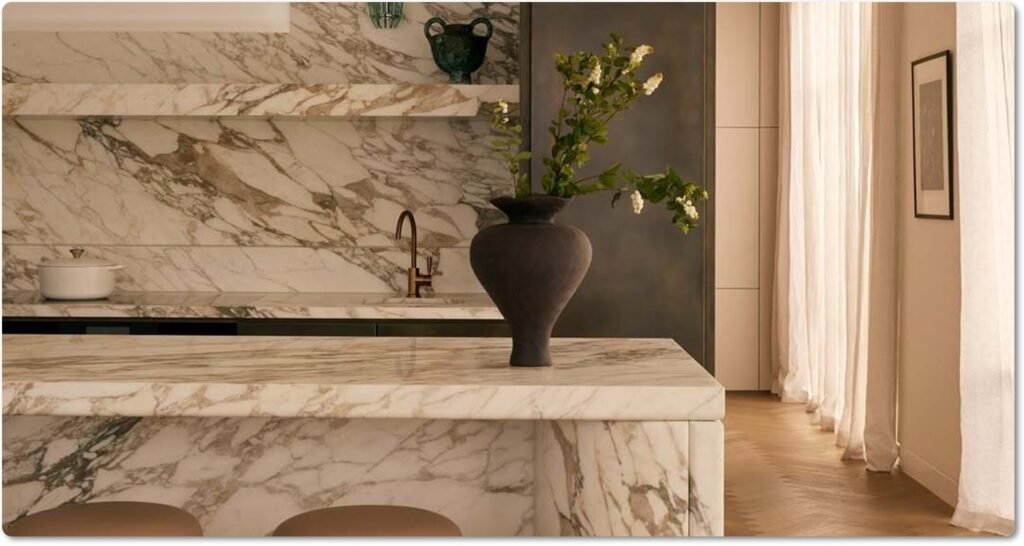
Marble is valued for its veining, mineral patterns, colour variation, and suitability for distinctive interior applications.
Common applications include:
Kitchen islands and selected kitchen worktops.
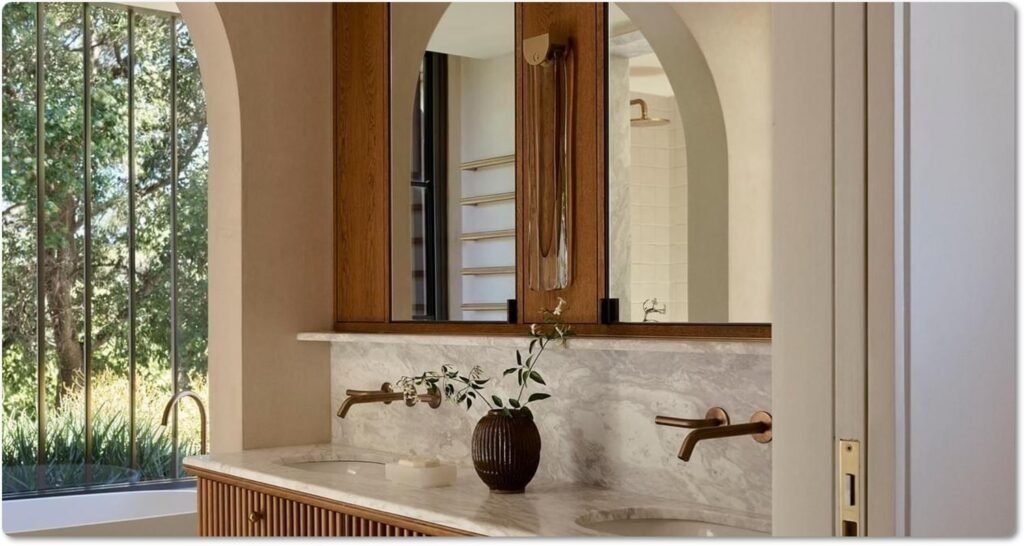
Bathroom vanity tops.
Powder-room countertops.
Hotel vanity surfaces.
Reception desks and hospitality interiors.
Decorative counters and bespoke furniture.
Selected outdoor applications where the material and environmental conditions are appropriate.
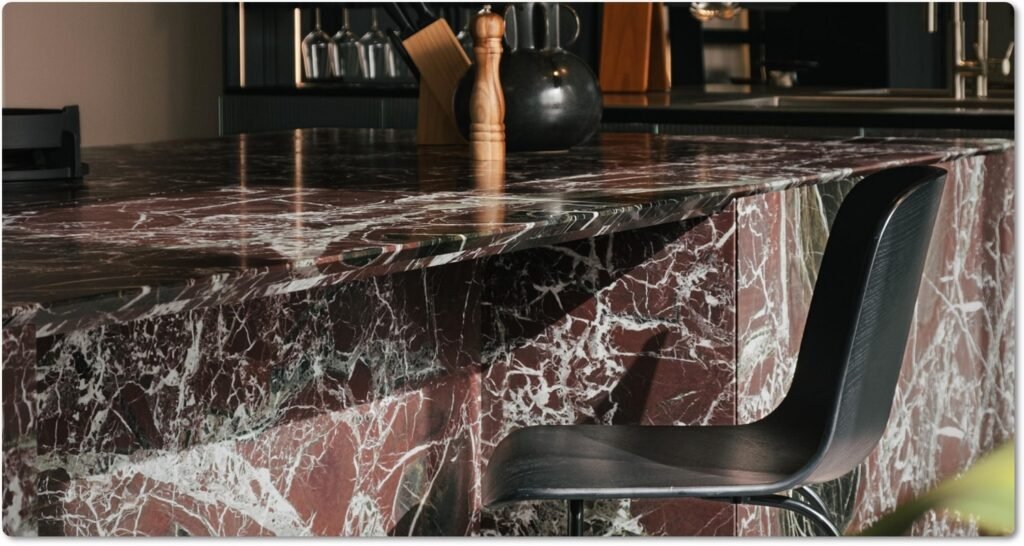
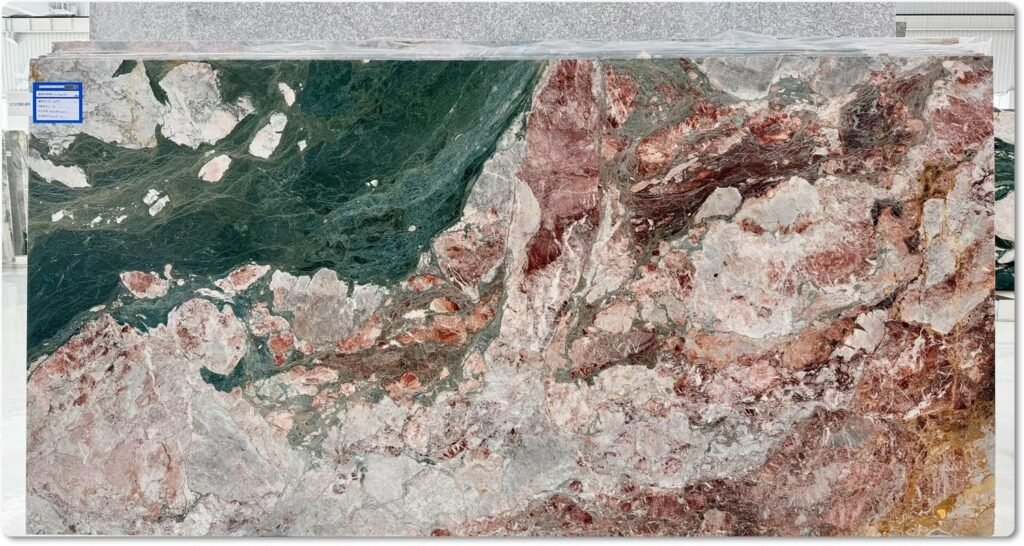
Natural marble is not a uniform manufactured material. Different blocks, slabs, and even different areas within a single slab can exhibit variations in colour, veining, mineral inclusions, and texture.
These characteristics must be considered during material selection and contractual acceptance.
2.2 What does Marble Countertops Supplier mean?
The term Marble Countertops Supplier can describe several different businesses.
Local marble slab supplier
A business that sells marble slabs, tiles, or other stone products from local inventory or an imported collection.
The buyer may need to arrange fabrication, transportation, templating, and installation separately.
Marble countertop fabricator
A specialist that cuts and processes stone into finished countertop components.
Depending on its capabilities, a fabricator may provide digital templating, sink cutouts, edge finishing, polishing, assembly, delivery, and installation.
Marble Countertops Manufacturer
A manufacturer may source blocks or slabs and fabricate finished products using its own production facilities or an established subcontracting network.
Buyers should verify whether the supplier actually controls the relevant manufacturing processes or primarily acts as a distributor.
Marble Countertops Dealer or wholesaler
A dealer or wholesaler generally focuses on selling and distributing stone products. Some dealers also operate fabrication facilities, but this should not be assumed.
Procurement principle: Identify which company is responsible for the material, fabrication, inspection, transport, installation, and warranty before comparing quotations.
2.3 Natural marble versus other countertop materials
The word stone covers products with different compositions, manufacturing processes, performance characteristics, and regulatory requirements.
| Material category | Material characteristics | Key purchasing consideration |
|---|---|---|
| Natural marble | Natural mineral structure and individual veining patterns | Staining, etching, variation, finish, and suitability for the application |
| Granite | Natural igneous rock with properties that vary by type | Absorption, strength, finish, and application-specific performance |
| Quartzite | Natural metamorphic rock with variable mineral composition | Correct material identification, performance testing, and fabrication requirements |
| Resin-bound engineered stone | Manufactured composite material | Australian prohibitions and applicable regulatory requirements |
| Porcelain or qualifying sintered stone | Manufactured ceramic or mineral-based material | Composition, product specifications, fabrication requirements, and applicable exclusions or regulations |
The Australian engineered stone prohibition is particularly important. As of 2026, buyers must not assume that every manufactured countertop material is legally equivalent to natural marble, porcelain, or resin-bound engineered stone.
The exact composition and product category must be established before purchase or import.
3. Technical Evaluation: How to Assess Marble Countertops Before Buying?
A marble countertop should be evaluated as both a natural material and a fabricated component.
Acceptable slabs can still produce unsatisfactory finished countertops if fabrication dimensions, structural support, cutouts, edge details, or installation requirements are poorly controlled.
3.1 Marble type, colour, and visual consistency
Start by defining the required marble selection.
Examples of commonly specified marble families include Carrara, Calacatta, Statuario, and other white, beige, grey, green, or dark-coloured marbles.
A commercial specification should identify:
Commercial material name.
Country or region of origin, where known and relevant.
Required background colour and veining characteristics.
Permitted natural variation.
Preferred slab dimensions.
Surface finish.
Thickness and thickness tolerance.
Whether bookmatching or coordinated veining is required.
Commercial names alone are insufficient to guarantee identical appearance. A named marble can vary between quarries, blocks, production batches, and suppliers.
Slab selection for high-visibility projects
For a luxury kitchen island or hotel vanity, ask the supplier to provide photographs or video of the actual slabs allocated to the order.
Where visual consistency is important, the approval process should define whether the buyer is accepting:
A representative sample.
A specific slab.
A coordinated group of slabs.
A finished fabricated component.
These are different approval levels.
A small sample can confirm broad colour and surface characteristics, but it cannot fully represent the natural variation of a large slab.
3.2 Thickness, dimensions, and structural support
Marble countertops may be fabricated in different thicknesses depending on the material, design, application, and local fabrication practice.
The specification should identify the actual stone thickness rather than relying solely on a nominal product description.
For example, a buyer might request a nominal 20 mm or 30 mm marble countertop, but the final specification must clarify:
Actual stone thickness and tolerance.
Whether the edge is a standard square edge, eased edge, bevel, bullnose, or laminated edge.
Whether a built-up edge is required.
Whether visible edges need additional polishing.
Whether support rails, brackets, or a substrate are required.
How joints, overhangs, and cantilevered sections will be supported.
A built-up edge should not be confused with a single solid slab of the same apparent thickness.
For large islands, unsupported overhangs, narrow stone bridges, and sink cutouts, obtain fabrication and support details from a competent fabricator.
There is no single universal overhang limit suitable for every marble type, thickness, cabinet arrangement, and loading condition.
3.3 Surface finish and maintenance
Common finishes include polished, honed, and selected textured finishes.
Polished marble has a reflective surface that can emphasise colour and veining. Depending on the stone, etching and surface marks may be visually noticeable.
Honed marble has a less reflective appearance. It can suit understated interior designs, but its maintenance requirements still depend on the stone and the substances it encounters.
Other finishes may be available depending on the material and intended use.
Before specifying a finish, confirm:
Whether the surface is suitable for the intended application.
Whether a sealer is recommended.
Which cleaning products are appropriate.
How acidic liquids may affect the surface.
Whether the finish changes the visual appearance of the selected marble.
Whether maintenance instructions will be supplied.
Sealers can reduce certain forms of liquid absorption, but they do not make marble immune to acid etching or eliminate all staining risks.
3.4 Material testing and quality documentation
For commercial and repeat orders, request relevant technical data where available.
Potentially useful information includes:
Water absorption.
Bulk density.
Flexural strength.
Compressive strength, where relevant.
Abrasion or surface-performance information where applicable.
Petrographic identification or material-description reports when identity is important.
Test methods and laboratory details.
ASTM C97/C97M addresses absorption and bulk specific gravity of dimension stone. ASTM C99/C99M addresses modulus of rupture, and ASTM C170/C170M addresses compressive strength.
These standards may be useful references when appropriate to the material and procurement purpose. Their applicability should be confirmed for the specific product, and test results should not be treated as automatic proof that a finished countertop is suitable for every installation.
Natural marble does not have one universal performance value. Results vary with material type, sampling, test method, and specimen condition.
For finished countertops, material testing should be combined with visual inspection, dimensional checks, and review of the fabrication drawings.
3.5 Fabrication accuracy and workmanship
The finished product must match the approved design.
Inspection should cover:
Overall length and width.
Thickness and dimensional tolerances.
Edge profile and polish.
Sink and tap-hole positions.
Cooktop cutout dimensions.
Internal cutout corner details.
Joint locations.
Surface chips, cracks, and damage.
Repairs or resin-filled areas, where relevant.
Veining direction and visual matching.
Identification labels for multi-piece projects.
Acceptance criteria should distinguish natural characteristics from defects that affect structural integrity, appearance, or intended use.
A visible mineral vein is not automatically a crack. Conversely, a feature that resembles natural veining should not automatically be accepted without examination if it may indicate a structural discontinuity.
For high-value projects, define the inspection method and the person authorised to approve deviations before production begins.
4. Marble Countertops Sourcing Options in Melbourne
4.1 Option A: Buy finished marble countertops from a Melbourne fabricator
This approach can simplify coordination when the fabricator controls the relevant stages of the project.
Depending on the contract, the business may arrange material selection, site measurement, fabrication, delivery, and installation.
Potential advantages include:
Easier communication with a local project team.
Possible access to physical slabs or samples.
Local site measurement where offered.
Coordination with cabinet installers and builders.
A clearer local contact for installation-related issues.
However, local sourcing does not guarantee immediate stock, lower costs, or a shorter production schedule.
A local fabricator may need to order a specific marble from overseas, wait for stock to arrive, or schedule work around other projects.
Questions to ask
Is the selected marble physically available in Melbourne?
Can I inspect the actual slab before fabrication?
Is site templating included?
Does the quotation include sink cutouts and edge finishing?
Who installs the countertop?
How are natural variations and repairs assessed?
What happens if the finished piece does not match the approved drawing?
4.2 Option B: Purchase slabs from a local stone supplier
This model separates material procurement from fabrication.
It may be suitable for countertop fabricators, cabinet companies, experienced builders, and importers with established processing partners.
The buyer can purchase locally stocked slabs and engage a separate fabricator to produce the required components.
The primary advantage is the ability to select material independently of the fabrication contract.
However, the buyer must coordinate the handover between supplier and fabricator.
Potential issues include:
Responsibility for slab damage during handling.
Whether the selected slab is reserved for the order.
Who transports the slab to the fabricator.
Whether the slab dimensions provide sufficient usable material.
Who bears the cost of unusable remnants.
Whether the slab supplier or fabricator is responsible for defects discovered after cutting.
Before paying a deposit, establish the chain of custody and inspection procedure.
4.3 Option C: Buy directly from an overseas Marble Countertops Manufacturer
Direct factory sourcing involves purchasing slabs or fabricated countertop components from an overseas manufacturer or exporter.
For Australian buyers, this can create an alternative supply channel for planned custom orders, coordinated material selections, and repeat commercial procurement.
An overseas Marble Countertops Manufacturer may offer different combinations of:
Natural marble slab selection.
Cut-to-size fabrication.
Edge processing.
Sink and tap cutouts.
CAD-based production.
Custom dimensions.
Project-specific packing.
Export documentation.
Containerised shipment.
Every capability must be verified individually. A factory that sells slabs may not fabricate finished countertops, while a fabricator may not have direct control over quarry supply.
EDG Stone is positioned as a Chinese stone-products manufacturer and exporter. Australian buyers considering EDG or another overseas supplier should request evidence of the specific material, processing capability, quality controls, packing arrangements, and export experience relevant to their project.
Direct sourcing is not automatically the best choice for a single urgent countertop. The buyer must compare the complete procurement process rather than the factory price alone.
5. Local Fabricators vs. Overseas Factories: How to Compare Them Fairly?
The central comparison is between two different supply models.
A local fabricator may sell a completed service package. An overseas factory may quote only for slabs or fabricated stone components.
Comparing these quotations without adjusting their scope can produce misleading conclusions.
5.1 Compare equivalent products
Before requesting prices, establish the same specification for every supplier.
For example, the RFQ should state:
Material: natural marble.
Required commercial marble type.
Stone thickness.
Finish.
Overall dimensions.
Edge profile.
Cutouts and tap holes.
Number of pieces.
Veining or bookmatching requirements.
Packing method.
Delivery destination.
Installation requirements.
Required delivery date.
If one quotation includes templating, installation, and local transport while another includes only fabricated stone packed for export, the prices are not directly comparable.
5.2 Compare operational responsibilities
| Evaluation area | Melbourne supplier | Overseas factory |
|---|---|---|
| Material approval | Confirm showroom, slab inspection, or sample availability | Confirm digital approval, sample shipment, and actual-slab approval process |
| Technical drawings | Confirm who prepares and approves them | Confirm CAD format, revision control, and production approval |
| Final measurement | Confirm site measurement responsibility | Usually requires approved dimensions and local measurement coordination |
| Production inspection | Confirm local inspection arrangements | Confirm inspection stages and evidence supplied before shipment |
| Transport | Confirm delivery scope and handling charges | Confirm export packing, freight, insurance, port charges, and local transport responsibilities |
| Installation | Confirm whether installation is included | Identify the local installer and agree responsibility for site work |
| Defect resolution | Confirm contractual remedy and response procedure | Agree evidence requirements, claim deadlines, and responsibility for replacement or repair |
| Repeat orders | Confirm local material availability and batch consistency | Confirm repeatability, material allocation, and production records |
5.3 When does direct factory sourcing make sense?
Direct factory sourcing may be worth evaluating when:
The buyer has several countertops or coordinated stone components.
A commercial project has a defined production schedule.
The buyer can approve drawings before production.
The selected material is available from the proposed supplier.
Freight and import costs can be estimated reliably.
Local installation capacity is already arranged.
The buyer can manage import documentation and quality claims.
The model may be less attractive when the buyer needs one replacement piece immediately, the dimensions are not final, or site conditions are likely to change.
The decision should be based on total delivered cost, project risk, and operational fit—not on the words “factory-direct” alone.
6. Samples, Measurements, and Technical Drawings
6.1 Why samples matter?
Samples allow buyers to assess colour, finish, and general material characteristics before committing to a larger order.
For natural marble, samples should be treated as representative rather than exact replicas of the final countertop.
A procurement process may include three approval stages:
Material approval: Confirm the marble type, colour range, and finish.
Slab approval: Review the actual slabs allocated to the order when practical.
Fabrication approval: Approve the final technical drawings and any agreed appearance requirements.
For a large kitchen island or hospitality project, actual-slab photographs with identification labels can help link the approved material to the production order.
6.2 What should the technical drawings include?
The drawings should identify every component and the dimensions needed for fabrication.
At minimum, include:
Overall countertop plan.
Individual component dimensions.
Stone thickness.
Edge profiles.
Sink cutouts.
Tap holes.
Cooktop cutouts.
Joint locations.
Backsplash dimensions, if included.
Finished-edge identification.
Overhang dimensions.
Support requirements.
Veining direction.
Piece identification numbers.
Relevant installation clearances.
Where the project involves multiple units, provide a component schedule and label each piece against its room, unit, or installation location.
6.3 Who should take the final measurements?
The contract must identify the party responsible for final dimensions.
A factory cannot reliably manufacture a site-specific countertop from incomplete information.
For an overseas order, the buyer and supplier should agree whether the production dimensions come from:
A local fabricator’s final site template.
Approved construction drawings.
A cabinet manufacturer’s verified measurements.
A separately agreed digital templating process.
The party taking measurements should account for site conditions, wall irregularities, cabinetry alignment, appliance specifications, and installation tolerances.
Do not begin irreversible fabrication until the authorised person has approved the final drawings in writing.
6.4 Revision control
Drawing revisions are a frequent source of avoidable disputes.
Each approved drawing should carry a revision identifier and date. Changes after approval should be documented, including any impact on cost, production schedule, or previously fabricated components.
For repeat orders, maintain a controlled record of the approved dimensions and specifications.
7. Freight, Customs Clearance, and Local Delivery in Australia
International shipping is one of the most important differences between purchasing locally and importing marble countertops.
The buyer must understand the distinction between the factory price, international freight, customs clearance, and the final delivery cost.
7.1 International freight planning
Depending on order size, packaging, route, and urgency, stone products may move by sea freight or another suitable transport method.
Sea freight is often considered for planned commercial shipments, but its suitability depends on the order and schedule.
Before confirming a shipment, obtain a written logistics quotation that identifies:
Origin pickup or factory loading arrangements.
Export documentation charges.
Port handling and terminal charges.
International freight.
Cargo insurance.
Destination port charges.
Customs brokerage.
Quarantine or biosecurity inspection costs, if applicable.
Port storage and demurrage exposure.
Local delivery to the agreed Melbourne destination.
Unloading arrangements.
Any restrictions on vehicle access or delivery timing.
These costs can vary with shipping conditions, cargo dimensions, weight, route, service level, and destination requirements.
Do not assume that a freight quotation includes every charge between the factory and the final delivery address.
7.2 Australian customs clearance
Australian importers must establish the applicable tariff classification, customs value, declaration requirements, and any relevant duties or taxes.
The Australian Border Force explains that an Import Declaration is generally required for goods with a combined value exceeding AUD 1,000 that are being cleared into home consumption. Applicable duties, taxes, and charges depend on the goods and the circumstances of importation.
Natural marble products may have different tariff classifications depending on whether they are rough stone, slabs, tiles, or fabricated articles.
Do not assume that all marble countertops use the same HS or Australian tariff code. Confirm the correct classification with a licensed customs broker or the Australian Border Force before calculating import costs.
The import budget should separately identify:
Customs value.
International transport and insurance.
Applicable customs duty.
Goods and Services Tax (GST).
Customs brokerage and import processing charges.
Other applicable government or port charges.
Australian GST on taxable importations is generally 10% of the value of the taxable importation, calculated under the applicable rules. This can include customs value, international transport and insurance to the place of consignment, and applicable customs duty.
The precise calculation and any concessions should be confirmed for the actual transaction.
7.3 Timber packaging and Australian biosecurity
Stone is heavy, so imported slabs and fabricated countertops may be shipped in timber crates, pallets, bearers, or other protective packaging.
Australian biosecurity requirements apply to relevant timber and bamboo packaging.
The Department of Agriculture, Fisheries and Forestry identifies ISPM 15 as the international standard governing specified solid-wood packaging used in international trade.
Before dispatch, ask the exporter to confirm:
The packaging materials being used.
Whether solid timber or bamboo is present.
Applicable treatment and marking requirements.
Required packing declarations.
Whether the packaging is clean and free of biosecurity risk material.
Whether the proposed packaging meets current Australian import conditions.
Non-compliant packaging can lead to inspection, treatment, export, or disposal at the importer’s expense.
Packaging compliance should therefore be checked before the goods leave the origin country, not only when the shipment reaches Australia.
7.4 Delivery to a Melbourne project site
Delivery to a port or warehouse is not the same as delivery to an installation-ready location.
Before accepting a quote, clarify:
Whether delivery is to a port, warehouse, commercial premises, or residential site.
Whether a suitable unloading area is available.
Whether a forklift, crane, or other handling equipment is required.
Who is responsible for unloading.
Whether access restrictions affect the vehicle or delivery time.
How the stone will be inspected on arrival.
How damage during transport will be documented.
Large marble components require careful handling. The delivery plan should reflect the size, weight, fragility, and access conditions of the actual pieces.
8. Installation, Warranty, and After-Sales Responsibilities
8.1 Separate product supply from installation
When importing finished marble countertops, buyers should identify the party responsible for installation.
An overseas factory may supply correctly fabricated components without providing local site measurement or installation.
The local installer may be responsible for checking the site, preparing the cabinets, placing the stone, coordinating joints, and completing installation-related work.
These responsibilities should be documented rather than assumed.
A practical responsibility matrix might look like this:
| Task | Responsibility to confirm |
|---|---|
| Marble selection | Buyer and supplier |
| Final slab approval | Buyer or authorised representative |
| Fabrication drawings | Factory or designated technical party |
| Site measurements | Local fabricator, installer, or other agreed party |
| Production inspection | Factory and/or independent inspector |
| Export packaging | Exporter or factory, as agreed |
| International freight | Party identified in the shipping contract |
| Customs clearance | Importer or appointed customs broker |
| Site delivery | Contracted carrier or logistics provider |
| Installation | Local fabricator or installer |
| Defect assessment | Parties identified in the purchase and installation contracts |
This is a planning framework. The final allocation must match the actual contract.
8.2 Natural marble and warranty expectations
Natural marble can develop surface etching, staining, chips, scratches, or other damage under certain conditions.
A warranty should distinguish between:
Manufacturing defects.
Dimensional errors.
Transport damage.
Installation damage.
Inappropriate support or structural movement.
Natural variation accepted under the specification.
Wear, staining, etching, or damage resulting from use and maintenance.
A warranty cannot make every natural characteristic a manufacturing defect, but a supplier should not use natural variation as a blanket explanation for all problems.
For Australian transactions, the Australian Consumer Law may apply depending on the transaction, the parties, and the product or service involved. Applicable consumer guarantees cannot simply be excluded by a supplier’s warranty disclaimer.
Businesses should obtain advice on their legal obligations for the particular transaction, especially where goods are imported for resale or incorporated into building projects.
8.3 Establish a practical claim procedure
For imported stone, a written claim procedure can reduce uncertainty.
The procedure should specify:
When the buyer must inspect the goods.
How visible transport damage must be recorded.
Which photographs, measurements, and documents are required.
How concealed damage is reported.
Who determines whether the problem originated during production, transport, storage, or installation.
Whether replacement, repair, credit, or another remedy is available.
How the cost of replacement freight and local labour is allocated.
A buyer should not assume that a factory will automatically pay for local removal, reinstallation, or project delays.
Likewise, a supplier should not assume that a buyer will accept damaged goods simply because the shipment arrived at the destination.
Agree on these matters before production begins.
9. Comparing EXW, FOB, and Delivered Pricing
One of the most important purchasing mistakes is comparing an EXW quotation from a factory with a delivered quotation from a local supplier as if they cover the same services.
They do not.
Under Incoterms® 2020, the named trade term and place define specific responsibilities for delivery, costs, and risk. They do not replace a complete sales contract.
9.1 EXW: Ex Works
Under EXW, the seller generally makes the goods available at the named place, such as the seller’s premises.
The buyer assumes substantial responsibility for collection, transport, and export and import arrangements under the applicable rule.
Although EXW may appear straightforward, export clearance can be complicated when the buyer is located in another country. For containerised export transactions, buyers should consider whether FCA would allocate responsibilities more appropriately.
Request a clear description of what is included in the factory’s EXW price.
9.2 FOB: Free On Board
FOB is intended for sea or inland waterway transport.
Under FOB, the seller delivers the goods on board the vessel at the named port of shipment, with risk transferring at that point under the rule.
The buyer generally arranges and pays for the main carriage and handles import clearance.
For a typical containerised shipment, the buyer should ask the freight forwarder and supplier whether FCA is more appropriate for the actual delivery arrangement.
The suitability of FOB depends on how the cargo is handed over and the contractual structure.
9.3 Delivered pricing
A delivered quotation may include some combination of international freight, destination handling, customs clearance, local transport, and other services.
However, the word delivered is not sufficiently precise by itself.
Ask the supplier to identify:
The named delivery location.
The applicable Incoterm, if any.
Whether customs duty and GST are included.
Whether import clearance is included.
Whether unloading is included.
Whether delivery is to the port, warehouse, kerbside, or final installation location.
Whether additional charges may arise at destination.
For example, DAP and DDP have different allocations of responsibility. DAP does not generally require the seller to clear the goods for import or pay import duties and taxes; DDP generally assigns those responsibilities to the seller, subject to the rule and the seller’s ability to fulfil them legally.
An importer should confirm that any proposed delivered-price arrangement is operationally and legally workable.
9.4 How to calculate the real procurement cost
Use a consistent cost model:
Estimated total procurement cost =
Product purchase price
export packing and origin handling
international freight
cargo insurance
destination handling and port charges
customs brokerage
applicable customs duty
import GST
biosecurity or inspection charges, where applicable
storage or other logistics charges
local delivery and unloading
local fabrication or installation not already included
inspection and quality-control costs
expected cost of defects, breakage, or replacements.
For commercial financial analysis, separate recoverable GST from non-recoverable expenses where applicable. The actual cash required at importation may differ from the final economic cost.
9.5 Illustrative landed-cost comparison
Suppose a Melbourne buyer receives two quotations for equivalent marble countertops.
Quotation A: A local supplier offers a completed supply package with agreed delivery and fabrication scope.
Quotation B: An overseas factory quotes for fabricated stone, with freight, import costs, and local installation handled separately.
The buyer should enter both quotations into the same cost model and identify missing items.
Do not add arbitrary freight percentages or assume a standard local fabrication rate. Obtain actual quotations for the relevant dimensions, weight, shipment route, quantity, and destination.
Only after the scope and costs are aligned can the buyer determine which option offers better commercial value.
10. Current Australian Regulatory Considerations
Australian countertop procurement requires careful attention to material identification and workplace safety requirements.
10.1 The engineered stone prohibition
Australia’s engineered stone prohibition is especially relevant to importers and countertop businesses.
The national prohibition on manufacturing, supplying, processing, and installing covered engineered stone benchtops, panels, and slabs took effect on 1 July 2024. A corresponding import prohibition for covered engineered stone benchtops, panels, and slabs took effect on 1 January 2025, subject to limited statutory permissions, confirmations, and exemptions.
The relevant legal definition focuses on products meeting specified compositional and manufacturing criteria, including a crystalline silica concentration of at least 1% by weight and the combination of natural stone materials with other constituents to produce a hardened artificial product.
The prohibition does not apply to natural marble simply because it is used as a countertop. It also does not automatically prohibit every manufactured surface material.
For example, qualifying porcelain and sintered stone products that do not contain resin are identified among the exclusions.
However, product names and supplier marketing descriptions are not enough to establish compliance.
What should importers do?
Before ordering countertop products that could be mistaken for engineered stone:
Obtain an accurate description of the product’s composition.
Request relevant technical documentation from the manufacturer.
Confirm whether the product meets the legal definition of engineered stone.
Check the current Australian Border Force import requirements.
Obtain any required permission, confirmation, or exemption before shipment where applicable.
Consult the relevant Australian workplace health and safety regulator when the classification or permitted work is uncertain.
The Australian Border Force may request evidence that imported products are not prohibited engineered stone. It advises importers not to ship goods requiring formal approval until that approval has been obtained.
The legal status of a product should be resolved before commercial commitments and shipping arrangements are finalised.
10.2 Workplace safety during stone fabrication
Natural marble is not covered by the engineered stone ban merely because it contains naturally occurring minerals.
Nevertheless, cutting, grinding, polishing, and other stone-processing activities can generate hazardous respirable dust, including respirable crystalline silica where present.
Australian businesses must comply with applicable workplace health and safety requirements and relevant controls for the actual materials and tasks involved.
Buyers should confirm that their fabrication and installation contractors understand the requirements applicable to their operations.
10.3 Customs, biosecurity, and packaging compliance
In addition to material classification, importers should verify:
Applicable tariff classification.
Customs value and declaration requirements.
Duties and GST.
Required shipping and commercial documents.
Timber packaging treatment and declaration requirements.
Any additional permits or restrictions applicable to the specific goods.
Requirements can change. Verify the rules that apply when the shipment is arranged rather than relying on an old quotation or previous import experience.
11. Procurement Checklist: Buying Marble Countertops in Melbourne
Use the following checklist before issuing a purchase order.
Stage 1: Define the project
Confirm the application: kitchen, bathroom, hotel, commercial, or another use.
Identify the required marble type.
Confirm the number of countertops and individual components.
Establish the project location and delivery access.
Set the target installation date.
Identify any visual matching or bookmatching requirements.
Stage 2: Approve the material
Request photographs or video of the proposed material.
Obtain samples if needed.
Confirm the finish and thickness.
Define acceptable natural variation.
Request relevant technical documentation.
Confirm the material composition and regulatory classification.
Stage 3: Approve the design
Obtain final dimensions.
Confirm the responsible party for site measurement.
Review sink and cooktop cutouts.
Confirm tap-hole positions.
Specify edge profiles.
Confirm joint locations.
Review support requirements and overhangs.
Approve the final drawing revision in writing.
Stage 4: Evaluate suppliers
Confirm whether the business is a manufacturer, fabricator, dealer, or trading company.
Request evidence of relevant production capabilities.
Check inspection procedures.
Confirm lead time and production milestones.
Review packing and handling methods.
Confirm delivery and installation responsibilities.
Agree on defect reporting and remedy procedures.
Stage 5: Compare the complete costs
Compare equivalent product specifications.
Identify excluded fabrication operations.
Obtain freight quotations where relevant.
Include customs duty and import GST where applicable.
Check port handling and brokerage charges.
Include local delivery and unloading.
Include installation and inspection costs.
Evaluate potential breakage, replacement, and delay exposure.
Stage 6: Finalise the order
Approve the commercial quotation.
Confirm the payment schedule.
Agree on the applicable Incoterm and named place.
Confirm packing and shipping documentation.
Establish the inspection and claim procedure.
Record the approved material, drawings, and tolerances.
Confirm that all regulatory questions have been resolved before shipment.
12. Cost and Risk Factors: What Can Change the Final Price?
The final cost of marble countertops in Melbourne is influenced by material selection, fabrication complexity, logistics, and project coordination.
12.1 Material selection
Different marble types can have different acquisition costs depending on availability, origin, block characteristics, finish, and market conditions.
Large, visually coordinated slabs may require more careful selection than standard stock.
A buyer should not assume that two materials with similar commercial names or background colours have equivalent pricing or performance.
12.2 Fabrication complexity
The following factors can affect fabrication costs:
Unusual dimensions.
Large islands.
Multiple joints.
Complex edge profiles.
Laminated edges.
Sink and cooktop cutouts.
Tap holes and accessories.
Curved or irregular components.
Bookmatching.
Special surface finishes.
Reinforcement or support requirements.
Tight dimensional tolerances.
A meaningful quotation should identify which of these operations are included.
12.3 Quantity and production scheduling
Order quantity can affect material allocation, production planning, packaging, and transport economics.
However, a larger order does not guarantee a lower unit price.
The result depends on the factory’s production process, available material, component sizes, packing arrangement, freight terms, and the amount of additional work required.
For multi-unit residential or hospitality projects, consider releasing orders in coordinated batches where this improves storage, delivery, and installation management.
12.4 Transport and breakage risk
Marble is heavy and can be vulnerable to damage during handling and transport.
Packaging should suit the component dimensions and weight, while loading plans should reduce movement and impact during transit.
The purchase agreement should specify who is responsible for packaging, inspection, insurance, and claims.
A low freight quotation may not be commercially attractive if it excludes important destination charges or leaves the buyer exposed to substantial damage-related costs.
12.5 Programme risk
The project schedule should account for more than factory production.
The total lead time may include:
Material selection and approval.
Drawing preparation and revision.
Fabrication.
Inspection.
Packing.
Export clearance.
International transport.
Australian customs clearance.
Delivery to the installation location.
Local installation.
The relevant question is not simply, “How long does production take?”
It is, “When can the approved countertops realistically be installed and accepted?”
13. Supplier Evaluation: What Should a Marble Countertops Supplier Provide?
A professional supplier should be able to explain its scope and support its claims with appropriate evidence.
13.1 Material and product documentation
Request:
Product and material descriptions.
Actual-slab photographs where applicable.
Available dimensions and thicknesses.
Surface-finish information.
Relevant technical test reports.
Details of material treatments or repairs where relevant.
Written confirmation of the agreed product specification.
13.2 Manufacturing and quality-control evidence
For a manufacturer or factory, request information about:
Relevant fabrication equipment.
Available cutting and edge-processing operations.
Drawing approval procedures.
Dimensional inspection methods.
Surface inspection criteria.
Identification and traceability of components.
Packaging procedures.
Final inspection records.
Claims should be specific to the actual order. A supplier’s general equipment list does not prove that every operation is included in the quotation.
13.3 Commercial and logistics documentation
The quotation should state:
Product description.
Quantity.
Dimensions and thickness.
Unit price and total price.
Currency.
Incoterm and named place.
Production lead time.
Payment terms.
Packing scope.
Shipping arrangements.
Excluded charges.
Warranty terms.
Defect claim procedure.
For an overseas order, request draft shipping documentation where appropriate and agree on the documents required for customs clearance.
13.4 Evaluating EDG Stone as an overseas supplier
Australian importers considering EDG Stone should evaluate the company using the same objective criteria applied to other manufacturers.
A suitable RFQ can specify natural marble countertops, slab supply, cut-to-size fabrication, edge processing, sink cutouts, CAD drawings, export packing, and shipment to Melbourne.
The response should clarify which services are available for the particular project and which require separate arrangements.
Buyers should request a quotation based on their actual drawings, material selection, quantities, and delivery requirements.
No price advantage, lead-time advantage, local installation service, or regulatory outcome should be assumed without supporting information.
14. Practical RFQ Template: Request a Marble Countertops Quote for Melbourne
The following template can be copied into an email or procurement document and sent to local suppliers or overseas factories.
Marble Countertops Request for Quotation — Melbourne, Australia
A. Buyer Information
Company name:
Contact person:
Email:
Project name:
Project location:
Buyer type: Importer / Fabricator / Cabinet Company / Developer / Contractor / Other
B. Product Requirements
Product: Natural marble countertops
Marble type or commercial name:
Country of origin preference, if any:
Colour and veining requirements:
Surface finish:
Nominal thickness:
Required edge profile:
Backsplash required: Yes / No
Bookmatching required: Yes / No
C. Quantity and Dimensions
Total quantity:
Number of individual pieces:
Piece-by-piece dimensions:
Sink cutouts:
Cooktop cutouts:
Tap holes:
Joint requirements:
Overhang dimensions:
Support requirements:
Drawing or CAD file attached: Yes / No
D. Quality Requirements
Material sample required: Yes / No
Actual-slab approval required: Yes / No
Dimensional tolerances:
Visual acceptance criteria:
Permitted repairs or filled areas:
Inspection method:
Inspection report required: Yes / No
E. Production Requirements
Site measurement responsibility:
Drawing preparation responsibility:
Final drawing approval deadline:
Required production completion date:
Required delivery or installation date:
Packing requirements:
Labelling requirements:
F. Shipping and Delivery
Preferred trade term:
Named port or delivery location:
Destination: Melbourne, Victoria, Australia
Freight quotation required: Yes / No
Cargo insurance required: Yes / No
Customs brokerage included: Yes / No
Local delivery included: Yes / No
Unloading included: Yes / No
Installation included: Yes / No
G. Commercial Terms
Currency:
Unit price:
Total product price:
Fabrication charges:
Packing charges:
Freight and insurance:
Estimated duties and taxes, where available:
Other charges:
Payment terms:
Quotation validity:
Warranty terms:
Defect claim procedure:
H. Supplier Confirmation
Please confirm:
Whether you are the manufacturer, fabricator, wholesaler, dealer, or another type of supplier.
Which production operations are performed in-house.
Whether the specified material is available.
Whether the quotation includes all requested fabrication operations.
What is excluded from the quotation.
What documents will be supplied before shipment.
How product quality and dimensional accuracy will be verified.
Who is responsible for transport damage, replacement components, and after-sales claims.
Please provide a quotation based on the attached specifications and clearly identify any assumptions, exclusions, or proposed alternatives.
15. Frequently Asked Questions: Marble Countertops in Melbourne
1. Where can I buy marble countertops in Melbourne?
Buyers can investigate local stone slab suppliers, countertop fabricators, specialist stone dealers, and overseas manufacturers that export to Australia. The appropriate choice depends on material availability, fabrication scope, project schedule, and whether local measurement and installation are required.
Before ordering, confirm whether the supplier sells slabs only or provides finished countertops.
2. Is it cheaper to import marble countertops from a factory than to buy locally in Melbourne?
Not necessarily. Direct factory sourcing may offer a commercially attractive option for some custom or repeat orders, but the final cost must include fabrication, export packing, freight, insurance, customs duty where applicable, GST, destination charges, local delivery, and installation.
The fairest comparison uses equivalent specifications and written quotations from both sourcing options.
3. Can I buy custom marble countertops directly from a Chinese manufacturer?
Yes, buyers can investigate Chinese manufacturers and exporters that offer the required natural marble products and fabrication services.
However, buyers should verify material availability, actual production capabilities, approved drawings, dimensional tolerances, inspection procedures, export packaging, and shipment arrangements. Local site measurement and installation must also be allocated to a responsible party.
4. What should I check before importing marble countertops into Australia?
Confirm the exact product composition, tariff classification, customs documentation, applicable duties and GST, shipping arrangements, and packaging requirements.
If the product resembles engineered stone, obtain sufficient documentation to establish whether the Australian engineered stone prohibition applies. Do not rely solely on a supplier’s commercial product name.
For solid timber packaging, check applicable Australian biosecurity conditions and ISPM 15 requirements before shipment.
5. How long does it take to receive imported marble countertops in Melbourne?
There is no universal lead time. The total schedule depends on material availability, sample and drawing approval, fabrication, inspection, packing, freight, customs clearance, local delivery, and installation scheduling.
Ask the supplier to provide a production schedule and separately identify the estimated shipping and destination-clearance periods. Confirm which events could delay the agreed delivery date.
16. Semantic Closure: How to Choose the Right Marble Countertops Supply Strategy
Marble Countertops in Melbourne: Procurement Insights and Decision Framework
What is the most important factor when sourcing marble countertops?
The most important factor is the relationship between product specification, supplier capability, total delivered cost, and project responsibility. A low material price does not guarantee a lower installed cost if fabrication, transport, customs clearance, or installation has been excluded.
How should buyers compare local and factory-direct supply?
Buyers should compare equivalent materials, dimensions, finishes, fabrication operations, quality requirements, delivery destinations, and warranty arrangements. Local supply may simplify site coordination, while overseas factory sourcing may be appropriate for planned custom orders, wholesale purchasing, and repeat commercial requirements.
Why are approved drawings and actual-slab inspection important?
Natural marble varies in colour, veining, and mineral structure. Approved drawings help control dimensions and cutouts, while slab inspection helps buyers understand the material allocated to the project. Neither process eliminates all natural variation, so the purchase contract should define acceptable appearance and dimensional tolerances.
What are the main considerations when importing marble countertops into Australia?
The importer should verify material classification, customs documentation, applicable duties and GST, international freight, timber packaging requirements, destination handling, and local delivery. The Australian engineered stone prohibition must also be considered when evaluating manufactured countertop materials.
Which sourcing option is best for commercial projects?
The answer depends on quantity, programme, material requirements, and the buyer’s operational capacity. Local suppliers may suit projects requiring immediate coordination or local installation. Direct factory sourcing may suit properly planned custom orders and repeat supply arrangements when the buyer can manage import logistics and local installation.
What should buyers do next?
Prepare a complete RFQ, obtain comparable quotations, approve the material and technical drawings, confirm oonjcuzlklildq ciivncdlauc, and calculate the total delivered cost before placing an order.
Core insight: The best Marble Countertops Supplier isn’t necessarily the closest supplier or the factory with the lowest initial price. It is the supplier whose documented capabilities, product quality, commercial terms, and delivery arrangements fit the buyer’s actual project requirements.
Practical conclusion for Australian buyers
A successful marble countertop procurement process should integrate material selection, technical design, fabrication, logistics, compliance, and installation into one coordinated plan.
For a small renovation, the convenience of a local fabricator may outweigh the potential benefits of importing.
For a commercial buyer, importer, cabinet company, or developer with a clear specification and suitable project volume, direct factory sourcing may provide another option worth evaluating.
The right decision should be supported by comparable quotations, verified supplier capabilities, an agreed technical specification, and a realistic delivery plan.
17. References and Technical Resources
The following official and technical sources provide a starting point for verifying regulatory and commercial requirements. Buyers should confirm the latest applicable requirements before importing or processing stone products.
Australian Border Force — Engineered Stone: Guidance on the import prohibition, product classification, supporting documentation, and limited permissions or exemptions.
Safe Work Australia — Engineered Stone Ban: Information about the national prohibition and relevant workplace health and safety requirements.
Australian Government Department of Agriculture, Fisheries and Forestry — ISPM 15: Guidance on timber packaging and biosecurity requirements for imported goods.
Australian Border Force — Import Declarations: Information on customs declarations, classification, and import clearance.
Australian Border Force — GST and Other Taxes: Guidance on GST for taxable importations and the value used to calculate it.
Australian Competition and Consumer Commission — Warranties and Consumer Guarantees: Information about the relationship between express warranties and statutory consumer guarantees.
International Chamber of Commerce — Incoterms® 2020: The international rules governing allocation of delivery responsibilities, costs, and risks.
ASTM C97/C97M: Standard Test Methods for Absorption and Bulk Specific Gravity of Dimension Stone.
ASTM C99/C99M: Standard Test Method for Modulus of Rupture of Dimension Stone.
ASTM C170/C170M: Standard Test Method for Compressive Strength of Dimension Stone.
ASTM standards should be checked against the applicable edition and project specification. A test method is not automatically a complete acceptance specification for finished marble countertops.
18. Request a Factory-Direct Marble Countertops Quote for Australia
EDG Stone supplies natural stone products and provides manufacturing and export services for international buyers. For Australian importers, countertop fabricators, cabinet companies, developers, and project contractors, factory-direct sourcing can be evaluated against local purchasing based on the actual product specification and supply requirements.
To request a quotation, prepare the following information:
Required marble type and preferred colour.
Stone thickness and surface finish.
Quantity and individual countertop dimensions.
Sink cutouts, tap holes, edge profiles, and other fabrication requirements.
Drawings, CAD files, or a component schedule.
Required delivery location in Melbourne or elsewhere in Australia.
Preferred shipping arrangement.
Target production and delivery dates.
Inspection, packaging, and documentation requirements.
EDG Stone can review the information and confirm which materials, fabrication operations, and export arrangements are available for the proposed order.
Any quotation should clearly identify its scope, exclusions, delivery terms, and the responsibilities that remain with the Australian buyer or local installer.
Ready to evaluate direct factory sourcing?
Request a factory-direct quotation based on your actual drawings, material requirements, quantities, and destination. Compare the resulting offer with local alternatives using the same specification and total-cost framework.
CTA: Request a Factory-Direct Marble Countertops Quote for Australia.