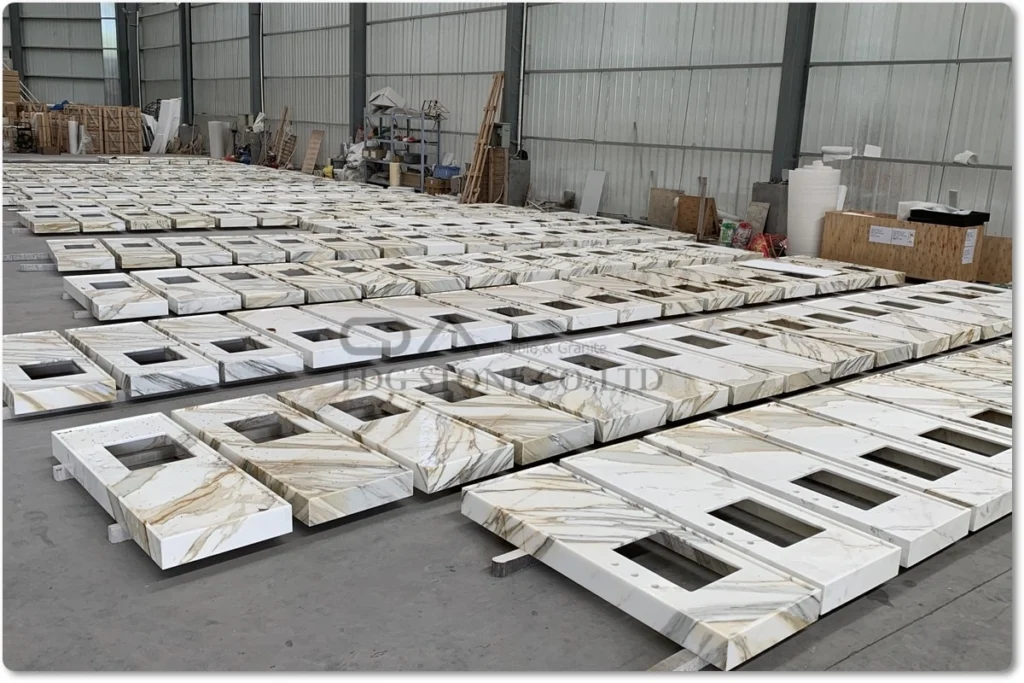
Executive Summary: How to Calculate Stone Furniture Cost?
The total cost of stone furniture consists of material, fabrication, structural components, finishing, assembly, sampling, tooling, quality inspection, packaging, international transportation, insurance, customs duties, import taxes, destination handling, and local delivery. Buyers should compare suppliers using the same product specifications, order quantities, packaging standards, delivery destination, and Incoterms® rules. The most useful purchasing metric is the total landed cost per accepted unit, calculated by dividing the relevant total procurement and delivery costs by the number of conforming units received.
Stone furniture pricing is more complex than the price of a marble slab or a finished tabletop. A natural stone coffee table, dining table, console, or vanity combines a material with variable visual characteristics, precision fabrication, structural engineering, protective packaging, and international logistics.
Two products with identical external dimensions can have substantially different costs because they use different stone grades, thicknesses, slab layouts, edge profiles, bases, assembly systems, and packaging designs.
For buyers placing a stone furniture bulk order, the lowest factory quotation does not necessarily represent the lowest total procurement cost. A lower unit price may be offset by poor material yield, excessive breakage, missing hardware, additional destination charges, or inconsistent production quality.
A reliable stone furniture cost calculation therefore needs to answer four questions:
What is included in the supplier’s quoted price?
Which design, material, production, and packaging decisions drive the cost?
What additional expenses arise between the factory and the final delivery location?
How can different manufacturers’ quotations be compared on an equivalent basis?
This guide provides a practical framework for calculating factory cost, export cost, and landed cost. It also explains how to prepare a complete stone furniture RFQ so suppliers can quote the same specifications and buyers can make defensible purchasing decisions.
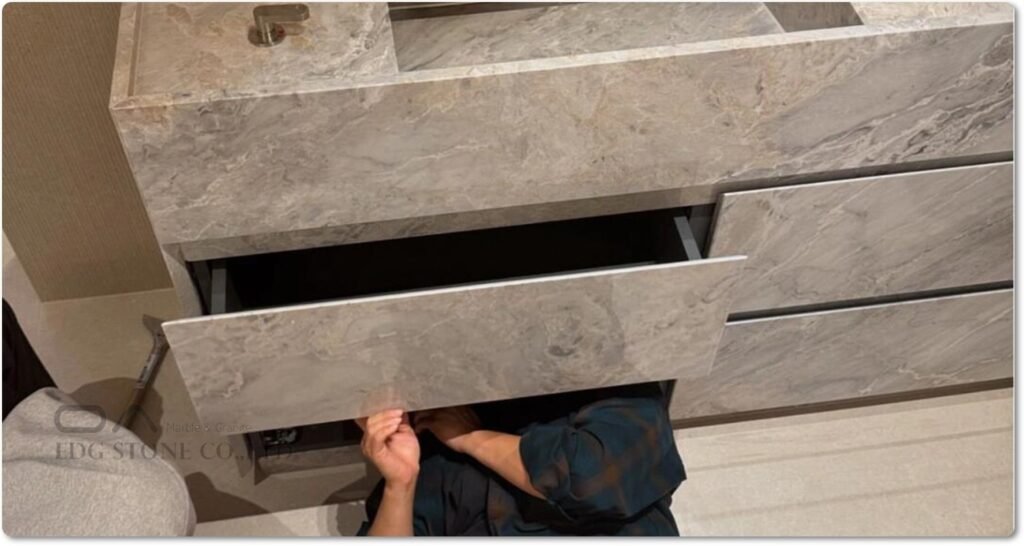
1. Scope and Definitions: Understanding Stone Furniture Pricing
1.1 What Products Are Included in Stone Furniture Procurement?
Stone furniture includes furniture made entirely or partially from natural stone or engineered surfaces, often combined with metal, wood, glass, or other structural materials.
Typical products include:
Marble coffee tables and side tables
Marble and quartzite dining tables
Travertine consoles and accent tables
Natural stone desks and reception counters
Stone bathroom vanities and furniture tops
Stone benches, stools, and selected outdoor furniture
Wood-and-stone furniture combinations
Custom furniture designed for hotels, villas, restaurants, and commercial interiors
The costing principles in this guide apply to both standard catalog products and customized OEM or ODM projects.
However, a solid marble pedestal table, a stone tabletop mounted on a steel frame, and a lightweight honeycomb-backed stone panel are different construction systems. Their costs should not be estimated using the same material assumptions.
1.2 Key Cost Terms Buyers Should Understand
| Term | Meaning in Procurement |
|---|---|
| Material cost | Cost of stone and other raw materials consumed in production |
| Fabrication cost | Cutting, CNC machining, edge profiling, drilling, polishing, and related processing |
| Factory price | Supplier price for the defined factory-gate or export scope; exact inclusions must be confirmed |
| Export packing cost | Crating, protective materials, labeling, and packing labor |
| Freight cost | Transportation charged for the specified route and shipment arrangement |
| Landed cost | A buyer-defined total cost through an agreed destination or receiving point |
| Cost per accepted unit | Relevant total cost divided by the quantity of conforming units received |
| MOQ | Minimum order quantity under the supplier’s commercial terms |
| RFQ | Request for quotation containing the specifications and commercial information needed for pricing |
| Material yield | Usable material obtained relative to the material consumed or purchased, according to a stated measurement basis |
Important distinction: Factory price, export price, and landed cost are not interchangeable. Each quotation should define its delivery point, included services, excluded charges, and applicable trade term.
1.3 Why a Stone Furniture RFQ Needs More Than Product Dimensions
A quotation request stating only “marble coffee table, 1,000 mm diameter” is incomplete.
A manufacturer still needs to establish:
Stone type, color, origin preference, and visual selection requirements
Finished dimensions and tolerances
Slab or block selection criteria
Thickness, edge treatment, and surface finish
Base construction and hardware specifications
Assembly requirements
Packaging and labeling standards
Order quantity and shipment schedule
Destination and applicable Incoterms® rules
Missing information creates quotation uncertainty. Suppliers may make different assumptions, making apparently comparable offers commercially misleading.
A complete RFQ reduces this uncertainty before production begins.

2. Technical Evaluation: The Main Cost Drivers of Stone Furniture
2.1 Stone Material Cost: Type, Thickness, Grade, and Selection
Stone is often the most visually important component of a furniture product, but its cost is not determined by material name alone.
Marble, granite, quartzite, travertine, limestone, onyx, engineered quartz, and porcelain-based surfaces have different purchasing, processing, and quality-control requirements.
The relevant cost factors include:
Material type and source. Different quarries, production regions, colors, and commercial grades can have different prices and availability. A material’s trade name alone does not guarantee a consistent appearance or specification.
Thickness. A thicker tabletop generally consumes more stone by volume and can increase cutting, handling, polishing, and transportation requirements. Actual cost depends on the production method and whether the design uses solid stone, laminated edges, a hollow structure, or a supported panel.
Visual selection. White marble, strongly veined marble, bookmatched surfaces, and slabs with a narrow acceptable color range may require more selective purchasing than products that permit broader natural variation.
Defects and usable area. Cracks, fissures, resin treatment, color variation, and other material characteristics may influence the usable cutting area and inspection requirements.
Availability and batch consistency. Reordering the same stone months later may not produce an identical visual match. Projects requiring coordinated tops or multiple production batches should define acceptable variation before procurement.
Stone Material Cost Formula
A practical first estimate is:
Material cost per finished unit = required material allocation + expected cutting waste + approved defect allowance + selection premium
The calculation method depends on how the factory purchases stone.
If the factory buys slabs, the relevant basis may be the purchase cost allocated to the nesting layout. If it purchases blocks or finished blanks, the basis may instead be volume, weight, or supplier-specific piece pricing.
Avoid applying a waste percentage twice. If the slab allocation already includes unusable remnants and cutting losses, an additional generic waste allowance may overstate the cost.
2.2 Marble Pattern Yield and Cutting Layout
Material yield is one of the most important variables in natural stone furniture production.
This is the finished circular area, not the slab area required to produce the table.
The actual material allocation may be larger because the factory must consider:
Slab dimensions and available thickness
Saw kerf and cutting clearance
Defect locations
Vein direction and pattern continuity
Spacing between nested parts
Edge finishing and dimensional allowances
Matching parts for multiple tables
Remaining material that may or may not be reusable
A rectangular slab may contain enough total area but still fail to yield the required number of acceptable tabletops if defects or unsuitable vein directions interrupt the nesting layout.
For patterned marble, the production team should evaluate both geometric yield and visual yield. Geometric yield measures material efficiency; visual yield measures how much of the available material meets the product’s appearance requirements.
How to Compare Material Yield?
Ask the supplier to identify:
The assumed slab dimensions or material format.
The number of finished parts obtainable from the proposed layout.
The anticipated usable remnants.
Any extra allowance for bookmatching or pattern alignment.
Whether the quoted price includes material selection and replacement of nonconforming pieces.
For large stone furniture orders, a nesting diagram or representative cutting plan can provide more useful evidence than a general claim that the supplier has “high material utilization.”
2.3 Fabrication Cost: Cutting, CNC, Edges, and Surface Finishing
Fabrication includes the processes needed to turn raw material into a finished furniture component.
Typical operations include:
Slab inspection and marking
Saw cutting and CNC cutting
Waterjet cutting where required
Edge profiling and shaping
Drilling, grooves, and hardware recesses
Surface polishing, honing, brushing, or other specified finishes
Chamfering and corner rounding
Dry fitting and dimensional inspection
Additional manual finishing
A simple rectangular tabletop with a standard polished edge may require less processing than a sculptural travertine pedestal with curved profiles and concealed assembly features.
What Determines Fabrication Cost?
Design complexity: Curves, radii, compound angles, sculptural forms, and tight tolerances may require additional machine time and skilled labor.
Edge length: A larger perimeter generally means more edge processing. However, the relationship is not perfectly linear because different profiles and corner details require different operations.
Surface finish: A specified honed finish, brushed texture, or other nonstandard finish can involve additional processing and inspection. Finish names should be defined using an agreed sample rather than assumed to mean the same thing at every factory.
Dimensional tolerance: Tighter tolerances can increase machining precision, setup time, and inspection requirements.
Quantity: Larger quantities may spread programming, fixture setup, and production preparation across more units. They do not guarantee lower prices if the design requires substantial manual work or material selection.
A useful quotation should separate unusually expensive fabrication operations rather than hiding them within a single unexplained “processing fee.”
2.4 Bases, Frames, Hardware, and Structural Components
The stone top is only one part of a furniture product.
Bases and supporting structures may use:
Solid stone or laminated stone
Stainless steel
Powder-coated steel
Aluminum
Solid wood or engineered wood
Adjustable feet and leveling systems
Metal brackets, inserts, and connectors
Concealed plates and mounting hardware
The base affects more than appearance. It determines structural support, stability, assembly complexity, transport configuration, and sometimes the size of the shipping crate.
A heavy solid-stone pedestal may increase stone consumption and handling requirements. A metal base may reduce the amount of stone required but add fabrication, welding, coating, hardware, and assembly costs.
For custom products, the buyer should specify the intended load, support arrangement, fixing method, and applicable stability requirements. The supplier should confirm whether the intended application requires structural calculations or product testing.
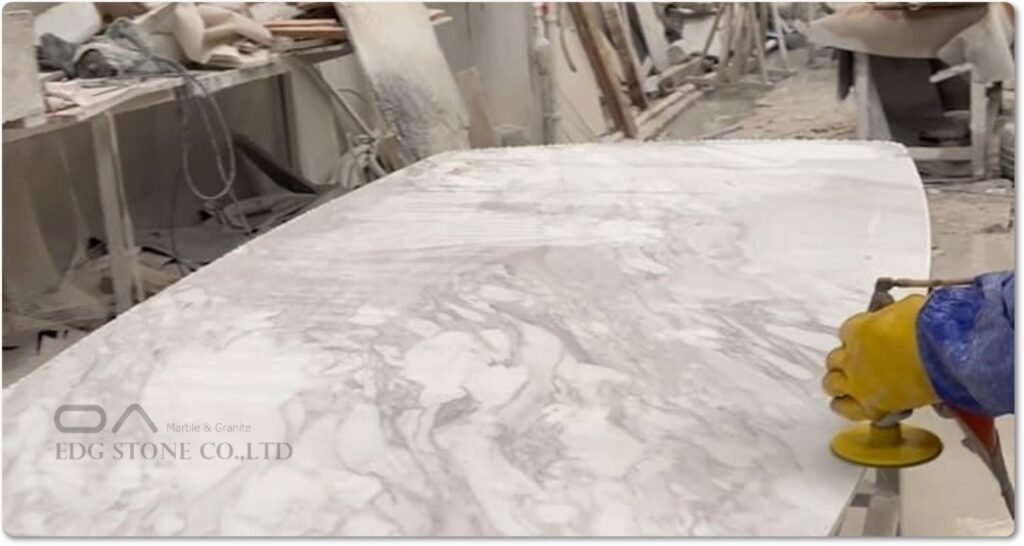
2.5 Assembly, Adhesives, and Labor
Assembly cost may include:
Dry fitting
Mechanical fixing
Adhesive application
Installation of inserts and brackets
Alignment and leveling
Final cleaning
Assembly inspection
Protective wrapping after assembly
Some furniture is shipped fully assembled; other designs are packed in separate components to reduce shipping volume or protect vulnerable joints.
The correct choice depends on product geometry, destination handling capabilities, installation requirements, and damage risk.
For products using adhesives, request information about the specified adhesive system, curing requirements, intended substrate, and relevant service conditions. Do not assume that a general-purpose adhesive is suitable for every stone, metal, moisture exposure, or structural application.
2.6 Sampling, Tooling, and Product Development
Custom stone furniture may require expenses before mass production begins.
These can include:
Material samples
Finished appearance samples
Prototype fabrication
CAD drawings and revisions
CNC programming
Dedicated jigs and fixtures
Special molds or forming tools, where applicable
Assembly trials
Packaging prototypes
Third-party testing
The quotation should state whether these charges are refundable, credited against a later order, or retained as separate development costs.
For example, if a hypothetical prototype costs $300 and the buyer orders 100 units, allocating the full prototype cost across the order adds $3 per unit, assuming the entire cost is assigned to that order.
If the same prototype is used for several production runs, the buyer may choose a different allocation method for internal costing. That accounting decision does not change the supplier’s original invoice.
2.7 Quality Inspection, Labels, and Documentation
Quality costs may include factory inspection, dimensional measurement, finish review, packing inspection, product identification, carton labels, and export documentation.
Depending on the project, buyers may also require:
Batch or lot identification
Product codes and barcodes
Country-of-origin marking where required
Installation instructions
Care and maintenance instructions
Packaging marks and handling symbols
Photographic inspection records
Independent pre-shipment inspection
A quality-control plan should identify the inspection stage, acceptance criteria, sampling method, responsible party, and treatment of rejected goods.
The applicable legal labeling requirements depend on the product, market, and import arrangement. Distinguish buyer-requested labels from mandatory regulatory markings.
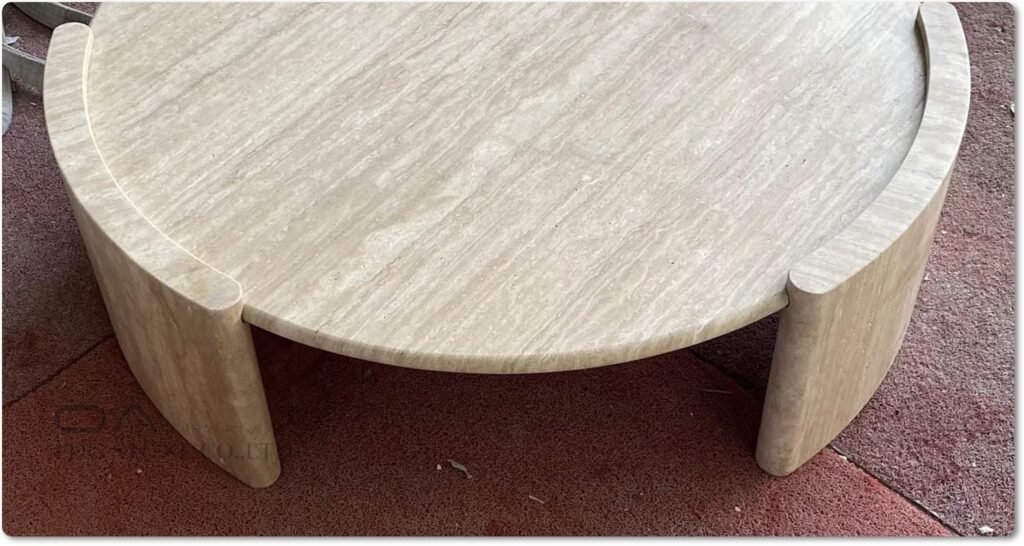
3. Procurement Checklist: Building a Comparable Stone Furniture RFQ
Use the following sequence before requesting prices from stone furniture manufacturers or factories.
Step 1: Freeze the Product Specification
Prepare a drawing or specification sheet covering:
Product name and reference number
Overall dimensions and tolerances
Stone material and acceptable alternatives
Thickness and edge details
Surface finish
Base material and coating
Hardware and assembly method
Color and vein-selection requirements
Required tests and quality criteria
If a specification remains open, label it as an option rather than allowing suppliers to assume different requirements.
Step 2: Define Quantity and Order Structure
State the quantity per model, total quantity, model mix, and expected repeat-order volume.
For mixed orders, distinguish between the total order quantity and the quantity of each SKU. A supplier may price 100 identical tables differently from 100 tables split across ten designs.
Also identify whether the order is a one-time project, a catalog launch, a phased delivery, or a recurring wholesale program.
Step 3: Agree on the Material Approval Process
Decide whether approval will be based on:
A physical sample
A full-size sample
Photographs of the selected slab
A digital image for preliminary reference
A signed sample or approved reference panel
For natural stone, explain the acceptable range of color, veining, fissures, filled areas, and other visible characteristics. Digital images alone cannot guarantee exact color reproduction or slab-to-slab consistency.
Step 4: Specify Packaging and Transit Protection
Request packaging appropriate to the product’s weight, shape, fragility, and transport route.
Clarify:
Whether the product ships assembled
Individual packaging versus consolidated crates
Corner and edge protection
Internal bracing and movement prevention
Moisture protection where appropriate
Crate dimensions and gross weight
Handling and lifting points
Labeling and packing-list requirements
Whether the proposed packaging has been validated for the intended logistics chain
Wood packaging used in international trade may be subject to the International Plant Protection Convention’s ISPM 15 requirements, depending on the material and shipment circumstances. Confirm the applicable rules for the destination and packaging type.
Step 5: Establish the Delivery Basis
State the named place or port, the requested Incoterms® rule, the delivery schedule, and the desired shipping arrangement.
For example, an RFQ may request separate quotations for EXW, FOB, and CIF where each option is commercially and operationally appropriate.
Do not compare an EXW factory price directly with a CIF destination-port price as if they covered the same services.
Step 6: Request a Cost Breakdown
Ask the supplier to separate:
Stone material
Fabrication
Base and hardware
Finishing and assembly
Sampling and tooling
Inspection and labeling
Export packaging
Inland transport and export handling, where applicable
International freight and insurance, where applicable
Excluded destination charges
The level of detail may vary by supplier, but all bidders should quote against the same cost scope.
Step 7: Validate the Final Commercial Offer
Before issuing a purchase order, confirm the quotation’s validity period, currency, payment terms, production lead time, approved specifications, packaging scope, delivery term, inspection provisions, and remedies for nonconforming goods.
A quotation is not a substitute for a complete purchase contract.
4. Cost and Risk Factors: Calculating Factory Cost and Landed Cost
4.1 The Main Stone Furniture Cost Formula
For internal budgeting, divide costs into factory production costs, export-related costs, transportation costs, destination costs, and other order-specific expenses.
These are management-accounting models, not universal supplier pricing formulas. Some factories include packaging, routine inspection, or other services in the quoted unit price. Avoid adding them again if already included.
4.2 How to Calculate Material Cost with Yield
Suppose a factory purchases stone based on an allocated material cost and estimates a usable yield of (Y), where (Y) is expressed as a decimal.
If the usable stone requirement for a product is (M_u), and the purchase cost per unit of stone measurement is (P_m), a simplified estimate is:
The $100/m² input and 80% yield are illustrative assumptions, not industry averages. Actual stone procurement may be based on whole slabs, thickness, block volume, or negotiated piece allocations, so a slab nesting plan is often more accurate.
4.3 Sample, Tooling, Packaging, and Inspection Costs
These expenses are frequently omitted from early budget estimates.
If a hypothetical custom fixture costs $600 and is allocated to 200 units, the allocation is $3 per unit.
Packaging should be costed separately when the quotation does not include it. A larger crate may increase packaging material, labor, handling, and freight costs. A stronger crate may increase packaging expense while reducing expected damage risk.
The buyer should evaluate the combined effect rather than choosing packaging solely on its initial price.
4.4 Freight, Insurance, Duties, and Destination Charges
Only include costs that are not already included in the quoted goods or freight price.
Potential additional charges include destination terminal handling, customs brokerage, port or terminal storage, demurrage, detention, unloading, inspection, and delivery appointments.
Not every shipment incurs every charge. The applicable costs depend on the carrier, route, contract, customs procedure, delivery arrangement, and whether delays occur.
How Import Duties Should Be Estimated?
Customs duty cannot be calculated reliably from the words “marble furniture” alone.
The buyer or customs broker must confirm the product’s correct tariff classification, country of origin, destination jurisdiction, customs valuation rules, applicable trade measures, and any relevant preferential treatment.
Import VAT, GST, or similar taxes may be recoverable by an eligible business under local rules, but they may still create cash-flow costs. Their treatment should therefore be shown separately in the landed-cost worksheet.
Do not assume the customs value always equals the supplier invoice total or automatically includes every shipping expense. The correct valuation method depends on the applicable customs rules.
4.5 Hypothetical Landed-Cost Example: A 100-Unit Stone Furniture Order
The following example demonstrates the calculation method only. Every price, freight amount, yield assumption, and charge below is hypothetical and is not a 2026 market benchmark.
Assume a buyer orders 100 marble side tables.
| Cost component | Hypothetical amount |
|---|---|
| Stone material per unit | $45 |
| Fabrication per unit | $28 |
| Base and hardware per unit | $20 |
| Finishing and assembly per unit | $10 |
| Routine quality inspection per unit | $2 |
| Export packaging per unit | $8 |
| Goods and packaging subtotal per unit | $113 |
| One-time sample and tooling costs | $500 |
| Hypothetical international freight for the order | $1,200 |
| Hypothetical insurance for the order | $100 |
| Hypothetical destination handling and brokerage | $400 |
| Hypothetical import duty | $600 |
| Hypothetical local delivery | $300 |
This example excludes any separately recoverable import taxes, financing costs, warehousing, and damage losses. It also assumes no listed cost is duplicated in another line item.
The actual landed cost may be higher or lower depending on the product, shipment, customs treatment, and contract.
4.6 How Breakage Changes the Cost per Accepted Unit?
Stone is heavy and may be vulnerable to impact, edge damage, or stress during handling. Packaging quality, product geometry, restraint, and handling procedures all influence the risk.
If the order cost is fixed but fewer units are accepted, the effective cost per accepted unit increases.
Using the hypothetical total of $14,400:
If 100 units are accepted, the cost is $144 per unit.
If 98 units are accepted, the cost is approximately $146.94 per unit.
If 95 units are accepted, the cost is approximately $151.58 per unit.
These calculations show the effect of fewer accepted units; they do not estimate an industry breakage rate.
The buyer should also consider the administrative and operational consequences of damage, such as claims, replacement production, delayed installation, and missed project deadlines. Those costs may not be fully captured by dividing the original invoice by the accepted quantity.
4.7 Comparing EXW, FOB, and CIF Quotations
Incoterms® rules allocate specified obligations, costs, and risks between seller and buyer. They do not, by themselves, define the entire purchase contract, payment terms, product acceptance rules, or every remedy for defective goods.
| Quotation basis | General scope | Key buyer consideration |
|---|---|---|
| EXW — Ex Works | Seller makes goods available at the named place under the rule | Confirm loading arrangements, export clearance responsibilities, collection, and all onward costs |
| FOB — Free On Board | For sea or inland waterway transport; seller delivers goods on board the vessel at the named port of shipment | Confirm origin charges, vessel loading, and buyer’s freight and insurance arrangements |
| CIF — Cost, Insurance and Freight | For sea or inland waterway transport; seller arranges and pays freight and specified insurance to the named destination port | Risk transfers at shipment under the rule, even though the seller pays freight and insurance to destination; destination charges may remain payable by the buyer |
Use the exact named place or port and state the applicable version of the Incoterms® rules in the contract.
EXW, FOB, and CIF are not interchangeable price labels. Their cost scopes and transfer points differ. For containerized shipments, the buyer should ask the logistics provider whether FCA is more appropriate than FOB, depending on how the goods are handed over to the carrier.
For each quotation, construct a cost bridge from the supplier’s price to the same agreed destination point. Add the missing services and charges, remove duplicates, and identify costs that cannot yet be confirmed.
4.8 Hidden Costs and Commercial Risks
The following risks deserve explicit treatment in a stone furniture procurement plan.
Material substitution: A lower-priced stone may not match the approved color or performance requirements.
Unclear natural variation: Disagreements may arise when the contract lacks an agreed visual acceptance range.
Design revisions: Changes after approval can require new programming, samples, tooling, or material allocation.
Packaging mismatch: A crate suitable for a small tabletop may not adequately restrain a heavy pedestal or assembled table.
Volume and weight surprises: Actual packed dimensions or gross weight may differ from preliminary estimates, affecting freight and handling.
Customs classification errors: An incorrect tariff classification can create unexpected duties, delays, or penalties.
Unspecified delivery charges: Port handling, customs brokerage, and local delivery may be excluded from the original offer.
Production and replacement delays: A damaged or rejected item may require a new production cycle, additional transport, and revised installation scheduling.
The best prevention is not to add an arbitrary contingency percentage to every line. It is to identify the uncertainty, obtain evidence, and decide whether to mitigate, allocate, insure, or explicitly accept the risk.
4.9 Cost Optimization Without Compromising Product Quality
Buyers can often improve total cost through design and procurement decisions made before production.
| Cost driver | Potential optimization | Limitation |
|---|---|---|
| Stone yield | Use nesting plans and coordinate part sizes | Visual selection may limit theoretical yield |
| Stone thickness | Match thickness to design and structural requirements | Do not reduce thickness without validating support and strength |
| Edge processing | Standardize profiles across SKUs | Must preserve the intended appearance |
| Base construction | Simplify connections or use repeatable components | Stability, durability, and appearance still matter |
| Product range | Consolidate similar finishes and hardware | Do not force unsuitable materials into one specification |
| Packaging | Design packaging around actual product geometry | Reduced packaging must still protect the product |
| Order quantity | Consolidate production where practical | Larger orders increase inventory and working-capital exposure |
| Inspection | Agree on measurable acceptance criteria in advance | Lower inspection cost is not a substitute for quality control |
The appropriate optimization is the one that reduces total cost while maintaining the required appearance, structural performance, safety, delivery reliability, and customer acceptance.
5. Supplier Evaluation: Evidence Buyers Should Request
5.1 Evaluate the Cost Breakdown, Not Just the Final Number
A reliable stone furniture manufacturer should be able to explain the main drivers of its quotation, even if it does not disclose confidential internal margins or every proprietary production rate.
Request clarification on:
Stone source, selection criteria, and material allowance
Fabrication processes and edge specifications
Base and hardware materials
Surface finish and assembly scope
Sample, tooling, and design charges
Packaging construction and dimensions
Quality inspection and acceptance criteria
Production lead time and shipment readiness
Delivery term, included charges, and exclusions
If a supplier cannot explain why two substantially different designs have similar prices, request a more detailed technical review before placing the order.
5.2 Technical and Quality Evidence
Depending on the project, useful evidence includes:
Dimensioned drawings and approved specifications
Photographs of representative production
Material samples or approved reference panels
Packaging drawings and crate specifications
Inspection reports and dimensional records
Relevant product test reports, where required
Records of material batch or product identification
Assembly instructions and care guidance
For commercial or hospitality projects, ask the supplier to explain how nonconforming units are identified, segregated, repaired, replaced, or otherwise resolved under the contract.
A generic certificate should not be treated as proof that every product meets every project requirement. Verify the document’s scope, issuing organization, product identity, and validity.
5.3 Production Capability and Repeatability
The ability to make one attractive sample is different from the ability to manufacture a consistent bulk order.
For a stone furniture bulk order, evaluate whether the supplier can demonstrate:
Repeatable cutting and finishing processes
Appropriate machinery for the specified geometry
Material selection and approval procedures
Consistent hardware and base fabrication
A documented quality-control process
Suitable packing and container-loading practices
Production planning for the required quantity
A defined procedure for handling variation and defects
For repeat orders, establish a reference sample, acceptable visual range, specification revision, and batch approval process.
5.4 Supplier Comparison Scorecard
Buyers can use a weighted scorecard to structure their evaluation. The weights below are illustrative procurement choices, not a published industry standard.
| Evaluation category | Illustrative weight |
|---|---|
| Specification compliance and quality controls | 25% |
| Comparable landed cost | 25% |
| Production capability and lead time | 20% |
| Packaging and shipping readiness | 15% |
| Documentation and communication | 10% |
| Commercial terms and change control | 5% |
| Total | 100% |
Score each supplier against the same evidence requirements. A low quotation should not automatically compensate for unresolved specification gaps, unclear exclusions, or an unverified packaging plan.
6. Practical RFQ Template: Stone Furniture Cost and Landed Cost
Copy the following template into an email, spreadsheet, or procurement system and send it to shortlisted manufacturers.
6.1 Product and Technical Specification
Subject: RFQ — Stone Furniture Manufacturing, Packaging and Export Quotation
Dear Sales Team,
We are requesting a quotation for the manufacture and export of stone furniture according to the following specifications.
A. Buyer and project information
Company:
Contact person:
Destination country:
Delivery city or port:
Project type: Wholesale / Distribution / Hospitality / Residential / Commercial / Other
Required delivery date:
Expected repeat-order potential:
B. Product details
Product name and SKU:
Product quantity:
Overall dimensions:
Stone type and preferred origin:
Stone color and visual-selection requirements:
Finished stone thickness:
Surface finish:
Edge profile:
Base material and finish:
Hardware and assembly requirements:
Product weight, if known:
Technical drawings attached: Yes / No
Reference images attached: Yes / No
C. Quality and approval
Dimensional tolerances:
Acceptable natural stone variation:
Sample or prototype required:
Inspection standard or checklist:
Required testing or certificates:
Product labeling and documentation:
Defect and replacement procedure:
D. Packaging and shipment
Packaging type:
Individual packaging or consolidated crates:
Assembly condition at shipment:
Required crate dimensions or restrictions:
Required shipping marks:
Estimated gross weight and packed volume:
Shipment mode:
Named port or delivery location:
Requested Incoterms® rule and version:
Insurance requirements:
Container loading or delivery requirements:
E. Commercial quotation
Please quote the following separately where applicable:
Stone material
Fabrication and finishing
Base and hardware
Assembly
Sampling and tooling
Quality inspection
Packaging and labeling
Inland transportation and export charges
International freight and insurance
Excluded destination charges or services
Please also state:
Unit price and total price
Currency and quotation validity
MOQ and price breaks
Sample and tooling charges
Production lead time
Payment terms
Estimated packed dimensions and weight
Included and excluded services
Any assumptions or proposed substitutions
Please identify any missing information that prevents an accurate quotation. We prefer a technically complete, comparable offer rather than a preliminary price based on unconfirmed assumptions.
Best regards,
[Buyer Name]
[Company Name]
[Contact Information]
6.2 Purchase Order and Pre-Shipment Acceptance Checklist
Before authorizing production, confirm the following:
Final drawings and dimensions approved
Stone type and visual reference approved
Thickness, edges, and finish confirmed
Base, hardware, and assembly method confirmed
Sample or prototype approval recorded
Unit price and all one-time charges agreed
Order quantity and SKU mix confirmed
Packaging design and labeling approved
Incoterms® rule, named place, and version stated
Freight and insurance responsibilities confirmed
Customs classification and importer responsibilities reviewed
Inspection method and acceptance criteria documented
Delivery schedule and nonconformity process agreed
This checklist helps turn a preliminary quote into a controlled purchasing specification.
7. Frequently Asked Questions: Stone Furniture Cost and Procurement
7.1 How Do You Calculate the Cost of Stone Furniture?
Add the applicable costs for stone material, fabrication, base and hardware, finishing, assembly, inspection, packaging, development, transportation, insurance, customs duties, destination handling, and local delivery. Remove any costs already included in the supplier’s price. Divide the resulting total by the number of conforming units received to calculate landed cost per accepted unit.
7.2 What Is Included in a Stone Furniture Factory Price?
The scope varies by supplier. A factory price may include material and fabrication but exclude packaging, sampling, export handling, freight, insurance, duties, and local delivery. Request a written breakdown of inclusions and exclusions before comparing manufacturers.
7.3 Why Does Marble Furniture Cost More Than Some Other Furniture?
Marble furniture pricing reflects the selected stone, usable material yield, visual selection, thickness, machining, edge finishing, structural design, labor, and packaging requirements. Premium veining, bookmatching, complex shapes, and stringent appearance tolerances may increase cost, but the effect depends on the actual design and sourcing conditions.
7.4 How Can I Reduce the Cost of a Stone Furniture Bulk Order?
Review material yield, standardize dimensions and edge profiles, simplify unnecessary machining, coordinate repeatable bases and hardware, optimize packaging, and consolidate production where practical. Request alternative designs with clearly stated trade-offs. Do not reduce thickness, support, or packaging protection without confirming the relevant technical requirements.
7.5 What Is the Difference Between EXW, FOB, and CIF for Stone Furniture?
EXW generally makes goods available at a named place; FOB is used for sea or inland waterway transport and requires delivery on board the vessel at the named shipment port; CIF requires the seller to arrange and pay freight and specified insurance to the named destination port, while risk transfers at shipment. The rules have different responsibilities and cost scopes, so quotations must be normalized before comparison.
8. Semantic Insight: What Really Determines the Total Cost of Stone Furniture?
This section brings together the technical, commercial, and logistical factors that buyers should evaluate when planning stone furniture procurement. It is intended as a concise decision framework, not simply another list of FAQs.
8.1 The Core Principle: Optimize Total Cost, Not the Factory Price Alone
What determines the real cost?
The real cost is the amount a buyer must spend to obtain the required quantity of conforming furniture at the agreed receiving point. Factory price is one component of that amount.
Why does this matter?
Two suppliers can quote different prices because they are using different material grades, yield assumptions, packaging methods, inspection scopes, or delivery terms. Without a common specification, the difference cannot be interpreted reliably.
How should buyers evaluate the options?
Create a cost bridge that starts with each supplier’s quoted price and adds the missing costs required to reach the same delivery point. Separately identify uncertain charges and assumptions that still require confirmation.
8.2 Material Efficiency Is a Design Decision as Well as a Production Decision
What is the opportunity?
The dimensions, geometry, vein direction, and part arrangement of a product determine how efficiently stone can be cut from the available slabs.
Why does it matter?
A design that looks simple in a rendering may require a large slab or create unusable remnants. A small change in a component’s dimensions or the coordination of several parts may improve nesting, provided the change does not compromise appearance or structural performance.
What should a procurement team do?
Request a proposed cutting layout for expensive or highly patterned stone. Where the design permits, compare alternative dimensions, thicknesses, and material formats before the production drawing is finalized.
8.3 Packaging Should Be Evaluated Against the Consequences of Damage
What is the trade-off?
Stronger packaging can increase upfront costs, but inadequate protection may increase damage, claims, replacement production, and project delays.
How should buyers decide?
Assess the product’s weight, center of gravity, exposed edges, joints, handling method, and shipping route. Require the supplier to explain the proposed restraints, internal supports, and handling instructions.
For recurring shipments, use inspection records and documented damage feedback to improve packaging design. Do not treat an unverified assumption about a low breakage rate as evidence that packaging can safely be reduced.
8.4 The Best Supplier Is the One Whose Offer Can Be Verified
What distinguishes a useful quotation?
A useful quotation connects the price to a defined product, a known production process, an explicit packaging scope, and an agreed delivery basis.
What evidence should buyers prioritize?
Look for drawings, material approvals, itemized inclusions, inspection criteria, packed dimensions, and a clear allocation of logistics responsibilities. These records make it easier to identify differences between quotations and manage production changes.
What is the purchasing implication?
The lowest initial price should be considered alongside specification compliance, repeatability, lead time, packaging quality, and total landed cost. A supplier that explains its assumptions clearly gives the buyer a stronger basis for cost control.
8.5 Regulatory and Trade Compliance Must Be Part of Cost Planning
International stone furniture procurement involves more than manufacturing and freight. Importers may need to verify tariff classification, customs valuation, origin documentation, applicable import measures, and packaging requirements.
The World Customs Organization’s Harmonized System provides the international framework for classifying traded goods, but national tariff schedules and additional legal requirements determine the applicable treatment in a particular destination.
Similarly, ISPM 15 addresses relevant wood packaging material used in international trade. Whether specific packaging is covered depends on its construction and the applicable rules.
The practical lesson is straightforward: identify compliance questions before shipment, confirm the current requirements with the relevant customs authority or qualified broker, and avoid treating a supplier’s previous shipment as proof that every future shipment will receive identical customs treatment.
8.6 A More Reliable Procurement Model
A robust stone furniture purchasing process connects five decisions:
Design: Define dimensions, construction, and performance requirements.
Material: Approve stone characteristics and realistic yield assumptions.
Manufacturing: Confirm fabrication, finishing, assembly, and inspection.
Logistics: Validate packaging, packed volume, transport responsibilities, and destination costs.
Commercial control: Compare equivalent offers, document assumptions, and calculate cost per accepted unit.
When these decisions are documented together, buyers can compare suppliers more accurately, identify avoidable cost drivers, and reduce preventable surprises during bulk production and international delivery.
9. References: Standards, Trade Rules, and Official Resources
The following sources provide authoritative starting points for stone furniture procurement, international trade, packaging, and customs planning. Verify the latest applicable edition and jurisdiction-specific requirements before using any standard or regulation as a contractual acceptance criterion.
9.1 Incoterms® and International Trade
International Chamber of Commerce (ICC) — Incoterms® rules, including EXW, FOB, CIF, FCA, and the allocation of seller and buyer obligations. Consult the official ICC Incoterms® 2020 materials and any applicable ICC updates.
World Customs Organization (WCO) — Harmonized System (HS) nomenclature and guidance on international tariff classification. Confirm the current national tariff schedule for the importing jurisdiction.
World Trade Organization (WTO) — Trade and tariff resources, including information on customs duties and trade policy. National measures and destination-specific rules should be verified separately.
9.2 Wood Packaging and International Shipment
International Plant Protection Convention (IPPC) — ISPM 15, Regulation of Wood Packaging Material in International Trade. Consult the current official text and the importing country’s implementation requirements.
International Maritime Organization (IMO) — International maritime safety framework and relevant cargo-related guidance. Confirm which requirements apply to the specific shipment and transport arrangement.
9.3 Natural Stone and Product Quality
Natural Stone Institute (NSI) — Technical resources on natural stone selection, care, fabrication, and installation. Use project-appropriate guidance rather than assuming that one recommendation applies to every stone.
ASTM International — Relevant natural stone and dimensional-stone test methods and specifications, selected according to the material and intended use. Confirm the current edition directly in the official ASTM catalog.
ISO — Applicable quality management and product-related standards where relevant to the supplier, project, or contract. Certification to a management-system standard should not be treated as automatic proof that a particular furniture product conforms to every requirement.
9.4 Customs and Import Tax
The importing country’s customs authority — Official tariff classification, customs valuation, country-of-origin, import duty, and entry requirements.
The importing country’s tax authority — Import VAT, GST, and other applicable tax rules, including recovery eligibility where relevant.
Reference note: This article does not assign universal stone furniture duties, standardized freight rates, material prices, or breakage percentages. Such values depend on the product, route, destination, order structure, and contract. Verify time-sensitive trade and regulatory information before purchase.
10. EDG Stone CTA: Request a Comparable Stone Furniture Quote
Source Stone Furniture with a Clear Cost Structure
Stone furniture procurement requires coordination between material selection, fabrication, design, packaging, and international logistics. A quotation becomes more useful when every supplier prices the same product specification and identifies the services included in the offer.
EDG Stone works with natural stone products and custom fabrication requirements. For buyers sourcing marble tables, travertine furniture, stone furniture components, or customized stone products, the first step is to prepare a defined RFQ with drawings, material preferences, quantities, finish requirements, and delivery details.
To request a project quotation, prepare the following:
Product drawings, dimensions, and reference images
Preferred stone type, color, thickness, and finish
Quantity by model and expected repeat-order volume
Base, hardware, and assembly specifications
Packaging and labeling requirements
Destination port or delivery location
Requested Incoterms® rule and required delivery schedule
Ask for clarification of one-time costs, packaging scope, shipment responsibilities, and excluded destination charges before comparing the final offers.
EDG Stone — Stone Furniture and Custom Stone Fabrication
Submit your product specifications through the EDG Stone website’s contact or quotation channel: https://edgstone.com/
A complete RFQ helps the supplier assess feasibility, identify missing information, and prepare a more comparable commercial proposal. Final pricing, production schedules, material availability, and shipping costs remain subject to confirmed specifications and the agreed quotation terms.