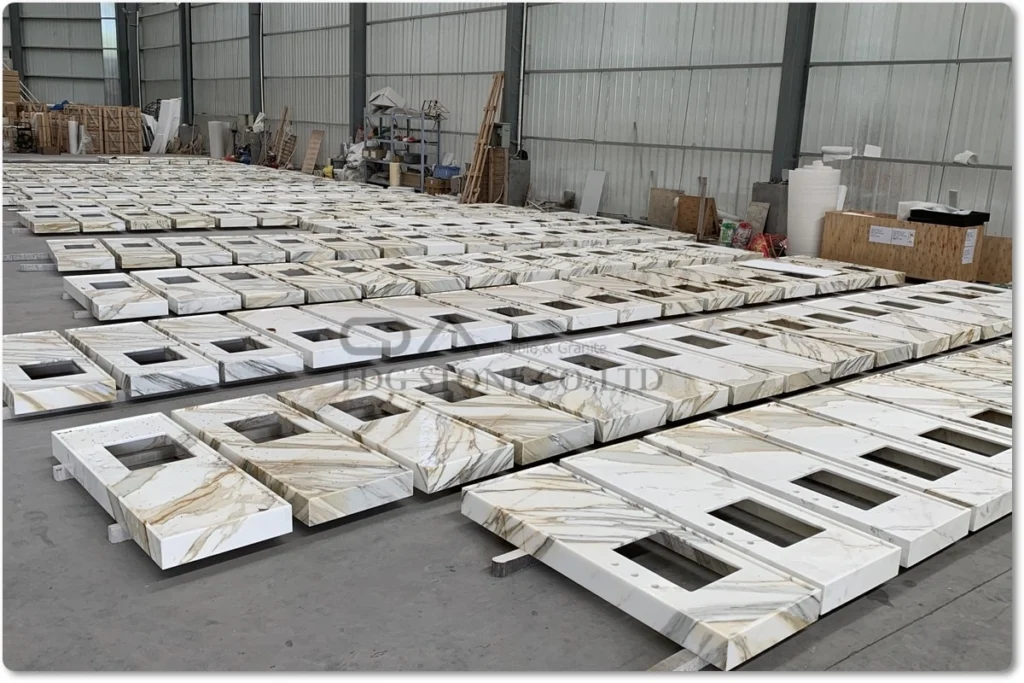
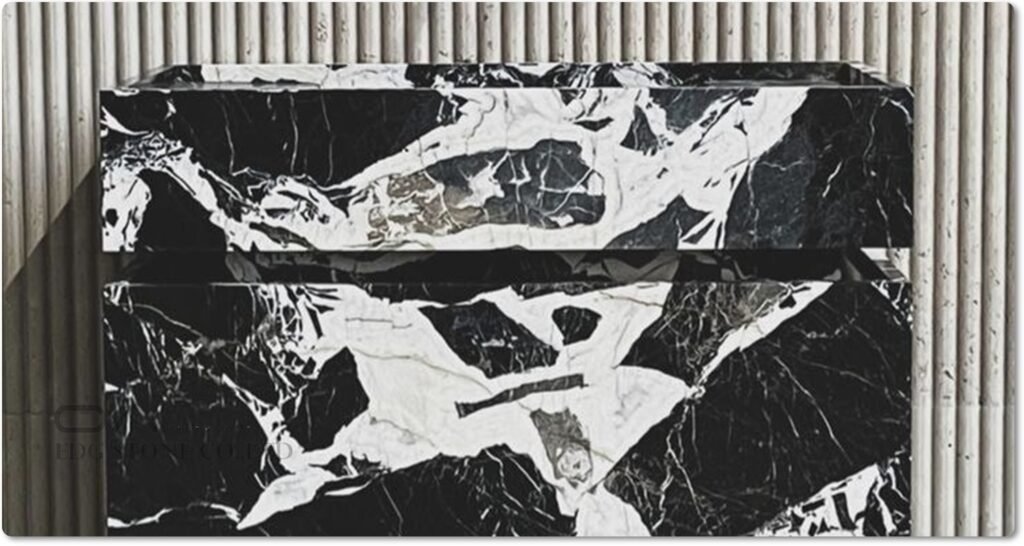
1. Executive Summary: How to Procure Stone Furniture Successfully?
Stone furniture is a specialized category of furniture manufacturing that combines natural or engineered stone with product design, structural engineering, precision fabrication, finishing, assembly, and international logistics.
Unlike conventional furniture made primarily from wood, metal, or upholstered components, stone furniture often involves heavy materials, natural variations, fragile edges, distinctive veining, and product-specific handling requirements. These characteristics directly influence manufacturing costs, minimum order quantities, production lead times, packaging methods, and shipping economics.
For B2B buyers, procurement should therefore begin with a clearly defined product specification rather than a request for the lowest available price.
A well-managed stone furniture purchasing process follows six stages:
Define the product, intended use, dimensions, material, and finish.
Prepare a standardized RFQ and request comparable quotations.
Evaluate MOQ, sample costs, production capability, and material availability.
Approve technical drawings, samples, and acceptable natural variation.
Confirm the production schedule, inspection criteria, packaging, and Incoterms.
Evaluate total landed cost, delivery risk, and supplier accountability.
Who should use this guide?
This procurement guide is intended for:
Wholesalers and distributors sourcing repeatable stone coffee tables, dining tables, consoles, and side tables.
Furniture brands developing OEM or ODM stone furniture collections.
Architects and interior designers specifying custom stone furniture for residential and commercial interiors.
Hotel and hospitality procurement teams purchasing furniture for guest rooms, suites, restaurants, lobbies, and public areas.
Importers and project contractors coordinating production schedules, container loading, and site delivery.
Retailers and resellers evaluating product assortment, packaging, margin, and reorder feasibility.
The central purchasing principle is simple: compare the same product specification, the same commercial scope, and the same delivery conditions before deciding which supplier offers the best value.
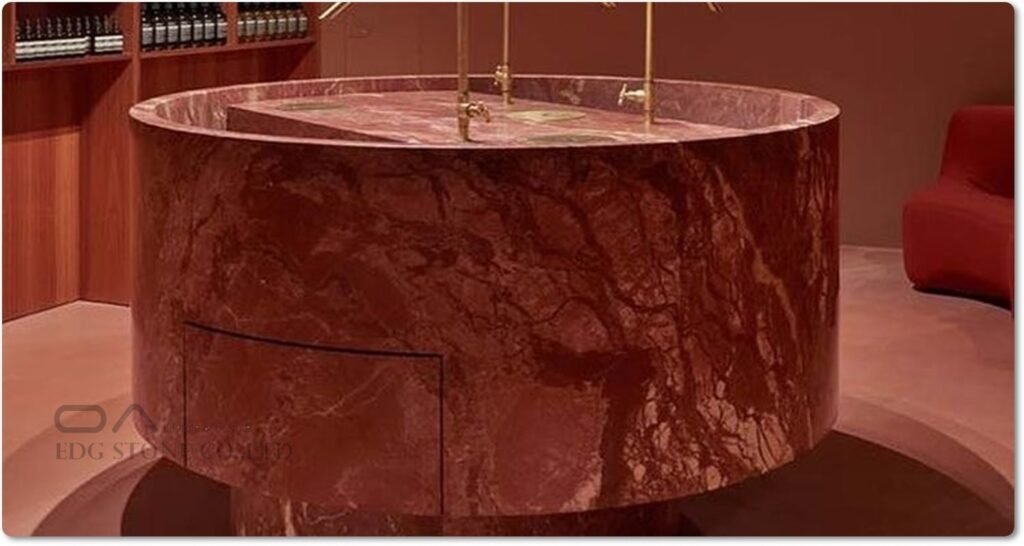
2. Scope and Definitions: Understanding Stone Furniture Procurement
2.1 What products are included?
Stone furniture includes functional furniture in which stone serves as the primary visible material or an important structural or decorative component.
Common product categories include:
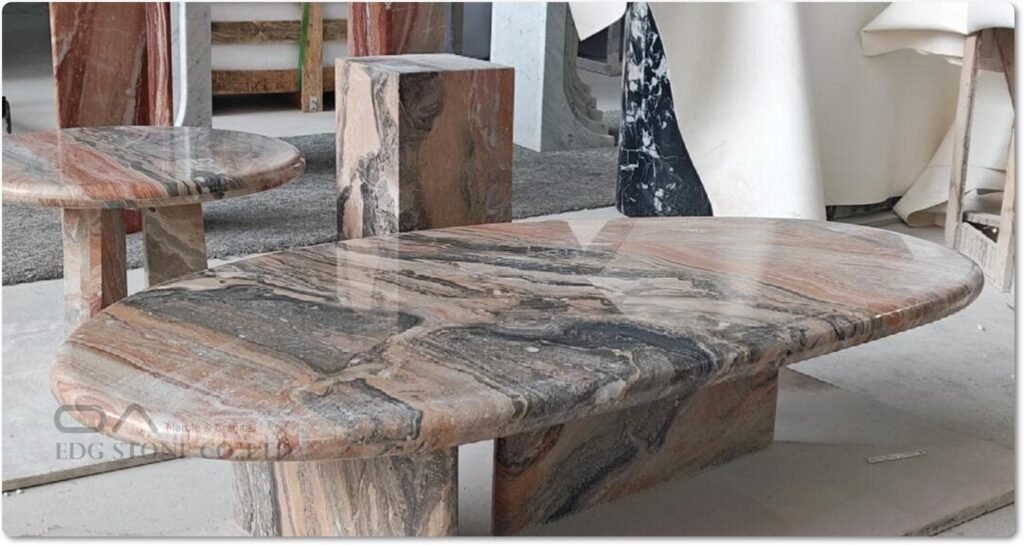
Marble coffee tables and side tables
Marble and quartzite dining tables
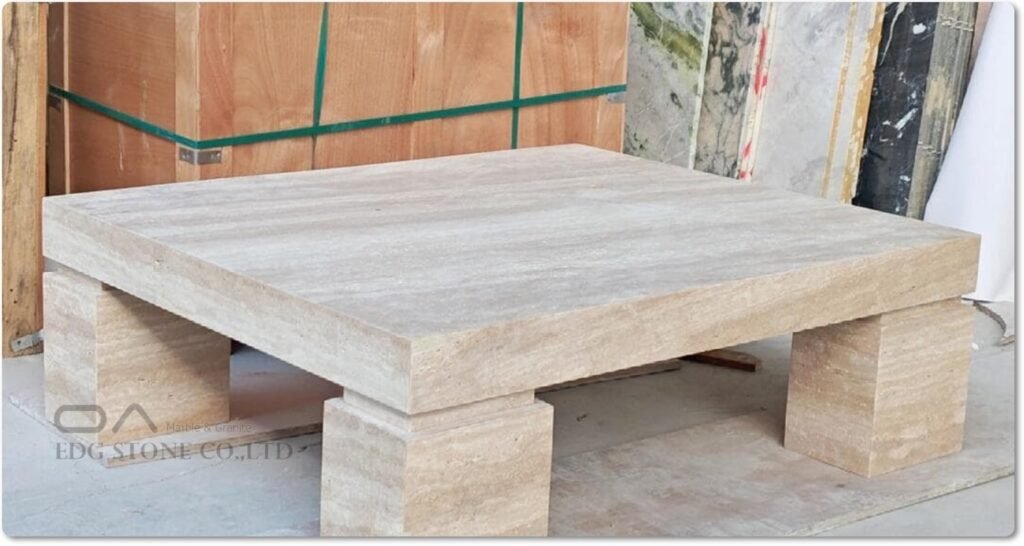
Travertine tables and consoles
Natural stone desks and reception tables
Stone-top dining tables with metal or wood bases
Marble bedside tables and nightstands
Stone benches and selected outdoor furniture
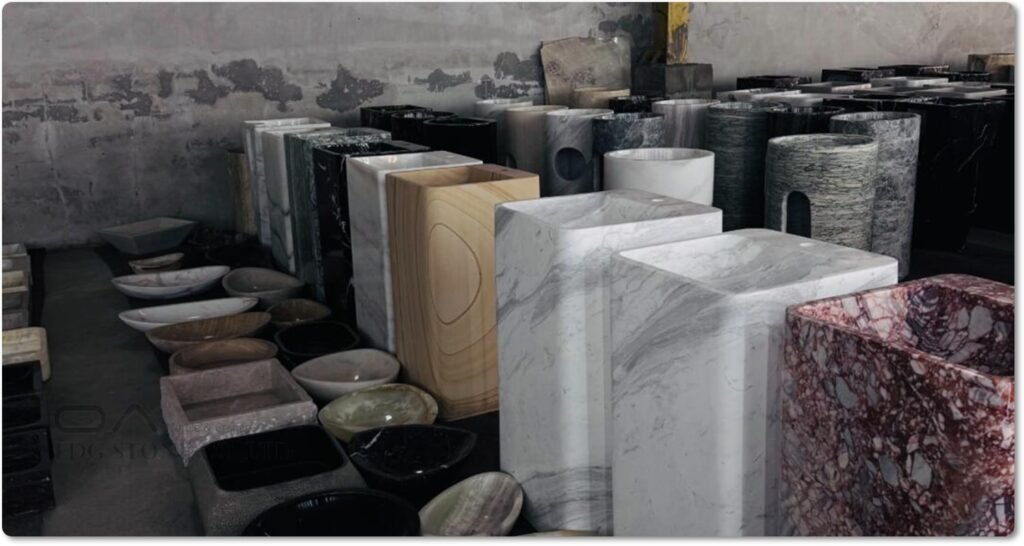
Stone vanity units and furniture-integrated washbasins
Custom sculptural furniture and architectural furniture pieces
Materials may include marble, granite, quartzite, limestone, travertine, onyx, and selected engineered stone products. Some designs combine stone with stainless steel, carbon steel, aluminum, solid wood, glass, or other materials.
Material selection must account for the actual stone variety, its physical properties, its finish, the product design, and the intended environment.
For example, a decorative marble coffee table used in a living room has different requirements from an outdoor stone bench exposed to rain and temperature changes.
2.2 Key procurement terminology
| Term | Definition | What buyers should confirm |
|---|---|---|
| RFQ | Request for Quotation | Complete specifications, quantities, commercial terms, and delivery requirements |
| MOQ | Minimum Order Quantity | Minimum quantity per SKU, design, material, or order |
| OEM | Original Equipment Manufacturing | Production based on buyer-provided designs or specifications |
| ODM | Original Design Manufacturing | Selection or adaptation of supplier-developed designs |
| Sample order | A preliminary order for evaluation | Sample cost, lead time, shipping, and approval criteria |
| Production lead time | Time required to manufacture an order | Start event, working days, approval dependencies, and completion milestone |
| Transit time | Time goods spend in transportation | Transport mode, route, and estimated transit window |
| Landed cost | Total cost of bringing goods to the defined destination | Product, packaging, freight, insurance, duties, taxes, and other applicable charges |
| Incoterms | ICC rules allocating specified delivery responsibilities and risks | Named rule, named place, and applicable edition |
2.3 MOQ is not the same as a container quantity
A supplier may accept a small production order but offer more competitive pricing for larger quantities. Another supplier may require a minimum number of units for each design, even when multiple designs can be combined in one shipment.
These are different commercial conditions.
Buyers should distinguish between:
Minimum order quantity per design or SKU
Minimum quantity per stone material or color
Minimum production batch
Minimum order value
Minimum shipment or container requirement
A supplier accepting mixed designs in one container does not necessarily mean every design can be produced in a single unit at the same price as a standard wholesale product.
2.4 Natural stone versus engineered stone
Natural stone is quarried and fabricated from geological material. Its color, veining, mineral composition, and other characteristics can vary between blocks and slabs.
Engineered stone products are manufactured from formulated materials using product-specific processes. Their composition, fabrication requirements, and applicable regulations depend on the material category.
These distinctions matter for cost, visual consistency, fabrication, maintenance, workplace safety, and regulatory compliance.
Buyers should identify the exact product category rather than using the word “stone” as a complete technical specification.
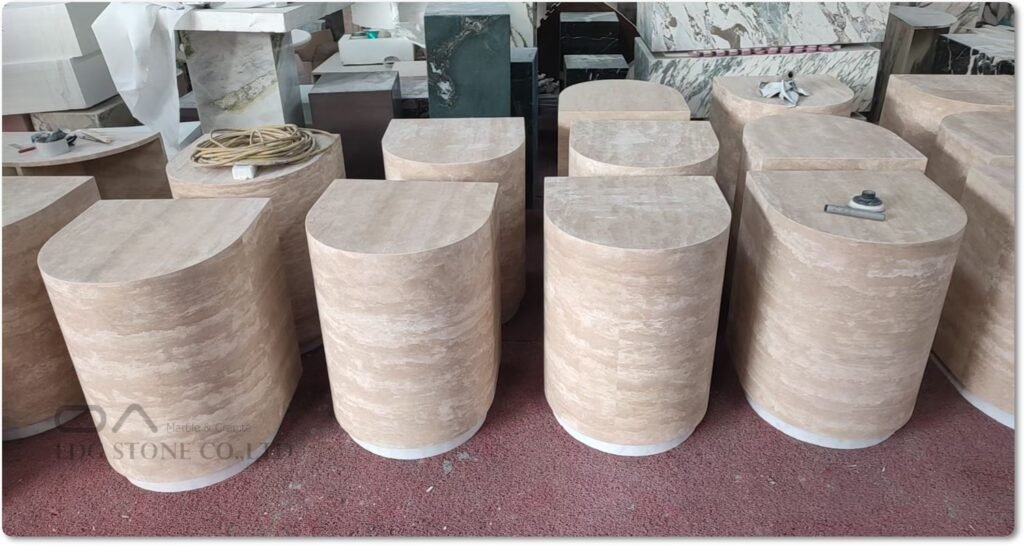
3. Technical Evaluation: The Specifications That Determine Price and Quality
Stone furniture pricing is not determined by material name alone. Two tables described as “marble coffee tables” may differ substantially in material consumption, fabrication hours, structural complexity, finishing requirements, and shipping cost.
The following specifications should be defined before requesting a binding quotation.
3.1 Material type, grade, and selection
The stone material is often one of the most visible determinants of product value.
Relevant factors include:
Stone type and commercial name
Quarry or country of origin, where material to that level is available and verifiable
Background color and veining characteristics
Block or slab availability
Thickness and usable yield
Surface defects and acceptable natural features
Bookmatching or directional vein requirements
Resin treatment, filling, mesh backing, or other documented treatments
Availability for repeat production
Why does material selection affect the price?
A common commercial stone with broad availability may allow more flexible sourcing than a rare variety with limited block availability. A design requiring closely matched veining may also produce more offcuts and lower usable yield than a design that permits ordinary variation.
For large dining tables, bookmatched consoles, or multi-piece furniture collections, the buyer should confirm whether all visible components can be selected from a coordinated block or slab batch.
Procurement recommendation: Request photographs or videos of the actual material batch when visual consistency is important. For high-value projects, define a physical reference sample and written acceptance criteria.
A supplier should not promise identical natural patterns across separate production batches unless the specified material and selection process can reasonably support that expectation.
3.2 Dimensions and stone thickness
Dimensions affect material consumption, cutting yield, handling, packaging, and structural design.
An RFQ should identify:
Overall length, width, and height
Stone top dimensions
Top thickness
Base dimensions
Internal supports and connection points
Finished-product tolerances
Assembly and disassembly requirements
A 1,600 mm dining table with a thick stone top is not commercially equivalent to a 1,200 mm table with a thinner top, even if both use the same stone.
Thicker stone generally increases weight and material consumption. However, the actual cost difference depends on the design, usable slab yield, edge treatment, reinforcement, and fabrication method.
A visually thick edge may sometimes be produced with a laminated or built-up construction rather than a solid block of stone. The quotation should clearly identify the construction method.
Technical note: nominal thickness versus finished thickness
The RFQ should state whether the requested thickness is:
The nominal slab thickness
The finished stone thickness
The visible edge thickness
The total assembled thickness, including laminated components
These measurements are not interchangeable.
3.3 Surface finish and edge profile
Surface treatment affects appearance, maintenance, fabrication time, and suitability for the intended environment.
Common finishes include:
Polished
Honed or matte
Leathered or textured, where suitable for the material
Brushed or other mechanically textured finishes
Specialized custom finishes
Not every finish is suitable for every stone. The supplier should confirm feasibility using the actual material and the intended application.
Edge profiles may include:
Straight or eased edges
Chamfered edges
Rounded edges
Bullnose profiles
Beveled edges
Custom CNC-machined profiles
Built-up or laminated visual edges
Complex profiles can require additional machining, grinding, polishing, inspection, and material allowance.
For dining tables and other frequently touched surfaces, buyers should also define acceptable edge sharpness, corner radius, visible seams, and finish consistency.
Quotation rule: Specify both the surface finish and the edge profile. “Polished marble table” is not a complete manufacturing specification.
3.4 Structure, support, and assembly
Stone is heavy, and its mechanical behavior differs from that of wood or metal. Structural design must account for dimensions, support spacing, thickness, material characteristics, load conditions, and connection details.
Potential design elements include:
Stone slab tops
Stone pedestal bases
Metal frames
Wood or metal substructures
Mechanical fasteners
Adhesive bonding
Reinforcement components
Adjustable feet and protective pads
Knock-down assembly systems
For larger tables, a supplier should assess the support arrangement and the risk of bending, cracking, tipping, or localized stress.
A thin stone top with a wide unsupported span may require a different structural solution from a compact side table. The correct approach depends on the actual design and verified material properties.
What should be included in the technical drawing?
At minimum, request:
Overall dimensions and critical tolerances
Stone thickness and visible edge construction
Base geometry and support points
Connection details and hardware
Assembly sequence, if applicable
Component identification and packing configuration
Any required load or stability verification
For hospitality, public-space, and other commercial applications, confirm whether applicable furniture safety, stability, durability, or load-testing requirements apply in the destination market.
Do not assume that a material certificate alone demonstrates the safety of the finished furniture.
3.5 Fabrication methods and manufacturing capability
Depending on the design, manufacturing may involve:
Slab inspection and material selection
Cutting and dimensioning
CNC machining
Waterjet cutting
Edge profiling
Surface grinding and polishing
Drilling and connection preparation
Dry fitting and assembly
Final inspection
Protective packaging
The supplier should explain which operations are performed in-house and which are subcontracted.
Outsourcing is not automatically a disadvantage. The important questions are whether the supplier controls specifications, quality, scheduling, traceability, and responsibility across the complete production process.
3.6 Quality criteria for stone furniture
A quality inspection plan should cover both material appearance and finished-product performance.
| Inspection area | Example acceptance criteria |
|---|---|
| Material identity | Agreed stone type and approved reference |
| Color and veining | Within the agreed visual acceptance range |
| Dimensions | Within drawing tolerances |
| Surface finish | Consistent with the approved sample |
| Edges and corners | No unacceptable chips, sharp defects, or inconsistent profiles |
| Assembly | Components fit as designed |
| Structural integrity | Suitable for the defined application and verification plan |
| Hardware | Correct specification and quantity |
| Packaging | Protection appropriate to weight, geometry, and shipping route |
| Identification | SKU, quantity, component labels, and packing list agree |
Acceptance limits should be documented before mass production. A vague requirement such as “perfect quality” is difficult to inspect consistently and resolve commercially.
4. Procurement Checklist: From Initial Inquiry to Shipment
A structured procurement workflow reduces misunderstandings and makes supplier quotations easier to compare.
Step 1: Define the product and intended use
Record the product category, target market, application, and whether it is for residential, hospitality, commercial, or outdoor use.
Identify any destination-specific requirements that affect product construction, finish, chemical composition, labeling, or testing.
Step 2: Prepare the specification package
Collect drawings, reference photographs, dimensions, stone selection requirements, finishes, edge profiles, base materials, hardware details, and assembly instructions.
If the product is still at concept stage, state which items are provisional. Ask the supplier to identify design assumptions separately rather than silently pricing an incomplete specification.
Step 3: Establish quantities and MOQ expectations
Separate the inquiry into:
Sample quantities
Initial production quantities
Quantity per SKU
Total quantity across all SKUs
Expected reorder quantities
Ask for price breaks at commercially relevant quantities, such as 10, 25, 50, or 100 units, when appropriate for the product. These are example quotation tiers, not universal MOQ standards.
Step 4: Request a sample or prototype
A sample may be a small stone specimen, a finish sample, a corner or edge mock-up, a component prototype, or a complete furniture piece.
Confirm whether the sample represents:
Material appearance only
Finish and edge workmanship
Construction and assembly
Final packaging
The complete production specification
A small material sample cannot prove the structural performance of a finished table.
Step 5: Standardize supplier quotations
Send the same RFQ to every shortlisted supplier. Require each supplier to state:
Unit price and currency
Price validity
MOQ and price breaks
Tooling, sample, and setup charges
Packaging scope
Production lead time
Shipping basis and Incoterms
Exclusions and assumptions
Payment terms
Warranty or defect-resolution policy
Step 6: Approve drawings and samples
The purchase order should identify the approved drawing revision and material reference.
Record approval dates because drawing changes, finish changes, or late material selection may affect the production schedule and price.
Step 7: Confirm production milestones
Agree on the events that control the schedule, such as deposit receipt, drawing approval, sample approval, material reservation, production start, inspection, and packing completion.
Avoid relying on a single unqualified promise such as “delivery in 30 days.”
Step 8: Arrange inspection and logistics
Before shipment, confirm inspection timing, packing photographs, carton or crate counts, gross and net weights, package dimensions, shipping marks, and export documentation.
For containerized cargo, verify the loading plan and weight distribution with the logistics provider.
Step 9: Review final commercial documents
Check the purchase order, commercial invoice, packing list, transport documents, and any required certificates for consistency.
Confirm who is responsible for booking transport, cargo insurance, customs formalities, import duties, and final delivery.
Step 10: Record lessons for repeat orders
Track actual lead time, defects, transit damage, packaging performance, and the final landed cost.
These records help buyers negotiate future orders based on evidence rather than relying exclusively on initial quotations.
5. Cost and Risk Factors: Understanding Stone Furniture Pricing
5.1 What determines the factory price?
Stone furniture pricing generally reflects the combined cost of material, fabrication, other components, labor, quality control, packaging, overhead, and supplier margin.
A simplified cost model is:
Ex-factory unit cost = material allocation + fabrication + base and hardware + finishing + quality control + packaging + allocated overhead and margin.
Depending on the supplier’s quotation scope, some of these items may be bundled together.
Material costs
Material cost depends on the stone variety, slab or block price, required thickness, usable yield, visual selection, and the amount of material needed to produce the finished components.
Fabrication costs
Fabrication cost depends on the cutting plan, edge profile, machining complexity, polishing, drilling, assembly, and production volume.
Base and hardware costs
A stone table with a custom metal frame may require additional design, metalworking, welding, coating, fitting, and inspection.
Packaging costs
Heavy and fragile products may require custom crates, foam or other cushioning, corner protection, moisture protection where appropriate, and handling labels.
Packaging should be evaluated as part of the product’s delivery system rather than as an optional afterthought.
5.2 Why may the lowest unit price be misleading?
Consider two hypothetical quotations for the same furniture design.
| Cost item | Supplier A | Supplier B |
|---|---|---|
| Product price per unit | $180 | $195 |
| Export packaging per unit | $25 | Included |
| Allocated freight and insurance | $35 | $35 |
| Estimated landed cost before duties and other charges | $240 | $230 |
In this example, Supplier A has the lower quoted product price but the higher estimated landed cost.
The figures are illustrative only, not current market quotations. Actual results depend on order size, route, package dimensions, shipping mode, insurance terms, and destination charges.
A buyer should also evaluate potential costs from breakage, delayed delivery, inconsistent batches, rework, rejected products, and replacement shipments.
5.3 Calculate total landed cost
A practical landed-cost formula is:
Total landed cost = product cost + sample/tooling allocation + packaging + origin charges + international freight + insurance + applicable duties and taxes + destination charges + inland delivery + expected quality and damage costs.
Not every cost applies to every transaction. Import VAT or sales taxes may be recoverable for eligible businesses, depending on local rules. Import duties depend on the product’s classification, origin, and destination.
Buyers should distinguish the following measures:
Factory unit price: price at the supplier’s stated factory or delivery point.
FOB or other agreed shipment price: price and responsibilities under the named Incoterm and location.
Landed cost: the defined total cost of bringing the goods to the specified destination.
Do not compare an ex-works quotation with a delivered quotation without adding the missing cost and responsibility components.
5.4 How does MOQ affect unit price?
MOQ is often influenced by setup effort, production efficiency, material procurement, design complexity, and the supplier’s commercial model.
A custom table requiring a new CNC program, metal frame, or special packaging may have a higher effective unit cost for a small order than for a larger batch.
The price difference is not necessarily linear. Some costs are fixed, while others increase with each additional unit.
Buyers should request quantity-based quotations that separate:
Fixed engineering or setup charges
One-time sample or tooling costs
Per-unit production costs
Packaging costs
Freight and other shipment charges
5.5 Single-design orders versus mixed-design orders
Mixed-design purchasing can improve assortment flexibility and may allow different products to share a shipment.
However, mixed orders can introduce additional complexity:
Separate drawings and approval cycles
Different material reservations
Multiple finishing processes
Different packaging dimensions
Different production durations
Lower production efficiency for small batches
Ask the factory whether MOQ is calculated by SKU, material, production run, or total purchase order.
A mixed container should not be assumed to eliminate the MOQ or setup cost of each design.
5.6 Sample and prototype costs
Sample costs may include material selection, cutting, machining, finishing, prototype assembly, special packaging, and shipping.
For custom furniture, a complete prototype may cost significantly more per unit than mass production because engineering and setup expenses are distributed over fewer pieces.
Clarify whether sample charges are refundable or creditable against a subsequent order. Treat any refund or credit as a negotiated commercial term, not an automatic industry standard.
5.7 International shipping and packaging risks
Stone furniture can be expensive to transport because freight charges may depend on gross weight, dimensional weight, volume, handling category, and route-specific requirements.
For containerized shipping, the loading plan should account for:
Total gross weight and applicable transport limits
Package dimensions and container utilization
Center of gravity and stability
Protection against impact, vibration, and movement
Forklift or lifting access
Separation of fragile components
Moisture and condensation risks where relevant
Safe unloading at the destination
Do not optimize container utilization at the expense of safe loading, weight distribution, or package protection.
5.8 Incoterms and commercial risk allocation
The ICC Incoterms® 2020 rules define important responsibilities for delivery, costs, and risk transfer between sellers and buyers.
The selected rule should always be accompanied by the named place or port. The contract should also state the agreed delivery milestone and the party responsible for each relevant logistics activity.
For example, EXW, FCA, FOB, CIF, and DAP do not represent interchangeable levels of service.
Buyers should verify which rule is suitable for the actual transport mode and transaction. FOB and CIF are intended for sea and inland waterway transport; for containerized cargo handed to a carrier before loading, FCA may be more appropriate depending on the circumstances.
Incoterms do not, by themselves, determine ownership transfer, payment terms, product acceptance, or every possible contractual remedy.
5.9 Regulatory considerations for international buyers
Stone furniture procurement should consider the regulations applicable to the finished product, the materials used, the destination market, and the supply chain.
Examples include:
United States: applicable consumer product safety requirements, chemical restrictions, labeling rules, and customs requirements should be assessed according to the specific product.
European Union: the General Product Safety Regulation (EU) 2023/988 has applied since 13 December 2024 to consumer products within its scope, subject to applicable exclusions and specialized legislation. Furniture businesses should evaluate relevant safety, traceability, economic-operator, and online-offer obligations.
Timber components: where a product incorporates wood, buyers should assess applicable timber legality and import requirements. The EU Deforestation Regulation has a changing implementation timetable and product scope; verify current applicability before relying on a compliance schedule.
Engineered stone: composition and processing methods may trigger specific workplace health and safety obligations. Buyers should distinguish the regulations governing manufacturing exposure from those governing the finished imported furniture.
Packaging: assess applicable packaging, waste, phytosanitary, and wood-packaging requirements for the destination and shipment method. ISPM 15 requirements may apply to regulated wood packaging used in international trade.
A stone furniture supplier should provide accurate product and material information, but the importer remains responsible for understanding its own legal obligations where applicable.
6. Supplier Evaluation: How to Compare Stone Furniture Manufacturers?
The best supplier is not necessarily the largest factory or the one with the lowest initial quotation. The objective is to find a supplier whose material sourcing, manufacturing capability, quality controls, commercial terms, and delivery performance fit the buyer’s requirements.
6.1 Manufacturer, factory, wholesaler, or trading company?
These business models can overlap, but buyers should understand who will actually manufacture and control the order.
Stone furniture manufacturer: May provide engineering, production, fabrication, assembly, and quality control.
Stone furniture factory: Refers to the production facility; confirm which operations and equipment are actually available on-site.
Stone furniture wholesaler: Typically focuses on supplying products in commercial quantities, often from an existing assortment.
Stone furniture trading company: May coordinate sourcing from multiple factories and provide consolidated purchasing, export documentation, or logistics services.
OEM/ODM supplier: May support production from buyer specifications or develop products based on existing designs and agreed customization.
No single label guarantees quality. Request evidence of the capabilities relevant to the specific project.
6.2 Supplier evaluation scorecard
Use a weighted scorecard to compare shortlisted suppliers consistently.
| Evaluation criterion | Suggested weight |
|---|---|
| Material sourcing and traceability | 15% |
| Fabrication and engineering capability | 20% |
| Quality control and inspection | 15% |
| Packaging and shipping preparation | 15% |
| MOQ and pricing transparency | 10% |
| Production lead-time reliability | 10% |
| Communication and technical support | 5% |
| Commercial terms and after-sales handling | 10% |
| Total | 100% |
These weights are a suggested starting point, not a universal industry benchmark. Adjust them to reflect the importance of engineering, appearance, delivery, and cost in your project.
Score each supplier from 1 to 5 for every criterion.
Weighted score = sum of (criterion weight × supplier rating ÷ 5).
A supplier scoring highly on price but poorly on technical capability or packaging may be unsuitable for a complex hospitality project.
6.3 Evidence buyers should request
Before placing a production order, request relevant evidence such as:
Factory and production-process photographs or videos
Examples of comparable completed products
Material samples and documented selection procedures
Technical drawings and revision-control practices
Equipment and subcontracting information
Quality inspection procedures and sample inspection reports
Packaging specifications and packing photographs
Proposed production schedule
Export and shipping documentation examples, where appropriate
Written policies for defects, transit damage, and replacement arrangements
Certificates should be checked for authenticity, scope, issuing organization, and applicability. A generic certificate does not automatically establish that a specific furniture model complies with every requirement in the destination market.
6.4 Red flags during supplier comparison
Investigate further if a supplier:
Quotes without confirming the key dimensions or material.
Cannot explain whether thickness refers to solid stone or built-up construction.
Promises identical natural patterns without a credible selection method.
Gives a delivery date without defining the schedule’s starting point.
Excludes packaging without clearly disclosing the exclusion.
Cannot identify who is responsible for inspection and defect resolution.
Changes the specified material or construction without written approval.
Offers unusually low prices but refuses to define the quotation scope.
Provides documents that do not match the product, manufacturer, or shipment.
The purpose of due diligence is not to reject suppliers automatically but to identify uncertainties before they become costly contractual disputes.
7. Practical RFQ Template: Copy and Send to Stone Furniture Factories
The following template can be copied into an email, spreadsheet, or purchasing system. Send the same specification to each shortlisted supplier so that the resulting quotations can be compared fairly.
7.1 Stone Furniture RFQ Form
Subject: Request for Quotation – Stone Furniture Production and Export
A. Buyer information
Company name:
Contact person:
Email:
Country:
Website:
Buyer type: Importer / Wholesaler / Distributor / Retailer / Designer / Contractor / Other
B. Product information
Product name:
Product category: Coffee table / Dining table / Side table / Console / Desk / Bench / Other
SKU or project reference:
Order type: Standard product / OEM / ODM / Fully customized
Intended application: Residential / Hospitality / Commercial / Outdoor / Other
Reference images or product links:
CAD, PDF, STEP, or other drawing files attached: Yes / No
C. Dimensions and construction
Overall length:
Overall width:
Overall height:
Stone top dimensions:
Nominal stone thickness:
Finished or visible edge thickness:
Base material: Stone / Metal / Wood / Mixed / Other
Base and support details:
Assembly required: Yes / No
Required tolerances:
Special structural or load requirements:
D. Material specifications
Stone type:
Commercial stone name or color:
Preferred origin, if required:
Material reference or sample code:
Required veining or pattern:
Bookmatching required: Yes / No
Acceptable natural variation:
Resin, mesh backing, or other treatment requirements, if applicable:
E. Finish and fabrication
Surface finish:
Edge profile:
Corner radius:
CNC or waterjet processing required:
Holes, cutouts, or special machining:
Visible seams or laminated edges permitted:
Additional hardware:
Custom branding or private label:
F. Quantity and MOQ
Sample quantity:
Initial production quantity:
Quantity per SKU:
Total quantity:
Expected annual or repeat-order volume:
Preferred price-break quantities:
Mixed designs permitted in one order: Yes / No
MOQ requested per SKU:
Sample and tooling charges requested separately: Yes / No
G. Quality and inspection
Approved reference sample required: Yes / No
Drawing approval required: Yes / No
Pre-production sample required: Yes / No
Pre-shipment inspection required: Yes / No
Inspection checklist or test requirements:
Packaging inspection required: Yes / No
Defect and transit-damage procedure requested: Yes / No
H. Packaging and logistics
Packaging type requested:
Individual product packaging required: Yes / No
Export crate or pallet requirements:
Gross and net weight required: Yes / No
Package dimensions required: Yes / No
Shipment mode: Sea / Air / Courier / To be advised
Estimated shipment quantity or container plan:
Destination country:
Destination port, city, or delivery address:
Preferred Incoterm and named place:
Cargo insurance requested: Yes / No
Import documentation requirements:
I. Commercial terms
Quotation currency:
Unit price:
MOQ:
Sample cost:
Tooling or setup cost:
Packaging cost:
Freight estimate, if requested:
Payment terms:
Quotation validity:
Warranty or defect-resolution terms:
Exclusions and assumptions:
J. Schedule
Drawing approval target date:
Sample approval target date:
Requested production completion date:
Required ship date:
Required arrival or delivery date:
Can the supplier meet the requested schedule? Yes / No / Subject to confirmation
Supplier’s estimated sample lead time:
Supplier’s estimated production lead time:
Estimated transit time, if available:
K. Supplier confirmation
Please confirm that your quotation is based on the specifications and attachments supplied. Clearly identify any deviations, substitutions, exclusions, assumptions, or additional charges. State when the production lead-time clock begins and which approvals or payments are required before production can start.
7.2 Supplier Comparison Worksheet
After receiving quotations, enter the information into a single comparison table.
| Field | Supplier A | Supplier B | Supplier C |
|---|---|---|---|
| Product specification matched | |||
| Material and finish confirmed | |||
| Unit price and currency | |||
| MOQ per SKU | |||
| Sample/tooling costs | |||
| Packaging included | |||
| Production lead time | |||
| Shipping terms and named place | |||
| Estimated landed cost | |||
| Inspection arrangements | |||
| Defect-resolution terms | |||
| Major exclusions or risks |
Do not mark a quotation as directly comparable until the supplier has confirmed the same material, dimensions, construction, finish, packaging scope, and delivery basis.
7.3 RFQ acceptance checklist
Before converting the selected quotation into a purchase order, confirm the following:
Final drawing and revision are identified.
Material and finish references are approved.
Dimensions and tolerances are documented.
Unit price, quantity, and price validity are confirmed.
MOQ and mixed-SKU conditions are understood.
Sample, setup, and tooling charges are agreed.
Production lead time and its start event are defined.
Inspection and acceptance criteria are documented.
Packaging and shipment responsibilities are confirmed.
Incoterm and named place are stated.
Required delivery date and schedule contingencies are agreed.
Defect, damage, and replacement procedures are documented.
8. Frequently Asked Questions: Stone Furniture Procurement
8.1 What is the typical MOQ for stone furniture?
There is no universal MOQ for stone furniture. Minimum quantities depend on the product design, material availability, production setup, fabrication complexity, packaging requirements, and supplier business model. Ask for separate MOQ terms for standard products, custom designs, and each SKU in a mixed order.
8.2 How do I get an accurate stone furniture factory quotation?
Provide complete dimensions, material and color specifications, thickness, finish, edge profile, construction details, quantities, drawings, packaging requirements, destination, and requested delivery date. Ask the factory to separate product pricing from optional sample costs, tooling, packaging, and shipping.
8.3 How long does stone furniture production take?
Lead time varies with material availability, order quantity, design complexity, sample approval, production capacity, inspection, and packaging. Request separate estimates for samples, production, packing, and transportation. Confirm the schedule in writing rather than relying on an unqualified delivery promise.
8.4 Is a stone furniture manufacturer cheaper than a trading company?
Not necessarily. A manufacturer may offer direct production access, while a trading company may provide product consolidation, sourcing flexibility, or export coordination. Compare the total quotation scope, technical accountability, quality controls, logistics services, and landed cost rather than assuming one business model is always cheaper.
8.5 How should I compare stone furniture wholesale prices?
Compare quotations for identical specifications, quantities, material selection, finishes, packaging, inspection, payment terms, Incoterms, and delivery destinations. Calculate landed cost and assess damage, quality, and schedule risks before selecting a supplier.
9. References: Standards, Regulations, and Procurement Resources
The following primary and authoritative resources provide a foundation for verifying the technical and commercial requirements relevant to stone furniture procurement. Applicability depends on the product, material, destination, and contract.
International Chamber of Commerce (ICC). Incoterms® 2020. Official rules governing specified delivery responsibilities, costs, and risk allocation in international sales contracts.
https://iccwbo.org/business-solutions/incoterms-rules/European Union. Regulation (EU) 2023/988 on General Product Safety. Published in the Official Journal of the European Union on 23 May 2023; generally applicable from 13 December 2024, subject to the regulation’s scope and exclusions.
https://eur-lex.europa.eu/eli/reg/2023/988/ojU.S. Consumer Product Safety Commission (CPSC). Product safety information, applicable regulations, and business guidance. The precise requirements depend on the furniture product and intended market.
https://www.cpsc.gov/ASTM International. Standards catalogue for relevant stone, material testing, and product-testing standards. Select standards according to the actual material and intended test; do not assume a stone material standard certifies an entire furniture product.
https://www.astm.org/Natural Stone Institute. Technical resources and guidance on natural stone selection, fabrication, care, and industry practices.
https://www.naturalstoneinstitute.org/International Plant Protection Convention (IPPC). ISPM 15: Regulation of Wood Packaging Material in International Trade. Consult the current standard and destination-country implementation requirements when wood packaging is used.
https://www.ippc.int/European Commission. EU Deforestation Regulation information, implementation updates, and product-scope guidance relevant to covered timber products and operators. Verify the current consolidated text and implementation dates before shipment.
https://environment.ec.europa.eu/topics/forests/deforestation/regulation-deforestation-free-products_enU.S. Customs and Border Protection (CBP). Importing into the United States, customs entry, and importer compliance resources.
https://www.cbp.gov/trade/basic-import-exportU.S. Occupational Safety and Health Administration (OSHA). Occupational safety resources, including applicable silica exposure requirements for workplaces performing stone fabrication. Workplace requirements should be distinguished from finished-product import rules.
https://www.osha.gov/silica-crystalline
Standards and legal verification note: Regulations, implementation dates, and technical standards can change. Confirm the current edition, legal text, product scope, and destination-market requirements before using a reference as a contractual compliance requirement. No statement in this guide implies that every listed standard applies to every stone furniture product.
10. EDG Stone: Stone Furniture Manufacturing, OEM/ODM and Export Procurement
Choosing a stone furniture supplier should be based on a clear specification, verifiable manufacturing capability, transparent quotation scope, and a delivery plan that accounts for the entire order.
EDG Stone supports stone fabrication and export-oriented product development for buyers seeking natural stone products and custom manufacturing solutions. Depending on the requested product and confirmed production scope, buyers can discuss material selection, dimensions, edge processing, CNC or waterjet fabrication, product customization, quality inspection, and export packaging.
For wholesale programs, hospitality projects, residential collections, and custom furniture development, provide your drawings, reference images, material preferences, quantity requirements, and destination information to begin a technical and commercial review.
Request a Stone Furniture Quotation
To help evaluate your project, include:
Product type and reference images
Dimensions and technical drawings
Stone material and finish preferences
Quantity per design and total order quantity
Target sample and production schedule
Destination country and preferred shipping arrangement
CTA: Contact EDG Stone for a Quote
For custom projects, include your CAD files or sketches so the team can assess the specification, fabrication requirements, and quotation scope.
Procurement principle: A reliable quotation is not simply a unit price. It is a documented offer covering the agreed product, quantity, quality criteria, packaging, delivery responsibilities, and commercial terms.
Semantic Closure: How to Make Stone Furniture Procurement More Predictable?
What makes a stone furniture procurement program commercially successful?
A successful procurement program aligns product design, material selection, manufacturing capability, commercial terms, and logistics before production begins. The buyer defines measurable requirements, the supplier identifies manufacturing assumptions, and both parties agree on approval milestones and acceptance criteria.
This approach is especially important for stone furniture because natural material variation, heavy components, fragile edges, and custom fabrication can create risks that are not visible in a unit-price comparison.
Why should buyers compare total landed cost instead of factory price?
Factory price measures only a defined portion of the transaction. The final cost may also include packaging, origin handling, international freight, insurance, import duties, taxes, destination charges, and the financial impact of damage or delays.
A supplier offering a higher factory price may still provide better overall value if its quotation includes appropriate packaging, clear inspection procedures, reliable scheduling, and a more suitable shipping arrangement.
How should a buyer select between standard, OEM, and ODM stone furniture?
Standard products are generally suitable when the existing design, dimensions, and finish meet the buyer’s needs. OEM production is appropriate when the buyer supplies the required design or specifications. ODM sourcing can be suitable when the buyer wants to select or adapt a supplier-developed design.
The choice should reflect customization requirements, intellectual-property arrangements, development costs, expected order volume, and the need for repeatable production.
Which procurement option is best for different buying scenarios?
Small trial order: Prioritize sample quality, clear setup charges, realistic MOQ terms, and the ability to validate packaging.
Wholesale collection: Prioritize SKU consistency, price breaks, mixed-design planning, replenishment capability, and standardized product specifications.
Hospitality or commercial project: Prioritize technical drawings, material coordination, inspection criteria, schedule control, and documented defect resolution.
Custom furniture program: Prioritize engineering review, prototype approval, change control, tooling arrangements, and ownership or permitted use of design files.
International container order: Prioritize packing dimensions, gross weight, loading safety, shipment documentation, named delivery terms, and landed-cost visibility.
What should buyers consider before issuing a purchase order?
Confirm that the selected supplier has quoted the same specification that the buyer intends to approve. Ensure that dimensions, material, finish, structure, quantity, packaging, schedule, inspection, and delivery responsibilities are documented. Any deviation should be identified and approved in writing.
The most effective stone furniture RFQ is therefore both a pricing request and a technical control document. It gives suppliers a consistent basis for quotation and gives buyers a defensible framework for evaluating cost, quality, and delivery risk.
The commercial takeaway
Stone furniture procurement becomes more predictable when buyers define the product precisely, separate fixed and variable costs, clarify MOQ by SKU, approve samples and drawings before production, and compare suppliers against the same total-delivery scope.
For buyers sourcing from a stone furniture factory or manufacturer, a complete RFQ is the starting point for a more reliable relationship—not merely a way to obtain a lower price.
Next step: Send EDG Stone your product drawings, material preferences, order quantities, and destination requirements to discuss manufacturing feasibility and request a project quotation.