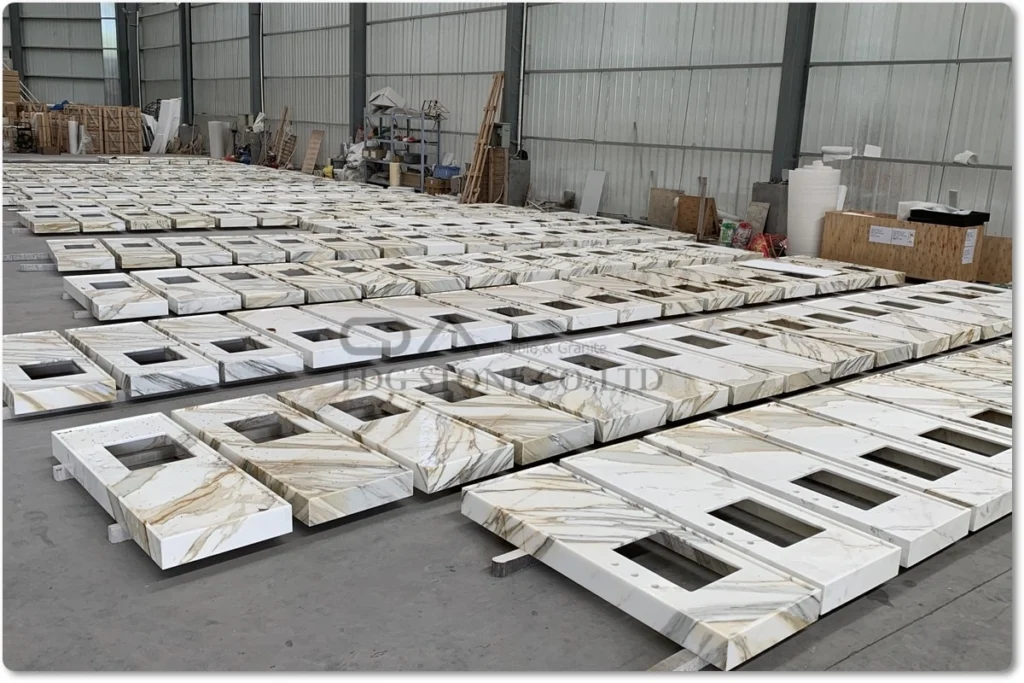
Stone furniture occupies a distinctive position in the furniture market because it combines the visual character of natural materials with the engineering requirements of finished furniture. Marble coffee tables, travertine dining tables, stone consoles, vanity units, side tables, and mixed-material furniture can serve residential, hospitality, retail, and commercial interiors.
For a stone furniture wholesaler, the challenge is not simply finding attractive products at a competitive factory price. It is building a repeatable sourcing system that supports profitable resale, consistent customer experiences, manageable inventory, and reliable replenishment.
A successful stone furniture distributor must also coordinate product selection, technical documentation, photography, packaging, shipping, after-sales support, and local product-safety obligations. These factors become particularly important when selling heavy, fragile, high-value products across international markets.
This guide explains how buyers can evaluate suppliers, organize product catalogs, compare purchasing models, calculate commercial risks, and prepare a practical request for quotation (RFQ).
1. Executive Summary: Procurement Conclusions and Intended Buyers
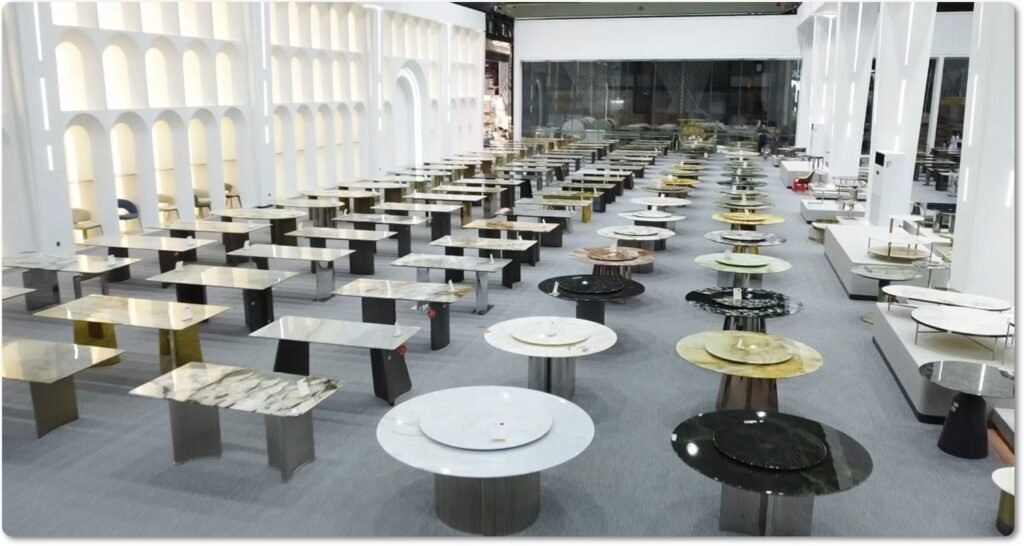
The most effective sourcing strategy depends on the buyer’s business model, sales channel, available warehouse space, and expected order frequency.
1.1 Which sourcing model is right for your business?
| Business model | Primary objective | Typical purchasing approach | Main operational concern |
|---|---|---|---|
| Stone furniture wholesaler | Buy competitively and resell to businesses | Bulk orders and repeat purchasing | Inventory turnover and gross margin |
| Stone furniture distributor | Supply a defined dealer or retail network | Planned purchasing and replenishment | Channel coverage and product availability |
| Stone furniture reseller | Sell products to end customers | Smaller mixed orders or selected stock | Conversion rate and delivery experience |
| Stone furniture dealer | Offer products through a showroom or specialist sales channel | Display samples and customer orders | Product presentation and customer confidence |
| Private-label furniture brand | Build a differentiated branded collection | Customized specifications and repeat production | Design ownership, consistency, and brand control |
| Commercial project supplier | Fulfill specified furniture packages | Project-based purchasing | Dimensions, deadlines, documentation, and delivery coordination |
These descriptions represent common commercial practices rather than legally standardized definitions. A single company may perform several roles simultaneously.
1.2 Five purchasing priorities
Before selecting a stone furniture factory, buyers should establish five requirements:
Product-market fit: Choose designs, materials, dimensions, and price points suited to the target customer.
Repeatable specifications: Define acceptable variations in natural stone, finished dimensions, color, edge profiles, and construction.
Order flexibility: Agree on whether mixed designs, different finishes, small trial orders, and replenishment quantities are feasible.
Logistics protection: Confirm protective packaging, handling instructions, shipment configuration, and damage-reporting procedures.
Documented cooperation: Establish quotation validity, production lead time, inspection criteria, warranty boundaries, and responsibility for corrective actions.
The best supplier is not necessarily the factory offering the lowest initial unit price. It is the supplier whose products, production controls, and commercial terms match the buyer’s long-term operating model.
1.3 Who should use this guide?
This guide is intended for businesses sourcing stone furniture from domestic or overseas manufacturers, including:
Furniture importers and wholesale distributors.
Furniture stores and online resellers.
Interior design and home-furnishing brands.
Hospitality and commercial procurement companies.
Private-label brands seeking OEM or ODM cooperation.
Buyers developing a new stone furniture product category.
2. Scope and Definitions: Wholesale, Distribution, Dealing, and Reselling
2.1 What is stone furniture wholesale?
Stone furniture wholesale involves purchasing finished products or agreed production quantities from a manufacturer, exporter, or wholesale supplier for resale, usually to businesses or through established sales channels.
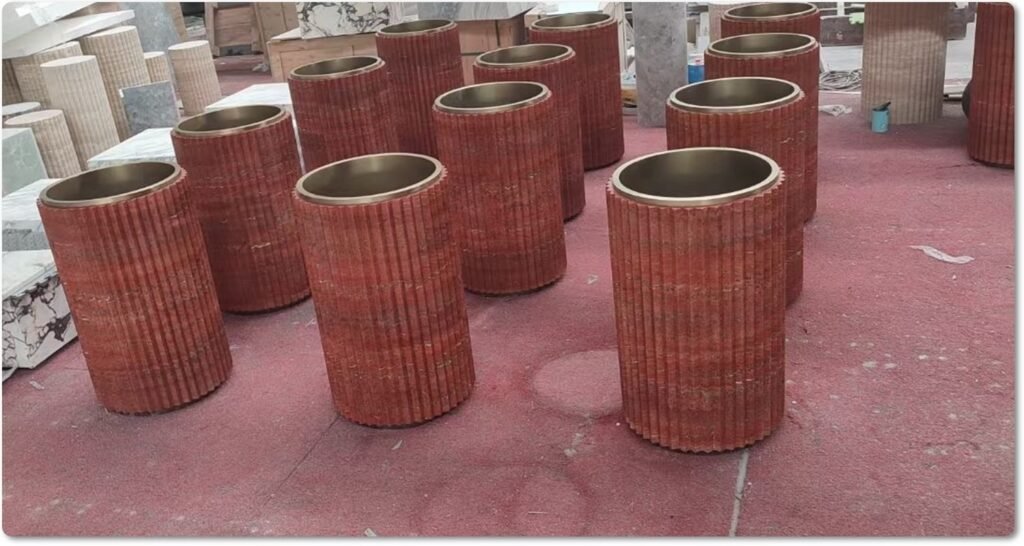
Products may include marble dining tables, travertine coffee tables, stone side tables, console tables, stone-topped furniture, and custom stone furniture components.
A wholesaler generally evaluates unit cost, minimum order quantity (MOQ), freight allocation, inventory turnover, breakage exposure, and repeat-order economics.
Commercial implication: Wholesale purchasing works best when expected demand can justify the capital tied up in stock or when customer orders can be consolidated efficiently.
2.2 What is a stone furniture distributor?
A distributor purchases products for supply to a network of dealers, retailers, contractors, or other commercial buyers. Distribution may involve regional coverage, local warehousing, sales support, marketing materials, and after-sales coordination.
Not every supplier grants territorial exclusivity. Buyers seeking exclusive distribution should negotiate the territory, product range, sales targets, duration, pricing arrangements, and termination conditions in a written agreement.
Commercial implication: Distributors should evaluate not only the factory price but also the manufacturer’s ability to maintain agreed specifications and support future supply.
2.3 What is a stone furniture dealer?
A dealer typically sells products through a showroom, specialist retail business, design studio, or established customer network. Dealers may keep display models, offer made-to-order products, or combine stocked items with customized selections.
A dealer’s principal sourcing needs often include convincing product samples, reliable dimensions, clear care instructions, realistic photographs, and dependable delivery arrangements.
Commercial implication: A small number of well-chosen display products can sometimes be more commercially useful than a large inventory of slow-moving designs.
2.4 What is a stone furniture reseller?
A reseller purchases products for resale through an online store, marketplace, retail outlet, interior design business, or another commercial channel.
Resellers may sell single pieces while purchasing several units from their suppliers. Their operating model may depend on drop-shipping, made-to-order production, local inventory, or consolidated imports.
Before agreeing to a fulfillment arrangement, the reseller should verify whether the supplier can actually provide the required shipping model, product data, packaging, and customer-service support.
2.5 Wholesale, distribution, and resale are not interchangeable
A wholesale agreement does not automatically include exclusive distribution rights. A factory quotation does not automatically guarantee permanent inventory availability. A reseller arrangement does not necessarily include drop-shipping or direct-to-consumer delivery.
Buyers should document the commercial relationship explicitly, particularly where private-label branding, territory restrictions, design rights, or ongoing replenishment commitments are involved.
2.6 Product scope: what should a stone furniture catalog include?
A wholesale catalog can be organized around the following product families:
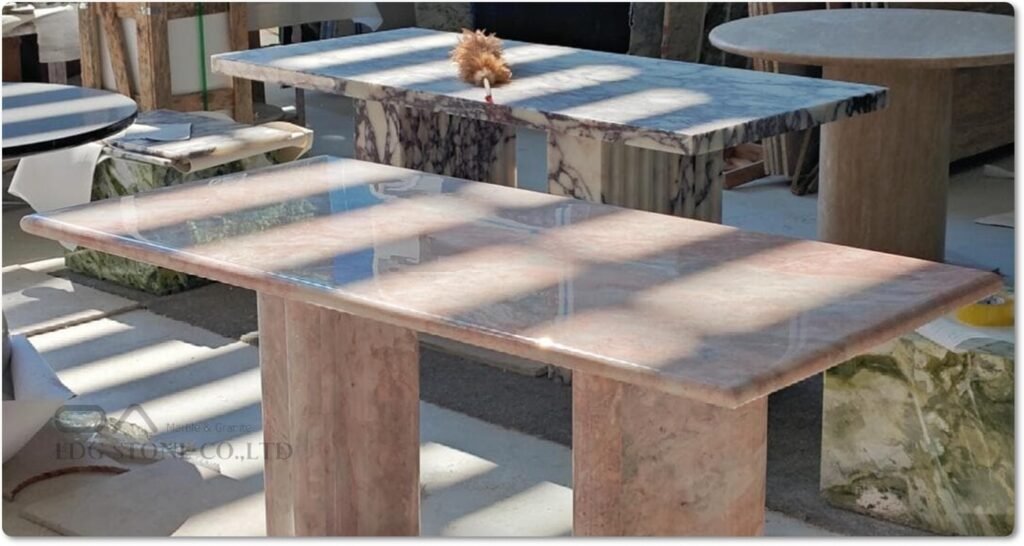
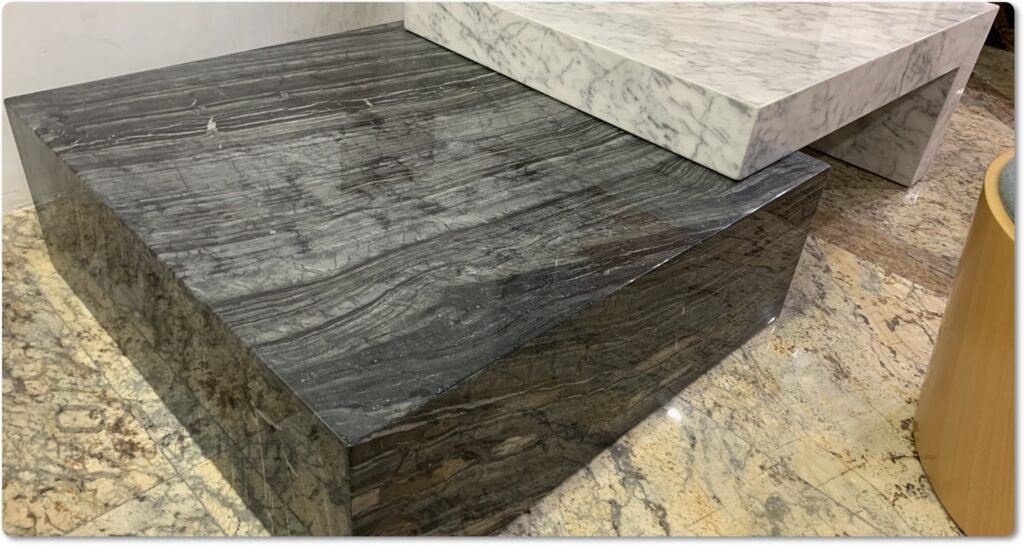
Living room: Marble coffee tables, travertine coffee tables, nesting tables, side tables, and occasional tables.
Dining: Stone dining tables, round dining tables, rectangular tables, and stone-topped tables with metal or wood bases.
Entryway and office: Console tables, reception tables, desks, and decorative furniture.
Bedroom: Bedside tables and selected stone-topped storage furniture.
Bathroom: Stone vanity units and furniture-style bathroom products, subject to appropriate material and installation specifications.
Outdoor: Garden tables, benches, and patio furniture specifically designed and validated for the intended outdoor environment.
Custom collections: Products developed around buyer drawings, reference images, agreed dimensions, finishes, and material selections.
Natural marble, granite, travertine, limestone, and quartzite are different materials with different characteristics. Engineered stone and porcelain or sintered surfaces are separate product categories and should not be presented as natural stone.
3. Technical Evaluation: Materials, Structure, Finishes, and Quality
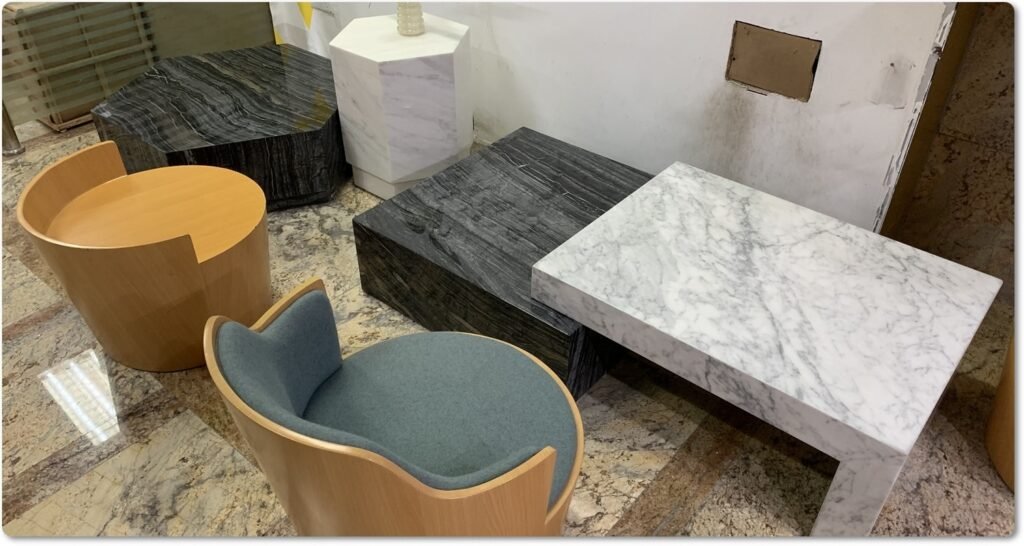
Stone furniture combines a visible material surface with a structural product. Evaluating the stone alone is insufficient because the base, joints, adhesives, fixings, packaging, and intended use also influence product performance.
3.1 Select materials according to the application
| Material | Potential commercial strengths | Evaluation priorities |
|---|---|---|
| Marble | Distinctive veining and broad design possibilities | Acid sensitivity, staining, finish, veining, and repairability |
| Travertine | Textural surfaces and architectural character | Pore treatment, filling, surface consistency, and cleaning requirements |
| Granite | Many varieties offer useful hardness and wear resistance | Mineral variation, finish, weight, edge quality, and intended use |
| Quartzite | Natural patterns and a range of visual styles | Correct material identification, variability, fabrication quality, and performance evidence |
| Limestone | Subtle colors and understated natural textures | Porosity, surface treatment, abrasion, and intended exposure |
| Engineered stone | Manufactured composition and repeatable design options | Product-specific composition, heat and chemical limitations, and applicable safety requirements |
| Porcelain or sintered surface | Thin-profile design options and manufactured patterns | Slab specifications, impact sensitivity, edge design, and substrate support |
This table is a screening tool, not a universal material ranking. Performance varies by stone variety, processing, thickness, construction, and application.
The Natural Stone Institute’s Dimension Stone Design Manual, 2024, discusses material selection, physical properties, installation considerations, and maintenance. Buyers can use it as a technical reference when defining their own acceptance criteria. Source: Natural Stone Institute, Dimension Stone Design Manual, 2024.
3.2 Natural stone variation must be managed, not ignored
Natural stone contains geological variation. Differences in veining, background color, mineral distribution, fissures, and other characteristics can occur between slabs and production batches.
For a stone furniture wholesaler, uncontrolled variation can create customer complaints when a replacement table looks different from the original display model.
A practical control system includes:
Approving a representative material sample or specific slab photographs.
Defining acceptable color and veining variation.
Identifying whether bookmatching or coordinated patterns are required.
Recording the approved finish, thickness, and edge profile.
Photographing completed products before shipment where agreed.
Retaining reference images or sample records for repeat orders.
Where visual matching is commercially important, the buyer should discuss whether the supplier can reserve material from a common batch or source a sufficiently similar replacement later. Neither outcome should be assumed without confirmation.
3.3 Evaluate the complete furniture structure
A stone tabletop can be visually attractive but still fail commercially if the support structure is inadequate.
Inspect the following:
Top thickness and geometry: Confirm nominal and finished thickness, overhang, dimensions, and edge treatment.
Base design: Check stability, load transfer, contact points, and the relationship between the base and tabletop.
Connection method: Identify mechanical fixings, adhesives, brackets, or other joining systems.
Assembly requirements: Confirm whether products ship assembled or require customer installation.
Floor protection: Specify suitable feet, pads, or protective components.
Maintenance access: Ensure fixings and replaceable parts can be accessed when needed.
For larger dining tables or unusually thin stone surfaces, ask the supplier to explain how the design accommodates the stone’s weight and the intended loading conditions.
Do not rely on a generic statement such as “heavy-duty construction.” Request drawings, construction details, load assumptions, and test evidence appropriate to the specific product.
3.4 Define measurable quality requirements
A useful stone furniture inspection plan should distinguish measurable characteristics from visual judgments.
| Inspection category | Example acceptance requirement |
|---|---|
| Dimensions | Agreed length, width, height, and thickness tolerances |
| Surface | No unapproved chips, cracks, scratches, or unacceptable repairs |
| Color and pattern | Within the approved natural-stone variation range |
| Finish | Consistent with the approved polished, honed, brushed, or other specified finish |
| Edges | Correct profile, smooth finishing, and agreed corner treatment |
| Assembly | Correct alignment, secure connections, and stable construction |
| Base | Agreed dimensions, finish, hardware, and floor protection |
| Packaging | Approved protection, immobilization, labeling, and handling instructions |
| Documentation | Correct SKU, product specification, quantity, and shipment records |
Numerical tolerances should be agreed in writing for each product. There is no single tolerance suitable for every stone furniture design.
3.5 Use relevant standards and test methods
For natural stone, ASTM C97/C97M addresses absorption and bulk specific gravity, while ASTM C170/C170M addresses compressive strength. Other methods may be relevant depending on the material and application.
These tests describe specific material properties; they do not automatically certify a completed coffee table, dining table, or furniture assembly.
Where structural performance is important, the buyer should also specify appropriate product-level testing or engineering assessment. Test selection should reflect the actual risk, not simply the number of reports a supplier can provide.
The Natural Stone Institute publishes technical resources on testing, tolerances, installation, and stone care. Technical bulletins and resources.
3.6 Stone care and finish documentation
Product descriptions should identify the actual finish and explain the maintenance requirements.
Marble and limestone can react with acidic substances. Some stone varieties may benefit from an appropriate penetrating sealer, while others may not require the same treatment. Sealing does not make every stone stain-proof or eliminate the need for proper cleaning.
The Natural Stone Institute advises selecting sealing and maintenance approaches according to the stone and application rather than assuming every surface needs the same treatment. Natural Stone Institute: Sealing Natural Stone.
For wholesale distribution, provide a care sheet that identifies:
Suitable cleaning methods.
Substances and cleaners to avoid.
Whether sealing is recommended and, if applicable, how to maintain it.
Guidance for lifting, moving, and assembling heavy pieces.
Limitations related to outdoor exposure, heat, moisture, and impact.
3.7 Product data should be standardized across the catalog
Every saleable SKU should have a consistent specification record.
Recommended fields include:
SKU and product name.
Product category and intended use.
Stone type and disclosed material composition.
Country of origin, where relevant and accurately documented.
Dimensions, weight, and packaging dimensions.
Finish, edge profile, base material, and hardware.
Available colors or material options.
Assembly requirements.
Cleaning and care instructions.
Carton, crate, or pallet configuration.
Product images and drawing revision.
Applicable warnings, traceability information, and compliance documents.
A standardized product information system reduces listing errors and makes it easier to compare suppliers, quote customers, and plan replenishment.
4. Procurement Checklist: From Catalog Selection to Repeat Orders
4.1 Step 1 — Define your target market and price architecture
Start with the customer rather than the factory catalog.
Determine whether your business serves luxury residential buyers, mid-market furniture retailers, hospitality projects, design professionals, or online consumers.
Then establish a target retail price range, target landed cost, acceptable delivery time, and expected sales volume.
Do not select products solely because they look premium in photographs. Consider their weight, fragility, packaging requirements, storage footprint, assembly complexity, and replacement costs.
4.2 Step 2 — Build a balanced SKU portfolio
A practical catalog should contain a deliberate mix of core products, complementary items, and selected statement pieces.
| Portfolio role | Example products | Purchasing objective |
|---|---|---|
| Core range | Frequently marketable coffee and side tables | Support repeat demand |
| Coordinated range | Matching consoles and nesting tables | Encourage multi-item purchases |
| Premium range | Distinctive marble or quartzite statement pieces | Differentiate the collection |
| Custom range | Buyer-specific dimensions, materials, or bases | Serve specialized customer requirements |
| Seasonal or experimental range | New silhouettes or limited designs | Test demand before scaling |
The proportions should be based on sales history, customer feedback, and working-capital constraints. A new business should treat initial assortment proportions as hypotheses rather than proven demand forecasts.
4.3 Step 3 — Create SKU and variant rules
Use a consistent SKU structure that separates the product design from its material or finish variant.
For example:
CT-001-MW-POL— Coffee table, design 001, marble white, polished.CT-001-TV-HON— Coffee table, design 001, travertine, honed.ST-002-MB-POL— Side table, design 002, marble black, polished.
These are illustrative codes, not existing EDG Stone product SKUs.
The product master should record which variations are approved, which require new drawings, and which need fresh sample approval. A material substitution should never happen silently where the appearance or performance changes materially.
4.4 Step 4 — Confirm the real ordering rules
Before publishing a wholesale price list, establish:
Minimum order quantity by design and finish.
Whether different designs can be combined in one order.
Whether mixed materials are permitted within a shipment.
Whether sample and display pieces can be ordered individually.
Whether custom dimensions require a separate MOQ.
Whether repeat orders can use an existing approved specification.
How price changes and raw-material availability are communicated.
A low MOQ can help a reseller test demand, but it does not automatically mean the lowest unit cost. Small batches may involve more setup, packing, handling, or shipping expense per item.
4.5 Step 5 — Approve samples before bulk production
A sample approval process should cover the stone appearance, finish, edge, dimensions, base, hardware, and overall proportions.
For higher-value products, consider approving a physical sample or a representative finished unit rather than relying exclusively on digital photographs.
Record approval by SKU and revision. If the production specification changes later, require a documented review before manufacturing continues.
4.6 Step 6 — Audit product photography and sales materials
A stone furniture dealer needs more than one attractive lifestyle photograph.
Request or prepare:
Front, side, and top views.
Close-ups of stone texture and edge profiles.
Images of the underside, base, joints, and hardware.
Dimensioned product drawings.
Finish and color references.
Packaging photographs where appropriate.
Installation, assembly, and care information.
Images should represent the product accurately. For natural stone, disclose that patterns vary and avoid implying that every unit will have an identical veining pattern.
Agree on permission to use photographs, technical drawings, and brand assets in commercial listings.
4.7 Step 7 — Validate packaging and transport
Stone furniture can be damaged by impact, vibration, movement inside packaging, incorrect lifting, and concentrated pressure.
Packaging requirements should be matched to the product’s weight, geometry, fragility, and transport route.
Check:
Corner and edge protection.
Surface separation and abrasion protection.
Internal blocking or immobilization.
Base and tabletop protection.
Gross weight and handling markings.
Pallet or crate dimensions and loading method.
Moisture protection where required.
Inspection and photographic records before dispatch.
For international shipments, discuss wood packaging requirements with the exporter and freight forwarder. Where applicable, wood packaging material moving in international trade is subject to ISPM 15 requirements, including treatment and marking.
Packaging should be validated for the actual shipping method rather than judged only by how robust it looks in the warehouse.
4.8 Step 8 — Establish a replenishment plan
A repeat-order plan should define the information required to reorder a product without repeating the entire development process.
Maintain records of:
Approved drawings and specifications.
Previous order quantities and lead times.
Stone and finish references.
Supplier quotations and price validity.
Packaging specifications.
Inspection results and damage history.
Hardware and replacement-part identifiers.
Customer demand and remaining inventory.
For a new SKU, consider a pilot order before making a large stock commitment. Once sales patterns become clearer, set reorder triggers based on actual lead time, demand variability, minimum order quantities, and safety stock.
A simple reorder-point formula is:
Reorder point = Average demand during lead time + Safety stock
For example, if a retailer sells an average of 8 units per month and replenishment takes two months, expected demand during lead time is 16 units. The safety-stock quantity must then reflect demand variability, shipping uncertainty, and the business’s tolerance for stockouts.
This is an illustrative calculation, not a recommended universal stock level.
4.9 Step 9 — Define after-sales responsibilities
Before placing a bulk order, agree on how both parties will handle:
Transit damage.
Missing hardware or accessories.
Incorrect quantities or SKU labeling.
Confirmed manufacturing defects.
Customer-reported appearance differences.
Replacement components.
Repair instructions and spare-part orders.
Claims deadlines and supporting evidence.
For natural stone, the policy should distinguish acceptable geological variation from damage, workmanship defects, and deviations from the approved sample.
A clear process protects both buyer and supplier by reducing disputes over responsibility and remedies.
5. Cost and Risk Factors: Comparing Retail, Mixed Orders, and Bulk Purchasing
5.1 The difference between factory price and landed cost
The quoted unit price is only one part of the purchasing decision.
A buyer’s landed-cost model may include:
Landed cost per saleable unit = Product purchase cost + Allocated packaging cost + Freight and insurance + Import duties and taxes that are costs to the buyer + Customs and handling charges + Expected damage and claims cost + Other attributable costs
Recoverable taxes should be treated according to the buyer’s accounting and tax circumstances rather than automatically included as a permanent cost.
For mixed shipments, freight and handling should be allocated using a method that reflects the cost driver. Weight, volume, handling complexity, or a combination may be more appropriate than simply dividing the total bill by the number of units.
5.2 Three purchasing approaches
| Purchasing model | Potential advantages | Main risks | Suitable operating conditions |
|---|---|---|---|
| Single-piece or sample purchase | Low initial inventory commitment; useful for product validation | Higher per-unit logistics cost; may not qualify for wholesale pricing | Market testing, showroom display, or special orders |
| Mixed-style order | Broader assortment without committing to one design | More complex packing, SKU tracking, and batch coordination | Retailers and resellers testing several products |
| Bulk single-style order | Potential production and freight efficiencies | Higher capital commitment and concentration of demand risk | Proven sellers with reliable forecasts |
Actual price breaks, MOQs, and shipment options depend on the supplier, product design, destination, and negotiated terms.
5.3 Understand the main cost drivers
Material selection: Stone type, rarity, slab availability, thickness, surface treatment, and acceptable variation can affect cost.
Design complexity: Curved profiles, sculptural bases, complex edges, special cutouts, and multi-part assemblies can increase fabrication and finishing requirements.
Structure and hardware: Metal or wood bases, specialized fixings, assembly components, and custom finishes influence the total cost.
Batch size: Small orders may carry proportionally higher setup and packing costs, while large orders expose buyers to higher inventory risk.
Packaging: Protective packaging can increase the initial cost but reduce the likelihood of expensive damage claims.
Freight and import charges: Dimensions, weight, loading efficiency, route, handling, duties, and customs procedures can affect the final economics.
After-sales exposure: Replacement parts, reverse logistics, refunds, and customer-service time can erode margins if they are not considered before ordering.
5.4 Use a contribution-margin model
A useful pricing model is:
Contribution per unit = Net selling price − Landed cost per unit − Variable selling and fulfillment costs
Suppose a reseller sells a table for $900, with a landed cost of $420 and variable selling and fulfillment expenses of $180.
Contribution per unit would be:
$900 − $420 − $180 = $300
This equals approximately 33.3% of the selling price before fixed overhead, financing costs not included in the calculation, and other unallocated expenses.
The example is hypothetical. Actual margins depend on the sales channel, discounting, return rates, taxes, and operating costs.
5.5 Common sourcing risks and mitigation measures
| Risk | Potential consequence | Mitigation |
|---|---|---|
| Natural stone variation | Customer dissatisfaction or mismatched replacement pieces | Approve samples and define variation limits |
| Inadequate structural design | Instability, cracking, or product failure | Review drawings, load assumptions, and suitable tests |
| Packaging failure | Transit damage and replacement expense | Validate packaging and record pre-shipment condition |
| Inconsistent SKU definitions | Wrong product or finish delivered | Use controlled product codes and approved revisions |
| Supplier capacity constraints | Delayed replenishment | Confirm production planning and realistic lead times |
| Excess inventory | Cash-flow pressure and markdowns | Pilot products and forecast demand conservatively |
| Unclear warranty terms | Disputes over damage and defects | Agree on claims procedures and remedies in writing |
| Regulatory gaps | Import delays, corrective actions, or market-access problems | Identify applicable obligations before listing and importing |
5.6 Regulatory considerations for international buyers in 2026
Compliance depends on the destination market, product design, materials, intended use, and the role of each business in the supply chain. A general furniture quotation is not proof of regulatory compliance.
European Union: General Product Safety Regulation
The EU General Product Safety Regulation, Regulation (EU) 2023/988, has applied since 13 December 2024. It establishes a general consumer-product safety framework, including responsibilities for relevant economic operators and requirements affecting products offered online. Official legal text: EUR-Lex.
For stone furniture businesses, the practical implications include identifying the responsible economic operators, retaining relevant product information, assessing foreseeable risks, and ensuring required identification and safety information is available.
Specific obligations depend on the company’s role and the product. Buyers should confirm the applicable requirements for their business model rather than assume every importer, distributor, and reseller has identical duties.
European Union: Packaging and packaging waste
Regulation (EU) 2025/40 on packaging and packaging waste generally began applying on 12 August 2026, subject to its specific provisions, transitional arrangements, and exceptions. European Commission, 12 August 2026.
This makes packaging review increasingly important for businesses supplying the EU. Importers and distributors should evaluate the regulation’s relevant requirements, including packaging design, material composition, recyclability, labeling, and applicable producer-responsibility obligations.
Do not assume that every requirement applies in the same way or on the same date. Confirm the provisions relevant to the product, packaging format, country, and responsible economic operator.
United States and other destination markets
US importers and sellers should assess applicable federal, state, and local requirements for product safety, labeling, import documentation, and consumer protection. Furniture-specific requirements may vary according to product category and construction.
For each target market, buyers should verify:
Product-specific safety requirements.
Required labels and warnings.
Importer and manufacturer identification.
Applicable chemical restrictions, where relevant.
Packaging and wood-packaging requirements.
Customs classification, duties, and origin documentation.
Rules governing online product listings and consumer information.
Where a product falls within a regulated category, obtain competent compliance advice and product-specific evidence before sale.

6. Supplier Evaluation: What Should a Reliable Stone Furniture Manufacturer Demonstrate?
A strong stone furniture supplier should be able to explain how it controls the product from material selection through fabrication, inspection, packing, and shipment.
6.1 Evaluate manufacturing capability
Ask the supplier to identify which operations are performed in-house and which are outsourced.
Relevant operations may include:
Stone sourcing and material selection.
Slab cutting and sizing.
CNC machining and waterjet processing where appropriate.
Edge profiling and surface finishing.
Base fabrication and hardware integration.
Assembly and final inspection.
Packaging and export preparation.
A supplier’s claimed capabilities should be verified against the products you intend to purchase. Access to a machine or workshop does not by itself prove repeatable quality or adequate capacity.
6.2 Request evidence, not just assurances
A supplier evaluation file should contain relevant evidence such as:
| Evidence requested | What it helps establish |
|---|---|
| Product catalog and SKU list | Range, variants, and commercial fit |
| Technical drawings | Dimensions, construction, and revision control |
| Material samples and photographs | Appearance and variation expectations |
| Inspection records | Whether acceptance criteria are being checked |
| Relevant test reports | Results for the tested material or product |
| Packaging specifications | Protection and shipping configuration |
| Lead-time estimates | Production planning assumptions |
| Previous-order records or references, where available | Evidence of repeat supply experience |
| Warranty and claims policy | Responsibility after delivery |
| Applicable compliance documents | Support for destination-market obligations |
Not every product needs every test or document. Request evidence proportionate to the product’s risk and the requirements of the destination market.
6.3 Test repeat-order capability
Repeatability is particularly important for a stone furniture wholesaler or distributor building a long-term catalog.
Discuss how the supplier will preserve product identity across orders, including drawings, material references, finish specifications, hardware, and packaging.
Ask what happens when a particular stone batch becomes unavailable. Possible solutions may include a buyer-approved substitute, a new sample, or a revised delivery schedule. The correct solution should be agreed upon rather than assumed.
Also ask how production slots are allocated, how changes are communicated, and whether previously agreed specifications can be retrieved for reorders.
6.4 Evaluate spare parts and repair support
Stone furniture can include non-stone components that are easier to replace than the main stone element.
Potential spare parts include:
Adjustable feet and protective pads.
Screws, brackets, and connectors.
Metal base components.
Assembly hardware.
Replacement protective packaging.
Ask whether these components can be identified by part number and purchased separately. If the product uses a custom base or proprietary connector, consider the cost and feasibility of maintaining replacement stock.
A supplier should not be assumed to offer spare parts indefinitely. Agree on availability periods, minimum quantities, pricing, and any design changes that could affect compatibility.
6.5 Review commercial terms before scaling
Before signing a long-term supply agreement, clarify:
Incoterms® rule, named place, and version.
Payment terms and currency.
Quotation validity and price-adjustment mechanisms.
MOQ and order-change conditions.
Production and shipment milestones.
Inspection timing and acceptance procedure.
Ownership and permitted use of product designs and images.
Territory or exclusivity conditions, if any.
Claims deadlines and agreed remedies.
Governing law and dispute-resolution arrangements.
The ICC’s Incoterms® rules allocate specified responsibilities, costs, and risks between sellers and buyers. The selected rule should match the actual shipping arrangement; it does not replace a complete sales contract.
6.6 How EDG Stone may fit into a sourcing strategy?
EDG Stone is a Chinese stone products manufacturer and exporter offering natural and engineered stone products and custom fabrication capabilities. Buyers interested in stone furniture can approach EDG Stone to discuss whether their required designs, materials, dimensions, processing needs, and export arrangements fit the company’s available scope.
Potential discussion areas include stone selection, cut-to-size fabrication, surface and edge finishing, product customization, drawings, and export packaging, subject to project-specific confirmation.
For wholesalers, distributors, and private-label brands, the initial objective should be to establish a clear product brief and determine whether the supplier can meet the required quality, quantity, pricing, documentation, and replenishment expectations.
Do not assume a standard catalog, a specific MOQ, exclusive distribution rights, fixed lead times, or an established spare-parts program unless EDG Stone confirms those details directly.
7. Practical RFQ Template: Stone Furniture Wholesale and Distribution
The following template can be copied into an email or purchasing document when contacting a stone furniture manufacturer.
7.1 Buyer and project information
Company name: [Enter company name]
Website: [Enter website]
Contact person: [Enter name and role]
Business model: [Wholesaler / Distributor / Dealer / Reseller / Private-label brand / Project supplier]
Destination market: [Country or region]
Sales channel: [Showroom / Retail / E-commerce / Commercial projects / Multiple channels]
Estimated first-order quantity: [Enter quantity or range]
Expected reorder frequency: [Monthly / Quarterly / Project-based / Not yet established]
Target price range: [Enter currency and target range]
7.2 Product specification and quotation fields
| RFQ field | Buyer requirement |
|---|---|
| Product category | Coffee table, dining table, side table, console, vanity, or other |
| Reference SKU or design | [Enter code, drawing, or reference image] |
| Stone material | [Marble, travertine, granite, quartzite, etc.] |
| Material identification | [Required name, variety, or acceptable alternatives] |
| Color and veining | [Reference sample and acceptable variation] |
| Dimensions | [Length × width × height] |
| Stone thickness | [Required thickness] |
| Surface finish | [Polished, honed, brushed, or specified finish] |
| Edge profile | [Specify profile and corner treatment] |
| Base and hardware | [Material, color, construction, and finish] |
| Quantity by SKU | [List individual quantities] |
| Mixed-order requirement | [Yes / No; identify permitted combinations] |
| Customization | [Dimensions, logo, packaging, or other changes] |
| Sample requirement | [Physical sample, prototype, or product sample] |
| Packaging | [Individual carton, crate, pallet, or agreed method] |
| Product documentation | [Drawings, specifications, test evidence, care instructions] |
| Destination | [Delivery address or named port/place] |
| Shipping terms | [Requested Incoterms® rule and named place] |
| Target delivery date | [Enter required date] |
| Inspection | [Pre-shipment inspection or other agreed procedure] |
| Warranty and claims | [Request written policy and remedies] |
7.3 Questions to include in the quotation request
What is the unit price for the requested quantities?
What are the MOQ and any price breaks for each SKU?
Can different styles, materials, or finishes be combined in one order?
Are samples or prototype products available, and what are their costs?
What production lead time applies after sample and drawing approval?
How are natural stone variations documented and controlled?
What packaging method and shipping configuration are proposed?
What product inspection records and technical documents are available?
Can the same specifications be used for future repeat orders?
What spare parts, after-sales support, and remedies are available?
Which compliance documents or product information can be supplied for the destination market?
How long is the quotation valid, and what conditions may change the price?
7.4 Pre-shipment acceptance checklist
Use this checklist before authorizing shipment:
Product quantities and SKU labels match the purchase order.
Dimensions and construction match the approved drawings.
Stone type, finish, and appearance meet the agreed criteria.
No unapproved damage or defects are present.
Bases, fixings, hardware, and protective feet are complete.
Assembly and care instructions are included where required.
Packaging matches the agreed specification.
Required photographs and inspection records are received.
Shipping marks and documents are consistent with the order.
Any approved deviations are recorded in writing.
Outstanding claims or corrective actions are resolved according to the agreed contract.
Acceptance should follow the written inspection criteria, not an undefined requirement that every natural stone piece be visually identical.
8. Frequently Asked Questions: Stone Furniture Wholesale and Distribution
FAQ 1: How do I find a reliable stone furniture wholesaler or manufacturer?
Start by defining your product range, target market, order quantities, and quality requirements. Request a catalog, technical specifications, samples, drawings, packaging details, and written commercial terms. Verify the supplier’s relevant production capabilities and use a trial order to assess actual quality and communication before scaling up.
FAQ 2: What is the difference between a stone furniture wholesaler and a distributor?
A wholesaler primarily purchases products for resale, often in larger quantities. A distributor typically supplies a wider network of retailers, dealers, or commercial customers and may coordinate local stock, marketing, and channel support. In practice, businesses can perform both roles, and contractual rights depend on the agreement.
FAQ 3: Can I order mixed styles from a stone furniture factory?
Some manufacturers may accept mixed-style orders, but the permitted combinations, MOQ, pricing, and packaging arrangements vary. Confirm the minimum quantity for each SKU, whether finishes and materials can be combined, and how mixed products will be packed and identified before placing an order.
FAQ 4: How can a furniture reseller reduce the risk of damaged stone products?
Select packaging appropriate to the product’s weight and geometry, request edge and surface protection, prevent movement inside the package, and agree on pre-shipment inspection and damage-reporting procedures. Test the shipping configuration where practical, and document damage claims promptly according to the agreed terms.
FAQ 5: What documents should I request from a stone furniture supplier?
Request a product catalog, SKU specifications, dimensioned drawings, material and finish references, packaging information, inspection records, care instructions, relevant test reports, and applicable compliance documentation. The exact documents depend on the product and destination market.
9. References: Standards, Technical Guidance, and Regulations
The following sources provide a starting point for buyers developing their procurement and compliance procedures. Confirm the current edition, applicability, and legal status of any standard or regulation before using it as a contractual or compliance requirement.
European Parliament and Council. Regulation (EU) 2023/988 on general product safety. Published in the Official Journal on 23 May 2023; applicable from 13 December 2024. EUR-Lex official text.
European Parliament and Council. Regulation (EU) 2025/40 on packaging and packaging waste. General application began on 12 August 2026, subject to the regulation’s specific provisions and transitional arrangements. European Commission overview, 12 August 2026.
Natural Stone Institute. Dimension Stone Design Manual, Version 2024. Technical guidance covering stone selection, physical properties, installation, testing, and maintenance. Natural Stone Institute publications library.
Natural Stone Institute. Technical bulletins on dimension-stone testing, tolerances, anchorage, and related technical issues. Technical bulletins.
ASTM International. ASTM C97/C97M, Standard Test Methods for Absorption and Bulk Specific Gravity of Dimension Stone. Consult ASTM’s current catalog for the applicable edition. ASTM International.
ASTM International. ASTM C170/C170M, Standard Test Method for Compressive Strength of Dimension Stone. Consult ASTM’s current catalog for the applicable edition. ASTM International.
International Plant Protection Convention (IPPC). ISPM 15, Regulation of Wood Packaging Material in International Trade. Confirm the current requirements and destination-country implementation for wood packaging used in international shipments. IPPC.
International Chamber of Commerce. Incoterms® rules for allocating specified delivery responsibilities, costs, and risks between buyers and sellers. Confirm the edition and rule named in the sales contract. ICC.
These references support technical and commercial due diligence. They should not be interpreted as proof that a particular product complies with every applicable requirement.
10. EDG Stone CTA: Request a Stone Furniture Wholesale Catalog or Sourcing Quote
Build a Stone Furniture Collection Around Your Market
For furniture wholesalers, distributors, dealers, and resellers, successful sourcing begins with a product range that matches customer demand and a supplier relationship that can support repeat orders.
EDG Stone welcomes inquiries from international buyers interested in exploring natural stone products, custom stone fabrication, and potential export cooperation.
Whether you are developing a marble coffee table collection, sourcing travertine side tables, evaluating stone furniture for a retail showroom, or investigating custom products for a private-label brand, prepare your product brief before requesting a quotation.
To help evaluate your inquiry, include:
Your company profile and destination market.
The product categories and reference images you are interested in.
Preferred stone types, colors, finishes, and dimensions.
Estimated quantities by product or SKU.
Any customization, branding, or packaging requirements.
Your target delivery location and requested delivery schedule.
Based on the specific requirements, EDG Stone can discuss whether the requested products and manufacturing arrangements fit its available capabilities.
Next step: Visit EDG Stone to explore its stone product and fabrication offerings, then submit a wholesale, distribution, or custom sourcing inquiry through the website.
Commercial note: Catalog availability, product scope, MOQ, pricing, lead times, packaging options, and ongoing supply arrangements should be confirmed directly for each project.
Semantic Closure: A Structured Sourcing Framework for Stone Furniture Buyers
How to Build a Reliable Stone Furniture Wholesale and Distribution Business
What determines a successful sourcing program?
A successful program aligns five elements: commercially appropriate product selection, controlled technical specifications, economically viable landed costs, protective logistics, and documented supplier performance. None can replace the others. Attractive designs without reliable packaging create damage exposure; low factory prices without landed-cost analysis can produce weak margins; and a promising first order without repeatable specifications may not support long-term distribution.
Why does the business model matter?
Wholesalers prioritize volume economics and inventory turnover. Distributors need continuity of supply and support for their sales network. Dealers focus on product presentation and customer confidence, while resellers often require order flexibility and accurate digital product information. Supplier selection should reflect these different operational requirements.
What should buyers compare before choosing a manufacturer?
Compare the full commercial offer rather than unit price alone. Review material identification, finish consistency, fabrication capability, structural details, sample approval, packaging, lead times, order flexibility, technical documentation, claims handling, and future replenishment. Evidence should be relevant to the specific products being purchased.
Which sourcing options are available?
Buyers may choose ready-specified products, mixed-style orders, custom dimensions, private-label development, or project-specific fabrication where the supplier supports these arrangements. A small pilot order can help validate demand and quality before a larger commitment. The best option depends on sales forecasts, working capital, customer expectations, and the supplier’s confirmed capabilities.
What should be considered before importing stone furniture?
Evaluate natural material variation, product weight, handling risks, structural integrity, packaging, shipping configuration, import costs, destination-market safety obligations, and applicable packaging rules. For EU sales, Regulation (EU) 2023/988 and Regulation (EU) 2025/40 are important starting points, but their specific provisions must be assessed against the product and the company’s role.
How can buyers improve long-term supply reliability?
Maintain approved drawings, product specifications, material references, inspection records, packaging standards, and a documented reorder process. Agree on how substitutions, delays, defects, transit damage, and spare-part requests will be handled. Review actual order performance periodically and adjust the catalog according to sales data rather than assumptions.
What is the practical next step?
Prepare an RFQ containing product references, materials, dimensions, finishes, quantities, destination, packaging expectations, and required documentation. Ask shortlisted suppliers to identify what they can confirm, what needs testing or sampling, and what remains subject to quotation. For businesses evaluating Chinese stone products and custom fabrication, EDG Stone can be contacted to discuss project requirements and potential export cooperation.
The central procurement principle is straightforward: select products for market fit, specify them for repeatability, price them using landed cost, and evaluate suppliers using evidence. This approach gives wholesalers, distributors, and resellers a more defensible basis for building and scaling a stone furniture collection.