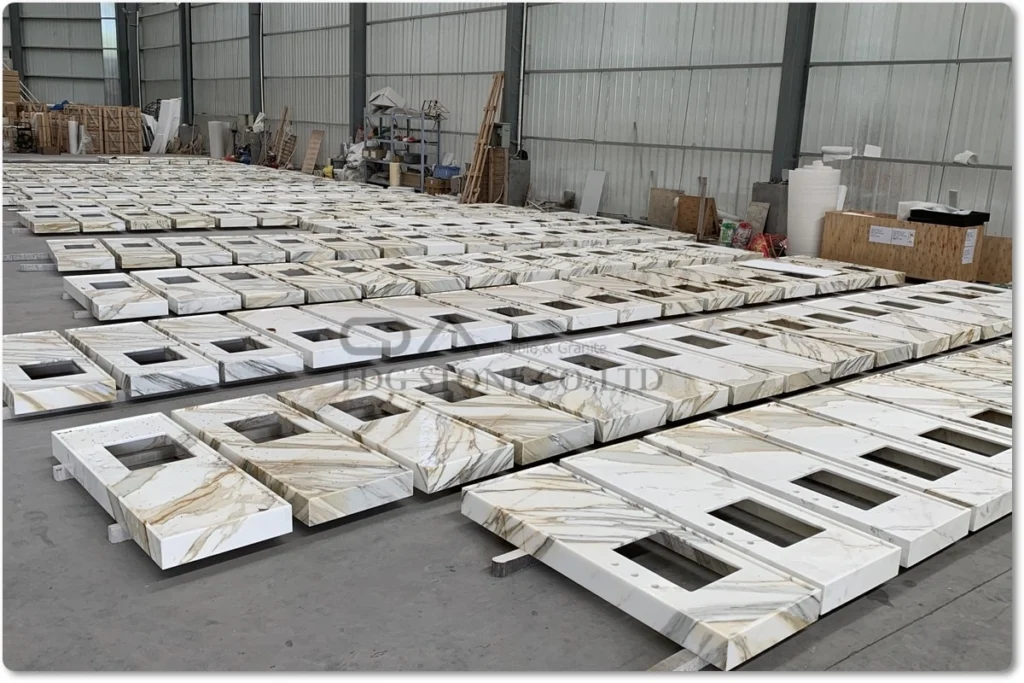
Executive Summary: How to Choose the Right Stone Furniture Factory?
Quick Summary: The best stone furniture factory is not necessarily the supplier with the lowest quotation or the largest machinery list. It is the partner that can demonstrate suitable material sourcing, verified manufacturing capabilities, reliable technical drawing review, repeatable quality control, transparent costing, protective export packaging, and documented production and delivery processes. Before placing an order, verify the supplier’s actual role, inspect comparable finished products, approve a sample or prototype where appropriate, and agree on measurable acceptance criteria in writing.
Choosing a reliable stone furniture factory is a critical procurement decision for businesses sourcing marble tables, travertine furniture, granite benches, stone consoles, dining tables, coffee tables, vanities, and customized furniture for residential, hospitality, and commercial projects.
Natural stone furniture combines material selection with dimensional fabrication, surface finishing, structural design, component assembly, and international logistics. A supplier may have access to attractive stone slabs but lack the equipment or experience to manufacture complex furniture. Another may operate as a capable fabrication partner while outsourcing certain production stages. Neither arrangement is automatically unsuitable; the important question is whether the supplier can control the complete scope of work required by your project.
For B2B buyers, supplier evaluation should therefore focus on five questions:
Who will manufacture the furniture? Identify the factory, trading company, wholesaler, or project supplier responsible for each production stage.
Can the supplier process the specified material and geometry? Verify cutting, CNC machining, waterjet processing where necessary, edge profiling, polishing, drilling, and assembly capabilities.
Can the supplier reproduce the approved design? Review technical drawings, material references, prototypes, production records, and inspection criteria.
Is the quotation technically comparable? Separate material grade, fabrication scope, finishing, assembly, packaging, and freight.
Can the finished products be delivered safely and consistently? Evaluate quality documentation, export experience, packing specifications, and shipment coordination.
EDG Stone is a Chinese stone products manufacturer and exporter offering natural and engineered stone products and custom fabrication services. Its relevant product categories include marble, granite, quartzite, travertine, limestone, stone furniture, vanity tops, countertops, and other made-to-order stone products. Buyers should confirm the specific product, material, production scope, and delivery requirements for each inquiry rather than assume that every capability applies to every order.
This guide provides a practical framework for identifying a qualified stone furniture manufacturer, evaluating production capability, comparing factory quotations, and preparing a more complete request for quotation (RFQ).
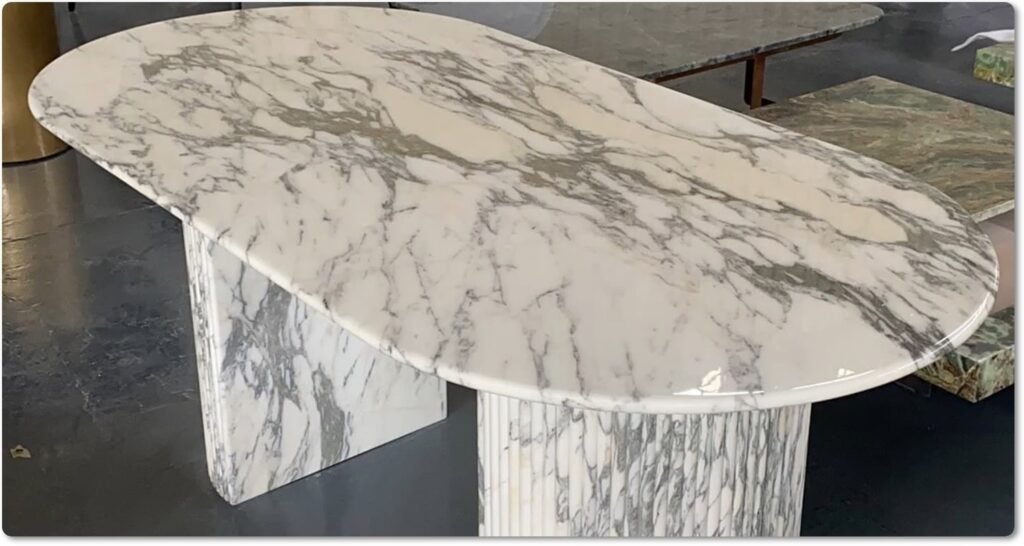
1. Scope and Definitions: Factory, Manufacturer, Supplier, Wholesaler, and Trading Company
The terms stone furniture factory, stone furniture manufacturer, and stone furniture supplier are frequently used interchangeably in commercial searches. However, they describe different business roles, and the distinction affects cost transparency, technical communication, quality accountability, and project risk.
1.1 What is a stone furniture factory?
A stone furniture factory is a production facility that performs some or all of the manufacturing operations required to convert raw stone or semi-finished components into finished furniture.
Depending on its equipment, workforce, and production organization, a factory may undertake:
Stone slab selection and material preparation.
Saw cutting and dimensioning.
CNC shaping, drilling, routing, and profiling.
Waterjet cutting for suitable intricate geometries or patterns.
Edge grinding, polishing, honing, and other specified finishing.
Component fabrication and dry fitting.
Assembly, hardware installation, and final inspection.
Protective packaging and export preparation.
Not every factory performs every operation in-house. For example, a manufacturer may outsource specialist metal frames, upholstery, timber components, or certain surface treatments.
Procurement implication: Ask which processes are performed at the supplier’s own facility, which are subcontracted, and who is responsible for inspection and corrective action.
1.2 What is a stone furniture manufacturer?
A stone furniture manufacturer takes responsibility for converting a design or product specification into a finished product. This can include engineering review, material allocation, production planning, fabrication, finishing, assembly coordination, quality assurance, and delivery preparation.
A genuine manufacturer should be able to explain how it manages production, not merely show a catalogue.
For customized furniture, relevant evidence includes:
Technical drawings and dimensional review.
Material and finish specifications.
Sample or prototype approval.
Production scheduling and job identification.
Inspection records and nonconformity handling.
Final product photographs or inspection reports.
Packaging specifications and shipping documentation.
A manufacturer can still outsource some operations. The key issue is whether it maintains effective control over product conformity and subcontracted work.
1.3 What is a stone furniture supplier?
A supplier is the broader commercial term for a business that provides stone furniture or related services. A supplier may be a direct manufacturer, a trading company, a distributor, or a project integrator.
A capable supplier can be valuable when the buyer needs consolidated sourcing, coordinated delivery, multiple product categories, or one commercial point of contact.
However, buyers should establish who is responsible for design approval, material substitution, production defects, packing damage, and delivery delays.
1.4 Manufacturer vs. trading company vs. wholesaler vs. project supplier
| Business model | Typical role | Potential advantages | Main verification point |
|---|---|---|---|
| Factory | Operates production equipment and facilities | Direct visibility into manufacturing | Confirm actual processes and product fit |
| Manufacturer | Takes responsibility for product production and conformity | Technical coordination and production control | Verifies engineering, inspection, and traceability |
| Trading company | Sources products from one or more factories | Flexible sourcing and communication | Identifies the actual production facility |
| Wholesaler | Buys and resells products, often in repeatable ranges | Stock access and consolidated orders | Verify stock, replenishment, and batch consistency |
| Project supplier | Coordinates multiple products, trades, or production partners | Simplified procurement for complex projects | Define accountability across suppliers and subcontractors |
These categories overlap. A manufacturer may also wholesale products, and a trading company may have a dedicated manufacturing partner. Business labels alone do not establish quality.
1.5 Which supplier model suits your project?
For standard, repeat-order products: A wholesaler or manufacturer with stable specifications and dependable replenishment may be suitable.
For one-off custom designs: Prioritize technical drawing review, prototyping, fabrication expertise, and clear ownership of design revisions.
For hotels, restaurants, and multi-unit residential projects: Look for production coordination, batch identification, consistent dimensions and finishes, inspection records, and shipment planning.
For mixed-material furniture: Confirm who coordinates stone, metal, wood, glass, upholstery, and hardware, including interfaces and assembly tolerances.
The correct choice is the supplier whose verified operating model matches the project’s complexity and risk.
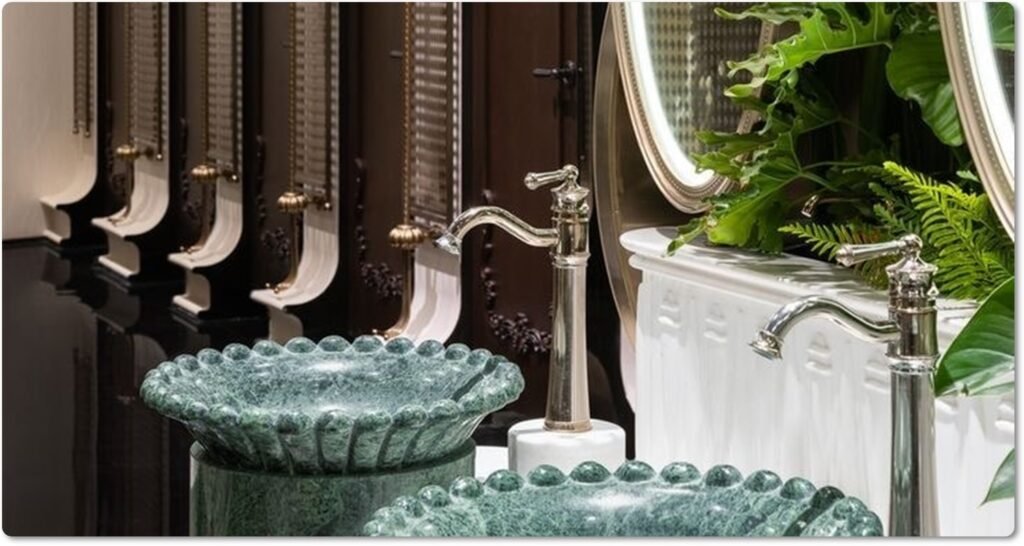
2. Technical Evaluation: Materials, Structure, Machinery and Quality
A stone furniture manufacturer’s capabilities must be assessed against the intended product. A factory that produces flat vanity tops efficiently may not automatically be equipped to manufacture sculptural pedestals, curved stone legs, complex bookmatched assemblies, or furniture combining stone with metal and wood.
2.1 Evaluate the material before evaluating the price
Natural stone varies in mineral composition, veining, porosity, strength, and susceptibility to staining or chemical attack. Two slabs with similar colors may perform differently.
Common furniture materials include:
| Material | Typical furniture applications | Important evaluation points |
|---|---|---|
| Marble | Dining tables, coffee tables, consoles, vanities | Staining, acid sensitivity, veining, finish, and edge vulnerability |
| Granite | Dining tables, outdoor tables, benches, utility surfaces | Material-specific strength, porosity, weather exposure, and finish |
| Quartzite | Premium tables, consoles, and statement furniture | Confirm the actual stone identity, mineral characteristics, and finish suitability |
| Travertine | Coffee tables, side tables, consoles, decorative furniture | Fill treatment, open pores, surface consistency, and edge integrity |
| Limestone | Consoles, decorative tables, architectural furniture | Absorption, surface durability, and suitability for the intended environment |
| Engineered quartz | Selected indoor furniture and surfaces | Product composition, manufacturer instructions, heat limitations, and applicable silica controls |
| Porcelain or sintered surfaces | Contemporary tables and selected furniture designs | Thickness, support requirements, edge details, impact risk, and fabrication instructions |
These are general selection considerations, not universal performance rankings. Suitability depends on the specific stone, its condition, thickness, support system, finish, and expected use.
Material verification checklist
Before confirming an order, request:
Commercial material name and, where available, geological identification.
Country or region of origin when relevant to the purchase.
Slab or block reference and available batch identification.
Actual photographs or video of the material allocated to the order.
Finished sample showing the proposed surface treatment.
Details of resin filling, mesh backing, color enhancement, or other treatments where applicable.
Relevant test reports when required by the project specification.
Do not rely exclusively on a trade name or a single showroom photograph. Natural variation is an inherent feature of natural stone and must be addressed through explicit sample approval and reasonable acceptance criteria.
2.2 Assess stone cutting and dimensioning
The first fabrication stage determines whether the material can be converted into the required components efficiently and accurately.
Ask the factory how it manages:
Slab inspection and defect mapping.
Cutting layouts and material yield.
Component dimensions and thickness.
Grain direction and visible veining.
Nesting of parts to reduce unnecessary waste.
Identification of individual components after cutting.
For a large dining table, a visually attractive slab is not enough. The material must also accommodate the specified tabletop dimensions, edge profile, support layout, and any required vein alignment.
2.3 CNC machining and profile fabrication
Computer numerical control (CNC) equipment can support repeatable shaping, drilling, routing, and profiling when the machine, tooling, programming, and workholding are appropriate for the material and geometry.
CNC capability is particularly relevant to:
Curved and sculptural table bases.
Repeated components for hospitality projects.
Custom edge profiles.
Recesses, grooves, and selected mounting details.
Repetitive furniture components requiring consistent dimensions.
Ask for examples of completed products with similar geometry. A photograph of a CNC machine does not prove that the factory has successfully manufactured your specific design.
2.4 Waterjet cutting: When is it useful?
Waterjet cutting can be appropriate for intricate outlines, decorative inlays, geometric components, and selected stone patterns. It may be particularly relevant to complex shapes that are difficult to achieve economically using conventional straight cutting.
However, waterjet processing is not essential for every stone furniture product. Straight-edged tables and simple consoles may be manufactured effectively with other equipment.
Verify:
Whether the required geometry can be produced with the proposed method.
The achievable dimensions and edge quality for the selected material.
Whether secondary grinding or polishing is required.
How fragile sections, internal corners, and narrow components will be handled.
Whether the quotation includes programming, cutting, finishing, and waste allowance.
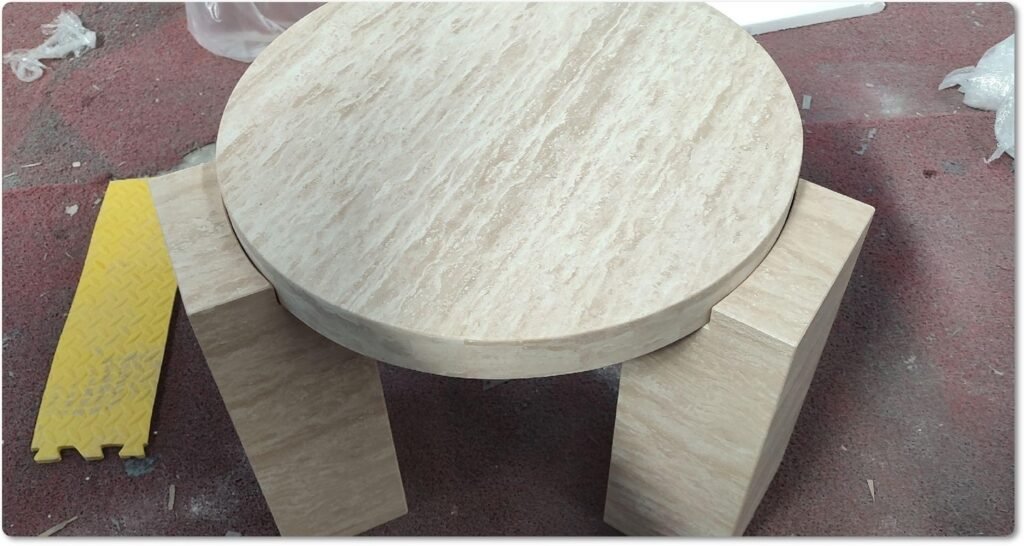
2.5 Edge profiling, polishing and surface finishing
The edge is both a design feature and a potential source of damage. Buyers should specify the profile using a drawing or approved sample rather than relying only on descriptions such as “rounded edge” or “premium finish.”
Possible requirements include:
Straight or eased edges.
Bullnose and half-bullnose profiles.
Beveled edges.
Ogee or other decorative profiles where technically suitable.
Honed, polished, brushed, or other agreed surface finishes.
For inspection, assess the edge along its full length, including corners, joints, cutouts, and transitions between different profiles. Look for chips, uneven polishing, visible grinding marks, inconsistent sheen, and damage that exceeds the agreed acceptance criteria.
2.6 Assembly and structural design
Stone is heavy and can be brittle. Furniture performance depends on the complete design, not simply the thickness of the stone.
Important factors include:
Tabletop dimensions and thickness.
Span between supports.
Base geometry and contact area.
Stone grain, flaws, and local weaknesses.
Mechanical fixing details.
Adhesive compatibility and joint design.
Metal frame dimensions and corrosion protection where applicable.
Packaging and lifting arrangements.
A stone top attached to a metal frame, for example, requires suitable support and fixing details. Adhesive selection alone cannot compensate for an inadequate support structure.
For large, unusually shaped, cantilevered, public-use, or high-value furniture, request a documented engineering review and appropriate verification of stability, load capacity, and assembly safety. The required tests depend on the design, applicable market requirements, and intended use.
2.7 Quality indicators buyers should define
Quality should be measurable wherever practical. Avoid relying on vague requirements such as “perfect,” “luxury quality,” or “no defects.”
| Inspection area | Recommended control |
|---|---|
| Dimensions | Approved drawing, specified measurement points, and tolerances |
| Flatness and alignment | Agreed method and acceptance limits |
| Color and veining | Approved sample, reference images, and natural-variation rules |
| Surface finish | Approved sheen, texture, and visible-defect criteria |
| Edges and corners | Profile consistency, chip limits, and corner condition |
| Joints and assembly | Joint dimensions, alignment, stability, and fixing requirements |
| Hardware | Approved type, finish, fit, and functional check |
| Structural performance | Design-specific verification where required |
| Packaging | Approved packing plan, component protection, and handling instructions |
| Traceability | Purchase order, material batch, production reference, and inspection record |
2.8 Relevant technical standards and regulatory considerations
Standards should be selected according to the actual product and risk. They should not be listed merely to make a supplier appear technically sophisticated.
For natural dimension stone, relevant ASTM test methods include:
ASTM C97/C97M — absorption and bulk specific gravity of dimension stone.
ASTM C99/C99M — modulus of rupture of dimension stone.
ASTM C170/C170M — compressive strength of dimension stone.
ASTM C880/C880M — flexural strength of dimension stone.
These tests address different properties and are not interchangeable. A result for one stone type or specimen does not automatically establish the performance of another batch or a complete furniture assembly. Consult the applicable current edition and agree on the test method before ordering. The Natural Stone Institute maintains a useful overview of ASTM natural stone standards. ASTM natural stone standards overview.
For quality management, ISO 9001:2026, published in September 2026, is the latest edition of the ISO 9001 quality management systems standard as of this article’s publication date. Buyers evaluating a claimed certification should verify the certificate’s edition, scope, validity, issuing certification body, and the transition arrangements relevant to the supplier. Certification does not, by itself, guarantee a particular furniture product’s quality. ISO 9001 official information.
Workplace safety is also an important indicator of responsible manufacturing. Stone fabrication can generate respirable crystalline silica, particularly during cutting, grinding, and polishing. In the United States, OSHA’s applicable silica requirements and any stricter state-level rules must be considered by the relevant employer. California’s silica rules for countertop fabrication have received particular attention, and the Natural Stone Institute continues to publish industry-specific guidance. OSHA silica guidance and Natural Stone Institute silica resources.
For exports to the European Union, assess the product’s actual regulatory classification. The EU Construction Products Regulation (EU) 2024/3110 generally applies from 8 January 2026, subject to the regulation’s specified exceptions and phased product-family requirements. Ordinary furniture is not automatically a construction product simply because it contains stone. Confirm which legislation, product-safety requirements, chemical restrictions, and documentation obligations actually apply to the finished item and its intended market. EU Regulation 2024/3110.
3. Procurement Checklist: How to Verify a Stone Furniture Factory?
A reliable supplier assessment combines documentary evidence, visual inspection, technical review, and a controlled trial order.
3.1 Verify the business and production location
Begin by confirming the supplier’s legal business identity and the actual location where the furniture will be manufactured.
Request:
Registered company name and business registration details.
Factory address and manufacturing contact.
Confirmation of which operations are performed in-house.
A live video tour or an appropriately arranged factory visit.
Current photographs of the relevant machinery and work areas.
References or case studies for comparable products, where available.
If the company uses subcontractors, ask for the subcontracted process, the quality controls applied, and the party responsible for final acceptance.
A polished showroom or an extensive website is useful for initial screening but is not proof of manufacturing capability.
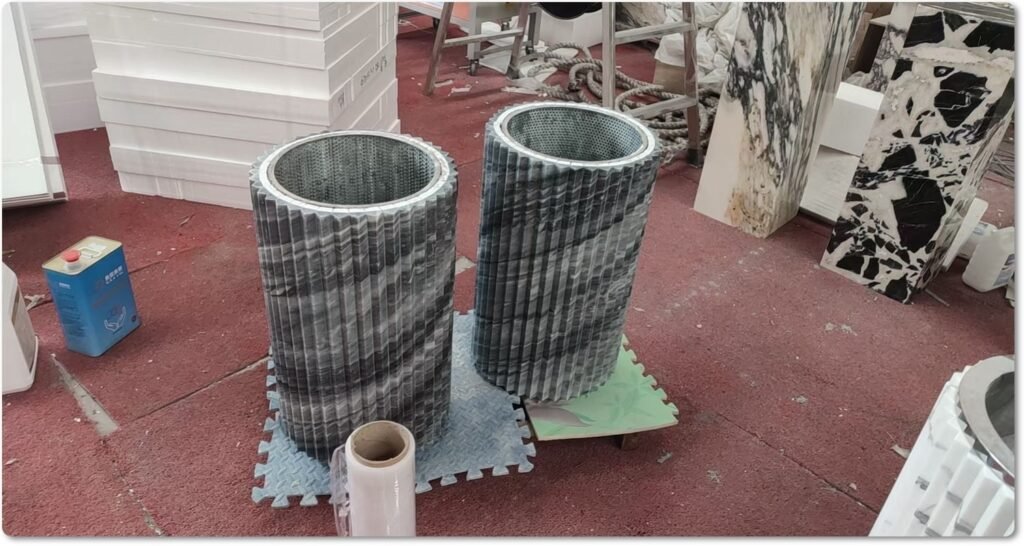
3.2 Inspect machinery through real production evidence
Instead of asking only, “Do you have CNC equipment?”, ask the supplier to demonstrate how the equipment is used for products comparable to yours.
A useful verification sequence is:
Request a photograph or video of the machine.
Ask to see the relevant operation in progress, where practical.
Request a completed product manufactured using that process.
Compare the product against a drawing or agreed specification.
Confirm whether secondary finishing or subcontracting was involved.
The purpose is not to collect an impressive equipment list. It is to determine whether the supplier can achieve the required geometry, finish, consistency, and output.
3.3 Review drawings before production
For custom stone furniture, the drawing approval stage is one of the most important risk-control measures.
A complete drawing package may include:
Overall dimensions and tolerances.
Individual component dimensions.
Stone thickness and material references.
Edge profiles and surface finishes.
Vein direction and bookmatching requirements.
Frame, bracket, fixing, and hardware details.
Assembly sequence and joint information.
Packing dimensions and handling points where relevant.
Do not authorize production based on a concept image alone if the project requires precise dimensions or complex interfaces.
The buyer and supplier should identify which document controls production and how revisions are approved. A dated drawing number and revision history can prevent a previously approved design from being replaced accidentally by an outdated file.
3.4 Require sample or prototype approval where appropriate
A sample is particularly useful when the order includes unusual stone, complex profiles, custom finishes, mixed materials, or substantial quantities.
Depending on the product, approval may involve:
A material sample.
An edge-profile sample.
A finish sample.
A small fabricated component.
A full-size prototype or first production article.
The approval record should identify the material, finish, dimensions, revision, and any accepted natural characteristics. Photographs can support approval, but they do not always replace physical inspection of color, texture, or assembly quality.
3.5 Check batch management and production tracking
Natural stone varies from block to block and even within the same slab. Batch control is therefore essential when multiple pieces must look consistent.
Ask how the factory records:
Material allocation and slab references.
Component identification.
Cutting and finishing stages.
Inspection results.
Rework or replacement parts.
Packing lists and carton or crate identification.
For a hotel or multifamily project, a traceable component schedule can help ensure that parts belonging to a particular table, room, or installation area remain correctly matched.
Where the project requires visual consistency, request an approved material allocation plan before mass production.
3.6 Evaluate quality control at three stages
A practical quality system includes three checkpoints.
Incoming inspection: Verify the material against the order, identify visible defects, and confirm suitability for the planned cutting layout.
In-process inspection: Check dimensions, edge profiles, drilling, joints, finish, and component identification before defects become expensive to correct.
Final inspection: Compare completed furniture with the approved drawings, sample, finish requirements, hardware specifications, and packing instructions.
For larger orders, agree in advance on whether the buyer, a third-party inspector, or the supplier’s own quality team will carry out the final inspection. Define the inspection scope, sampling method where applicable, reporting format, and corrective-action process.
3.7 Verify export and packaging experience
Stone furniture is vulnerable to impact, vibration, abrasion, moisture-related packaging problems, and poor load distribution. The packaging method must match the product’s weight, shape, fragility, shipping route, and handling conditions.
Ask the supplier to explain:
How tabletops and bases are separated or supported.
How polished surfaces are protected against abrasion.
How corners and narrow projecting parts are reinforced.
How heavy items are secured inside crates.
How components are identified and matched after unpacking.
Whether crate dimensions and gross weights are available before shipment.
Whether loading photographs and packing lists can be supplied.
For applicable international shipments, confirm the requirements for wood packaging under ISPM 15 with the exporter and freight forwarder. Do not assume that every packaging material or shipment has identical treatment requirements.
Export experience should be verified through relevant documentation, such as redacted commercial invoices, packing lists, bills of lading, shipment records, or comparable project references, subject to confidentiality constraints.
3.8 Use a supplier scorecard
The following scorecard is a suggested internal procurement tool, not an industry certification.
| Evaluation category | Suggested weight |
|---|---|
| Material sourcing and traceability | 15% |
| Fabrication and technical capability | 20% |
| Drawing review and engineering coordination | 15% |
| Quality control and inspection evidence | 20% |
| Packaging and export execution | 15% |
| Communication, quotation clarity, and corrective action | 15% |
| Total | 100% |
Score each category from 1 to 5, then multiply the score by its weight. For example, a score of 4/5 in a 20%-weighted category contributes 16 points out of 100.
Set minimum acceptance thresholds for essential requirements, including structural safety, material conformity, and required legal compliance. A strong overall score must not compensate for a failure in a critical safety or contractual requirement.
4. Cost and Risk Factors: How to Compare Stone Furniture Factory Quotations?
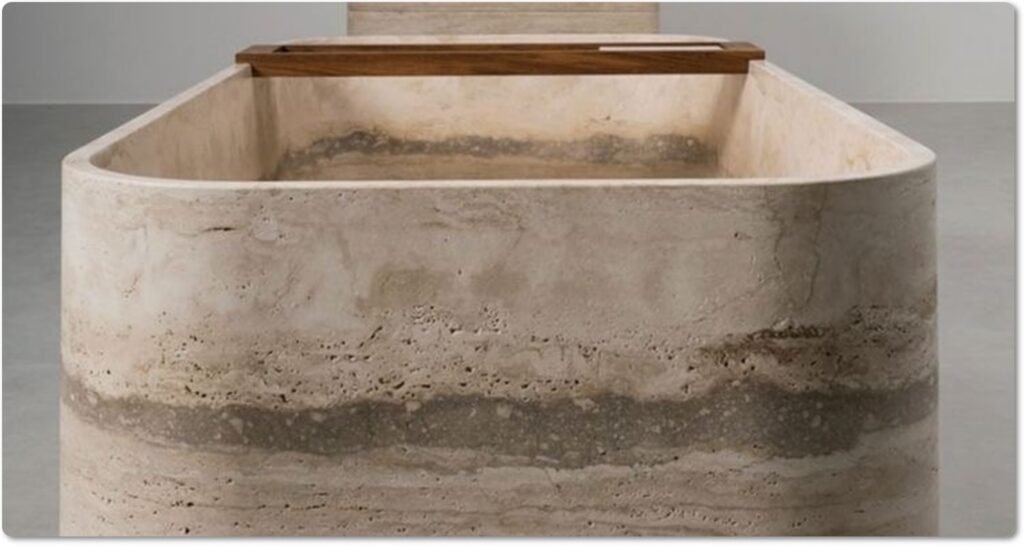
The cheapest quotation is not necessarily the lowest-cost procurement option. Two offers can describe apparently identical tables while including different stone grades, thicknesses, finishing operations, structural components, packaging, and delivery terms.
4.1 Break the quotation into comparable cost components
A complete quotation should identify, where applicable:
Material cost: Stone type, grade, thickness, selection requirements, and estimated yield.
Cutting and fabrication: Saw cutting, CNC machining, waterjet operations, drilling, routing, and profiling.
Finishing: Grinding, polishing, honing, filling, sealing, and other specified treatments.
Structural components: Metal frames, timber parts, brackets, hardware, adhesives, and assembly.
Sampling and engineering: Drawing review, programming, prototype fabrication, and sample transport.
Quality control: Inspection, measurements, test reports, and third-party inspection if requested.
Packaging: Protective materials, cartons, crates, foam, pallets, and export packing.
Logistics: Inland transport, export handling, freight, insurance, customs-related charges, and destination delivery, as applicable.
Commercial terms: Payment schedule, production lead time, quotation validity, warranty, and responsibilities for defects.
Not every quotation needs to list every item as a separate charge, but the included and excluded scope must be clear.
4.2 Why material grade and yield matter
Natural stone has inherent variation. A project requiring carefully selected veining, matched tabletops, or a consistent appearance across many units may consume more material and generate more waste than a basic specification.
Compare quotations using the same:
Material identification and selection criteria.
Finished dimensions and thickness.
Visible-face requirements.
Edge profile and finish.
Acceptable variation and defect criteria.
Number of units and replacement requirements.
A lower price may reflect a different material selection, less stringent visual matching, a different thickness, or fewer finishing operations. It is important to identify the actual difference before deciding whether the saving is acceptable.
4.3 Understand the cost of customization
Custom furniture may require additional technical review, CAD work, CNC programming, prototype approval, jigs or fixtures, and coordination between different materials.
For repeat orders, clarify whether setup or programming charges are one-time costs or recur with each order. Ask how design changes after sample approval will be priced and how they affect the production schedule.
If the design is not yet finalized, request a budgetary quotation with clearly stated assumptions rather than comparing it directly with a fully engineered fixed quotation.
4.4 Packaging and transport are part of product quality
A well-fabricated tabletop can still arrive damaged if the crate is unsuitable, the product is inadequately supported, or the loading arrangement permits movement.
The packaging quotation should specify the protection method, crate or pallet arrangement, estimated dimensions and weights, component separation, and any special handling instructions.
Where appropriate, request photographs of the actual packed goods and container loading. For high-value shipments, agree on the inspection and claims procedure before dispatch.
4.5 Common procurement risks and mitigation
| Risk | Typical cause | Preventive measure |
|---|---|---|
| Material mismatch | Trade name or reference photo is insufficient | Approve identified material samples or allocated slabs |
| Dimensional errors | Incomplete drawings or unclear tolerances | Sign off a controlled production drawing |
| Finish inconsistency | Subjective descriptions and no reference sample | Define finish and acceptance criteria |
| Structural failure | Inadequate support or fixing design | Obtain an appropriate technical review |
| Schedule slippage | Unconfirmed material availability or revisions | Agree on milestones and change-control rules |
| Hidden costs | Incomplete quotation scope | Use a standardized RFQ comparison sheet |
| Transit damage | Inadequate protection or loading | Approve packaging and handling requirements |
| Disputed defects | No agreed acceptance procedure | Document inspection, notification, and corrective action |
4.6 Calculate total landed cost, not just factory price
For international purchasing, compare the expected total cost of receiving acceptable goods at the agreed destination.
Depending on the transaction, this can include the factory price, packaging, inland transport, export handling, international freight, insurance, duties, taxes, customs clearance, destination charges, inspection, and expected costs associated with damage or rework.
The exact allocation depends on the agreed Incoterms® rule and named place. Confirm the applicable edition, such as Incoterms® 2020, and ensure the contract clearly allocates responsibilities and costs.
A supplier with a moderately higher factory price may offer better value if the quotation is complete, the documentation is reliable, and the packaging reduces avoidable damage risk.

5. Supplier Evaluation: What Should a Professional Stone Furniture Manufacturer Provide?
A credible manufacturer should be able to support its proposal with evidence appropriate to the product and order size.
5.1 Company and factory evidence
Request a reasonable selection of the following:
Company registration and business details.
Actual manufacturing address.
Relevant factory photographs or a live video walkthrough.
Machinery list matched to your requested operations.
Examples of comparable finished products.
Explanation of in-house and subcontracted processes.
Quality management certificates, if claimed.
Customer references or project records where disclosure is permitted.
Verify claims independently where practical. Do not treat a certificate, equipment photograph, or marketing statement as proof of every production capability.
5.2 Technical and quality documents
For custom furniture, the most useful documents often include:
Approved drawings with revision numbers.
Material and finish schedule.
Sample approval record.
Component and hardware specification.
Inspection checklist and completed inspection report.
Applicable material test reports.
Packaging specification and packing photographs.
Nonconformity and corrective-action records where relevant.
The required documentation should be proportional to the product’s complexity, risk, and commercial value.
5.3 How to verify real manufacturing capacity?
Production capacity is not simply the number of machines or the size of the factory building. It depends on the equipment’s suitability, labor and skill availability, production routing, material supply, subcontractor capacity, current workload, finishing time, inspection requirements, and packing resources.
Ask the supplier to explain how it would schedule your specific order, including:
Material confirmation.
Drawing approval.
Sampling and prototype approval.
Production start.
In-process inspection.
Final inspection.
Packaging and dispatch.
For repeat orders, ask what would happen if demand increases or a component fails inspection. A useful manufacturer can explain the constraints and contingency arrangements rather than promising an unsupported production volume.
5.4 How EDG Stone fits into a stone furniture sourcing strategy
EDG Stone is a Chinese stone products manufacturer and exporter serving buyers seeking natural stone products and customized fabrication. Its relevant product scope includes marble, granite, quartzite, travertine, limestone, countertops, vanity tops, stone furniture, and custom-cut stone components.
For a stone furniture inquiry, buyers can discuss the required material, dimensions, surface finish, edge details, and project-specific fabrication scope with EDG Stone. Depending on the design, customization may involve drawing review, cutting, CNC machining, waterjet processing, edge finishing, polishing, and coordination of the specified components.
The appropriate process depends on the particular item. Buyers should request confirmation of which operations are available for their design and whether any specialist component or finishing process will be subcontracted.
EDG Stone’s export-oriented service scope can also be relevant to buyers coordinating packing, container loading, and international shipment preparation. Exact packing arrangements, lead times, and shipping responsibilities should be confirmed in the individual quotation.
For an accurate evaluation, request product-specific evidence rather than assuming that general stone fabrication experience automatically proves suitability for every furniture design. The objective is to establish a clear match between the buyer’s technical specification and the manufacturer’s verified production scope.
5.5 Red flags during supplier selection
Exercise caution when a supplier:
Cannot identify the actual production facility.
Avoids technical questions about the proposed manufacturing process.
Refuses to clarify which operations are outsourced.
Quotes without reviewing dimensions or material requirements.
Offers no clear sample or drawing approval procedure.
Cannot explain its quality inspection process.
Makes unsupported claims about production volume, certifications, or delivery time.
Treats packaging as an unspecified afterthought.
Changes materials or specifications without written approval.
Any one issue may have an explanation. Repeated refusal to provide reasonable evidence, however, is a significant procurement concern.
6. Practical RFQ Template: Stone Furniture Factory Inquiry
Use the following template when contacting a stone furniture manufacturer, factory, wholesaler, or project supplier. Providing consistent information allows buyers to compare offers on a like-for-like basis.
6.1 Copy-ready RFQ fields
Subject: RFQ – Custom Stone Furniture Manufacturing
A. Buyer and project information
Company name:
Contact person:
Destination country and city:
Project type:
Required delivery date:
Expected order quantity:
Estimated annual repeat-order volume, if applicable:
B. Product specification
Product type: dining table / coffee table / console / side table / bench / vanity / other
Product drawing or reference number:
Overall dimensions:
Stone thickness:
Material and commercial name:
Required material origin, if applicable:
Surface finish:
Edge profile:
Color and veining requirements:
Natural variation acceptance criteria:
Required hardware or structural components:
Indoor or outdoor application:
Intended load and use requirements, where relevant:
C. Manufacturing requirements
Required cutting and fabrication processes:
CNC or waterjet requirements:
Drilling, grooves, or cutouts:
Assembly requirements:
Sample or prototype required:
Drawing approval required:
Testing or inspection requirements:
Third-party inspection required:
D. Quality and traceability
Applicable standards or project specifications:
Dimensional tolerances:
Surface and edge acceptance criteria:
Batch identification requirements:
Required inspection report:
Required material or test documentation:
Warranty and corrective-action expectations:
E. Packaging and logistics
Individual or consolidated packing:
Export crate or pallet requirements:
Protection for polished surfaces and edges:
Required shipping marks:
Estimated packing dimensions and gross weight:
Required packing photographs:
Preferred Incoterms® rule and named place:
Destination port or delivery address:
Freight and insurance requirements:
F. Commercial requirements
Unit price and currency:
Tooling, programming, or setup charges:
Sample and prototype charges:
Minimum order quantity, if any:
Production lead time after approvals:
Payment terms:
Quotation validity:
Included and excluded costs:
Replacement, repair, and claims procedure:
G. Supplier evidence
Actual manufacturer and production location:
In-house and subcontracted processes:
Comparable completed projects:
Relevant certificates, if applicable:
Available production and inspection records:
Proposed production schedule:
Please identify all assumptions and exclusions in your quotation. Do not substitute materials, finishes, hardware, or approved dimensions without written authorization.
6.2 First-order acceptance checklist
Before authorizing shipment, the buyer and supplier should confirm the following:
Material matches the approved specification.
Finished dimensions comply with the approved drawing.
Edge profiles and surface finishes match the reference.
Structural components and hardware are complete.
Assembly and stability checks are completed where required.
Visible defects meet the agreed acceptance criteria.
Product identification and packing lists are correct.
Packaging and handling arrangements have been checked.
Inspection findings and corrective actions are documented.
Shipment documents and delivery responsibilities are confirmed.
This checklist should be adapted to the product. It does not replace engineering verification, regulatory compliance, or any mandatory product-specific testing.
7. Frequently Asked Questions: Choosing a Stone Furniture Manufacturer
FAQ 1: How do I find a reliable stone furniture factory in China?
Start by defining your product specification and then shortlist manufacturers whose demonstrated experience matches the material, geometry, and finish required. Verify the actual production location, inspect comparable finished products, review drawings and quality controls, and confirm export packaging procedures. For custom products, a controlled sample or first-article approval is often more informative than a catalogue alone.
FAQ 2: What is the difference between a stone furniture manufacturer and a supplier?
A manufacturer takes responsibility for producing the furniture, while supplier is a broader term that may include factories, trading companies, wholesalers, and project coordinators. A supplier can still be suitable if it clearly identifies its manufacturing partners and accepts defined responsibility for technical coordination, quality, and delivery.
FAQ 3: What machinery should a stone furniture factory have?
The required machinery depends on the product. Basic furniture may need appropriate stone cutting, edge finishing, polishing, and assembly equipment. Complex designs may require CNC machining, waterjet cutting, specialist drilling, or additional equipment for mixed-material components. Verify demonstrated results for the specific design instead of using a universal machinery checklist.
FAQ 4: How can I compare quotations from different stone furniture factories?
Standardize the material, dimensions, thickness, finish, edge profile, assembly requirements, inspection scope, packaging, quantity, delivery terms, and payment conditions. Then identify all exclusions and calculate the expected landed cost. A lower quotation should be evaluated against its actual specifications and risks, not simply its headline price.
FAQ 5: Can a stone furniture factory manufacture custom OEM or ODM products?
Many manufacturers offer customized production, but OEM and ODM capabilities should be confirmed individually. Provide drawings, reference images, material preferences, and performance requirements. Ask whether the factory can review the design, produce samples, manage revisions, and reproduce approved specifications. Clarify ownership and permitted use of drawings, tooling, and designs in the purchase agreement.
8. References: Standards, Regulations and Industry Resources
The following primary and industry sources can help buyers verify the technical and regulatory points discussed in this guide. Always confirm the applicable edition, jurisdiction, product scope, and current legal status before incorporating a requirement into a contract.
International Organization for Standardization (ISO). ISO 9001:2026, Quality management systems — Requirements. Published September 2026.
https://www.iso.org/standard/9001ASTM International. ASTM C97/C97M, Standard Test Methods for Absorption and Bulk Specific Gravity of Dimension Stone. Consult the current active edition.
https://store.astm.org/standards/c97Natural Stone Institute. ASTM International standards applicable to natural stone, including absorption, strength, and related testing methods.
https://www.naturalstoneinstitute.org/stoneprofessionals/astm/U.S. Occupational Safety and Health Administration (OSHA). Respirable crystalline silica guidance and interpretation relevant to stone fabrication.
https://www.osha.gov/laws-regs/standardinterpretations/2023-09-22Natural Stone Institute. Silica safety, exposure controls, training, and fabrication-industry guidance.
https://www.naturalstoneinstitute.org/silica/European Union. Regulation (EU) 2024/3110 on harmonised rules for the marketing of construction products, including its scope, application dates, and transitional provisions.
https://eur-lex.europa.eu/legal-content/EN/TXT/?uri=CELEX:32024R3110International Plant Protection Convention (IPPC). International Standard for Phytosanitary Measures No. 15 (ISPM 15), relevant to regulated wood packaging material in international trade.
https://www.ippc.int/International Chamber of Commerce (ICC). Incoterms® rules and guidance on allocating costs, risks, and responsibilities in international sales.
https://iccwbo.org/business-solutions/incoterms-rules/
9. Semantic Insight: What Actually Makes a Stone Furniture Factory the Right Choice?
Choosing a stone furniture factory is ultimately a decision about manufacturing control, product suitability, and risk allocation. The most reliable supplier is not defined by one machine, one certificate, one attractive sample, or one low quotation. It is defined by the consistency between the approved specification, the actual production process, the inspection evidence, and the delivered product.
What should buyers prioritize first?
Start with the product and its intended use. A small marble side table, a large hospitality dining table, and an outdoor stone bench have different material, structural, finishing, and transport requirements. The supplier’s capabilities should be evaluated against these specific requirements rather than against a generic claim of being a full-service manufacturer.
Why does production transparency matter more than equipment quantity?
Equipment creates potential capability, but the result depends on tooling, operator skill, process planning, maintenance, and quality control. A factory with a smaller but appropriate equipment setup may be a better fit for a particular order than a larger facility without relevant experience. Buyers should request evidence of comparable completed work and understand which stages are performed in-house.
What is the best way to reduce the gap between quotation and delivery?
Convert expectations into controlled documents. An approved drawing defines dimensions and interfaces; a material schedule defines the stone; a sample defines the expected finish; an inspection plan defines acceptance; and a packing specification defines how the product will be protected. These documents reduce the scope for misunderstanding and make supplier comparisons more objective.
Which procurement option is most appropriate?
Standard products: Prioritize stable specifications, repeatability, stock or material availability, and replenishment.
Custom furniture: Prioritize drawing review, prototyping, technical communication, and change control.
Hospitality and multifamily projects: Prioritize batch consistency, production tracking, dimensional control, and coordinated delivery.
Premium natural stone: Prioritize material selection, vein and color approval, finish quality, and careful handling.
Mixed-material designs: Prioritize interface engineering, component coordination, assembly checks, and clear accountability.
What should buyers consider beyond the factory gate?
The product must remain fit for purpose during packing, international transport, installation, and normal use. Buyers should consider structural stability, surface care, weight and handling, packaging protection, installation conditions, and any applicable destination-market obligations. Material test data, product certification, and assembly testing each answer different questions; one should not be used as a substitute for another.
What is the commercial value of a structured supplier evaluation?
A structured process helps buyers distinguish genuine cost savings from omitted scope, identify technical risks before production, and create a repeatable basis for supplier selection. It also helps manufacturers receive clearer inquiries, prepare more accurate quotations, and reduce avoidable revisions.
For EDG Stone and other stone furniture sourcing partners, the most productive inquiry is one that defines the intended product, required stone, dimensions, finish, quantity, quality expectations, and destination. That information makes it easier to establish whether the requested work matches the manufacturer’s available capabilities and to determine the appropriate next step.
10. EDG Stone CTA: Source Custom Stone Furniture and Fabricated Stone Products
Work with a Stone Products Manufacturer and Exporter
EDG Stone works with international buyers seeking natural stone products and custom fabrication, including marble, granite, quartzite, travertine, limestone, countertops, vanity tops, and stone furniture-related products.
Whether you are sourcing a custom coffee table, a stone console, a dining tabletop, a vanity, or components for a larger interior project, start with a clear technical brief. Share your drawings, reference photographs, preferred material, finished dimensions, surface treatment, quantity, and destination.
EDG Stone can then review the inquiry scope and confirm the relevant fabrication requirements, available customization options, quotation details, and export packing arrangements for the specific order.
Explore EDG Stone:
Stone Countertops Manufacturer — Explore stone products and fabrication for countertop projects.
Custom Stone Fabrication Manufacturer — Visit EDG Stone to explore stone products and discuss project-specific fabrication requirements.
Request a quotation: Provide your drawings, specifications, quantity, and delivery destination so that the relevant production scope and commercial terms can be evaluated.
Note: Equipment availability, production capacity, certifications, minimum order quantities, lead times, and project-specific services should be confirmed directly for the requested product. No unverified facility statistics or production figures are implied in this article.