Quick Summary: Stone Furniture Trends & Design Ideas for 2026
Stone furniture occupies a distinctive position between functional furniture and architectural material. Unlike furniture made entirely from wood, metal, or engineered boards, a natural stone table or console can make its geological patterns, surface texture, mass, and edge profile central to the design.
For 2026 projects, designers and manufacturers can develop new products around sculptural side tables, round marble dining tables, thick-edge coffee tables, travertine accent furniture, and stone-and-metal or stone-and-wood combinations. The commercial opportunity is not simply to reproduce attractive reference images. It is to convert a visual concept into a safe, manufacturable, inspectable, and repeatable product.
The Natural Stone Institute’s Dimension Stone Design Manual 2024, published in its resource library on January 8, 2025, includes dedicated technical guidance on stone furniture, material characteristics, fabrication, tolerances, and maintenance. It provides a useful technical foundation for evaluating furniture concepts alongside current design observations. Source: Natural Stone Institute, Dimension Stone Design Manual 2024.
This guide explains how to select stone, coordinate colors and textures, develop furniture geometry, prepare production drawings, assess cost and risk, and evaluate a stone furniture manufacturer or factory before placing an order.
1. Executive Summary: Which Stone Furniture Designs Should Buyers Consider in 2026?
Stone furniture buyers should prioritize designs that combine a clear visual identity with realistic manufacturing requirements, material suitability, and a defined commercial use case.
The most useful starting points are:
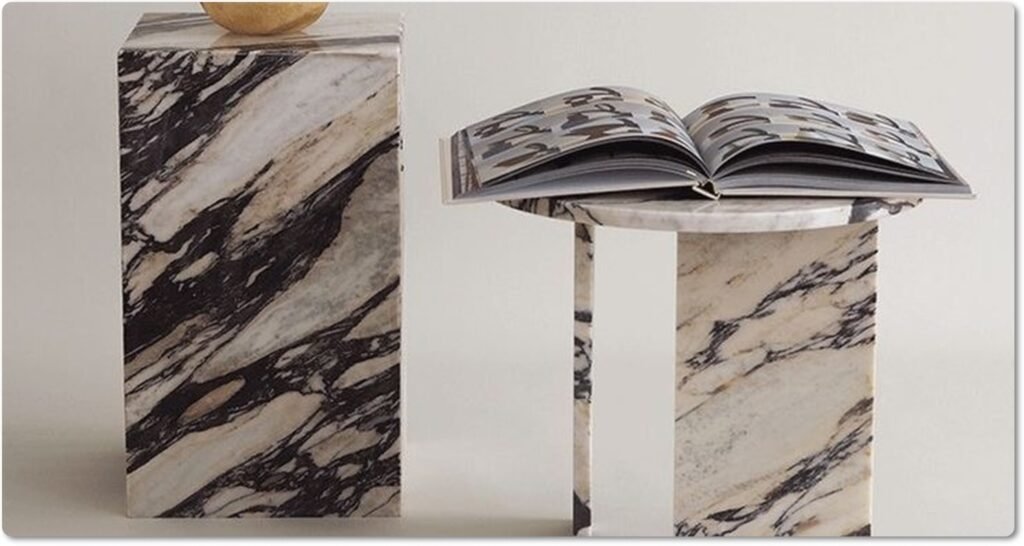
Sculptural side tables: Compact products with curved, cylindrical, fluted, or pedestal-inspired forms.
Round marble dining tables: Social dining formats featuring a circular top, a stable base, and carefully planned seating clearance.
Thick-edge coffee tables: Furniture that creates a substantial, architectural appearance through solid stone or a carefully engineered built-up edge.
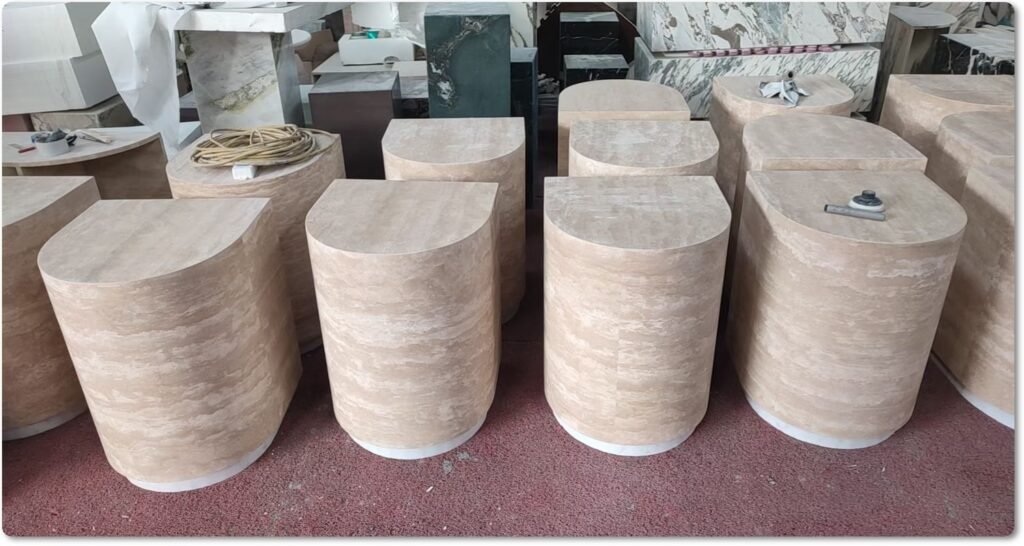
Travertine accent furniture: Textural pieces that introduce warm neutrals, pores, and naturally varied surfaces.
Stone-and-wood furniture: Designs that combine mineral texture with the visual warmth of timber.
Stone-and-metal furniture: Contemporary pieces using brass-tone, stainless steel, blackened metal, or other specified finishes.
Custom consoles and occasional tables: Product families that can be adapted to residential interiors, hospitality projects, and designer collections.
These are practical design directions rather than a statistically ranked list of 2026 consumer preferences. No market-share percentages or universal demand rankings are asserted here.
Who should use this guide?
| Buyer or professional | Primary objective |
|---|---|
| Furniture brands | Develop distinctive collections and private-label products |
| Interior designers and architects | Translate a design concept into buildable furniture |
| Wholesalers and distributors | Identify products suitable for repeat orders and multiple markets |
| Hotels and hospitality buyers | Specify furniture for lobbies, suites, restaurants, and public areas |
| Developers and contractors | Coordinate furniture dimensions, finishes, quantities, and delivery |
| OEM/ODM buyers | Establish drawings, approved samples, quality criteria, and production specifications |
Procurement conclusion: Select the stone and structural concept together, not separately. A beautiful slab does not automatically make a safe or economical table. The final design must account for span, support, weight, edge geometry, joints, handling, packaging, and intended use.
2. Scope and Definitions: Materials, Furniture Types, and Design Terminology
This white paper focuses on natural stone furniture and furniture incorporating natural stone components. It covers design development, factory production, quality control, and international B2B procurement.
2.1 What is stone furniture?
Stone furniture is furniture in which stone functions as a primary structural component, a load-bearing surface, a decorative facing, or a combination of these roles.
Common product categories include:
Coffee tables, side tables, and end tables.
Dining tables and occasional tables.
Console tables and entryway furniture.
Desks, conference tables, and reception furniture.
Stone benches, stools, and selected seating components.
Stone-topped cabinets, vanities, and storage furniture.
Bespoke furniture for hotels, luxury residences, and commercial interiors.
The engineering requirements vary according to whether stone carries the load, covers a supporting frame, or is attached to a separate substrate.
2.2 Which materials are commonly considered?
Marble: Suitable for expressive veining, bookmatching, polished surfaces, honed finishes, and sculptural furniture. Marble selection should account for mineral composition, porosity, fissures, sensitivity to acids, and the intended maintenance regime.
Travertine: Recognized for its pores, layered appearance, and warm neutral palette. Depending on the material and specification, pores may be filled or left open. The chosen treatment affects appearance, cleaning, and maintenance.
Granite: An option for projects requiring a different balance of hardness, texture, color, and surface performance. Actual properties depend on the specific stone.
Quartzite: Can provide dramatic veining and a distinctive mineral appearance. Buyers should verify the exact material identity and relevant test data rather than relying on a trade name alone.
Limestone: Often selected for understated, architectural furniture. Porosity, surface sensitivity, and finish suitability need to be evaluated for the intended environment.
Engineered stone, porcelain, and other composite surfaces: These may be appropriate alternatives for particular designs, but they are not interchangeable with natural stone. Composition, fabrication methods, handling requirements, and applicable regulations must be checked separately.
2.3 What do common design terms mean?
Sculptural furniture: Furniture whose shape and volume are important to its visual identity, in addition to its function.
Monolithic appearance: A design that looks like one substantial volume, whether it is genuinely solid or constructed from multiple pieces.
Bookmatching: Arranging adjacent or selected stone surfaces so their patterns mirror each other.
Built-up edge: An edge assembly designed to create the appearance of a thicker top than the underlying slab thickness.
Shop drawing: A dimensioned production drawing showing the actual geometry, fabrication details, interfaces, and assembly requirements.
OEM: Manufacturing according to a buyer’s product design or specification.
ODM: Developing a product design or product solution that a buyer can adopt or customize.
These definitions matter commercially because a product image communicates appearance, while a manufacturing specification communicates what must actually be produced.
3. Technical Evaluation: Stone Materials, Forms, Structure, and Finishes
3.1 Match stone color and texture to the interior
Material selection should begin with the overall spatial concept, lighting conditions, surrounding materials, and maintenance expectations.
| Design direction | Potential stone choices | Suggested furniture applications | Main considerations |
|---|---|---|---|
| Light and understated | Carrara marble, selected white marbles, light limestone | Coffee tables, consoles, dining tables | Vein consistency, staining, surface care |
| Warm and earthy | Beige marble, travertine, warm limestone | Side tables, consoles, hospitality furniture | Pores, filling, finish consistency |
| Dramatic and expressive | Calacatta marble, selected bookmatched marble, patterned quartzite | Statement dining tables, feature consoles | Slab yield, vein placement, visual matching |
| Dark and architectural | Black marble, dark granite, dark quartzite | Desks, coffee tables, reception furniture | Scratches, dust visibility, finish and edge quality |
| Green and distinctive | Selected green marbles and other verified natural stones | Accent tables, luxury furniture | Material variation, mineral features, batch approval |
| Minimalist and tactile | Honed marble, brushed or textured stone, selected travertine | Side tables, sculptural furniture | Texture consistency, cleaning, edge durability |
These combinations are starting points for design development, not rules that every project must follow. Always review actual slabs or representative samples under lighting similar to the intended installation.
Light, dark, and veined stone
Light-colored marble can make a substantial table appear visually lighter, although the actual weight remains determined by its dimensions, density, and construction.
Dark stone can create a strong contrast with pale walls, light timber, and neutral upholstery. Its suitability depends on the chosen finish, visible surface marks, cleaning expectations, and lighting.
Highly veined marble can become the focal point of a room. On smaller furniture, one carefully positioned vein may be more effective than using an entire surface with competing patterns. For bookmatched designs, the approved layout should specify the slab orientation and vein continuity.
3.2 Sculptural side tables: Make the shape manufacturable
Sculptural side tables are a useful category for experimenting with form because their compact dimensions may permit more varied silhouettes than a large dining table.
Common design approaches include cylindrical pedestals, rounded blocks, fluted columns, curved profiles, tapered bases, and stacked geometric volumes.
The manufacturing challenge is to ensure that the shape does not create weak sections or unstable support.
Before approving a sculptural design, evaluate:
The minimum thickness around curved or recessed areas.
The relationship between the top footprint and the base footprint.
The position of the center of gravity.
The risk of chipping at narrow projections and sharp corners.
The finishing method for curved surfaces and internal recesses.
The lifting, handling, and packaging method for the finished product.
A design that appears solid in a rendering may require a hollow construction, multiple bonded components, or a concealed support structure. These alternatives should be agreed upon before pricing and sampling.
3.3 Round marble dining tables: Balance proportion and stability
Round dining tables can soften the geometry of a room and support flexible seating arrangements. They also introduce specific engineering questions: top diameter, slab thickness, pedestal dimensions, overhang, joint construction, and resistance to tipping.
The buyer should specify:
Finished tabletop diameter and thickness.
Required seating capacity and chair dimensions.
Pedestal geometry and base footprint.
Whether the top is one piece or assembled from multiple components.
The intended support method and any concealed reinforcement.
Floor protection and adjustable leveling requirements.
Maximum allowable finished-product weight, if handling constraints apply.
Do not assume that a thicker tabletop is automatically safer. A suitable design must consider the actual stone, geometry, supports, loading, and connection details.
3.4 Thick-edge coffee tables: Achieve visual mass without unnecessary stone
A thick-edge coffee table creates a substantial visual profile. Depending on the design, the apparent thickness can be achieved through a solid block, a built-up edge, mitered components, or a combination of stone and concealed support.
Each method has different cost and risk implications.
Solid stone construction may offer visual continuity but can increase weight, material consumption, and handling difficulty.
Built-up edges can reduce the amount of stone required for the visible profile, but the joints must be properly detailed, bonded, finished, and inspected.
Waterfall-style construction can create a continuous visual effect between horizontal and vertical faces, but corner joints, vein alignment, impact exposure, and edge protection need careful attention.
The specification should show the real slab thickness, finished apparent thickness, joint locations, edge radius or chamfer, and acceptable visibility of seams.
3.5 Stone consoles: Design for both appearance and everyday use
Console tables are frequently used in entrances, hotel corridors, living rooms, and commercial reception areas. They often have a relatively narrow top and a long span, making support and fixing details particularly important.
Evaluate the proposed design for:
Top length, depth, thickness, and unsupported span.
Support spacing and attachment points.
Resistance to tipping and accidental impact.
Integration with drawers, shelves, or metal frames.
Wall-clearance and floor-leveling requirements.
Cable access, if the console includes lighting or electronic equipment.
A slender appearance should not be achieved by reducing stone thickness or support dimensions without appropriate technical assessment.
3.6 Combine stone with wood and metal
Stone-and-wood furniture combines mineral patterns with timber grain. Stone-and-metal furniture can create a more industrial, contemporary, or refined appearance, depending on the profile and finish.
The critical consideration is not only color coordination but also how the materials interact physically.
Stone and wood
Wood can respond to changes in humidity and moisture differently from stone. The assembly should accommodate foreseeable movement rather than rigidly forcing the two materials to behave identically.
Specify the timber species or approved equivalent, finish, moisture requirements where applicable, fixing method, and any separation or movement allowance.
Stone and metal
Metal bases can support a slim visual profile or create a contrast with natural stone. However, the design must account for load transfer, corrosion resistance in the intended environment, surface protection, attachment geometry, and potential stress concentrations at the stone interface.
Specify the metal grade or agreed material, finish, weld quality where applicable, connection hardware, and whether the base can be disassembled for shipping.
3.7 Finish and edge profiles are part of the design language
The finish affects how a stone’s color, veins, pores, and surface variations are perceived.
| Finish or detail | Visual effect | Procurement consideration |
|---|---|---|
| Polished | Reflective, saturated appearance | Reflections, visible marks, scratch expectations |
| Honed | Softer, low-reflection surface | Uniformity, staining and maintenance |
| Brushed or textured | Tactile, less formal appearance | Texture consistency and cleaning |
| Rounded edge | Softer silhouette | Radius consistency and protection |
| Chamfered edge | Defined, controlled profile | Width, angle, and uniformity |
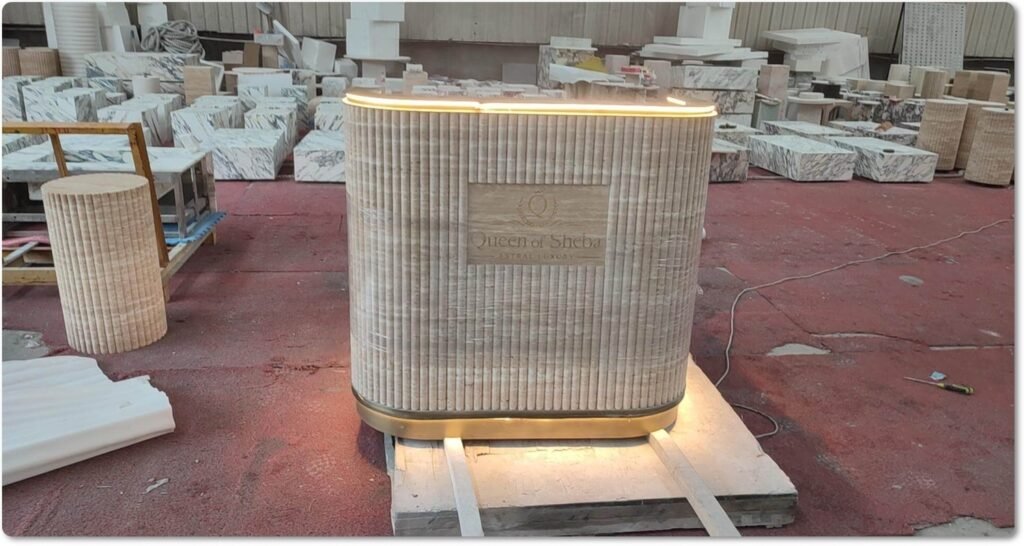
| Fluted surface | Repeated linear relief | Groove depth, spacing, and finishing |
| Mitered edge | Continuous thick-edge appearance | Joint quality, corner protection, pattern alignment |
For custom work, use a drawing or approved sample to define the finish. Terms such as “matte,” “natural,” and “premium” are not sufficient acceptance criteria on their own.
3.8 Convert design drawings into production-ready files
A successful custom stone furniture project requires a clear handover between the designer, buyer, engineering team, and factory.
The recommended drawing package includes:
A. General arrangement drawings
Front, side, and top views.
Overall dimensions and finished heights.
Major component dimensions.
Reference datums and dimensioning units.
B. Sections and construction details
Cross-sections through the tabletop and base.
Actual and apparent stone thicknesses.
Edge profiles and corner radii.
Joint locations, adhesive areas, and concealed support details.
Metal or timber interface details.
C. Material and finish schedule
Stone name and approved alternative, if permitted.
Slab selection and vein orientation.
Surface finish and edge finish.
Metal, timber, and hardware specifications.
Filling, reinforcement, and repair requirements.
D. Production files
Depending on the factory’s equipment and workflow, approved drawings may be translated into CAD files, CNC machining paths, waterjet cutting data, templates, or other fabrication instructions.
A PDF drawing may communicate the design, but it does not automatically contain the geometry and manufacturing information needed by CNC equipment. The factory should verify file compatibility, scale, units, tool access, and machining allowances before production.
The approval sequence
Submit the reference images and initial concept.
Confirm dimensions, materials, construction, and target application.
Prepare shop drawings and technical details.
Review and approve the drawings in writing.
Produce a prototype or first article where appropriate.
Inspect the sample against agreed criteria.
Record approved materials, finishes, dimensions, and construction.
Release repeat production against the controlled specification.
Key principle: A product is repeatable when the approved specification defines not only its appearance but also its dimensions, materials, construction, tolerances, inspection requirements, and packaging.
4. Procurement Checklist: From Design Inspiration to Approved Production
The following checklist helps buyers manage a custom stone furniture project from the initial brief through shipment.
Stage 1 — Define the product
Identify the product type and intended environment.
Supply reference images, sketches, or existing product links.
Confirm target dimensions and functional requirements.
Identify the intended customer segment and price positioning.
State the required order quantity and expected repeat-order volume.
Stage 2 — Approve the stone
Confirm the commercial stone name and material identity.
Review representative samples and actual slab photographs.
Define acceptable color, veining, and natural variation.
Specify filled or unfilled pores where relevant.
Agree on surface finish, edge finish, and repair visibility.
Request relevant test data where the application warrants it.
Stage 3 — Approve engineering and fabrication
Review top, front, and side views.
Review cross-sections and connection details.
Confirm actual stone thickness and finished dimensions.
Assess stability, support, and intended loads.
Define assembly, disassembly, and installation requirements.
Approve all revisions before cutting begins.
Stage 4 — Confirm sample and production criteria
Approve a physical sample or first article where appropriate.
Document dimensional tolerances.
Agree on surface, edge, joint, and repair acceptance criteria.
Confirm the inspection method and inspection timing.
Establish a procedure for approving substitutions and deviations.
Stage 5 — Approve packaging and delivery
Confirm individual-product protection.
Specify crates, pallets, or other suitable export packaging.
Review protection at corners, edges, and contact points.
Confirm gross weight, package dimensions, and handling orientation.
Check container-loading plans and shipment documentation where applicable.
Agree on the process for recording and reporting transit damage.
The checklist should be adapted to the product. A small decorative side table and a large conference table do not have identical engineering, inspection, or shipping requirements.
5. Cost and Risk Factors: What Determines the Price of Custom Stone Furniture?
There is no single reliable price for a custom stone table without knowing the material, dimensions, construction, quantity, finish, and delivery requirements. A low quotation may reflect a simpler design, but it may also exclude essential components or quality controls.
5.1 Main cost components
| Cost factor | Why it matters |
|---|---|
| Stone selection | Rarity, slab availability, quality, and visual consistency |
| Material yield | Cutting layout, defects, vein direction, and waste |
| Product geometry | Curves, fluting, thick edges, and complex profiles |
| Fabrication | Cutting, CNC work, waterjet cutting, polishing, and assembly |
| Supporting structure | Metal frames, timber components, reinforcement, and hardware |
| Finishing and repair | Filling, polishing, surface treatment, and agreed repair standards |
| Sampling and engineering | Drawings, prototypes, testing, and design revisions |
| Quality inspection | Dimensional checks, finish inspection, and functional testing |
| Packaging | Crates, protective materials, custom inserts, and handling |
| Logistics | Weight, volume, freight, insurance, duties, and delivery terms |
For a simplified commercial estimate:
Total landed cost = product manufacturing + packaging + origin charges + freight + insurance, if purchased + import duties and taxes + destination charges + delivery and installation, where applicable.
The exact inclusions depend on the agreed Incoterm and quotation. Buyers should compare like-for-like quotations rather than comparing a factory-gate price with a delivered and installed price.
5.2 Common design and production risks
Risk 1: Approving a rendering without technical review.
A rendering does not establish actual thickness, support requirements, joint construction, or machining feasibility. Require dimensioned drawings before production approval.
Risk 2: Treating all natural slabs as identical.
Natural stone varies. Approve a representative sample and, for visually sensitive projects, the actual slab layout or slab photographs under agreed viewing conditions.
Risk 3: Using an unsupported thick edge.
An attractive thick profile may hide joints or inadequate internal construction. Confirm the actual section, bond details, and support system.
Risk 4: Ignoring total weight.
Heavy furniture can create challenges during lifting, assembly, installation, and transport. Request estimated finished weight and handling instructions.
Risk 5: Underestimating packaging requirements.
Stone can chip, crack, or be damaged by movement during transport. Packaging should be designed around the product’s geometry, mass, fragile edges, and shipping method.
Risk 6: Changing materials after sample approval.
Substituting stone, adhesives, finishes, or hardware can affect appearance and performance. Require written approval for material changes.
Risk 7: Specifying an unsuitable stone for the application.
A material that works well as a decorative side table may not be the best choice for a heavily used dining surface or a commercial environment. Evaluate the actual use conditions.
5.3 Sustainability and regulatory considerations
Sustainability should be evaluated through evidence rather than appearance or marketing claims alone. Buyers can request information on material sourcing, expected service life, repairability, packaging, manufacturing waste, and the availability of replacement components.
The EU Ecodesign for Sustainable Products Regulation, Regulation (EU) 2024/1781, establishes a framework for ecodesign requirements for covered products. It does not automatically mean that every natural stone furniture item has an immediately applicable product-specific requirement. Buyers and exporters should verify the product category, applicable implementing measures, and current compliance obligations before making a claim.
Likewise, requirements for chemical substances, product safety, packaging, labeling, and import documentation depend on the destination market and the specific product. Do not assume that one certificate automatically establishes compliance in every country.
A responsible supplier should distinguish between existing legal obligations, customer-specific requirements, voluntary sustainability information, and future regulatory developments.
6. Supplier Evaluation: How to Choose a Stone Furniture Manufacturer or Factory
A capable stone furniture supplier should demonstrate more than access to attractive slabs. The buyer needs evidence that the supplier can translate design intent into controlled production.
6.1 Evaluate the supplier’s technical capability
Request evidence of:
Relevant stone furniture projects and finished-product photographs.
Experience with comparable dimensions, shapes, and materials.
Cutting, edge processing, polishing, CNC, or waterjet capabilities where required.
CAD drawing and technical coordination processes.
Metal or wood integration capabilities, whether in-house or through qualified partners.
Sample development and first-article inspection procedures.
Export packaging methods for heavy or fragile furniture.
Written quality criteria and documented corrective-action procedures.
The Natural Stone Institute’s accredited fabricator program is one example of a documented industry qualification framework. It is not a universal certification for all stone furniture manufacturers, and a buyer should verify the scope of any qualification claimed by a supplier.
6.2 Ask for evidence, not only promises
| Evaluation area | Evidence to request |
|---|---|
| Material control | Stone identification, sample approval, slab records where available |
| Design capability | Shop drawings, section details, revision records |
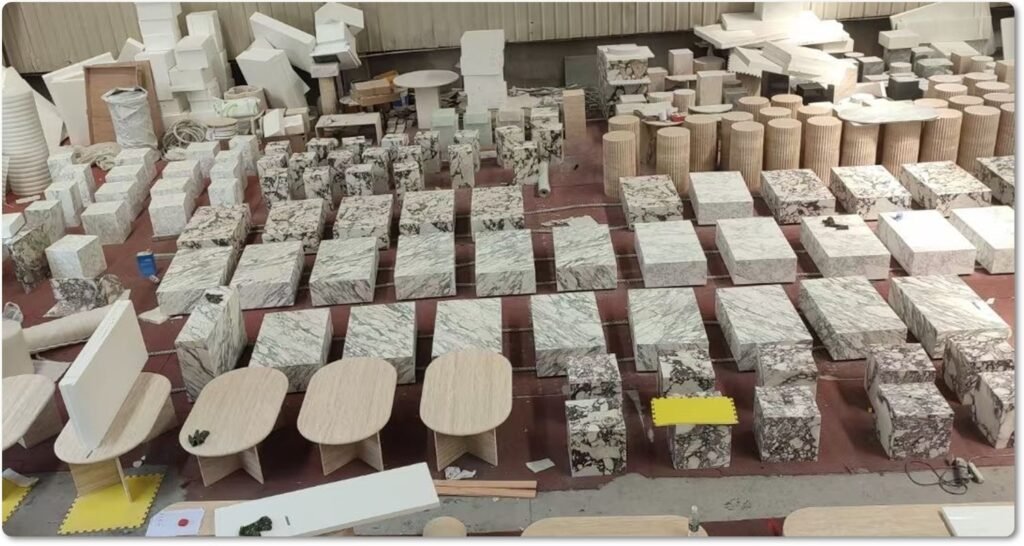
| Manufacturing | Photographs or videos of comparable fabrication work |
| Quality control | Inspection checklist, dimensional records, defect criteria |
| Repeatability | Approved master specification and sample retention process |
| Packaging | Crate photographs, package dimensions, loading procedures |
| Delivery | Production schedule, lead-time assumptions, shipment responsibilities |
| Commercial terms | Itemized quotation, payment terms, Incoterm, warranty conditions |
6.3 Distinguish a trading supplier from a manufacturing partner
A trading company may offer sourcing, product consolidation, and commercial coordination. A factory may offer more direct control over fabrication, engineering feedback, and production scheduling. Neither label alone guarantees better quality.
The important question is whether the supplier can clearly identify who is responsible for design approval, stone selection, fabrication, assembly, inspection, packaging, and corrective action.
For OEM and ODM projects, document the ownership and permitted use of drawings, molds or templates where applicable, product designs, and approved specifications in the commercial agreement.
7. Practical RFQ Template: Custom Stone Furniture
Buyers can copy the following template into an email or procurement document when contacting a stone furniture manufacturer, supplier, or wholesale partner.
Custom Stone Furniture Request for Quotation
A. Buyer and project details
Company:
Contact person:
Destination country and city:
Project name:
Intended application: Residential / Hospitality / Commercial / Retail / Other
Target delivery date:
B. Product specification
Product type: Coffee table / Side table / Dining table / Console / Desk / Other
Quantity:
Overall dimensions (L × W × H or diameter × height):
Stone material and preferred color:
Approved alternative materials, if any:
Stone thickness:
Surface finish:
Edge profile:
Vein matching or bookmatching requirements:
Base material: Stone / Metal / Wood / Combination
Required hardware or accessories:
C. Drawings and engineering
Reference images attached: Yes / No
CAD files attached: Yes / No
Required shop drawings: Yes / No
Required sections and connection details: Yes / No
Required prototype or first article: Yes / No
Functional or loading requirements:
Installation or assembly requirements:
D. Quality requirements
Approved sample or slab-selection process:
Dimensional tolerances:
Surface and edge acceptance criteria:
Joint and repair acceptance criteria:
Required test reports:
Inspection stage:
Required photographs or inspection records:
E. Packaging and shipping
Packaging requirements:
Maximum package dimensions or weight, if applicable:
Shipping method:
Destination port or delivery address:
Required Incoterm and named place:
Export documentation requirements:
Insurance requirements:
Assembly instructions required: Yes / No
F. Commercial quotation
Please provide:
Unit price and quotation currency.
Sample or prototype cost.
Engineering and drawing fees, if applicable.
Minimum order quantity, if any.
Production lead time after drawing and sample approval.
Packaging cost.
Estimated gross weight and package dimensions.
Payment terms.
Warranty and claims procedure.
Quotation validity and all exclusions.
Suggested first-article acceptance record
| Inspection item | Acceptance basis | Result |
|---|---|---|
| Dimensions | Approved drawing and agreed tolerances | Pass / Fail |
| Stone appearance | Approved sample or slab layout | Pass / Fail |
| Surface finish | Approved finish sample | Pass / Fail |
| Edge profile | Approved drawing and sample | Pass / Fail |
| Joints and bonding | Approved construction details | Pass / Fail |
| Stability and function | Agreed product-specific test | Pass / Fail |
| Packaging | Approved packaging specification | Pass / Fail |
The acceptance criteria must be agreed before production. A checklist without measurable requirements cannot reliably resolve disputes.
8. Frequently Asked Questions: Stone Furniture Design and Manufacturing
8.1 What are the main stone furniture design trends to explore in 2026?
Useful design directions include sculptural silhouettes, natural veining, rounded forms, thick-edge tables, tactile finishes, and combinations of stone with metal or wood. These are qualitative design observations rather than a statistically ranked market forecast.
8.2 Which stone is best for modern furniture designs?
There is no universally best stone. Marble is frequently considered for expressive veining; travertine for porous texture and warm tones; granite and selected quartzites for alternative performance and aesthetic requirements. The final choice depends on the actual stone’s properties, geometry, intended use, finish, and maintenance expectations.
8.3 Are travertine coffee tables suitable for commercial interiors?
They can be suitable when the specific stone, finish, construction, and maintenance requirements are appropriate for the application. Buyers should define pore treatment, stain expectations, impact exposure, cleaning procedures, and replacement or repair requirements.
8.4 Can a factory manufacture furniture from a reference image?
A reference image is a useful starting point, but accurate manufacturing usually requires confirmed dimensions, material selection, construction details, and approved shop drawings. Complex products may also require a physical sample or first article.
8.5 How can buyers achieve consistent quality in repeat orders?
Use a controlled specification covering the stone, finish, dimensions, tolerances, construction, hardware, inspection criteria, and packaging. Establish a sample-approval process and require written approval for substitutions or changes.
9. References: Technical Standards, Industry Guidance, and Regulatory Sources
The following sources provide a technical and regulatory foundation for further investigation. They do not establish that every furniture design is compliant or that every design direction represents a measured 2026 market trend.
Natural Stone Institute — Dimension Stone Design Manual 2024. Published in the institute’s resource library on January 8, 2025. Includes material guidance, fabrication details, tolerances, care and maintenance, and a dedicated chapter on stone furniture.
https://pubs.naturalstoneinstitute.org/resources/library/Natural Stone Institute — ASTM International Standards. Reference list covering dimension stone test methods and specifications, including absorption, strength, and material-specific requirements.
https://www.naturalstoneinstitute.org/stoneprofessionals/astm/ASTM C97/C97M — Standard Test Methods for Absorption and Bulk Specific Gravity of Dimension Stone. Consult the current active edition and determine whether the method is relevant to the selected material and application.
https://store.astm.org/standards/c97ASTM C99 — Standard Test Method for Modulus of Rupture of Dimension Stone. A material-testing reference that may be relevant to engineering evaluation, depending on the stone and design. Verify the current edition and project-specific applicability through ASTM International.
ASTM C880 — Standard Test Method for Flexural Strength of Dimension Stone. Consult the current edition when evaluating applicable flexural testing requirements. A test result alone does not establish the structural safety of a finished table.
European Union — Regulation (EU) 2024/1781 establishing a framework for ecodesign requirements for sustainable products. Published in the Official Journal of the European Union in 2024. Verify current implementing measures and product-specific applicability.
https://eur-lex.europa.eu/eli/reg/2024/1781/ojNatural Stone Institute — A Homeowner’s Guide to Natural Stone Countertops. Practical background on natural variation, material expectations, care, and documented communication with suppliers. Although focused on countertops, some material-selection principles are relevant to stone furniture.
https://www.naturalstoneinstitute.org/default/assets/file/consumers/homeownersconsumer_countertop.pdf
Evidence and methodology note
This article separates three types of information:
Technical reference: Published industry manuals, test methods, and legislation.
Design observation: Qualitative design directions offered for product development, not measured market-share claims.
Procurement recommendation: Practical procedures for reducing ambiguity in drawings, materials, fabrication, quality control, and delivery.
No quantified market forecast, survey result, or search-volume figure is claimed in this article. The design directions should be validated against the buyer’s target market, customer research, relevant design exhibitions, and actual sales or inquiry data before being used as quantitative business forecasts.
ASTM standards are maintained and revised independently. Buyers should verify the current edition, scope, and applicability of each cited standard before incorporating it into a contract or inspection plan.
10. EDG Stone CTA: Turn Your Stone Furniture Design into a Production-Ready Product
From inspiration to fabrication
A distinctive stone furniture product begins with a design concept, but its commercial success depends on how effectively that concept can be translated into material selection, engineering, fabrication, quality control, and delivery.
EDG Stone works with natural stone and custom fabrication requirements, supporting the development of stone components and made-to-order products. Buyers exploring marble furniture, travertine furniture, sculptural side tables, thick-edge coffee tables, consoles, and bespoke stone designs can begin with a reference image, sketch, or CAD drawing.
Send EDG Stone your design brief to discuss:
Stone material recommendations and visual selection.
Custom dimensions, finishes, and edge profiles.
CAD drawing review and production detailing.
CNC machining, waterjet cutting, and custom fabrication where suitable.
Sample development and approval requirements.
Quality inspection, export packaging, and shipping coordination.
What to send for your first inquiry
One or more reference images or a product rendering.
CAD drawings, if available.
Preferred stone type and finish.
Product dimensions and required quantity.
Destination country and target delivery date.
If you do not have production drawings yet, start with your reference images, approximate dimensions, and intended application. The next step is to clarify the product’s geometry, materials, and manufacturing requirements before confirming a quotation.
Explore EDG Stone’s custom fabrication services:
https://edgstone.com/
Suggested internal links for publication:
Custom Stone Fabrication Manufacturer — link to the relevant EDG Stone service page.
Stone Countertops Manufacturer in China — link to the existing countertops manufacturer page.
White Marble — link to the EDG Stone white marble collection.
Green Marble — link to the relevant green marble product collection.
Stone Furniture — link to the corresponding EDG Stone furniture category or product page, if available.
Call to action: Send us your reference images or CAD drawings to discuss a custom stone furniture project, material options, production feasibility, and a quotation.
Semantic Closure: How to Turn 2026 Stone Furniture Design Ideas into Commercial Products?
What defines a successful stone furniture design?
A successful design connects the visual qualities of natural stone with the functional and manufacturing requirements of a finished product. Color, veining, shape, finish, proportions, stability, joint construction, and packaging must work together. A striking rendering is only the beginning; the production specification determines whether the product can be made consistently.
How should buyers choose between marble, travertine, and other stones?
Start with the intended use, then evaluate the actual stone’s physical characteristics, appearance, maintenance requirements, and available fabrication options. Marble may be selected for expressive patterns, travertine for textural warmth, and granite or selected quartzites for different aesthetic and performance needs. The decision should be based on the identified material and application, not on a general assumption that one stone is always superior.
Why do shop drawings matter more than reference images alone?
Reference images communicate the intended appearance, while shop drawings define dimensions, sections, edge details, interfaces, and assembly. Without this information, a supplier may interpret the design differently from the buyer. Drawing approval creates a documented basis for sampling, manufacturing, inspection, and repeat orders.
Which design options should be explored first?
Begin with a manageable product family: a sculptural side table, a round dining table, a thick-edge coffee table, and a console. Compare each concept by material suitability, complexity, material yield, structural support, shipping weight, and target selling price. Develop a sample or first article for designs where appearance or construction cannot be adequately verified from drawings alone.
What should buyers verify before placing a production order?
Confirm the approved stone, dimensions, finish, construction, tolerances, sample status, inspection procedure, packaging method, delivery terms, and responsibility for any changes. Ensure that the quotation includes the components and services needed to deliver the specified product.
How can a stone furniture manufacturer support OEM and ODM projects?
A suitable manufacturing partner can help translate the design brief into a technical specification, identify fabrication constraints, prepare production drawings, coordinate samples, document approved changes, and establish repeatable inspection criteria. Buyers should verify these capabilities through relevant project evidence and written production procedures.
What is the next step for a custom stone furniture project?
Prepare a reference image or CAD file, approximate dimensions, preferred stone and finish, intended application, quantity, and destination. Send these details to EDG Stone to begin a discussion about design feasibility, material selection, custom fabrication, and quotation.
The central principle is straightforward: the best stone furniture design is not merely visually distinctive. It is also technically defined, suitable for its intended use, inspectable, transportable, and repeatable.