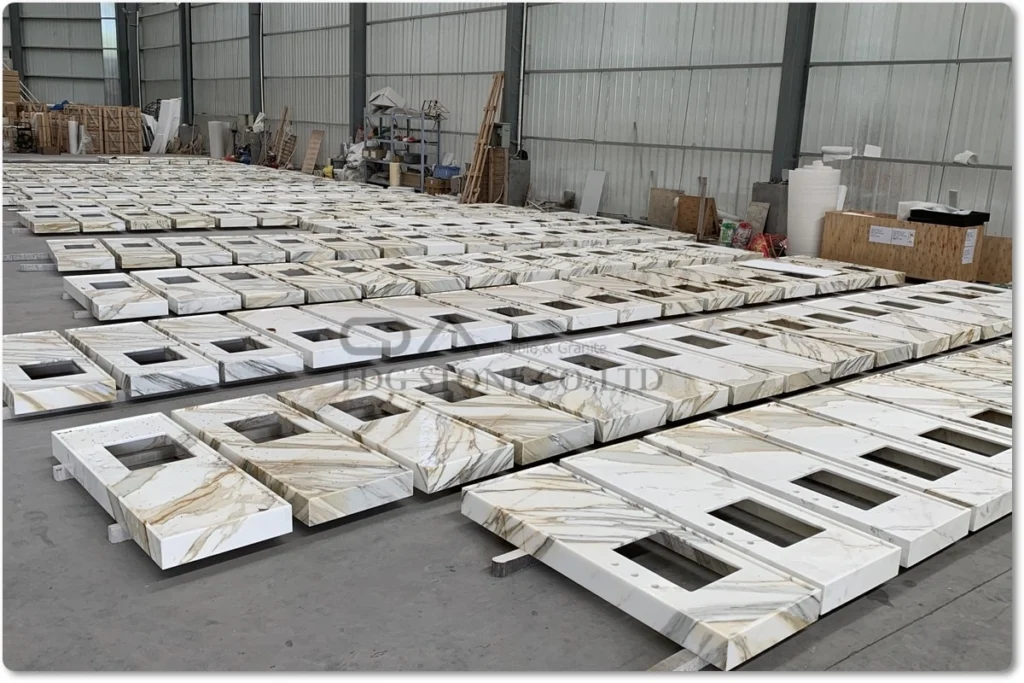
Stone furniture combines the natural variation of geological materials with the engineering requirements of finished furniture. A marble dining table, travertine coffee table, granite console or quartzite side table can look attractive in a photograph but still present serious procurement problems if its dimensions are inaccurate, its base is unstable, its joints are weak, or its packaging cannot withstand international transport.
For importers and wholesale buyers, quality inspection is therefore not simply a final visual check. It is a controlled process that begins with material selection and continues through fabrication, assembly, structural verification, packing and delivery.
A professional stone furniture supplier should be able to explain what material will be used, how the finished product will be manufactured, which tolerances will apply, how the supporting structure will be verified, and what evidence will be supplied before shipment.
This guide provides a practical framework for evaluating stone furniture factories, manufacturers, vendors, and dealers. It is intended to help buyers establish measurable requirements before production rather than negotiate disputed quality issues after the goods arrive.
Who should use this guide?
Furniture importers purchasing natural stone furniture in bulk.
Stone furniture wholesalers and distributors building repeatable product lines.
Interior designers and architects specifying custom furniture.
Hotel, hospitality, and multifamily procurement teams purchasing project quantities.
Retailers and dealers sourcing private-label furniture from overseas factories.
Contractors and project managers coordinating custom fabrication and installation.
The central procurement principle is simple: approve the specification, inspect against the specification, and retain evidence of the result.
1. Scope and Definitions
1.1 What Is Stone Furniture Quality Inspection?
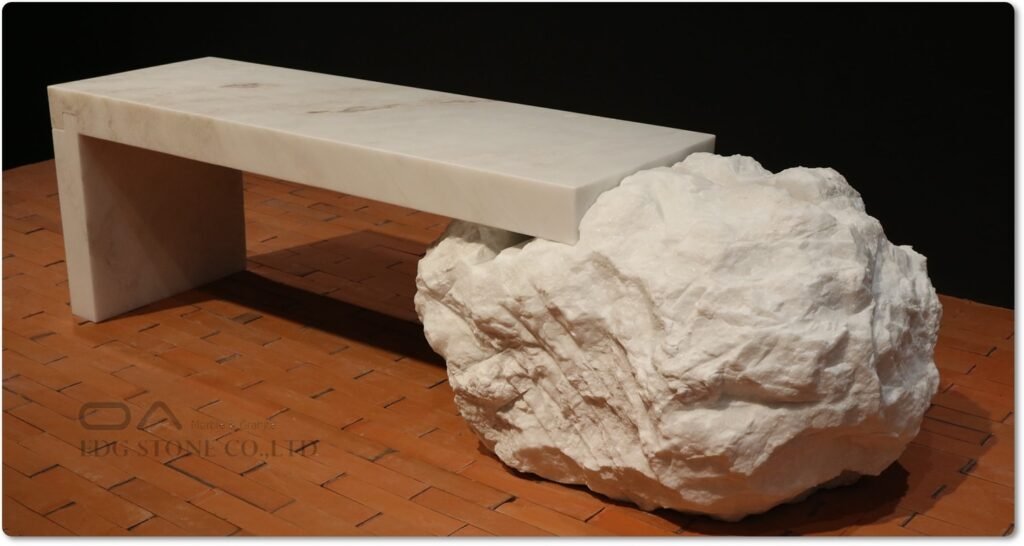
Stone furniture quality inspection is the systematic verification of the materials, dimensions, appearance, fabrication, assembly, stability, functionality, and packaging of a completed furniture product against agreed specifications.
It includes three related but distinct evaluation levels.
| Inspection level | Primary objective | Typical examples |
|---|---|---|
| Material inspection | Confirm the stone or other specified material meets requirements | Color, veining, cracks, repairs, finish, thickness |
| Fabrication inspection | Verify the stone components are processed correctly | Dimensions, edge profiles, cutouts, holes, joints |
| Finished-product inspection | Confirm the assembled furniture performs as intended | Stability, alignment, load-related verification, assembly, packaging |
These levels should not be treated as interchangeable. A slab may pass an applicable material test but still be unsuitable for a particular tabletop design. Likewise, a visually excellent tabletop may be poorly supported by an inadequately designed metal base.
1.2 Which Products Are Covered?
This guide applies to natural stone and stone-combination furniture, including:
Marble dining tables, coffee tables and side tables.
Granite and quartzite tables and countertops used in furniture.
Travertine consoles, accent tables and occasional furniture.
Stone desks, reception tables and hospitality furniture.
Marble cabinets, vanities and furniture with stone tops.
Stone-and-metal, stone-and-wood and stone-and-glass combinations.
Custom stone furniture manufactured to architectural or project drawings.
Engineered quartz, porcelain, sintered stone, terrazzo and other manufactured surfaces may require different material-specific evaluation methods. The correct inspection criteria depend on the actual material composition, intended application, and manufacturer’s technical information.
1.3 Essential Definitions
Approved sample: A physical reference sample or approved control specimen used to establish the agreed appearance and material expectations.
Golden sample: The agreed reference product or representative component used for production comparison. For large or variable natural stone products, one sample may not adequately represent an entire batch.
First article inspection: Examination of the first completed unit, or an agreed representative unit, before unrestricted mass production.
In-process inspection: Checks performed while materials are being cut, machined, finished,d or assembled.
Pre-shipment inspection (PSI): Inspection of finished goods before dispatch, normally after the specified proportion of the order has been completed and packed or made available for examination.
Acceptance criteria: Written requirements defining acceptable, conditionally acceptable and unacceptable results.
Nonconformity: A failure to meet an agreed specification, drawing, approved sample or applicable requirement.
1.4 Define the Inspection Boundary Before Ordering
A purchase order should identify which requirements are mandatory, which are aesthetic preferences, and which require independent testing.
For example, a buyer may specify a polished marble tabletop with a nominal thickness of 30 mm, a particular edge profile, a defined dimensional tolerance,ce and a black powder-coated steel base. The buyer should also specify how much natural variation is acceptable, which surfaces are visible, what assembly method is required, and whether the supplier must provide a structural verification report.
Without these definitions, phrases such as “premium quality,” “perfect finish,” and “export standard” are too subjective to provide reliable contractual acceptance criteria.
2. Technical Evaluation: Materials, Fabrication and Construction
2.1 Raw Material Batch Control
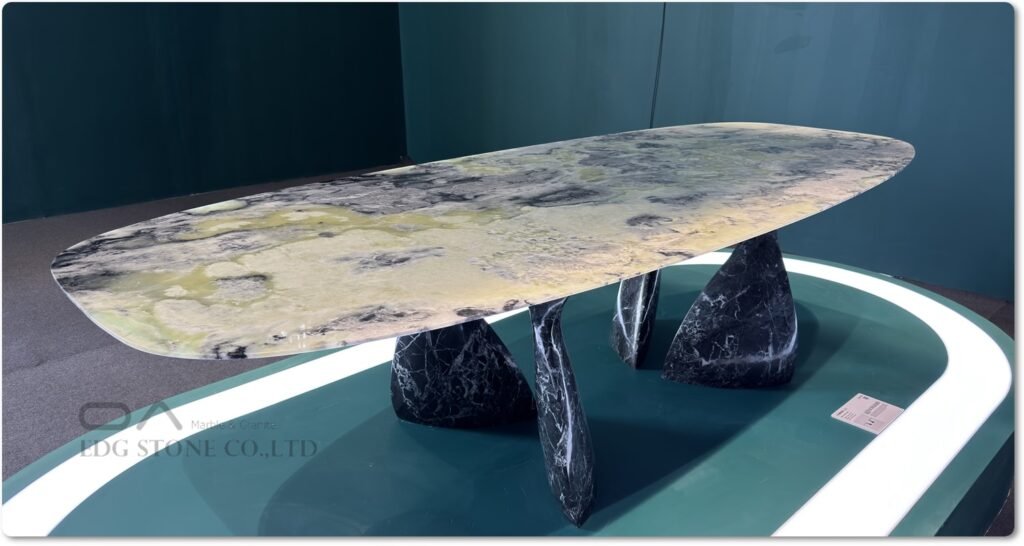
Natural stone is a geological material. Color, veining, mineral distribution, grain structure, and small natural features can vary between blocks, slabs,s and quarry lots.
The objective of batch inspection is not to eliminate all natural variation. It is to ensure that the supplied material is consistent with the agreed design intent and that significant deviations are identified before fabrication.
What buyers should verify
Material identity and commercial name.
Country or quarry origin when specified and verifiable.
Slab or block batch identification, where available.
Base color, background tone and characteristic veining.
Visible fissures, open cracks, chips, pits, and other discontinuities.
Resin filling, mesh backing, reinforcement and other treatments.
Finish consistency under suitable lighting.
Material thickness and any required reinforcement.
Whether the material matches the approved sample and project photographs.
A commercial stone name does not always guarantee a unique geological source or identical appearance. Buyers should approve representative material and document the acceptable range of variation.
Sample approval and production matching
For a repeat order or large project, retain an approved reference sample and, where practical, photographs of the actual slabs selected for production.
For bookmatched or visually coordinated pieces, approve the layout before cutting. For dining tables, paired side tables and multi-unit hospitality projects, review the overall appearance across the production batch rather than approving each component in isolation.
A small hand sample may demonstrate color and texture but cannot fully predict the distribution of veins across a large slab. Full-slab photographs and a cutting layout are often more useful for appearance-sensitive applications.
2.2 Material Testing: What ASTM Methods Can and Cannot Prove
ASTM International publishes standardized test methods for specific material properties. The applicable method depends on the stone type, the property being evaluated, and the intended use.
Relevant examples include:
ASTM C97/C97M, addressing absorption and bulk specific gravity of dimension stone.
ASTM C170/C170M, addressing compressive strength of dimension stone.
ASTM C880/C880M, addressing flexural strength of dimension stone.
ASTM C99/C99M, addressing modulus of rupture of dimension stone.
ASTM C241/C241M, addressing abrasion resistance of stone subjected to foot traffic.
The latest applicable edition and its scope should be confirmed directly with ASTM before specifying a test. Not every method is relevant to every furniture application, and not every property needs to be tested for every order.
For a thin tabletop spanning between supports, flexural performance and the actual support arrangement may be more relevant than compressive strength alone. For a surface exposed to frequent spills, absorption and stain resistance may matter more to daily maintenance than a strength result considered in isolation.
Critical distinction: These material tests do not independently certify the structural safety of a finished table or chair. A stone specimen tested in a laboratory is not equivalent to a complete furniture assembly with joints, fasteners, a metal frame, and a particular load distribution.
The final furniture design must be assessed against its intended use and foreseeable loading conditions.
2.3 Color, Veining and Surface Appearance
A stone furniture quality checklist should distinguish between acceptable natural characteristics and manufacturing defects.
| Feature | Inspection approach | Acceptance method |
|---|---|---|
| Base color | Compare under consistent lighting | Approved sample and agreed variation range |
| Veining | Review full-surface photographs or physical pieces | Approved layout or reference images |
| Natural fissures | Assess location, openness,s and relevance to the design | Written limits and technical review where needed |
| Resin-filled areas | Identify and disclose when relevant | Approved treatment and visual expectations |
| Surface pits | Check visible and functional surfaces | Agreed limits by product and finish |
| Chips and scratches | Inspect edges, corners and top surfaces | No unapproved transport or fabrication damage |
| Polish or honed finish | Inspect under appropriate lighting | Consistent agreed appearance |
| Repairs | Record visible and concealed repairs when specified | Disclosure and approval requirements |
Inspection should take place under consistent lighting conditions and from agreed viewing distances. Strong raking light may reveal surface imperfections that are not visible under normal room lighting, so the buyer should define the viewing conditions for acceptance.
Natural variation should not automatically be classified as a defect. Conversely, a supplier should not use “natural stone variation” to excuse damage, unapproved repairs or deviations from an expressly approved layout.
2.4 Dimensional Accuracy and Geometric Tolerances
Dimensional problems can cause assembly failures, misaligned furniture components, and expensive site rework.
The purchase specification should establish the nominal dimensions and permitted deviations for each critical measurement.
Inspect:
Overall length, width, and height.
Finished stone thickness.
Flatness of the tabletop.
Squareness and diagonal dimensions where applicable.
Edge profile and edge thickness.
Position and diameter of holes and cutouts.
Distance between mounting points.
Alignment between the stone top and its base.
Levelness and coplanarity of assembled components.
Fit between adjoining stone pieces.
How to define tolerances
Do not assume that one universal tolerance is suitable for every stone furniture product. A small side table, a large dining table, a bookmatched console,e and a custom stone desk have different functional requirements.
The buyer should specify a numerical tolerance for each critical dimension, along with the measurement method and reference points.
For example, a project may require a tabletop length of 1,800 mm with a tolerance of ±2 mm. This is an illustrative procurement requirement, not a universal industry standard. The supplier must confirm that the tolerance is achievable for the selected material, fabrication method, od and product geometry before it is included in the purchase order.
A measurement report should record actual readings, not merely state “OK.”
2.5 Edge Processing, Holes and Joints
Edges and cutouts deserve particular attention because they are common locations for chipping, dimensional errors,ors and stress concentration.
Edge inspection
Check whether:
The edge profile matches the approved drawing.
The polished or honed finish is consistent.
Corners have the specified radius or shape.
There are visible chips, cracks,acks or grinding marks.
Edge thickness remains consistent.
Sharp edges have been treated as specified for the intended use.
Cutout and drilling inspection
For mounting holes, cable openings, fastener holes, and other cutouts, verify:
Position relative to the drawing datum.
Diameter and shape.
Distance from the stone edge.
Smoothness and condition of the cut edge.
Compatibility with the specified hardware.
Any reinforcement or support requirements.
Holes and cutouts can reduce the effective strength of a stone component. The acceptability of their placement should therefore be considered as part of the design, not just checked after machining.
Joint inspection
For multi-piece furniture, inspect the joint width, alignment, adhesive appearance, and fit of the adjoining surfaces. Where the design uses mechanical fasteners, verify the connection method and required access for installation or maintenance.
A visually narrow joint is not automatically a structurally adequate joint. Functional suitability depends on the materials, joint design, loads and manufacturing process.
2.6 Structural Stability: Bases, Legs and Supports
Structural stability is one of the most important checks for completed stone furniture.
Stone tops can be heavy, and their mass creates significant demands on supporting structures, especially when the furniture has a narrow footprint, a long overhang,erhang or a tall center of gravity.
Inspect the following components:
Metal bases and legs.
Wooden frames and supporting rails.
Brackets, plates and connecting hardware.
Adhesive bonds and mechanical fasteners.
Adjustable feet and floor-contact points.
Cross-bracing and anti-racking elements.
Stone-to-base support surfaces.
Protection against sliding, tipping and unintended movement.
Practical stability checks
Place the furniture on a suitable, level inspection surface.
Confirm that all specified feet contact the surface as intended.
Check for rocking, twisting or obvious assembly misalignment.
Verify that fasteners are installed according to the approved assembly instructions.
Inspect welds, brackets, and mounting plates for visible defects.
Confirm that the tabletop is properly supported and that overhangs match the approved design.
Conduct any required load, deflection, tipping or stability tests using a documented procedure appropriate to the product.
Do not invent an arbitrary load test and assume it establishes safety. Test loads, directions, duration, allowable deflection, and pass/fail criteria should be established by a qualified designer, relevant product standard ,or project-specific engineering assessment.
Heavy stone furniture may also require anchoring, anti-tip provisions ,or special installation instructions, particularly in commercial environments and locations where children may be present.
2.7 Finished-Product Appearance and Function
The finished inspection should assess the assembled product, not only the stone components.
Review:
Overall appearance against the approved reference.
Color and finish consistency across all visible surfaces.
Tabletop alignment and levelness.
Base position and symmetry.
Smooth operation of any drawers, doors or adjustable components.
Fastener accessibility and assembly completeness.
Surface protection and floor-contact pads.
Product labeling and assembly instructions, when required.
Stability and other functional requirements defined in the specification.
For hospitality or commercial projects, inspect a representative sample of each product type and any materially different construction configuration. A successful inspection of one table design should not automatically be treated as approval for a different design using a different base or tabletop geometry.
2.8 Production Quality Control: Four Mandatory Checkpoints
A reliable inspection program should include four stages.
Checkpoint 1 — Material approval
Before cutting, verify the material identity, appearance, thickness, finish, and any required test documentation. Obtain written approval for appearance-sensitive slabs and layouts.
Checkpoint 2 — First article approval
Inspect the first completed representative unit against the approved drawing and sample. Check dimensions, fabrication, assembly, sstabilityy and appearance. Record any corrections before proceeding with the full order.
Checkpoint 3 — In-process inspection
During production, check critical dimensions, machining quality, edge processing, hardwareinstallationi,n and assembly. Correct recurring issues before they affect the entire batch.
Checkpoint 4 — Pre-shipment inspection
Verify the finished quantity, appearance, dimensions, assembly, functional requirements, labels, accessories,ies and packing condition against the agreed acceptance criteria.
For large orders, define inspection frequency, sampling method, defect classification and the process for handling failed units in the purchase order.
2.9 Packaging and International Transport
Stone furniture may be damaged even when fabrication quality is excellent. Packaging must protect heavy stone components from impact, vibration,abrasiona,sion and movement during handling and transit.
The packing specification should address:
Individual protection for finished stone surfaces.
Corner and edge protection.
Separation between stone components and metal hardware.
Internal blocking and restraint.
Crate strength and handling points.
Moisture management where relevant.
Clear gross weight and handling markings.
Safe lifting and unloading requirements.
Packing lists and component identification.
Photographs of the completed packing configuration.
The packaging design should reflect the actual product weight, geometry, fragility, shipping route, and handling method. A packaging arrangement suitable for a small side table may be inadequate for a large marble dining table.
Packaging inspection before and after closure
Before closing the crate, photograph the product, protective materials, accessories and internal restraints. After closure, photograph the exterior, markings,s and visible crate condition.
For higher-value shipments, consider recording crate dimensions, gross weight, shipping marks and the condition of the loaded cargo where practical.
If damage occurs during transit, preserve the original packaging, take photographs before moving or repairing the item, record the delivery condition and notify the relevant carrier, insurer and supplier according to the applicable contractual deadlines.
Packaging photographs do not prove that damage cannot occur. They provide evidence to help distinguish potential manufacturing defects from handling and transport damage.
3. Procurement Checklist: How to Inspect Stone Furniture
3.1 Before Placing the Purchase Order
The buyer should complete the following checks before authorizing production.
Confirm the stone type, commercial name, and specified source information.
Approve a representative physical sample.
Request full-slab photographs for appearance-sensitive projects.
Define acceptable color and veining variation.
Specify dimensions, thickness, and dimensional tolerances.
Approve edge profiles, holes, cutouts,s and joint details.
Review the base design, support points, ts and assembly method.
Confirm intended use and any special structural requirements.
Define material testing and product-level verification requirements.
Agree on inspection checkpoints and acceptance criteria.
Specify packing, labeling, ing and shipping documentation.
Establish procedures for nonconforming products and corrective action.
3.2 First Article Inspection Checklist
The first article should be representative of the intended production process and finished configuration.
Material matches the approved sample.
Dimensions match the approved technical drawing.
Thickness and edge profile are correct.
Surface finish is consistent.
Cutouts and mounting holes are correctly positioned.
Stone components fit the supporting structure.
Fasteners and connecting hardware match the specification.
The product stands as intended on a suitable level surface.
Required stability or structural tests have been completed.
Assembly instructions and accessories are complete.
Photos and measurements have been recorded.
Buyer approval has been obtained before mass production where required.
3.3 In-Process Inspection Checklist
Material batches remain traceable.
Production components match the approved material selection.
Cutting and machining dimensions are checked.
Edges and corners are inspected during fabrication.
Cracks, chips, and other nonconformities are documented.
Hardware and base components are checked.
Assembly problems are corrected before final finishing.
Rework and replacement components are identified.
Inspection results are recorded against the relevant order or batch.
3.4 Pre-Shipment Inspection Checklist
Ordered quantity and product models are correct.
Finished dimensions meet agreed tolerances.
Material appearance matches the approved standard.
Visible surfaces are free from unacceptable damage.
Edges, joints, holes,s and cutouts meet the specification.
Bases, fasteners and supports are correctly assembled.
Required functional and structural checks are documented.
Accessories, hardware and assembly instructions are included.
Product identification and shipping labels are correct.
Packing materials protect the stone and finished surfaces.
Crates are appropriately secured and marked.
Photographs and inspection records are complete.
Nonconforming units are identified and disposition is agreed.
Shipment release follows the agreed approval process.
3.5 Defect Classification
Define defect categories before production so the supplier and buyer apply consistent decisions.
| Category | Examples | Recommended response |
|---|---|---|
| Critical | A condition presenting a serious safety risk or a failure of a mandatory safety requirement | Stop release; isolate affected units; investigate and resolve before acceptance.nce |
| Major | Incorrect dimensions preventing installation, serious visible damage, unstable construction, or missing essential components | Reject or hold affected units pending documented corrective action |
| Minor | Small cosmetic deviations within a separately agreed minor-defect category | Accept, repair or reject according to the written agreement |
This is a practical procurement framework, not a universal regulatory classification. The parties must define the actual defect categories and disposition rules for their product and market.
For statistical sampling, an agreed acceptance quality limit (AQL) plan may be useful for appropriate defect classes. However, AQL is a sampling and decision framework, not a guarantee that every unit is defect-free. Safety-critical characteristics should not be treated as ordinary cosmetic sampling items.
4. Cost and Risk Factors
4.1 What Determines Stone Furniture Quality-Control Costs?
Inspection costs vary with product complexity, batch size, testing requirements, and shipping risk.
| Cost factor | Why it matters | Procurement approach |
|---|---|---|
| Material variability | Natural variation can require more sample review and slab selection | Approve actual slabs and layouts where necessary |
| Custom fabrication | Complex edges, cutouts, and joints require additional measurement | Prioritize critical dimensions on the inspection plan |
| Structural complexity | Unusual bases, long spans or overhangs may need engineering review | Obtain design verification before production |
| Independent laboratory testing | Test fees depend on method, sample preparation, and laboratory | Specify applicable methods and reporting requirements |
| Third-party inspection | Travel, time, sampling and reporting affect cost | Agree on inspection scope and timing in advance |
| Export packaging | Heavy, fragile and oversized products may require specialized crates | Approve packaging design and handling requirements |
| Rework and replacement | Late discovery can affect labor, materials, and shipment schedules | Move checks upstream to the material and first-article stages |
The lowest quotation does not necessarily produce the lowest total procurement cost. A slightly higher initial cost may be justified if it reduces rework, replacement, installation delays, and claims.
4.2 The Hidden Cost of Weak Inspection
Common financial consequences include:
Recutting or replacing incorrectly sized components.
Replacing stone damaged during fabrication or assembly.
Rebuilding bases that fail stability or alignment requirements.
Delays caused by missing hardware or unclear assembly instructions.
Additional freight and handling for replacement parts.
Site labor wasted on components that do not fit.
Customer disputes over natural variation or visible repairs.
Insurance and carrier claims complicated by insufficient evidence.
The most effective cost-control strategy is to identify expensive failure modes before production begins. A drawing review may prevent a hole-position error; a first article may reveal an unsuitable support arrangement; a packaging trial may identify a weak restraint before a full container is loaded.
4.3 Risk-Based Inspection for Different Applications
Inspection depth should reflect the consequences of failure.
Residential accent furniture: Focus on appearance, dimensions, edge safety, assembly and stability appropriate to the product.
Large dining tables: Give additional attention to stone weight, overhangs, support geometry, connections, stability, and handling.
Hospitality and commercial furniture: Establish repeatability, batch consistency, maintainability, documentation and any applicable project or market requirements.
Custom architectural furniture: Require approved drawings, material traceability where applicable, dimensional records, installation details and appropriate engineering verification.
Stone furniture for markets with specific product regulations: Identify applicable legislation, standards, labeling obligations,s and conformity requirements before production. Do not assume that one country’s requirements automatically satisfy another country’s requirements.
4.4 Regulatory and Standards Considerations in 2026
There is no single global standard that certifies every type of stone furniture for every application.
Buyers should distinguish among:
Material test methods.
Furniture performance and stability requirements.
Chemical or emissions requirements for relevant components.
Packaging and transport requirements.
Market-specific product safety and conformity obligations.
For example, ASTM dimension-stone methods can help characterize a stone material, but they do not replace a suitable finished-product assessment.
In the European Union, the General Product Safety Regulation (GPSR), Regulation (EU) 2023/988, has applied since 13 December 2024 to consumer products within its scope. Whether and how it applies depends on the product, supply-chain role, le and circumstances. Professional B2B use does not automatically remove every product-safety obligation, and other sector-specific legislation may also apply.
For furniture sold in the United States, buyers should identify the applicable federal and state requirements for the product category and intended use. Relevant requirements may differ for general tables, children’s products, upholstered furniture and other specialized products.
For wood-based or composite components, adhesives, coatings, and metal finishes, assess any applicable chemical, emissions, labeling, and market-access requirements separately. Do not assume that a stone test report covers the complete furniture assembly.
Best practice: Ask the importer, responsible economic operator,r or qualified compliance professional to confirm the requirements applicable to the destination market and exact product.
5. Supplier Evaluation: How to Choose a Reliable Stone Furniture Supplier
5.1 Documents a Professional Supplier Should Provide
A capable stone furniture manufacturer or factory should be able to provide documentation appropriate to the product and project.
| Document or evidence | What it helps establish |
|---|---|
| Product specification | Material, dimensions, finish and construction requirements |
| Approved sample record | The agreed material and appearance reference |
| Technical drawings | Geometry, tolerances, cutouts, joints and support details |
| Material identification | The stone or manufactured surface selected for the order |
| Relevant laboratory reports | Tested properties under the identified method and edition |
| First-article report | Measurements and observations for the initial representative unit |
| In-process QC records | Production checks and identified corrective actions |
| Final inspection report | Results against the agreed acceptance criteria |
| Structural verification records | Evidence appropriate to the product’s load and stability requirements |
| Packing specification | Protection, crate construction and handling information |
| Shipment photographs | Product condition, internal protection and closed packaging |
| Corrective-action records | How nonconformities were investigated and resolved |
Not every project requires every document. Requirements should be proportionate to the risk, product complexity, and customer expectations.
5.2 Questions to Ask a Stone Furniture Manufacturer
Before approving a supplier, ask:
Can you manufacture against our technical drawings and dimensional tolerances?
Can we approve the actual stone slabs or representative material before cutting?
How do you control color variation across a multi-unit order?
What is your procedure for first-article approval?
Which critical dimensions do you measure during production?
How do you verify the compatibility of stone tops, bases and connecting hardware?
What structural checks are appropriate for this product?
Can you provide inspection photographs and measurement records?
How are repairs, replacements, and nonconforming products documented?
How is the furniture packed for the proposed shipping method?
What evidence can you provide if transport damage occurs?
Who approves changes to material, construction or finish after production starts?
A reliable supplier should answer these questions with specific procedures and evidence rather than relying exclusively on general claims such as “high quality,” “professional factory,” or “strict inspection.”
5.3 Manufacturer, Factory, Wholesaler, Vendor or Dealer?
These terms describe different commercial roles, and buyers should confirm the actual responsibilities of the contracting party.
Stone furniture manufacturer: Typically manages or directly controls manufacturing activities and production specifications.
Stone furniture factory: Refers to the production facility; the scope of in-house fabrication and assembly should be verified.
Stone furniture wholesaler: Primarily supplies products in commercial quantities, potentially sourcing from several factories.
Stone furniture vendor: A broad term for a seller or contracted supplier.
Stone furniture dealer: Typically sells or distributes products through a commercial channel.
A manufacturer may outsource some operations, and a dealer may have excellent quality-control systems. The important question is not the label alone but who controls material selection, fabrication, assembly, inspection, and corrective action.
5.4 Supplier Scorecard
Use a consistent scorecard to compare potential suppliers.
| Evaluation category | Suggested weighting |
|---|---|
| Material control and sample matching | 20% |
| Fabrication accuracy and finish quality | 20% |
| Construction and structural verification | 20% |
| Quality documentation and traceability | 15% |
| Packaging and export experience | 15% |
| Communication and corrective-action process | 10% |
| Total | 100% |
These weightings are an illustrative procurement model, not an industry benchmark. Adjust them to suit the project. A structurally complex commercial table may justify a higher weight for engineering verification, while a highly appearance-sensitive natural stone collection may require greater emphasis on material selection.
6. Practical RFQ Template: Stone Furniture Quality Requirements
Copy the following template into your RFQ, purchase order, or supplier evaluation document. Replace the bracketed fields with project-specific information.
Stone Furniture RFQ and Inspection Specification
A. Project Information
Buyer / Company: [Company name]
Project name: [Project name]
Destination market: [Country/region]
Product type: [Dining table / coffee table / console / desk / other]
Quantity: [Number of units]
Required delivery date: [Date]
Shipping method: [Seaair/roadd / other]
Material type: [Marble / granite / quartzite / travertine / engineered surface / other]
Commercial material name: [Name]
Required origin, if applicable: [Origin]
Color and veining reference: [Approved sample/photographs / slab selection]
Finish: [Polished/honed / brushed/other]
Nominal thickness: [mm]
Reinforcement or backing: [Required / not required/specify]
Permitted natural variation: [Describe]
Repair and resin disclosure requirements: [Describe]
Overall dimensions: [L × W × H, mm]
Dimensional tolerances: [Specify each critical dimension]
Flatness requirement: [Value and measurement method]
Edge profile: [Drawing or description]
Cutouts and holes: [Dimensions and locations]
Base material and finish: [Specify]
Joint and connection method: [Specify]
Assembly requirements: [Specify]
Structural verification: [Applicable method, load conditions and acceptance criteria]
Applicable standards and editions: [Specify after verification]
D. Inspection Plan
Material approval required before cutting: [Yes / No]
First-article approval required: [Yes / No]
In-process inspection: [Frequency/checkpoints]
Pre-shipment inspection: [Scope/timing]
Inspection party: [Buyer/supplier / independent inspector]
Sampling plan, if applicable: [Standard/sample size/acceptance criteria]
Critical defects: [Define]
Major defects: [Define]
Minor defects: [Define]
Required inspection report: [Format/photographs/measurements]
Nonconformity disposition: [Repair/replacement/reinspection / other]
E. Packaging and Shipping
Individual surface protection: [Specify]
Edge and corner protection: [Specify]
Crate type: [Specify]
Internal restraint: [Specify]
Moisture protection, if needed: [Specify]
Product and crate labeling: [Specify]
Gross weight and dimensions: [Required / not required]
Pre-packing photographs: [Required / not required]
Closed-crate photographs: [Required / not required]
Cargo-loading photographs: [Required / not required]
Damage notification and evidence procedure: [Specify]
F. Approval and Acceptance
Approved drawing reference: [Drawing number/revision]
Approved sample reference: [Sample ID/date]
Inspection report reference: [Document number]
Outstanding nonconformities: [List]
Corrective action completed: [Yes / No / not applicable]
Buyer release authorization: [Name/date]
Final acceptance conditions: [Specify]
Recommended RFQ Clause
“The supplier shall manufacture the stone furniture in accordance with the buyer-approved drawings, material reference, finish requirements, and written acceptance criteria. Material substitutions, significant appearance changes, dimensional deviations, and changes to structural components shall require written approval where specified in the purchase order. Inspection results shall be recorded against the applicable requirements. Any identified nonconformity shall be documented and resolved in accordance with the agreed corrective-action procedure before shipment release, where required.”
This clause is a starting point, not a substitute for a complete contract. Buyers should align inspection, payment, title, risk of loss, warranty, claim,s and dispute-resolution provisions with their commercial agreement.
7. Frequently Asked Questions
1. How do you inspect the quality of stone furniture?
Inspect the raw material, dimensions, surface finish, edges, cutouts, joints, supporting structure, stability, assembly and packaging. Begin with approved samples and drawings, examine the first article before mass production, perform in-process checks and document a final inspection before shipment.
2. What should I ask a stone furniture supplier before placing a bulk order?
Ask for technical drawings, representative material samples, dimensional tolerances, the production inspection procedure, relevant material test reports, structural verification where appropriate, packaging details and a documented process for correcting nonconforming products.
3. Which ASTM standards apply to natural stone furniture?
Potentially relevant dimension-stone methods include ASTM C97/C97M for absorption and bulk specific gravity, ASTM C170/C170M for compressive strength, ASTM C880/C880M for flexural strength, and ASTM C99/C99M for modulus of rupture. The applicable method depends on the stone, property and intended use. These tests do not independently certify the safety of the assembled furniture.
4. How can buyers prevent marble table damage during international shipping?
Specify protective separation, corner protection, suitable internal restraints and packaging designed for the product’s weight and geometry. Photograph the furniture before packing, record the internal protection and closed-crate condition, and preserve packaging and delivery evidence if damage occurs.
5. How do I choose a reliable stone furniture manufacturer or wholesale vendor?
Evaluate documented material control, fabrication capability, first-article approval, dimensional records, structural verification, final inspection, export packaging and corrective-action procedures. Compare suppliers against the same written specification rather than relying on price or marketing claims alone.
8. References and Technical Resources
Use primary standards and official regulatory sources when preparing project specifications. Always confirm the latest applicable edition, amendments, scope and any contractual requirements before citing a standard as mandatory.
ASTM International — ASTM C97/C97M, Standard Test Methods for Absorption and Bulk Specific Gravity of Dimension Stone. Official standards catalog: https://www.astm.org/
ASTM International — ASTM C170/C170M, Standard Test Method for Compressive Strength of Dimension Stone. Official standards catalog: https://www.astm.org/
ASTM International — ASTM C880/C880M, Standard Test Method for Flexural Strength of Dimension Stone. Official standards catalog: https://www.astm.org/
ASTM International — ASTM C99/C99M, Standard Test Method for Modulus of Rupture of Dimension Stone. Official standards catalog: https://www.astm.org/
ASTM International — ASTM C241/C241M, Standard Test Method for Abrasion Resistance of Stone Subjected to Foot Traffic. Official standards catalog: https://www.astm.org/
Natural Stone Institute, technical resources on natural stone selection, care, installation and stone performance. https://www.naturalstoneinstitute.org/
European Union — Regulation (EU) 2023/988 on General Product Safety, adopted 10 May 2023; generally applicable from 13 December 2024, subject to its scope and provisions. EUR-Lex: https://eur-lex.europa.eu/eli/reg/2023/988/oj
U.S. Consumer Product Safety Commission (CPSC), official information on product safety requirements, applicable regulations and business compliance. https://www.cpsc.gov/
International Organization for Standardization (ISO), official standards catalog for quality management, sampling and other relevant technical standards. https://www.iso.org/standards.html
International Safe Transit Association (ISTA), transport packaging and distribution testing resources. https://ista.org/
Technical note: This guide provides a procurement framework, not a universal certification or legal opinion. A material test report should identify the tested material, sample, method, edition, laboratory and results. A furniture inspection report should identify the finished product, applicable specification, test conditions, observed results and acceptance decision. These records serve different purposes and should not be substituted for one another.
9. EDG Stone: Quality-Controlled Stone Furniture for B2B Projects
For international buyers, successful stone furniture procurement requires more than attractive stone. It requires coordination between material selection, fabrication, supporting structures, finishing, inspection and export packaging.
EDG Stone works with natural stone products and custom fabrication requirements for international B2B buyers. For stone furniture projects, buyers should communicate the intended application, material preferences, dimensions, quantities, finish, construction details and destination market at the quotation stage so that production and inspection requirements can be evaluated together.
What to include in your inquiry
Product type and intended application.
Stone selection and approved appearance references.
Dimensions, thickness and edge profiles.
Base material, hardware and construction drawings.
Estimated order quantity and project schedule.
Destination country and shipping requirements.
Inspection, testing and packaging expectations.
A complete specification helps establish realistic manufacturing requirements, clarify acceptance criteria and reduce avoidable disputes.
Request a Stone Furniture Quote
Discuss your project requirements with EDG Stone to explore material options, custom fabrication, technical coordination and export packing.
Explore: Stone Furniture and Custom Fabrication
Prepare: Technical drawings, reference images and quantity schedules
Request: A project-specific quotation and quality-control plan
Call to action: Contact EDG Stone for a Stone Furniture Quote
The most effective way to reduce procurement risk is to define quality before production, verify it at the right checkpoints, and retain the evidence needed to make a clear acceptance decision.
Stone Furniture Quality: The Complete Buyer Decision Framework
What Defines High-Quality Stone Furniture?
High-quality stone furniture is the result of coordinated material selection, accurate fabrication, appropriate structural design, controlled assembly, and protective export packaging. No single characteristic, including stone appearance or laboratory strength results, is sufficient to establish the quality of the finished product.
How Should Buyers Evaluate Stone Furniture Manufacturers?
Buyers should assess a manufacturer’s ability to maintain material consistency, follow approved drawings, control production tolerances, verify the supporting structure, and provide traceable inspection records. A documented first-article approval process and a clearly defined pre-shipment inspection plan provide stronger evidence of manufacturing control than general quality claims.
Why Does Material Quality Differ from Finished-Product Quality?
Natural stone testing evaluates specific properties of the material under defined laboratory conditions. Finished furniture introduces additional variables, including support geometry, stone thickness, cutouts, fasteners, joints, load distribution, and assembly quality. Consequently, material test reports and finished-product structural verification serve different purposes and should be evaluated separately.
Which Quality-Control Option Is Best for a B2B Project?
For standard wholesale products, a documented sample approval, first-article inspection, and risk-based final inspection may provide an appropriate foundation. For customized furniture, large stone spans, high-value hospitality projects,s or products with demanding installation conditions, buyers should consider additional drawing reviews, engineering verification, in-process inspections, ns and project-specific testing.
What Should Buyers Consider Before Approving Production?
The purchase order should define the material reference, dimensions, tolerances, finish, acceptable natural variation, structural requirements, inspection stages, defect classification, packaging specifications,ons and shipment-release procedure. These requirements should be agreed upon before production rather than introduced after the finished goods are ready for dispatch.
How Is Stone Furniture Quality Assurance Evolving?
A more reliable procurement model combines physical samples with digital slab photographs, revision-controlled drawings, recorded measurements, batch identification and photographic inspection records. This approach improves communication between buyers, manufacturers, designers, inspectors and logistics providers. It also creates a clearer evidence trail when a quality dispute or transport-damage claim occurs.
Commercial Insight: Quality Is a Procurement System, Not a Marketing Claim
For importers, wholesalers, dealers and commercial project buyers, the most useful measure of a stone furniture supplier is its ability to demonstrate that the agreed requirements were followed. A reliable quality system makes expectations measurable, identifies problems early, and documents the final acceptance decision.
The practical conclusion is that buyers should evaluate the complete product and its manufacturing process—not simply the stone slab, the supplier’s advertised capabilities, or the lowest quotation.
Final Procurement Recommendation
Before issuing a purchase order, create one controlled specification that connects the approved sample, technical drawing, inspection checklist, structural requirements, and packaging plan. Use the same specification throughout production and final acceptance.
For custom stone furniture, the most effective B2B inquiry includes product drawings, reference images, dimensions, quantity, destination market, and the required quality-control documentation. This allows a manufacturer to assess the actual project requirements and propose an appropriate production and inspection plan.