Executive Summary: How to Select the Right Natural Stone for Furniture?
Natural stone furniture combines the visual character of geological materials with the functional requirements of furniture engineering. A marble dining table, granite console, quartzite coffee table, or travertine side table must satisfy more than aesthetic expectations. Its stone composition, thickness, dimensions, support system, edge profile, surface finish, and intended use all influence its service life and commercial suitability.
For B2B buyers, the central question is not simply which stone is hardest or most expensive. It is which stone, fabrication specification, and finishing system provide the appropriate balance of appearance, durability, maintenance, production consistency, and total delivered cost for the intended application.
A successful procurement process therefore establishes measurable requirements before production begins. These include the approved stone variety, sample reference, finish, permissible visual variation, dimensional tolerances, relevant material test methods, repair disclosure, packaging requirements, and inspection procedures.
This guide provides a practical framework for selecting natural stone for furniture and evaluating suppliers, including factories offering OEM, ODM, wholesale, and custom fabrication services.
Who Should Use This Guide?
Furniture brands and manufacturers: Select stone materials that match the design brief and production requirements.
Importers and wholesalers: Establish repeatable quality standards across multiple orders.
Interior designers and architects: Coordinate stone appearance, finish, and performance with the intended space.
Hospitality and commercial project buyers: Assess suitability for tables, reception desks, vanities, and other frequently used furniture.
Stone furniture distributors: Reduce disputes by specifying acceptable variation and inspection criteria before shipment.
1. Scope and Definitions: Understanding Natural Stone Furniture Materials
Natural stone furniture includes products made from quarried stone, either as solid components or as stone surfaces integrated with engineered support structures.
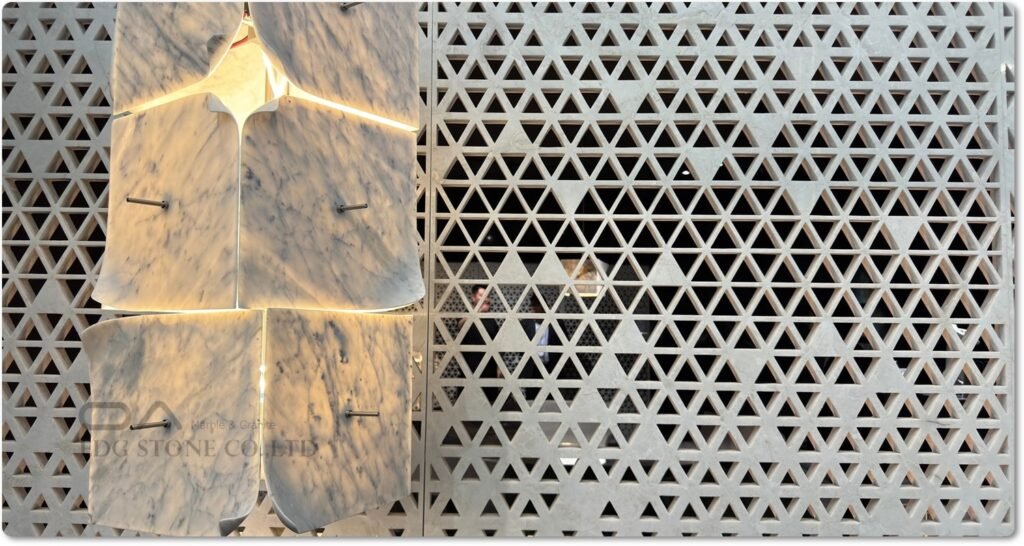
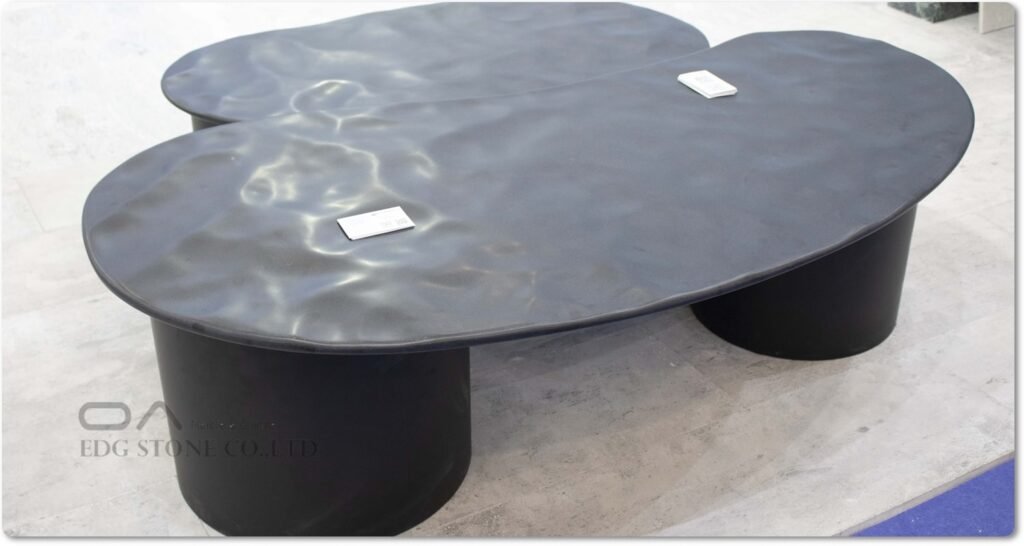
Typical products include dining tables, coffee tables, side tables, console tables, desks, bedside tables, countertops, reception desks, vanity units, cabinets, and decorative furniture.
The term natural stone furniture describes the material and product category; it does not guarantee a particular level of performance. Two stones sold under the same commercial name may exhibit different mineral compositions, veining, pore structures, absorption characteristics, and mechanical properties.
1.1 What Is Natural Stone Furniture?
Natural stone furniture generally uses one or more of the following materials:
Marble and other commercially classified decorative carbonate stones.
Granite and other suitable natural igneous stones.
Quartzite and other metamorphic silicate stones.
Travertine and other porous carbonate stones.
Limestone, onyx, and additional natural stones selected for specific applications.
The final product may consist of a solid stone slab, several bonded stone pieces, a stone veneer attached to a substrate, or a combination of stone, metal, wood, and other materials.
These constructions should not be treated as interchangeable. A solid stone tabletop has different weight, support, and repair considerations from a thin stone veneer bonded to a lightweight panel.
1.2 Natural Stone, Engineered Quartz, and Porcelain: Important Differences
| Material category | Composition and manufacturing | Main purchasing consideration |
|---|---|---|
| Natural marble | Geological carbonate stone, commonly calcite or dolomite rich | Veining, finish, acid sensitivity, and stone-specific performance |
| Natural granite | Natural igneous stone with mineral compositions that vary by deposit | Grain structure, finish, strength, and suitability for the application |
| Natural quartzite | Metamorphic rock whose mineral composition varies by geological origin | Correct material identification, pattern, fabrication behavior, and performance |
| Travertine | Porous carbonate stone formed through mineral deposition | Open pores, filling method, surface texture, and maintenance |
| Engineered quartz | Manufactured composite containing mineral aggregates and a binder | Product-specific composition, heat limitations, and manufacturer instructions |
| Porcelain or sintered surface | Manufactured ceramic or mineral-based surface produced through industrial processing | Thickness, edge details, impact behavior, fabrication requirements, and product certification |
Procurement principle: Never assume that engineered quartz is natural quartzite, or that a material’s commercial name alone establishes its technical properties. Specify the actual material category, product identity, and supporting documentation.
1.3 Why Furniture Applications Need Different Standards from Wall Cladding?
A decorative wall panel and a dining tabletop may use the same stone, but their failure risks differ substantially.
A tabletop may experience concentrated loads, impact from tableware, repeated cleaning, spills, and stresses around joints or support points. A freestanding pedestal may also be vulnerable to tipping or failure at a narrow connection.
For this reason, material selection must be coordinated with the product’s structural design. Stone thickness alone cannot demonstrate that a furniture item is safe or durable.
2. Technical Evaluation: Comparing Marble, Granite, Quartzite, and Travertine
2.1 Natural Stone Furniture Procurement Comparison Matrix
The following matrix is a preliminary selection tool, not a universal ranking. Performance depends on the particular stone variety, geological source, finish, fabrication quality, and installation conditions.
| Evaluation factor | Marble | Granite | Quartzite | Travertine |
|---|---|---|---|---|
| Typical appearance | Distinctive veins and soft tonal transitions | Crystalline grains and varied mineral patterns | Often dramatic veins or granular patterns | Warm, layered, porous textures |
| Common design positioning | Luxury, classic, contemporary, sculptural | Contemporary, commercial, practical | Premium statement furniture | Organic, Mediterranean, natural interiors |
| Relative scratch resistance | Highly variable; many varieties scratch more readily than quartz-rich stones | Often good, but mineral composition varies | Often good for properly identified quartz-rich varieties | Generally requires careful use |
| Resistance to acidic substances | Many calcite-rich varieties are acid-sensitive | Often better, depending on mineral composition | Often good, but impurities and composition matter | Many varieties are acid-sensitive |
| Porosity and absorption | Varies by variety | Varies by variety | Varies by variety | Often contains pores or cavities; filling is common |
| Finish options | Polished, honed, brushed, leathered where suitable | Polished, honed, flamed or other suitable finishes | Polished, honed, brushed where suitable | Honed, brushed, filled, unfilled, and other suitable finishes |
| Key fabrication concern | Etching, veining, fissures, and edge damage | Grain structure, edge integrity, and finish consistency | Hardness, tooling, fissures, and slab variability | Pore filling, voids, edge fragility, and cleaning |
| Typical furniture applications | Dining tables, consoles, coffee tables, vanities | Dining tables, desks, side tables, commercial furniture | Premium tabletops, consoles, statement pieces | Coffee tables, side tables, decorative furniture |
| Main purchasing risk | Cosmetic etching and damage to vulnerable areas | Assuming every granite has identical properties | Misidentification or unsuitable slab selection | Inadequate filling, excessive open voids, or unsuitable finish |
| Required verification | Specific material data, finish sample, and defect criteria | Specific material data, finish sample, and structural review | Material identification, technical data, and fabrication review | Filling specification, surface inspection, and maintenance guidance |
2.2 Marble Furniture: Appearance, Versatility, and Care Requirements
Marble is widely used in premium furniture because its natural veining and tonal variation can create a strong visual identity.
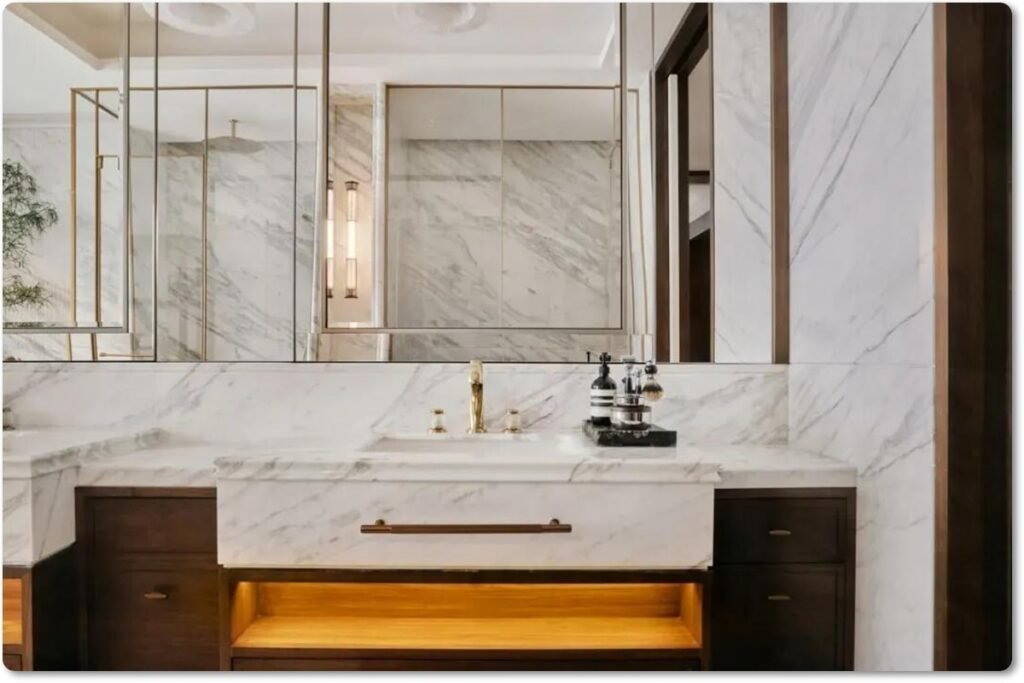
Popular applications include dining tables, coffee tables, bedside tables, console tables, reception counters, and vanity tops. White, beige, grey, green, and black marbles can support different design directions.
However, marble is not one uniform material. Calcite-rich varieties can react with acidic liquids, including lemon juice and vinegar, causing surface etching. This is a chemical change to the surface rather than simply a stain, so a penetrating sealer does not make marble acid-proof.
For furniture used in dining or hospitality environments, buyers should consider:
Whether the intended finish makes etching more visible.
Whether spills will be cleaned promptly.
Whether the surface will receive frequent chemical cleaning.
Whether the user accepts natural patina and routine maintenance.
Whether the stone contains visible fissures, repairs, or fragile edges.
A polished marble tabletop can be visually striking but may reveal surface etching under directional light. A honed finish can reduce the mirror-like appearance, although it does not eliminate acid sensitivity.
Best procurement approach: Select marble primarily for its specific appearance and suitability for the use environment, then define cleaning guidance, surface acceptance criteria, and repair disclosure in writing.
2.3 Granite Furniture: Practicality Without Assuming Universal Performance
Granite is often considered for furniture requiring a robust stone surface. Many granites offer good resistance to everyday abrasion and are suitable for tables, desks, consoles, and commercial furniture.
Nevertheless, the commercial term granite covers a broad range of natural stones. Mineral composition, grain size, microcracks, absorption, and polishing response vary.
A supplier should not claim that every granite is stain-proof, scratch-proof, or maintenance-free. Some varieties may absorb liquids or contain minerals that influence weathering, color stability, or finish behavior.
Before approving a granite furniture order, request:
Identification of the specific commercial stone and source, where available.
A representative slab or finish sample.
Relevant absorption and strength test results.
A review of the proposed tabletop dimensions and support system.
Written maintenance instructions for the supplied finish.
Granite can be a practical choice for furniture that receives frequent use, provided the actual material and design meet the project requirements.
2.4 Quartzite Furniture: Premium Patterns and Material Verification
Quartzite is attractive for high-end furniture because some varieties display dramatic movement, contrasting veins, and sophisticated colors.
However, the name quartzite must be used carefully in commercial procurement. Decorative stones are sometimes marketed under inconsistent trade names, and visual appearance alone cannot reliably establish geological identity.
True quartz-rich quartzite can be hard to cut and polish, increasing tooling demands and the importance of appropriate fabrication methods. Natural fissures, mineral boundaries, and variations in slab structure also require assessment.
Buyers should request material identification and technical information appropriate to the project. For valuable or performance-critical orders, independent petrographic examination may be justified.
Quartzite should not automatically be assumed to outperform every marble or granite. Its suitability depends on the actual stone, its internal structure, the selected finish, and the finished furniture design.
2.5 Travertine Furniture: Natural Texture and Pore Management
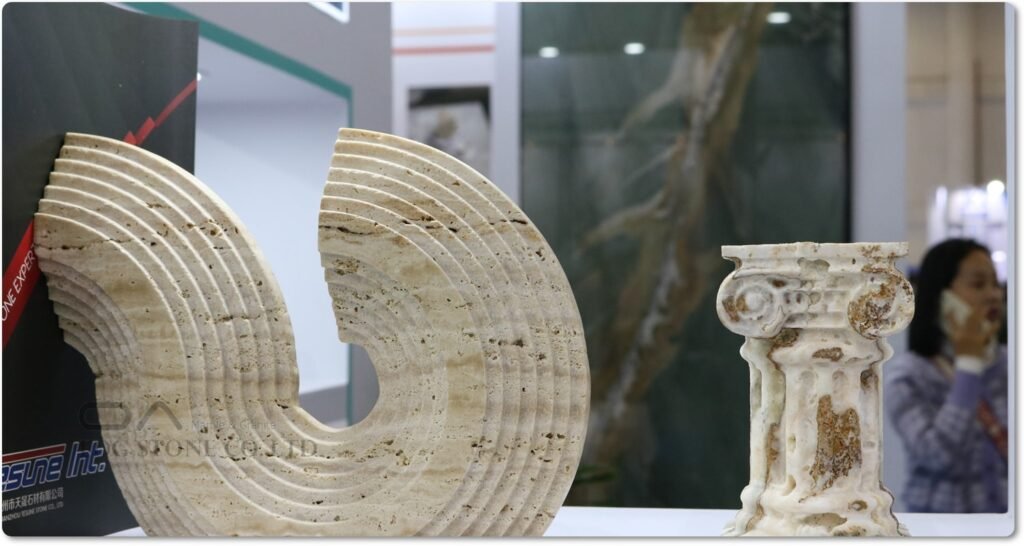
Travertine is frequently chosen for contemporary and organic furniture designs. Its warm tones, linear bands, and distinctive cavities create a different visual effect from the crystalline appearance of many granites or the veining of marble.
Travertine is commonly supplied with filled or unfilled surfaces.
Filled travertine: Cavities are filled using an agreed filling material to create a more continuous surface.
Unfilled travertine: Natural voids remain visible and contribute to the intended appearance.
Brushed or textured travertine: The finish emphasizes the stone’s surface character and may retain more texture than a polished surface.
Neither filled nor unfilled travertine is inherently superior. The correct specification depends on the design, hygiene requirements, cleaning method, and intended use.
For dining tables, vanity furniture, and hospitality projects, specify which voids may remain open, the permitted filler color variation, and whether the finished surface must be smooth enough for the intended function.
2.6 How to Read Natural Stone Test Data?
A technical report should be interpreted in the context of the material, test method, specimen preparation, and intended application.
Three frequently encountered indicators are water absorption, bulk density, and flexural strength.
Water absorption
Water absorption is commonly expressed as a percentage determined under a specified test procedure. It indicates how much water a specimen absorbs under the test conditions.
It can help buyers assess potential moisture sensitivity, but it does not directly predict every type of staining, chemical damage, or long-term performance.
Bulk density
Bulk density, also called bulk specific gravity in some reporting contexts, describes mass relative to bulk volume under the relevant method.
It is useful when estimating product weight, planning transport, and reviewing material consistency. It is not a stand-alone quality score.
Flexural strength
Flexural strength measures a material’s resistance to failure under a specified bending test. It can help inform engineering assessments of stone components.
A reported value is not a direct allowable load for a dining table. Product dimensions, span, support conditions, edge details, defects, load distribution, and appropriate design safety factors must also be considered.
| Test indicator | What it helps evaluate | What it cannot establish by itself |
|---|---|---|
| Water absorption | Moisture uptake under defined conditions | Complete stain resistance or suitability for every environment |
| Bulk density | Weight estimation and material characterization | Structural safety or overall stone quality |
| Flexural strength | Material response under a defined bending test | Safe tabletop dimensions without engineering assessment |
| Abrasion resistance | Performance under a specified wear procedure | Universal scratch resistance in every real-world situation |
| Petrographic examination | Mineral composition, texture, and relevant geological features | The safety of an entire furniture assembly without design review |
Important: Compare test results only when the material identity, test method, units, and specimen conditions are sufficiently comparable. Do not create a universal quality ranking from a single absorption, density, or strength figure.
3. Technical Evaluation: Surface Finishes, Fabrication, and Furniture Performance
3.1 Polished, Honed, Brushed, and Other Finishes
A surface finish changes not only how a stone looks but also how visible scratches, etching, pores, and fingerprints may be during use.
| Finish | Visual effect | Maintenance considerations | Common limitations |
|---|---|---|---|
| Polished | Glossy, reflective, often emphasizes color and pattern | Fingerprints, surface etching, and reflected light can reveal imperfections | Gloss can vary across the surface; sensitive stones remain chemically vulnerable |
| Honed | Matte or low-sheen appearance | Can provide a softer visual effect; stains and etching remain possible | May show darkening or uneven texture depending on the stone |
| Brushed | Textured surface with softened relief | Texture may retain dirt or residue and require suitable cleaning | Texture consistency and ease of cleaning depend on the material |
| Leathered | Textured, often softly reflective surface | Cleaning requirements depend on the degree of texture and porosity | Availability and appearance vary by stone |
| Flamed | Rough, thermally textured finish commonly used on suitable silicate stones | Texture can be harder to clean than a smooth polished surface | Not suitable for every stone; generally less common for fine indoor tabletops |
| Filled | Cavities are filled to create a more continuous surface | Filler integrity and color stability should be monitored | Filler may differ visually or wear differently from the stone |
| Unfilled | Natural cavities remain visible | Voids can retain residue and complicate cleaning | May be unsuitable for some food-contact or precision-use surfaces |
Finish names alone do not define a measurable quality standard. Suppliers should provide actual samples or approved reference panels, together with any agreed gloss, texture, or visual criteria.
3.2 What Does “Stone Furniture Paint” Mean?
The keyword stone furniture paint can refer to several different processes. It should not be treated as a synonym for natural stone finishing.
There are four important distinctions.
1. Natural stone surface finishing
Grinding, polishing, honing, brushing, and similar operations mechanically modify the stone surface. They do not necessarily introduce a decorative paint layer.
2. Penetrating sealers
Some products penetrate the stone’s pore system and may reduce liquid absorption or staining under specified conditions. A sealer is not automatically a waterproof membrane, scratch-resistant coating, or acid-proof treatment.
3. Surface coatings and protective films
Coatings may form a film over the stone to change its appearance or provide particular surface properties. Performance depends on the product chemistry, surface preparation, adhesion, curing, abrasion resistance, and maintenance conditions.
4. Paints and color treatments
Paints, pigments, and other coloring systems may be used in certain decorative applications. Their compatibility with natural stone must be established rather than assumed.
Before applying paint or a coating, buyers should establish whether the treatment is compatible with the stone’s porosity, moisture condition, intended use, cleaning products, and exposure to heat or sunlight.
A coating can alter the original appearance, obscure natural texture, change vapor transmission, or become damaged through wear. Not all natural stones are suitable for painting, and paint should not be used to conceal defects without disclosure.
For custom stone furniture, specify whether the requested finish is a mechanically processed natural surface, a penetrating sealer, a topical coating, or a color treatment.
3.3 Thickness, Edges, Joints, and Support Systems
A beautiful stone slab can still fail if the finished furniture is poorly engineered.
The required thickness depends on the stone’s mechanical properties, tabletop dimensions, support spacing, cutouts, edge details, loading, and the intended safety requirements.
Consider these factors before approving production:
Unsupported span: Longer spans can increase bending stress and deflection.
Cutouts and openings: Sink openings, cable holes, and other cutouts can create stress concentrations.
Edge profiles: Sharp corners and complex profiles can be vulnerable to chipping.
Joints and bonding: Adhesive selection, joint design, surface preparation, and curing affect assembly performance.
Substrate and reinforcement: Metal frames, wood supports, and other structures may change the load path.
Transport and installation: Stone may be damaged by twisting, impact, uneven lifting, or inadequate support.
Where the furniture has large dimensions, cantilevered areas, heavy components, or public-use implications, obtain a design review appropriate to the risk. A material test report is not a substitute for checking the finished assembly.
3.4 Color Matching, Vein Direction, and Bookmatching
Natural stone is not a factory-produced uniform color sheet. Variations can occur between blocks, slabs, and even different areas of the same slab.
For projects involving multiple tables, coordinated sets, or large stone panels, the visual specification should include:
Approved color range and representative samples.
Vein direction and orientation for each component.
Whether bookmatching or sequence matching is required.
Acceptable differences in background color and mineral markings.
Whether visible repairs, resin fills, or mesh backing are permitted.
Requirements for consistency between separate pieces in the same order.
For bookmatched furniture or coordinated tabletops, ask the factory to provide photographs of the actual selected slabs before cutting. Reference images from unrelated slabs should not be used as a guarantee of the final product’s exact pattern.
3.5 Edge Quality and Fabrication Inspection
Inspect the finished component under suitable lighting and from agreed viewing distances.
Check for:
Chips, cracks, and fractures.
Edge-profile inconsistency.
Uneven polishing or visible tool marks.
Lippage or misalignment at bonded joints.
Exposed adhesive or filler.
Unapproved repairs or discoloration.
Sharp edges where a softened edge is specified.
Damage around corners, cutouts, and narrow sections.
A small natural fissure is not necessarily equivalent to a structural crack. Its acceptability depends on its location, extent, stability, and effect on the finished component. Where the distinction is uncertain, seek a qualified technical assessment rather than relying solely on a visual judgment.
4. Procurement Checklist: Establishing Measurable Acceptance Criteria
4.1 Step 1 — Define the Furniture Application
Record the intended product and its operating environment before selecting the stone.
Examples include:
Indoor residential coffee table.
High-use restaurant dining table.
Hotel reception desk.
Bathroom vanity furniture.
Outdoor dining furniture.
Decorative console or display table.
Outdoor exposure introduces additional considerations, including freeze-thaw conditions where relevant, ultraviolet exposure, thermal cycling, moisture, and the suitability of metal or adhesive components.
4.2 Step 2 — Identify the Actual Stone
The specification should include the commercial stone name, material category, source information where available, and any additional identification requirements for high-value or performance-critical applications.
For premium quartzite, unusual decorative stones, or materials whose identity is disputed, independent petrographic assessment may be worthwhile.
4.3 Step 3 — Approve the Sample and Finish
Request a sample that represents the intended stone and surface treatment.
For a large or visually sensitive project, a small hand sample may be insufficient to demonstrate the full range of color and veining. Consider approving actual slab photographs, full-size mockups, or a first-off production sample.
Record the sample identification, finish, date of approval, and any limitations on its representativeness.
4.4 Step 4 — Define Tolerances Before Production
Do not rely on the phrase “standard tolerance” without defining what it means for the specific order.
The buyer and supplier should agree on tolerances for:
Length, width, and thickness.
Flatness and squareness.
Edge profiles and corner radii.
Hole and cutout locations.
Joint gaps and alignment.
Surface finish and visual variation.
Repair visibility and permissible natural features.
Numerical tolerances should be appropriate to the product design, manufacturing process, applicable standards, and installation requirements. They should be written into the purchase order or approved technical drawing rather than invented after production.
4.5 Step 5 — Review Relevant Test Reports
Ask for reports that identify the stone tested, the test method, the laboratory, the date, and the measured results.
A report from a different stone variety or an unidentified specimen may not reliably represent the material being supplied. Where a project has contractual performance requirements, consider independent testing or laboratory verification.
4.6 Step 6 — Conduct First-Article and Pre-Shipment Inspection
For repeat orders and large projects, first-article inspection helps identify issues before they affect the full production batch.
A pre-shipment inspection should verify:
Material and finish against the approved reference.
Dimensions against the latest approved drawing.
Surface and edge quality.
Assembly and stability, where applicable.
Packaging, labels, and product identification.
Photographic records and documented nonconformities.
The sampling plan and acceptance criteria should be agreed in advance. Visual inspection alone cannot establish hidden structural integrity.
4.7 Recommended Inspection Record
| Inspection item | Verification method | Acceptance basis |
|---|---|---|
| Material identity | Supplier documentation and, if needed, independent analysis | Approved specification |
| Color and veining | Comparison with approved sample and slab records | Written visual range |
| Surface finish | Visual examination and agreed instrumental checks where appropriate | Approved finish reference |
| Dimensions | Calibrated measuring equipment | Approved drawing and tolerance schedule |
| Edge condition | Visual and tactile inspection | Defined defect criteria |
| Repairs and filling | Visual examination and supplier disclosure | Contractual repair policy |
| Structural assembly | Design review and suitable physical checks | Approved engineering requirements |
| Packaging | Inspection of protective materials and loading arrangements | Agreed export packing specification |
5. Cost and Risk Factors: Understanding the Total Cost of Stone Furniture
5.1 What Determines the Purchase Price?
Natural stone furniture pricing depends on several interacting variables.
Material cost: Quarry availability, stone variety, block quality, slab selection, thickness, color, and the amount of usable material all affect cost.
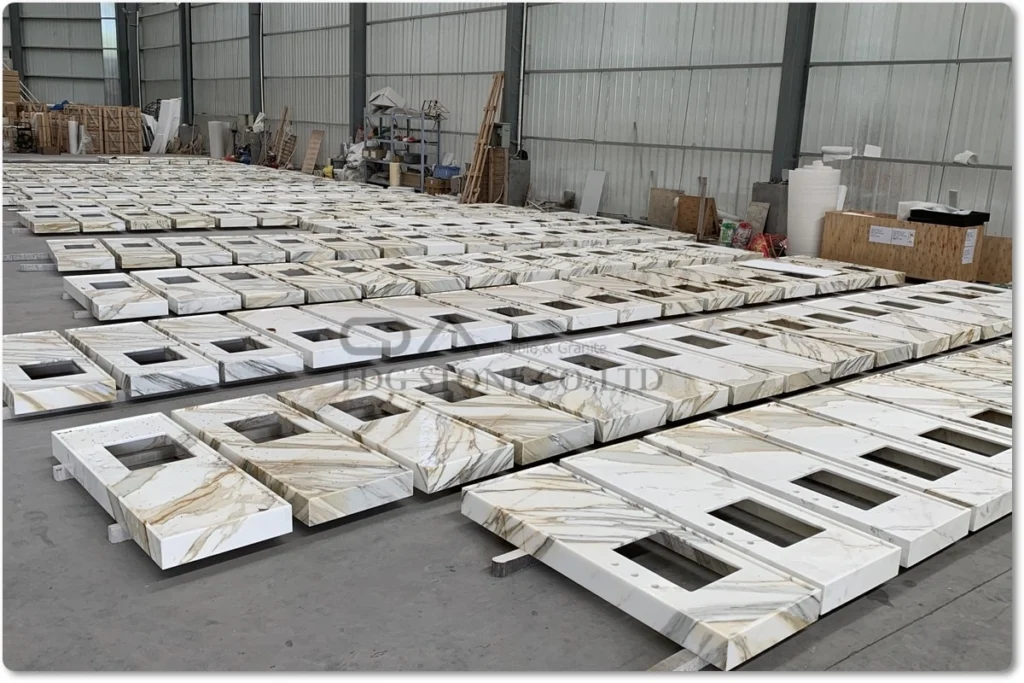
Fabrication cost: Cutting, polishing, edge profiling, drilling, CNC processing, waterjet work, bonding, reinforcement, and custom shaping add production requirements.
Yield and waste: Complex veining, bookmatching, cutouts, and visual selection can reduce the usable yield from each slab.
Quality requirements: Tight tolerances, premium surface consistency, third-party testing, mockups, and additional inspections may increase costs.
Packaging and logistics: Product weight, dimensions, crate design, protective materials, handling, freight, insurance, and destination charges affect the landed cost.
Commercial requirements: Order quantity, design changes, production scheduling, payment terms, and replacement obligations may influence the quotation.
A lower stone price does not automatically mean a lower total project cost. Poor slab selection, inadequate protection, inconsistent finishes, and breakage can create substantial downstream expenses.
5.2 Common Procurement Risks and Mitigation Measures
| Risk | Potential consequence | Recommended control |
|---|---|---|
| Unclear material identity | Performance mismatch or disputes | Specify stone category and identification requirements |
| Sample differs from production | Customer rejection | Approve actual slabs or a representative production sample |
| Hidden or undisclosed repairs | Appearance concerns or disputes | Require repair disclosure and written acceptance criteria |
| Inadequate structural support | Cracking, instability, or breakage | Review dimensions, support spacing, and engineering requirements |
| Inconsistent finish | Visible differences across furniture sets | Approve reference panels and measurable finish criteria |
| Unspecified tolerances | Disagreements at inspection | Include a signed tolerance schedule |
| Poor export packaging | Damage during handling and transit | Approve crate design, protection, and loading procedures |
| Unsuitable coating or sealer | Discoloration, peeling, or inadequate protection | Verify product compatibility and application requirements |
5.3 Compliance and Regulatory Considerations in 2026
Regulatory obligations depend on the destination market, product classification, materials used, and whether the furniture is residential, commercial, or intended for a regulated setting.
Buyers should distinguish between a voluntary material test, a contractual specification, an industry standard, and a legal requirement. These are not interchangeable.
For example, U.S. purchasers may reference ASTM standards for natural stone properties, while European projects may require consideration of applicable EN standards, REACH-related chemical obligations, product safety rules, and the requirements relevant to the finished furniture. The exact applicability must be verified for the specific product and market.
For coated furniture, bonded assemblies, or products containing composite components, request information about coatings, adhesives, emissions, and other chemical-related requirements where applicable.
The EU General Product Safety Regulation (GPSR), Regulation (EU) 2023/988, has applied since 13 December 2024 to consumer products within its scope, subject to its exclusions and interaction with other EU legislation. It should not be assumed to apply identically to every B2B transaction or every commercial installation.
Likewise, the U.S. requirements applicable to a stone table may differ from those applicable to children’s products, electrical furniture, or products incorporating regulated materials.
Procurement recommendation: Identify the destination market, importer responsibilities, intended end user, and product category before confirming compliance documentation. Do not accept a generic “international certificate” as proof that every applicable requirement has been met.
6. Supplier Evaluation: What a Qualified Stone Furniture Factory Should Provide?
Selecting a supplier requires evaluating more than price, product photography, or the ability to source a particular stone.
A reliable supplier should be able to explain how materials are selected, how drawings are converted into production instructions, how surface quality is controlled, and how nonconforming products are handled.
6.1 Essential Supplier Documentation
Request the following information according to the project’s risk and complexity:
Company and factory information.
Product range and relevant manufacturing capabilities.
Stone specifications and available source information.
Material test reports relevant to the supplied stone.
Samples or actual slab photographs.
Technical drawings and revision records.
Finish and edge-profile specifications.
Inspection procedures and acceptance criteria.
Disclosure of repairs, resin treatment, filling, or reinforcement where relevant.
Packaging specifications and loading photographs.
Commercial quotation with clear inclusions and exclusions.
Written procedures for complaints, replacements, and corrective actions.
Not every order requires every document. The purpose is to match the evidence requested to the value, risk, and complexity of the product.
6.2 Questions to Ask a Natural Stone Furniture Manufacturer
Before placing a wholesale or OEM order, ask:
How do you identify and select the specified stone?
Can you provide photographs of the actual slabs allocated to the order?
How are color variation, veining, and repairs recorded?
Which test methods support your material performance claims?
How do you inspect dimensions, edges, and finished surfaces?
What structural support or reinforcement is recommended for the proposed design?
How are production changes and drawing revisions controlled?
How will the furniture be packed and protected for export?
What happens if goods do not meet the agreed acceptance criteria?
Can you produce a first article or pre-production sample before bulk manufacturing?
6.3 Evaluating OEM, ODM, and Wholesale Capabilities
For OEM projects, confirm that the supplier can follow the buyer’s drawings, material selection, branding requirements, and inspection procedures.
For ODM projects, establish who owns the design, who approves technical changes, and how prototypes will be evaluated.
For wholesale purchases, focus on consistency between batches, availability of replacement materials, packaging reliability, and clear descriptions of natural variation.
A professional natural stone furniture manufacturer should be transparent about what can be controlled, what naturally varies, and which performance claims require independent verification.
7. Practical RFQ Template: Natural Stone Furniture Material Selection
Buyers can copy the following template into an email, spreadsheet, or purchase specification.
7.1 Request for Quotation Fields
Project Information
Project name:
Destination country:
Intended application:
Estimated quantity:
Required delivery date:
Stone Specification
Commercial stone name:
Material category:
Country or quarry source, if required:
Color range:
Veining and orientation requirements:
Sample or reference ID:
Product Construction
Product type:
Overall dimensions:
Stone thickness:
Support structure:
Edge profile:
Cutouts, joints, and assembly requirements:
Surface Finish
Requested finish: polished / honed / brushed / leathered / filled / unfilled / other
Finish reference:
Required sealer or coating, if any:
Maintenance requirements:
Quality and Inspection
Relevant test reports:
Required test methods:
Dimensional tolerances:
Surface acceptance criteria:
Natural variation allowance:
Repair and resin disclosure requirements:
First-article approval:
Pre-shipment inspection requirements:
Packaging and Commercial Terms
Export packaging specification:
Product labeling:
Shipping terms:
Quotation currency:
Unit price and total price:
Lead time:
Warranty or corrective-action terms:
Quotation validity:
7.2 Suggested Natural Stone Furniture Acceptance Schedule
| Item | Agreed specification |
|---|---|
| Approved stone | Commercial name and material identification |
| Reference sample | Sample number, date, and approval record |
| Finish | Named finish and approved physical reference |
| Dimensions | Drawing number and revision |
| Tolerances | Defined by dimension and product requirement |
| Natural variation | Agreed color, veining, and mineral-feature range |
| Repairs | Permitted treatments and disclosure requirements |
| Surface defects | Defined limits for chips, cracks, pits, and finish defects |
| Structural design | Approved support and assembly details |
| Inspection | Method, sampling plan, and acceptance criteria |
| Packaging | Approved protection and export packing method |
| Nonconformity | Reporting, correction, replacement, or other contractual remedy |
The acceptance schedule should be completed and approved before bulk production. It should not rely on undefined phrases such as “perfect quality,” “same as photo,” or “no color difference.”
8. Frequently Asked Questions: Natural Stone Furniture Selection
8.1 Which Natural Stone Is Best for Furniture?
There is no universally best stone. Marble is often chosen for decorative veining, granite for many demanding applications, quartzite for distinctive patterns and potentially strong performance, and travertine for natural texture. The correct choice depends on the specific material, furniture design, finish, maintenance expectations, and intended environment.
8.2 Is Granite Better Than Marble for Dining Tables?
Granite may offer advantages in abrasion resistance for many applications, while marble may be preferred for its appearance. However, mineral composition and performance vary between varieties. Buyers should compare the actual materials, surface finishes, and structural designs rather than relying on the commercial names alone.
8.3 Is Quartzite More Durable Than Marble?
Some quartzite varieties are highly resistant to scratching, but quartzite is not a uniform product category and may contain fissures or other structural features. Marble also varies significantly. Material identification, relevant test results, fabrication quality, and the finished product design are necessary for a meaningful comparison.
8.4 Which Finish Is Easiest to Maintain?
A smooth, properly finished surface may be easier to clean than a deeply textured or open-pore surface. However, ease of maintenance also depends on the stone’s composition, absorption, intended use, and cleaning products. The finish should be evaluated using a representative sample and realistic maintenance conditions.
8.5 Can Natural Stone Furniture Be Painted?
Some stone surfaces can receive compatible paints or coatings, but suitability depends on the stone, surface preparation, product chemistry, moisture, and intended exposure. Painting is different from polishing or applying a penetrating sealer. Buyers should request a documented compatibility assessment and sample test before authorizing treatment.
8.6 Does Low Water Absorption Guarantee High Quality?
No. Water absorption is only one material property. It does not independently establish structural safety, resistance to acidic substances, surface quality, or long-term performance. The specific stone and finished furniture design must be evaluated together.
8.7 How Can Buyers Control Natural Color Variation?
Approve a representative sample and, for important projects, photographs of the actual slabs. Define the permitted color and veining range, record slab allocation, and establish how bookmatching or sequence matching will be handled. Natural stone should not be specified as perfectly identical unless the product and acceptance criteria realistically support that expectation.
8.8 What Should a Stone Furniture Manufacturer Provide Before Bulk Production?
At minimum, buyers should obtain a clear quotation, approved technical drawings, a material and finish specification, sample approval, defined tolerances, and agreed inspection criteria. Depending on the project, relevant test reports, repair disclosures, engineering review, and export packaging specifications may also be necessary.
8.9 How Should Buyers Inspect Natural Stone Furniture Before Shipment?
Check material identity, color and veining against the approved reference, dimensions against the latest drawings, surface and edge condition, disclosed repairs, assembly quality, and packaging. Use an agreed sampling plan and record defects with photographs. Visual inspection should be supplemented by technical testing or engineering review where required.
8.10 How Can Importers Find a Reliable Natural Stone Furniture Factory?
Evaluate the factory’s material sourcing transparency, fabrication capabilities, sample process, quality documentation, communication, packaging standards, and ability to follow approved drawings. Compare quotations using the same specification and acceptance criteria instead of selecting solely on unit price.
9. References: Standards, Technical Sources, and Regulatory Guidance
The following sources provide a starting point for material testing, procurement specifications, and regulatory verification. Confirm the latest edition, applicability, and full requirements before incorporating any standard into a purchase contract.
9.1 Natural Stone Test Standards
ASTM International
ASTM C97/C97M — Test methods for absorption and bulk specific gravity of dimension stone.
ASTM C99/C99M — Test method for modulus of rupture of dimension stone.
ASTM C880/C880M — Test method for flexural strength of dimension stone.
ASTM C119 — Standard terminology relating to dimension stone.
Official standards catalog: https://www.astm.org/
These standards address particular test procedures or terminology. A test result must be interpreted according to the applicable method and the actual material tested. Confirm the current edition and whether a project specification requires a particular version.
9.2 European Standards and Stone Industry Guidance
European Committee for Standardization (CEN)
Relevant EN standards for natural stone may address terminology, test methods, product specifications, and intended applications. The appropriate standard depends on the type of stone product and its intended use.
Official standards information: https://standards.cencenelec.eu/
Natural Stone Institute
The Natural Stone Institute provides industry resources covering natural stone selection, care, installation, and technical considerations.
Website: https://www.naturalstoneinstitute.org/
9.3 European Union Product Safety and Chemical Compliance
Regulation (EU) 2023/988 — General Product Safety Regulation
Official EUR-Lex text: https://eur-lex.europa.eu/eli/reg/2023/988/oj
The regulation applies from 13 December 2024 to consumer products within its scope, subject to applicable exclusions and interactions with other legislation. Determine whether and how it applies to the particular furniture product and supply arrangement.
REACH — Registration, Evaluation, Authorisation and Restriction of Chemicals
Official European Chemicals Agency website: https://echa.europa.eu/regulations/reach/understanding-reach
REACH-related obligations depend on the substances, mixtures, articles, and supply-chain circumstances involved. Do not assume that every natural stone product has identical chemical compliance obligations. Coatings, adhesives, treatments, and composite components may require separate assessment.
9.4 U.S. Consumer Product Safety Resources
U.S. Consumer Product Safety Commission (CPSC)
Website: https://www.cpsc.gov/
Check the requirements applicable to the actual product category, intended user, and market. Do not automatically apply rules for children’s products or other specially regulated products to every stone furniture item.
9.5 How to Use These References Correctly
A standard number alone is not evidence that a product complies with a contract. Buyers should identify the required test, applicable edition, specimen, laboratory, acceptance criteria, and intended application.
Where an exact current edition or a legal obligation has not been verified, the purchase specification should explicitly require confirmation rather than presenting an unverified edition or general industry practice as mandatory law.
10. EDG Stone CTA: Request Natural Stone Furniture Samples and a Custom Quotation
Selecting the right stone is the first step toward successful furniture production. The next step is turning the material choice into an approved, manufacturable specification.
EDG Stone supports natural stone product sourcing and custom fabrication for furniture, countertops, vanity tops, decorative panels, and project-based applications. Buyers can discuss material selection, surface finishes, edge processing, cut-to-size requirements, and export packaging according to their project specifications.
For a more efficient quotation, provide:
Your preferred stone or reference image.
Product type and approximate dimensions.
Finish and edge-profile requirements.
Quantity and intended application.
Destination country and delivery requirements.
Sample, testing, and inspection expectations.
For visually sensitive projects, request sample confirmation and discuss actual slab selection before authorizing bulk production.
Explore EDG Stone: https://edgstone.com/
Next Step: Submit your natural stone furniture requirements to discuss suitable materials, finish samples, custom fabrication, and a project-specific quotation.
The objective is not to select the most expensive stone or the stone with the highest single test result. It is to specify the right material, finish, structure, and acceptance criteria for a reliable finished product.
11. Natural Stone Furniture Selection: From Material Choice to Commercial Performance
How Should Buyers Connect Stone Selection with Furniture Design?
The correct selection process starts with the intended application, not the stone name. A dining table used every day requires a different balance of surface appearance, maintenance, impact resistance, and structural support from a decorative console or a sculptural occasional table.
Buyers should first establish the functional requirements, then compare candidate stones, finishes, construction methods, and maintenance expectations. The selected material must work as part of the complete furniture assembly.
Why Does Material Quality Depend on More Than Laboratory Results?
Laboratory tests describe specific material properties under defined conditions. They do not independently determine whether a finished table will resist every stain, survive every impact, or remain stable during transportation.
Commercial performance results from several interacting factors: the stone’s mineral composition, internal discontinuities, dimensions, edge design, support conditions, fabrication accuracy, and exposure environment.
A technically sound procurement decision therefore combines relevant test reports with sample approval, production inspection, and an assessment of the finished product’s design.
What Is the Best Surface Finish for Natural Stone Furniture?
The best finish is the one that satisfies the intended appearance and use requirements.
Polished surfaces emphasize reflections and often enhance the visual depth of natural stone. Honed surfaces offer a softer appearance. Brushed and leathered finishes introduce texture, while filled and unfilled travertine provide different interpretations of natural porosity.
Finish selection should also consider cleaning practices, visible wear, the likelihood of chemical exposure, and the feasibility of maintenance or refinishing. A surface that looks attractive in a showroom may behave differently under intensive restaurant or hospitality use.
Options: How Should Buyers Compare Materials and Treatments?
Option A — Prioritize decorative character. Consider marble or selected quartzite varieties when veining, color, and visual identity are central to the design. Review the specific stone’s sensitivity and structural characteristics before approval.
Option B — Prioritize frequent-use performance. Evaluate suitable granite, quartzite, and other candidate materials against the actual service conditions. Use relevant testing and a realistic maintenance assessment rather than assuming a commercial stone name guarantees performance.
Option C — Prioritize natural texture. Consider travertine and other textured stones when pores, tonal layering, and a tactile appearance are intentional design features. Define filling, open-void, and cleaning requirements before fabrication.
Option D — Modify the surface appearance. Where a sealer, coating, paint, or color treatment is proposed, distinguish the treatment from the natural stone itself. Verify compatibility, appearance, adhesion, maintenance, and applicable chemical requirements using a representative sample.
These options are procurement pathways, not a universal ranking. The appropriate choice depends on the project brief and documented requirements.
Considerations: What Should Be Agreed Before Bulk Production?
A successful purchase specification should define the stone identity, approved sample, finish, dimensions, edge details, permissible natural variation, repair policy, relevant technical evidence, inspection method, and packaging requirements.
For visually coordinated projects, buyers should also establish slab allocation, vein direction, and any bookmatching requirements. For larger or structurally demanding products, the specification should reference an approved design and appropriate engineering assessment.
The supplier and buyer should agree on acceptance criteria before production begins. Undefined phrases such as “premium quality,” “perfect finish,” or “same as the photograph” are not substitutes for measurable requirements.
Industry Insight: Why Traceability and Documented Specifications Matter
As natural stone furniture becomes increasingly customized, commercial value depends on the ability to reproduce an agreed design and explain how quality was verified.
A documented connection between the approved sample, selected slab, production drawing, inspection record, and shipping package can reduce misunderstandings and improve accountability across the supply chain.
For importers, distributors, designers, and project contractors, this approach supports more consistent purchasing decisions. For manufacturers, it provides a clearer basis for material selection, production planning, and corrective action.
The practical direction for 2026 is therefore not simply to seek harder stone or lower absorption. It is to combine appropriate material evidence, transparent specifications, design-aware fabrication, and documented inspection.
Final Decision Framework
Choose natural stone furniture by answering five connected questions:
Material: Is the stone correctly identified and suitable for the intended application?
Appearance: Does the approved sample establish the acceptable color, veining, finish, and repair policy?
Construction: Are the dimensions, supports, edges, joints, and assembly appropriate for the expected loads?
Verification: Are relevant test reports, tolerances, and inspection procedures documented?
Delivery: Can the supplier protect the finished product through handling, export packaging, and transportation?
When these five elements are addressed together, buyers can make more defensible material choices, reduce avoidable quality disputes, and obtain natural stone furniture that meets the project’s visual and functional expectations.