Quick Summary: How to Buy Green Marble in Bulk
Commercial procurement principle: For large green marble projects, the purchasing decision should be based on material consistency, technical suitability, fabrication capability, quality control, logistics reliability, and documentation, rather than slab price alone.
For buyers sourcing green marble wholesale, green marble bulk orders, green marble slabs wholesale, or custom green marble fabrication, the objective is to establish a repeatable procurement process that reduces variation between approved samples, production slabs, fabricated components, and delivered materials.
Green marble has become increasingly relevant to hospitality, luxury residential, commercial interiors, furniture, bathrooms, feature walls, flooring, vanity tops, countertops, and architectural applications. However, buying green marble for a small residential project is fundamentally different from purchasing several containers for a hotel, multifamily development, stone distributor, furniture manufacturer, or architectural project.
For commercial procurement, the key question is not simply:
“How much does green marble cost?”
The more important question is:
“Can the supplier consistently deliver the required material, appearance, dimensions, quality, fabrication, packing, and documentation at commercial scale?”
This guide explains how professional buyers can structure the entire purchasing process.
1. Define the Application Before You Buy Green Marble
The first step in bulk procurement is to define exactly where the material will be used.
Different applications create different technical, aesthetic, fabrication, and maintenance requirements.
Common commercial applications
Green marble can be specified for:
- Kitchen countertops
- Bathroom countertops
- Vanity tops
- Shower walls
- Bathroom walls
- Flooring
- Interior wall cladding
- Hotel guestrooms
- Hotel lobbies
- Luxury villas
- Commercial interiors
- Reception desks
- Restaurant interiors
- Fireplace surrounds
- Furniture
- Coffee tables
- Side tables
- Dining tables
- Custom stone furniture
- Decorative panels
- Waterjet patterns
- Custom architectural elements
The intended application determines the appropriate material selection and fabrication method.
Example: Bathroom vanity project
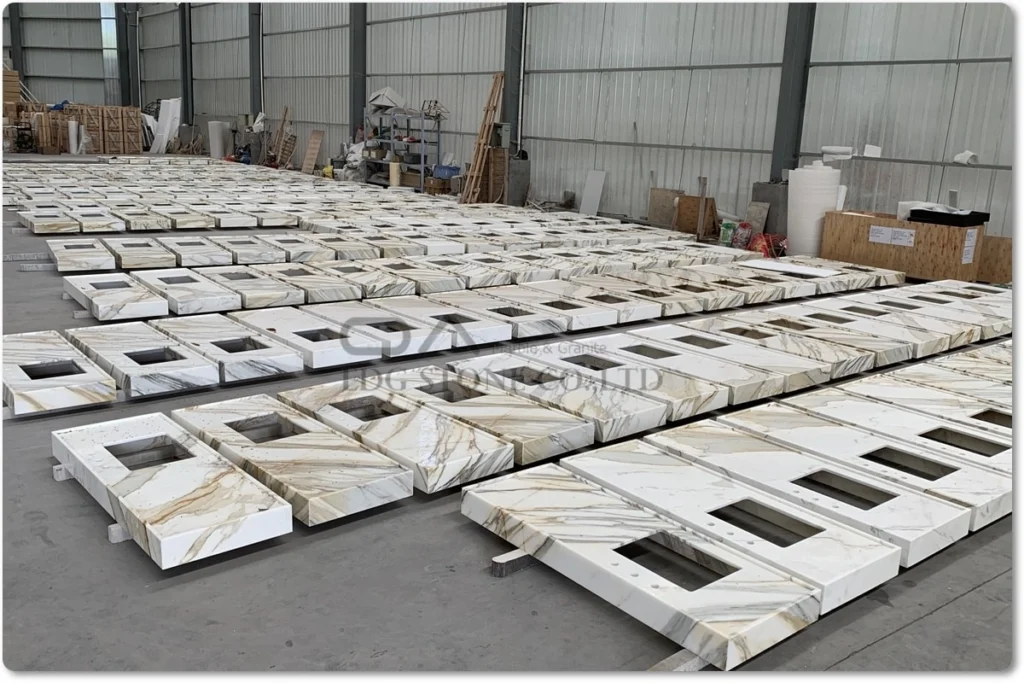
A hotel purchasing team ordering 300 green marble vanity tops should define:
- Finished dimensions
- Thickness
- Edge profile
- Sink cutout
- Faucet holes
- Backsplash requirements
- Surface finish
- Corner radius
- Dimensional tolerances
- Number of pieces
- Packaging method
- Installation requirements
The material cannot be evaluated independently from fabrication.
Example: Feature-wall project
For a large feature wall, the buyer may prioritize:
- Slab size
- Vein direction
- Background color
- Pattern continuity
- Bookmatching
- Thickness
- Resin treatment if applicable
- Surface finish
- Numbered slab sequencing
- Installation drawings
Therefore, application definition comes before supplier selection.
2. Define the Green Marble Material
Once the application is clear, define the material itself.
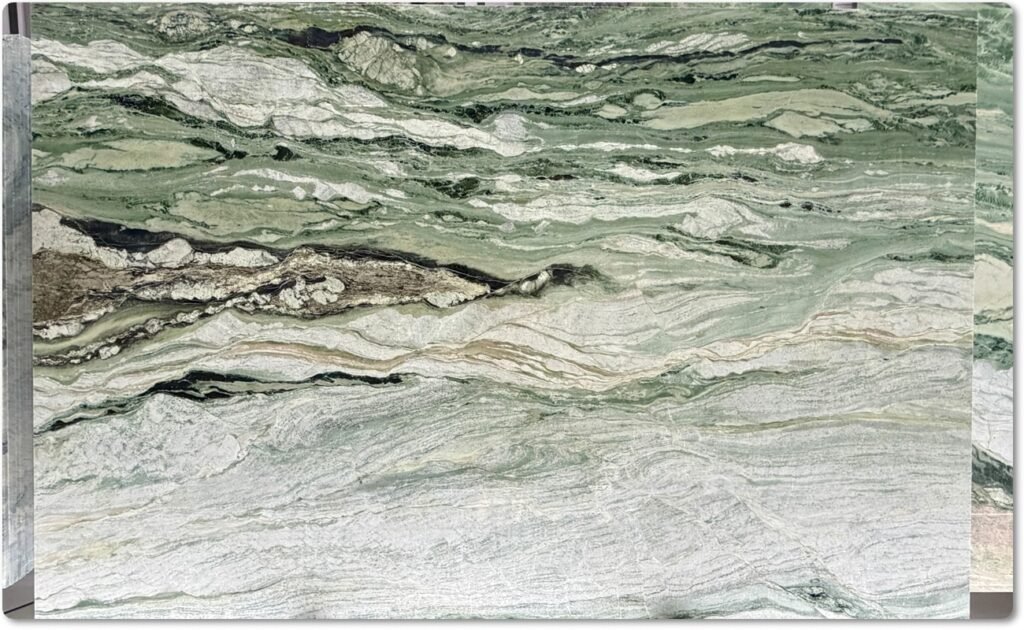
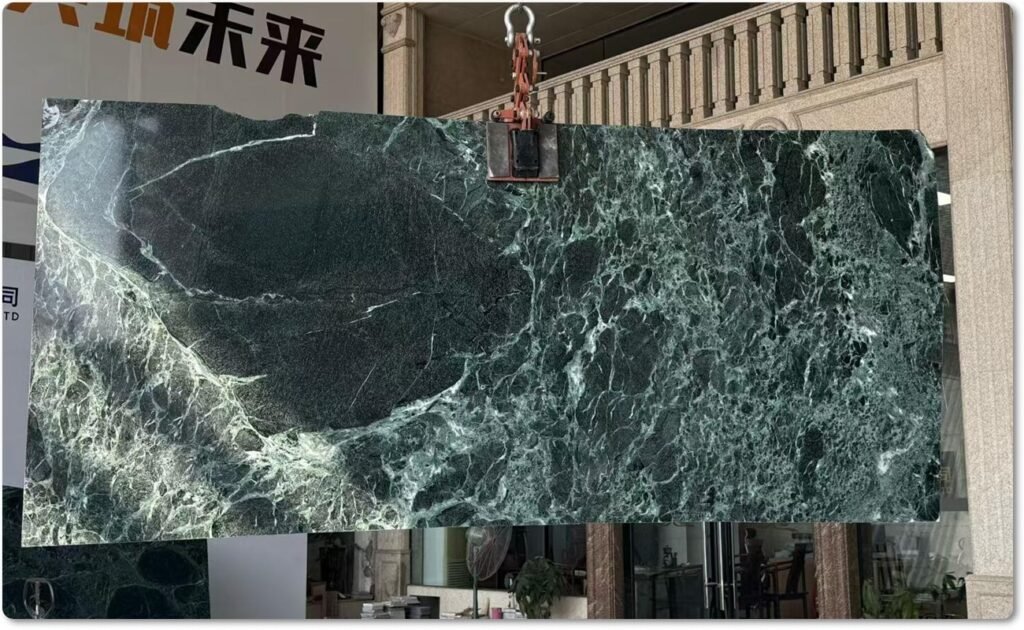
“Green marble” is a broad commercial category rather than one single standardized stone.
Green stones sold commercially under green marble terminology can vary significantly in:
- Color
- Mineral composition
- Veining
- Pattern
- Density
- Water absorption
- Hardness
- Strength
- Finish response
- Availability
- Block size
- Slab yield
- Geographic origin
Common commercial appearance categories
Buyers may encounter:
- Light green marble
- Dark green marble
- Emerald green marble
- Forest green marble
- Indian green marble
- Rainforest-patterned green marble
- Veined green marble
- Clouded green marble
- Brecciated green marble
- Plain green marble
These commercial descriptions are useful for purchasing but should not replace actual material identification and technical documentation.
What should a material specification include?
A commercial green marble specification can include:
| Specification | Buyer Requirement |
|---|---|
| Material | Natural green marble |
| Origin | Country / quarry / source where available |
| Color | Approved reference |
| Pattern | Veined/plain/clouded/brecciated etc. |
| Thickness | Project requirement |
| Finish | Polished/honed / leathered / other |
| Size | Slab or cut-to-size dimensions |
| Water absorption | Test value |
| Density / specific gravity | Test value |
| Strength | Applicable test data |
| Tolerances | Project specification |
| Surface quality | Approved sample standard |
| Fabrication | Required processing |
| Packing | Export standard |
| Inspection | Agreed QC procedure |
The more detailed the specification, the less room there is for disagreement later.
3. Identify the Quarry, Source, Manufacturer or Factory
When buying green marble in bulk, source traceability becomes increasingly important.
A buyer should distinguish between:
Quarry / source → block supplier → slab processor → manufacturer → exporter → trading company
A company may perform one or several of these functions.
For commercial projects, ask:
Is the supplier a green marble manufacturer?
A manufacturer may control:
- Block purchasing
- Slab production
- Cutting
- Polishing
- Calibration
- CNC processing
- Waterjet fabrication
- Quality inspection
- Packing
- Export loading
Is the supplier a green marble factory?
A factory-based supplier may offer more direct control over production scheduling and custom fabrication.
However, the buyer should verify the actual production capability rather than relying only on the word “factory.”
Is the company a green marble exporter?
An exporter may manage:
- International documentation
- Container booking
- Export packing
- Customs documentation
- Shipping coordination
- Commercial invoices
- Packing lists
- Certificates where applicable
For international buyers, the ideal procurement partner may combine manufacturing and export capabilities.
4. Request Representative Samples
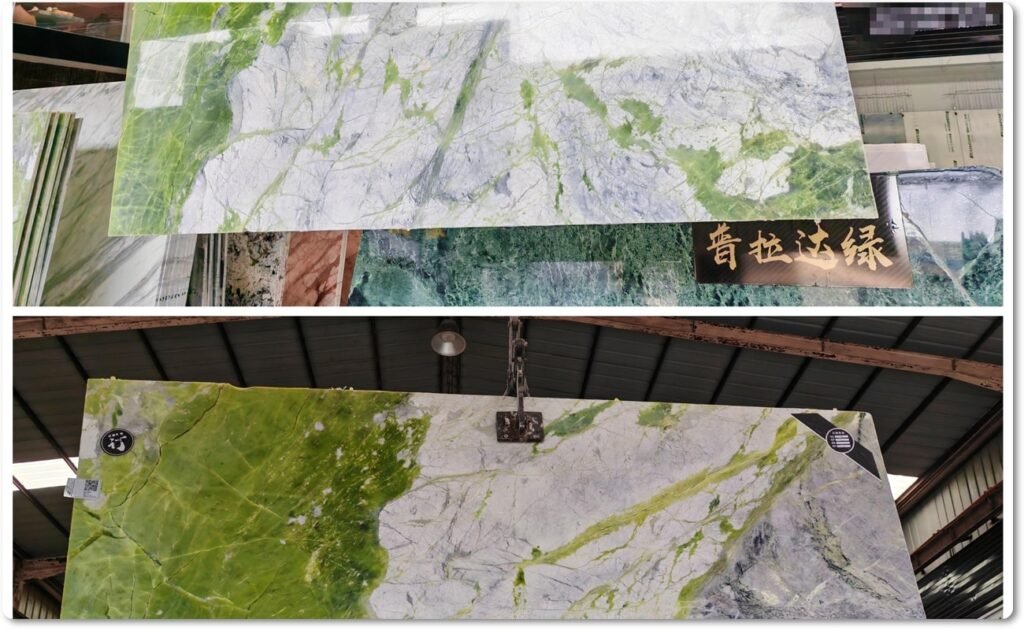
Samples are essential—but a small sample is not enough for approving a large commercial order.
A sample should answer two questions:
- Does the material meet the buyer’s aesthetic expectations?
- Does the sample reasonably represent the production material?
Request more than one sample when necessary
For natural stone, one small sample may not represent the complete range of:
- Color variation
- Veining
- Fossils
- Mineral concentration
- Natural cavities
- Brecciation
- Pattern movement
- Background variation
For large projects, buyers should consider requesting representative slab photographs or videos in addition to physical samples.
Sample approval should be documented
A commercial approval record can include:
- Sample number
- Material name
- Finish
- Thickness
- Date
- Photos
- Buyer approval
- Acceptable variation
- Unacceptable defects
This becomes the visual reference for production.
5. Review Green Marble Slabs Before Bulk Production
This is one of the most important stages in commercial procurement.
A sample can be approved while the actual slabs later show significant variation.
Therefore:
Do not approve a large commercial green marble order based only on a small sample when appearance consistency is critical.
Slab review should evaluate
Color
Check:
- Overall background color
- Light and dark areas
- Color consistency
- Unexpected tonal changes
Pattern
Check:
- Vein direction
- Vein density
- Pattern scale
- Clouding
- Brecciation
- Natural movement
Surface
Check:
- Polishing
- Resin treatment where applicable
- Scratches
- Pits
- Open veins
- Cracks
- Edge condition
Dimensions
Check:
- Slab length
- Slab width
- Thickness
- Flatness
- Edge condition
Bookmatching
For premium architectural projects, slab sequencing may be part of the design.
The supplier should provide:
- Slab numbering
- Slab photographs
- Direction indicators
- Bookmatch sequence
- CAD or installation references when required
This is especially important for hotel lobbies, feature walls, luxury villas, reception desks, and large furniture pieces.
6. Confirm Technical Data Before Ordering
A commercial green marble procurement specification should include technical information appropriate to the intended application.
Relevant properties may include:
- Water absorption
- Density
- Specific gravity
- Compressive strength
- Flexural strength
- Abrasion resistance where applicable
- Dimensional tolerances
- Surface finish requirements
Testing should use the applicable standards specified for the project and jurisdiction.
For example, ASTM standards commonly used for dimension stone testing include ASTM C97/C97M for absorption and bulk specific gravity and ASTM C170/C170M for compressive strength. The exact test program should be matched to the stone type and project specification.
The key procurement principle is:
Use test data to verify suitability; do not assume suitability from appearance alone.
For public, hospitality, commercial, or high-value projects, the buyer may require laboratory reports, project specifications, or additional testing.
7. Approve CAD and Custom Green Marble Fabrication
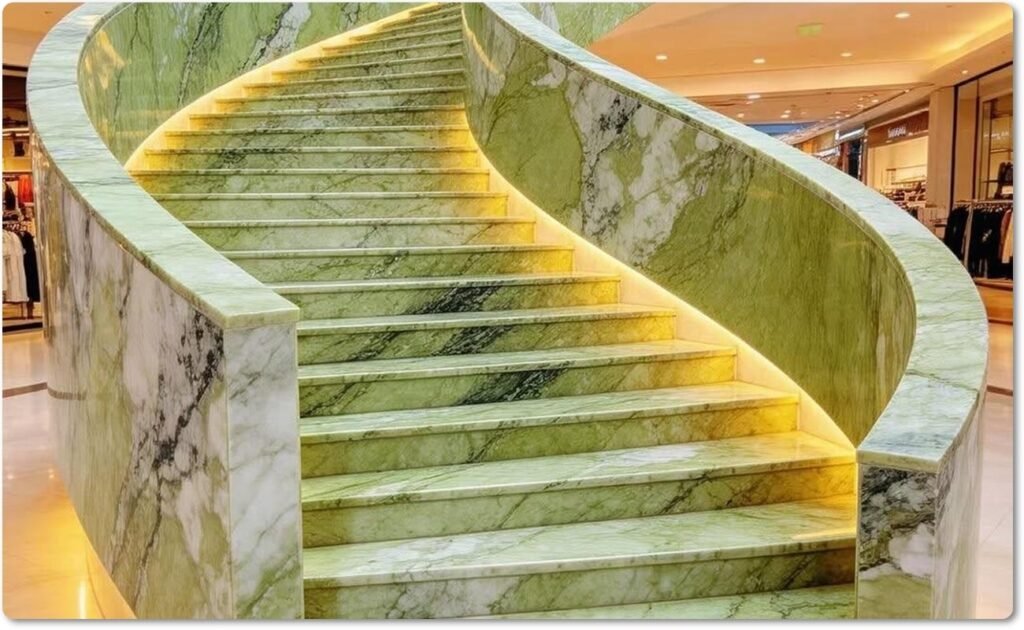
Bulk green marble procurement often moves beyond slabs into finished components.
This is where a manufacturer becomes more valuable than a simple slab supplier.
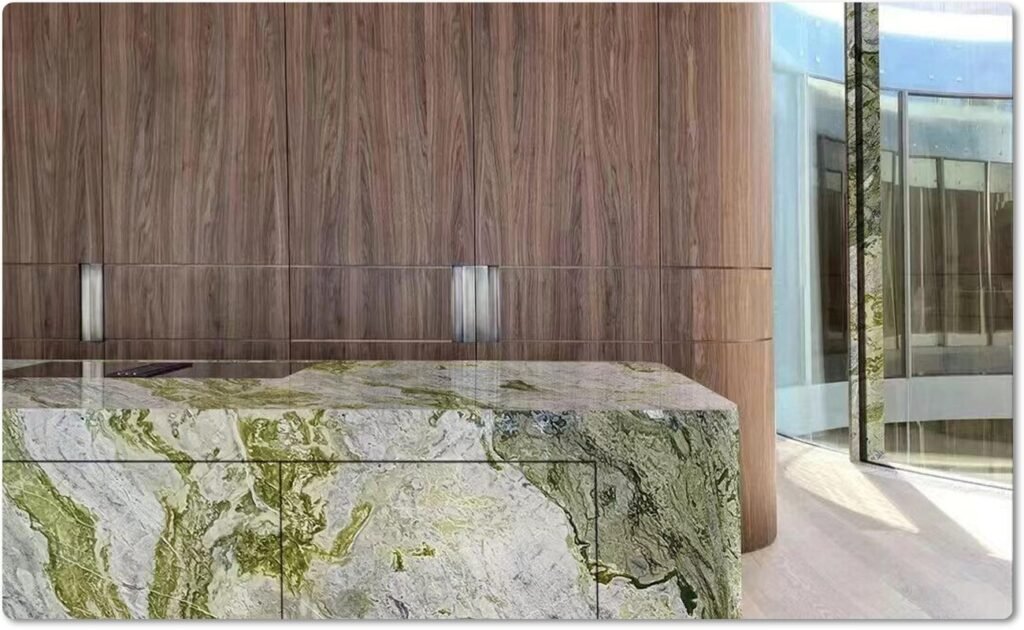
Custom green marble fabrication may include
- Cut-to-size
- CNC processing
- Waterjet cutting
- Edge profiling
- Sink cutouts
- Faucet holes
- Drain openings
- Mitred edges
- Laminated edges
- Curved components
- Tabletops
- Vanity tops
- Wall panels
- Stair components
- Furniture parts
- Decorative patterns
CAD approval workflow
A recommended process is:
Architectural drawing
↓
Supplier CAD drawing
↓
Buyer review
↓
Revision
↓
Final approval
↓
Production
↓
QC
↓
Packing
The supplier should not begin irreversible cutting until the final dimensions and processing requirements are approved.
Why CAD approval matters
A material defect may be visible on a slab, but a fabrication error can be created after cutting.
CAD approval therefore controls:
- Dimensions
- Cutouts
- Orientation
- Edge details
- Joint positions
- Quantity
- Numbering
- Installation sequence
8. Confirm the Quality Control Standard
A commercial buyer should establish QC before production rather than arguing about quality after production.
A practical green marble QC sequence is:
Visual Inspection
Check:
- Color
- Pattern
- Veins
- Cracks
- Chips
- Surface defects
- Finish
Physical Testing
Where required:
- Water absorption
- Density
- Strength
- Other project-specific tests
Slab Inspection
Check:
- Dimensions
- Thickness
- Flatness
- Finish
- Surface defects
- Numbering
Fabrication Inspection
Check:
- Finished dimensions
- Cutouts
- Edges
- Angles
- Polishing
- Surface protection
Packing Inspection
Check:
- Crates
- Protection
- Labels
- Moisture protection where applicable
- Internal supports
- Loading arrangement
A written QC checklist creates a common standard between buyer and supplier.
9. Confirm Export Packing
Stone is heavy, fragile, and expensive to transport.
For this reason, packing is not an administrative detail—it is part of the product.
A commercial green marble supplier should consider:
- Slab protection
- Edge protection
- Wooden crates or frames
- Internal supports
- Protective materials
- Moisture considerations
- Labels
- Quantity identification
- Project identification
- Container loading requirements
Export packing should match the shipment
A container of loose slabs requires a different handling strategy from a container containing hundreds of fabricated vanity tops.
For cut-to-size products, each package should ideally be traceable to:
- Project
- Drawing
- Piece number
- Quantity
- Dimensions
- Installation area
This reduces confusion during unloading and installation.
10. Confirm Container Loading
For green marble bulk procurement, container loading is an important cost and risk-control stage.
Stone is extremely dense, so loading must account for:
- Weight distribution
- Package dimensions
- Container capacity
- Product protection
- Loading sequence
- Unloading requirements
- Local transportation regulations
A professional loading plan should answer
What is being loaded?
How many packages?
What is the estimated gross weight?
How are packages positioned?
How are fragile components protected?
How will the buyer identify each package after arrival?
For fabricated stone projects, a package list and loading photos can be extremely useful.
A buyer should request loading records when appropriate, including:
- Container number
- Package count
- Loading photographs
- Packing list
- Gross weight
- Product identification
11. Prepare Shipping Documents
International green marble wholesale transactions require accurate documentation.
Depending on the transaction, documents may include:
- Commercial invoice
- Packing list
- Bill of lading
- Certificate of origin where applicable
- Customs documentation
- Inspection documents
- Test reports
- Insurance documentation where applicable
The exact documents depend on:
- Export country
- Import country
- Incoterms
- Product classification
- Buyer requirements
- Project requirements
- Applicable regulations
Important 2026 procurement principle
Do not assume that the supplier’s previous export documentation automatically satisfies the requirements of your current shipment.
Import rules, customs requirements, trade measures, environmental requirements, and documentation requirements can change.
The buyer and supplier should confirm the applicable requirements before shipment.
12. Arrival Inspection
The procurement process does not end when the container leaves the factory.
Arrival inspection should compare the delivered goods with:
- Purchase order
- Approved sample
- Approved slab selection
- Technical specification
- CAD drawings
- QC records
- Packing list
Check immediately after arrival
Inspect for:
- Broken slabs
- Cracked components
- Chipped edges
- Moisture-related issues
- Packaging damage
- Missing pieces
- Incorrect dimensions
- Incorrect labeling
- Surface defects
Photographs and records should be taken before installation if damage or discrepancies are discovered.
For large commercial projects, an organized receiving inspection can make claims and supplier communication much easier.
13. Installation and Final Acceptance
The final stage is installation.
Even technically correct green marble can produce poor results if:
- Substrates are unsuitable
- Adhesives are inappropriate
- Joints are incorrectly positioned
- Slabs are installed in the wrong sequence
- Bookmatched pieces are reversed
- Fabricated components are incorrectly positioned
- Sealers or maintenance products are improperly selected
Therefore, installation instructions should be considered during procurement—not after production.
Installation documentation may include
- Slab numbering
- Elevation drawings
- Installation sequence
- Piece numbers
- Joint layout
- Approved finish
- Maintenance recommendations
For large projects, procurement, fabrication, logistics, and installation should operate as one connected workflow.
Green Marble Bulk Procurement Checklist
The following checklist can be used by importers, distributors, contractors, architects, hotel procurement teams, furniture manufacturers, and commercial buyers.
Material
Application defined
Green marble type selected
Material origin documented
Quarry/source information reviewed
Color range approved
Pattern range approved
Finish approved
Thickness approved
Sampling
Physical sample received
Representative slab photos reviewed
Slab videos reviewed where necessary
Variation tolerance agreed
Sample approval documented
Technical
Water absorption data reviewed
Density/specific gravity reviewed
Strength data reviewed where required
Dimensional tolerances confirmed
Applicable standards identified
Fabrication
CAD drawings approved
Cut-to-size dimensions confirmed
Edge profile confirmed
Sink/faucet cutouts confirmed
Waterjet/CNC requirements confirmed
Piece numbering confirmed
QC
Visual QC standard approved
Slab QC completed
Fabrication QC completed
Packing QC completed
Inspection records prepared
Logistics
Packing method approved
Crate requirements confirmed
Package labels confirmed
Container loading plan confirmed
Loading photographs requested
Gross weight confirmed
Shipping
Commercial invoice
Packing list
Bill of lading
Certificate of origin if applicable
Test reports if required
Other import/export documents confirmed
Arrival
Container inspected
Package count checked
Damage documented
Dimensions checked
Surface quality checked
Missing pieces reported
Installation
Installation drawings available
Slab sequence confirmed
Installation team briefed
Maintenance requirements communicated
- Final acceptance completed
How to Choose a Green Marble Supplier for Bulk Orders
When comparing green marble suppliers, buyers should avoid relying on price alone.
A more useful procurement framework evaluates the supplier across several dimensions.
Manufacturing Capability
Can the supplier actually process the quantity required?
Look for evidence of:
- Production equipment
- Slab processing
- CNC
- Waterjet
- Edge processing
- Custom fabrication
- Quality control
- Packing capability
Material Access
Can the supplier obtain sufficient blocks or slabs with reasonably consistent characteristics?
This is particularly important for large projects where several containers may be required.
Export Experience
A green marble exporter should understand:
- International packaging
- Container loading
- Export documents
- Shipping coordination
- International buyer communication
Project Management
A commercial order may involve hundreds or thousands of individual components.
The supplier should be able to manage:
Drawing → Production → QC → Packing → Loading → Shipping
rather than simply selling slabs.
Green Marble Wholesale vs. Retail Purchasing
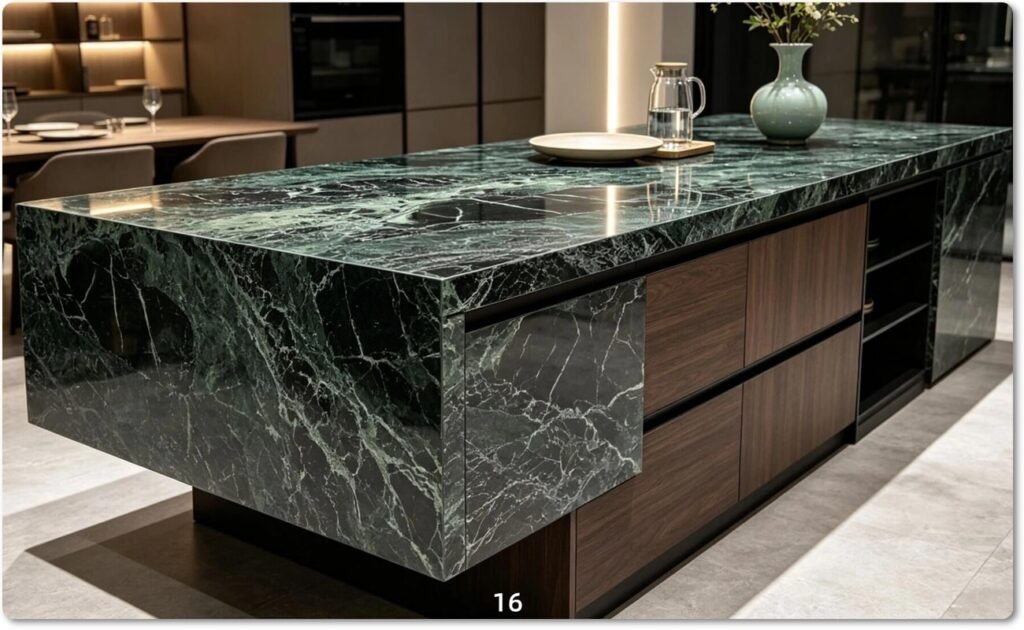
Commercial buyers often need a different purchasing model from residential customers.
Retail purchasing
Usually involves:
- Small quantity
- Limited fabrication
- One project
- Local delivery
- Fewer inspection requirements
Green marble wholesale
May involve:
- Multiple slabs
- Multiple containers
- Repeated orders
- Distributor inventory
- Project pricing
- Standardized packaging
- Long-term supply
Green marble bulk procurement
Can involve:
- Hotel projects
- Multifamily projects
- Large residential developments
- Commercial buildings
- Furniture production
- Distributor programs
- Architectural projects
The larger the order, the more important process control and documentation become.
What Makes Custom Green Marble Procurement Different?
Custom green marble is not simply “green marble cut to size.”
It can involve a complete engineered production process.
For example:
Raw slab selection
↓
Slab numbering
↓
CAD nesting
↓
CNC / Waterjet
↓
Edge processing
↓
Surface finishing
↓
QC
↓
Protective packing
↓
Installation sequence
This makes custom fabrication particularly relevant to architects, interior designers, contractors, hotel procurement teams, and furniture manufacturers.
A capable green marble manufacturer and factory can integrate these processes under one procurement workflow.
How EDG Stone Supports Commercial Green Marble Procurement
For international buyers, EDG Stone approaches green marble procurement as a combination of material sourcing, manufacturing, custom fabrication, quality control, and export logistics.
EDG Stone operates as a professional natural stone manufacturer and exporter, supporting buyers who require natural stone slabs as well as project-specific fabrication.
Depending on project requirements, the procurement workflow can include:
Material Selection
↓
Sample Approval
↓
Slab Review
↓
CAD / Shop Drawings
↓
Custom Fabrication
↓
QC
↓
Export Packing
↓
Container Loading
↓
Shipping
For buyers purchasing green marble slabs wholesale, custom green marble components, vanity tops, countertops, furniture parts, wall panels, or other fabricated products, the objective is to connect material selection with the final application.
For large commercial orders, buyers should provide as much project information as possible at the quotation stage:
- Material preference
- Quantity
- Slab or cut-to-size requirement
- Dimensions
- Thickness
- Finish
- Application
- Drawings
- Delivery destination
- Target schedule
- Packaging requirements
- Inspection requirements
This allows the supplier to quote and plan production more accurately.
2026 Green Marble Procurement Trends
The direction of commercial stone procurement is increasingly focused on traceability, technical verification, digital documentation, sustainability information, and supply-chain transparency.
Several broader regulatory and market developments are relevant to international buyers.
Supply-chain transparency is becoming more important
Importers increasingly need better documentation around:
- Product origin
- Supplier identity
- Material specifications
- Shipment records
- Environmental information
- Regulatory compliance
Requirements vary significantly by market, product, and application, so buyers should verify current obligations with customs authorities and relevant regulators before ordering.
Digital product information is becoming more valuable
Commercial buyers increasingly expect:
- Digital catalogs
- Slab photographs
- Technical reports
- CAD files
- Product specifications
- QC records
- Packing photographs
- Shipment documentation
This creates a more traceable procurement chain.
Sustainability claims require evidence
Green marble is a natural material, but “natural” should not automatically be interpreted as proof of a particular environmental performance.
Professional buyers should distinguish between:
Material origin
Environmental claim
Certification
Life-cycle data
Project-specific sustainability documentation
If a project requires environmental documentation, the buyer should specify exactly what evidence is required rather than accepting generic sustainability language.
Friendly Procurement Insight: What Should Buyers Actually Compare?
Green Marble Buying Decision Framework
What should a commercial buyer compare?
Compare material consistency, source traceability, technical suitability, production capability, fabrication quality, QC procedures, packaging, loading, documentation, lead time, and total delivered risk—not only the quoted price per square meter.
Why does source matter?
Natural green marble can vary from block to block and slab to slab. Understanding the source and reviewing representative production material helps buyers establish realistic expectations for color, pattern, and availability.
What is the difference between buying slabs and buying finished products?
Slab procurement primarily focuses on material selection, slab quality, dimensions, finish, packing, and logistics. Finished-product procurement adds CAD approval, cutting, CNC or waterjet processing, edge treatment, dimensional control, fabrication QC, and installation sequencing.
Which option should a buyer consider?
The appropriate procurement model depends on the project. A distributor may require standardized slabs and repeat inventory. A hotel project may require cut-to-size vanity tops or wall panels. A furniture manufacturer may require custom components. An architectural project may require bookmatched slabs and carefully sequenced fabrication.
What should buyers consider before placing a bulk order?
The most important considerations are material consistency, application suitability, technical data, slab availability, production capacity, quality-control procedures, fabrication capability, packaging, container loading, shipping documentation, and arrival inspection.
Final Green Marble Procurement Principle
The safest way to buy green marble in bulk is to treat the purchase as a controlled procurement process, not simply as a material transaction.
The complete workflow is:
01 — Define Application
↓
02 — Define Material
↓
03 — Identify Quarry / Source
↓
04 — Request Samples
↓
05 — Review Slabs
↓
06 — Confirm Technical Data
↓
07 — Approve CAD / Cutting
↓
08 — Confirm QC Standard
↓
09 — Confirm Packing
↓
10 — Confirm Container Loading
↓
11 — Shipping Documents
↓
12 — Arrival Inspection
↓
13 — Installation
This process helps commercial buyers reduce misunderstandings between sample approval, production, fabrication, shipping, and final installation.
For green marble wholesale, green marble bulk orders, green marble slabs wholesale, or custom green marble projects, evaluate the supplier not only as a source of stone but as a partner that can manage the complete production and export workflow.
Green Marble Procurement Checklist — Downloadable PDF
A downloadable Green Marble Procurement Checklist can be provided as a separate PDF resource for purchasing teams.
The checklist should cover:
Material → Sample → Slab → Technical Data → CAD → QC → Packing → Container Loading → Shipping → Arrival → Installation
For procurement teams, this turns a general buying guide into an operational document they can use during supplier evaluation, quotation comparison, pre-production approval, factory inspection, and shipment receiving.
Frequently Asked Questions About Buying Green Marble in Bulk
1. How do I buy green marble in bulk?
Start by defining the application, material type, dimensions, thickness, finish, quantity, technical requirements, and delivery destination. Then evaluate green marble suppliers based on material access, manufacturing capability, fabrication, QC, export packing, and shipping experience. Request representative samples and production slab information before approving a bulk order.
2. Where can I buy green marble slabs wholesale?
Commercial buyers can purchase green marble slabs wholesale directly from quarries, slab manufacturers, stone factories, exporters, distributors, or integrated stone suppliers. For international projects, compare source traceability, slab availability, technical information, QC procedures, packing, and export capability rather than comparing slab price alone.
3. What should I check before ordering green marble wholesale?
Check the material’s appearance, origin, slab availability, thickness, finish, technical data, acceptable natural variation, surface quality, dimensional tolerances, packaging, QC standards, and shipping requirements. For large projects, review actual production slabs whenever appearance consistency is important.
4. How do I choose a reliable green marble manufacturer?
Look for evidence of actual manufacturing and fabrication capability, including slab processing, CNC, waterjet, cut-to-size production, edge processing, QC, export packing, and container loading. Ask for project references, production photographs, technical documentation, samples, and a clearly defined quality-control process.
5. Is green marble suitable for commercial projects?
Green marble can be used in many commercial interior applications, including hotels, luxury residences, bathrooms, vanity tops, wall cladding, furniture, reception areas, and decorative features. Suitability should be evaluated according to the specific application, project specification, material properties, fabrication requirements, installation method, and maintenance conditions.
Semantic Closed-Loop Insight: The 2026 Green Marble Procurement Model
Green Marble Procurement: From Material Selection to Project Delivery
How should green marble be purchased? Commercial procurement should begin with application requirements and continue through material selection, source verification, sampling, slab inspection, technical review, CAD approval, fabrication, QC, packing, container loading, shipping, receiving, and installation.
Why is bulk procurement different from buying a sample? Natural stone contains inherent variation. A small sample can demonstrate the general appearance but cannot always represent every production slab. Bulk buyers therefore need a defined acceptable variation, representative slab review, and documented approval process.
What is the value of a manufacturer or factory? An integrated green marble manufacturer can potentially coordinate material sourcing, slab production, custom fabrication, QC, packing, and export logistics. This can simplify communication when a project requires cut-to-size products rather than standard slabs.
What options exist for commercial buyers? Buyers can source standard slabs, wholesale slabs, cut-to-size products, fabricated countertops, vanity tops, wall panels, furniture components, or fully customized architectural products. The appropriate option depends on project drawings, volume, installation method, design requirements, and procurement objectives.
What should buyers consider in 2026? Beyond price, commercial procurement increasingly depends on traceability, technical documentation, quality control, digital records, packaging, logistics reliability, and evidence supporting regulatory or sustainability requirements. Buyers should define documentation requirements before production and verify current import and regulatory requirements for the destination market.
What is the central procurement insight? Green marble procurement is best understood as a connected supply-chain system: material → manufacturing → fabrication → quality control → packaging → logistics → installation. A reliable procurement process makes every stage measurable and traceable.
Conclusion
Buying green marble in bulk requires a structured approach because natural stone is both a design material and a manufactured/exported product.
The strongest commercial procurement process connects:
Application
→ Material
→ Source
→ Samples
→ Slabs
→ Technical Data
→ CAD
→ Fabrication
→ QC
→ Packing
→ Container Loading
→ Shipping
→ Installation
For importers, distributors, architects, contractors, hotel procurement teams, furniture manufacturers, and commercial developers, this approach can make green marble purchasing more predictable and easier to manage.
When evaluating a green marble supplier, green marble manufacturer, green marble factory, or green marble exporter, ask a simple question:
Can the supplier demonstrate control of the complete procurement chain from approved material to delivered project component?
That question is often more useful than asking only for the lowest price.
For international buyers looking for green marble wholesale, green marble bulk supply, green marble slabs wholesale, or custom green marble fabrication, EDG Stone can support the process from material selection and custom fabrication through QC, export packing, and container shipment.
The objective is not simply to buy green marble. The objective is to procure the right green marble, in the right quantity, to the right specification, with controlled quality and reliable delivery.