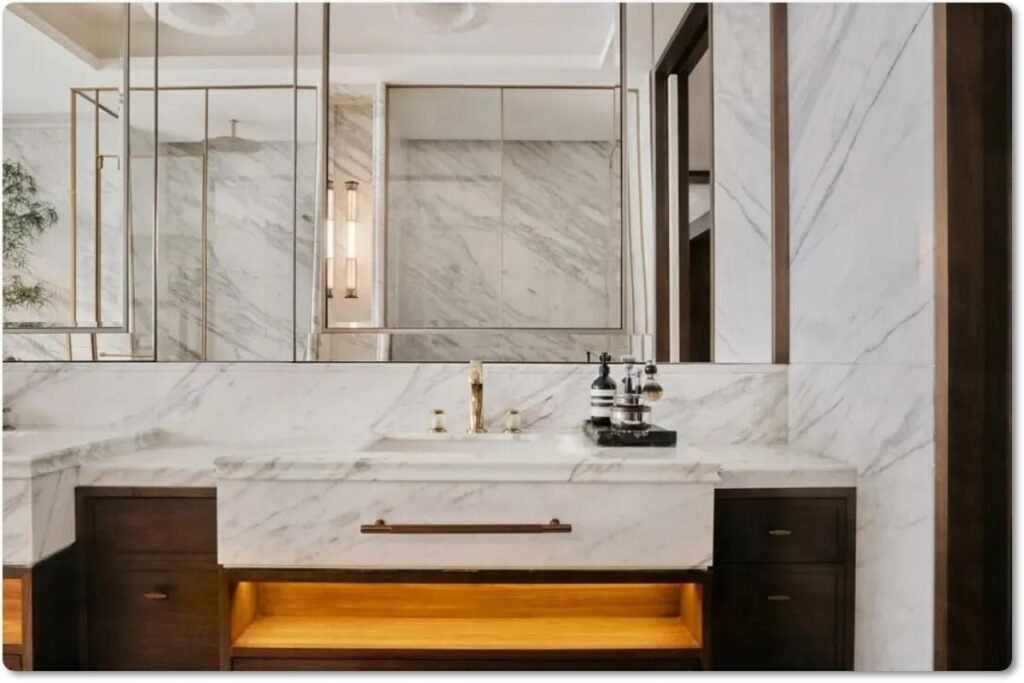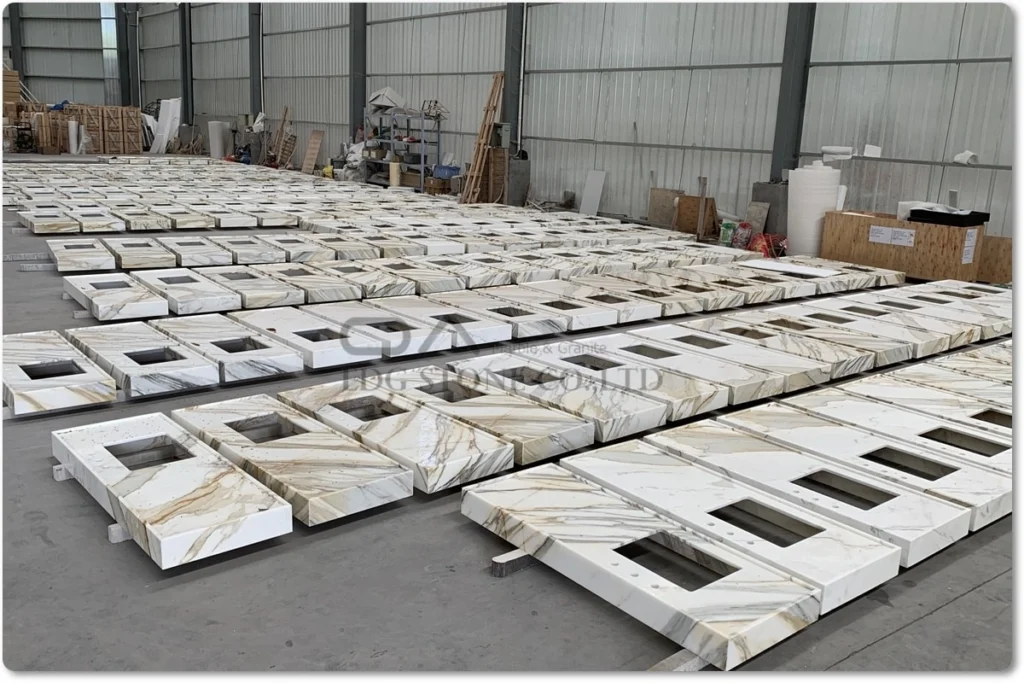
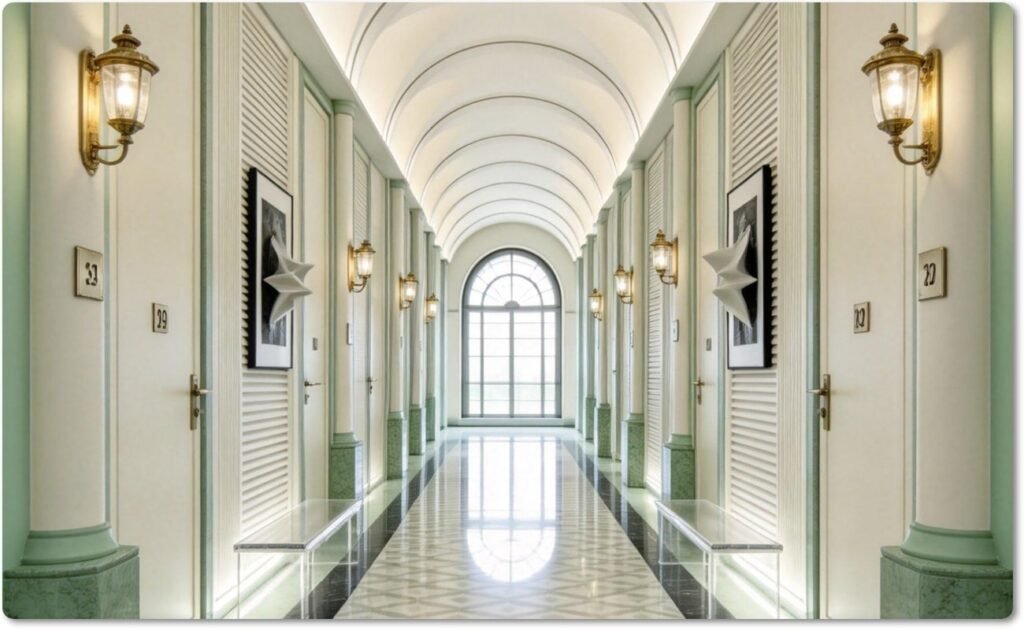
Green marble has moved beyond the traditional concept of a decorative stone. Today, architects, interior designers, contractors, developers, and stone buyers use green marble tiles and slabs across floors, bathrooms, shower walls, backsplashes, feature walls, fireplaces, vanities, countertops, stair treads, and custom architectural elements.
The key procurement decision is not simply choosing a beautiful green stone. The more important question is whether the tile, slab, thickness, finish, fabrication method, installation system, and maintenance specification are appropriate for the intended application.
This guide explains how green marble can be selected and applied across residential, hospitality, commercial, and luxury architectural projects—from relatively modular green marble tiles to large-format green marble slabs and precision cut-to-size architectural components.
Quick Summary: How to Choose Green Marble for Different Applications
Semantic Definition
Green marble is a natural dimension stone with green coloration and potentially contrasting veins, clouds, brecciation, or mineral patterns. Commercial green marble names do not necessarily describe identical geological materials, so buyers should evaluate the actual quarry source, petrographic characteristics, physical properties, finish, and sample or slab before approving a project.
The same green marble may therefore be available in several commercial forms:
Green marble block → slab → tile → cut-to-size component → finished architectural product
This makes green marble particularly useful as a material family rather than a single product.
Green Marble Tiles vs. Green Marble Slabs
What Are Green Marble Tiles?
Green marble tiles are smaller, modular pieces cut from marble slabs or blocks. They are commonly used where installation flexibility, repeatable dimensions, and modular layouts are more important than achieving one uninterrupted stone pattern.
Typical applications include:
- Green marble flooring
- Bathroom floors
- Shower walls
- Bathroom walls
- Backsplashes
- Entry floors
- Decorative borders
- Feature niches
- Hospitality bathrooms
- Residential accent walls
Tile formats can vary significantly by producer and project. Common procurement formats may include square, rectangular, or custom dimensions.
For commercial projects, buyers should specify more than simply “green marble tile.”
A professional specification may include:
Stone → color/pattern → origin or commercial designation → tile size → thickness → finish → tolerance → quantity → packaging → inspection standard
This reduces ambiguity during purchasing.
What Are Green Marble Slabs?
Green marble slabs are larger pieces produced from marble blocks and are generally selected when the visual continuity of the stone is important.
Slabs are especially useful for:
- Green marble feature walls
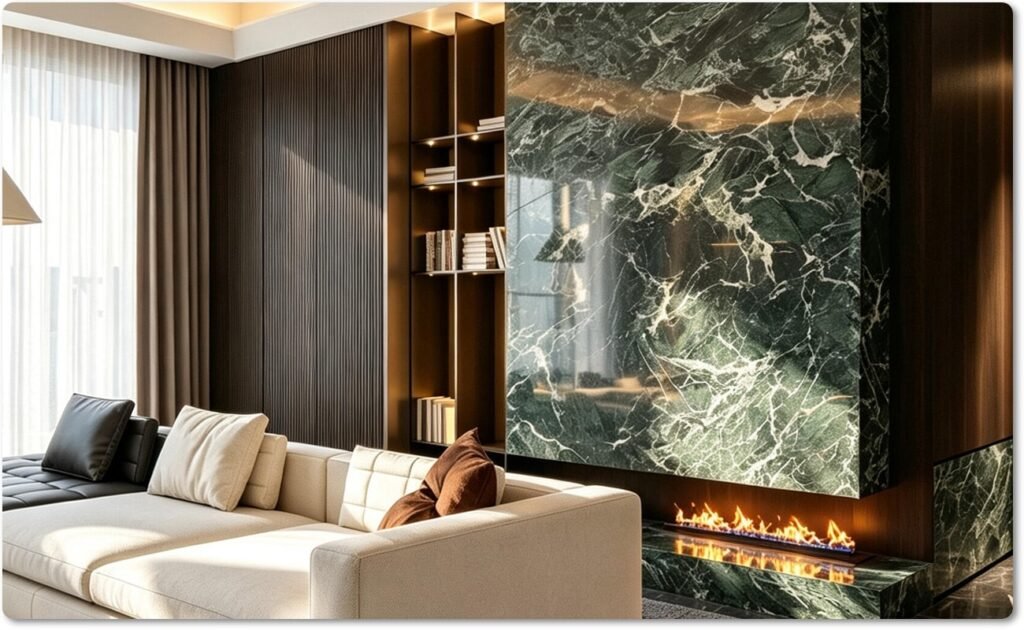
- Fireplace surrounds
- Large-format wall panels
- Vanity tops
- Countertops
- Reception desks
- Hotel bathrooms
- Luxury residential interiors
- Furniture components
- Bookmatched architectural installations
One of the biggest advantages of slab applications is the ability to preserve and coordinate the natural movement of the stone.
For highly veined green marble, this can be a major architectural advantage.
Instead of treating each piece as an independent tile, the designer can treat several slabs as a visual composition.
Green Marble Tiles for Flooring
Why Use Green Marble Flooring?
Green marble flooring can create a distinctive architectural identity without relying on artificial patterns.
Depending on the stone and finish, green marble flooring can contribute:
- Natural color variation
- Mineral movement
- Visual depth
- Reflective character
- Custom geometric layouts
- High-end hospitality aesthetics
- Residential luxury interiors
However, marble flooring should not be selected solely on appearance.
Floor applications require consideration of:
- Abrasion
- Slip resistance
- Water exposure
- Staining
- Surface finish
- Traffic level
- Maintenance
- Installation conditions
The Natural Stone Institute notes that stone selection can require consideration of slip resistance, abrasion resistance, absorption, compressive strength, and bending strength depending on the application.
ASTM C503/C503M-23, the active ASTM specification for marble dimension stone, addresses physical characteristics including absorption, density, compressive strength, modulus of rupture, abrasion resistance, and flexural strength.
Green Marble Flooring for Residential Projects
Residential applications may include:
- Entrance halls
- Living rooms
- Dining rooms
- Powder rooms
- Luxury bathrooms
- Interior staircases
A honed or other low-gloss finish may be considered where designers want a softer appearance and reduced visual emphasis on surface reflections.
A polished finish can produce a more formal appearance, but finish selection should be evaluated against the actual use and maintenance requirements.
Green Marble Flooring for Hospitality and Commercial Spaces
Hotels, restaurants, boutiques, luxury retail environments, and high-end residential developments can use green marble as a branding and interior-design element.
In these projects, procurement teams should pay particular attention to batch consistency and replacement availability.
A beautiful sample is not enough.
If a project requires hundreds or thousands of square meters, the buyer should confirm:
- Available block reserves
- Production capacity
- Slab yield
- Color range
- Veining range
- Thickness tolerance
- Batch control
- Replacement material availability
- Packaging method
This is where working with an experienced green marble manufacturer or factory can become important.
Green Marble Tiles for Bathrooms and Shower Walls
Green Marble Bathroom Applications
Green marble has a natural relationship with bathroom design because green tones can work with stone, wood, metal, glass, and neutral architectural finishes.
Common applications include:
- Bathroom flooring
- Shower walls
- Vanity walls
- Backsplashes
- Shower niches
- Tub surrounds
- Vanity tops
- Wall borders
- Decorative panels
A bathroom project should distinguish between wet-area exposure and dry-area exposure.
Water exposure does not automatically make every marble unsuitable, but it increases the importance of absorption, sealing, installation detailing, drainage, and maintenance.
Green Marble Shower Walls
For shower walls, designers should evaluate:
- Water absorption
- Surface finish
- Tile/slab dimensions
- Joint design
- Substrate preparation
- Waterproofing system
- Adhesive compatibility
- Sealer compatibility
- Cleaning products
The marble itself is only one component of the complete wall assembly.
For large-format green marble slabs, the installation system also becomes important because larger panels introduce additional handling, support, and installation considerations.
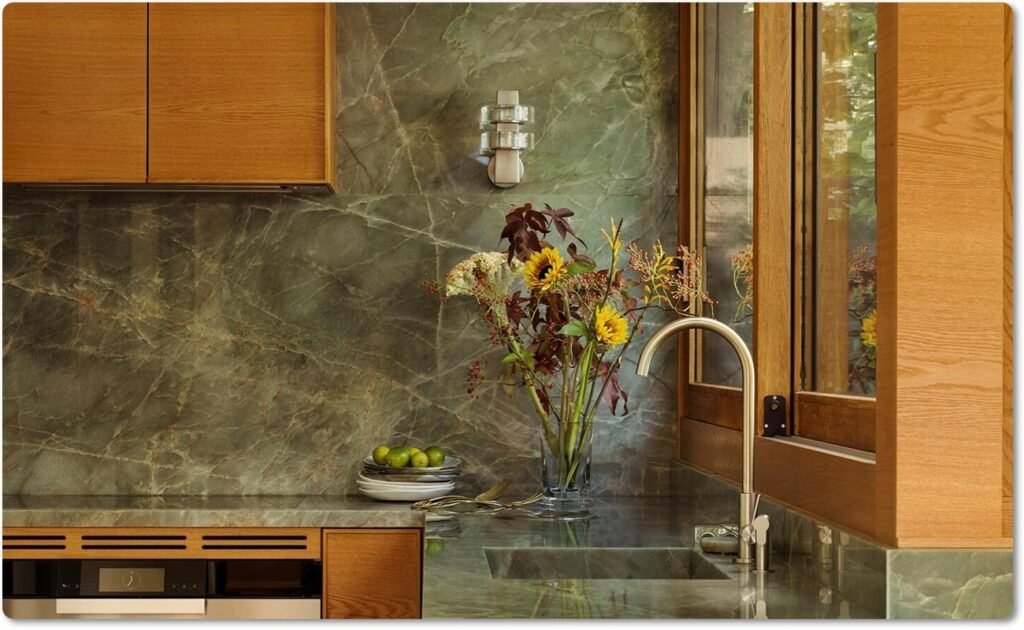
Green Marble Backsplash Design
A green marble backsplash can connect countertops, cabinetry, walls, and flooring into a coherent design language.
Tile is useful when the design calls for:
- Repeating patterns
- Small formats
- Borders
- Mosaic combinations
- Modular layouts
Slab is useful when the objective is:
- Continuous veining
- Minimal joints
- Bookmatching
- Dramatic visual movement
- Full-height backsplash installation
For heavily veined material, slab selection should happen before fabrication.
The fabricator should ideally receive the approved slab layout and understand which section of the slab corresponds to each finished component.
Green Marble Slabs for Feature Walls
Why Green Marble Works as a Feature Wall
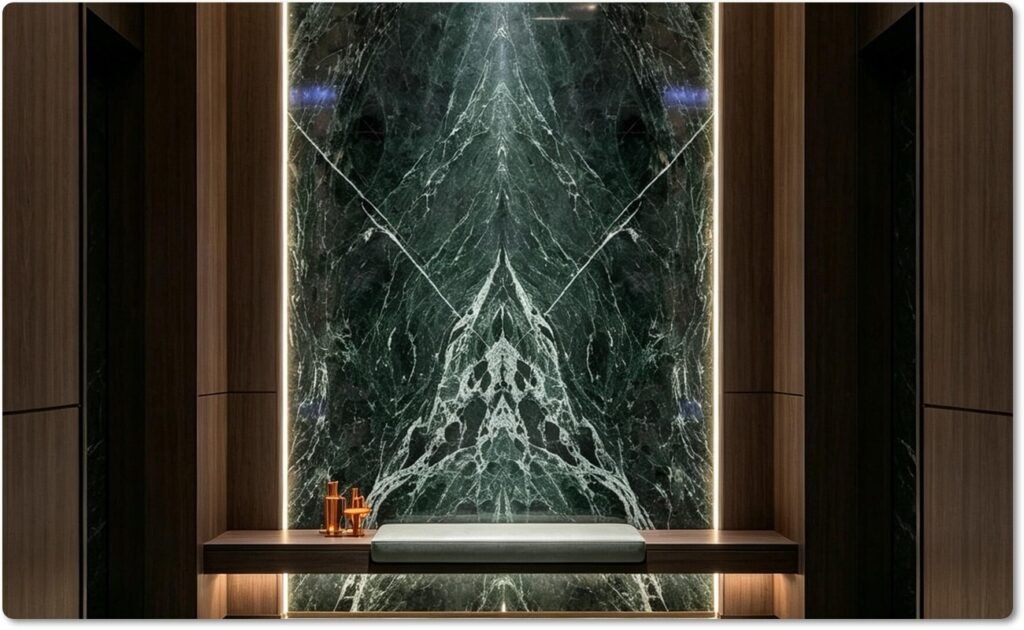
A green marble wall can function almost like a large-scale artwork.
Rather than covering every wall with decorative elements, designers can use one carefully selected marble surface as the dominant visual feature.
Applications include:
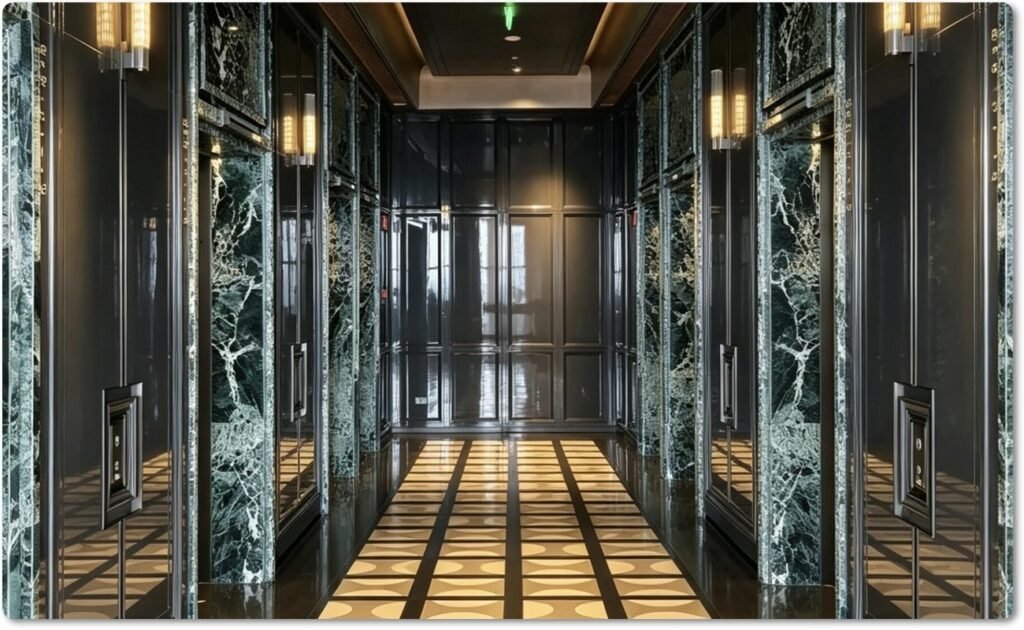
- Hotel lobby walls
- Reception walls
- Elevator surrounds
- Fireplace walls
- Restaurant feature walls
- Luxury residential living rooms
- Bedroom headboards
- Retail display walls
- Bar back walls
The most important design factor is often not simply the green color but the relationship between slab size and natural pattern.
Large-Format Green Marble Walls
Large-format slabs reduce the number of visible joints and can make the natural pattern appear more continuous.
However, larger panels also require more detailed engineering coordination.
For stone panels attached to subframes or curtain-wall components, ASTM C1242 provides guidance concerning the selection, design, and installation of dimension-stone attachment systems and emphasizes compliance with applicable regulations, manufacturer recommendations, and relevant standards.
Therefore:
Large slab ≠ simply a larger tile.
It can represent a different fabrication and installation category.
A project may need:
- Structural review
- Panel weight calculation
- Mechanical anchoring
- Substrate assessment
- Joint planning
- Edge reinforcement
- Handling equipment
- Installation drawings
Green Marble Fireplace Applications
Green marble can be used for:
- Fireplace surrounds
- Mantels
- Hearths
- Full-height fireplace walls
- Decorative fireplace portals
The designer should distinguish between the visual stone application and the technical requirements of the fireplace assembly.
The stone specification should be coordinated with the fireplace system, heat exposure, clearances, substrate, and local building requirements.
For a luxury project, bookmatching two or more slabs around the fireplace can create a strong architectural focal point.
Green Marble Vanity Tops and Countertops
Green Marble Vanity
Green marble vanity tops are particularly suitable for:
- Luxury hotels
- Residential bathrooms
- Powder rooms
- Boutique hospitality
- High-end residential developments
A vanity may combine several fabrication processes:
Slab selection → CAD drawing → sink cutout → edge profile → polishing → inspection → packing
This is an important transition from simply buying stone to purchasing a finished fabricated stone component.
Green Marble Countertops
Green marble countertops can create a dramatic kitchen or bar environment.
However, marble countertops require realistic expectations concerning:
- Scratching
- Etching
- Staining
- Acidic substances
- Sealing
- Cleaning
- Daily maintenance
For this reason, green marble countertop procurement should include a written maintenance specification.
The buyer should also confirm whether the proposed stone has been tested for the intended application rather than assuming that all green marble varieties perform identically.
Cut-to-Size Green Marble for Architectural Applications
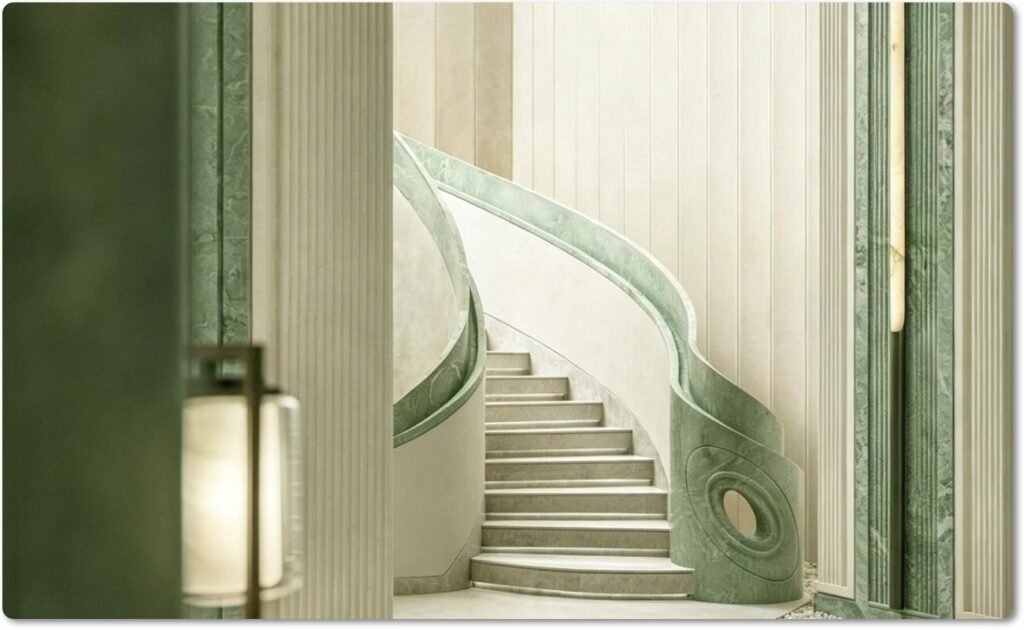
Green Marble Stair Treads
Green marble can be fabricated into:
- Stair treads
- Risers
- Landings
- Stair nosings
- Stringer components
For stair applications, dimensional accuracy and edge finishing are particularly important.
The procurement specification should define:
- Length
- Width
- Thickness
- Edge profile
- Surface finish
- Nose detail
- Tolerances
- Quantity
- Packaging
Green Marble Wall Panels
Cut-to-size fabrication allows large projects to transform slabs into coordinated wall panels.
Typical workflow:
Approved slab → slab scanning → CAD nesting → CNC/waterjet cutting → edge processing → dry layout → QC → packing
This can be especially valuable for hotel and commercial projects where dozens or hundreds of individual components must correspond to architectural drawings.
Green Marble Sills and Thresholds
Smaller architectural components are often overlooked during initial stone selection.
Green marble can also be fabricated for:
- Window sills
- Door thresholds
- Shower thresholds
- Wall caps
- Baseboards
- Transition pieces
- Counter ledges
Using the same material across these details can improve visual continuity throughout a project.
Tile, Slab or Cut-to-Size? A Practical Selection Framework
| Application | Preferred Format | Main Selection Priority |
|---|---|---|
| Bathroom floor | Tile | Slip resistance, absorption, finish |
| Shower wall | Tile / Slab | Water exposure, joints, maintenance |
| Backsplash | Tile / Slab | Pattern and joint strategy |
| Large feature wall | Slab | Veining and slab continuity |
| Fireplace | Slab / Cut-to-size | Pattern, fabrication, assembly requirements |
| Vanity | Slab / Cut-to-size | Fabrication and sink integration |
| Countertop | Slab | Surface behavior and maintenance |
| Stair tread | Cut-to-size | Thickness, dimensions, edge treatment |
| Wall panel | Cut-to-size | CAD accuracy and installation |
| Window sill | Cut-to-size | Dimensional accuracy |
| Custom furniture | Slab / Cut-to-size | Yield and fabrication |
The fundamental principle is simple:
Choose the format according to the architectural function—not simply according to the stone’s appearance.
How to Select Green Marble for a Commercial Project
Step 1: Define the Application
Start with the intended use.
Is the material going to be used for:
- Flooring?
- Wall cladding?
- Shower walls?
- Countertops?
- Vanities?
- Stairs?
- Fireplace surrounds?
- Furniture?
Different applications create different technical requirements.
Step 2: Approve the Actual Material
Do not approve a project based only on the commercial name.
“Green Marble” can represent materials with significantly different:
- Mineral composition
- Veining
- Porosity
- Strength
- Absorption
- Color stability
- Surface response
The final approval should ideally reference a physical sample, representative slab images, or an approved slab batch.
Step 3: Request Technical Data
Depending on the project, request available information covering:
- Water absorption
- Density
- Compressive strength
- Flexural strength
- Abrasion resistance
- Petrographic description
- Slip-related performance where relevant
- Recommended finish
- Recommended applications
ASTM C503/C503M-23 explicitly identifies several of these physical properties as relevant to marble dimension-stone selection.
Step 4: Evaluate Slab Yield
A low-cost slab is not necessarily a low-cost finished project.
Consider:
Purchase price + cutting loss + fabrication + finishing + packing + transport + installation risk
For highly patterned green marble, slab yield can be particularly important because a visually unusable section may remain after nesting.
This is why professional stone procurement should evaluate cost per usable finished component, not simply cost per square meter of raw slab.
Green Marble Manufacturing and Factory Procurement
For importers, distributors, contractors, and architectural procurement teams, purchasing directly from a green marble manufacturer or factory can provide greater control over:
- Slab selection
- Tile production
- Custom thickness
- Surface finishing
- Cut-to-size fabrication
- CNC processing
- Waterjet processing
- Edge treatment
- CAD-based nesting
- Quality inspection
- Export packing
An experienced green marble factory can also coordinate several product forms under one project.
For example:
Green marble slabs + green marble tiles + vanity tops + stair treads + wall panels
This can simplify procurement when the same stone needs to appear throughout an entire building.
EDG Stone works with natural stone slabs and custom fabrication for international architectural and interior projects, including tile, slab, cut-to-size, CNC, waterjet, edge processing, and project fabrication.
Wholesale Green Marble: What Buyers Should Specify
For green marble wholesale purchasing, the specification should be more detailed than “green marble, polished.”
A professional purchase specification can include:
Material
- Commercial stone name
- Origin
- Quarry/source information where available
- Representative photographs
- Approved physical sample
Dimensions
- Length
- Width
- Thickness
- Tile size
- Cut-to-size dimensions
Finish
- Polished
- Honed
- Brushed
- Leathered or other project-specific finish
Quality
- Color range
- Veining range
- Cracks/fissures
- Resin treatment if applicable
- Repairs
- Surface defects
- Edge quality
Fabrication
- Sink cutouts
- CNC profiles
- Waterjet cutting
- Edge profiles
- Miters
- Bookmatching
- Numbering
Logistics
- Crate specification
- Moisture protection
- Corner protection
- Container loading
- Identification labels
- Packing list
- Inspection photographs
For international purchasing, packaging is part of product quality.
A technically perfect marble slab that arrives damaged is not a successful procurement result.
Green Marble Quality Control Before Shipment
A professional QC process should include multiple stages.
Raw Slab Inspection
Inspect:
- Color
- Pattern
- Cracks
- Fissures
- Voids
- Repairs
- Resin
- Thickness
- Surface finish
Fabrication Inspection
Check:
- Dimensions
- Diagonals
- Cutouts
- Edge profiles
- Surface finish
- Corners
- Polishing
- Visible damage
Final Packing Inspection
Check:
- Piece identification
- Quantity
- Packing list
- Crate strength
- Corner protection
- Internal separation
- Labels
- Loading photographs
For large projects, photographs of each finished component can also help connect the physical shipment to the approved CAD drawings.
Sustainability, Environmental Data and the Direction of the Stone Industry
Sustainability is increasingly becoming part of professional stone procurement rather than simply a marketing statement.
The European Union’s revised Construction Products Regulation, Regulation (EU) 2024/3110, entered into force in January 2025 and introduces a stronger framework for the green and digital transition of construction products. The European Commission identifies environmental sustainability, life-cycle assessment information, and digital product information as important elements of the revised framework.
The new CPR framework is also moving toward environmental characteristics based on life-cycle assessment and a Digital Product Passport (DPP) containing machine-readable product information.
This direction has practical implications for stone manufacturers and buyers.
Future-oriented stone suppliers should increasingly be prepared to provide structured information covering:
- Product identification
- Material characteristics
- Origin
- Technical performance
- Environmental information where applicable
- Installation instructions
- Safety information
- Product documentation
This does not mean every green marble tile or slab automatically requires the same certification in every market. Requirements depend on the product category, intended use, applicable harmonized technical specifications, and destination market.
The important trend is that traceable product information is becoming increasingly valuable in construction procurement.
Green Marble Design Trends: From Decorative Material to Architectural System
The broader direction of green marble design is increasingly moving toward material continuity.
Instead of using green marble only as a small decorative tile, designers can coordinate the same material across:
Floor → wall → vanity → countertop → furniture → architectural details
This creates a unified material language.
Another important direction is the combination of:
Large slabs + bookmatching + minimal joints + custom fabrication
This approach allows natural stone to function as a major architectural element rather than simply a surface covering.
At the same time, professional projects are becoming more data-driven.
Material selection increasingly combines:
Visual approval + technical performance + fabrication capability + documentation + logistics
That combination is particularly important for international projects.
Green Marble Application Decision Guide
Choose Green Marble Tiles When:
- The project needs modular installation.
- Tile dimensions are standardized.
- A repeating pattern is desired.
- The installation contains many smaller areas.
- Replacement pieces may be needed.
- The design uses borders or geometric layouts.
Choose Green Marble Slabs When:
- Natural veining is the main design feature.
- Large uninterrupted surfaces are required.
- Bookmatching is desired.
- Feature walls are involved.
- Fireplaces or large vanities are required.
- A luxury visual effect is important.
Choose Cut-to-Size Green Marble When:
- Architectural drawings define exact dimensions.
- Stair treads are required.
- Wall panels need specific sizes.
- Sills and thresholds are required.
- Custom furniture components are required.
- Multiple fabricated parts must be coordinated.
Green Marble Buyer Checklist
Before placing an international order, buyers should confirm:
Material
Stone name
Source/origin information
Approved sample
Approved slab photographs
Color range
Veining range
Technical
Absorption data
Density
Strength data
Abrasion performance where relevant
Slip-related requirements where relevant
Application suitability
Fabrication
Tile dimensions
Slab dimensions
Thickness
Finish
Edge profile
Cutouts
CNC/waterjet requirements
Bookmatch requirements
QC
Pre-production inspection
In-process inspection
Final inspection
Dimensional inspection
Surface inspection
Quantity verification
Logistics
Crate specification
Labels
Packing list
Protection
Container loading plan
Loading photographs
Expert Procurement Insight: The Most Important Question Is Not “Is Green Marble Good?”
There is no universal answer to whether a particular green marble is “good.”
The more useful procurement question is:
Is this specific green marble, in this specific thickness, finish, fabrication format, and installation system, appropriate for this specific application?
A green marble that performs well as a decorative wall tile may require a different evaluation for high-traffic flooring.
A visually excellent slab may be inefficient for small cut-to-size components.
A low-priced raw slab may become expensive after cutting loss.
Therefore, professional procurement should evaluate the complete chain:
Material → Application → Technical Performance → Fabrication → Installation → Maintenance → Logistics
That is the foundation of reliable natural-stone specification.
Semantic Insight: How Green Marble Connects Design and Procurement
Green marble is particularly powerful because it sits at the intersection of material aesthetics and architectural functionality.
For designers, the attraction is natural pattern, color, movement, and texture.
For contractors, the focus is fabrication, dimensions, installation, and tolerances.
For importers, the priority may be consistency, price, packaging, lead time, and documentation.
For architects, the concern may include performance, detailing, visual continuity, and project specifications.
For developers, the calculation extends to lifecycle, maintenance, replacement, and overall project value.
A professional green marble supplier therefore needs to communicate with all of these audiences.
The strongest product information is not simply a catalog description.
It is a material knowledge system.
FAQ: Green Marble Tile & Slab
1. Is green marble good for flooring?
Green marble can be used for interior flooring when the selected material, finish, and installation system are appropriate for the expected traffic and environment. Buyers should evaluate absorption, abrasion-related performance, slip considerations, strength, finish, and maintenance requirements rather than choosing solely by color.
2. What is the difference between green marble tile and green marble slab?
Green marble tile is a smaller modular format generally used for floors, bathrooms, shower walls, and backsplashes. Green marble slabs are larger pieces better suited to feature walls, fireplaces, vanities, countertops, and applications where continuous natural veining is important.
3. Can green marble be used on shower walls?
Yes, green marble can be considered for shower-wall applications, but the specific stone and installation system must be evaluated for wet-area use. Waterproofing, substrate preparation, joints, sealing, cleaning, and maintenance should all be included in the specification.
4. Can green marble be used for kitchen countertops?
Green marble can be fabricated into kitchen countertops, but buyers should understand that marble can be susceptible to scratching, etching, and staining. The selected material, finish, sealing strategy, maintenance expectations, and intended kitchen use should therefore be discussed before approval.
5. How do I buy green marble slabs from a manufacturer or factory?
Start by defining the stone type, application, thickness, finish, slab size, quality range, quantity, fabrication requirements, inspection procedure, and packaging requirements. For large projects, request representative slab photographs, technical information, fabrication drawings, QC documentation, and a clear packing/loading plan before production.
Semantic Closure: Green Marble as a Complete Architectural Material System
Green Marble: Application, Selection & Procurement Insights
What is the right green marble format?
The right format depends on the architectural function. Green marble tiles are generally suited to modular applications such as flooring, bathrooms, shower walls, and backsplashes, while slabs are better suited to large visual surfaces such as feature walls, fireplaces, vanities, and countertops. Cut-to-size marble provides a third option for stairs, wall panels, sills, thresholds, and custom architectural components.
How should green marble be selected?
Selection should begin with the intended application rather than the appearance alone. Buyers should evaluate the actual material, physical properties, finish, thickness, fabrication requirements, installation conditions, maintenance expectations, and project-specific regulations.
Why does the same green marble look different from one project to another?
Natural marble contains geological variation. Color, veining, mineral patterns, fissures, clouds, and other characteristics can vary between blocks and slabs. For this reason, commercial names should not be treated as complete technical descriptions. Representative samples and approved slab selections are important for architectural projects.
Which option provides the greatest visual impact?
Large-format slabs can provide greater visual continuity because they expose more of the natural stone pattern with fewer joints. Bookmatching can further emphasize directional veining and create a deliberate architectural composition.
What should commercial buyers consider beyond price?
Commercial procurement should consider the complete delivered and installed value: material yield, fabrication, quality consistency, packaging, transportation, installation requirements, maintenance, replacement availability, and technical documentation. The lowest slab price does not necessarily produce the lowest project cost.
What is changing in the natural-stone procurement industry?
The industry is moving toward more structured technical and environmental information. The revised EU Construction Products Regulation places greater emphasis on environmental characteristics, digital product information, and life-cycle-related data, creating a broader direction toward more traceable construction-product documentation.
What does this mean for green marble manufacturers?
Manufacturers increasingly need to combine traditional stone expertise with technical documentation, quality control, digital product information, fabrication precision, and international logistics. A modern green marble factory is therefore not simply a source of slabs; it can function as a material and fabrication partner for architectural projects.
What is the central principle for specifying green marble?
The most reliable approach is to connect material + application + performance + fabrication + installation + maintenance + logistics. Green marble becomes a successful architectural material when these elements are specified as one system rather than treating the stone as an isolated decorative product.
Conclusion
Green Marble Tile & Slab for Elegant Spaces represents more than a decorative-material trend. Green marble can operate across an entire architectural project—from modular green marble tiles for floors and bathrooms to large green marble slabs for feature walls, fireplaces, vanities, and countertops, and finally to precision cut-to-size components for stairs, wall panels, sills, thresholds, and custom architectural details.
The key is application-specific selection.
For tiles, focus on format, finish, absorption, traffic, slip considerations, and maintenance.
For slabs, focus on pattern, slab dimensions, yield, bookmatching, fabrication, and installation.
For cut-to-size components, focus on CAD accuracy, tolerances, edge processing, QC, packaging, and project coordination.
For international procurement, add technical documentation, quality control, logistics, and destination-market requirements.
The result is a more reliable way to specify green marble—not simply as a beautiful stone, but as a complete architectural material system.