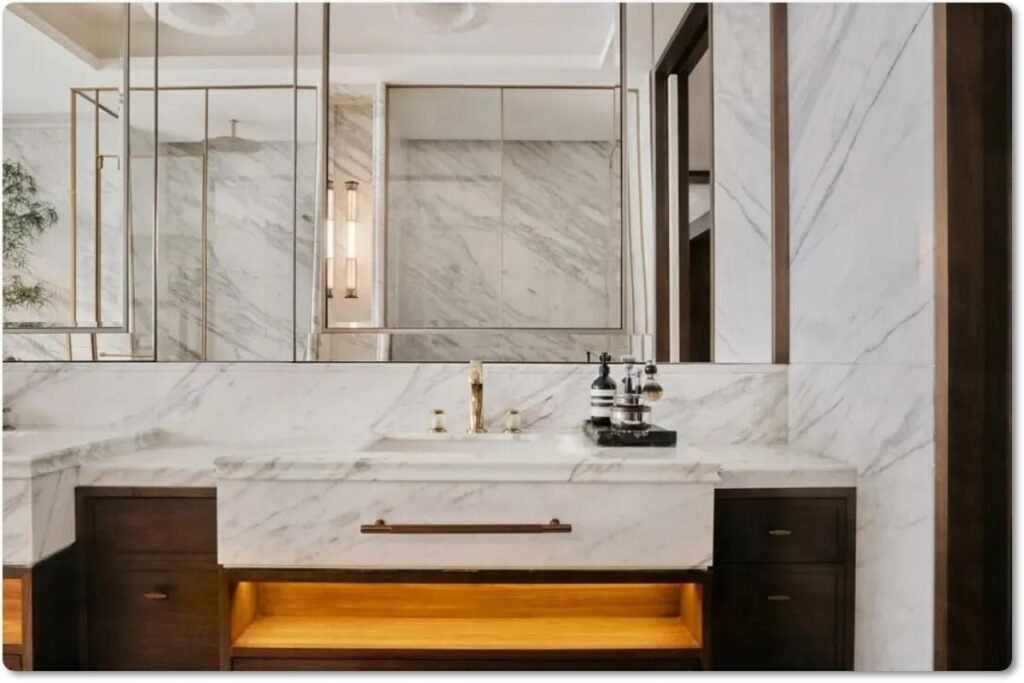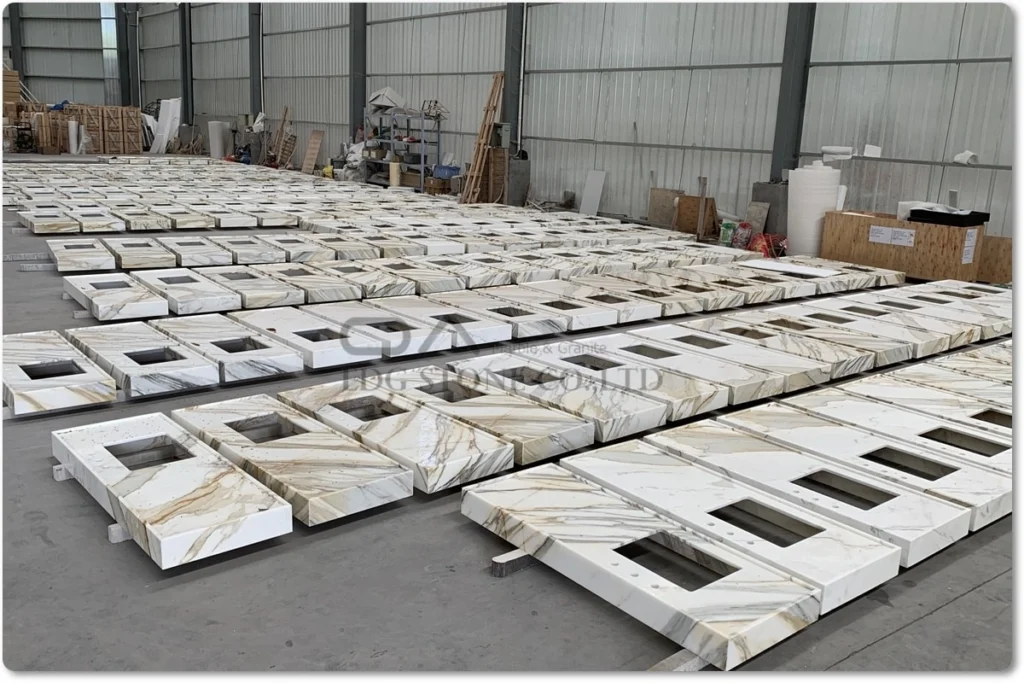
Green marble countertops bring a distinctive natural pattern, mineral variation, and architectural character to kitchens, bathrooms, hospitality interiors, and luxury residential projects. However, selecting green marble for a countertop is not simply an aesthetic decision. The buyer must evaluate the stone’s mineral composition, slab consistency, water exposure, acid sensitivity, staining potential, fabrication requirements, edge design, sealing system, and intended application.
For manufacturers, fabricators, designers, contractors, and wholesale buyers, the most reliable approach is to treat the countertop as a complete system:
Material Selection → Slab Inspection → CAD / Template → CNC Cutting → Sink Cutout → Edge Profile → Polishing → Sealing → Installation → Maintenance
This guide explains each stage and provides a practical procurement framework for green marble countertops, green marble kitchen countertops, islands, backsplashes, and green marble vanity tops.
Quick Summary: What Buyers Should Know About Green Marble Countertops
Green Marble Countertops at a Glance
| Procurement Factor | What to Check |
|---|---|
| Material | Marble classification and mineral composition |
| Appearance | Base color, veining, movement, and slab-to-slab variation |
| Water exposure | Absorption and application environment |
| Acid resistance | Potential for etching from acidic substances |
| Staining | Oil, coffee, wine, cosmetics, and food exposure |
| Slab quality | Cracks, fissures, repairs, resin, pits and weak areas |
| Fabrication | CNC cutting, drilling, sink cutouts and edge processing |
| Finish | Polished, honed or other specified finish |
| Protection | Appropriate impregnating treatment where applicable |
| Installation | Cabinet support, seams, overhangs and movement |
| Maintenance | Neutral cleaners, spill control and periodic assessment |
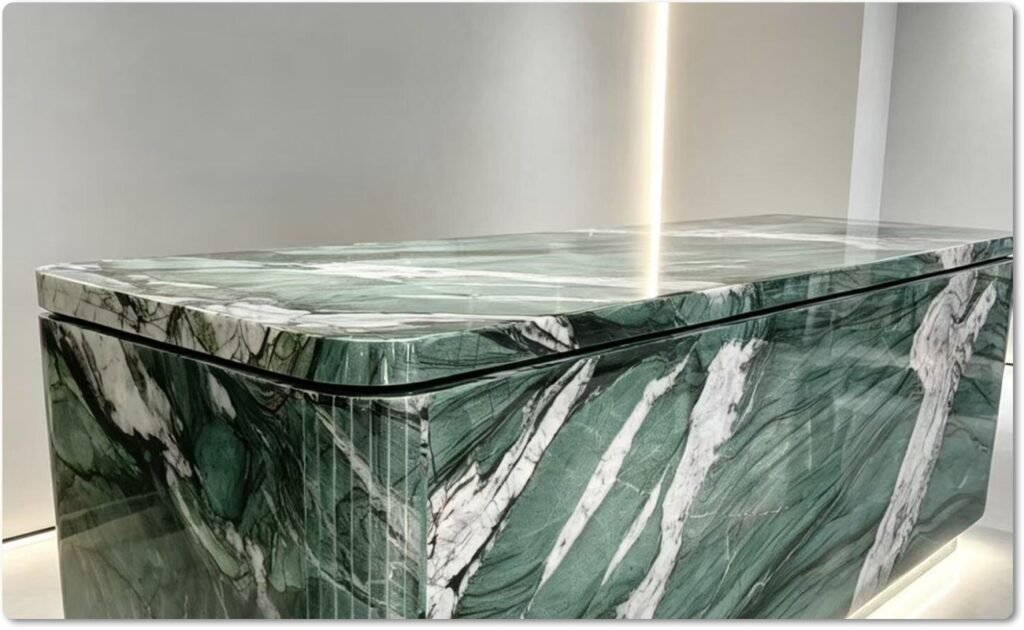
What Are Green Marble Countertops?
Green marble countertops are fabricated natural-stone surfaces produced from green-colored marble or commercially designated green marble materials. The appearance may range from pale sage and olive tones to deep forest, emerald, dark green, or highly patterned materials.
The important procurement point is that “green marble” is a commercial appearance category rather than a guarantee of identical geological composition.
Different green stones may have substantially different mineral compositions and therefore different responses to acids, water, abrasion, staining, polishing, and cleaning chemicals.
The Natural Stone Institute notes that marble containing calcite is vulnerable to mild acids commonly encountered in kitchens and bars. It also distinguishes serpentine, which is magnesium-silicate-based and can be more acid- and abrasion-resistant than true calcite marble.
Therefore, buyers should not evaluate a green countertop exclusively by its color or trade name.
Why Green Marble Is Used for Countertops
Green marble is often selected because it can provide:
- Strong natural variation
- Dramatic veining
- A distinctive architectural identity
- A connection with biophilic and nature-inspired interiors
- Bookmatched design opportunities
- Compatibility with stone furniture and wall applications
- Custom fabrication possibilities
- A premium natural-stone appearance
Recent interior-design coverage also points toward continued interest in natural stone and nature-inspired colors in kitchen design, although design trends should not be treated as technical performance specifications.
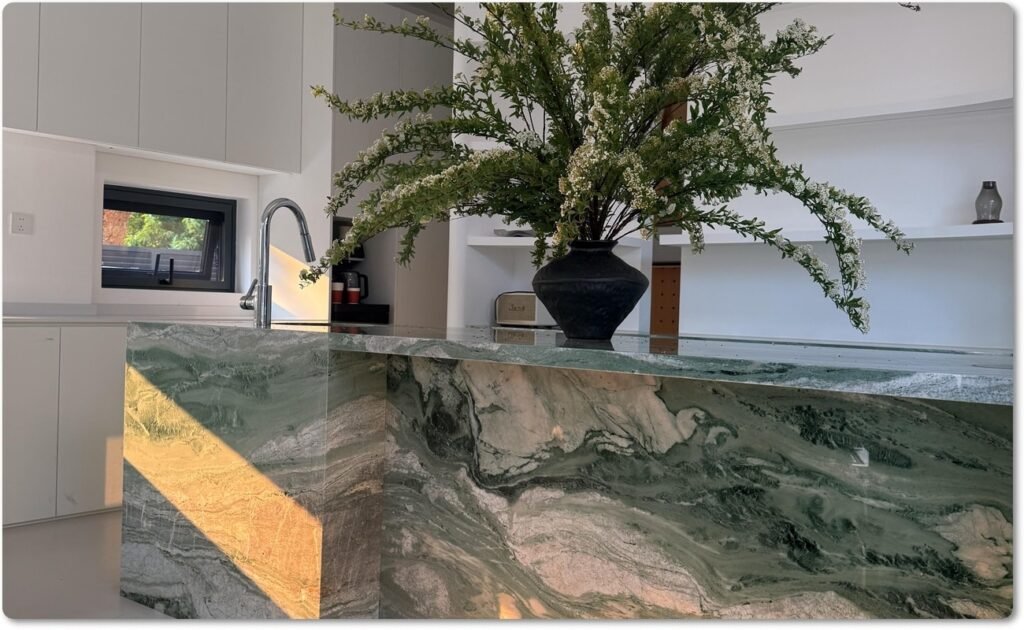
Green Marble Kitchen Countertops: Is Green Marble Suitable for a Kitchen?
A green marble kitchen can be highly practical when the selected stone and maintenance expectations are appropriate.
The key question is not simply:
“Is green marble suitable for kitchens?”
A better procurement question is:
“Is this specific green marble suitable for the expected kitchen environment and the owner’s maintenance expectations?”
Kitchen Countertops
Kitchen countertops experience several types of exposure:
- Water
- Cooking oils
- Coffee
- Wine
- Fruit juice
- Lemon
- Vinegar
- Tomato
- Spices
- Cosmetics
- Cleaning chemicals
- Heat from cookware
- Abrasion from everyday use
Marble’s primary concern in kitchens is often chemical sensitivity rather than structural failure.
A sealed marble countertop can still develop an etch mark when an acidic substance contacts the surface. Sealing primarily improves resistance to liquid penetration and staining; it does not turn marble into an acid-proof material. The Natural Stone Institute specifically advises against vinegar on calcareous stones such as marble.
Green Marble Islands
Large kitchen islands can be excellent applications for green marble because they provide enough surface area for the natural pattern to become a design feature.
However, island fabrication requires special attention to:
- Slab dimensions
- Vein direction
- Bookmatching
- Overhangs
- Structural support
- Sink or cooktop openings
- Seams
- Transportation
- Installation access
For large islands, the fabrication drawing should be approved before cutting.
Material Selection: Choosing Green Marble for Countertops
The first stage of the process is material selection.
Evaluate the Stone Beyond Color
A professional selection process should consider:
- Geological/material classification
- Mineral composition where relevant
- Water absorption
- Visual variation
- Fissures and natural characteristics
- Surface condition
- Previous resin or repair treatment
- Slab thickness
- Available slab size
- Intended application
- Fabrication complexity
- Maintenance expectations
Light Green vs Dark Green Marble
Light green materials may show:
- Fine scratches
- Etching
- Water marks
- Staining
more visibly than some darker or heavily patterned stones.
Dark green marble can visually conceal some everyday marks, but this does not mean that it is automatically more chemically resistant.
Color should never be used as a substitute for material testing.
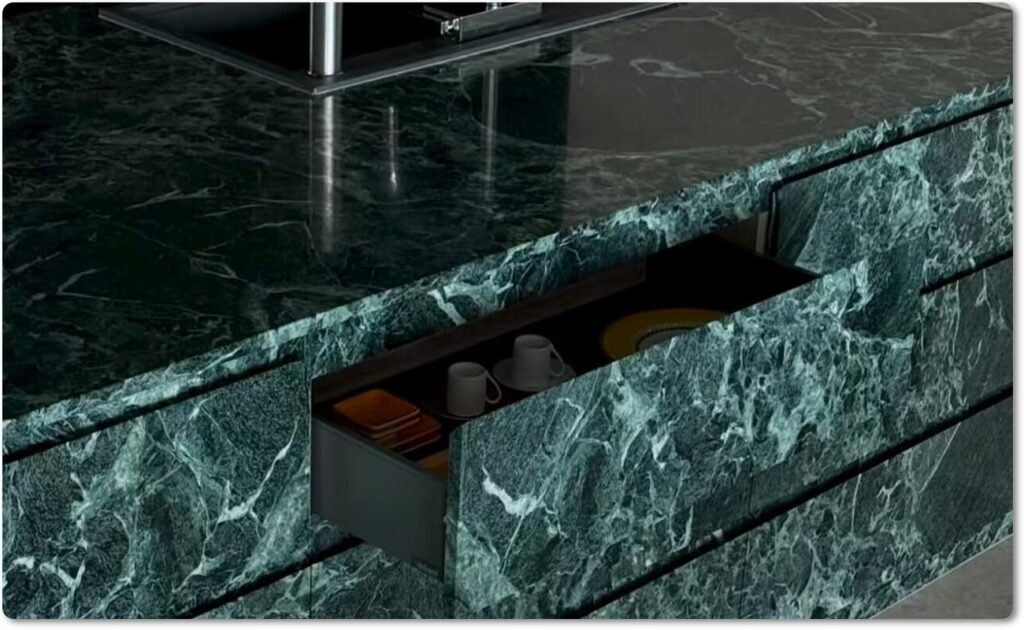
Plain, Veined, Clouded and Brecciated Patterns
For commercial procurement, green marble can generally be discussed by visual pattern:
- Plain green
- Veined green
- Clouded green
- Brecciated green
- Forest-patterned green
- High-movement green
These descriptions are useful for design selection but are not standardized geological classifications.
For large projects, the buyer should approve actual slabs rather than relying only on a small sample.
Slab Inspection: What Should Buyers Check?
Once the material has been selected, the next step is green marble slab inspection.
A professional inspection should examine both appearance and fabrication risk.
Surface Inspection
Check for:
- Cracks
- Open fissures
- Filled fissures
- Pits
- Resin
- Repaired areas
- Uneven polishing
- Scratches
- Surface waviness
- Color variation
- Mineral inclusions
Natural stone contains inherent geological characteristics. Not every visible line or inclusion represents a defect.
The critical question is whether a characteristic could affect:
structural integrity + fabrication + appearance + service performance.
Slab Thickness
Confirm:
- Nominal thickness
- Actual thickness
- Thickness tolerance
- Flatness
- Calibration where applicable
For countertop projects, the fabricator should confirm that the available thickness is compatible with the specified edge profile and installation method.
Absorption and Water Exposure
Water absorption is particularly relevant for:
- Kitchen countertops
- Bathroom vanity tops
- Wet-area applications
- Sink surrounds
- Backsplashes
Testing should be based on the applicable stone specification and project requirements rather than an arbitrary universal acceptance value.
For commercial projects, buyers can request laboratory or supplier test data appropriate to the material and specification.
CAD / Template: Turning the Design Into a Fabrication Plan
After slab approval comes the digital fabrication stage.
A professional countertop project should establish a CAD drawing or template showing:
- Overall dimensions
- Wall dimensions
- Cabinet dimensions
- Sink location
- Faucet holes
- Cooktop opening
- Backsplash dimensions
- Seams
- Overhangs
- Edge profiles
- Finished corners
- Grain/vein direction
- Bookmatch direction
Why CAD Matters
Natural stone is expensive to replace after cutting.
A detailed CAD drawing helps minimize:
- Incorrect dimensions
- Sink-position errors
- Poor vein alignment
- Unnecessary seams
- Material waste
- Incorrect edge locations
For high-value green marble, the CAD drawing should be reviewed against the actual slab layout before fabrication begins.
CNC Cutting: Precision Fabrication for Green Marble Countertops
CNC fabrication provides controlled cutting and edge-processing capabilities for customized countertop production.
A typical workflow may include:
CAD File → Slab Layout → CNC Cutting → Profiling → Drilling → Sink Cutout → Polishing → QC
Slab Layout Is Critical
The fabricator should determine the location of each countertop component before cutting.
This is especially important when the green marble contains strong directional veins.
For example:
Island + Perimeter Countertop + Backsplash
should be laid out as one coordinated visual system rather than as three independent pieces.
Vein Direction
The buyer should specify whether the project requires:
- Vein running front-to-back
- Vein running left-to-right
- Continuous vein
- Bookmatched pattern
- Symmetrical layout
- Random natural orientation
For premium projects, slab photographs with numbered cutting diagrams can provide a useful approval record.
Sink Cutout: One of the Most Important Fabrication Areas
Sink openings introduce concentrated geometry and stress into a countertop.
The fabricator should confirm:
- Sink model
- Sink dimensions
- Mounting method
- Cutout radius
- Faucet-hole requirements
- Minimum material around openings
- Cabinet support
- Edge treatment
Undermount Sink
Undermount installations require particularly careful:
- Cutout accuracy
- Edge polishing
- Radius control
- Surface finishing
- Support
The polished edge around the opening becomes a visible part of the finished countertop.
Avoid Sharp Internal Corners
Where appropriate, rounded internal corners can help reduce stress concentration compared with extremely sharp internal corners.
The exact geometry should be determined according to the sink specification, stone characteristics, fabrication method, and fabricator’s engineering practice.
Edge Profile: From Simple Eased Edge to Custom Profiles
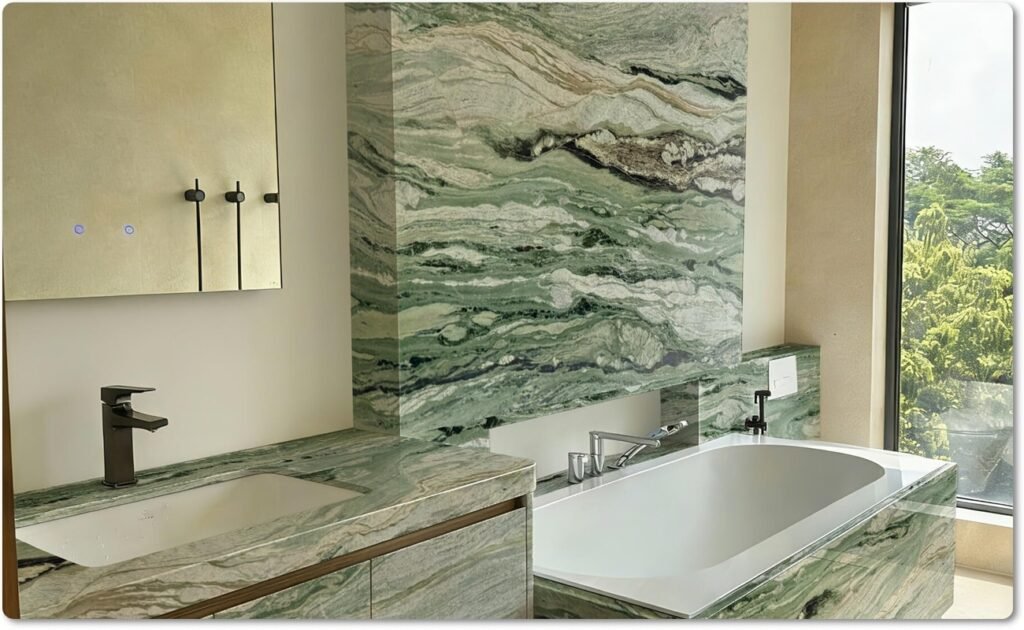
The edge profile has both aesthetic and functional implications.
Common profiles include:
Eased Edge
A relatively simple modern profile that works well for contemporary kitchens.
Half Bullnose
Creates a softer, more rounded appearance.
Full Bullnose
Provides a strongly rounded edge and can emphasize the stone’s color.
Ogee and Decorative Profiles
These may be appropriate for traditional or luxury interiors but require more fabrication time and careful polishing.
Custom Edge Profiles
For premium green marble projects, custom edges can become part of the architectural design.
The selected edge should consider:
- Stone thickness
- Slab characteristics
- Corner geometry
- Impact exposure
- Fabrication capability
- Cleaning requirements
- Design intent
Polishing: Creating the Finished Green Marble Surface
Polishing is not simply a cosmetic final step.
The fabrication sequence can influence:
- Color depth
- Vein visibility
- Surface reflectivity
- Edge consistency
- Scratch visibility
- Overall visual continuity
Polished Green Marble
A polished finish emphasizes:
- Color saturation
- Veining
- Mineral variation
- Reflectivity
It can be particularly effective for dramatic green marble.
Honed Green Marble
A honed surface has lower reflectivity and can create a softer architectural appearance.
However, finish selection should be evaluated together with the stone’s mineralogy and intended use.
Sealing Green Marble Countertops
Sealing is frequently misunderstood.
A penetrating impregnator does not make natural stone completely impermeable.
The Natural Stone Institute explains that impregnating products function primarily as repellents and increase resistance to staining rather than making stone completely stain-proof.
What Sealing Can Do
Depending on the stone and product, appropriate treatment may:
- Reduce liquid penetration
- Increase stain resistance
- Provide additional protection against everyday spills
What Sealing Cannot Do
A sealer generally cannot:
- Make marble acid-proof
- Prevent every stain
- Prevent scratching
- Eliminate natural variation
- Replace regular cleaning
- Correct an unsuitable stone selection
Food-Contact Areas
For kitchen countertops, any product used for surface protection should be suitable for the intended application and applied according to the manufacturer’s instructions. The Natural Stone Institute specifically recommends confirming that products used in food-preparation areas are non-toxic and appropriate for that use.
Installation: The Final Stage of Countertop Fabrication
Even an excellent slab and precise CNC fabrication can produce a poor result if installation is inadequate.
Installation should verify:
- Cabinet level
- Cabinet support
- Wall conditions
- Seam position
- Overhang support
- Sink support
- Cooktop clearance
- Backsplash alignment
- Joint treatment
- Final cleaning
Large Green Marble Islands
Large-format islands require additional planning because weight, access, transportation, and support become increasingly important.
The installation team should verify the structural support before placing heavy natural-stone components.
Seams
Seam location should ideally be planned during CAD layout rather than decided at the installation site.
For visually strong green marble, seam placement should consider the direction of the veining and overall slab pattern.
Green Marble Countertop Maintenance
Proper maintenance is straightforward when the owner understands the material.
Daily Cleaning
For routine cleaning, use:
- Warm water
- Neutral stone cleaner
- Mild detergent where appropriate
- Soft cloth
The Natural Stone Institute recommends neutral cleaners, stone soap, or mild liquid dishwashing detergent with warm water for natural stone.
What Should Be Avoided?
Avoid using acidic household cleaners such as:
- Vinegar
- Lemon-based cleaners
- Acidic bathroom cleaners
- Strong descaling products
on acid-sensitive marble.
Acids can create etch marks, which are chemical changes to the surface finish rather than ordinary stains.
Water Exposure
Water itself is not necessarily a problem, but prolonged moisture exposure can reveal absorption differences or contribute to water-related staining under certain conditions.
For bathroom vanities:
- Wipe standing water
- Dry around faucet bases
- Keep cosmetics from sitting directly on the surface
- Clean spills promptly
Acidic Foods: Lemon, Vinegar, and Tomato
This is one of the most important issues for green marble kitchen countertops.
Common acidic substances include:
- Lemon juice
- Lime juice
- Vinegar
- Tomato products
- Wine
- Some soft drinks
If the marble is acid-sensitive, these substances may etch the surface.
Etching vs Staining
These are not the same problem.
Stain: A substance penetrates or discolors the stone.
Etch: Acid reacts with susceptible minerals and changes the surface finish.
A sealer can improve stain resistance but should not be marketed as an “etch-proof” coating.
Staining: How to Reduce the Risk
Common staining materials include:
- Cooking oil
- Coffee
- Wine
- Cosmetics
- Food coloring
- Some sauces
- Grease
The best defense is a combination of:
appropriate material selection + suitable surface treatment + immediate spill response + correct cleaning.
When a spill occurs, blot rather than aggressively wiping it across a large surface. The Natural Stone Institute recommends prompt spill removal and rinsing with water and mild soap.
Green Marble Vanity Tops: Bathroom-Specific Considerations
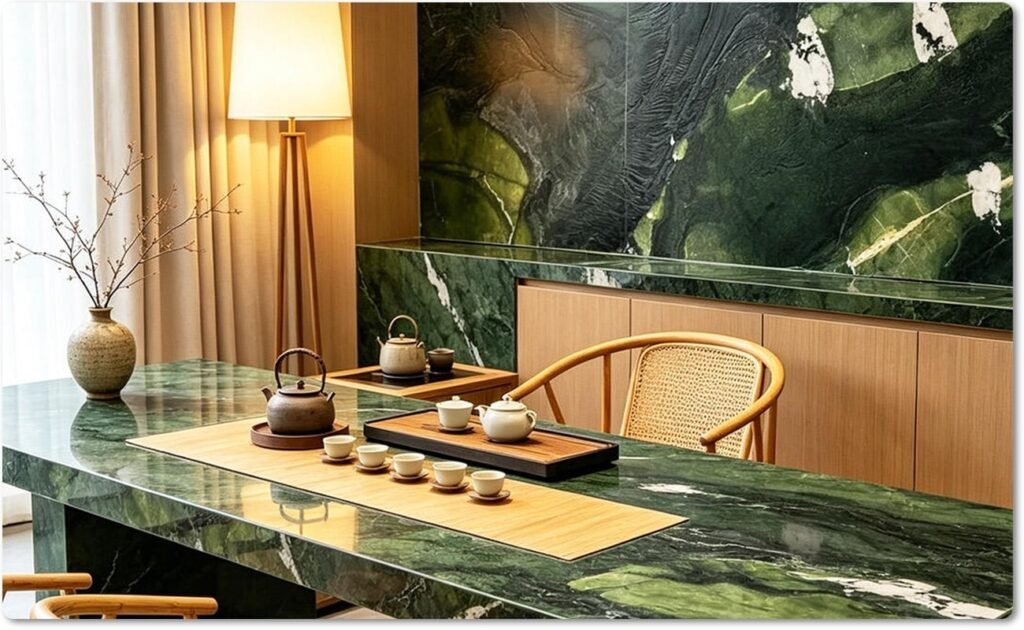
A green marble vanity can create a strong focal point in residential, hospitality, and luxury bathroom interiors.
Bathroom vanity tops typically experience:
- Water
- Soap
- Cosmetics
- Toothpaste
- Shampoo
- Hard-water deposits
- Perfume
- Hair products
Vanity Maintenance
Users should:
- Wipe standing water.
- Clean spills promptly.
- Avoid acidic cleaners.
- Use a neutral stone cleaner.
- Keep cosmetics from remaining on the surface.
- Inspect the stone periodically for staining or surface changes.
A squeegee can also reduce soap-scum accumulation in wet environments, according to Natural Stone Institute guidance.
Backsplashes: An Opportunity for Vein Continuity
Green marble backsplashes can be fabricated from the same slab as the countertop.
This creates opportunities for:
- Continuous visual flow
- Bookmatched panels
- Vein matching
- Full-height backsplash designs
- Waterjet details
- Integrated outlets and openings
For premium interiors, the backsplash should be included in the original slab-layout plan.
Green Marble Countertop Manufacturing: What Should Buyers Ask a Factory?
For importers, distributors, contractors, and project buyers, purchasing from a professional green marble countertop manufacturer involves more than asking for a price per square meter.
Ask the factory to provide:
Material Information
- Quarry/source information where commercially available
- Material/trade name
- Slab dimensions
- Thickness
- Finish
- Available quantity
- Photos/videos of actual slabs
Fabrication Information
- CNC capability
- Waterjet capability where needed
- Sink cutout processing
- Edge profiles
- Polishing
- CAD drawing capability
- Quality-control procedure
- Packaging method
Project Information
- Approved drawings
- Slab layout
- Number of pieces
- Piece dimensions
- Edge specifications
- Sink specifications
- Packaging requirements
- Loading plan
For international procurement, these details can significantly reduce communication errors between the designer, buyer, factory, installer and end customer.
Green Marble Countertops Wholesale Procurement Checklist
For green marble countertops wholesale orders, the purchasing process should be standardized.
Before Order Confirmation
Confirm:
- Material
- Color range
- Pattern
- Slab size
- Thickness
- Finish
- Quantity
- Fabrication scope
- CAD requirement
- Sink cutouts
- Edge profile
- Packaging
- Shipping terms
- Inspection procedure
Before Production
Approve:
- Actual slab photos
- Slab numbers
- CAD drawings
- Cutting layout
- Sink templates
- Edge profile
- Finish
- Packing specifications
Before Shipment
Check:
- Dimensions
- Quantity
- Surface quality
- Edge quality
- Cutouts
- Labels
- Crate condition
- Moisture protection where applicable
- Loading documentation
Industry Safety and Regulatory Direction
Countertop fabrication also has an important occupational-safety dimension.
Cutting, grinding, drilling and polishing stone can generate respirable crystalline silica depending on the material and process. OSHA identifies stone countertop manufacturing, finishing and installation as activities that can expose workers to respirable crystalline silica. Its current guidance emphasizes engineering controls such as wet methods, local exhaust ventilation and appropriate dust-control systems.
OSHA’s countertop-fabrication guidance also highlights wet cutting, water-fed tools, HEPA-filtered vacuum systems and local exhaust ventilation as control approaches where applicable.
For natural marble specifically, silica content can vary substantially by material. OSHA notes that calcium-based stones such as certain marbles contain little or no silica, while other natural stones can contain considerably more. Therefore, fabrication safety should be based on the actual material and workplace exposure assessment rather than assuming all “stone” behaves identically.
Procurement implication: A professional countertop manufacturer should treat dust control, wet fabrication, ventilation, housekeeping and worker protection as part of responsible production—not merely as optional factory features.
Green Marble Countertop Quality-Control Workflow
A robust factory QC system can be organized into nine checkpoints:
1. Material QC
Verify stone identity, slab condition and appearance.
2. Slab QC
Check dimensions, thickness, cracks, repairs and surface quality.
3. Drawing QC
Compare CAD drawings against approved specifications.
4. Layout QC
Confirm vein direction and piece positioning.
5. CNC QC
Verify dimensions and cutout geometry.
6. Edge QC
Check profile consistency and polishing.
7. Surface QC
Inspect polishing, scratches, chips and finish uniformity.
8. Assembly QC
Check dry fitting, seams and component relationships where applicable.
9. Packing QC
Protect finished components against impact and movement during transportation.
For export projects, packaging should be considered part of product quality because a correctly fabricated countertop can still be damaged during handling or transportation.
How to Specify Green Marble Countertops in a Project
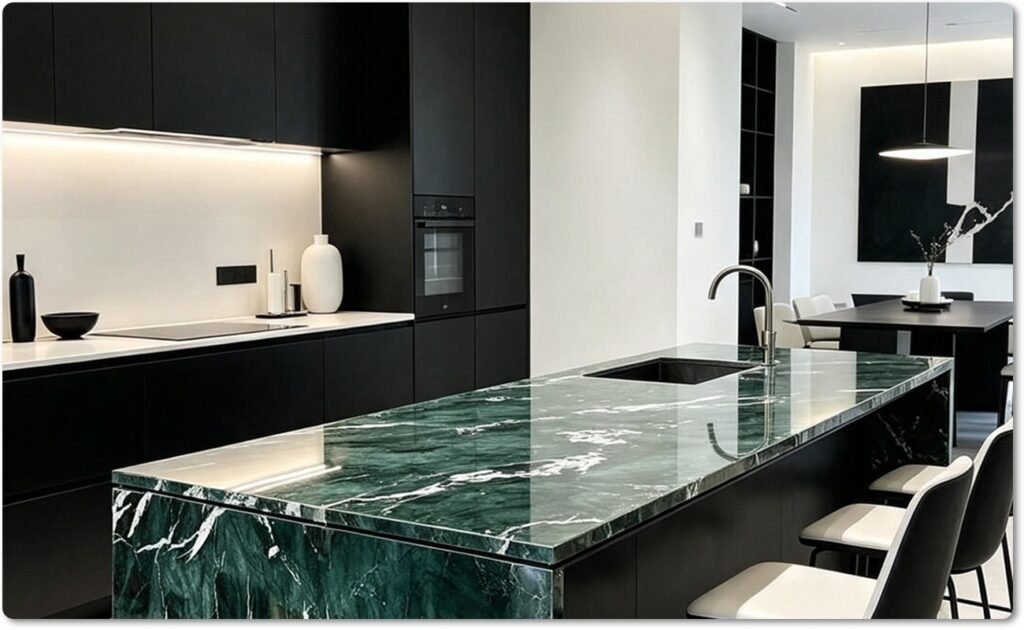
A professional specification might include:
Material: Natural Green Marble
Application: Kitchen Countertop / Island / Vanity
Finish: Polished or Honed
Thickness: Project-specified
Edge: Project specified
Sink: Undermount / Top Mount / Integrated
Cutouts: According to approved templates
Sealing: Manufacturer-approved impregnating treatment where required
Fabrication: CNC cut-to-size and edge processing
Quality: Approved sample/slab and project drawings
Packaging: Export-grade stone packaging
Installation: According to project installation requirements
This format reduces ambiguity between designer, purchaser, fabricator, and installer.
Semantic Closure: Green Marble Countertops Explained Through How / Why / Options / Considerations
Green Marble Countertops: Selection, Fabrication and Maintenance Insights
How should green marble countertops be selected?
Selection should begin with the actual stone rather than the commercial name. Buyers should evaluate mineral characteristics, appearance, slab quality, absorption behavior, acid sensitivity, thickness, available slab dimensions,s and the intended application. For commercial or wholesale projects, representative slabs or actual slab photographs should be approved before fabrication.
Why does slab inspection matter?
Natural marble contains geological characteristics that can influence both appearance and fabrication. Cracks, fissures, repairs, resin, pits, thickness variation, and weak areas should be identified before CNC cutting. Early inspection allows the cutting layout to use the strongest and most visually appropriate portions of the slab.
What fabrication options are available?
Green marble countertops can be produced through CAD-based fabrication, CNC cutting, precision sink cutouts, drilling, edge profiling, polishing,g and other custom stone-processing methods. Waterjet fabrication can be used for specialized geometry and decorative applications. The appropriate process depends on the project drawing, stone characteristics, quantity, ty and required tolerances.
What should buyers consider for kitchens?
Kitchen use introduces water, oil, food, acidic substances,ces and frequent cleaning. Acid-sensitive marble may develop etching when exposed to lemon juice, vinegar, or other acidic substances. Sealing can improve stain resistance but does not make marble acid-proof. Buyers should therefore select the material together with an appropriate maintenance expectation.
What should buyers consider for bathrooms?
Green marble vanity tops can perform well in bathrooms when water, cosmetics,etics and cleaning chemicals are properly managed. Standing water should be removed, spills should be cleaned pr,omptly and acidic or unsuitable cleaners should be avoided. Faucet areas and frequently wet zones deserve particular attention during installation and maintenance.
What is the role of sealing?
Sealing or impregnating treatment is primarily a stain-resistance strategy. It should be selected according to the stone and the intended application, and products used in food-preparation areas should be appropriate for that purpose. A maintenance program remains necessary after treatment.
What defines a reliable green marble countertop manufacturer?
A capable manufacturer should be able to connect material selection with CAD planning, slab layout, CNC fabrication, sink cutouts, edge processing, polishing, quality control, and export packaging. For international buyers, clear drawings, actual slab approval, fabrication documentation and protective packing are particularly important because the finished countertop must survive both fabrication and transportation.
Where is the industry heading?
The countertop sector is moving toward greater digital fabrication, stronger traceability, more detailed project documentation, and increased attention to worker safety. At the fabrication level, current U.S. OSHA guidance emphasizes engineering controls for respirable crystalline silica exposure during stone cutting, grinding, drilling, and polishing. Responsible manufacturers should therefore integrate wet processing, ventilation, housekeeping,g and other applicable controls into production systems.
The result is a useful distinction between design selection, material performance, fabrication quality, and maintenance responsibility. A beautiful green marble slab becomes a successful countertop only when all four are considered together.
Green Marble Countertop Buyer Checklist
Before approving a green marble countertop order, ask:
Material
- What is the exact material?
- Is it true marble or another commercially marketed green stone?
- What is its mineral composition?
- Has its suitability for the intended application been evaluated?
Slab
- What are the actual slab dimensions?
- What is the thickness?
- Are there visible fissures or repairs?
- Has the slab been inspected?
Fabrication
- Is there an approved CAD drawing?
- Has the slab layout been approved?
- Is vein direction specified?
- Are sink cutouts confirmed?
- Is the edge profile specified?
Protection
- Is sealing required?
- Which product will be used?
- Is it appropriate for the intended application?
- What maintenance interval is recommended?
Installation
- Are cabinets properly supported?
- Are overhangs adequately supported?
- Are sink supports specified?
- Are seams strategically positioned?
Maintenance
- What cleaners are recommended?
- Which chemicals should be avoided?
- How should spills be handled?
- What should the owner expect regarding etching and patina?
Frequently Asked Questions About Green Marble Countertops
1. Are green marble countertops good for kitchens?
Green marble can be used for kitchen countertops when the specific stone is suitable for the application, and the owner understands natural-marble maintenance. Acid-sensitive marble can develop etching from substances such as lemon juice and vinegar, so kitchen users should avoid acidic cleaners and promptly remove acidic food spills.
2. Do green marble countertops need to be sealed?
Some green marble countertops can benefit from an appropriate impregnating treatment, particularly where stain resistance is important. However, sealing does not make marble completely stain-proof or acid-proof, and the appropriate treatment depends on the stone and its intended use.
3. Can lemon and vinegar damage green marble?
Yes, if the material is acid-sensitive. Acidic substances can create etch marks by reacting with susceptible minerals in marble. Vinegar and other acidic cleaners should therefore not be used routinely on acid-sensitive marble.
4. How do you clean green marble countertops?
Routine cleaning can generally be performed with warm water and a neutral stone cleaner or mild detergent appropriate for natural stone. Spills should be blotted and removed promptly, while acidic and abrasive cleaning products should be avoided unless specifically approved for the particular stone.
5. Can a green marble countertop be custom fabricated?
Yes. Green marble can be fabricated into countertops, islands, vanity tops, backsplashes, and other custom components using CAD-based layout, CNC cutting, sink cutouts, drilling, edge profiling,g and polishing. For large or highly patterned projects, slab layout and vein direction should be approved before production.
Conclusion: Green Marble Is a System, Not Just a Slab
A successful green marble countertop project begins long before installation.
The most reliable workflow is:
Select the right material → inspect the actual slab → approve CAD → optimize slab layout → CNC cut → fabricate sink openings → process edges → polish → apply appropriate protection → install correctly → maintain according to the stone’s characteristics.
For kitchens, the most important consideration is understanding the difference between staining and etching. A suitable sealer can improve stain resistance, but it cannot eliminate marble’s inherent sensitivity to acids.
For bathrooms, water management, cosmetics, cs and cleaning chemicals become more important.
For wholesale and commercial projects, quality control extends beyond the stone itself to include actual slab approval, CAD documentation, fabrication accuracy, edge quality, inspection, and export packaging.
For manufacturers and exporters, the future of countertop production increasingly combines natural-stone expertise with digital fabrication, documented QC and responsible workplace controls.
EDG Stone can position itself within this complete workflow as a natural stone countertop manufacturer and exporter, supplying green marble slabs and custom-fabricated countertops, vanity tops, islands, and related stone components for residential, hospitality, and commercial projects.
Suggested Internal Link Opportunities for EDG Stone
To build topical authority around this article, I recommend internally linking to:
- Green Marble: The Complete 2026 Buyer’s Guide
- Green Marble Types: Indian Green, Dark Green, Light Green, Emerald & Forest Green
- Indian Green Marble: Origin, Quarry Regions & Material Selection Guide
- Udaipur Green Marble vs Baroda Green vs Rainforest Green Marble
- Green Marble Slabs: Sizes, Thickness, Finishes & Slab Selection Guide
- How to Inspect & Test Green Marble Before Buying
- Stone Countertops
- Stone Vanity Tops
- Custom Stone Fabrication
- CNC / Waterjet / Cut-to-Size Stone Fabrication
I would not internally link this article heavily to a future Green Marble vs Quartz comparison yet. Keep that comparison as a separate search-intent cluster so Google and AI systems can distinguish the two topics.