Quick Summary: Green marble quality should be evaluated through four complementary QC layers: visual inspection, laboratory physical testing, slab-level inspection, and packing inspection. Buyers should verify water absorption, bulk specific gravity/density, compressive strength, flexural strength, abrasion resistance, dimensional tolerance, surface defects, repairs, resin treatment, cracks, fissures, color consistency, slab flatness, finish quality, and packaging condition. ASTM C97/C97M-25 provides test methods for absorption and bulk specific gravity of dimension stone, while ASTM C503/C503M-23 addresses relevant physical requirements for marble dimension stone. A professional green marble supplier should be able to provide traceable samples, test reports, slab inspection records, production QC evidence, and export-packing documentation.
Semantic Procurement Overview
What should buyers inspect? Buyers should inspect both the intrinsic properties of the stone and the manufacturing quality of the finished slabs or products. A visually attractive green marble is not automatically suitable for every application.
Why is testing important? Green marble can vary significantly in mineral composition, veining, porosity, fissuring, density, color, and strength. Laboratory testing helps convert subjective visual judgments into measurable performance data.
What should be tested? The core technical checks include water absorption, bulk specific gravity/density, compressive strength, flexural strength, abrasion resistance where relevant, dimensional tolerance, surface quality, and finish consistency.
How should buyers inspect a supplier? A serious procurement inspection should follow the complete supply chain: quarry/material identification → sample approval → laboratory testing → slab production → finished slab inspection → packing → container loading.
What should buyers consider? The correct acceptance criteria depend on intended use, thickness, finish, fabrication method, installation system, applicable project specification, and destination-market requirements. ASTM or European standards should be treated as technical references rather than automatically applying one universal pass/fail value to every green marble product.
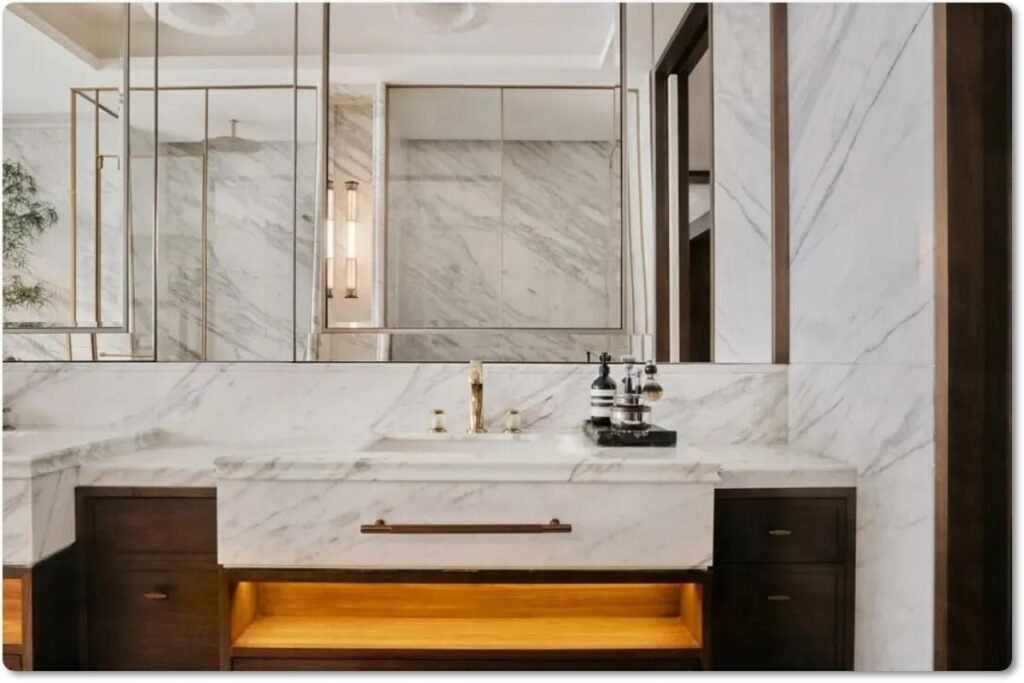
Green marble is increasingly used for countertops, vanity tops, wall cladding, flooring, furniture, reception desks, bathroom applications, decorative panels, fireplaces, tiles, and custom architectural projects. Yet green marble is not a single standardized material. Commercial names such as Indian Green Marble, Udaipur Green, Baroda Green, Rainforest Green, Forest Green, Emerald Green, Dark Green Marble, and other quarry or trade names can describe materials with substantially different physical and visual characteristics.
For professional buyers, therefore, the question is not simply “Is this green marble beautiful?”
The better question is:
“Does this specific lot of green marble meet the technical, visual, fabrication, and project requirements I have specified?”
This distinction is fundamental to professional green marble procurement.
1. Why Green Marble Quality Requires Technical Inspection
1.1 Natural stone is not a uniform manufactured material
Unlike engineered surfaces produced from a controlled formulation, natural marble is a geological material. Its mineral composition, grain structure, veining, fissures, pores, density, and color can vary from block to block and sometimes within the same quarry zone.
This means that a supplier’s sample should not automatically be treated as a guarantee that every future slab will look identical.
A professional procurement specification should therefore distinguish between:
- Material identity
- Physical performance
- Visual appearance
- Manufacturing tolerance
- Surface treatment
- Lot consistency
- Packaging condition
These are separate quality dimensions.
1.2 Green color does not indicate durability
One of the most common purchasing mistakes is assuming that a darker or visually denser green marble is automatically stronger.
Color is primarily a visual characteristic. It should not be used as a substitute for laboratory measurements.
Two green marbles may have very different:
- Water absorption
- Bulk density
- Compressive strength
- Flexural strength
- Abrasion resistance
- Fissure characteristics
- Weathering behavior
Consequently, green marble durability should be evaluated according to test data and intended application, not simply according to appearance.
1.3 The application determines what matters
A green marble slab used as a decorative wall panel does not face the same performance requirements as marble used for flooring or a heavily fabricated vanity.
For example:
| Application | Important QC considerations |
|---|---|
| Wall cladding | Strength, thickness, flatness, anchoring suitability, appearance |
| Countertops | Absorption, fissures, strength, finish, fabrication suitability |
| Vanity tops | Absorption, surface finish, dimensional accuracy, sink cutouts |
| Flooring | Abrasion resistance, finish, thickness, slip-related considerations |
| Furniture | Appearance, strength, edge quality, dimensional accuracy |
| Bathroom applications | Absorption, finish, staining considerations, fissures |
| Outdoor use | Weather exposure, water absorption, freeze-thaw where applicable |
| Decorative panels | Visual consistency, slab selection, bookmatching, surface quality |
ASTM C503/C503M-23 specifically identifies absorption by weight, density, compressive strength, modulus of rupture, abrasion resistance, and flexural strength among the physical properties relevant to marble dimension stone.
2. The Four-Layer Green Marble Quality Control System
Layer 1 — Visual Inspection
Visual inspection identifies obvious appearance and manufacturing defects before expensive testing or fabrication.
Layer 2 — Physical Testing
Laboratory testing converts important material properties into measurable technical data.
Layer 3 — Slab Inspection
The finished slab must be inspected independently because a good quarry block can still produce poor finished slabs.
Layer 4 — Packing Inspection
The final inspection must verify that accepted slabs are correctly protected for international transportation.
This four-layer approach is particularly useful for green marble supplier inspection because it prevents buyers from relying exclusively on either photographs or laboratory reports.
3. Layer One: Visual Inspection of Green Marble
3.1 Confirm the actual material
Before evaluating quality, confirm what material is actually being supplied.
The inspection record should identify:
- Commercial stone name
- Quarry or source region where available
- Block number
- Slab number
- Production date
- Finish
- Thickness
- Lot or batch
- Supplier/manufacturer
- Intended application
Commercial names should not automatically be interpreted as geological classifications.
For example, the term “Forest Green” may be used differently by different suppliers or markets. The buyer should therefore prioritize the approved physical sample, slab photographs, material description, and technical documentation.
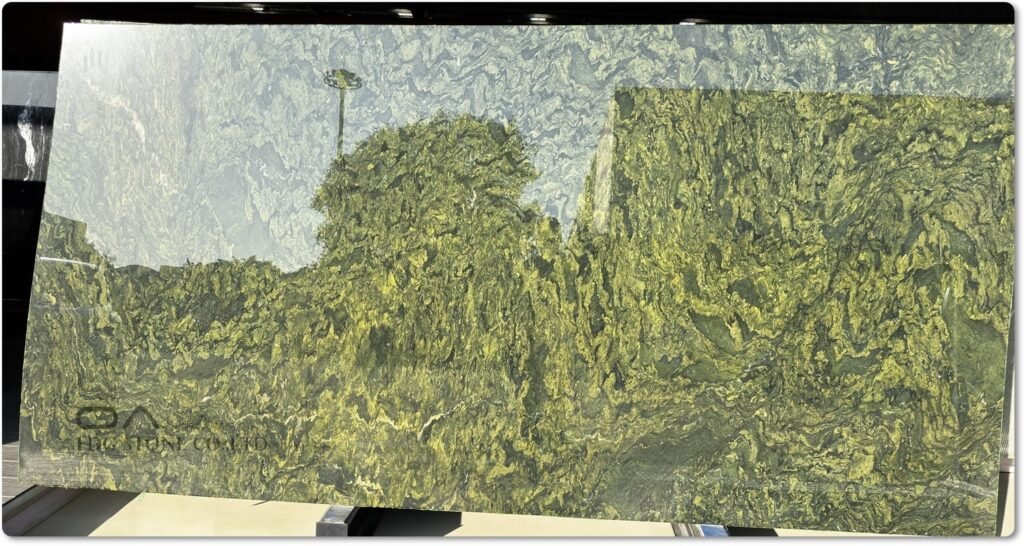
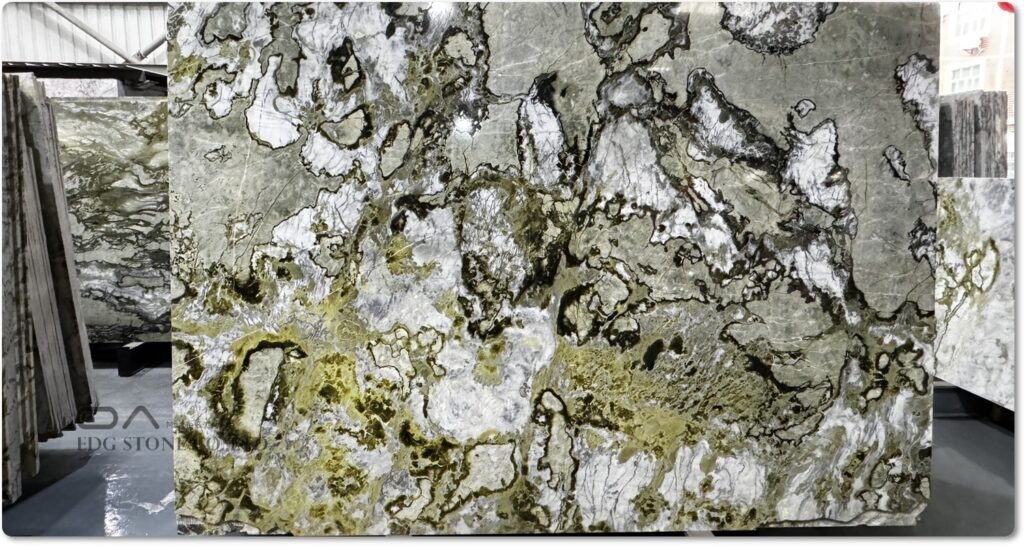
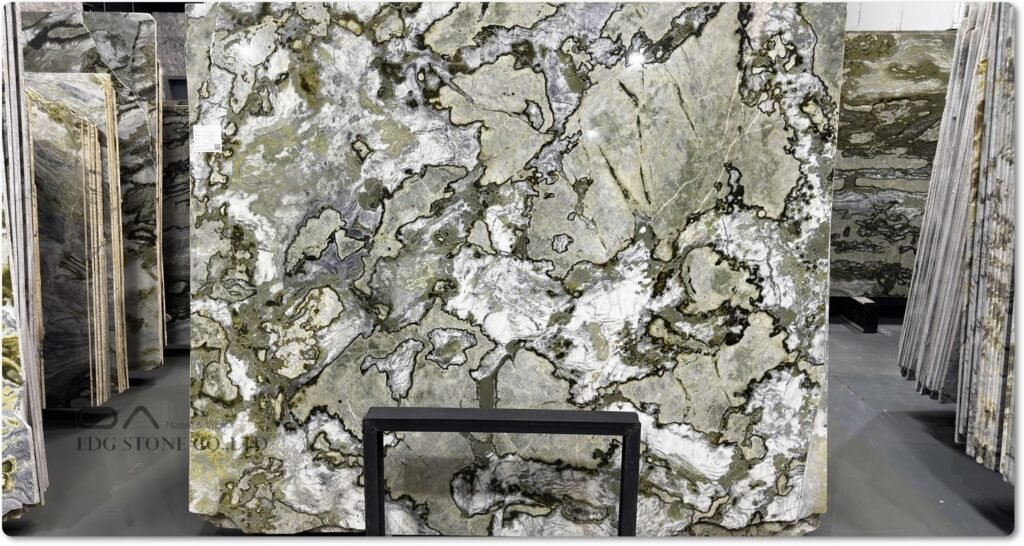
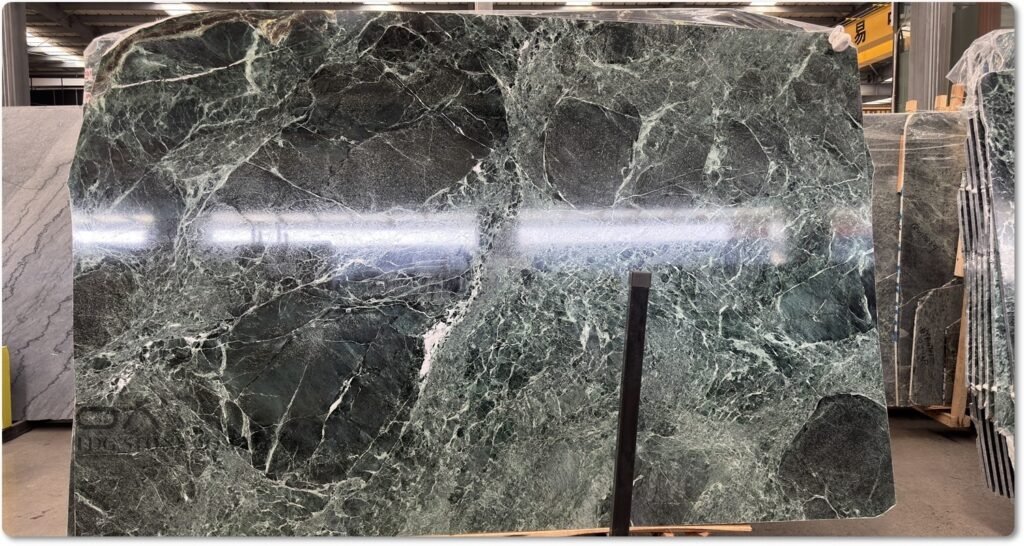
3.2 Inspect color consistency
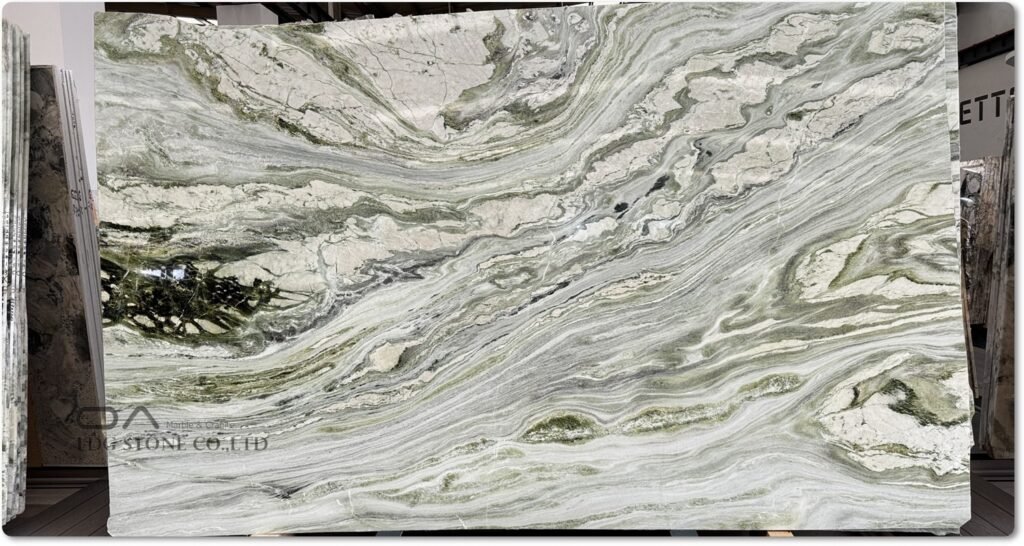
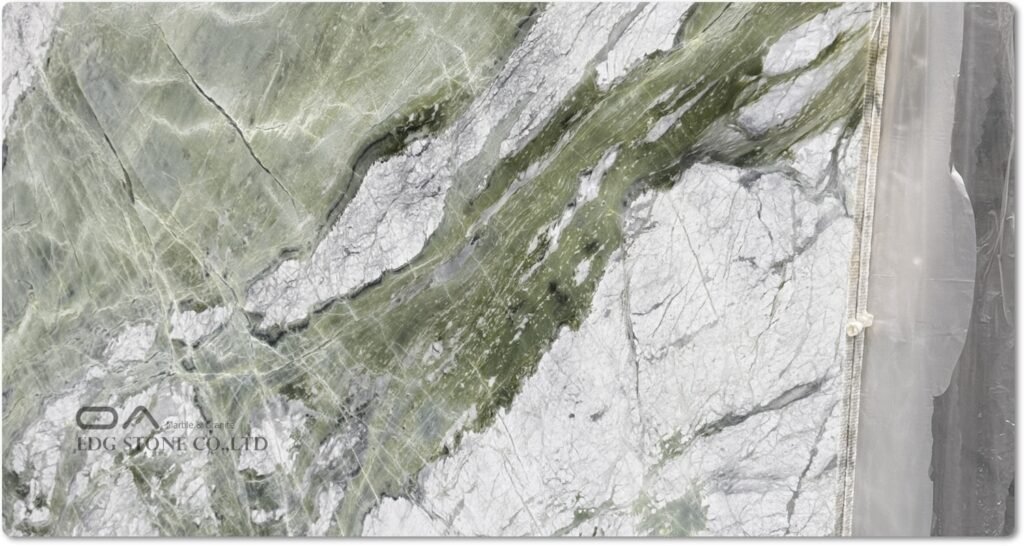
Green marble can contain:
- Light green zones
- Dark green zones
- White veins
- Black mineral patterns
- Clouded areas
- Brecciation
- Fossil-like structures
- Natural inclusions
The goal is not necessarily to eliminate natural variation.
Instead, the buyer should define what degree of variation is acceptable.
For commercial projects, it is useful to establish:
Approved sample → acceptable range → unacceptable visual defects.
This is more practical than demanding absolute color uniformity from a natural stone.
3.3 Inspect cracks and fissures
Fissures require particular attention.
Not every visible line represents a structural failure, but buyers should distinguish among:
- Natural veins
- Hairline fissures
- Open cracks
- Repaired fissures
- Filled voids
- Resin-treated areas
- Edge cracks
- Through-body fractures
A supplier should disclose significant resin treatment or repair when it affects the appearance or expected performance of the product.
3.4 Inspect resin and filler treatment
Some natural stones are processed with resin or other treatments to stabilize fissures, improve surface appearance, or facilitate polishing.
A professional inspection should record:
- Whether resin treatment is used
- Whether mesh backing is present
- Whether repairs are visible from the face
- Whether filler color matches the stone
- Whether treatment is consistent across the slab
- Whether the treatment is acceptable for the specified application
Treatment itself is not automatically evidence of poor quality. The important issue is whether the treatment is declared, suitable, consistent, and accepted by the project specification.
4. Layer Two: Green Marble Physical Testing
4.1 Water Absorption
Water absorption is one of the most important technical indicators for natural stone procurement.
ASTM C97/C97M-25 is the current ASTM test method covering absorption and bulk specific gravity of dimension stone, and ASTM states that the method applies to all types of dimension stone except slate.
The basic procurement principle is:
Lower absorption generally indicates less water uptake, but the acceptable value must be evaluated against the stone type, application, and applicable specification.
Do not establish a universal “good green marble” absorption number without considering the specific material and intended use.
For bathroom, countertop, exterior, or wet-area projects, absorption deserves particular attention.
4.2 Bulk Specific Gravity and Density
Bulk specific gravity and density provide useful information about the physical characteristics of the stone.
In simplified terms:
Density = mass ÷ volume
ASTM C97/C97M-25 specifically covers bulk specific gravity as well as absorption.
Density can help buyers:
- Compare materials
- Estimate shipping weight
- Check consistency between lots
- Identify unusual variation
- Support engineering calculations
However, density should not be interpreted independently from other properties.
4.3 Compressive Strength
Compressive strength indicates how much compressive load the stone can withstand under the defined laboratory test conditions.
It is relevant when marble is used in:
- Architectural components
- Heavy stone elements
- Certain structural or semi-structural applications
- Thick slabs
- Custom furniture
- Stone assemblies where load considerations matter
ASTM C503/C503M-23 identifies compressive strength among the physical properties applicable to marble dimension stone.
For critical projects, buyers should request the laboratory test method, specimen orientation, conditioning state, sampling information, and actual test results rather than simply asking whether the material is “strong.”
4.4 Flexural Strength
Flexural strength is especially relevant because slabs and thin stone elements can experience bending stresses.
ASTM C880/C880M-25 is the active ASTM test method for flexural strength of dimension stone. The standard notes that tests may need to consider loading perpendicular and parallel to the bedding plane and, when relevant, wet conditions.
This is important for procurement because stone behavior can vary with orientation and moisture condition.
For thin green marble slabs, wall panels, furniture components, and fabricated pieces, flexural performance can be more informative than compressive strength alone.
4.5 Abrasion Resistance
Abrasion resistance matters particularly for flooring, stairs, and other surfaces exposed to repeated foot traffic.
ASTM C241/C241M-21 covers abrasion resistance of stone subjected to foot traffic and is intended for floors, steps, and similar applications.
Therefore:
Do not use a countertop-oriented test package as a substitute for a flooring-oriented performance evaluation.
If green marble is intended for high-traffic flooring, the buyer should specify an appropriate abrasion-resistance test and acceptance requirement.
5. Layer Three: Green Marble Slab Inspection
5.1 Slab dimensions
Finished slab inspection should verify:
- Length
- Width
- Thickness
- Diagonal dimensions
- Squareness
- Flatness
- Edge condition
Dimensional tolerance should be agreed before production.
The buyer should avoid vague requirements such as “standard thickness” because different markets and manufacturers may use different nominal tolerances.
5.2 Thickness consistency
Thickness variation can affect:
- Installation
- Edge profiling
- Sink cutouts
- Laminations
- Cabinet interfaces
- Wall-panel installation
- Transportation weight
- Final project dimensions
A professional QC report should record multiple thickness measurements rather than one measurement taken from the center of the slab.
5.3 Surface defects
Inspect the entire slab under appropriate lighting.
Common defects include:
- Scratches
- Pinholes
- Open pits
- Chipping
- Uneven polishing
- Resin marks
- Filler mismatch
- Water marks
- Cloudy polishing
- Grinding lines
- Edge damage
- Color inconsistency
The acceptance criteria should distinguish between natural characteristics and manufacturing defects.
A natural vein should not automatically be classified as a defect.
A poorly polished artificial scratch should.
5.4 Surface finish
Common finishes include:
- Polished
- Honed
- Leathered or textured finishes where technically applicable
- Brushed
- Sandblasted or other project-specific finishes
The inspection should verify:
- Finish type
- Uniformity
- Gloss/visual appearance where applicable
- Surface texture
- Edge consistency
- Absence of visible processing defects
A polished green marble surface can reveal certain fissures and repairs more strongly than a honed surface, so finish selection should be evaluated together with the stone’s natural characteristics.
6. Green Marble Quality Control: A Practical Inspection Checklist
A professional green marble QC inspection can be organized into the following checklist.
Material Identification
Stone name confirmed
Quarry/source documented
Block number recorded
Lot/batch recorded
Sample matched to production material
Visual Quality
Color within approved range
Veining within approved range
No unacceptable open cracks
Fissures recorded
Repairs disclosed
Resin treatment disclosed
Surface free from unacceptable defects
Physical Testing
Water absorption
Bulk specific gravity
Density
Compressive strength
Flexural strength
Abrasion resistance where applicable
Slab Quality
Length
Width
Thickness
Flatness
Squareness
Edge quality
Surface finish
Slab identification
Packing
Slabs securely supported
Appropriate protective materials
Moisture protection where appropriate
Corner protection
Labels visible
Packing list matched
Container loading documented
Photos taken before closing container
7. How to Evaluate a Green Marble Supplier
7.1 Ask for a technical data package
A professional supplier should be able to provide more than product photographs.
Depending on the project, request:
- Technical data sheet
- Laboratory test report
- Material specification
- Sample photographs
- Slab photographs
- Inspection report
- Dimensional inspection data
- Packing photographs
- Container-loading photographs
- Commercial invoice
- Packing list
- Relevant compliance documentation
The exact documents required depend on the destination market and project.
7.2 Ask whether test reports are traceable
A test report becomes much more useful when it can be connected to the actual material being purchased.
Ask:
- What laboratory performed the test?
- What material was tested?
- What sampling date was used?
- What lot or quarry material was represented?
- What test standard was followed?
- Was the sample from the same production source?
- How old is the report?
An old report from an unrelated material should not automatically be treated as evidence of current production quality.
7.3 Factory inspection is different from sample inspection
A sample may look excellent while production consistency is poor.
For larger projects, consider inspecting:
Raw block → cutting → slab processing → polishing → QC → packing → container loading.
This gives the buyer visibility into the complete production process.
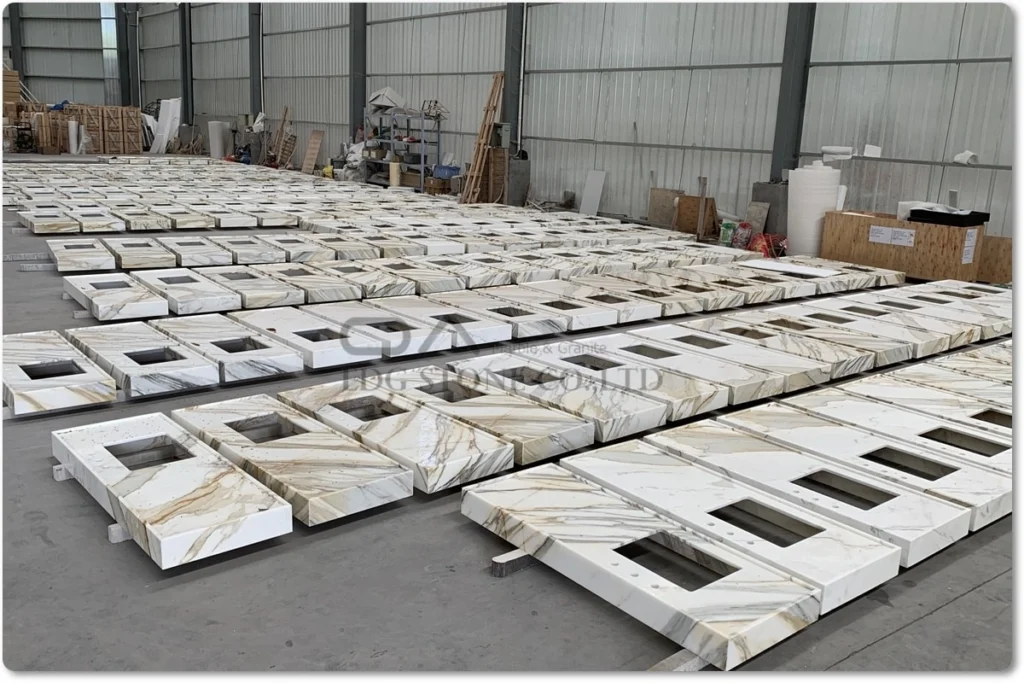
For professional buyers sourcing from China, a green marble manufacturer/factory that can show actual production, QC records, fabrication capability, and packing procedures can provide substantially more procurement evidence than a trading listing containing only polished slab photographs.
8. ASTM Standards and 2026 Procurement Direction
8.1 ASTM C97/C97M-25
ASTM C97/C97M-25 is the current active ASTM method for determining absorption and bulk specific gravity of dimension stone. ASTM describes these tests as useful for identifying differences in absorption among dimension stones and comparing stones of the same type.
For green marble procurement, this makes C97/C97M-25 particularly relevant when water absorption is a key project requirement.
8.2 ASTM C503/C503M-23
ASTM C503/C503M-23 is the current ASTM specification for marble dimension stone.
It covers material characteristics, physical requirements, and sampling for marble used for general building and structural purposes. Its listed physical properties include absorption by weight, density, compressive strength, modulus of rupture, abrasion resistance, and flexural strength.
This makes it a valuable technical reference when establishing a marble procurement specification.
8.3 ASTM C880/C880M-25
ASTM C880/C880M-25 provides the current active ASTM test method for flexural strength of dimension stone. It specifically recognizes the relevance of stone orientation and, where required, wet testing.
This is particularly relevant for thin slabs and fabricated architectural components.
8.4 EU Construction Products Regulation 2024
The European regulatory environment is also evolving.
Regulation (EU) 2024/3110 revises the EU Construction Products Regulation framework. The European Commission states that the new CPR entered into force in January 2025, with the main part becoming applicable on 8 January 2026. The transition from CPR-2011 to CPR-2024 will occur progressively by product family.
The revised framework places greater emphasis on:
- Product performance information
- Environmental characteristics
- Digital information
- Market surveillance
- Declaration of Performance and Conformity
- Digital Product Passport development
The European Commission also explains that CE marking is linked to applicable harmonised technical specifications or a European Technical Assessment where applicable; it is not a universal requirement for every construction product simply because it is sold into Europe.
For stone exporters, this points toward a broader industry direction:
Future procurement will increasingly require traceable technical and environmental product information rather than photographs and commercial descriptions alone.
9. What a Professional Green Marble QC Report Should Contain
A useful inspection report should be structured so that another person can understand what was inspected without being present at the factory.
Recommended QC Report Structure
Section 1 — Material
- Stone name
- Source
- Block/lot
- Finish
- Thickness
Section 2 — Visual Inspection
- Color
- Veining
- Fissures
- Repairs
- Surface defects
Section 3 — Dimensions
- Length
- Width
- Thickness
- Flatness
- Squareness
Section 4 — Laboratory Data
- Absorption
- Bulk specific gravity
- Density
- Compressive strength
- Flexural strength
- Abrasion resistance where applicable
Section 5 — Fabrication
- Cut-to-size dimensions
- Edge processing
- Sink cutouts
- CNC work
- Waterjet work
- Surface finish
Section 6 — Packing
- Wooden crate/frame
- Protection
- Labels
- Container loading
- Photographic evidence
Section 7 — Final Acceptance
- Accepted
- Accepted with observations
- Rejected
- Corrective action required
10. Common Green Marble Purchasing Mistakes
Mistake 1: Buying based only on photographs
Photography can hide:
- Surface repairs
- Fissures
- Uneven polishing
- Color variation
- Thickness variation
Always request physical samples and production photographs.
Mistake 2: Asking for “the strongest green marble”
There is no universal strongest green marble without defining:
- Material
- Test method
- Sample condition
- Loading direction
- Thickness
- Intended application
The technically correct approach is to specify the performance requirement first.
Mistake 3: Using one test for every application
A wall panel, countertop, floor, and outdoor architectural element have different risk profiles.
The testing package should match the application.
Mistake 4: Treating natural characteristics as manufacturing defects
Natural veins, mineral patterns, color variation, and geological structures are part of the identity of natural marble.
The procurement specification should therefore distinguish:
Natural variation ≠ manufacturing defect.
Mistake 5: Inspecting only before production
A supplier can pass sample approval and still produce inconsistent slabs.
For important projects, conduct:
Pre-production approval → In-process QC → Final slab inspection → Packing inspection.
11. How to Build a Green Marble Acceptance Specification
A strong purchasing specification should contain five elements.
11.1 Appearance Standard
Define:
- Approved sample
- Color range
- Veining
- Natural inclusions
- Fissures
- Repairs
- Surface defects
11.2 Physical Performance
Specify applicable:
- Absorption
- Density
- Compressive strength
- Flexural strength
- Abrasion resistance
11.3 Dimensional Requirements
Specify:
- Nominal thickness
- Permitted thickness variation
- Length/width tolerance
- Flatness
- Squareness
11.4 Manufacturing Quality
Specify:
- Finish
- Edge profile
- Cutouts
- CNC tolerances
- Waterjet tolerances
- Repair disclosure
11.5 Export Packaging
Specify:
- Crate type
- Protection
- Slab separation
- Labeling
- Container loading
- Photographic documentation
This transforms a vague purchase order into a measurable technical procurement document.
12. Why Factory-Level Quality Control Matters
For large-scale green marble procurement, the supplier’s manufacturing capability becomes part of the quality equation.
A professional green marble manufacturer should ideally control:
Material sourcing → block selection → gang sawing/cutting → slab processing → resin treatment where applicable → polishing → inspection → fabrication → packing → export loading.
This integrated process can reduce the risk of disconnects between a material seller, processor, fabricator, and exporter.
For wholesale buyers, this is particularly important because large projects may require dozens or hundreds of slabs with reasonably consistent:
- Color
- Thickness
- Finish
- Dimensions
- Surface quality
- Packaging
- Documentation
A green marble factory with standardized QC procedures can provide more consistent procurement evidence than a supplier relying solely on marketplace images.
For project buyers, the objective is not simply to find a low-price slab.
It is to establish a repeatable supply system.
13. Green Marble Inspection Workflow for International Buyers
A practical international procurement workflow can be summarized as follows:
Step 1 — Define the application
Countertop, vanity, flooring, wall, furniture, outdoor, or decorative application.
Step 2 — Approve the material
Confirm commercial name, appearance, finish, and sample.
Step 3 — Request technical data
Obtain relevant laboratory reports and specifications.
Step 4 — Approve the production lot
Confirm block/lot/source information.
Step 5 — Inspect finished slabs
Check appearance, dimensions, fissures, repairs, finish, and flatness.
Step 6 — Verify fabrication
For custom products, inspect CAD dimensions, CNC processing, waterjet cutting, edges, cutouts, and finished tolerances.
Step 7 — Inspect packing
Verify crates, protection, labeling, and loading.
Step 8 — Retain records
Keep:
- Approved sample
- Test reports
- QC report
- Slab photographs
- Packing photographs
- Packing list
- Container loading records
This creates a traceable procurement chain.
What defines green marble quality?
Green marble quality is a combination of material properties, visual consistency, fabrication quality, dimensional accuracy, surface finish, and application suitability. No single characteristic—such as color, density, or strength—can independently define overall quality.
Why should green marble be tested before purchase?
Testing reduces uncertainty by providing measurable information about properties such as water absorption, bulk specific gravity, compressive strength, flexural strength, and abrasion resistance. Laboratory data should be interpreted together with the intended application and applicable specification.
How should buyers inspect green marble?
The most reliable approach is a four-layer inspection system: visual inspection, physical testing, slab inspection, and packing inspection. This covers both the natural material and the manufacturing/export process.
What should buyers consider when choosing a green marble supplier?
Buyers should evaluate material traceability, sample-to-production consistency, laboratory documentation, factory QC procedures, fabrication capabilities, dimensional control, packing standards, and export experience. For larger projects, factory inspection or third-party inspection can add another layer of procurement assurance.
What is changing in natural stone procurement?
The direction of professional procurement is moving toward measurable performance, documented quality control, traceability, digital product information, and greater environmental transparency. The EU’s CPR 2024 framework is one example of this broader movement toward structured construction-product information.
What is the most important buying principle?
Do not purchase green marble based on appearance alone. Approve the visual characteristics, verify relevant physical performance, inspect the finished slabs, and confirm that the final packaging and documentation match the approved specification.
14. Green Marble Buyer’s Final QC Checklist
Before releasing a purchase order or approving shipment, ask:
Material
- Is the stone correctly identified?
- Is the quarry/source documented?
- Does production match the approved sample?
Testing
- Is water absorption documented?
- Is bulk specific gravity/density available?
- Are compressive and flexural strength data available where relevant?
- Is abrasion resistance tested for flooring applications?
Slabs
- Are dimensions within agreed tolerance?
- Is thickness consistent?
- Are fissures and repairs acceptable?
- Is polishing consistent?
- Are surface defects within the agreed acceptance standard?
Factory
- Does the supplier have documented QC?
- Can the supplier provide production photographs?
- Can the supplier provide inspection reports?
- Can the supplier fabricate custom components?
Packing
- Are slabs adequately protected?
- Are labels correct?
- Is the packing list accurate?
- Is container loading documented?
Compliance
- Have destination-market requirements been checked?
- Is the applicable standard identified?
- Are required declarations or technical documents available?
- For EU construction products, has the applicable CPR/CE route been verified rather than assumed?
15. Frequently Asked Questions About Green Marble Inspection
1. How do you check the quality of green marble?
Green marble should be checked through visual inspection, laboratory testing, finished slab inspection, and packing inspection. Key checks include water absorption, density/bulk specific gravity, compressive strength, flexural strength, abrasion resistance where applicable, dimensions, surface defects, fissures, repairs, finish, and packaging.
2. What is the most important test for green marble?
There is no single universally most important test. Water absorption is particularly useful for evaluating moisture-related performance, while compressive and flexural strength provide information about mechanical performance. The appropriate testing package depends on whether the marble will be used for countertops, flooring, walls, furniture, bathrooms, exterior applications, or other purposes.
3. Does low water absorption mean green marble is better?
Not necessarily. Lower water absorption can be beneficial for certain applications, but overall stone suitability also depends on strength, abrasion resistance, fissures, finish, dimensional stability, installation method, and project requirements. Buyers should evaluate the complete technical profile rather than one number.
4. How can I inspect a green marble supplier?
Request material samples, technical test reports, production photographs, slab inspection records, dimensional data, packing photographs, and relevant compliance documentation. For large projects, consider factory inspection or independent third-party inspection before shipment.
5. What should I ask a green marble manufacturer before buying?
Ask for the stone source, block/lot information, available test reports, slab sizes and thicknesses, finish options, allowable tolerances, repair/resin policy, QC process, fabrication capabilities, packing method, container-loading procedure, and export documentation. A reliable supplier should be able to explain how the approved sample will be controlled through production and shipment.
Conclusion: Buy Green Marble by Evidence, Not Appearance
Green marble is a natural material, and its visual beauty is one of its greatest commercial advantages. But professional procurement requires more than selecting the most attractive slab.
A reliable green marble quality control system should connect four stages:
Visual Inspection → Physical Testing → Slab Inspection → Packing Inspection
At the material level, buyers should evaluate water absorption, bulk specific gravity/density, compressive strength, flexural strength, and abrasion resistance where applicable. ASTM C97/C97M-25 provides a current reference for absorption and bulk specific gravity, while ASTM C503/C503M-23 identifies a broader set of physical properties relevant to marble dimension stone.
At the manufacturing level, buyers should inspect thickness, dimensions, surface finish, fissures, repairs, polishing, fabrication accuracy, and packaging.
At the supplier level, the strongest procurement evidence comes from traceable material information, current test data, documented QC, production inspection, and export records.
For international buyers, this approach is becoming increasingly important as construction-product markets move toward more structured technical, environmental, and digital product information. The EU’s CPR 2024 framework, whose main provisions became applicable in January 2026, illustrates this broader regulatory direction.
The practical rule is simple:
Do not ask only whether a green marble looks good. Ask whether the material, test data, finished slabs, fabrication, documentation, and shipment all meet the specification.
That is the foundation of professional green marble procurement.