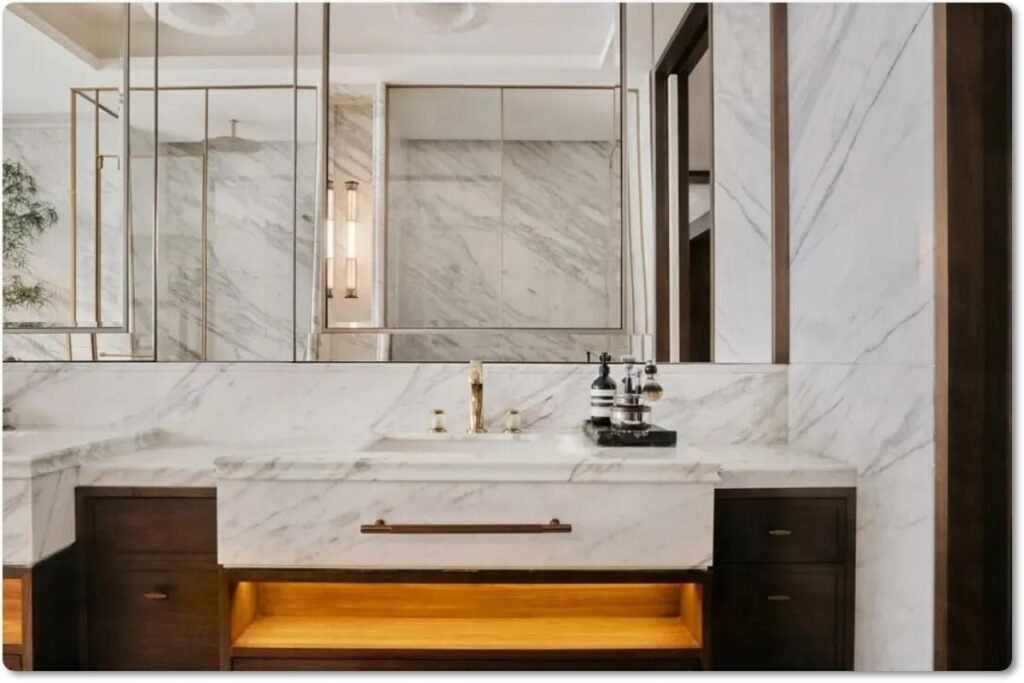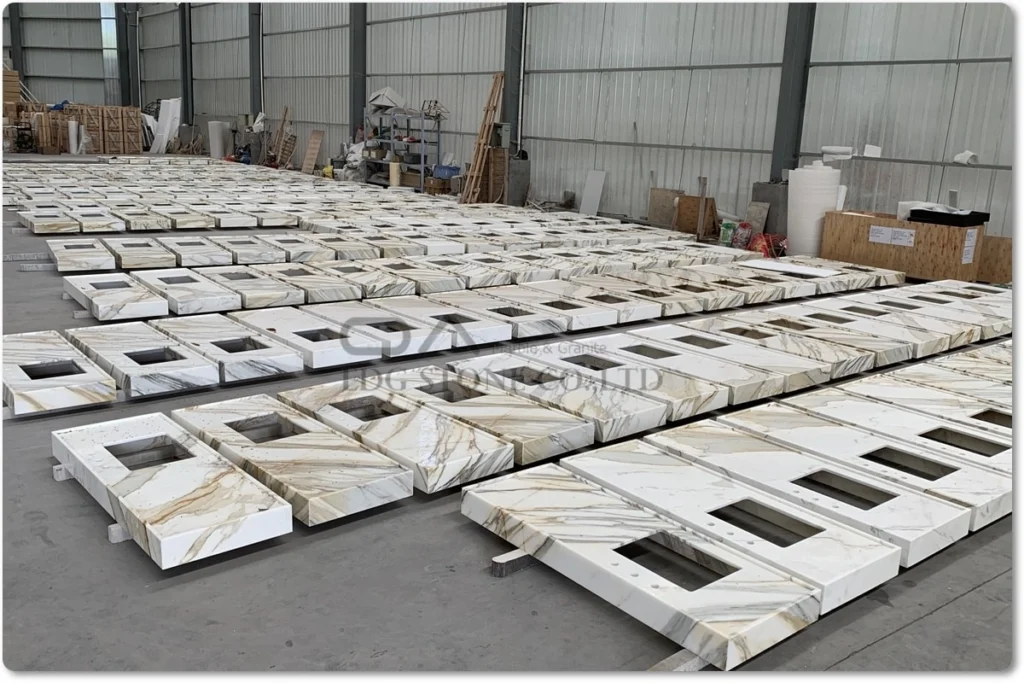
Natural green marble is not an industrially uniform material. Even when slabs are sold under the same commercial name, their background color, veining, movement, fissures, mineral concentrations, surface response, and visual pattern can vary from block to block and slab to slab.
That makes green marble slab selection fundamentally different from selecting a manufactured panel with a fixed color code.
For architects, importers, distributors, fabricators, contractors, and hospitality procurement teams, the purchasing question should therefore be broader than:
“Does this sample look green?”
The more important questions are:
- What is the actual slab size?
- What is the calibrated thickness?
- Is it 2 cm or 3 cm?
- Is the slab from a gangsaw block or cutter block?
- What percentage of the slab is usable after fabrication?
- Is the material polished, honed, brushed, leathered, or antique?
- Has the slab received resin or epoxy treatment?
- How consistent are the slabs within the same block?
- How should the slabs be laid out for bookmatching or vein matching?
- What edge profile is required?
- What testing and technical documentation are needed for the application?
- Has the buyer approved actual slabs rather than only a small sample?
These questions become particularly important for highly patterned green marbles, including materials commercially marketed as Rainforest Green, where the visual identity of each slab can be dramatically different.
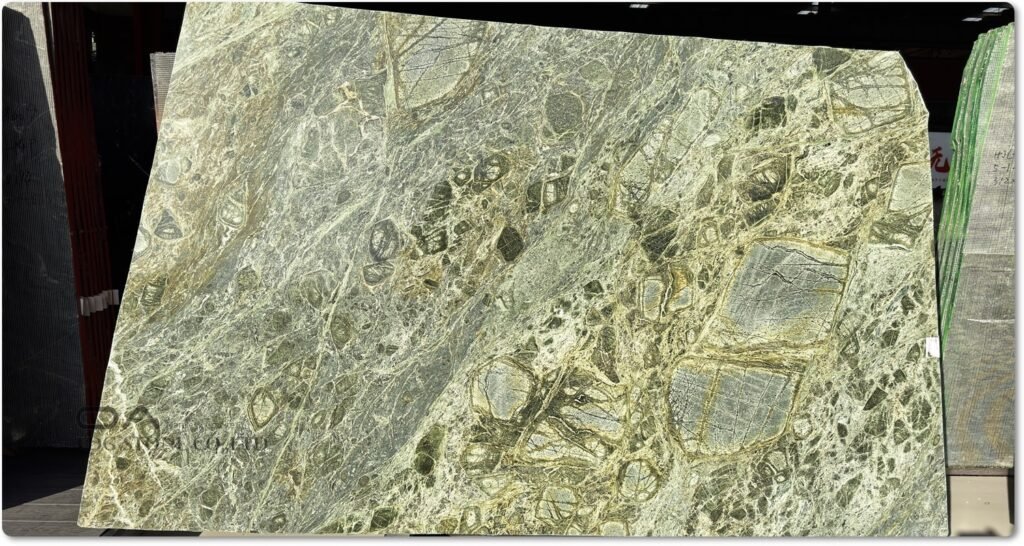
What Are Green Marble Slabs?
Green marble slabs are large-format natural stone panels made by extracting marble blocks from a quarry and then sawing, calibrating, polishing, or otherwise finishing the material.
The term green marble slab describes a commercial product format rather than one single geological material.
Green marble can contain different mineral compositions, structures, and patterns. Commercial names such as Indian Green Marble, Udaipur Green, Baroda Green, Rainforest Green, and other green-marble names may refer to materials from different quarry regions and geological settings.
This distinction matters because two products may both be called “green marble” while having significantly different:
- hardness
- porosity
- absorption
- flexural strength
- density
- fissure structure
- mineral composition
- polishing behavior
- surface-treatment response
- fabrication requirements
The U.S. Geological Survey defines dimension stone as natural rock quarried to produce blocks or slabs that meet requirements for size, shape, and thickness, with color, grain, pattern, and surface finish also important selection characteristics. USGS specifically identifies durability, strength, and ability to take a polish as relevant criteria.
For construction applications, ASTM C503/C503M-23 provides a specification framework for marble dimension stone and addresses characteristics including absorption, density, compressive strength, modulus of rupture, abrasion resistance, and flexural strength.
Therefore, “green marble” is only the beginning of the specification process.
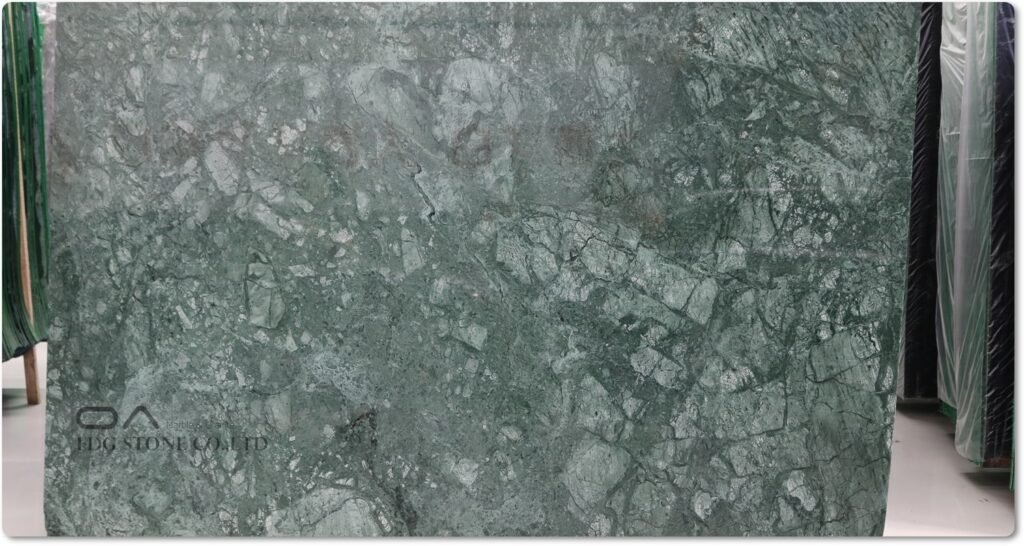
Green Marble Slab Specifications at a Glance
| Specification | Common Commercial Consideration | What Buyers Should Verify |
|---|---|---|
| Material | Green marble | Exact commercial name and quarry/source |
| Thickness | 20 mm / 2 cm; 30 mm / 3 cm commonly available | Actual calibrated thickness and tolerance |
| Slab format | Standard, medium, large, jumbo | Actual usable dimensions |
| Production | Gangsaw or cutter | Block size, slab yield and dimensions |
| Finish | Polished, honed, brushed, leathered, antique | Finish consistency and surface response |
| Treatment | Resin/epoxy or untreated | Treatment type and disclosure |
| Edge | Straight, eased, bevel, bullnose, custom | Fabrication drawing and profile |
| Pattern | Veined, cloudy, forest, brecciated, plain | Slab-to-slab variation |
| Application | Wall, floor, countertop, vanity, furniture, etc. | Technical suitability |
| Quality control | Visual + dimensional + technical | Inspection procedure and acceptance criteria |
The important point is that slab size, thickness, finish, and treatment should be specified together rather than treated as independent purchasing details.
What Slab Thickness Should I Buy?
The most common commercial question is:
Should I buy 2 cm or 3 cm green marble slabs?
There is no universal answer.
Thickness is a design and engineering variable determined by application, span, support, fabrication, installation method,d and local requirements.
2 cm Green Marble Slabs
A 20 mm slab is widely used in commercial natural-stone fabrication and can be attractive when the project prioritizes:
- lower material weight
- reduced stone consumption
- easier handling
- certain wall applications
- laminated or built-up edges
- furniture components
- applications with appropriate continuous support
For countertops, however, the fabricator must account for support conditions, overhangs, cutouts, sink openings, gs and edge construction.
A 2 cm slab is not automatically inferior to a 3 cm slab. It is simply a different engineering and fabrication configuration.
3 cm Green Marble Slabs
A 30 mm slab provides additional material thickness and is commonly preferred where the design requires:
- a substantial exposed edge
- greater visual mass
- reduced reliance on built-up edge construction
- certain countertop configurations
- larger or more demanding fabrication details
But 3 cm should not be interpreted as “structurally suitable for everything.”
A thicker slab does not eliminate the need to evaluate the substrate, span, cutouts, support, and installation system.
ASTM’s current dimension-stone selection guide, C1528/C1528M-26, emphasizes that natural stone is one component of a building assembly and that the related components and assemblies must be evaluated together; it also states that applications must comply with applicable building codes.
Practical 2 cm vs 3 cm Comparison
| Factor | 2 cm Green Marble | 3 cm Green Marble |
|---|---|---|
| Material weight | Lower | Higher |
| Visual edge mass | Lower | Higher |
| Built-up edge | More likely | Less likely |
| Handling | Generally easier | Heavier |
| Material consumption | Lower | Higher |
| Countertop suitability | Application-dependent | Application-dependent |
| Wall applications | Often practical where specified | Also possible |
| Furniture | Common for selected designs | Useful for substantial pieces |
| Large unsupported spans | Requires engineering review | Still requires engineering review |
| Cost | May be lower | Usually higher material consumption |
Buyer rule: do not select thickness simply because “3 cm is better.” Select thickness according to the complete fabrication and installation system.
Green Marble Slab Dimensions: Standard, Large and Jumbo Formats
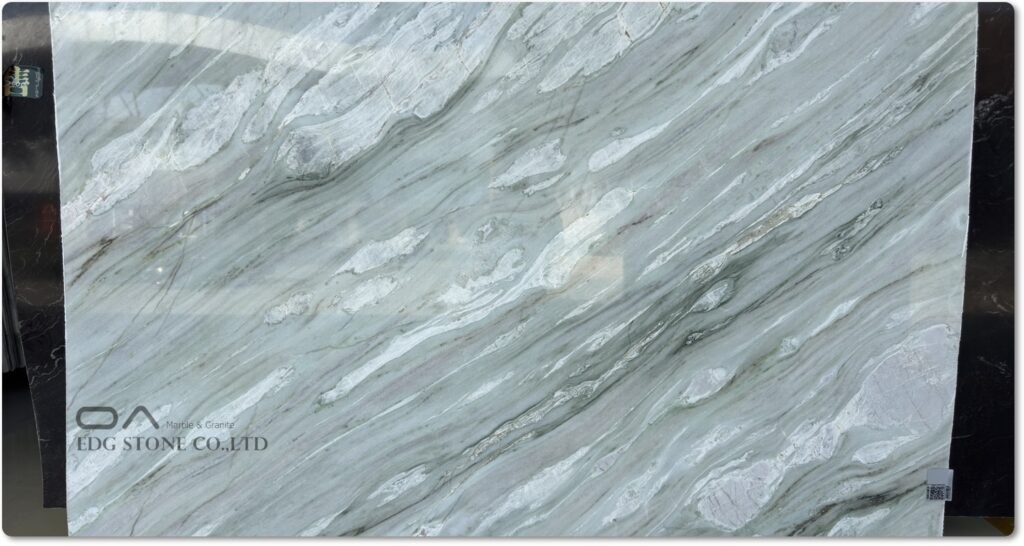
Slab dimensions depend primarily on the quarry block.
Natural stone is extracted in blocks, and blocks are not standardized like manufactured sheet goods.
Consequently, green marble slabs can vary significantly in:
- length
- width
- diagonal dimensions
- usable area
- thickness
- edge condition
- pattern continuity
Historical Natural Stone Institute material notes that commonly marketed marble slab dimensions have included approximately 8 ft × 5 ft with thicknesses around 2–3 cm, while also noting that custom formats can be offered.
Modern suppliers may offer substantially larger formats when the quarry block allows them.
Why Jumbo Slabs Matter
Jumbo green marble slabs can be particularly valuable for:
- luxury kitchen islands
- hotel reception counters
- feature walls
- elevator interiors
- bathroom feature walls
- large vanity tops
- dining tables
- conference tables
- fireplace surrounds
- bookmatched architectural installations
The advantage is not merely size.
Large slabs can reduce the number of joints and allow the designer to preserve a continuous visual pattern.
For heavily veined green marble, this can make a major aesthetic difference.
But Jumbo Does Not Mean Better
A large slab may contain:
- more dramatic movement
- larger fissures
- more mineral variation
- resin-filled areas
- irregular color zones
- weaker areas requiring fabrication consideration
Therefore, the buyer should evaluate usable slab area, not simply gross slab dimensions.
Gangsaw vs Cutter Slabs: What Is the Difference?
One of the most important purchasing distinctions is the production route.
Gangsaw Slabs
Gangsaw production is generally associated with larger blocks being sawn into relatively large slabs.
This format is particularly useful when the project requires:
- large wall panels
- large countertops
- bookmatching
- continuous veining
- high-end architectural surfaces
- large furniture components
The larger format can provide greater layout flexibility.
Cutter Slabs
Cutter slabs are typically produced from smaller blocks or through production routes optimized for smaller slab formats.
They can be appropriate for:
- smaller countertops
- vanity tops
- residential applications
- smaller furniture
- tiles and cut-to-size production
However, the exact terminology and production configuration can vary between producers and markets.
Gangsaw vs Cutter: Buyer Comparison
| Factor | Gangsaw | Cutter |
|---|---|---|
| Typical block requirement | Larger | Smaller |
| Slab format | Larger | Smaller |
| Large feature walls | Excellent potential | More limited |
| Bookmatching | Often advantageous | Depends on block |
| Small projects | May create more waste | Often efficient |
| Material yield | Project-dependent | Project-dependent |
| Pattern continuity | Often advantageous | More limited by format |
| Procurement cost | Can be higher | Can be economical |
The right choice depends on the cutting plan, not simply the name of the production method.
Green Marble Finish Guide
The same green marble can look completely different depending on its surface finish.
The finish changes:
- color intensity
- reflection
- perceived depth
- tactile character
- maintenance requirements
- visual consistency
- slip-related characteristics where flooring is involved
Natural Stone Institute technical material describes polished stone as a high-gloss, mirror-like finish produced through progressively finer abrasives, while honed stone is non-reflective and satin-like.
Polished Green Marble
Polished green marble has a reflective, high-gloss surface.
Polishing can intensify:
- green background color
- white or black veins
- mineral movement
- depth
- contrast
It is frequently selected for:
- luxury interiors
- hotel lobbies
- feature walls
- countertops
- vanities
- furniture
- reception desks
- decorative panels
For dramatic Rainforest-type materials, polishing can make the visual movement particularly prominent.
However, polished surfaces should not automatically be assumed suitable for every wet or walking surface. Surface performance must be evaluated for the intended application.
Honed Green Marble
Honed green marble has a softer, low-reflective appearance.
It is commonly selected when the designer wants:
- understated luxury
- reduced reflection
- softer color
- contemporary appearance
- tactile visual character
Honed finishes can also make some surface irregularities less visually dramatic than a high-gloss polish.
However, honing does not eliminate the natural variation of marble.
Brushed Green Marble
Brushing mechanically textures the surface to create a more tactile appearance.
Brushed green marble may be used when the project wants:
- aged character
- tactile texture
- less formal appearance
- natural architectural aesthetics
Because the surface is mechanically textured, the buyer should request an actual finish sample or preferably a representative finished slab.
Leathered Green Marble
A leathered finish creates a textured surface with a more tactile and often less reflective appearance.
It can work well in:
- hospitality interiors
- luxury residential interiors
- furniture
- feature surfaces
- selected countertops
The exact texture can vary significantly between processors, so “leathered” should not be treated as a single universal visual specification.
Antique Green Marble
An antique finish generally aims to create an aged or historically inspired appearance.
It may combine mechanical surface processes such as brushing, tumbling, or other texturing techniques.
For projects using antique green marble, buyers should specify:
- target texture
- degree of aging
- edge treatment
- surface uniformity
- acceptable variation
Green Marble Surface Treatment: Resin and Epoxy
One of the most misunderstood issues in green marble purchasing is resin treatment.
Some natural stones contain fissures, micro-openings, pits, or structural characteristics that processors may treat with resin or epoxy.
Treatment can potentially:
- stabilize selected fissures
- improve surface appearance
- reduce visible openings
- support polishing
- create a more uniform finished surface
But treatment does not mean the stone has become a different material.
Nor should treatment be hidden from a commercial buyer.
A proper specification should disclose:
- whether resin treatment is applied
- which surfaces are treated
- whether treatment is front-side, back-side or both
- whether epoxy is used
- whether mesh backing is applied
- whether treatment is structural or primarily cosmetic
- any limitations related to heat, chemicals or outdoor exposure
Natural Stone Institute technical guidance also notes that joint fillers and materials such as epoxy or polyester resin can have specific protection and maintenance requirements, which should follow the manufacturer’s recommendations.
Resin-Treated vs Untreated Slabs
| Characteristic | Resin-Treated | Untreated |
|---|---|---|
| Surface appearance | May be more uniform | More natural |
| Visible fissures | May be reduced | More visible |
| Polishing | Can support certain stones | Depends on material |
| Disclosure | Should be documented | Still document condition |
| Maintenance | Treatment compatibility matters | Natural stone maintenance applies |
| Buyer inspection | Essential | Essential |
Never specify “resin treated” as a quality grade by itself.
The actual question is whether the treatment is appropriate, stable, and correctly disclosed for the intended application.
Green Marble Edge Finishing
Slab selection does not end with the surface.
For countertops, vanity tops, tables, and furniture, the edge can represent a substantial portion of the finished appearance.
Common edge profiles include:
- eased edge
- pencil edge
- bevel
- bullnose
- demi-bullnose
- ogee
- waterfall edge
- custom CNC profiles
The selected edge should be evaluated against:
- slab thickness
- stone structure
- finish
- corner geometry
- sink cutouts
- overhang
- support
- installation requirements
For 2 cm green marble, a fabricator may create a built-up edge to achieve the visual appearance of a thicker slab.
For 3 cm material, a substantial natural-stone edge may be possible without the same degree of buildup.
The edge should therefore be included in the original fabrication drawing rather than decided after slab procurement.
Natural Stone Institute technical guidance recommends detailed shop drawings showing the layout, seams, and edge-treatment conditions before fabrication.
How to Select Green Marble Slabs for Commercial Projects
This is where purchasing decisions become critical.
Step 1: Define the Application
First, determine whether the green marble will be used for:
- countertops
- vanity tops
- walls
- floors
- stairs
- furniture
- tables
- fireplaces
- reception desks
- hospitality interiors
- elevator surrounds
- exterior applications
The same slab should not automatically be approved for every application.
ASTM C1528/C1528M-26 specifically frames dimension-stone selection around the intended application and emphasizes compliance with applicable building codes.
Step 2: Establish the Thickness
Specify:
Nominal thickness + actual calibrated thickness + acceptable tolerance.
Do not simply write:
Green marble, 2 cm.
A better purchase specification identifies the required finished thickness and tolerance.
For multi-slab projects, consistency matters. Natural Stone Institute countertop guidance has previously specified that slab thickness within a project should not vary by more than 1/8 inch (3 mm) between the thickest and thinnest slabs.
Project specifications may impose tighter requirements.
Step 3: Establish Slab Dimensions
Ask the supplier to provide:
- gross slab dimensions
- net usable dimensions
- thickness
- slab number
- block number where available
- finish
- treatment status
- photographs
For large projects, actual slab dimensions should be incorporated into the cutting layout.
Step 4: Review the Actual Slab
This is the most important rule in this article:
Never approve a large commercial order based only on a small color sample.
A small sample can demonstrate:
- approximate background color
- approximate texture
- general finish
But it cannot reliably demonstrate:
- full-slab movement
- vein direction
- large mineral concentrations
- fissure distribution
- slab-to-slab variation
- bookmatching potential
- actual usable area
Natural Stone Institute guidance specifically recognizes that highly varied materials may require customers to participate in the layout of actual slabs.
Why Rainforest Green Requires Slab-to-Slab Review?
Highly patterned green marble deserves a different procurement process.
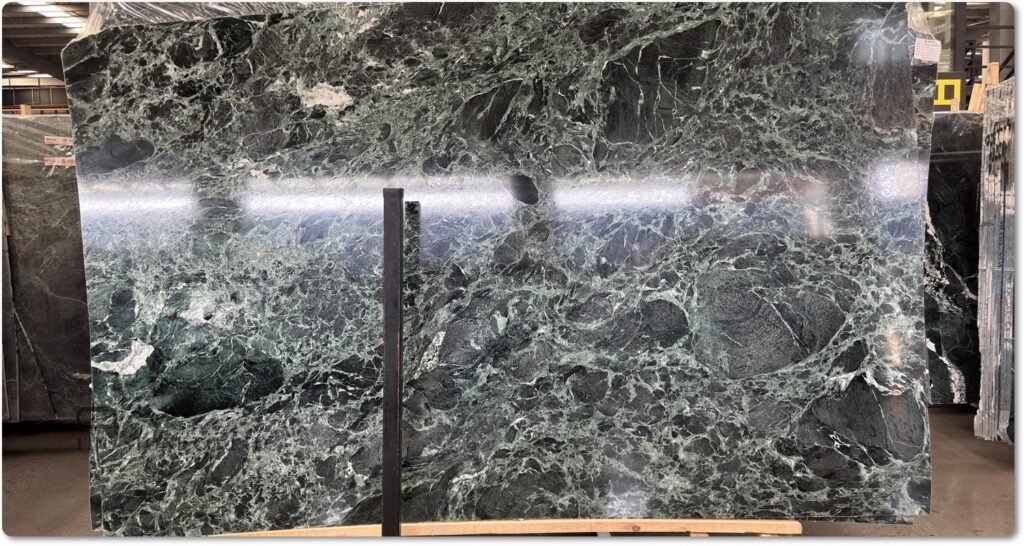
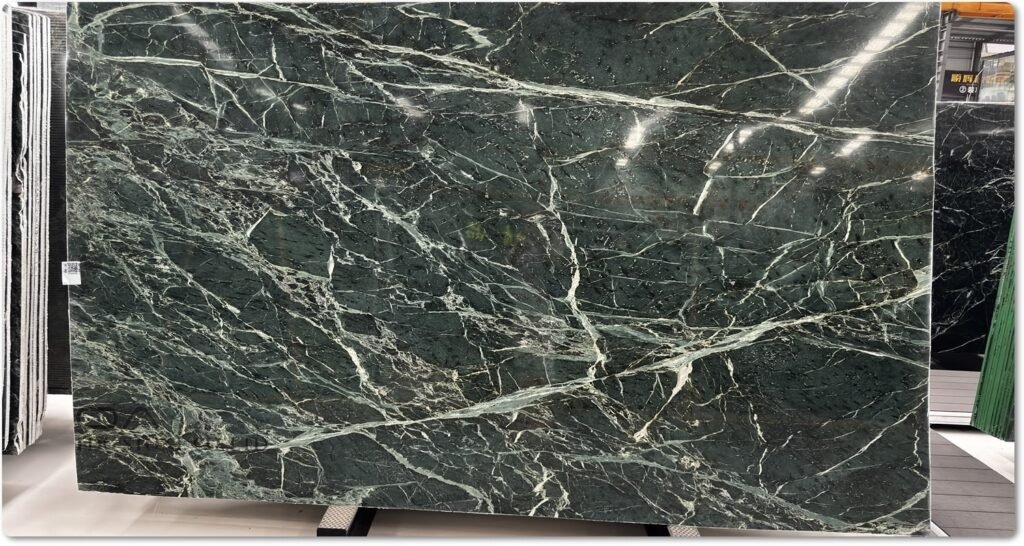
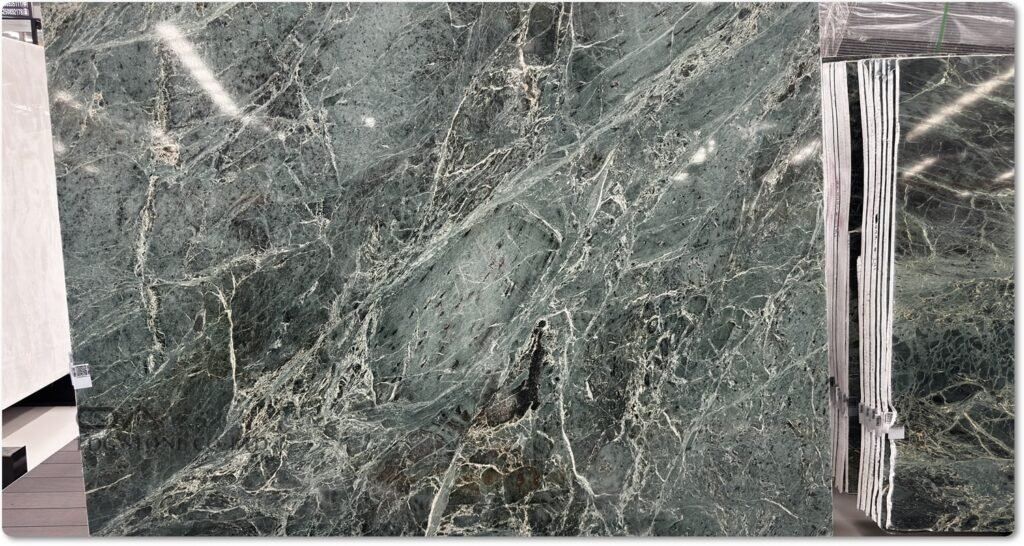
Materials sold as Rainforest Green or similar forest-patterned green marbles can contain strong networks of veins and contrasting mineral patterns.
One slab may look:
- predominantly green
- heavily veined
- clouded
- forest-like
- brecciated
- dark
- light
- highly contrasted
Another slab from the same commercial material can look substantially different.
Therefore, a single 10 × 10 cm sample cannot define the visual range of a commercial shipment.
For projects involving multiple slabs, request:
A Slab Range
Ask the supplier for photographs or videos showing:
- several slabs
- full slab faces
- slab numbers
- sequential slabs
- front and back where relevant
- finish under consistent lighting
A Slab Layout
For important architectural areas, create a proposed layout showing:
- slab A
- slab B
- slab C
- slab D
- cutting direction
- bookmatch sequence
- seams
- sink openings
- corners
- feature areas
This converts “I like this stone” into a measurable procurement process.
Small Sample vs Full Slab: What Should Buyers Approve?
| Inspection Method | What It Can Tell You | What It Cannot Fully Tell You |
|---|---|---|
| Small sample | Basic color | Full movement |
| Finish sample | Surface appearance | Slab variation |
| Single slab photo | Overall pattern | Shipment range |
| Multiple slab photos | Pattern range | Physical condition |
| Full slab inspection | Pattern + condition | Installation performance |
| Slab layout | Pattern + fabrication relationship | Final installed appearance |
For natural stone, sample approval and slab approval are not the same thing.
A professional purchase specification should distinguish between:
Material approval
and
Actual slab approval.
Green Marble Quality Control Checklist
Before approving a shipment, buyers should inspect at least five categories.
1. Visual Quality
Check:
- background color
- vein direction
- movement
- mineral concentration
- cracks
- fissures
- filled areas
- surface defects
- finish consistency
2. Dimensional Quality
Check:
- length
- width
- thickness
- flatness
- squareness
- edge condition
3. Treatment
Confirm:
- resin
- epoxy
- mesh
- filling
- surface coating
- treatment disclosure
4. Fabrication Suitability
Check:
- cutouts
- edge profile
- seams
- bookmatching
- CNC requirements
- waterjet requirements
5. Documentation
For commercial projects, maintain:
- material specification
- technical data
- test reports where required
- shop drawings
- slab photos
- inspection records
- packing records
- lot or slab identification
Green Marble Slabs and International Standards
For international buyers, technical compliance is becoming increasingly important.
ASTM C503/C503M-23 is the current ASTM specification listed for marble dimension stone and covers material characteristics and physical requirements relevant to marble dimension stone.
The Natural Stone Institute also identifies ASTM C503 for marble and references ASTM guides concerning dimension-stone selection, exterior use, and attachment systems.
In Europe, relevant natural-stone product standards include EN 1469 for slabs for cladding, EN 12058 for slabs for floors and stairs, and EN 12059 for dimensional stone work.
The European regulatory environment is also evolving.
Regulation (EU) 2024/3110 revises the EU Construction Products Regulation framework. The European Commission states that the new CPR entered into force on 7 January 2025, with the main part becoming applicable on 8 January 2026, while product families transition according to the applicable harmonised technical specifications. The revised framework also introduces stronger environmental information requirements and a Digital Product Passport framework.
The Commission further explains that CPR obligations are tied to products covered by cited harmonised standards or European assessment routes rather than automatically applying to every product that might broadly be described as a construction product.
This means green marble exporters and importers should avoid generic statements such as:
“Our marble is CE certified.”
Instead, the project should determine:
- intended use;
- applicable product standard;
- applicable harmonised technical specification;
- required Declaration of Performance or other documentation;
- applicable CE-marking obligations;
- national installation/building requirements.
The EU also issued Commission Implementing Decision (EU) 2026/284 on 6 February 2026, amending the harmonised standards framework under the existing CPR system.
Regulations are application-specific. Buyers should verify current requirements for the destination market and intended use before placing a project order.
Green Marble Procurement Trends in 2026
The natural-stone procurement model is moving from simple color selection toward documented material qualification.
This is especially relevant for premium green marble.
Trend 1: Full-Slab Visual Documentation
Buyers increasingly expect:
- slab photography
- videos
- numbered slabs
- digital layouts
- bookmatch visualization
This is particularly valuable for natural materials with high visual variation.
Trend 2: More Detailed Technical Specifications
Instead of:
Green Marble — Polished
professional specifications increasingly identify:
Material + source + thickness + finish + treatment + dimensions + application + quality criteria.
Trend 3: Environmental Documentation
The revised EU Construction Products Regulation is increasing the importance of environmental performance and digital product information in the construction-product ecosystem.
For international suppliers, this points toward stronger documentation around:
- product identification
- technical performance
- environmental information
- traceability
- digital product information
Trend 4: Application-Based Selection
The industry is moving away from the idea that one material specification works for every application.
The correct question is:
Is this particular green marble suitable for this particular application under this particular installation system?
What Does the 2026 Market Data Tell Us?
Natural stone remains a significant dimension-stone category even though green marble itself is not separately reported as a standalone commodity in broad government statistics.
The USGS Mineral Commodity Summaries 2026 estimates that approximately 2.3 million tons of dimension stone, valued at approximately $460 million, were sold or used by U.S. producers in 2025. USGS reports that dimension stone was produced by approximately 150 companies operating 215 quarries across 34 states.
USGS also reports that limestone accounted for approximately 46% of U.S. dimension-stone tonnage in 2025, followed by granite at 18% and sandstone at 17%; marble was part of the remaining category together with several other stone types.
The significance for green marble buyers is not that these statistics measure green marble demand directly—they do not.
Rather, they demonstrate that dimension stone continues to operate as a substantial commercial material category, while project-level procurement increasingly depends on technical specification, fabrication quality, and documented selection.
How to Write a Green Marble Slab Purchase Specification?
For commercial purchasing, a useful specification can follow this structure:
Material
Natural Green Marble
Commercial Name
[Exact commercial name]
Source
[Country/quarry region/quarry where commercially documented]
Slab Format
[Gangsaw/cutter/jumbo / project-specific]
Thickness
[20 mm / 30 mm / other]
Finish
[Polished / honed/brushed/leathered / antique]
Treatment
[Untreated / resin treated / epoxy treated / mesh-backed]
Surface
[Front face requirements]
Edge
[As per fabrication drawings]
Visual Range
[Approved slab range/reference slab/mock-up]
Quality Requirements
[Project-specific dimensional and technical criteria]
Documentation
[Technical data/test reports/photographs/inspection]
Packing
[Export-grade stone packing and container loading requirements]
This specification gives both buyer and supplier a common reference.
How Can EDG Stone Support Green Marble Slab Procurement?
For an international B2B project, a green marble supplier should provide more than a product name.
A professional green marble slab supplier should be able to support:
- slab selection
- actual slab photography
- slab numbering
- thickness calibration
- polishing
- honing
- brushing
- leathered finishes
- antique finishes
- resin and epoxy treatment where appropriate
- CNC processing
- waterjet cutting
- cut-to-size fabrication
- edge finishing
- bookmatch selection
- shop drawings
- quality inspection
- export packing
- container loading
For EDG Stone, this is particularly relevant when green marble is purchased not simply as raw slabs but as part of a complete fabrication project.
A buyer may require:
Green marble slabs → slab selection → layout → CNC fabrication → edge processing → inspection → export packing → container loading.
This integrated workflow can reduce the risk of communication gaps between slab procurement and final fabrication.
Expert Buyer Opinion: The Most Important Green Marble Slab Rule
The most important purchasing principle can be summarized in one sentence:
Approve the visual range, not merely the sample.
For relatively uniform stones, a small sample may provide a reasonable indication of the material.
For highly variable green marbles, it may not.
The more expensive and visually important the project, the more important actual slab review becomes.
For a hotel lobby, luxury villa, large island, reception desk, or bookmatched feature wall, the purchasing process should ideally progress from:
Small Sample → Slab Range → Actual Slab Selection → Layout Approval → Fabrication → Final Inspection
rather than:
Small Sample → Large Purchase Order
This approach is especially important for Rainforest Green and other strongly patterned materials.
Green Marble Slab Selection: Buyer Decision Matrix
| Buyer Question | Recommended Procurement Approach |
|---|---|
| What thickness should I buy? | Select according to application, support, fabrication, and code requirements |
| 2 cm or 3 cm? | Compare material weight, edge design, support, and project specification |
| Need large walls? | Consider gangsaw/jumbo availability |
| Need small vanity tops? | Cutter formats may improve cutting efficiency |
| Want dramatic color? | Polished may enhance depth and contrast |
| Want softer appearance? | Consider honed |
| Want tactile texture? | Consider brushed or leathered |
| Want aged appearance? | Consider an antique finish |
| Stone has fissures? | Request treatment disclosure and technical evaluation |
| Need bookmatch? | Approve actual slabs and sequence |
| Large commercial order? | Never rely solely on a small sample |
| European project? | Confirm applicable CPR/EN requirements |
| U.S. project? | Check ASTM/project specification and local code requirements |
Semantic Insight: What Makes a Green Marble Slab Commercially Valuable?
Green Marble Slab Selection: What Buyers Should Understand Before Ordering
What determines the value of a green marble slab?
The commercial value of a green marble slab is determined by more than color. Slab size, thickness, usable area, visual pattern, consistency, finish quality, treatment, fabrication potential, technical suitability, and project availability all influence purchasing value.
How should buyers compare two green marble suppliers?
Buyers should compare the complete material specification rather than comparing only the quoted price per square meter. The comparison should include slab dimensions, calibrated thickness, finish, treatment, usable yield, visual range, technical documentation, fabrication capability, inspection procedures,s and export packaging.
Why does actual slab inspection matter?
Natural marble is inherently variable. A small sample can communicate a general color and finish but cannot fully represent the movement, veining, mineral concentration, and fissure distribution of a large slab. Highly patterned materials therefore require actual slab review or an agreed representative slab range before major commercial approval.
What is the right option for 2 cm versus 3 cm marble?
Neither thickness is universally superior. A 2 cm slab can be appropriate when the design, support, ort and fabrication system allow it, while 3 cm can provide greater visual mass and may simplify certain edge details. The correct specification depends on the application, span, support, fabrication and applicable project requirements.
Why are finish and treatment part of material selection rather than cosmetic details?
Polishing, honing, brushing, leathering, and antique processing change the appearance and tactile character of marble. Resin and epoxy treatments can also influence the appearance and behavior of selected stones. Therefore, the finish and treatment should be specified and approved as part of the material itself.
What is changing in international stone procurement?
International procurement is becoming more documentation-driven. ASTM and European standards provide frameworks for material performance and product requirements, while the revised EU Construction Products Regulation is increasing attention to environmental information, digital product information, and harmonised technical specifications for products within its scope.
What is the core procurement principle?
The core principle is simple: specify the material completely, inspect representative actual slabs, approve the layout where visual variation matters, and match the material to the application rather than assuming that a commercial stone name defines performance or appearance.
Frequently Asked Questions About Green Marble Slabs
1. What is the best thickness for green marble slabs?
There is no single best thickness. 20 mm (2 cm) and 30 mm (3 cm) are common commercial choices, but the appropriate thickness depends on application, support, span, fabrication, edge design, and local/project requirements.
2. What is the difference between 2 cm and 3 cm green marble?
The main differences are material thickness, weight, visual edge mass, and fabrication possibilities. A 3 cm slab can provide a more substantial edge, while 2 cm can reduce material weight and may be suitable for applications with appropriate support.
3. Are jumbo green marble slabs better for large projects?
Jumbo slabs can reduce seams and provide more flexibility for large feature areas and bookmatching. However, larger slabs can also contain more dramatic natural variation, so actual slab inspection remains important.
4. Is polished green marble better than honed green marble?
Neither finish is universally better. Polished green marble provides a reflective surface and can intensify color and pattern, while honed green marble provides a softer, low-reflective appearance. The choice should be based on design intent and application.
5. Should I approve Rainforest Green based on a sample?
No. A small sample should not be considered a complete representation of a highly variable natural stone. For a large commercial order, request actual slab photographs, videos, a representative slab range, or direct slab-to-slab review, and approve the proposed layout where appropriate.
Final Green Marble Slab Buying Checklist
Before issuing a purchase order, confirm:
- Exact green marble commercial name
- Source/quarry information, where available
- Application
- 2 cm / 3 cm / project-specific thickness
- Actual calibrated thickness
- Slab dimensions
- Gangsaw or cutter format
- Jumbo requirement
- Polished / honed/brushed/leathered / antique finish
- Resin/epoxy treatment
- Mesh backing if applicable
- Edge profile
- Actual slab photos
- Slab numbers
- Slab-to-slab review
- Bookmatch sequence
- Cutting layout
- Technical data
- Applicable ASTM/EN/project requirements
- Inspection criteria
- Export packaging
- Container loading plan
Most importantly: never approve a large commercial green marble order based only on a small color sample.
For strongly patterned materials such as Rainforest Green, slab selection is part of the product specification—not merely a final aesthetic step.
References & Technical Sources
- ASTM International, ASTM C503/C503M-23, Standard Specification for Marble Dimension Stone. The standard addresses material characteristics, physical requirements, and sampling relevant to marble dimension stone.
- ASTM International, ASTM C1528/C1528M-26, Standard Guide for Selection of Dimension Stone, active 2026 edition.
- Natural Stone Institute, ASTM International Standards / Dimension Stone Technical Guidance.
- Natural Stone Institute, Residential Countertop Technical Module, including slab thickness, finishes, shop drawings, and highly varied material layout guidance.
- U.S. Geological Survey, Dimension Stone Statistics and Information.
- U.S. Geological Survey, Mineral Commodity Summaries 2026, Dimension Stone.
- European Commission, Construction Products Regulation 2024 revision, Regulation (EU) 2024/3110.
- European Commission, Products & Harmonised Technical Specifications under the CPR framework.
- European Commission / JRC, technical information referencing EN 1469, EN 12057, EN 12058 and EN 12059 for natural stone products.
- EUR-Lex, Commission Implementing Decision (EU) 2026/284, 6 February 2026, concerning harmonised standards for construction products.