Quick Summary
When architects, fabricators, distributors, and homeowners ask “How are ultra compact slabs made?”, they are usually trying to understand more than the manufacturing process.
They want to know:
- What are ultra compact surfaces?
- What is the difference between an ultra compact material and traditional stone?
- Why are ultra compact slabs so dense?
- How are large-format compact slabs manufactured?
- What makes ultra compact countertops suitable for kitchens?
- How should buyers evaluate an ultra compact slabs manufacturer or factory?
- Are ultra compact surfaces becoming a major material category for future construction and interior design?
The short answer is that ultra compact slabs are produced by transforming mineral-based raw materials into an extremely dense surface through advanced compaction and thermal processing technologies.
Unlike natural stone, which develops through geological processes over millions of years, an ultra compact surface is manufactured under controlled industrial conditions. Manufacturers carefully manage particle size, mineral formulation, pressure, temperature, density, thickness, surface finish, and dimensional accuracy.
For companies sourcing ultra compact slabs wholesale, understanding this process is essential. Manufacturing technology directly affects slab quality, fabrication performance, consistency, durability, and long-term project reliability.
At EDG Stone, ultra compact slabs are evaluated not only as decorative surfaces but also as high-performance architectural materials suitable for global residential, commercial, hospitality, and furniture applications.
What Are Ultra Compact Surfaces?
Ultra compact surfaces are high-density engineered surface materials manufactured from selected mineral-based raw materials using advanced industrial compaction and thermal processing technologies.
The exact formulation and manufacturing technology can vary between manufacturers and product categories. However, many ultra compact materials use combinations of mineral components commonly associated with ceramic, porcelain, glass, quartz-based, or other inorganic raw materials.
The objective is consistent:
Create an extremely dense, stable, low-porosity surface with predictable technical and aesthetic performance.
Ultra compact surfaces are commonly manufactured in large-format slabs and can be used for:
- Kitchen countertops
- Bathroom vanity tops
- Dining tables
- Coffee tables
- Wall panels
- Interior wall cladding
- Exterior façade systems
- Flooring
- Fireplace surrounds
- Furniture surfaces
- Commercial interiors
- Hospitality projects
The term ultra compact surface is often associated with next-generation architectural surfaces designed to combine decorative flexibility with high technical performance.
What Are Ultra Compact Countertops?
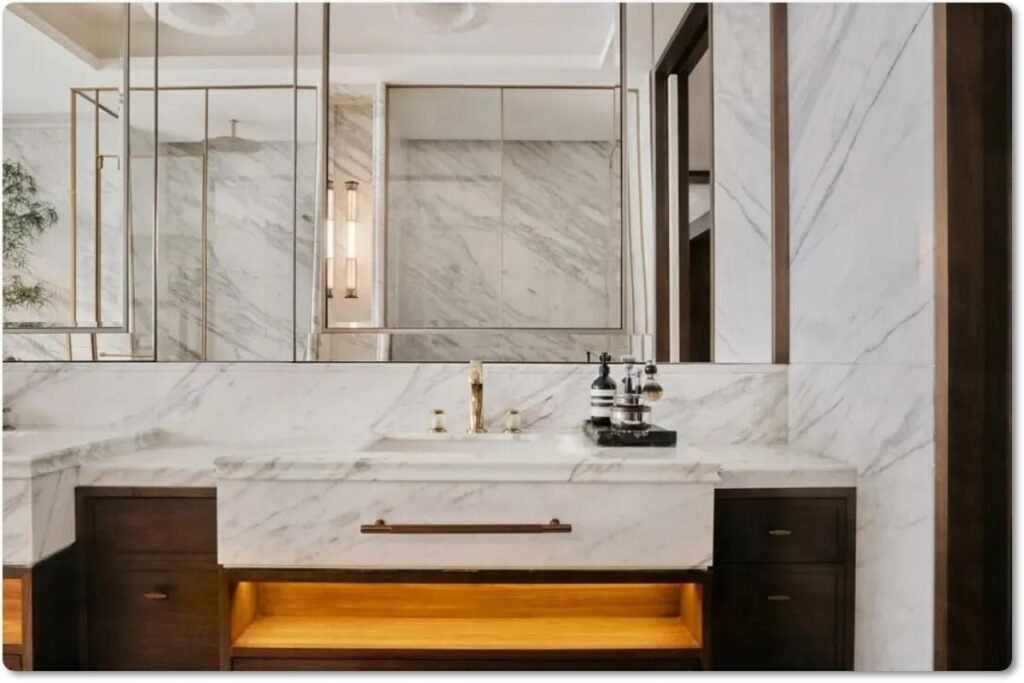
Ultra compact countertops are countertop surfaces fabricated from ultra compact slabs.
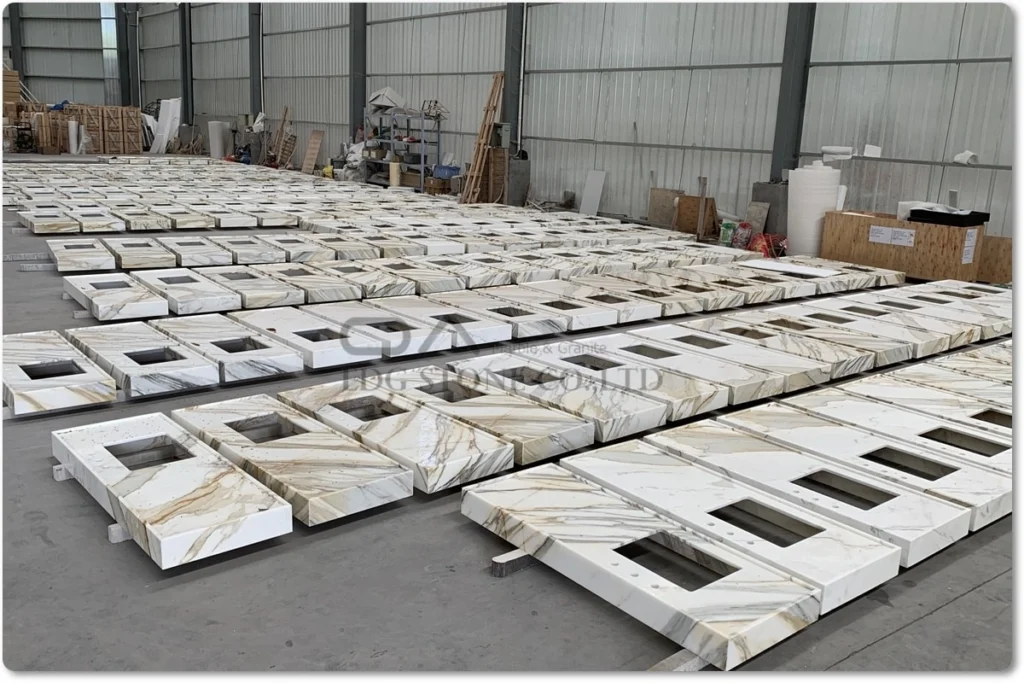
After manufacturing, the large slab is processed into finished components through operations such as:
- CNC cutting
- Bridge saw cutting
- Waterjet cutting
- Edge profiling
- Sink cutouts
- Cooktop cutouts
- Drilling
- Polishing
- Surface finishing
The final countertop may then be installed in residential kitchens, luxury apartments, hotels, restaurants, offices, or commercial projects.
Why Are Ultra Compact Slabs Called “Ultra Compact”?
The word compact refers primarily to the density and internal structure created during manufacturing.
A high-performance compact slab is designed to reduce internal voids and create a tightly consolidated material structure.
This matters because density and porosity influence many important performance characteristics.
A properly manufactured ultra compact material may provide advantages related to:
- Water absorption
- Surface durability
- Dimensional stability
- Stain resistance
- Heat performance
- UV resistance
- Long-term appearance
- Cleaning and maintenance
The manufacturing process is therefore not simply about creating a beautiful surface pattern.
It is fundamentally about controlling the material’s internal structure.
The Ultra Compact Slab Manufacturing Process Explained
The production of ultra compact slabs involves multiple controlled manufacturing stages.
Although specific technologies vary by manufacturer, the process generally follows the sequence below:
Raw Materials → Selection → Crushing → Grinding → Formulation → Mixing → Compaction → Thermal Processing → Surface Finishing → Calibration → Quality Control → Cutting → Packaging
Each stage contributes to the final performance of the slab.
Step 1: Selecting the Raw Materials
Mineral Composition Is the Foundation of the Product
Every ultra compact slab begins with carefully selected raw materials.
Depending on the product technology and manufacturer, these materials may include combinations of:
- Natural minerals
- Clays
- Silica-containing materials
- Feldspar
- Kaolin
- Mineral oxides
- Pigments
- Other inorganic components
The selection of raw materials affects the slab’s:
- Density
- Color
- Texture
- Surface pattern
- Thermal behavior
- Mechanical properties
- Fabrication performance
For manufacturers, raw material consistency is extremely important.
A small variation in mineral composition can potentially affect firing behavior, shrinkage, color consistency, or surface performance.
This is why professional ultra compact slab manufacturers typically maintain strict incoming-material quality controls.
Raw Material Testing
Before production, materials may be tested for characteristics such as:
Chemical Composition
Chemical analysis helps manufacturers control mineral consistency.
Particle Characteristics
Particle behavior affects how materials compact and react during later manufacturing stages.
Moisture
Moisture must be controlled to ensure stable processing.
Color Consistency
For decorative surfaces, raw material variation can influence the final appearance.
Step 2: Crushing and Grinding the Raw Materials
Creating Controlled Particle Sizes
Raw materials are processed through crushing and grinding systems.
The objective is to produce particles with controlled size distributions.
Particle size is important because it influences:
- Material packing
- Compaction efficiency
- Surface density
- Thermal processing behavior
- Final mechanical performance
Very large particles may create structural inconsistencies.
Extremely fine particles may behave differently during processing.
Professional manufacturing requires a carefully controlled particle system.
Why Particle Size Matters
Imagine filling a container with only large stones.
Large gaps remain between them.
Now imagine filling those gaps with smaller particles.
The material can become more tightly packed.
The same general principle helps explain why particle engineering is important in high-density surface manufacturing.
Controlled particle distributions can contribute to:
- Reduced voids
- Improved density
- More consistent material structure
Step 3: Formulating the Ultra Compact Material
Manufacturing the Surface Recipe
After preparation, the raw materials are combined according to a controlled formulation.
This stage is often one of the most important parts of the manufacturing process.
The formulation determines characteristics such as:
- Base color
- Decorative appearance
- Density
- Processing behavior
- Thermal stability
- Surface properties
Different designs may require different formulations.
For example, a white marble-look ultra compact slab may require a different decorative system than a dark concrete-look compact slab.
Creating Modern Surface Designs
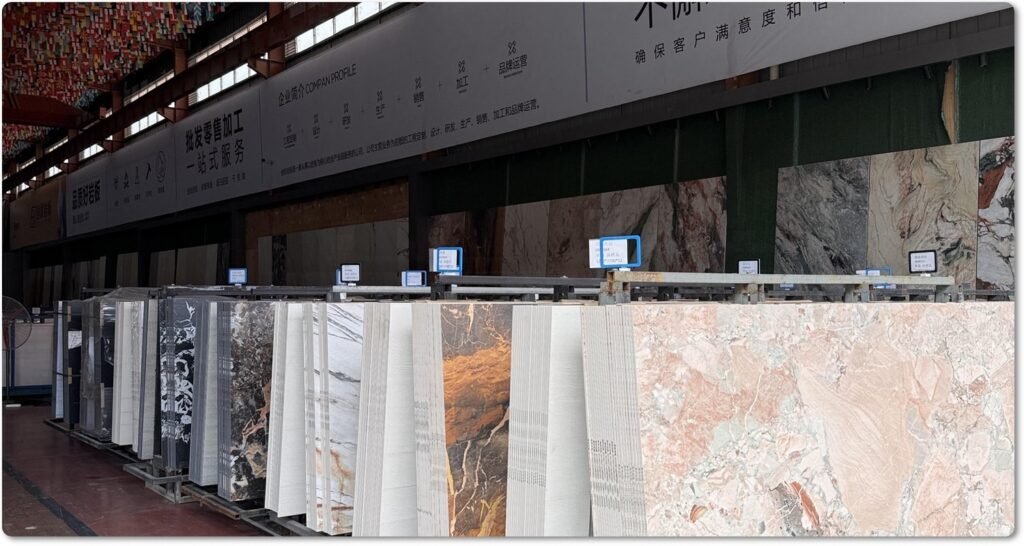
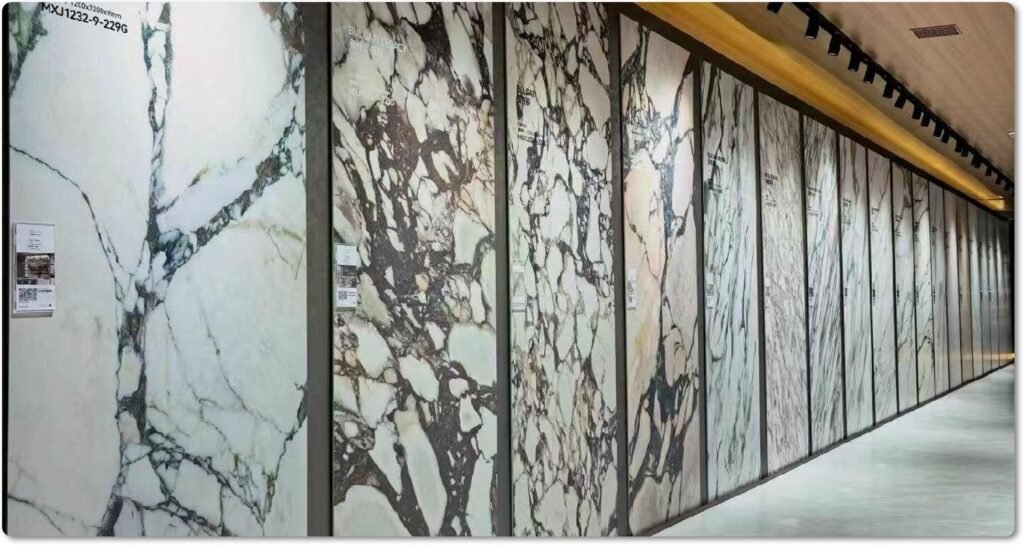
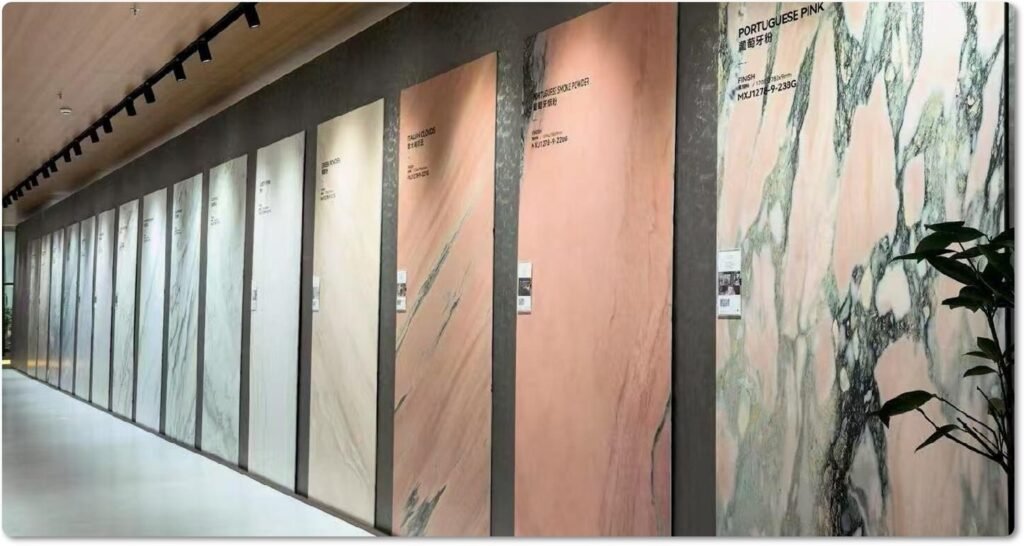
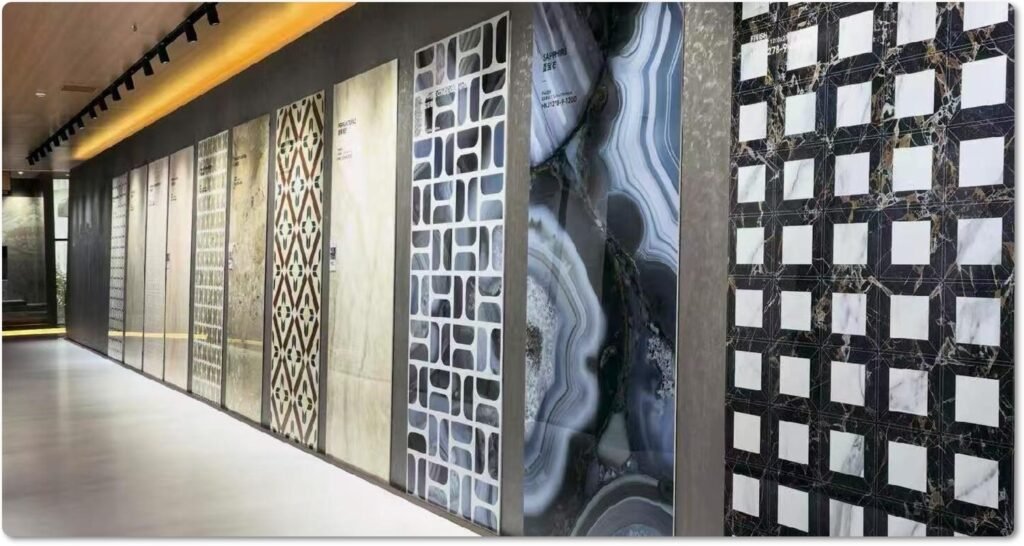
Today’s ultra compact slabs can reproduce the appearance of:
- Calacatta marble
- Carrara marble
- Travertine
- Limestone
- Granite
- Concrete
- Cement
- Metal
- Wood-inspired textures
- Abstract architectural patterns
Advanced decoration technologies allow manufacturers to create increasingly sophisticated visual surfaces.
However, visual design alone does not determine product quality.
The underlying material structure remains equally important.
Step 4: Mixing and Homogenization
Creating a Consistent Material System
The prepared materials are mixed to create a uniform composition.
This process is designed to ensure that the ingredients are distributed consistently.
Poor mixing can create:
- Color variation
- Density variation
- Surface defects
- Structural inconsistency
A professional ultra compact surface factory should control:
- Mixing time
- Material ratios
- Moisture levels
- Batch consistency
Automation and digital process control are increasingly important in modern manufacturing.
Step 5: High-Pressure Compaction
The Stage That Creates the “Compact” Structure
Compaction is one of the defining stages in ultra compact slab production.
The prepared material is formed into a slab and subjected to powerful industrial compaction technology.
The purpose is to create a highly consolidated material structure.
During this process, particles are brought into close contact.
Internal air spaces are reduced.
The material becomes increasingly dense.
Why High Density Matters
A dense material structure can contribute to:
- Lower porosity
- Better dimensional stability
- Improved surface durability
- Reduced water penetration
- Stronger structural integrity
This is one of the main reasons ultra-compact slabs are often considered suitable for demanding architectural applications.
Step 6: Controlled Thermal Processing and Sintering
Transforming the Material Structure
After forming and compaction, many ultra-compact surfaces undergo controlled high-temperature thermal processing.
This stage is commonly described as sintering.
During thermal processing, the material undergoes important physical and chemical transformations.
The process helps create stronger bonding between the mineral components.
The final result is a dense, consolidated surface material.
What Is Sintering?
Sintering is a manufacturing process in which powdered or compacted materials are heated under controlled conditions so that their particles bond and consolidate.
For ultra compact materials, the exact thermal cycle depends on the formulation and manufacturing technology.
Manufacturers must carefully control:
- Temperature
- Heating rate
- Processing time
- Cooling conditions
Poor thermal control can potentially lead to:
- Warping
- Cracking
- Dimensional variation
- Surface defects
Why Controlled Cooling Matters
Manufacturing does not end when the slab reaches its maximum processing temperature.
Cooling is also critical.
If temperature changes occur too aggressively, internal stresses may develop.
Professional factories use controlled cooling systems to support material stability.
Step 7: Surface Finishing
Creating the Final Visual and Tactile Effect
After the primary manufacturing process, the slabs receive additional surface treatment.
Popular ultra compact slab finishes include:
- Polished
- Honed
- Matte
- Silk
- Satin
- Textured
- Structured
- Leather-inspired finishes
The selected finish influences both appearance and functionality.
Polished Ultra Compact Slabs
Polished surfaces are popular for:
- Luxury kitchens
- Bathroom vanity tops
- Feature walls
- High-end interiors
They provide strong visual depth and reflectivity.
Matte and Honed Compact Slabs
Matte finishes are increasingly popular in contemporary architecture.
They are frequently used for:
- Modern kitchens
- Minimalist interiors
- Commercial projects
- Furniture
Textured Surfaces
Textured ultra compact surfaces may be used where additional visual depth or surface functionality is desired.
Applications can include:
- Exterior walls
- Flooring
- Architectural cladding
Step 8: Calibration and Thickness Control
Precision Matters in Large-Format Slabs
Ultra compact slabs must be dimensionally controlled.
Calibration helps ensure more consistent:
- Thickness
- Flatness
- Surface quality
- Fabrication performance
Large-format slabs create additional manufacturing challenges.
Even small dimensional variations can affect:
- Countertop fabrication
- Wall installation
- Joint alignment
- Project planning
Professional manufacturers use inspection and calibration systems to improve consistency.
Step 9: Quality Control and Technical Inspection
How Are Ultra Compact Slabs Tested?
Before shipment, slabs may be inspected for visual and technical quality.
Common quality-control categories include:
Visual Inspection
Inspectors evaluate:
- Color consistency
- Pattern quality
- Surface defects
- Cracks
- Edge condition
Dimensional Inspection
Factories may check:
- Length
- Width
- Thickness
- Flatness
Performance Testing
Depending on the product and intended application, testing may involve relevant standards for characteristics such as:
- Water absorption
- Flexural strength
- Abrasion resistance
- Chemical resistance
- Thermal performance
- Surface quality
For buyers, it is important to understand that the applicable test method and compliance requirements depend on the product category and the market where the material will be sold or installed.
Step 10: Cutting and Fabricating Ultra Compact Slabs
From Large Slabs to Finished Products
A slab is not always the final product.
Large-format compact slabs can be transformed into:
- Ultra compact countertops
- Vanity tops
- Table tops
- Wall panels
- Flooring
- Furniture components
Fabrication may involve advanced equipment such as:
- CNC machines
- Bridge saws
- Waterjet machines
- Edge polishing machines
Why Professional Fabrication Is Important
Ultra compact material is highly dense and can require specialized fabrication knowledge.
Incorrect processing may increase the risk of:
- Edge damage
- Chipping
- Cracking
- Poor cutout quality
For large commercial projects, factory prefabrication can improve:
- Accuracy
- Production efficiency
- Installation speed
- Quality consistency
Ultra Compact Slabs vs Natural Stone: How Are They Different?
Ultra compact slabs and natural stone slabs are fundamentally different materials.
Natural stone is created by geological processes.
Ultra compact material is created through controlled industrial manufacturing.
| Feature | Ultra Compact Slabs | Natural Stone |
|---|---|---|
| Origin | Industrial manufacturing | Geological formation |
| Pattern consistency | More controllable | Naturally variable |
| Large-format production | Highly standardized | Depends on quarry blocks |
| Porosity | Often engineered for low absorption | Varies by stone type |
| UV stability | Often suitable for UV exposure depending on product | Depends on stone |
| Maintenance | Generally designed for relatively easy maintenance | Depends on material |
| Appearance | Controlled decorative design | Natural geological beauty |
Neither material is automatically “better” for every project.
The correct choice depends on:
- Design requirements
- Performance requirements
- Budget
- Installation environment
- Maintenance expectations
What Makes Ultra Compact Countertops Popular?
Ultra compact countertops have become increasingly popular because modern kitchens require materials that combine appearance with performance.
Homeowners and project developers increasingly expect countertops to resist everyday challenges.
These may include:
- Heat exposure
- Food stains
- Cleaning chemicals
- Scratches
- UV exposure
A high-quality ultra compact countertop can provide an attractive balance between modern design and technical performance.
Popular Applications
Kitchen Countertops
Large-format slabs can reduce the number of visible joints.
Kitchen Islands
Ultra compact slabs can create dramatic waterfall island designs.
Bathroom Vanity Tops
Low-maintenance surfaces are attractive for hospitality and residential bathrooms.
Outdoor Kitchens
Products specifically suitable for exterior use can offer strong advantages where UV and weather resistance are required.
Furniture
Ultra compact surfaces are increasingly used for:
- Dining tables
- Coffee tables
- Side tables
- Console tables
Ultra Compact Slabs for Large Architectural Projects
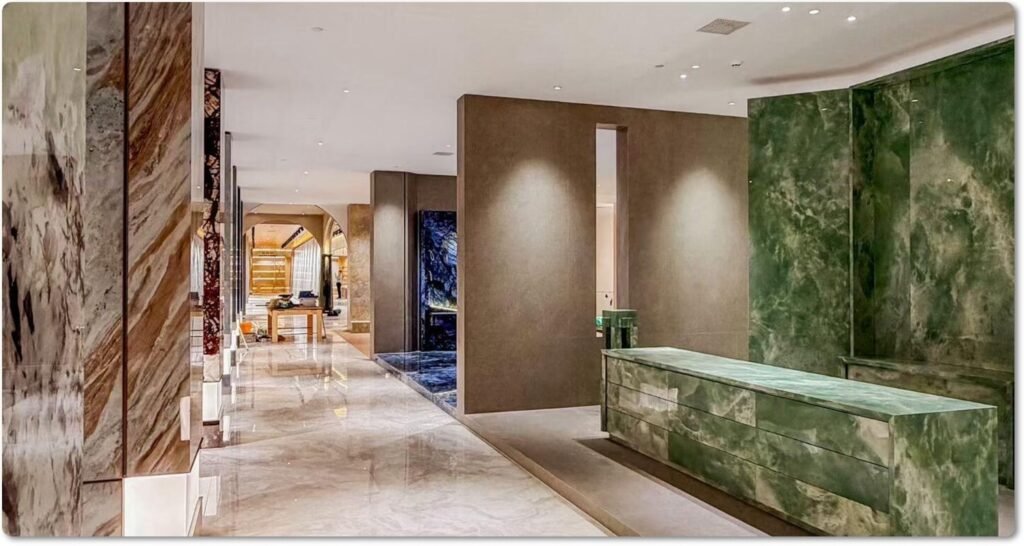
Why Architects Use Large Compact Slabs
Large-format architectural surfaces offer design advantages.
They can create:
- Fewer visible joints
- Continuous visual patterns
- Modern minimalist interiors
- Large uninterrupted wall surfaces
Applications include:
- Hotels
- Airports
- Luxury apartments
- Retail stores
- Restaurants
- Office buildings
Sustainability and the Future of Ultra Compact Surface Manufacturing
Modern construction materials are increasingly evaluated according to more than appearance and price.
Architects and procurement teams are asking questions about:
- Environmental information
- Material traceability
- Product documentation
- Lifecycle performance
- Supply-chain transparency
The regulatory direction is also becoming more digital and data-driven.
The European Union’s revised Construction Products Regulation, Regulation (EU) 2024/3110, entered into force on 7 January 2026 and modernizes the framework for construction products, including stronger emphasis on sustainability information, digital documentation, traceability, and the future Construction Digital Product Passport system.
For international manufacturers and exporters, this trend is strategically important.
The Future Factory Will Sell More Than Slabs
A competitive manufacturer will increasingly need to provide:
- Product specifications
- Technical data
- Performance declarations where applicable
- Installation guidance
- Safety information
- Traceability information
- Sustainability documentation
- Digital product data
This means the future of ultra-compact slab manufacturing is not only about producing better surfaces.
It is also about producing better product information.
Worker Safety and Ultra Compact Surface Fabrication
Why Fabrication Safety Matters
Different stone and engineered surface materials can contain different mineral compositions.
Cutting, grinding, drilling, and polishing mineral-based materials can generate respirable dust.
OSHA identifies crystalline silica exposure as a significant occupational hazard in industries involving stone, ceramic products, artificial stone, and related fabrication activities. OSHA notes that approximately 2.3 million workers in the United States are exposed to silica at work and maintains separate standards for construction and general industry.
For countertop and surface fabrication, appropriate controls can include:
- Wet cutting
- Water delivery systems
- Local exhaust ventilation
- HEPA-filtered vacuum systems
- Dust collection
- Proper housekeeping
- Worker training
OSHA guidance for stone and manufactured-surface fabrication specifically emphasizes exposure assessment and engineering controls. Its silica standards identify an action level of 25 μg/m³ and a permissible exposure limit of 50 μg/m³ as an 8-hour time-weighted average.
For factories and fabricators, safety is increasingly part of professional supply-chain qualification.
How to Choose an Ultra Compact Slabs Manufacturer
If you are sourcing ultra compact slabs wholesale, do not evaluate suppliers based only on slab photographs.
A professional purchasing process should evaluate the entire manufacturing and supply system.
1. Manufacturing Capability
Ask about:
- Factory capacity
- Production technology
- Available slab sizes
- Thickness options
- Surface finishes
2. Quality-Control System
Ask how the factory controls:
- Thickness
- Flatness
- Color consistency
- Surface defects
- Packaging quality
3. Technical Documentation
A professional supplier should be able to provide appropriate technical information for the intended market and application.
4. Fabrication Capability
For project buyers, consider whether the supplier can provide:
- CNC cutting
- Countertop fabrication
- Custom dimensions
- Sink cutouts
- Edge profiles
5. Export Packaging
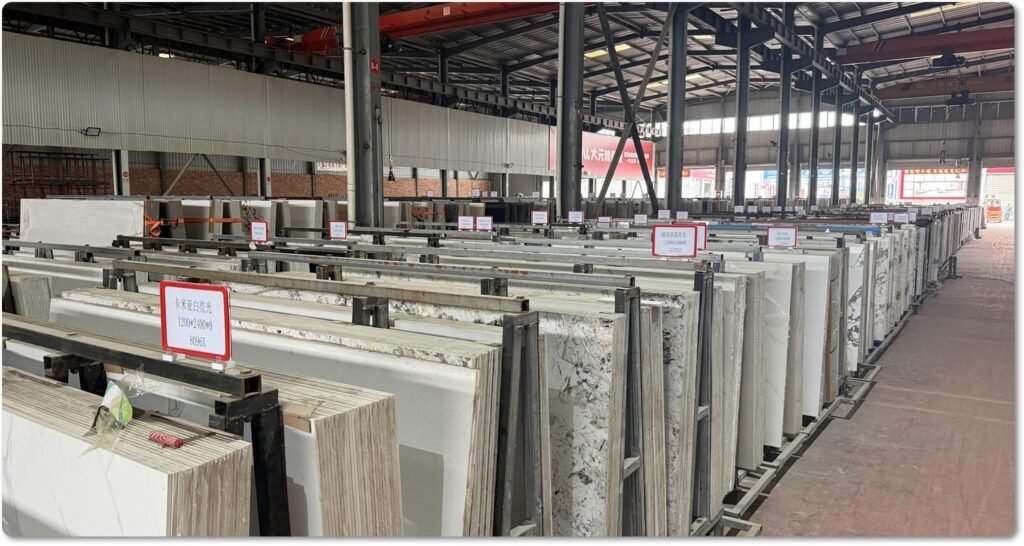
Large-format slabs require professional packaging.
Poor packaging can create significant shipping risks.
Look for:
- Strong wooden bundles
- A-frame systems
- Protective separators
- Edge protection
- Secure container loading
Why Work With EDG Stone for Ultra Compact Slabs?
EDG Stone works with global buyers seeking stone and architectural surface solutions for residential and commercial projects.
For ultra-compact slab sourcing, buyers may require more than standard slabs.
They may need:
- Material selection
- Multiple slab designs
- Custom thicknesses
- Project cutting
- Countertop fabrication
- Furniture components
- Export packaging
- International logistics coordination
From Slab Selection to Finished Project Components
The value of an experienced stone and surface supplier is the ability to connect multiple stages of the supply chain.
For example:
Ultra Compact Slab → Technical Review → Fabrication → Quality Inspection → Packaging → Export
This can be particularly valuable for:
- Apartment projects
- Hotels
- Commercial buildings
- Kitchen projects
- Furniture manufacturers
Ultra Compact Slabs Market Direction: What Will Happen Next?
The surface-material industry is moving toward several major trends.
Trend 1: Larger Slab Formats
Architects increasingly prefer continuous surfaces with fewer joints.
Trend 2: Thin but High-Performance Panels
Lightweight systems can support new wall and furniture applications.
Trend 3: Digital Product Information
Future construction materials will increasingly require better documentation and traceability.
The EU’s revised CPR explicitly supports digital product information and a Construction Digital Product Passport system, with machine-readable and interoperable product information forming part of the broader regulatory direction.
Trend 4: Sustainable Procurement
Professional buyers increasingly evaluate:
- Material efficiency
- Supply-chain transparency
- Product documentation
- Long-term durability
Trend 5: Factory Prefabrication
More projects will purchase finished components rather than raw slabs.
This can reduce:
- On-site cutting
- Installation time
- Material waste
- Project complexity
How Are Ultra Compact Slabs Different From Quartz Countertops?
This is one of the most frequently searched questions.
Ultra compact surfaces and quartz countertops are different product categories.
Quartz surfaces commonly use an engineered manufacturing system involving mineral components and binders, while ultra compact materials are generally associated with highly compacted, mineral-based surfaces produced through advanced thermal processing technologies.
The correct comparison should include:
- Material composition
- Manufacturing technology
- Heat performance
- UV requirements
- Fabrication requirements
- Intended application
Buyers should avoid choosing materials based solely on a generic label.
Always request the specific technical documentation for the exact product being purchased.
Are Ultra Compact Slabs Suitable for Outdoor Use?
Some ultra compact slabs are designed for exterior applications.
However, suitability depends on the specific product.
Before purchasing, buyers should evaluate:
- UV resistance
- Temperature performance
- Frost resistance
- Installation method
- Thickness
- Structural requirements
Do not assume that every compact slab is automatically suitable for every outdoor application.
The Global Surface Industry Is Becoming More Performance-Driven
The broader stone and architectural-surface industry remains significant.
For context, the U.S. Geological Survey reported that approximately 2.2 million tons of dimension stone, valued at approximately $370 million, were sold or used by U.S. producers in 2024.
While dimension stone and ultra compact surfaces are different product categories, the data illustrates the continuing economic importance of architectural surface materials.
The future market will likely reward companies that combine:
Design + Performance + Documentation + Safety + Supply-Chain Reliability
This is particularly important for manufacturers selling into international construction and architectural markets.
How/Why/What/Options/Considerations: The Complete Ultra Compact Surface Decision Framework
Understanding Ultra Compact Slabs Beyond the Manufacturing Process
What Is the Core Value of an Ultra Compact Surface?
Ultra compact slabs are designed to provide a combination of architectural appearance and engineered performance. Their core value comes from controlled manufacturing: carefully prepared mineral materials are compacted and thermally processed to create a dense, stable surface that can be manufactured in consistent large formats.
How Does the Manufacturing Process Affect Final Performance?
The performance of an ultra compact slab is directly connected to raw-material quality, particle control, formulation, compaction, thermal processing, cooling, calibration, and quality inspection. Manufacturing consistency is therefore one of the most important purchasing considerations when comparing suppliers.
Why Are Ultra Compact Slabs Becoming More Important?
Modern architecture increasingly requires large-format surfaces that combine decorative flexibility, durability, easier maintenance, and compatibility with kitchens, bathrooms, walls, furniture, and selected exterior applications. At the same time, construction markets are moving toward greater traceability, sustainability information, and digital product documentation.
What Options Can Buyers Choose?
Buyers can evaluate ultra compact slabs according to color, pattern, thickness, slab size, surface finish, fabrication requirements, intended application, and project specifications. Options may include marble-look, concrete-look, natural-stone-look, solid-color, polished, matte, and textured surfaces.
What Should Professional Buyers Consider Before Purchasing?
Professional procurement should evaluate the complete supply chain rather than only the slab price. Buyers should consider technical data, application suitability, dimensional consistency, fabrication capability, packaging, quality-control procedures, export experience, regulatory requirements, and long-term supplier reliability.
Where Is the Industry Heading?
The next generation of ultra-compact surface manufacturing will be increasingly data-driven. Digital documentation, traceability, sustainability information, worker safety, prefabrication, and intelligent manufacturing are becoming important competitive factors alongside design and material performance.
Bottom Line: Ultra compact slabs are not simply decorative large-format panels. They represent a manufacturing-driven category of architectural surfaces in which raw-material engineering, high-density processing, controlled thermal technology, fabrication expertise, and increasingly transparent product information all contribute to the final value delivered to architects, distributors, fabricators, and project buyers.
Frequently Asked Questions About Ultra Compact Slabs
1. What are ultra compact surfaces made of?
Ultra compact surfaces are generally manufactured from carefully selected mineral-based raw materials processed through controlled grinding, formulation, high-density compaction, and thermal manufacturing technologies. The exact composition varies by manufacturer and product system.
2. How are ultra compact slabs made?
Ultra compact slabs are generally produced through raw-material preparation, grinding, mixing, slab formation, high-pressure compaction, controlled thermal processing, cooling, surface finishing, calibration, and quality inspection.
3. What is the difference between ultra compact slabs and quartz?
The two materials use different manufacturing technologies and material systems. Buyers should compare the specific product’s composition, technical performance, intended application, fabrication requirements, and supplier documentation.
4. Are ultra compact countertops heat resistant?
Ultra compact surfaces are generally designed for strong thermal performance, but buyers should always follow the specific manufacturer’s technical guidance for direct heat exposure and installation requirements.
5. Where can I buy ultra compact slabs wholesale?
Professional buyers can source ultra compact slabs through specialized manufacturers, factories, exporters, and architectural surface suppliers. When purchasing wholesale, evaluate manufacturing capability, quality control, technical documentation, fabrication services, packaging, and export experience in addition to price.
Conclusion: How Are Ultra Compact Slabs Made?
Ultra compact slabs are manufactured through a sophisticated combination of mineral engineering, controlled particle preparation, formulation, high-density compaction, thermal processing, surface finishing, and precision quality control.
The process transforms carefully selected raw materials into large-format architectural surfaces designed for demanding modern applications.
For buyers, understanding how slabs are made provides an important advantage.
It helps answer critical sourcing questions:
- Which manufacturer has reliable production capability?
- How consistent is the slab quality?
- Is the product suitable for the intended application?
- Can the supplier provide fabrication services?
- Does the supplier provide appropriate technical documentation?
- Can the material meet project and market requirements?
As the global construction-material industry moves toward larger formats, higher performance, digital traceability, sustainability information, and safer fabrication practices, ultra compact slabs are positioned to remain an important category of modern architectural surfaces.
For wholesalers, distributors, architects, contractors, kitchen companies, furniture manufacturers, and project developers, the best purchasing strategy is not simply to find the lowest-priced slab.
It is to find the right combination of:
Reliable Manufacturing + Verified Quality + Technical Knowledge + Professional Fabrication + Global Supply Capability.
EDG Stone can support buyers seeking ultra compact slabs and integrated stone-surface solutions for international residential, commercial, hospitality, countertop, wall-panel, and furniture projects.