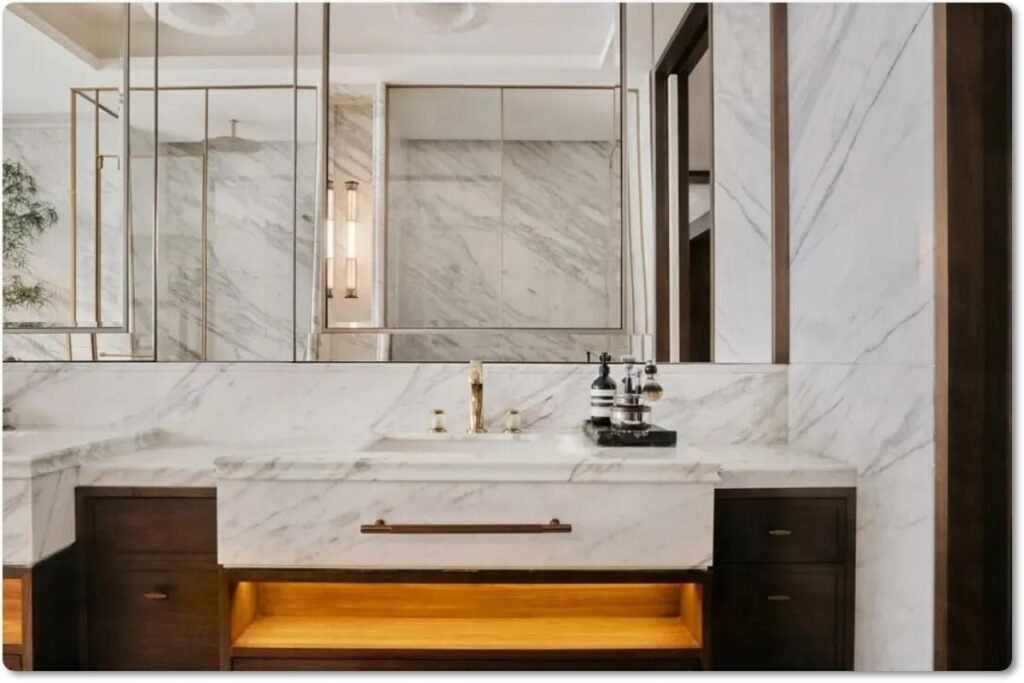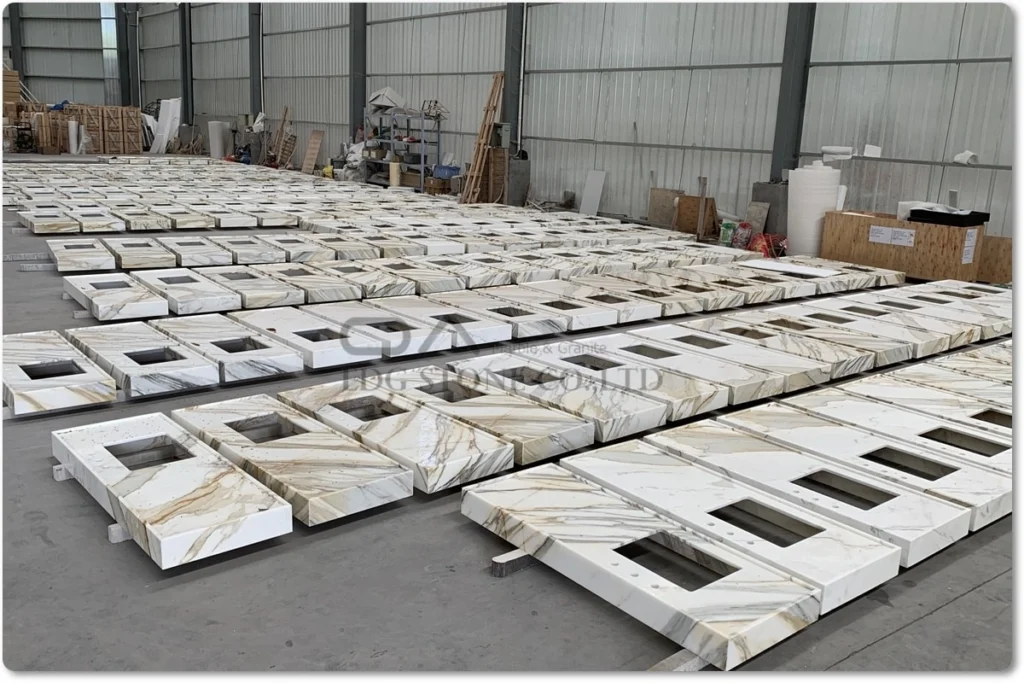
Quick Summary: What Is Calacatta Quartz and How Is It Manufactured?
Calacatta quartz has become one of the most recognizable categories in the engineered stone market because it combines the visual language of Italian Calacatta marble with the consistency and engineered performance expected from quartz surfaces.
For architects, kitchen companies, countertop fabricators, importers, distributors, developers, and wholesale buyers, understanding how Calacatta quartz is made is more valuable than simply comparing photographs in a showroom. Manufacturing technology directly affects vein realism, color consistency, slab flatness, polish quality, fabrication performance, stain resistance, packaging reliability, and ultimately project cost.
According to the U.S. International Trade Commission, typical quartz surface production includes mixing, combining, dispensing and molding, pressing, curing, cooling, calibration and polishing, followed by inspection. Vacuum and vibration-assisted pressing are used to compact the material and remove trapped air.
At the same time, the engineered stone industry is undergoing a major regulatory transformation. OSHA identifies cutting, grinding, drilling, and crushing stone as activities that can generate respirable crystalline silica, while its 2026 countertop manufacturing hazard alert places particular emphasis on worker protection.
This means that the future of the Calacatta quartz manufacturer is no longer determined only by design and production capacity. A competitive manufacturer increasingly needs to demonstrate quality control, traceability, dust-control systems, responsible material selection, fabrication guidance, regulatory awareness, and reliable international supply-chain management.
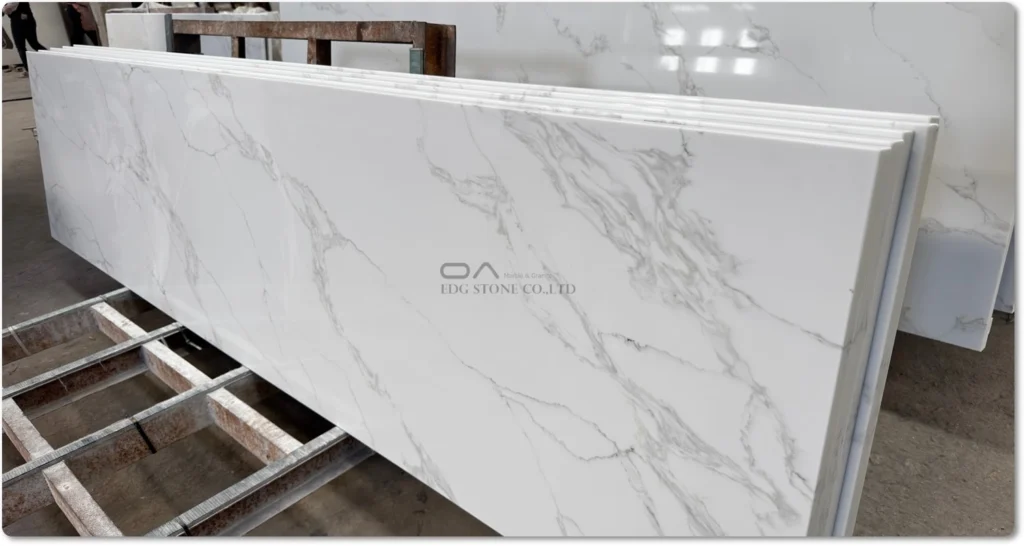
1. What Is Calacatta Quartz Material?
Calacatta quartz is an engineered quartz surface created to imitate the appearance of Calacatta marble.
Unlike natural Calacatta marble, which is quarried as a geological material, Calacatta quartz is manufactured by combining mineral aggregates with binders, pigments, and decorative components and then forming the mixture into slabs.
A typical quartz surface may contain a high proportion of quartz aggregate. Industry specifications commonly describe quartz agglomerate as containing substantial quartz aggregate combined with polymer resin binders and pigments.
The exact formula varies by manufacturer.
Calacatta Quartz vs. Natural Calacatta Marble
The most important difference is origin.
| Characteristic | Calacatta Quartz | Natural Calacatta Marble |
|---|---|---|
| Origin | Engineered/manufactured | Natural quarry material |
| Pattern | Designed and controlled | Naturally formed |
| Slab consistency | Generally higher | Naturally variable |
| Vein control | Digitally/physically engineered | Geological |
| Porosity | Generally low | Higher and varies |
| Maintenance | Relatively straightforward | Requires more stone-specific care |
| Manufacturing | Factory-produced | Quarry + processing |
| Custom pattern development | High | Limited to available blocks |
| Supply consistency | Usually more predictable | Dependent on quarry blocks |
The phrase “Calacatta” therefore describes the design aesthetic rather than proving that the material is natural marble.
2. How Are Calacatta Quartz Slabs Made?
The manufacturing process can be divided into several major stages.
Stage 1 — Selecting Quartz Aggregates
The first step is selecting and preparing mineral aggregates.
Manufacturers may use different particle sizes to create the desired visual depth and physical characteristics.
Typical raw-material categories include:
- Quartz aggregates
- Fine quartz powder
- Resin binder
- Pigments
- Decorative particles
- Vein-effect materials
- Functional additives
Particle-size distribution is important because it affects packing density, surface appearance, color, and final slab performance.
Stage 2 — Mixing the Raw Materials
The selected ingredients are carefully proportioned according to the product formulation.
This is where a manufacturer begins controlling:
- Background color
- Vein color
- Vein density
- Particle distribution
- Surface texture
- Final appearance
- Physical properties
For premium Calacatta quartz, the formulation is considerably more sophisticated than simply mixing white quartz and pigment.
The manufacturer needs to reproduce a convincing marble-like visual hierarchy:
white background → translucent mineral variation → primary veins → secondary veins → subtle tonal movement.
This visual hierarchy is one reason high-end Calacatta quartz products can look significantly more realistic than low-cost alternatives.
Stage 3 — Creating the Calacatta Vein Pattern
The vein system is one of the most important manufacturing steps.
There are several approaches to creating Calacatta-style veins.
Traditional Pigment and Aggregate Veining
Pigments and selected mineral materials are distributed through the slab mixture.
This approach can produce natural-looking variation but requires highly controlled production parameters.
Localized Vein Application
Some manufacturers introduce concentrated vein materials into specific areas before pressing.
This can create:
- Bold gray veins
- Gold veins
- Warm beige veins
- Fine hairline veins
- Multi-directional marble patterns
Printed Quartz
Printed quartz uses digital or controlled printing technology to introduce a high-resolution decorative image or pattern onto the surface or within a controlled surface system.
The concept is similar to digital decorative printing used in other architectural materials: a digital design can reproduce specific marble imagery more consistently than relying entirely on random aggregate distribution.
However, printing technology and conventional through-body vein technology are not identical.
A buyer should ask a Calacatta quartz manufacturer whether the pattern is:
- Through-body engineered,
- Surface printed,
- A combination of techniques,
- Or digitally controlled during the molding process.
This distinction can influence edge appearance, fabrication behavior, visual depth, and long-term aesthetic consistency.
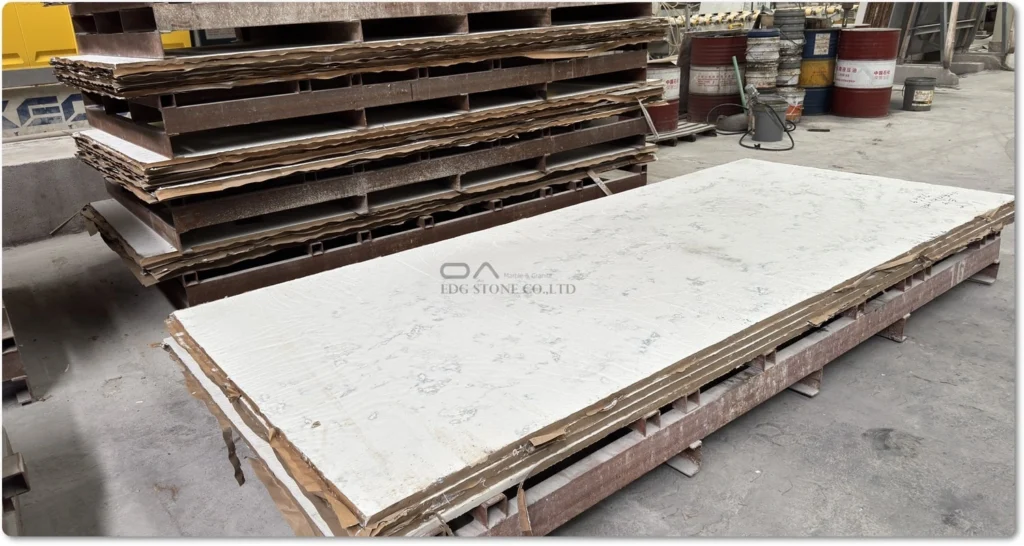
3. Vacuum Vibro-Compaction: The Core Manufacturing Technology
One of the most important technologies in engineered quartz manufacturing is vacuum vibro-compaction.
During this process, the prepared mixture is placed into a mold and subjected to vacuum and mechanical compaction. Vibration helps remove trapped air and improve material density.
The USITC describes quartz surface slab production as involving pressing under vacuum, with vibration potentially used to remove gases from the mixture and improve the resulting slab.
A simplified production sequence is:
Raw Materials → Mixing → Vein Design → Molding → Vacuum → Vibration → Pressing → Curing → Cooling → Calibration → Polishing → QC
The objective is to create a dense, flat, consistent slab.
Why Vacuum Matters
Air trapped inside the material can contribute to internal defects.
Vacuum-assisted production helps manufacturers achieve:
- Improved density
- Reduced internal voids
- Better surface quality
- More consistent physical characteristics
- Improved slab uniformity
Why Vibration Matters
Vibration helps distribute the material during compaction.
When combined with vacuum and mechanical pressure, the process can produce a highly compact slab structure.
This is one reason buyers should not evaluate a Calacatta quartz factory only by looking at its polishing equipment.
The upstream mixing and compaction system is equally important.
4. How Quartz Slabs Are Cured, Calibrated, and Polished
After pressing, the slab must be cured.
Curing transforms the resin-containing mixture into a stable engineered surface.
The exact curing temperature, time, resin chemistry, and production parameters vary between factories and product formulations.
The USITC describes a representative production process in which pressed slabs are heated for curing, cooled, calibrated, and then polished before final inspection.
Calibration
Calibration controls slab thickness and dimensional consistency.
For commercial projects, calibration is especially important because inconsistent thickness can complicate:
- Countertop fabrication
- Edge profiling
- Seam alignment
- Cabinet installation
- Backsplash installation
- CNC processing
Polishing
Polishing creates the final surface appearance.
Depending on the product, finishes may include:
- Polished
- Honed
- Matte
- Suede-like
- Leather-inspired textures
For Calacatta quartz, polishing quality is particularly important because reflections can dramatically affect the perceived realism of marble-style veining.
5. Calacatta Gold Quartz: Why It Is Different
Calacatta Gold quartz is one of the most commercially attractive variations of Calacatta-style quartz.
Instead of relying primarily on gray veining, Calacatta Gold typically introduces:
- Warm gold veins
- Beige undertones
- Taupe movement
- Soft gray accents
- White or ivory backgrounds
The challenge for a Calacatta Gold quartz manufacturer is controlling the balance between luxury and artificiality.
Too much gold can make the slab appear decorative rather than marble-inspired.
Too little variation can make the slab look flat.
Premium designs generally use multiple vein intensities and carefully controlled tonal transitions.
What Buyers Should Ask a Calacatta Gold Quartz Manufacturer
Before placing a wholesale order, ask:
- Is the pattern digitally controlled or manually created?
- Are veins consistent from slab to slab?
- Can the factory provide full-slab high-resolution photographs?
- Is the vein visible on the edge?
- What is the recommended fabrication method?
- What are the standard slab dimensions?
- What thicknesses are available?
- What is the actual material composition?
- What QC system is used?
- What export packaging is provided?
- What warranty is available?
- Which destination markets are currently supplied?
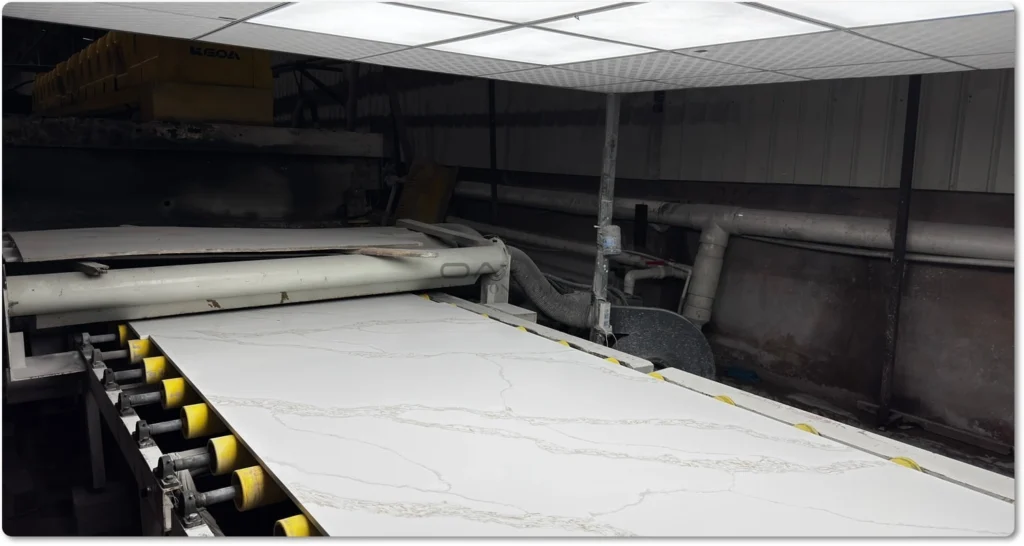
6. Where Are Quartz Countertops Made?
Quartz countertops are manufactured in many countries, including major production centers in Asia, Europe, North America, and other stone-processing regions.
China has become an important manufacturing base for engineered stone and quartz surfaces because of its established stone-processing ecosystem, raw-material supply chains, machinery infrastructure, skilled workforce, and export logistics.
For buyers searching for a Calacatta quartz manufacturer, Calacatta quartz company, or Calacatta quartz factory, country of origin should not be the only evaluation criterion.
The more important question is:
Can the factory consistently produce the required design, specification, quality, documentation, packaging, and delivery performance?
7. How to Fabricate Quartz Countertops
Fabrication transforms a finished slab into a countertop.
Typical fabrication operations include:
- Measuring
- Template preparation
- CNC cutting
- Bridge-saw cutting
- Waterjet cutting
- Sink cutouts
- Faucet drilling
- Edge profiling
- Polishing
- Seaming
- Inspection
- Installation
Why Fabrication Is Different From Manufacturing
Manufacturing creates the slab.
Fabrication creates the finished countertop.
This distinction is important because the best slab can still produce a poor countertop if fabrication is poorly executed.
Fabricators need to consider:
- Slab thickness
- Support requirements
- Cutout positioning
- Edge details
- Vein direction
- Seam placement
- Heat exposure
- Transportation
- Installation conditions
For Calacatta quartz, vein matching is particularly important.
A kitchen island made from two slabs can look dramatically different depending on whether the veins are aligned or randomly joined.
8. Calacatta Quartz Maintenance: How Should It Be Cared For?
One of the commercial advantages of quartz surfaces is relatively straightforward daily maintenance.
Daily Calacatta Quartz Care
A practical maintenance routine generally includes:
- Wiping spills promptly
- Using a soft cloth
- Using mild soap and water
- Avoiding highly abrasive cleaners
- Avoiding aggressive scouring pads
- Following the manufacturer’s care instructions
Calacatta Quartz Maintenance for Kitchens
Kitchen countertops should receive particular attention around:
- Cooking areas
- Sink zones
- Food preparation areas
- Coffee stations
- Frequently touched surfaces
Although quartz is engineered for demanding interior applications, it should not be treated as indestructible.
Manufacturers may have different recommendations regarding:
- Hot cookware
- Strong chemicals
- Solvents
- Abrasive cleaners
- Sharp objects
- Prolonged chemical exposure
Therefore, the manufacturer’s technical documentation should always take precedence over generic maintenance advice.
Does Calacatta Quartz Need Sealing?
In general, engineered quartz surfaces are manufactured as low-porosity materials and normally do not require routine sealing in the same way that some natural stones do.
However, buyers should verify the exact product specification with their Calacatta quartz company because formulation and surface technology can vary.
9. The 2026 Regulatory Shift: Why Quartz Manufacturing Is Changing
The most important development in the engineered stone sector is not another marble-look design.
It is silica regulation and worker safety.
OSHA states that respirable crystalline silica can be generated during cutting, grinding, drilling, and crushing stone, and identifies countertop manufacturing, finishing, and installation as relevant exposure environments.
Under OSHA’s general industry silica standard, the permissible exposure limit is 50 μg/m³ as an 8-hour time-weighted average, with an action level of 25 μg/m³.
The Australian Engineered Stone Ban
Australia has taken an even more significant approach.
From July 1, 2024, Australia implemented a prohibition covering the manufacture, supply, processing, and installation of specified engineered stone benchtops, panels and slabs containing at least 1% crystalline silica under its engineered-stone definition. Imports were prohibited from January 1, 2025.
Importantly, Australia’s definition excludes certain products such as sintered stone and porcelain products provided they do not contain resin.
This has major implications for international stone manufacturers.
California’s 2026 Regulatory Direction
California is also moving toward stricter regulation.
In May 2026, California’s Occupational Safety and Health Standards Board voted to initiate a process toward prohibiting fabrication and installation of artificial stone products containing more than 1% crystalline silica. The action initiated an expedited rulemaking process rather than itself constituting the final prohibition.
The United Kingdom’s 2026 Enforcement Direction
The UK’s Health and Safety Executive issued new guidance in 2026 stating that dry cutting of engineered stone is unacceptable and emphasizing water suppression as the appropriate control approach. HSE subsequently announced enforcement action against businesses following inspections.
HSE also states that employers must assess and control exposure to respirable crystalline silica under COSHH requirements.
What This Means for Calacatta Quartz Manufacturers
The direction of the industry is becoming clear:
Design innovation + manufacturing quality + occupational safety + material transparency + destination-market compliance
will increasingly determine competitiveness.
A modern manufacturer should therefore be prepared to provide:
- Material composition information
- Technical data sheets
- Safety documentation
- Fabrication guidance
- Silica-risk information
- Dust-control procedures
- Wet-processing capability
- Quality-control records
- Traceability
- Destination-market compliance documentation
This is particularly important for wholesale buyers supplying markets with increasingly strict workplace-safety requirements.
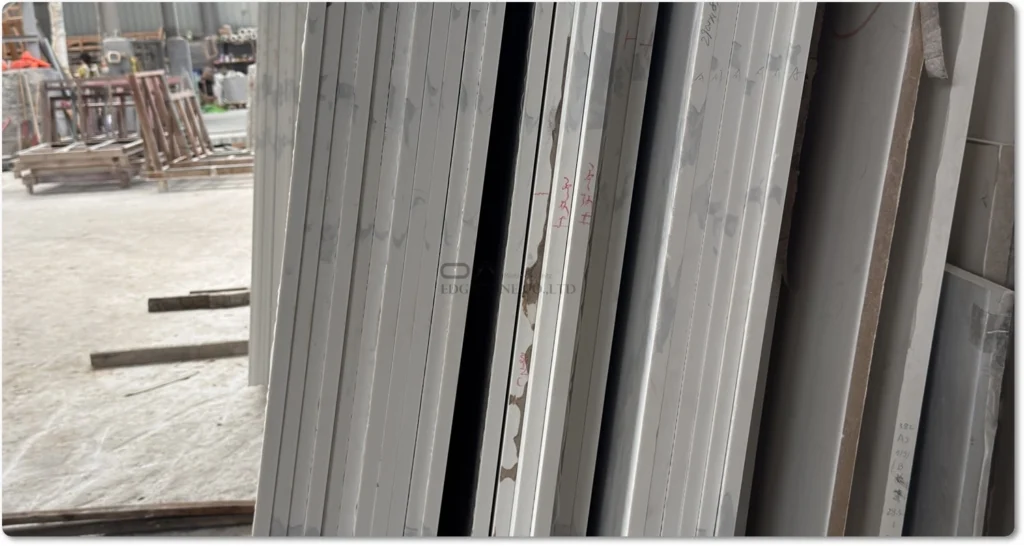
10. What Makes a Professional Calacatta Quartz Manufacturer?
A professional manufacturer should be evaluated across multiple dimensions.
Manufacturing Capability
Look for:
- Automated mixing
- Controlled dosing
- Vacuum vibro-compaction
- Stable curing
- Precision calibration
- Modern polishing
- CNC processing capability
- Reliable packaging
Design Development
A strong factory should be capable of developing:
- Calacatta White
- Calacatta Gold
- Calacatta Extra
- Soft-vein designs
- Bold-vein designs
- Warm-white backgrounds
- Cool-white backgrounds
- Custom private-label patterns
Quality Control
Quality control should cover the entire production chain rather than only final inspection.
A professional QC system should monitor:
Raw materials → formulation → mixing → molding → compaction → curing → calibration → polishing → appearance → dimensions → packaging
11. How to Choose a Calacatta Quartz Manufacturer for Wholesale
For distributors, contractors, kitchen companies, and importers, price should not be the only purchasing criterion.
Compare Manufacturers Using These 10 Factors
| Evaluation Factor | Why It Matters |
| Slab consistency | Reduces project variation |
| Vein realism | Determines product positioning |
| Production capacity | Supports wholesale orders |
| QC system | Reduces claims |
| Packaging | Prevents transit damage |
| Fabrication performance | Reduces installation problems |
| Technical support | Helps downstream fabricators |
| Compliance documentation | Reduces regulatory risk |
| Customization | Supports private-label products |
| Lead time | Improves project planning |
A factory that is 5% cheaper but generates repeated replacement claims may ultimately be much more expensive than a reliable manufacturer.
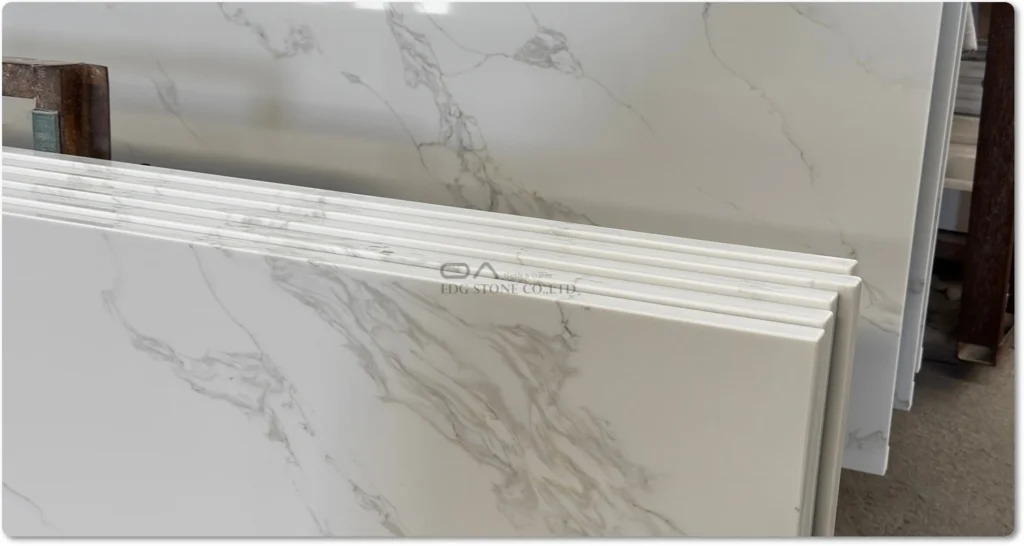
12. Why EDG Stone Is Relevant to Calacatta Quartz Procurement
For buyers searching for a Calacatta quartz manufacturer, Calacatta quartz factory, Calacatta quartz wholesale supplier, or Calacatta quartz company, EDG Stone can position its offering around the complete B2B supply chain rather than simply selling individual slabs.
The key value proposition for a professional stone supplier should include:
- Factory sourcing
- Product development
- Quartz slab selection
- Calacatta design options
- Countertop fabrication
- Vanity-top production
- CNC processing
- Technical drawings
- Quality control
- Export packaging
- Container loading
- Project support
This approach is particularly useful for hospitality, residential development, kitchen programs, commercial interiors, and wholesale distribution.
13. Calacatta Quartz Manufacturing Trends for 2026 and Beyond
The market is moving toward several important trends.
Trend 1 — More Realistic Marble Replication
Consumers increasingly expect quartz to reproduce natural stone more convincingly.
The next generation of Calacatta designs is likely to focus on:
- Less repetitive patterns
- More natural vein branching
- Greater tonal depth
- Subtle translucency effects
- Better slab-to-slab variation
Trend 2 — Digital Design and Pattern Control
Digital tools allow manufacturers to design increasingly sophisticated patterns.
This can help create more predictable bookmatching and coordinated slab sequences.
Trend 3 — Lower-Silica and Alternative Surfaces
Regulatory pressure is accelerating interest in:
- Lower-crystalline-silica formulations
- Porcelain
- Sintered stone
- Other mineral surfaces
- Resin-free alternatives
Australia’s regulatory framework specifically distinguishes certain sintered and porcelain products from its engineered-stone prohibition when they meet the relevant definition.
Trend 4 — Safer Fabrication
Wet cutting, local exhaust ventilation, dust extraction, HEPA filtration, controlled workshop environments, and better housekeeping are becoming increasingly important.
OSHA specifically identifies wet methods, water delivery systems, dust shrouds, HEPA-filtered vacuum systems, and local exhaust ventilation among control approaches for countertop work.
Trend 5 — Material Transparency
Buyers will increasingly ask:
What exactly is inside this slab?
A future-oriented manufacturer should therefore treat material composition and safety documentation as commercial assets rather than merely compliance paperwork.
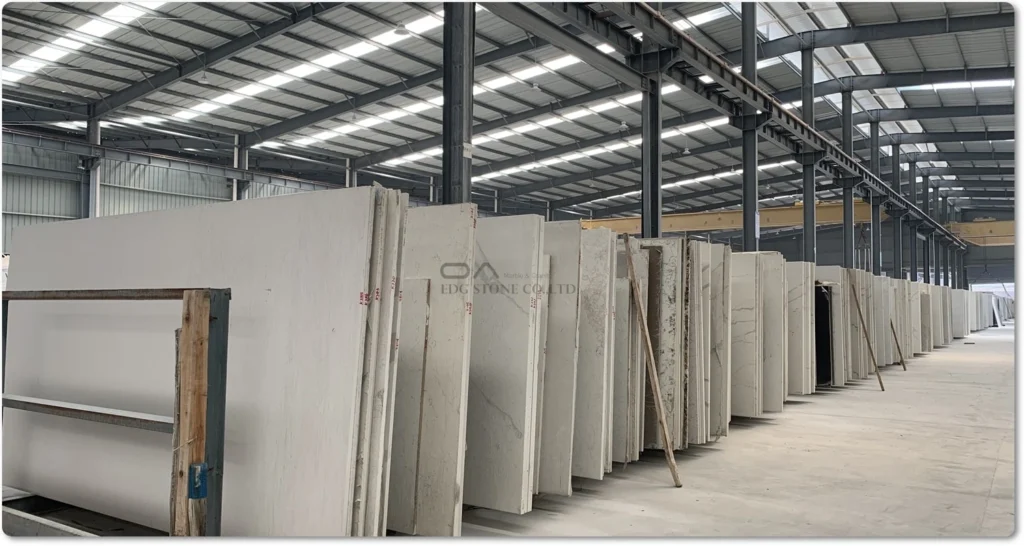
14. Calacatta Quartz Procurement Checklist
Before ordering from a Calacatta quartz manufacturer, a wholesale buyer should confirm:
Product
- Slab dimensions
- Thickness
- Surface finish
- Pattern
- Background color
- Vein direction
- Vein consistency
- Edge appearance
Manufacturing
- Manufacturing location
- Production capacity
- Manufacturing technology
- QC procedure
- Calibration tolerance
- Polishing standard
- Batch control
Commercial
- MOQ
- Wholesale price
- Sample policy
- Lead time
- Payment terms
- Container loading
- Replacement policy
- Warranty
Compliance
- Technical data sheet
- Material composition
- SDS where applicable
- Silica information
- Fabrication instructions
- Destination-market requirements
15. What Buyers Should Understand Before Purchasing Calacatta Quartz
The most important purchasing decision is not simply:
“Does this slab look like Calacatta marble?”
A professional procurement decision should ask:
Can this manufacturer repeatedly produce the same visual standard, physical specification, packaging quality, documentation, and supply reliability at commercial scale?
That is the difference between buying a sample and building a supply chain.
For architects and designers, appearance may be the first consideration.
For fabricators, processing performance matters.
For distributors, consistency and replacement rates matter.
For developers, delivery and project continuity matter.
For international importers, regulatory compliance and documentation increasingly matter.
Therefore, the best Calacatta quartz manufacturer is not necessarily the factory offering the lowest FOB price. It is the supplier capable of delivering the best combination of design, manufacturing, QC, compliance, logistics, technical support, and long-term supply stability.
16. Semantic Insight: The Future of Calacatta Quartz Manufacturing
How is Calacatta quartz made?
Calacatta quartz is manufactured by combining quartz aggregates, resin binders, pigments, additives, and decorative vein materials, followed by molding, vacuum vibro-compaction, curing, cooling, calibration, polishing, inspection, and packaging. The Calacatta appearance is created through controlled pigment, aggregate, vein, and pattern technologies.
Why does manufacturing technology matter?
Manufacturing technology determines density, flatness, color consistency, vein appearance, surface finish, dimensional accuracy, fabrication performance, and production repeatability. Vacuum and vibration-assisted compaction are especially important for producing dense and consistent engineered quartz slabs.
What are the main options when choosing Calacatta quartz?
Buyers can select conventional Calacatta quartz, Calacatta Gold quartz, bold-vein designs, subtle-vein designs, digitally controlled patterns, or customized private-label designs. The appropriate choice depends on the target market, interior design style, project scale, fabrication requirements, and wholesale positioning.
What should buyers consider beyond appearance?
A professional procurement evaluation should include material composition, slab dimensions, thickness tolerance, pattern consistency, fabrication guidance, QC procedures, packaging, warranty, production capacity, lead time, technical documentation, and destination-market regulatory requirements.
Why are regulations changing the quartz industry?
Processing engineered stone can generate respirable crystalline silica. OSHA regulates occupational exposure in the United States, Australia has prohibited specified engineered-stone benchtops, panels, and slabs, California initiated further rulemaking in 2026, and the UK has increased enforcement and guidance concerning silica exposure. These developments are accelerating the industry’s movement toward safer processing, stronger dust controls, lower-silica formulations, and alternative surfaces.
What should the future Calacatta quartz manufacturer look like?
The future manufacturer will combine advanced surface design with automated production, strong quality control, transparent material information, safer fabrication systems, regulatory awareness, digital pattern development, export logistics, and reliable B2B technical support.
The central conclusion is therefore straightforward:
Calacatta quartz is no longer simply a marble-look countertop product. It is a technology-driven architectural surface category whose competitiveness increasingly depends on design realism, manufacturing precision, fabrication safety, regulatory compliance, and supply-chain reliability.
17. Frequently Asked Questions About Calacatta Quartz
1. Is Calacatta quartz real quartz?
Yes. Calacatta quartz is an engineered surface containing quartz-based mineral aggregate, combined with binders, pigments, and other components. “Calacatta” refers primarily to the marble-inspired visual design rather than natural geological origin.
2. How is Calacatta quartz made?
It is generally produced through raw-material preparation, mixing, decorative pattern creation, molding, vacuum vibro-compaction, pressing, curing, cooling, calibration, polishing, inspection, and packaging.
3. Is Calacatta quartz better than Calacatta marble?
Neither material is universally better. Calacatta quartz generally offers greater manufacturing consistency and relatively straightforward maintenance, while natural Calacatta marble provides genuine geological variation and natural-stone character. The right choice depends on application, design requirements, maintenance expectations, and project specifications.
4. Does Calacatta quartz need sealing?
Most engineered quartz surfaces are low-porosity and generally do not require routine sealing like many natural stone surfaces. However, buyers should follow the specific maintenance and warranty instructions supplied by the manufacturer.
5. Where can I buy Calacatta quartz wholesale?
Wholesale buyers should work directly with an established Calacatta quartz manufacturer or factory where possible and evaluate samples, production capacity, slab consistency, QC documentation, packaging, technical support, lead time, and destination-market compliance before placing a large order.
Conclusion: Choosing the Right Calacatta Quartz Manufacturer in 2026
Calacatta quartz has evolved from a simple marble alternative into a highly engineered architectural surface.
The manufacturing process involves far more than mixing quartz and resin. High-quality production requires controlled raw materials, sophisticated vein development, vacuum vibro-compaction, curing, calibration, polishing, inspection, and professional packaging.
At the same time, 2026 marks a significant turning point for the industry. OSHA continues to emphasize respirable crystalline silica controls, Australia has already prohibited specified engineered-stone products, California is moving toward additional restrictions, and the UK has intensified silica enforcement.
For buyers, this means the definition of a good Calacatta quartz manufacturer is changing.
The strongest suppliers will not simply offer attractive slabs.
They will offer:
Realistic designs + stable manufacturing + reliable QC + technical documentation + safer fabrication guidance + regulatory awareness + dependable wholesale supply.
For architects, fabricators, distributors, developers, and importers looking for a long-term supplier, these factors should form the foundation of Calacatta quartz procurement in 2026 and beyond.