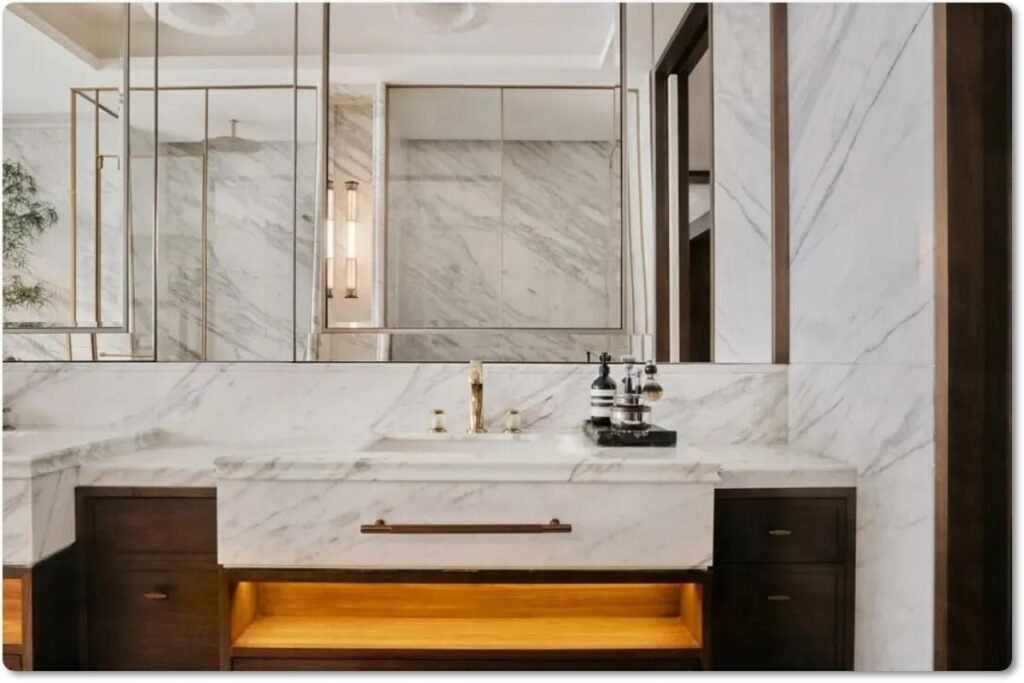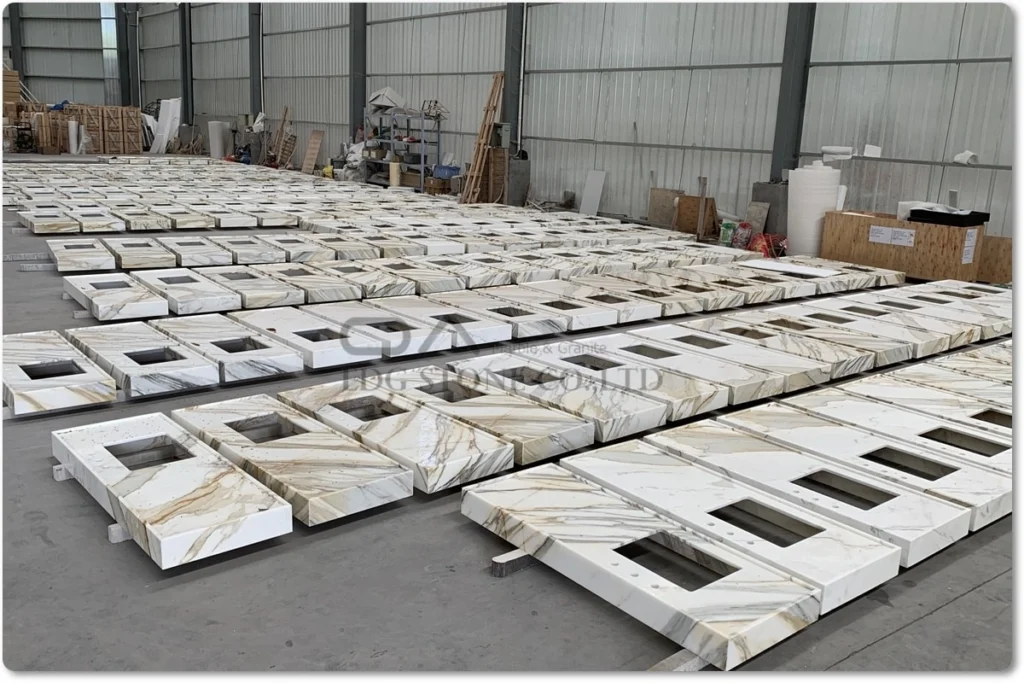
Quick Summary: White Quartz Countertops Buying Guide
White quartz countertops have become one of the most versatile countertop choices for modern kitchens, bathrooms, hospitality projects, apartments, and commercial interiors. Their combination of a bright stone appearance, consistent manufacturing, extensive design options, and relatively simple daily care has made white quartz a major category within the countertop market.
But choosing the right slab is more complicated than simply asking, “What is the best white quartz?”
A professional buyer needs to consider appearance, quartz composition, slab size, thickness, fabrication, installation, maintenance, pricing, supplier reliability, regulatory considerations, and long-term application requirements.
This white quartz countertop buying guide explains the most important factors in one place—from white quartz countertop prices and Calacatta designs to sparkle finishes, veining options, quartz vs. granite, installation, cleaning, pros and cons, and sourcing from a manufacturer or wholesale factory.
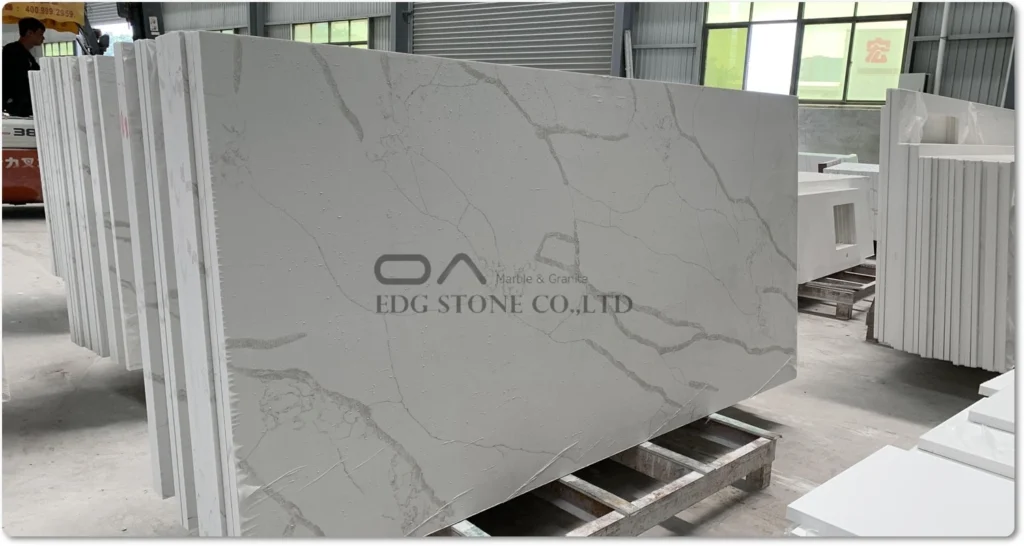
1. What Are White Quartz Countertops?
White quartz countertops are engineered stone surfaces manufactured using quartz-containing mineral materials combined with binders, pigments, and other formulation components.
The manufacturing process allows producers to control color, pattern, particle distribution, surface finish, thickness, and slab dimensions more consistently than many natural stones.
This is important because “white quartz” does not describe a single appearance.
There are many different categories:
Pure White Quartz Countertops
Pure white quartz countertops are designed to create a clean, uniform appearance with minimal or no visible veining.
They work particularly well with:
- Modern kitchens
- Minimalist interiors
- White cabinets
- Contemporary bathrooms
- Commercial interiors
- Small kitchens where visual simplicity is desirable
Warm White Quartz Countertops
Warm white quartz has subtle cream, ivory, beige, or warm-gray undertones.
It can be a better choice when pure white would look too cold against:
- Natural oak
- Walnut cabinets
- Beige flooring
- Brass hardware
- Warm lighting
- Cream-colored walls
Off-white quartz countertops
Off-white quartz countertops provide a softer appearance than bright white surfaces.
They are increasingly useful for transitional and luxury interiors where designers want a sophisticated neutral rather than a stark white.
2. White Quartz Countertops: Colors and Design Options
White quartz has expanded far beyond the traditional solid-white slab.
Today, buyers can select designs based on veining, movement, background tone, sparkle, and visual depth.
White Quartz Countertops with Veins
Veined white quartz is one of the strongest design categories because it can visually resemble marble while offering the consistency associated with engineered surfaces.
Popular options include:
- White quartz with gray veins
- White quartz with beige veins
- White quartz with black veins
- White quartz with brown veins
- White quartz with gold veins
- Calacatta-style white quartz
- Carrara-style white quartz
- White quartz with subtle linear movement
The most important consideration is vein scale.
Large, dramatic veins create a luxury statement, while fine veins provide a quieter marble-inspired appearance.
White Quartz Countertops with Gold Veins
White quartz countertops with gold veins are especially suitable for luxury residential and hospitality interiors.
Gold veining can be combined with:
- White cabinetry
- Brass faucets
- Champagne hardware
- Dark wood
- Warm lighting
- Cream-colored walls
However, buyers should inspect full slabs rather than relying only on a small sample. Gold vein direction, intensity, continuity, and contrast can vary considerably between designs.
White Quartz Countertops with Black Veins
Black veins create stronger contrast and can make a countertop function as an architectural feature.
They are particularly effective with:
- White cabinets
- Black islands
- Matte black fixtures
- Contemporary kitchens
- Large waterfall islands
White Quartz Countertops with Beige or Brown Veins
Beige and brown veining provides a warmer interpretation of white quartz.
These designs are excellent for projects using natural wood, beige cabinetry, travertine, warm porcelain flooring, and Mediterranean or transitional interiors.
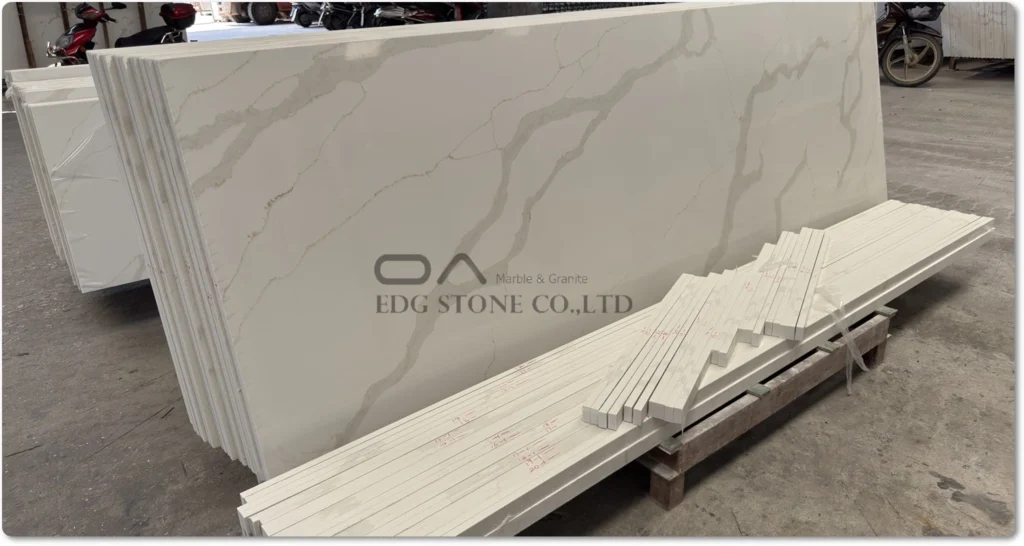
3. White Quartz Countertops Calacatta: Why Are They So Popular?
Calacatta-style white quartz countertops imitate the visual language of premium Italian marble: a bright background combined with expressive veins.
The major difference is that a quartz manufacturer can reproduce a controlled design across multiple slabs.
For large projects, this can be valuable because designers and developers may need multiple slabs with a relatively consistent visual identity.
Calacatta Quartz vs. Natural Calacatta Marble
Calacatta-style quartz can provide:
- Consistent engineered appearance
- Multiple slab availability
- Predictable color
- Easier sourcing for repeat projects
- Lower routine maintenance requirements than many marble applications
Natural Calacatta marble, however, remains a genuine natural stone with unique geological variation.
Therefore, buyers should not treat “Calacatta quartz” and “Calacatta marble” as identical products. They are visually related but materially different.
4. White Quartz Countertops with Sparkle
White quartz countertops with sparkle incorporate reflective particles into the slab design.
Depending on the formulation, sparkle may appear as:
- Fine crystalline particles
- Glass-like reflective particles
- Subtle mineral highlights
- Metallic-looking accents
- Larger decorative inclusions
Sparkle quartz is often selected for glamorous kitchens, bathrooms, vanity tops, entertainment spaces, and hospitality interiors.
For sophisticated projects, subtle sparkle is generally easier to coordinate than highly reflective designs.
How to Evaluate Sparkle Quartz?
Ask the supplier:
- Is the sparkle distributed uniformly?
- Does the appearance change significantly under warm and cool lighting?
- Are the reflective particles visible from normal viewing distance?
- Is the sparkle consistent between slabs?
- Does the finish remain visually balanced after fabrication?
A small sample cannot always answer these questions. For large projects, inspect a full slab whenever possible.
5. White Quartz Kitchen Ideas
White quartz countertops can work with almost every major kitchen design language.
White Quartz Countertops with White Cabinets
White-on-white kitchens create a bright, continuous appearance.
To avoid a flat or overly sterile result, designers can introduce:
- Wood flooring
- Brass hardware
- Textured backsplash
- Veined quartz
- Pendant lighting
- Natural wood islands
White Quartz with Wood Cabinets
Warm wood and white quartz create a balanced combination.
For these kitchens, warm white, off-white, beige-veined, or brown-veined quartz can be particularly effective.
White Quartz with Dark Cabinets
White quartz provides strong contrast against black, charcoal, navy, or dark walnut cabinetry.
For contemporary kitchens, white quartz with black or dramatic gray veins can create a strong focal point.

6. White Quartz Countertops Pros and Cons
Pros of White Quartz Countertops
1. Broad design selection
Manufacturers can produce solid white, marble-inspired, Calacatta-style, sparkle, and multi-vein designs.
2. Consistent appearance
Engineered production can provide greater consistency than naturally occurring stone.
3. Low routine maintenance
Quartz surfaces generally do not require the same sealing routine associated with some porous natural stones.
4. Strong design flexibility
White quartz can work with contemporary, transitional, minimalist, luxury, and hospitality interiors.
5. Easy specification for projects
For developers and commercial buyers, standardized colors can simplify repeat procurement.
Cons of White Quartz Countertops
1. Not completely maintenance-free
Quartz should still be cleaned properly and protected from excessive heat and harsh chemicals.
2. Visible stains can be more noticeable
On pure white surfaces, food, pigments, dust, and residue can be visually obvious.
3. Fabrication quality matters
Poor cutting, polishing, edge processing, or installation can negatively affect an otherwise high-quality slab.
4. Heat and impact require attention
Quartz should not be treated as indestructible. Hot cookware, concentrated heat, heavy impact, and improper use can damage the surface.
5. Silica-related fabrication regulations are increasingly important
This is particularly important for manufacturers, fabricators, installers, distributors, and project buyers.
7. White Quartz Countertops vs. Granite
The choice between white quartz and granite depends on the application rather than a universal “better” material.
| Factor | White Quartz | Granite |
|---|---|---|
| Material type | Engineered stone | Natural stone |
| Pattern consistency | Generally high | Naturally variable |
| White design selection | Very extensive | Depends on quarry |
| Marble-look designs | Extensive | Limited to natural geology |
| Routine maintenance | Generally simple | May require sealing depending on stone |
| Natural variation | Controlled | High |
| Custom design options | High | Limited by natural material |
| Project repeatability | Excellent | More variable |
| Fabrication considerations | Silica exposure must be controlled | Silica exposure can also occur |
OSHA identifies both natural and engineered stone countertop fabrication as potential sources of respirable crystalline silica exposure. Its current guidance emphasizes engineering and work-practice controls such as wet methods, local exhaust ventilation, and enclosures.
Therefore, the comparison should not be simplified into “quartz is safe and granite is unsafe.” Fabrication conditions and workplace controls matter.
8. White Quartz Countertops Price: What Should Buyers Expect?
White quartz countertops price varies substantially according to market, supplier, thickness, design, slab size, brand positioning, fabrication, edge profile, cutouts, transportation, installation, and project volume.
A useful way to understand pricing is to divide the cost into several layers:
Material Cost
This is the slab or material price.
Basic pure white designs are generally positioned differently from premium Calacatta or exotic-looking designs.
Fabrication Cost
Fabrication may include:
- Cutting
- Polishing
- Edge processing
- Sink cutouts
- Faucet holes
- Cooktop cutouts
- Drainboard fabrication
- Waterjet work
- CNC processing
Installation Cost
Installation depends on:
- Site location
- Countertop dimensions
- Number of seams
- Island size
- Waterfall edges
- Sink type
- Access conditions
- Existing cabinetry
Logistics Cost
For wholesale buyers, shipping can represent a significant part of the landed cost.
The practical formula is:
Total Countertop Cost = Material + Fabrication + Packaging + Freight + Installation + Project-Specific Costs
Therefore, asking only for the “white quartz countertops price per square foot” can produce an incomplete comparison.
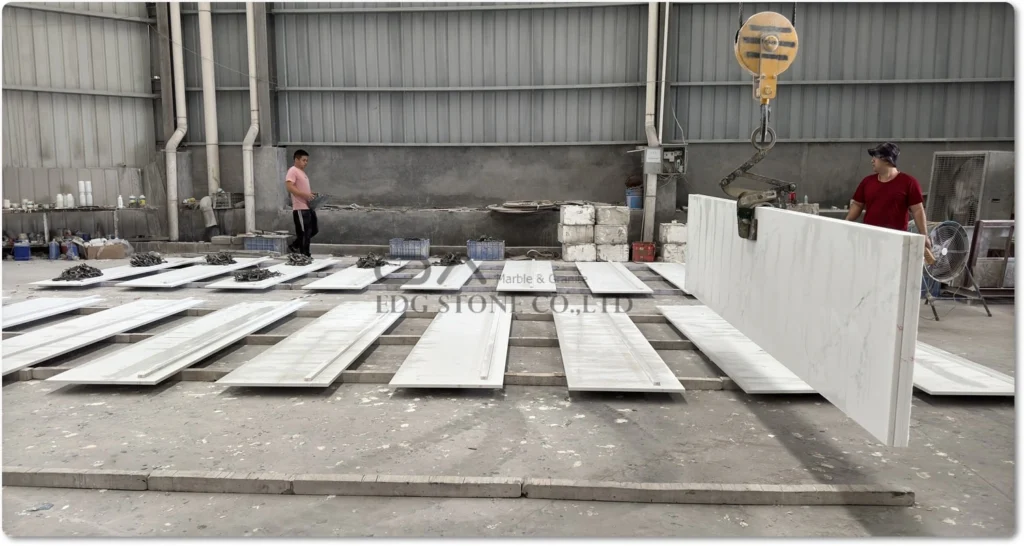
9. How to Buy White Quartz Countertops from a Manufacturer or Factory?
For homeowners, purchasing through a local fabricator may be the simplest option.
For distributors, builders, developers, kitchen companies, and international buyers, sourcing directly from a white quartz countertops manufacturer or factory can provide additional advantages.
What to Ask a Quartz Manufacturer
Product Specifications?
Request:
- Slab dimensions
- Thickness options
- Surface finish
- Weight
- Composition information
- Available colors
- Vein direction
- Production tolerances
Quality Control
Ask how the factory controls:
- Color consistency
- Thickness
- Surface flatness
- Edge quality
- Vein placement
- Slab defects
- Packaging
Project Capability
For wholesale projects, ask whether the supplier can provide:
- Sample approval
- Full-slab photos
- Production samples
- Container loading
- Export packaging
- Custom dimensions
- Repeat production
- Technical documentation
Why Factory Direct Can Matter
A professional factory relationship is especially valuable when the project requires dozens or hundreds of slabs.
The buyer needs more than a competitive price. They need repeatability.
For example, a hospitality project may require the same white Calacatta quartz design across multiple buildings. Consistent production becomes more important than simply finding the lowest initial quotation.
10. White Quartz Countertops Wholesale Buying Guide
Wholesale buyers should evaluate suppliers using a broader procurement framework.
1. Product Consistency
Can the manufacturer reproduce the same background color and vein structure?
2. Production Capacity
Can the factory handle the required monthly or project volume?
3. Quality Control
Does the supplier have documented inspection procedures?
4. Packaging
Are slabs protected against breakage during international transportation?
5. Documentation
Can the supplier provide technical specifications and relevant compliance documentation for the target market?
6. Lead Time
A low price is not useful if production delays disrupt the project schedule.
7. After-Sales Support
Professional suppliers should have a clear process for handling quality claims and replacement requirements.
For international procurement, EDG Stone can position itself around factory capability, project coordination, export packaging, quality control, custom fabrication, and wholesale supply rather than competing only on price.
11. How Are White Quartz Countertops Installed?
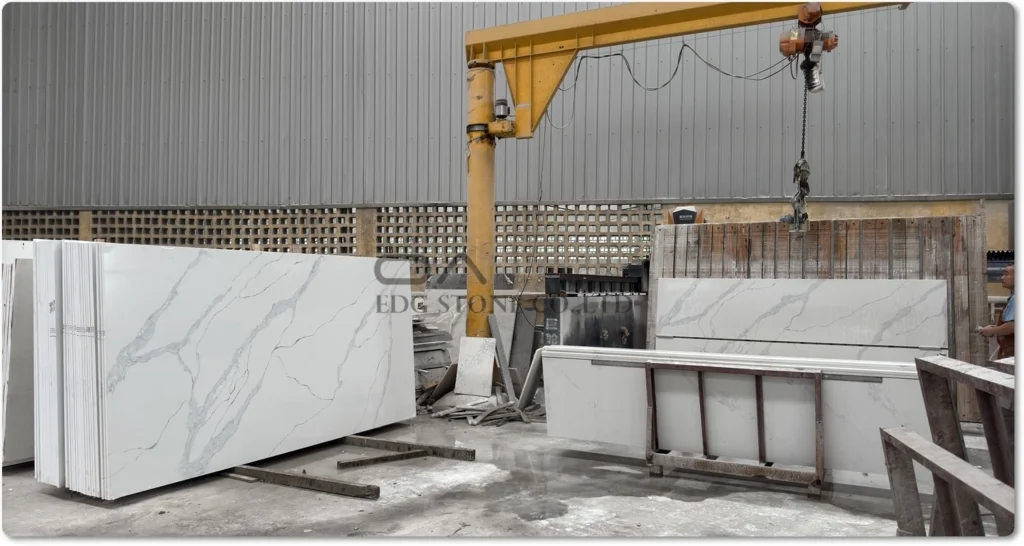
Professional installation generally involves several stages.
Step 1: Site Measurement
The installer verifies cabinet dimensions, walls, corners, sink locations, appliances, and overhangs.
Step 2: Template
A digital or physical template is created to determine cutting dimensions.
Step 3: Slab Selection
For veined quartz, slab orientation is particularly important.
The installer should determine how the veins will flow across:
- Islands
- Peninsulas
- Backsplashes
- Waterfall edges
Step 4: Fabrication
The slabs are cut and processed using appropriate equipment.
Step 5: Installation
The fabricated pieces are positioned, leveled, joined, and secured.
Step 6: Final Inspection
The installer checks:
- Seam quality
- Edge finish
- Sink fit
- Level
- Overhang
- Surface condition
- Cabinet support
For large-format or highly veined quartz, installation planning should begin before fabrication—not after the slabs have already been cut.
12. How to Clean White Quartz Countertops?
One of the biggest advantages of white quartz is relatively straightforward routine cleaning.
Daily Cleaning
Use:
- Warm water
- Mild dish soap
- Soft cloth
- Non-abrasive sponge
Wipe spills promptly, particularly:
- Coffee
- Tea
- Wine
- Tomato sauce
- Cooking oils
- Food dyes
What to Avoid
Avoid unnecessary use of:
- Highly abrasive powders
- Strong solvents
- Harsh chemical cleaners
- Abrasive scouring pads
- Prolonged exposure to aggressive chemicals
Always follow the specific manufacturer’s care instructions because formulations and warranties can differ.
13. White Quartz Countertops Reviews: What Should Buyers Look For?
When evaluating white quartz countertop reviews, do not focus only on star ratings.
Look for comments concerning:
- Actual color
- Slab consistency
- Vein appearance
- Stain behavior
- Fabrication
- Installation
- Customer service
- Warranty
- Long-term appearance
A useful review should tell you what happened after installation, not simply whether the sample looked attractive.
For commercial buyers, supplier references and completed project examples can be even more valuable than consumer reviews.
14. Regulatory Changes Are Reshaping the Quartz Countertop Industry
This is one of the most important developments buyers should understand in 2026.
The issue is not the normal use of a finished countertop in a home. The major occupational concern involves respirable crystalline silica generated during cutting, grinding, drilling, polishing, and related fabrication activities.
OSHA states that respirable crystalline silica exposure can cause silicosis, lung cancer, COPD, and kidney disease, and identifies countertop manufacturing, finishing, and installation among activities where exposure can occur.
Under OSHA’s general-industry standard, the permissible exposure limit for respirable crystalline silica is 50 μg/m³ as an 8-hour time-weighted average, with an action level of 25 μg/m³.
California has gone further. Cal/OSHA’s rules include enhanced protections for high-exposure trigger tasks involving artificial stone and other silica-containing materials. The California Department of Industrial Relations states that these protections include wet methods, safe housekeeping, respiratory protection, medical surveillance, medical removal protections, and reporting requirements.
More recently, California convened an advisory meeting in July 2026 concerning proposed emergency rulemaking to prohibit fabrication of engineered stone countertops containing more than 1% crystalline silica. This is a proposed regulatory action, not something buyers should describe as an already-effective statewide ban.
This regulatory direction has an important implication for the industry:
The future of quartz procurement will increasingly involve not only color, price, and design, but also material composition, fabrication controls, worker protection, documentation, and market-specific compliance.
For importers, distributors, manufacturers, and project developers, this means supplier due diligence is becoming more important.

15. What Does This Mean for the Future of White Quartz?
The white quartz category is likely to continue moving in several directions.
Lower-Silica and Alternative Surface Technologies
The regulatory environment is encouraging the industry to investigate formulations and materials with lower crystalline silica content.
This may increase interest in alternative surfaces such as:
- Porcelain slabs
- Sintered stone
- Low-silica engineered surfaces
- Natural stones with lower silica content
- Other advanced mineral surfaces
The important point is that “quartz-look” and “quartz” are not necessarily the same thing.
More Realistic Marble Designs
Calacatta-inspired surfaces are likely to remain important because they combine a premium visual language with engineered production.
More Warm Whites
The market is moving beyond cold pure white toward:
- Ivory
- Cream
- Warm white
- Beige-white
- Soft gray-white
Greater Vein Movement
Large-scale veins and bookmatch-inspired patterns are increasingly valuable for statement islands and hospitality applications.
16. How to Choose the Best White Quartz Countertops?
Use this practical evaluation framework before purchasing.
Appearance
Does the background match the interior design?
Veining
Is the vein subtle, dramatic, linear, cloudy, or highly directional?
Slab Size
Is the slab large enough to minimize unnecessary seams?
Thickness
Does the thickness suit the application and fabrication method?
Finish
Choose between the available polished or other manufacturer-approved finishes according to the project requirements.
Performance
Review the manufacturer’s technical data and warranty.
Fabrication
Confirm that the selected fabricator has appropriate equipment and experience.
Installation
Confirm cabinet support, seam placement, overhang, sink configuration, and access.
Price
Compare landed and installed cost, not only slab price.
Supplier
Evaluate manufacturing capability, quality control, communication, export experience, packaging, and project support.
17. White Quartz Countertops Buying Checklist
Before placing an order, confirm:
- Product name and SKU
- Exact background color
- Vein color
- Vein direction
- Slab dimensions
- Thickness
- Surface finish
- Quantity
- Sample approval
- Full-slab inspection procedure
- Fabrication requirements
- Packaging specification
- Shipping method
- Lead time
- Warranty
- Technical documentation
- Market-specific compliance requirements
- Installation requirements
- Maintenance instructions
For large commercial projects, create a written approved material specification before mass production.
This prevents the common problem where a buyer approves a small sample but receives slabs with a substantially different visual effect.
18. Final Buying Advice: Is White Quartz Right for Your Project?
White quartz countertops remain one of the most flexible surface categories for modern kitchens and interior projects.
The best choice depends on the intended design and procurement strategy.
For a minimalist kitchen, pure white quartz may be ideal.
For a luxury kitchen, Calacatta white quartz with dramatic veins can create a stronger focal point.
For warm interiors, off-white or beige-veined quartz may coordinate better with wood and cream tones.
For statement interiors, white quartz with gold veins or black veins can provide stronger contrast.
For glamorous applications, white quartz with sparkle adds reflective detail.
For wholesale and commercial procurement, however, the most important question is not simply:
“Which white quartz countertop is cheapest?”
The better question is:
“Which supplier can consistently deliver the required design, quality, volume, fabrication support, packaging, documentation, and long-term project reliability at the right landed cost?”
That is where the difference between a simple quartz reseller and a professional white quartz countertops manufacturer, factory, and wholesale supplier becomes significant.
EDG Stone can use this procurement model to serve distributors, retailers, contractors, kitchen companies, designers, developers, hospitality projects, and international stone buyers looking for dependable surface sourcing rather than one-off material transactions.
19. Frequently Asked Questions About White Quartz Countertops
1. Are white quartz countertops a good choice for kitchens?
Yes. White quartz is popular for kitchens because it offers a broad range of colors and patterns, relatively simple routine maintenance, and strong design flexibility. However, buyers should follow the manufacturer’s care and heat-use recommendations.
2. How much do white quartz countertops cost?
White quartz countertop pricing varies by design, thickness, supplier, fabrication, installation, logistics, and location. Basic white designs typically cost less than premium Calacatta, gold-veined, or highly customized designs. Wholesale buyers should compare total landed cost rather than slab price alone.
3. Are white quartz countertops better than granite?
Neither is universally better. White quartz generally offers more predictable engineered designs and greater consistency, while granite provides naturally occurring geological variation. The right choice depends on appearance, application, maintenance expectations, sourcing, and project requirements.
4. How do you clean white quartz countertops?
Routine cleaning can generally be performed with warm water, mild soap, and a soft cloth. Avoid abrasive cleaning materials and aggressive chemicals unless specifically approved by the manufacturer.
5. What are the most popular white quartz countertop designs?
Popular options include pure white, warm white, off-white, Calacatta-style white quartz, white quartz with gray veins, beige veins, black veins, brown veins, gold veins, and subtle sparkle designs. The best choice depends on cabinetry, flooring, lighting, and overall interior style.
20. Semantic Content Loop: White Quartz Countertops — What Buyers Should Understand Before Choosing?
What Is the Core Value of White Quartz Countertops?
White quartz countertops combine a highly controlled engineered appearance with a broad design vocabulary, ranging from pure white and warm white to Calacatta-style veining, gold accents, black veins, beige movement, and sparkle effects. Their primary value is not simply “white color,” but the ability to deliver a coordinated surface appearance across residential and commercial projects.
Why Do Buyers Choose White Quartz Instead of Other Countertop Materials?
The strongest reason is design flexibility. White quartz can imitate several visual characteristics associated with natural stone while providing manufacturers with greater control over color, pattern, and repeatability. This makes it particularly useful when a project requires multiple slabs with a similar appearance.
What Options Should Buyers Compare?
Buyers should compare pure white, off-white, warm white, Calacatta-style, gray-veined, beige-veined, black-veined, brown-veined, gold-veined, and sparkle quartz according to the project’s lighting, cabinetry, flooring, architectural style, slab size, and desired visual movement. The “best” white quartz is therefore application-specific rather than universal.
What Should Buyers Consider Beyond Appearance?
A professional purchasing decision should include slab dimensions, thickness, finish, technical specifications, quality control, fabrication capability, installation requirements, warranty, logistics, packaging, supplier capacity, and market-specific compliance requirements. For wholesale buyers, repeatability and supply-chain reliability can be more important than the lowest initial quotation.
How Is the Industry Changing?
The engineered-stone industry is undergoing a major shift toward occupational safety, silica exposure control, regulatory compliance, and alternative material technologies. OSHA continues to emphasize silica exposure prevention in countertop manufacturing and installation, while California has implemented enhanced protections and is evaluating further restrictions on high-silica engineered stone fabrication.
What Should the Future White Quartz Procurement Model Look Like?
Future procurement will increasingly combine design + performance + manufacturing transparency + worker-safety controls + compliance documentation + logistics + total landed cost. Buyers should therefore evaluate a supplier as a manufacturing and project-support partner rather than simply as a source of inexpensive slabs.
What Is the Bottom Line?
White quartz countertops remain a major design option because they connect the visual appeal of bright stone surfaces with engineered consistency and extensive pattern choices. The most successful purchases come from matching the right design to the application and selecting a supplier capable of delivering consistent quality, reliable production, professional packaging, appropriate documentation, and long-term project support.