Updated: August 2026
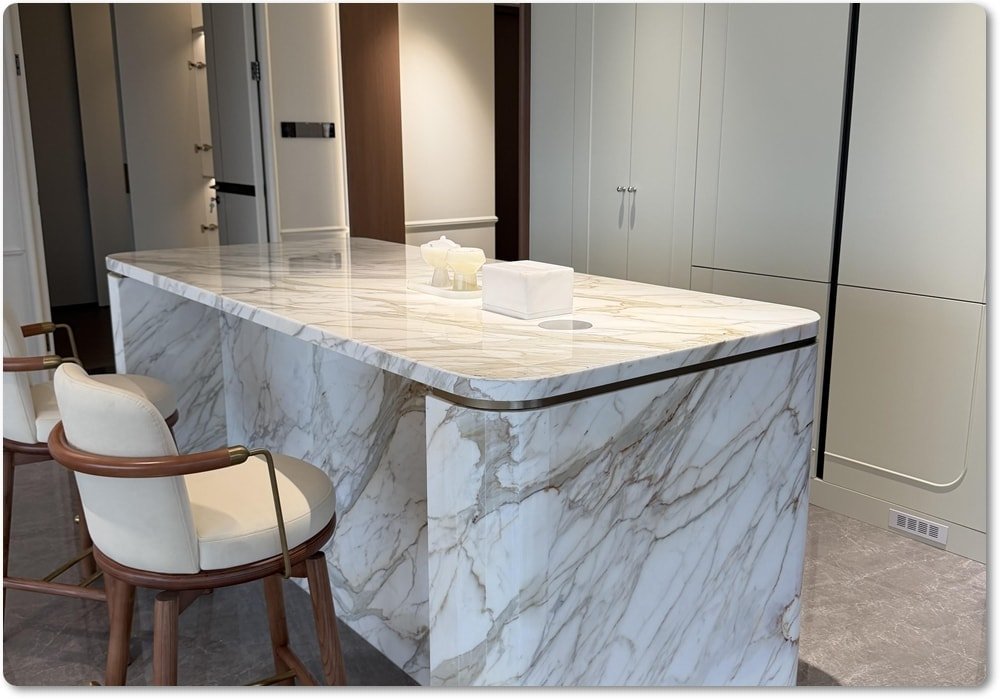
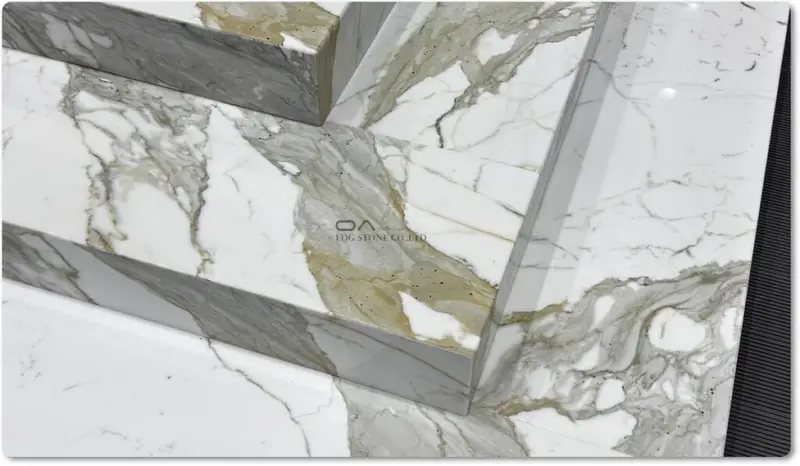
Marble countertops remain one of the most recognizable natural-stone surfaces in residential and hospitality design. But marble countertop cost is not determined by the stone alone.
The final budget depends on several variables: marble type, slab size, thickness, material yield, veining, fabrication, edge profile, cutouts, finish, delivery, installation, site conditions, and project location.
For U.S. residential projects, current public cost guides show a wide market range. HomeAdvisor reports an average marble countertop project cost of about $3,000, with typical projects ranging from approximately $2,000 to $5,000. Angi also reports an average of around $3,000, while Fixr reports a national average of about $3,500 and a broader range of $1,750–$7,000. These figures are consumer-market benchmarks, not factory quotations.
The purpose of this guide is to explain why marble countertops cost what they cost and how buyers, designers, contractors, importers, and developers can control the total project cost.
1. Executive Summary
A marble countertop quotation should never be evaluated only by asking:
“How much is marble per square foot?”
A professional quotation should answer at least eight questions:
- What marble is being used?
- What is the slab thickness?
- How much slab area must be purchased?
- How much material becomes usable countertop?
- What fabrication is required?
- How many cutouts and seams are needed?
- What finish and edge profile are required?
- Does the price include delivery and installation?
Public U.S. cost guides currently place common marble material pricing roughly in the $40–$100+ per square foot range, while premium and specialty marble can exceed $100 per square foot and reach much higher levels. HomeAdvisor currently reports an overall marble range of $15–$190 per square foot across the market, with many projects falling around $25–$60 per square foot.
Installed pricing is higher because fabrication, labor, transportation, templates, cutouts, edge work, installation, and other project costs sit on top of the stone.
The key procurement lesson is simple:
Compare complete specifications, not only material prices.
2. Key Takeaways
- Marble countertop cost varies widely by stone type and project complexity.
- Common Carrara marble is generally less expensive than rare Calacatta or highly selected Statuario.
- Slab pricing and installed countertop pricing are not the same thing.
- A small countertop can require purchasing a much larger slab.
- Bookmatching and vein matching can increase material waste and fabrication labor.
- Edge profiles influence fabrication cost.
- Sink, cooktop, faucet, and outlet cutouts add fabrication work.
- Demolition and disposal can add significant project cost.
- Marble is a calcareous stone and can react with acidic substances.
- Sealing improves stain resistance but does not make marble stain-proof.
- ASTM C503/C503M provides a recognized specification framework for marble dimension stone.
- U.S. construction and remodeling demand remains commercially important, although recent construction spending data show a mixed market.
- For large projects, factory-direct procurement can reduce unnecessary layers in the supply chain, but buyers must control specifications, quality inspection, packaging, and logistics.
3. What Is a Marble Countertop?
Definition
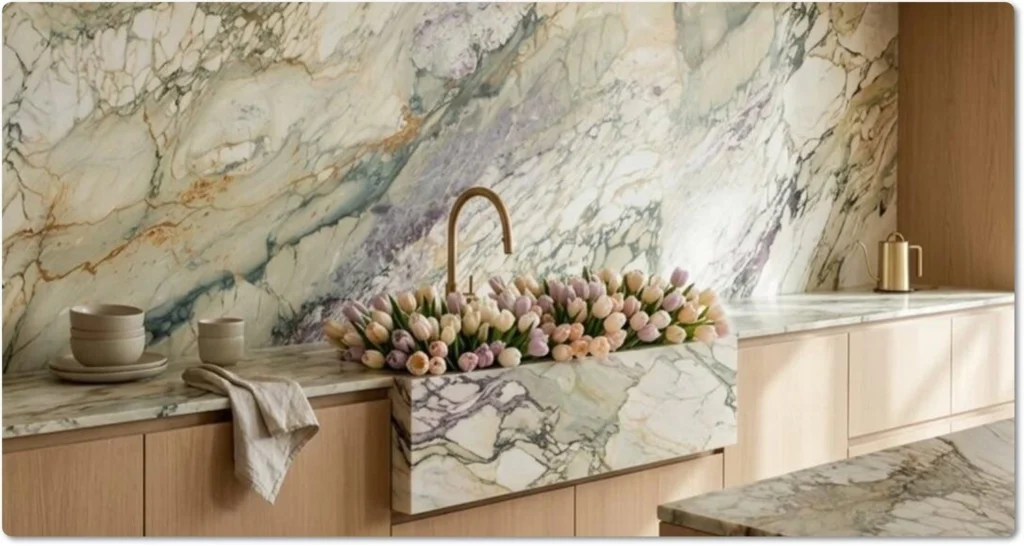
A marble countertop is a fabricated natural-stone surface produced from marble blocks or slabs.
Marble is generally a metamorphic carbonate rock. Commercial countertop marble may contain mainly calcite or dolomite, depending on its geological composition.
ASTM C503/C503M covers marble dimension stone and identifies physical properties such as absorption, density, compressive strength, abrasion resistance, flexural strength, and modulus of rupture as relevant characteristics for specification and selection.
This distinction matters.
A marble countertop is not simply a piece of polished rock.
The final product is the result of:
Quarrying → Block Selection → Slab Production → Inspection → Cutting → CNC Fabrication → Edge Processing → Polishing → Quality Control → Packaging → Shipping → Installation
Each step can affect the final price.
4. 2026 Marble Countertop Cost at a Glance
| Cost Element | Typical Market Position | Main Cost Driver |
|---|---|---|
| Common marble material | Lower to mid range | Availability and selection |
| Premium marble | Mid to high range | Rarity and appearance |
| Luxury marble | High to very high | Quarry, rarity, veining |
| Fabrication | Variable | Cutouts, edges, seams |
| Installation | Variable | Labor and site conditions |
| Demolition | Additional | Existing countertop |
| Delivery | Additional | Distance and weight |
| Bookmatching | Premium | Slab selection and yield |
| Waterjet/CNC work | Premium | Design complexity |
| Custom edge | Premium | Linear feet and profile |
| Restoration | Additional lifecycle cost | Damage and surface condition |
HomeAdvisor’s current 2026 guide estimates marble slabs at around $40–$100 per square foot in many common cases, while reporting an average of approximately $60 per square foot. Its broader material table shows that specialty marble can reach around $190 per square foot.
HomeGuide reports a broader $30–$130 per square foot fabricated-slab range and an installed range of approximately $40–$150 per square foot. These figures demonstrate why a single “marble price” is misleading.
5. How Is the Marble Countertop Cost Calculated?
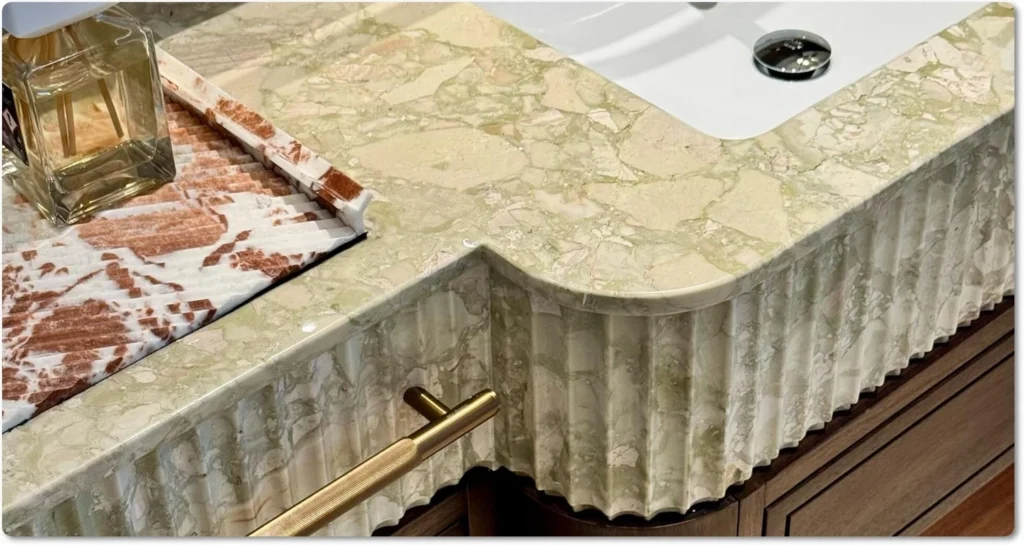
A useful budgeting model is:
Total Cost = Material + Fabrication + Edge Work + Cutouts + Finishing + Packaging + Delivery + Installation + Site Work + Taxes/Fees
For international procurement, add:
International Cost = Factory Price + Packing + Inland Freight + Port Charges + Ocean Freight + Insurance + Customs/Duties + Local Delivery + Fabrication/Installation
The second formula is especially important for commercial buyers.
A factory price may look low while the final landed cost becomes much higher after logistics and local fabrication.
6. Material Cost: The First Major Variable
6.1 Marble Type
The marble itself can create the largest price difference.
Public 2026 cost data show examples such as:
| Marble Type | Indicative Material Benchmark |
| Makrana | Lower-cost segment |
| Carrara | Common mid-market option |
| Statuario | Premium segment |
| Danby | Premium segment |
| Calacatta | High-end segment |
| Rare specialty marble | Potentially very high |
HomeAdvisor currently lists examples including approximately $40/SF for Carrara, $50/SF for Statuario, $80/SF for Danby, and $180/SF for Calacatta. These numbers are useful for understanding market positioning, but they should not be treated as universal wholesale prices.
Why does Calacatta cost more?
Price can rise because of:
- quarry availability
- block quality
- background whiteness
- vein structure
- color contrast
- slab consistency
- size
- selection ratio
- international demand
- design preference
The commercial value is therefore not simply based on geology.
It is also based on visual selection.
7. Slab Price Is Not Countertop Price
This is one of the most important concepts in marble procurement.
Suppose a kitchen requires 45 square feet of finished countertop.
That does not mean the buyer should purchase exactly 45 square feet of marble.
The fabricator may need:
- one full slab
- two slabs
- additional material for vein matching
- extra material for backsplash
- additional material for waterfall edges
- material for repairs or selection
The usable yield depends on the slab dimensions and countertop geometry.
Example
A project needs:
45 SF finished countertop
But the slab layout may require:
65–75 SF purchased material
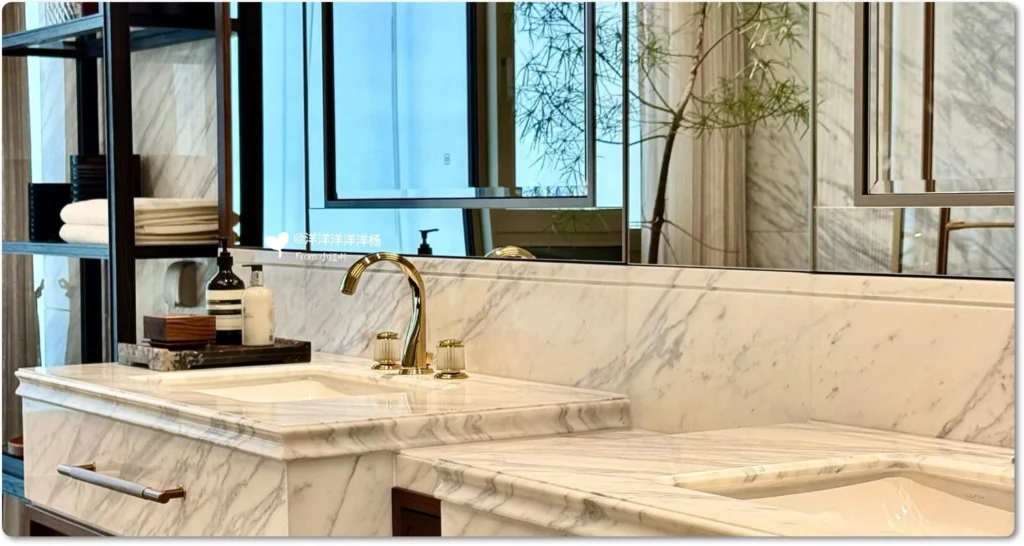
The buyer therefore pays based on the required slab selection and fabrication yield rather than only the finished surface area.
This is why a lower material price does not always produce a lower project cost.
8. Material Yield and Waste
Material yield is a technical and commercial issue.
A simple rectangular countertop has relatively efficient material use.
An L-shaped kitchen creates more offcuts.
A large island with a waterfall edge requires even more planning.
Bookmatched slabs can increase the required slab count because the slabs must be selected as a coordinated visual set.
Simplified Procurement Model
Finished Area ÷ Usable Yield = Required Material Area
For example:
If a project needs 50 SF of finished countertop and the effective yield is 75%:
50 ÷ 0.75 = 66.7 SF
The project may therefore require approximately 67 SF of usable slab inventory.
This is only a planning formula. Actual yield must be calculated from the slab dimensions and approved cutting layout.
9. Fabrication Cost
Fabrication converts a slab into a countertop.
Typical operations include:
- digital templating
- slab layout
- cutting
- CNC processing
- sink cutouts
- cooktop cutouts
- faucet holes
- outlet openings
- edge profiling
- polishing
- seam preparation
- reinforcement
- inspection
Simple fabrication costs less than complex fabrication.
A straight kitchen with a standard eased edge is easier to fabricate than a large island with multiple curves, waterfall sides, mitered edges, and bookmatched veins.
10. Edge Profile Cost
Edge profiles are often underestimated during budgeting.
Common options include:
- eased edge
- pencil edge
- bevel
- bullnose
- half bullnose
- ogee
- Dupont
- mitered edge
- waterfall edge
HomeAdvisor’s 2026 data indicate that simple edge treatments can be considerably less expensive than more elaborate profiles, with published examples ranging from around $10–$12 per linear foot for simpler profiles to $30–$40 for more ornate treatments.
Actual fabrication pricing varies by fabricator and region.
For commercial procurement, always request the edge profile in the specification.
11. Cutout Costs
Cutouts are another cost driver.
Typical cutouts include:
- undermount sink
- farmhouse sink
- drop-in sink
- cooktop
- faucet
- soap dispenser
- electrical outlet
- charging station
Each cutout requires additional fabrication and quality control.
Complex sink designs can require reinforcement and more detailed edge finishing.
The safest procurement method is to provide the actual appliance and sink specifications before fabrication.
12. Thickness and Structural Design
Common countertop thicknesses include:
- 2 cm
- 3 cm
- laminated edges
- mitered built-up edges
The correct thickness depends on the application and structural design.
Do not assume that a thicker slab is automatically better.
The fabricator should evaluate:
- span
- cabinet support
- overhang
- cutouts
- stone characteristics
- reinforcement
- installation method
ASTM standards provide material and testing frameworks, but project-specific design still requires professional judgment.
13. Finish and Surface Treatment
Common marble finishes include:
| Finish | Appearance | Typical Use |
| Polished | Reflective | Luxury kitchens |
| Honed | Soft/matte | Modern interiors |
| Leathered | Textured | Specialty interiors |
| Brushed | Subtle texture | Decorative applications |
| Antique | Aged appearance | Traditional design |
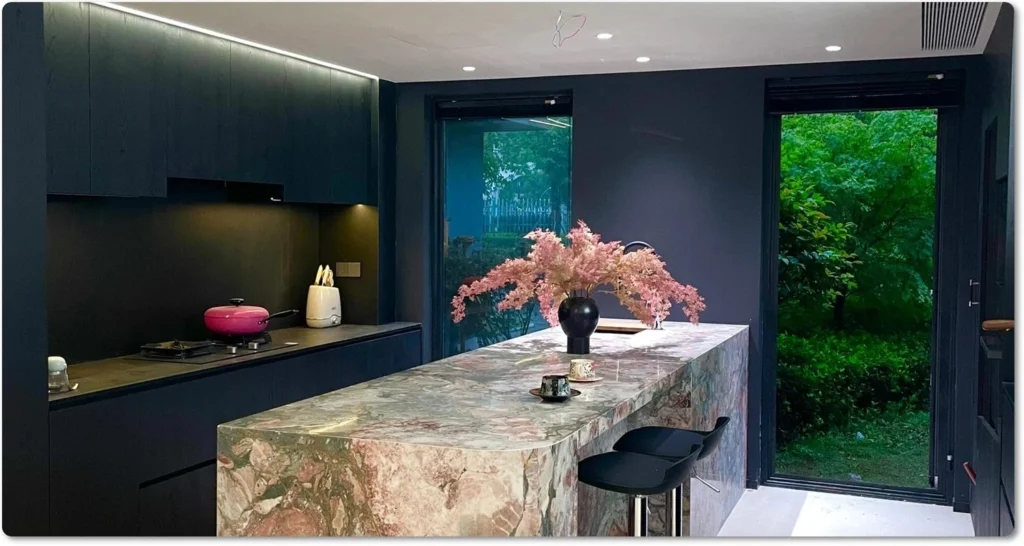
Finish selection affects both appearance and maintenance.
A polished surface can make veining appear stronger.
A honed surface creates a softer appearance but may show certain marks differently.
The correct choice depends on the design goal and expected use.
14. Marble Countertops by Application
14.1 Kitchen Countertops
Kitchen countertops require careful material selection because food, oils, acids, heat, impact, and daily cleaning can affect the surface.
Marble is especially sensitive to acids.
The Natural Stone Institute classifies marble as a calcareous stone and explains that acidic products such as lemon and vinegar can dull or etch susceptible stones.
For a kitchen, the buyer should consider:
- stain resistance
- etching risk
- finish
- sealing
- cleaning routine
- cooking habits
- desired aging appearance
Marble can be an excellent kitchen material for users who understand its characteristics.
It is not the best choice for buyers who expect a surface to remain completely unchanged under heavy use.
15. Bathroom Vanity Tops
Marble is often a strong design choice for:
- master bathroom vanities
- hotel bathrooms
- luxury apartments
- powder rooms
- hospitality projects
Bathroom vanity tops generally experience less direct food-related acid exposure than kitchens.
However, cosmetics, hair products, soaps, water, and cleaning chemicals can still affect natural stone.
The procurement specification should therefore include:
Marble type + thickness + finish + edge + sink cutout + faucet holes + backsplash + sealing requirement
16. Luxury Hospitality Applications
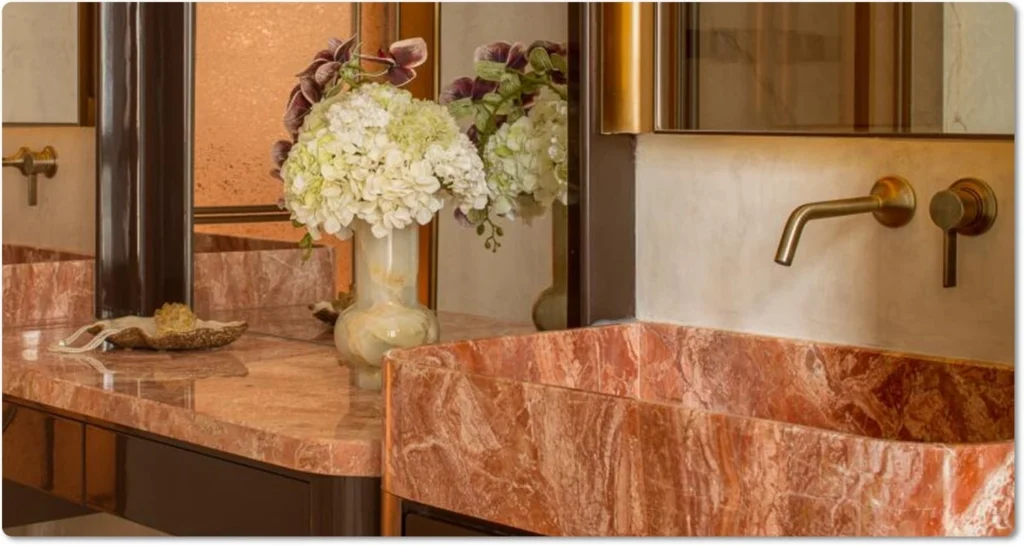
Hotels and resorts may use marble for:
- bathroom vanity tops
- reception counters
- bar counters
- restaurant counters
- executive suites
- spa areas
- lobby features
Commercial projects require more than visual selection.
Buyers should evaluate:
- repeatability
- batch consistency
- slab availability
- replacement availability
- fabrication tolerance
- packaging
- shipping
- installation sequence
- spare material
For large developments, a stable supply program can be more valuable than obtaining the lowest first quotation.
17. Marble vs. Granite vs. Quartzite vs. Quartz
| Factor | Marble | Granite | Quartzite | Engineered Quartz |
| Natural stone | Yes | Yes | Yes | No |
| Veining | Excellent | Variable | Excellent | Engineered |
| Acid sensitivity | High | Generally lower | Generally lower | Depends on formulation |
| Sealing | Often considered | Depends on stone | Often considered | Usually not required |
| Heat resistance | Good | Very good | Very good | Follow manufacturer guidance |
| Maintenance | Higher | Lower | Moderate | Lower |
| Design character | Very high | High | Very high | High |
| Custom luxury use | Excellent | Excellent | Excellent | Excellent |
| Price range | Very broad | Very broad | Broad | Broad |
The Natural Stone Institute emphasizes that stone chemistry matters when choosing cleaning and maintenance methods. Calcareous stones such as marble are more sensitive to acids than siliceous stones.
Quartzite should not be confused with engineered quartz.
ASTM’s dimension-stone framework treats quartz-based stone and quartzite separately from marble.
18. Marble Countertop Pros and Cons
Pros
1. Natural appearance
Each slab has a unique pattern.
2. Strong design value
Marble works with traditional, transitional, modern, and luxury interiors.
3. Excellent veining
Premium marble can create strong visual focal points.
4. Fabrication flexibility
Natural marble can be cut, polished, CNC-machined, and finished into many custom forms.
5. Long service potential
With appropriate use and maintenance, natural stone can remain in service for many years.
6. Repairability
Certain scratches, chips, and surface defects can be repaired or refinished by qualified professionals.
HomeAdvisor notes that marble countertops can serve for decades with routine care.
Cons
1. Acid etching
Acidic substances can damage the finish.
2. Staining risk
Porous stones may absorb liquids.
3. Scratching
Marble is generally softer than granite and quartzite.
4. Maintenance
Users need suitable cleaners and reasonable care.
5. Variation
Natural variation is part of the product.
6. Higher premium-material cost
Rare slabs can become expensive.
19. Marble Maintenance and Lifecycle Cost
The purchase price is only one part of ownership cost.
The Natural Stone Institute states that sealing can increase stain resistance but does not make natural stone completely stain-proof. It also recommends selecting suitable products for the specific stone and application.
A practical maintenance program includes:
Daily
- Wipe spills quickly.
- Use a soft cloth.
- Avoid acidic cleaners.
Weekly
- Clean with a suitable neutral stone cleaner.
- Remove residue.
Periodically
- Inspect the surface.
- Check areas around sinks and high-use zones.
- Evaluate whether resealing is appropriate.
When damage occurs
- Identify whether the problem is staining, scratching, or etching.
- Use professional restoration when needed.
HomeAdvisor currently estimates marble countertop restoration at approximately $4–$20 per square foot, with an average around $12 per square foot.
That makes maintenance part of the total cost of ownership.
20. What Actually Drives the Final Price?
A useful cost hierarchy is:
Tier 1 — Material
Marble type, quarry, rarity, color, and slab quality.
Tier 2 — Quantity
Finished area versus actual slab requirement.
Tier 3 — Fabrication
Cutting, polishing, CNC work, edges, cutouts, and seams.
Tier 4 — Logistics
Packaging, transportation, loading, insurance, and delivery.
Tier 5 — Installation
Labor, site access, cabinet preparation, leveling, and final fitting.
Tier 6 — Design Complexity
Bookmatching, waterfall edges, curves, integrated backsplashes, and special details.
21. U.S. Market Statistics and Industry Context
Marble countertop demand should be viewed within the broader construction and remodeling market.
The U.S. Census Bureau reported that total U.S. construction spending reached a seasonally adjusted annual rate of $2.2102 trillion in May 2026. Residential construction was approximately $930.2 billion at a seasonally adjusted annual rate.
The Census Bureau’s construction-spending methodology includes both new construction and improvements to existing structures.
The National Association of Home Builders also identified aging housing stock and accumulated home equity as factors supporting remodeling activity.
At the same time, the U.S. Geological Survey reported that U.S. dimension-stone sales had declined in recent years through 2025, while the United States remained one of the world’s major dimension-stone markets.
This creates an important commercial conclusion:
The market is large, but buyers are becoming more cost-sensitive and specification-driven.
22. Engineering Quality: What Buyers Should Ask For?
Do not rely only on terms such as:
- Grade A
- Premium
- First Choice
- Super White
- Luxury Quality
These terms can have different meanings between suppliers.
Instead, ask for measurable information.
ASTM C503/C503M identifies relevant physical properties for marble dimension stone, including absorption, density, compressive strength, abrasion resistance, flexural strength, and modulus of rupture.
For a serious project, request:
- Stone name
- Quarry/source
- Country of origin
- Slab dimensions
- Thickness
- Finish
- Water absorption data where relevant
- Visual inspection standard
- Fissure/fill disclosure
- Resin treatment disclosure
- Fabrication tolerance
- Packaging specification
- Inspection procedure
- Approved sample
- Replacement policy
23. Natural Variation Is Not Automatically a Defect
Natural marble contains geological variation.
Possible characteristics include:
- veins
- crystals
- mineral changes
- small fissures
- color variation
- pits
- movement
- open areas
- filled areas
The procurement contract should define which characteristics are acceptable.
This is especially important for white marble.
A buyer expecting a perfectly uniform engineered surface may be disappointed by natural marble.
A buyer who understands natural variation can use it as part of the design.
24. Bookmatching: Why Luxury Projects Cost More?
Bookmatching means placing slabs so their veining creates a mirrored or coordinated visual pattern.
It is popular for:
- luxury kitchen islands
- fireplace walls
- hotel lobbies
- bathroom feature walls
- reception desks
- luxury villas
Bookmatching increases cost because:
- slabs must be visually selected as a set
- cutting layouts become more restrictive
- material yield can decline
- fabrication requires more planning
- installation requires greater precision
For a large luxury project, the buyer should approve the
25. Custom Marble Countertop Fabrication Workflow
Project Brief
      ↓
Site Measurements / CAD
      ↓
Marble Selection
      ↓
Slab Inspection
      ↓
Digital Layout
      ↓
Customer Approval
      ↓
CNC / Saw Cutting
      ↓
Edge Processing
      ↓
Cutouts
      ↓
Polishing / Honing
      ↓
Quality Inspection
      ↓
Protective Packaging
      ↓
Delivery
      ↓
Installation
      ↓
Final Inspection
This workflow reduces avoidable errors.
For complex projects, CAD drawings and approved slab layouts should be part of the purchasing package.
26. How to Reduce Marble Countertop Cost Without Reducing Quality?
Strategy 1: Choose the right marble
Do not automatically choose the rarest stone.
A visually attractive Carrara or other commercially available marble may deliver better value.
Strategy 2: Optimize slab layout
Ask the fabricator to produce a cutting layout before purchasing slabs.
Strategy 3: Avoid unnecessary complexity
Simple edges and fewer cutouts reduce fabrication work.
Strategy 4: Use standard dimensions where possible
Standard designs can improve production efficiency.
Strategy 5: Purchase directly from a qualified factory
For larger projects, factory-direct procurement can reduce unnecessary trading layers.
Strategy 6: Consolidate shipments
Multiple small shipments can increase logistics costs.
Strategy 7: Approve samples early
Early approval reduces rework risk.
27. Local Retail vs. Factory-Direct Procurement
| Factor | Local Retail/Fabricator | Factory-Direct |
| Local installation | Strong | Usually requires local installer |
| Product selection | Depends on inventory | Often broader |
| Custom fabrication | Strong | Strong |
| Factory pricing | Usually higher supply-chain layers | Potentially more competitive |
| International logistics | Simpler | Buyer must manage/import |
| Large-volume projects | Good | Often attractive |
| Project control | Medium | High if specifications are clear |
| Quality inspection | Local | Must be built into procurement |
Factory-direct purchasing does not automatically mean lower cost.
The benefit comes from supply-chain control, manufacturing capability, and volume.
28. EDG Stone Factory Case Module
Global Quartzite Slabs & Countertops Manufacturer and Exporter
EDG Stone Factory can be positioned within this procurement model as a manufacturer and exporter serving international stone projects.
The key value of a factory model is not simply the word “factory.”
It is the ability to connect:
Stone Selection → Slab Production → Fabrication → QC → Packing → Export
EDG Stone’s product and fabrication scope can support projects involving:
- marble slabs
- quartzite slabs
- stone countertops
- vanity tops
- CNC stone fabrication
- waterjet cutting
- custom edges
- bookmatched stone
- marble furniture
- architectural stone components
For buyers comparing suppliers, the evaluation should focus on measurable production information rather than generic marketing claims.
Recommended EDG Stone RFQ Package
A commercial buyer should provide:
Project
- Project name
- Country
- Application
- Quantity
Stone
- Material
- Color
- Quarry preference
- Slab size
- Thickness
- Finish
Fabrication
- CAD drawings
- Edge profile
- Sink cutouts
- Cooktop cutouts
- Faucet holes
- Seam locations
- Bookmatch requirements
Quality
- Acceptable variation
- Fissure policy
- Filling requirements
- Surface inspection
- Dimensional tolerance
Logistics
- Packing requirements
- Container loading
- Destination port
- Delivery term
- Required shipment date
This approach allows a buyer to compare suppliers on the same technical basis.
29. Procurement Strategy for Builders, Designers, and Importers
Stage 1 — Define the application
Kitchen, vanity, hospitality, retail, restaurant, or commercial project.
Stage 2 — Define the stone
Do not begin with price.
Begin with:
performance + appearance + availability + budget
Stage 3 — Approve the sample
Use a physical sample or approved slab photographs.
For premium projects, inspect actual slabs.
Stage 4 — Confirm fabrication
Provide CAD drawings.
Stage 5 — Confirm yield
Request a slab layout.
Stage 6 — Confirm commercial terms
Compare:
- EXW
- FOB
- CIF
- DDP where appropriate
Do not compare one supplier’s EXW quotation against another supplier’s CIF quotation.
Stage 7 — Control quality
Define inspection before production.
Stage 8 — Control logistics
Confirm:
- crate design
- moisture protection
- corner protection
- slab separators
- labeling
- container loading
- shipping documents
30. Marble Countertop Cost Example
Consider a hypothetical U.S. kitchen requiring:
45 SF finished countertop
Assume a market benchmark of:
$60/SF material
A simple material calculation would be:
45 × $60 = $2,700
But this is not necessarily the final material cost.
If the cutting layout requires 65 SF of purchased slab:
65 × $60 = $3,900
Then add:
- fabrication
- edge work
- cutouts
- delivery
- installation
- demolition if required
The final project can therefore move significantly above the initial $2,700 assumption.
This example demonstrates the most common budgeting mistake:
Finished countertop area is not the same as purchased slab area.
31. Expert Opinion
From a procurement perspective, the most important question is not:
“What is the cheapest marble countertop?”
The better question is:
“What specification delivers the required appearance and performance at the lowest reliable total cost?”
A professional buyer should optimize five variables:
Stone + Yield + Fabrication + Logistics + Risk
If one supplier offers cheaper marble but produces poor yield, inconsistent slabs, weak packaging, or high rejection rates, the apparent saving may disappear.
For commercial projects, the lowest quotation is not always the lowest cost.
The better metric is:
Total Cost of Ownership + Project Risk
32. Sustainability and Lifecycle Considerations
Natural stone has a long potential service life, but extraction and transportation have environmental impacts.
Architectural Digest’s review of marble sustainability highlights both sides of the issue: marble can be durable and repairable, but quarrying, processing, waste, energy use, water use, and long-distance transportation can increase environmental impact.
For responsible procurement, buyers can ask:
- Where was the stone quarried?
- Where was it processed?
- How far will it travel?
- How much waste is expected?
- Can offcuts be reused?
- Can smaller pieces be used for vanities or backsplashes?
- Is reclaimed stone available?
- What packaging is used?
USGS identifies color, grain texture, pattern, finish, durability, strength, and polishability as important selection factors for dimension stone.
33. Marble Countertop Cost FAQ
Q1. How much do marble countertops cost in 2026?
Public U.S. cost guides currently place typical marble countertop projects around several thousand dollars. HomeAdvisor reports approximately $2,000–$5,000, while Fixr reports $1,750–$7,000. Actual prices depend heavily on stone type, project size, fabrication, location, and installation.
Evidence: Current U.S. consumer cost databases.
Summary: Use these figures as budgeting references, not supplier quotations.
Q2. How much does marble cost per square foot?
Current published U.S. data show a very broad range. HomeAdvisor reports many marble materials around $40–$100 per square foot, with specialty marble reaching much higher prices.
Evidence: HomeAdvisor 2026.
Summary: Marble type and selection quality matter more than a single industry-wide price.
Q3. Is Carrara marble cheaper than Calacatta?
Usually, yes.
Carrara is more widely available and generally occupies a lower price position than rare Calacatta selections. HomeAdvisor’s 2026 examples list Carrara around $40/SF and Calacatta around $180/SF.
Evidence: Current U.S. cost benchmark.
Summary: Availability and visual selection drive much of the price difference.
Q4. Is marble more expensive than quartz?
Not always.
Both materials have wide price ranges. Premium natural marble can cost substantially more than many engineered quartz products, while some marble products can overlap with mid-market quartz.
Evidence: HomeAdvisor’s 2026 countertop comparison shows marble ranging from approximately $15–$190/SF and engineered quartz around $15–$70/SF.
Summary: Compare the exact product and complete installed specification.
Q5. Does marble need to be sealed?
Many marble countertops benefit from appropriate sealing, but sealing does not make the stone stain-proof.
The Natural Stone Institute explains that sealing increases stain resistance rather than creating complete stain protection.
Summary: Follow the stone and sealer manufacturer’s recommendations.
Q6. Can lemon juice damage marble?
Yes.
Marble is generally calcareous, so acids can cause etching.
The Natural Stone Institute specifically warns that acidic products such as lemon and vinegar can dull or etch susceptible natural stone.
Summary: Clean spills promptly and avoid acidic cleaners.
Q7. Is marble good for kitchen countertops?
Yes, if the owner accepts its maintenance requirements.
Marble offers strong visual appeal and good functional performance, but it is more sensitive to acid etching and scratching than some harder countertop materials.
Summary: Marble is a design-led choice rather than a zero-maintenance material.
Q8. What is the most important factor in marble countertop cost?
The largest variables are usually:
stone selection + quantity + fabrication + installation
Rare marble can change the budget dramatically.
Q9. Why can a small countertop require a full slab?
Because slabs have fixed dimensions and the cutting layout may not allow the fabricator to use only the exact finished area.
Summary: Always request a slab layout for larger or expensive projects.
Q10. Is factory-direct marble cheaper?
It can be, especially for wholesale and project quantities, but it is not guaranteed.
The correct comparison is:
factory price + logistics + QC + installation + risk
rather than material price alone.
Q11. What should be included in a marble countertop quotation?
At minimum:
- stone type
- origin
- slab dimensions
- thickness
- finish
- quantity
- fabrication
- cutouts
- edge profile
- packaging
- delivery
- installation
- taxes/duties where applicable
Q12. What ASTM standard applies to marble?
ASTM C503/C503M is the principal ASTM specification for marble dimension stone. It addresses material characteristics and physical requirements such as absorption, density, strength, abrasion resistance, and flexural properties.
Q13. Is natural variation a defect?
Not automatically.
Veins, mineral changes, color movement, and some natural characteristics are inherent to natural stone.
The buyer and supplier should define acceptable characteristics before production.
Q14. Is quartzite the same as marble?
No.
Quartzite and marble have different geological compositions and performance characteristics. ASTM lists quartzite under quartz-based dimension stone, while marble is covered separately by C503/C503M.
Q15. How can commercial buyers reduce marble countertop cost?
The most effective strategies are:
- Select a commercially available stone.
- Optimize slab yield.
- Reduce unnecessary fabrication complexity.
- Standardize dimensions.
- Consolidate shipments.
- Purchase directly from a qualified manufacturer when volume justifies it.
- Control quality before production.
34. Final Summary
Marble countertop cost is a system, not a single number.
The stone itself is only the first variable.
A reliable project budget should consider:
Material → Slab Yield → Fabrication → Edge → Cutouts → Finish → Packaging → Logistics → Installation → Maintenance
For U.S. homeowners, current public cost guides suggest that a typical marble countertop project often falls in the low-thousands-of-dollars range, but premium materials and complex designs can push costs much higher.
For architects, builders, importers, and developers, the procurement process should go further.
The best purchasing decision combines:
Design Quality + Engineering Suitability + Manufacturing Control + Logistics + Total Cost
EDG Stone Factory can be incorporated into this procurement model as a factory-direct source for marble, quartzite slabs, countertops, vanity tops, and custom stone fabrication.
The strongest RFQ is not:
“Please quote marble countertop.”
It is:
“Please quote this exact stone, thickness, finish, slab size, fabrication specification, CAD layout, packaging standard, quantity, and delivery term.”
That level of specification makes supplier comparison faster, reduces ambiguity, and creates a much stronger basis for international stone procurement.