Summary
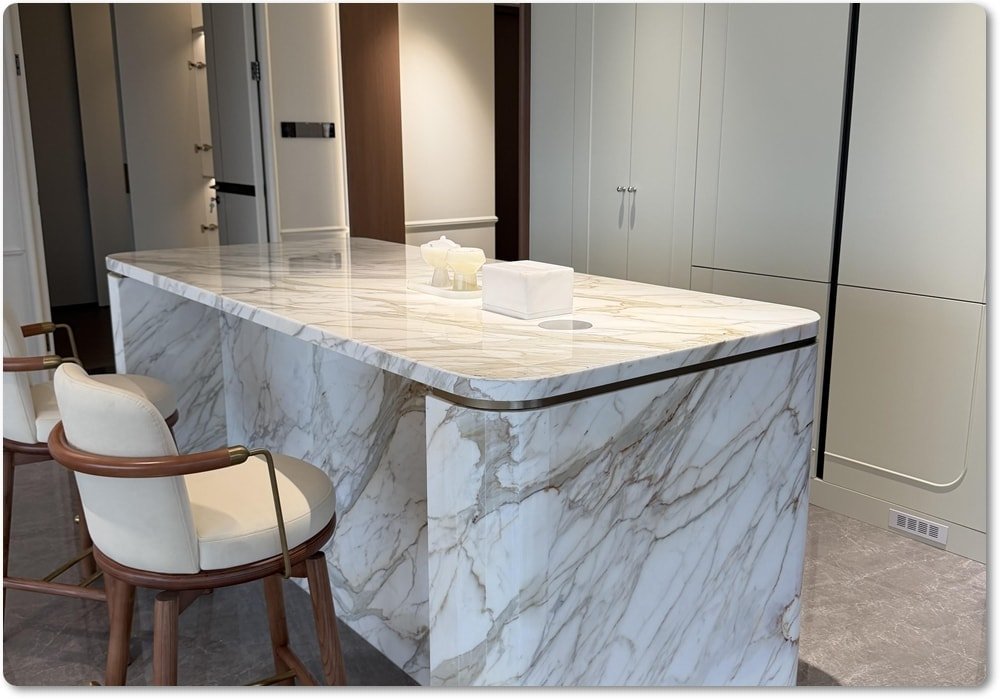
Carrara marble and Calacatta marble represent two of the most popular natural stone materials specified in commercial and residential architecture. While both originate from the Apuan Alps in Tuscany, Italy, they differ in mineral composition, visual characteristics, supply rarity, and physical performance. Carrara marble features a blue-gray background with soft, feathered veining and a higher average density. Calacatta marble presents a bright white background with bold, dramatic veining patterns and commands a higher price per square foot due to limited quarry yields.
Choosing between these two materials impacts project budgets, installation timelines, structural load calculations, and long-term maintenance protocols. This whitepaper analyzes these two Italian marbles across geological properties, mechanical specs, cost benchmarks, fabrication guidelines, and architectural applications.
Key Takeaways
Geological Origin: Both marbles come from Carrara, Italy, but belong to distinct quarry beds with different veining intensity and background color purity.
Cost Difference: Carrara marble averages $40 to $100 per square foot installed, while premium Calacatta marble ranges from $180 to $500+ per square foot.
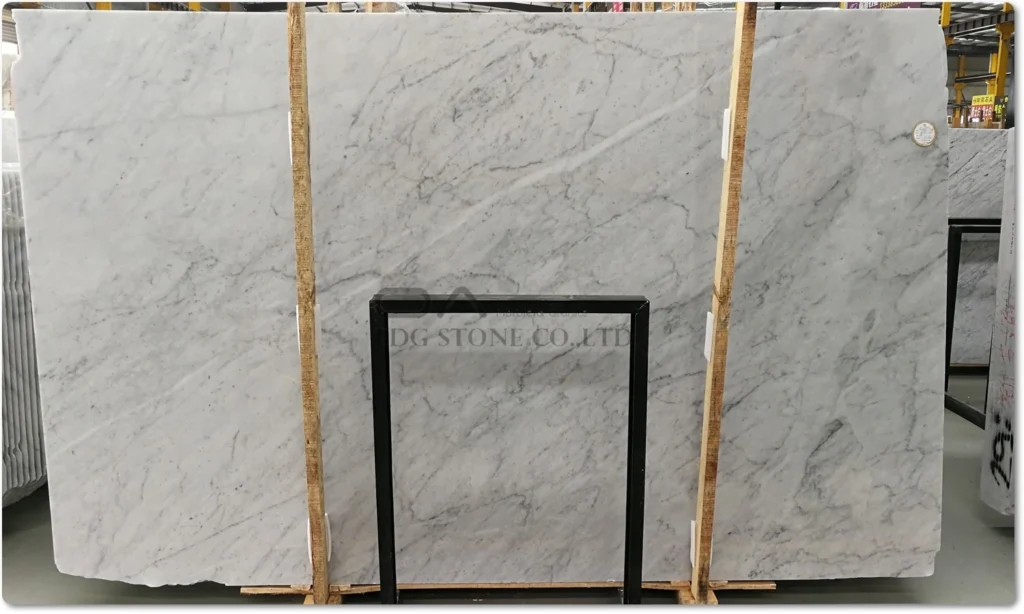
Visual Identification: Carrara displays a grayish-white base with fine, linear, feathered veins. Calacatta exhibits a cold or warm white base with thick, high-contrast gold, gray, or taupe veining.
Porosity & Staining: Carrara has a water absorption rate of approximately 0.15%, whereas Calacatta ranges between 0.20% and 0.25%, requiring more frequent sealing under high-use conditions.
Commercial Specification: Carrara works well for high-foot-traffic flooring and large-scale facade cladding. Calacatta works best for book-matched feature walls, low-traffic executive suites, and high-end residential focal points.
Supply Chain Alternative: Project owners seeking higher stain resistance and lower maintenance often hybridize natural marble designs with engineered Quartzite Slabs & Countertops.
Definitions
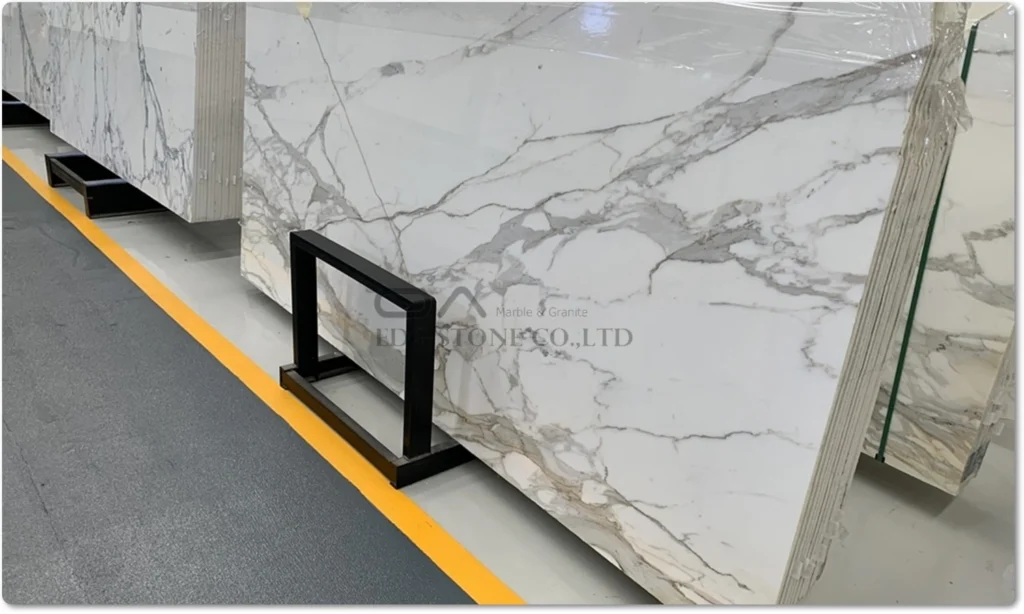
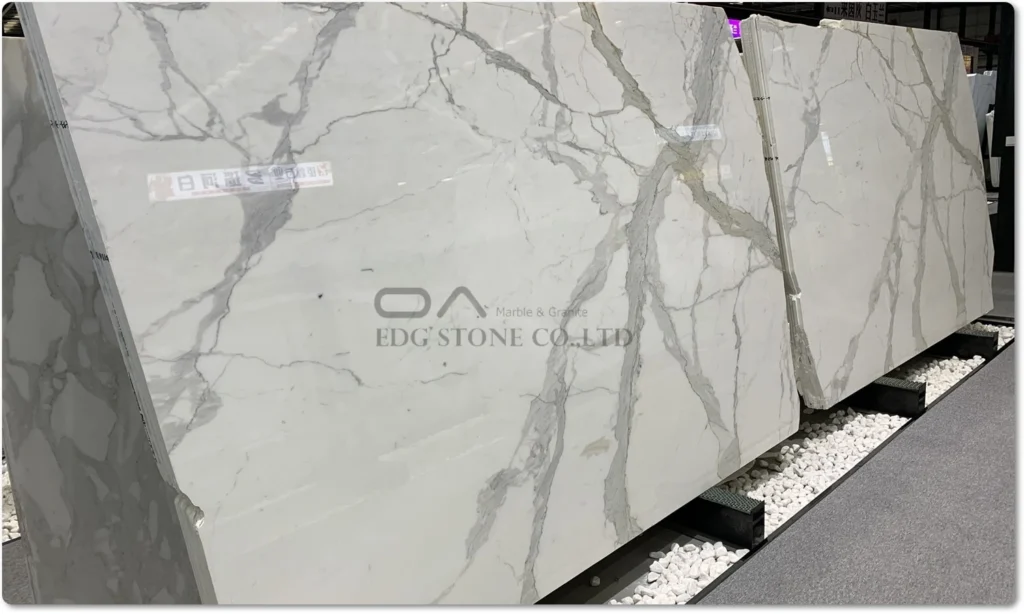
Carrara Marble: A fine-grained, metamorphic calcium carbonate rock quarried in the city of Carrara, Italy. Characterized by its soft gray background and subtle, blurred veining.
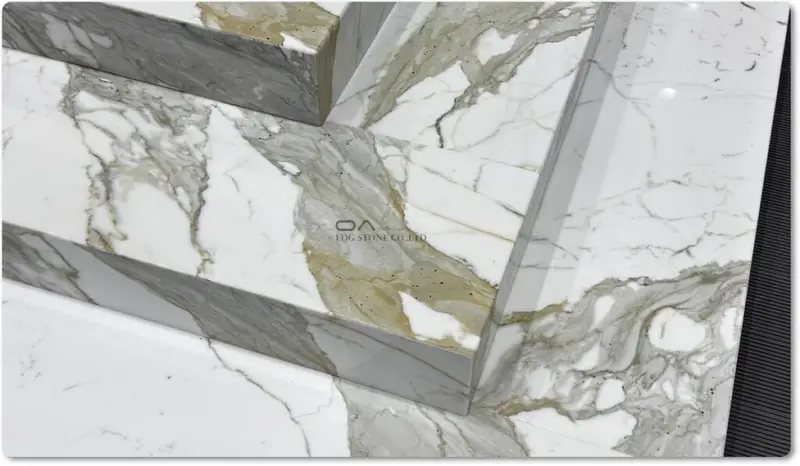
Calacatta Marble: A rare metamorphic marble from the same Tuscan region, valued for its bright white ground and wide, dramatic, interconnected vein networks.
Vein-Matching: The practice of aligning the natural lines of adjacent stone slabs to create a continuous pattern across walls, floors, or countertops.
Book-Matching: The technique of mirroring two consecutive stone slabs from the same block so they resemble an open book.
Honed Finish: A smooth, non-reflective surface finish created by stopping the grinding process just short of a full polish, offering improved slip resistance.
Polished Finish: A high-gloss surface achieved through mechanical grinding and chemical buffering that enhances color depth and light reflectivity.
Calcite ($CaCO_3$): The primary mineral component of both Carrara and Calacatta marbles, susceptible to acid etching when exposed to liquids with a pH below 7.
Statistics & Industry Benchmarks
Natural stone procurement decisions rely on verifiable physical specifications and global trade data. The following metrics show the mechanical properties and economic profiles of Tuscan marbles.
| Specification / Metric | Carrara Marble (Giaia / Venato) | Calacatta Marble (Oro / Borghini) | Testing Standard |
| Average Density | $2,710 \text{ kg/m}^3$ | $2,700 \text{ kg/m}^3$ | ASTM C97 |
| Compressive Strength | $132 \text{ MPa}$ | $125 \text{ MPa}$ | ASTM C170 |
| Flexural Strength | $11.5 \text{ MPa}$ | $10.8 \text{ MPa}$ | ASTM C880 |
| Water Absorption Rate | $0.15\% \text{ by weight}$ | $0.22\% \text{ by weight}$ | ASTM C97 |
| Mohs Hardness | 3.0 – 3.5 | 3.0 – 3.5 | Mohs Scale |
| Abrasion Resistance ($H_a$) | 18.2 | 16.5 | ASTM C241 |
| Acid Sensitivity | High (Reacts with $pH < 7$) | High (Reacts with $pH < 7$) | Chemical Resistance Test |
| Average Material Cost | $25 – $60 / sq. ft. | $120 – $400+ / sq. ft. | Global Trade Indices |
| Global Market Share (Marble) | ~18% of global white marble | ~2% of global white marble | USGS Mineral Resources |
                       WHITE MARBLE MARKET SHARE DISTRIBUTION
┌─────────────────────────────────────────────────────────────────────────────────┐
│ [====================] Carrara Marble (~18%)                                    │
│ [==] Calacatta Marble (~2%)                                                     │
│ [================================================================] Others (80%) │
└─────────────────────────────────────────────────────────────────────────────────┘
Material Comparison: Carrara vs. Calacatta
Understanding the technical and aesthetic differences between Carrara and Calacatta marble helps engineers, architects, and buyers select the right surface for their project.
                   Tuscan Marble Comparison Architecture
                  ┌─────────────────────────────────────┐
                  │          Apuan Alps Quarry          │
                  └──────────────────┬──────────────────┘
                                     │
           ┌─────────────────────────┴─────────────────────────┐
           ▼                                                   ▼
┌───────────────────────┐                           ┌───────────────────────┐
│    Carrara Marble     │                           │   Calacatta Marble    │
├───────────────────────┤                           ├───────────────────────┤
│ • Grayish-white base  │                           │ • Bright white base   │
│ • Soft, fine veining  │                           │ • Bold, thick veining │
│ • Higher yield (~18%) │                           │ • Scarce yield (~2%)  │
│ • $40-$100/sq.ft.     │                           │ • $180-$500+/sq.ft.   │
│ • Heavy traffic use   │                           │ • Focal point walls   │
└───────────────────────┘                           └───────────────────────┘
Visual Characteristics and Color Profiles
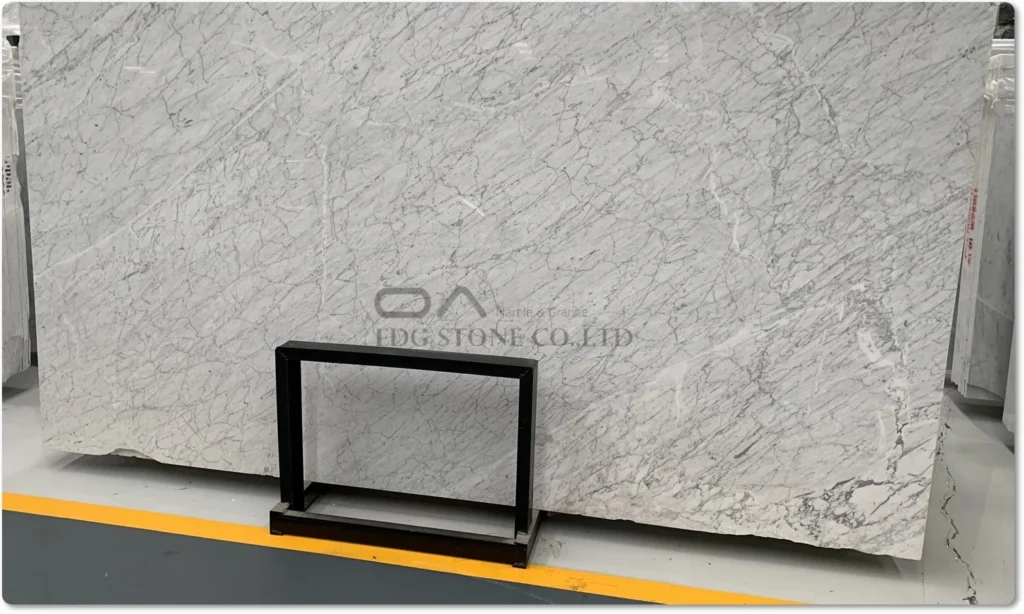
Carrara marble displays a softer, cooler appearance. Its background ranges from light gray to soft off-white, covered with hazy, linear pencil veins. The contrast between the background and the veining remains low to moderate.
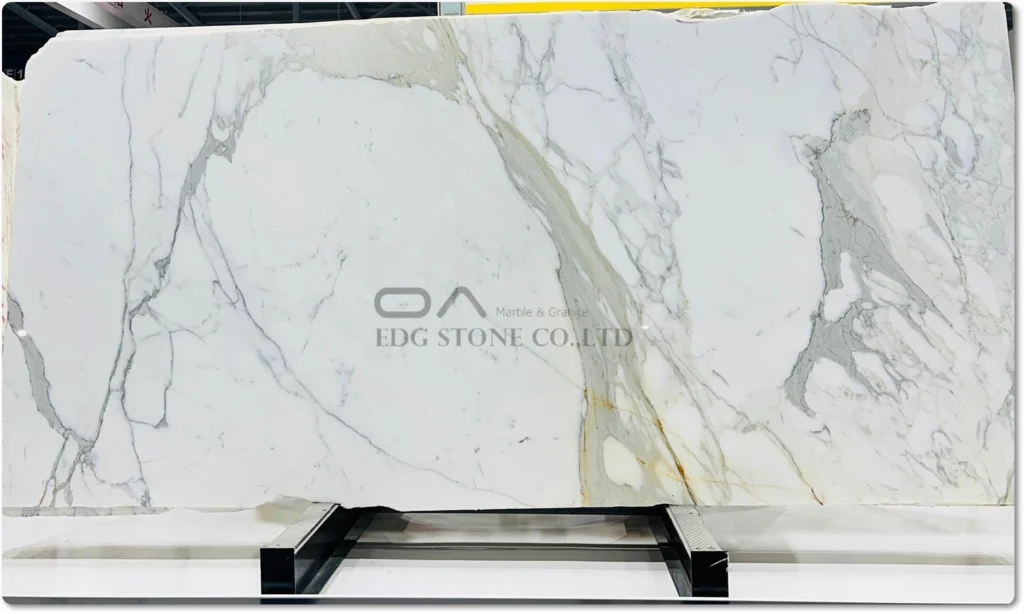
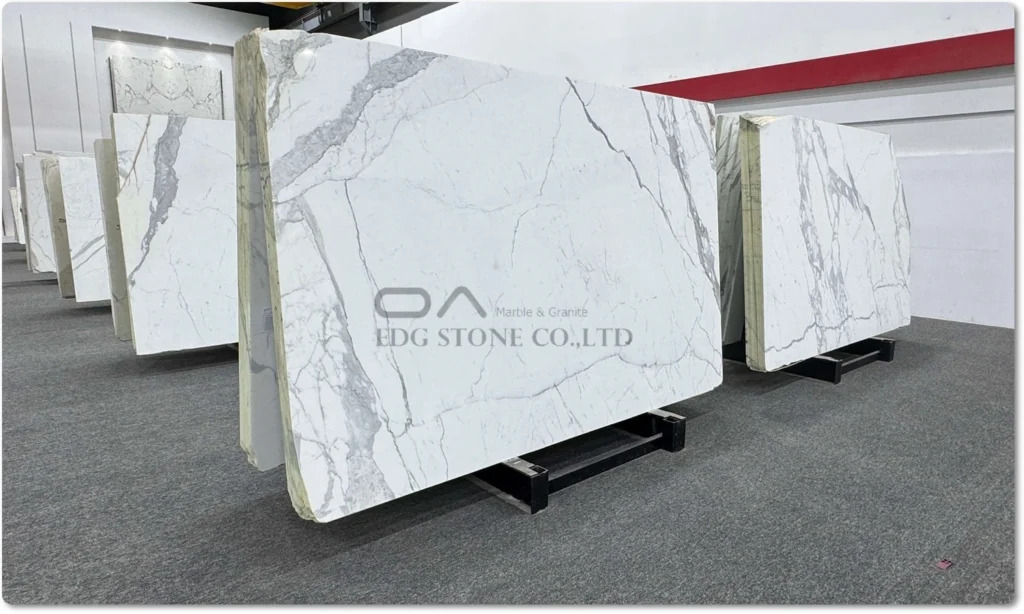
Calacatta marble offers high visual contrast. Its background is a sharp, brilliant white. The veining is thick, dramatic, and varied in color—ranging from dark charcoal gray to warm amber, gold, and taupe. Calacatta slabs feature bold patterns that work exceptionally well for book-matching.
Geological Formation and Mineralogy
Both stones consist primarily of calcite formed through the metamorphism of limestone under extreme heat and pressure during the regional tectonic activity of the Apuan Alps.
Carrara marble layers experienced uniform metamorphic pressure, creating fine-grained calcite crystals with evenly distributed iron oxides and carbonaceous impurities.
Calacatta marble formed in quarry pockets subjected to localized tectonic shifts. These shifts created fractured breccia structures filled with concentrated mineral veins, yielding its bold patterns and bright white calcite background.
Physical and Mechanical Performance
From a mechanical standpoint, Carrara marble offers slightly higher density and lower porosity than Calacatta marble:
Compressive and Flexural Strength: Carrara scores approximately $132 \text{ MPa}$ in compressive strength versus Calacatta’s $125 \text{ MPa}$. Carrara handles heavy structural loads slightly better in flooring and exterior panel installations.
Water Absorption: Carrara absorbs roughly $0.15\%$ water by weight, compared to Calacatta’s $0.22\%$. This lower absorption rate gives Carrara a small advantage in moisture exposure.
Wear Resistance: Carrara rates higher on the ASTM C241 abrasion scale ($18.2$ vs. $16.5$), making it more durable under foot traffic over time.
Side-by-Side Comparison Matrix
| Technical Parameter | Carrara Marble | Calacatta Marble |
| Primary Quarry Yield | High (Mass production capability) | Low (Extremely scarce supply) |
| Background Color | Grayish-white, soft silver | Bright white, warm ivory |
| Vein Type | Fine, feathered, linear blur | Thick, structural, wide-sweeping |
| Vein Colors | Slate gray, blue-gray | Charcoal, gold, green, amber |
| Book-Match Suitability | Moderate | High (Ideal for feature walls) |
| Stain Susceptibility | Moderate ($0.15\%$ absorption) | Moderate to High ($0.22\%$ absorption) |
| Scratch Resistance | Mohs 3.0 | Mohs 3.0 |
| Installation Cost Index | Base ($1.0\times$) | Premium ($3.5\times$ to $6.0\times$) |
Pros & Cons Analysis
Evaluating both materials helps specifiers match stone properties with real-world budget constraints and functional requirements.
Carrara Marble
Pros
Budget-Friendly Pricing: Offers an economical path to specifying authentic Italian white marble in large commercial spaces.
Consistent Supply: High quarry production guarantees supply continuity across multi-phase construction projects.
Versatile Aesthetics: Subtle veining blends cleanly with modern, classic, and transitional designs.
Higher Wear Resistance: Performs reliably in high-traffic commercial hallways and lobby floors.
Cons
Grayish Cast: The off-white background can look dark under low-kelvin lighting.
Limited Visual Impact: Does not deliver the high-contrast drama required for statement feature walls.
Batch Color Variations: Wide variations between quarry blocks require strict batch sorting before installation.
Calacatta Marble
Pros
Luxury Visual Appeal: Strong pattern contrast creates striking book-matched installations.
Bright Light Reflection: Clean white base reflects ambient light, brightening interior spaces.
High Property Valuation: Increases perceived real estate value in luxury developments.
Unique Slab Patterns: No two slabs are alike, creating distinctive interior spaces.
Cons
High Material Cost: High price per square foot can stretch budget allocations.
Fragile Fabrication: Broad vein networks create structural weak points that require fiberglass mesh backing.
Higher Porosity: Needs routine sealing to prevent liquids from penetrating the light surface.
Supply Constraints: Securing matching slabs for large projects can take long lead times.
Architectural Applications & Scene Logic
Selecting between Carrara and Calacatta depends on the project setting, foot traffic levels, maintenance capacity, and total budget.
                      SCENE LOGIC SELECTION FLOWCHART
                      ┌───────────────────────────────┐
                      │    Project Specification      │
                      └───────────────┬───────────────┘
                                      │
               ┌──────────────────────┴──────────────────────┐
               ▼                                             ▼
     [ Large-Scale Surface ]                       [ High-Impact Feature ]
     • Flooring / Facades                          • Countertops / Walls
     • Budget Conscious                            • High Luxury Focus
               │                                             │
               ▼                                             ▼
    ┌────────────────────┐                        ┌────────────────────┐
    │   Carrara Marble   │                        │  Calacatta Marble  │
    └────────────────────┘                        └────────────────────┘
Commercial High-Traffic Areas (Lobbies, Corridors, Facades)
Recommended Material: Carrara Marble (Honed Finish)
Large commercial spaces require consistent stone patterns, high abrasion resistance, and controllable replacement costs. Carrara marble handles heavy foot traffic well when finished with a honed surface ($H_a = 18.2$). Its lower price point makes it an efficient option for covering thousands of square feet of flooring without budget overruns.
Executive Suites, Hospitality Feature Walls, and Luxury Baths
Recommended Material: Calacatta Marble (Polished or Honed Finish)
Luxury spaces benefit from the dramatic visual presentation of Calacatta marble. Architects often specify book-matched Calacatta slabs for lobby reception desks, bathroom vanities, and full-height shower walls. In these controlled spaces, low foot traffic limits abrasion risks, making the stone’s high cost worth the investment.
Kitchen Countertops and High-Acid Environments
Recommended Material: Engineered Quartzite or Acid-Resistant Natural Quartzite
Both Carrara and Calacatta marble consist of calcium carbonate ($CaCO_3$). They etch when exposed to acidic foods like lemon juice, vinegar, or wine. For heavy-use commercial kitchens or high-traffic home countertops, specifiers often choose hard quartzite options like Super White Quartzite or Taj Mahal Quartzite. These stones offer marble-like aesthetics with a Mohs hardness of 7 and high acid resistance.
Commercial Procurement Case Study: Integrated Sourcing with EDG Stone Factory
Large international projects often balance natural marble features with hard-wearing quartzite materials to control costs and improve durability.
Case Overview: 5-Star Commercial Hotel Development (Dubai, UAE)
Total Surface Area: $18,500 \text{ m}^2$ ($199,000 \text{ sq. ft.}$)
Design Brief: Premium Italian white aesthetics for guest rooms, high-traffic main lobbies, and heavy-use kitchen service bars.
Budget Constraint: Cap raw material supply costs at $65 per square meter average.
Engineering & Sourcing Strategy
Main Lobby Flooring & Corridors ($11,000 \text{ m}^2$): Specified honed Carrara Marble tiles ($600 \times 600 \times 20 \text{ mm}$). This provided a classic Italian white finish while keeping material costs within budget.
Executive Presidential Suites ($2,500 \text{ m}^2$): Specified book-matched Calacatta Gold Marble slabs ($20 \text{ mm}$) for feature wall claddings and master bath vanities.
High-Traffic Hotel Bar Countertops & Kitchen Prep Surfaces ($500 \text{ m}^2$): Partnered with EDG Stone Factory, a global Quartzite Slabs & Countertops Manufacturer and Exporter. EDG Stone supplied high-density quartzite slabs that matched the white-and-gray marble look. This provided the necessary resistance to acid etching, heat damage, and heavy scratches in high-use service zones.
                  HYBRID MATERIAL DISTRIBUTION MATRIX
┌─────────────────────────────────────────────────────────────────────────┐
│ [====================================] Carrara Floor/Corridor (60%)     │
│ [===========] Calacatta Exec Suites (13.5%)                             │
│ [=] EDG Stone Quartzite Countertops (2.7%)                              │
│ [==========] Other Services/Tiles (23.8%)                               │
└─────────────────────────────────────────────────────────────────────────┘
Procurement Results
Cost Savings: Blending Carrara, Calacatta, and engineered Quartzite lowered total raw material costs by 34% compared to an all-Calacatta spec.
Durability: Using quartzite from EDG Stone Factory for bar countertops reduced maintenance service calls by 88% over the first two years of operation.
Schedule Efficiency: Sourcing through an integrated manufacturer ensured on-time slab delivery without phase delays.
Technical Knowledge Content: Evidence-Based Analysis
Q1: Does Calacatta marble stain faster than Carrara marble under identical liquid exposure?
Answer
Yes. Calacatta marble stains slightly faster than Carrara marble under equal exposure to unsealed liquids.
Evidence
ASTM C97 testing shows Carrara marble has a water absorption rate of $0.15\%$ by weight, while Calacatta marble ranges between $0.20\%$ and $0.25\%$. The higher absorption rate comes from Calacatta’s larger crystalline pore structure near its mineral veins.
In lab testing, exposure to red wine without a protective sealer led to visible liquid absorption in Calacatta within 12 minutes, compared to 22 minutes for Carrara.
                LIQUID PENETRATION TIME (UNSEALED SURFACE)
┌─────────────────────────────────────────────────────────────────────────┐
│ [======================] Carrara Marble (22 Mins)                       │
│ [============] Calacatta Marble (12 Mins)                               │
└─────────────────────────────────────────────────────────────────────────┘
Summary
Calacatta marble features a higher open-pore ratio than Carrara marble. It requires impregnating penetrative sealers every 6 to 12 months in moist or wet environments, whereas Carrara can run on a 12 to 18-month maintenance cycle.
Q2: Why does Calacatta marble cost significantly more than Carrara marble?
Answer
Calacatta marble costs more because of extreme supply scarcity, low quarry yields, and high global demand for its bold veining patterns.
Evidence
Geological quarry data from the Carrara region shows that Calacatta-grade stone accounts for less than 2% of total white marble extracted annually from the Apuan Alps.
Carrara-grade stone makes up roughly 18% of the region’s output. Furthermore, Calacatta extraction yields fewer solid, defect-free blocks suitable for large-slab processing, driving up raw material costs.
                 RAW MARBLE BLOCK YIELD PER 100 TONS EXTRACTED
┌─────────────────────────────────────────────────────────────────────────┐
│ [==================] Carrara Grade (18 Tons)                            │
│ [==] Calacatta Grade (2 Tons)                                           │
└─────────────────────────────────────────────────────────────────────────┘
Summary
The high price of Calacatta marble comes down to natural scarcity. Its low quarry yields drive up raw block prices, making it a luxury material reserved for high-budget architectural projects.
Q3: Can surface sealers prevent acid etching on Carrara and Calacatta marble countertops?
Answer
Standard impregnating sealers do not stop acid etching on natural marble. Only specialized topical anti-etch coatings or films can block acidic corrosion.
Evidence
Impregnating sealers fill the microscopic pores below the surface to repel water and oils. However, they do not shield the calcite minerals ($CaCO_3$) from reacting chemically with acid.
When exposed to liquids with a pH below 7 (such as lemon juice at pH 2.0 or vinegar at pH 2.4), the calcite dissolves on contact, creating a dull spot regardless of whether an impregnating sealer is present. Chemical barrier films or high-density quartzite alternatives (such as those supplied by EDG Stone Factory) are required to prevent acid damage completely.
             SURFACE DISSOLUTION RATE AT pH 2.2 ACID EXPOSURE
┌─────────────────────────────────────────────────────────────────────────┐
│ [==================================================] Calcite Marble     │
│ [==] Quartzite / EDG Engineered Quartz (Negligible)                     │
└─────────────────────────────────────────────────────────────────────────┘
Summary
Standard stone sealers prevent deep staining, but they do not stop surface etching. Projects that need full stain and acid protection should consider anti-etch liquid barriers or specify acid-resistant quartzite materials instead.
Expert Opinion
“When specifying white Italian marble for large projects, mechanical performance must take precedence over visual aesthetics. Architects frequently request high-contrast Calacatta for high-foot-traffic floor zones, only to discover that its lower abrasion resistance and higher porosity demand continuous maintenance.
We recommend a hybrid specification: specify honed Carrara for high-traffic floors to leverage its density and wear resistance, reserve Calacatta for vertical feature panels where it shines visually without physical wear, and utilize engineered quartzite from specialized manufacturers like EDG Stone Factory for heavy-use kitchen and bar countertops. This approach preserves the design vision while protecting the long-term investment.”
— Dr. Alessandro Vanezzi, Senior Materials Engineer & Natural Stone Consultant, Milan Architectural Testing Labs
Internal Link Architecture Strategy
To build domain authority and support clear site navigation, connect this whitepaper to related natural stone guides across your knowledge base:
                          INTERNAL LINK MAP
                         ┌─────────────────┐
                         │ Main Whitepaper │
                         └────────┬────────┘
                                  │
      ┌───────────────────────────┼───────────────────────────┐
      ▼                           ▼                           ▼
┌───────────┐               ┌───────────┐               ┌───────────┐
│  Tier 1   │               │  Tier 2   │               │  Tier 3   │
│ Geological│               │ Practical │               │ Product & │
│ Mechanics │               │  Design   │               │ Commercial│
└───────────┘               └───────────┘               └───────────┘
Tier 1: Geological & Mechanical Deep Dives
Understanding the Geology of the Apuan Alps Natural Stone Extraction
ASTM Testing Protocols for Natural Stone Density and Porosity
Compressive Strength Benchmarks: Marble vs. Granite vs. Quartzite
Tier 2: Practical Design & Fabrication Guides
Step-by-Step Guide to Book-Matching Calacatta Slabs for Wall Cladding
Honed vs. Polished Marble: Choosing the Right Surface Finish
How to Prevent Rusting and Discoloration in Italian White Marble
Fabrication Manual: Cutting, Edge Profiling, and Handling Marble Slabs
Tier 3: Product Comparisons & Commercial Sourcing
Super White Quartzite vs. Calacatta Marble: The Ultimate Countertop Guide
Selecting Natural Quartzite Countertops for High-Traffic Commercial Spaces
Commercial Marble Procurement: Managing Sourcing, Freight, and Batch Control
Direct Sourcing Solutions with EDG Stone Factory: Quartzite Slabs & Countertops
Preventing Tile Thermal Expansion in Large-Scale Marble Installations
References & Academic Sources
ASTM International. (2023). ASTM C97/C97M-18: Standard Test Methods for Absorption and Bulk Specific Gravity of Dimension Stone. ASTM International, West Conshohocken, PA.
ASTM International. (2022). ASTM C170/C170M-17: Standard Test Method for Compressive Strength of Dimension Stone. ASTM International, West Conshohocken, PA.
ASTM International. (2021). ASTM C880/C880M-21: Standard Test Method for Flexural Strength of Dimension Stone. ASTM International, West Conshohocken, PA.
Natural Stone Institute (NSI). (2024). Dimension Stone Design Manual, Version 2024. Natural Stone Institute, Oberlin, OH.
United States Geological Survey (USGS). (2023). Mineral Commodity Summaries: Stone (Dimension). U.S. Department of the Interior, Washington, D.C.
Italian Trade Agency (ITA). (2023). Italian Natural Stone Industry Annual Report: Production and Global Export Metrics. Ministry of Foreign Affairs, Rome, Italy.
Carmignani, L., et al. (2015). Geology and Tectonic Evolution of the Apuan Alps Metamorphic Complex (Tuscany, Italy). Journal of the Geological Society of Italy, 134(2), 145-162.
Weiss, T., et al. (2018). Thermal Expansion and Weathering Behavior of Marble Cladding Panels. Environmental Earth Sciences, 77(11), 412.
European Committee for Standardization. (2020). EN 12407: Natural Stone Test Methods – Petrographic Examination. CEN, Brussels, Belgium.
Marble Institute of America. (2022). Maintenance and Chemical Care Protocols for Calcite-Based Interior Surfaces. MIA Press, Cleveland, OH.