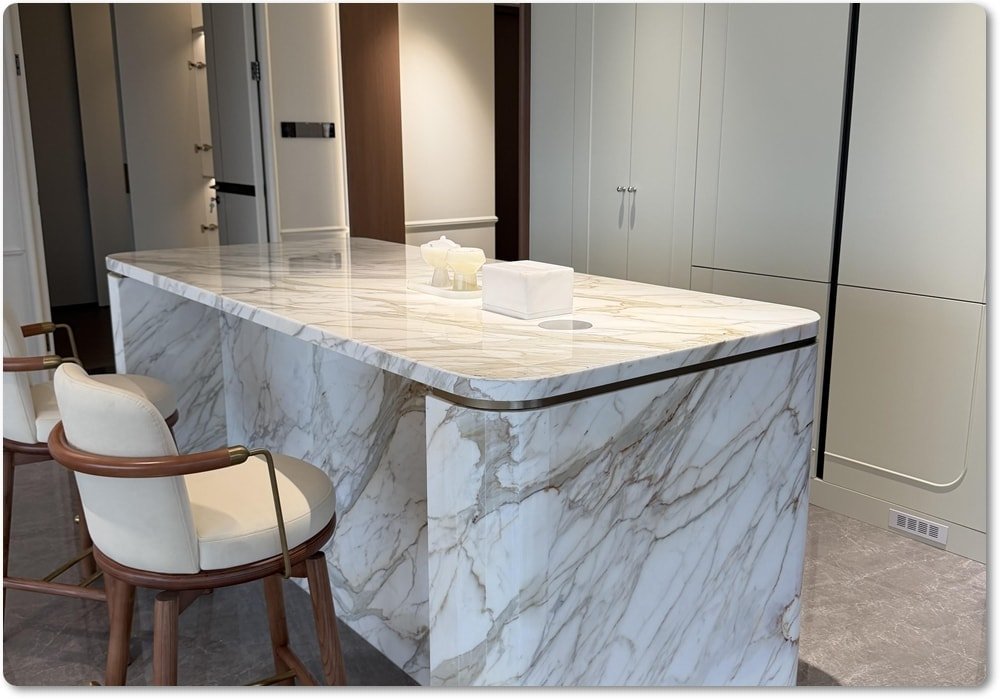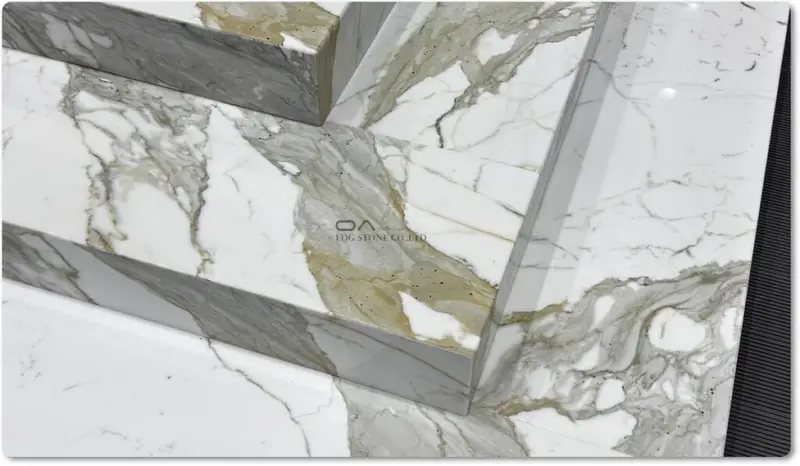
White quartz countertops remain the dominant choice for residential and commercial surfacing projects globally. This price guide provides procurement managers, fabricators, architects, and real estate developers with an engineer-level, data-backed cost analysis across the entire supply chain—from raw material synthesis at the factory level to final installation.
Executive Summary & Definition
Engineered white quartz is a composite material made of 90% to 93% crushed natural quartz aggregate bound together with 7% to 10% polymer resins, pigments, and additives. Manufacturers cure this mixture under intense vacuum vibro-compression to eliminate air pockets, creating a non-porous, highly durable surface.
+------------------+     +-------------------+     +---------------------+     +--------------------+
| Raw Quartz Sand  | --> | Resin & Pigment   | --> | Vibro-Compression   | --> | Curing & Polishing |
| (90% - 93%)      |     | Mixing (7% - 10%) |     | (Vacuum Chamber)    |     | (Slab Finishing)   |
+------------------+     +-------------------+     +---------------------+     +--------------------+
Key Takeaways
Factory FOB Slabs: Standard wholesale prices range from $5 to $18 per square foot ($50 to $190 per square meter) depending on resin purity, quartz grit size, and pattern complexity (calacatta veining vs. fine grain).
Fabrication & Installation: Material expenses represent only 30% to 40% of total installed costs. Fabrication and labor account for 60% to 70% of the final project invoice.
Turnkey Installed Cost: Expect to pay between $50 and $120 per square foot installed in North America and Western Europe, compared to $30 to $65 per square foot in the Middle East and Southeast Asia.
Import Dynamics: Anti-dumping duties (AD/CVD) significantly shift sourcing channels, driving North American buyers toward suppliers in Vietnam, India, and Malaysia.
Core Industry Statistics
The following metrics reflect verified market benchmarks across top manufacturing hubs and distribution channels:
Global Market Size: Valued at $21.4 Billion USD in 2024, projected to reach $31.8 Billion USD by 2031 (CAGR 5.8%).
Average Density: 2.35 to 2.45 g/cm³, ensuring absorption rates below 0.03%.
Mohs Hardness Rating: 6.5 to 7.0, significantly higher than natural marble (3.0 to 4.0).
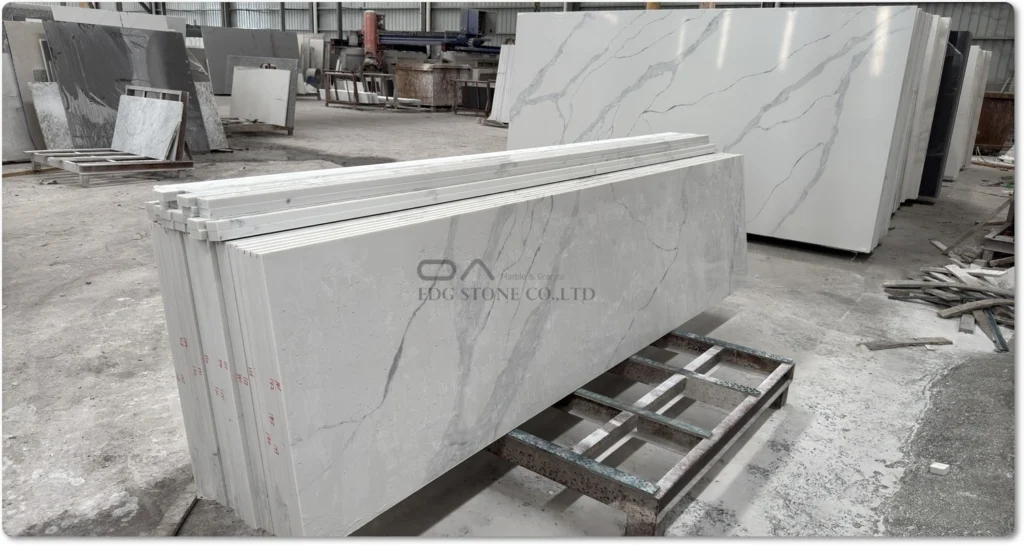
Standard Slab Dimensions: Jumbo Slabs measure 126 in x 63 in (3200 mm x 1600 mm) or 138 in x 79 in (3500 mm x 2000 mm) at standard thicknesses of 20 mm (3/4 in) or 30 mm (1-1/4 in).
Complete Price Breakdown Across the Value Chain
Understanding the price structure requires breaking down cost factors from factory gate to final job site.
+---------------------------------------------------------------------------------+
|  Factory FOB Slabs   |   Import & Tariffs   |   Distributor Margin / Retail     |
|  $5 - $18 / sq ft    |   +20% - 150%        |   $25 - $45 / sq ft               |
+---------------------------------------------------------------------------------+
                                       |
                                       v
+---------------------------------------------------------------------------------+
|  Fabrication (Cut/Edge) |   Installation Labor   |  Final Turnkey Price         |
|  $15 - $35 / sq ft      |   $10 - $25 / sq ft    |  $50 - $120 / sq ft          |
+---------------------------------------------------------------------------------+
1. Factory Cost & FOB Pricing (Manufacturer Gate)
At the manufacturing source, price depends primarily on resin quality, pigment purity, and design complexity. Fine-grained pure white slabs require high-purity optical sand, which increases raw material costs.
| Grade / Pattern Type | Description | FOB Price (USD / Sq Ft) | FOB Price (USD / Sq Meter) |
| Monochromatic Pure White | Fine crystal grit, consistent tone, standard resin. | $5.00 – $7.50 | $54 – $80 |
| Sparkle / Grain White | Mirror fleck or medium grain aggregate. | $6.00 – $8.50 | $64 – $91 |
| Carrara Veined White | Soft grey linear veins, short press cycles. | $8.00 – $12.00 | $86 – $129 |
| Calacatta Bold Veined White | Multi-layer vein insertion, high-purity titanium dioxide. | $12.00 – $18.00 | $129 – $194 |
2. Wholesale & Distributor Pricing
Wholesale distributors import container-load quantities (typically 60 to 100 slabs per 20ft container depending on weight limits). They factor in ocean freight, customs clearance, port handling, inventory holding, and regional overheads.
Wholesale Slabs (Non-Veined): $15.00 – $25.00 per sq ft
Wholesale Slabs (Premium Calacatta): $25.00 – $45.00 per sq ft
3. Fabrication Costs
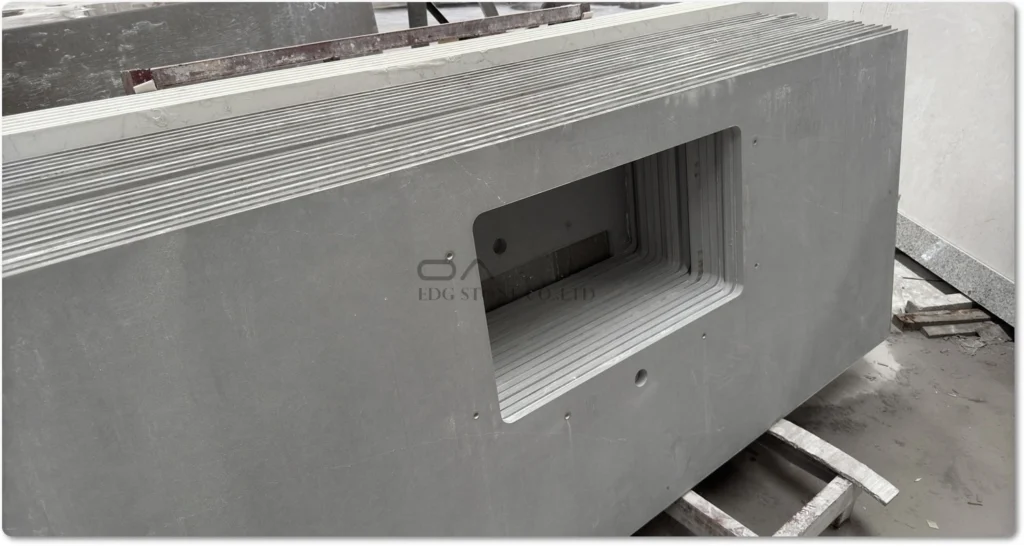
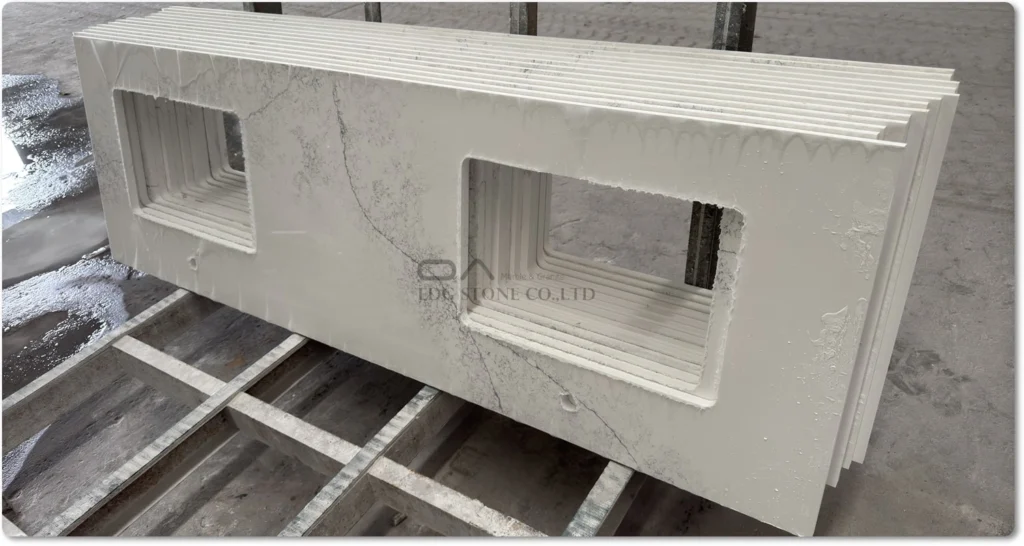
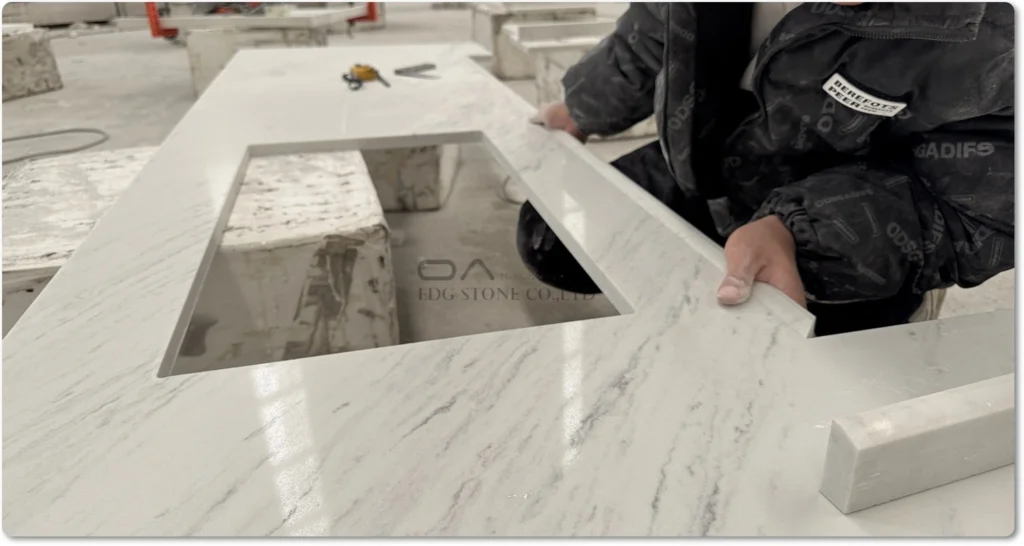
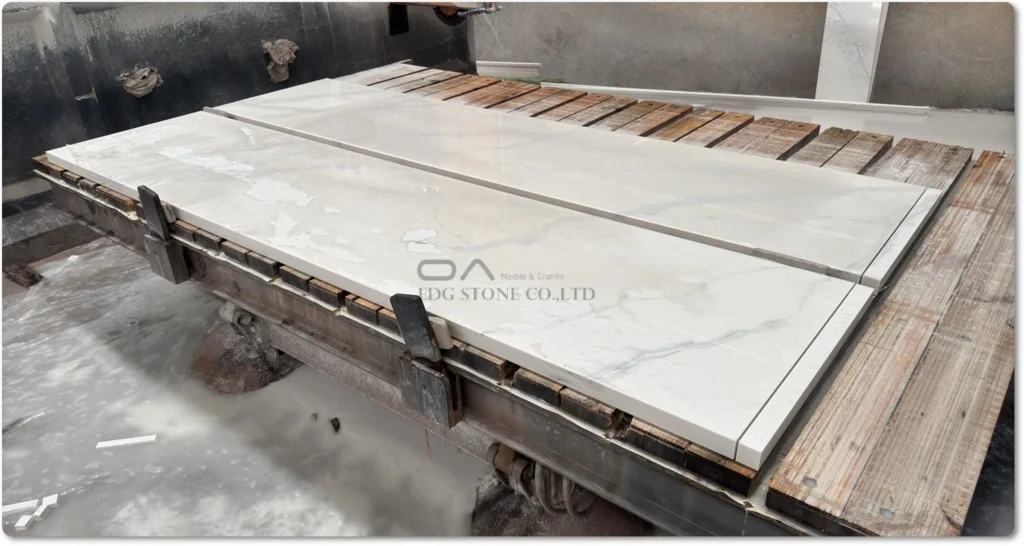
Fabrication involves digitizing template measurements, waterjet cutting, CNC edge profiling, and cutouts for sinks and cooktops.
Straight Edge / Eased Edge: $10.00 – $15.00 per linear foot
Ogee / Bullnose / Beveled Edge: $20.00 – $35.00 per linear foot
Mitered Waterfall Edge (45-degree angle): $40.00 – $75.00 per linear foot
Sink Cutouts (Undermount polished): $150.00 – $250.00 per opening
4. Retail & Installed Pricing Summary
| Tier | Slab Material Cost (sq ft) | Fabrication & Labor (sq ft) | Total Installed Cost (sq ft) |
| Budget / Builders Grade | $15 – $25 | $25 – $35 | $40 – $60 |
| Mid-Range Commercial | $25 – $40 | $35 – $45 | $60 – $85 |
| Premium Calacatta / Custom | $40 – $70 | $45 – $65 | $85 – $135+ |
Key Drivers of Quartz Price Variance
Titanium Dioxide ($TiO_2$) Purity: Pure white quartz requires high-grade pigments to prevent yellowing over time under ambient UV radiation. Superior optical-grade white pigment increases chemical costs by 15% to 25%.
Veining Technology: Single-color slabs drop directly from mechanical hoppers into mold trays. Calacatta veining requires robotic mechanical injectors or hand-poured contrast veins before vacuum pressing, slowing line production rates.
Resin-to-Quartz Ratio: Cheap manufacturers increase unsaturated polyester resin content above 12% to lower quartz sand raw costs. High resin ratios lower heat tolerance and cause surface discoloration under thermal stress.
Slab Thickness: 30 mm (1-1/4 in) slabs carry a 25% to 35% material price premium over 20 mm (3/4 in) slabs, but reduce substrate support requirements during installation.
Regional Price Benchmark Analysis
+--------------------------------------------------------------------------+
| Region              | Average Installed Price / Sq Ft (USD)              |
+--------------------------------------------------------------------------+
| United States       | $65 - $125                                         |
| Europe (EU/UK)      | $55 - $110                                         |
| Australia           | $60 - $115                                         |
| Middle East (GCC)   | $30 - $60                                          |
+--------------------------------------------------------------------------+
United States Market
Average Installed Cost: $65 – $125 / sq ft
Key Factors: High labor rates ($45–$80/hr for skilled stone masons) and anti-dumping tariffs on Chinese quartz imports. US buyers import heavily from Vietnam, India, Turkey, and domestic US facilities.
European Market (EU & UK)
Average Installed Cost: €50 – €100 / sq meter ($55 – $110 / sq ft equivalent)
Key Factors: Strong demand for thin-profile surfaces (12 mm and 20 mm). Strict European Union health regulations regarding respirable crystalline silica (RCS) force fabricators to adopt wet-cutting CNC equipment.
Australian Market
Average Installed Cost: AUD $90 – AUD $180 / sq meter ($60 – $115 / sq ft)
Key Factors: Australia banned engineered quartz containing high crystalline silica effective July 2024. The market rapidly shifted to zero-silica or low-silica alternatives (using recycled glass and bio-resins), creating temporary price hikes of 15% to 20% while global supply chains adapted.
Middle East Market (GCC Region)
Average Installed Cost: $30 – $60 / sq ft
Key Factors: Direct proximity to Asian supply chains, lower import duties, and streamlined labor costs for large multi-unit commercial developments in the UAE and Saudi Arabia.
Comprehensive Surface Material Comparison
| Attribute | Engineered White Quartz | Calacatta Natural Marble | Absolute White Granite | Sintered Stone / Porcelain |
|---|---|---|---|---|
| Material Cost (sq ft) | $15 – $45 | $40 – $150 | $20 – $50 | $30 – $60 |
| Installed Cost (sq ft) | $50 – $120 | $90 – $250+ | $55 – $110 | $70 – $140 |
| Mohs Hardness | 7.0 | 3.0 – 4.0 | 6.0 – 6.5 | 8.0 – 9.0 |
| Porosity Rate | < 0.03% | 0.5% – 2.0% | 0.1% – 0.5% | < 0.01% |
| Stain Resistance | Excellent | Poor (Requires sealing) | Moderate | Superior |
| Heat Resistance | Up to 150°C (300°F) | High | High | Up to 1000°C (1800°F) |
| Maintenance | Zero Sealing | Regular Sealing | Annual Sealing | Zero Sealing |
Industry Case Study: Global Manufacturing & Export Dynamics
EDG Stone Factory Case Profile
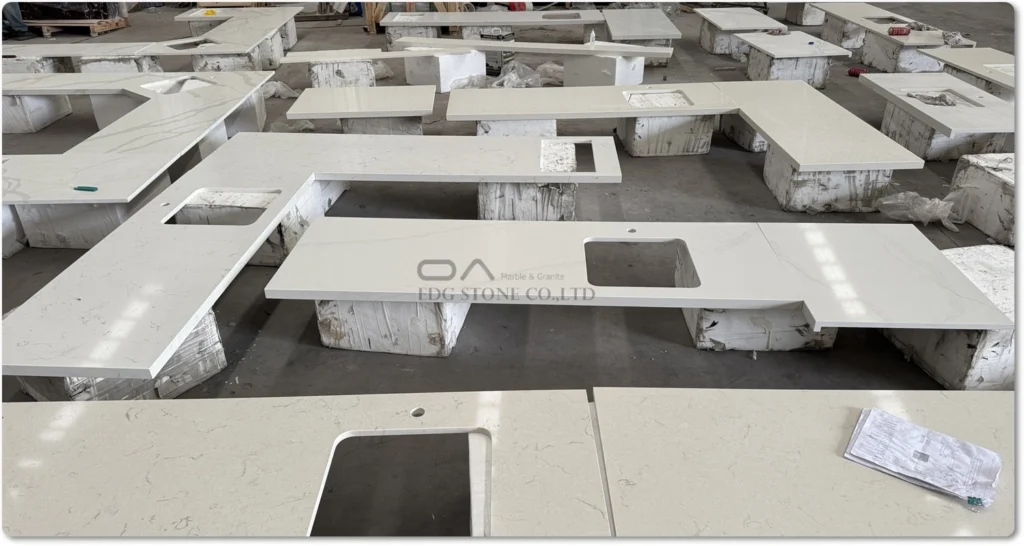
EDG Stone Factory operates as a global Quartzite Slabs & Countertops Manufacturer and Exporter, providing commercial procurement teams and volume distributors with factory-direct material options.
Manufacturing Capabilities: Automated Italian Breton-style vibro-compression press lines capable of generating up to 100 metric tons of compaction force per square meter.
Material Standards: Standardized production featuring low-silica formulas, zero-void resin distribution, and uniform batch color control.
Export Logistics: Direct FOB loading from major ports with specialized wooden bundle packaging, reducing slab transit breakage rates below 0.1%.
Target Applications: Commercial hotel towers, high-density residential apartments, and institutional healthcare facilities requiring NSF-51 certified surfaces.
Pros & Cons Analysis for Commercial Procurement
Pros
Non-Porous Surface: Does not harbor bacteria, viruses, or mold. Certified under NSF-51 for direct food contact.
Color Consistency: Unlike natural quarried stone, engineered quartz slabs deliver predictable veining and color across hundreds of units.
Low Maintenance: Requires no ongoing sealers, wax coatings, or specialized stone soaps. Clean with mild soap and water.
High Chemical Resistance: Resists common household acids like vinegar, lemon juice, and wine.
Cons
Thermal Shock Vulnerability: Direct placement of hot cookware exceeding 150°C (300°F) can scorch the resin binder, leaving permanent discoloration.
UV Sensitivity: Prolonged exposure to direct sunlight degrades polyester resins, causing yellowing. Not recommended for outdoor applications.
Respirable Silica Fabrication Hazards: Cutting dry quartz releases fine airborne silica dust. Fabricators must invest in wet-cutting systems and personal protective gear.
Knowledge Base: Strategic Entity Cluster Analysis
Question 1: How does white quartz compare to porcelain in high-traffic commercial environments?
Answer
Engineered white quartz offers higher impact resistance than porcelain tile, while porcelain provides superior scratch and thermal heat tolerance.
Evidence
Quartz features high flexural strength (typically 40 to 50 MPa) due to its resin matrix, making edge chipping less likely during heavy installation. Porcelain achieves a higher Mohs hardness (8.0+), but its brittle matrix makes edge profiling more complex and prone to micro-fractures under point impacts.
Summary
Choose white quartz for high-traffic food preparation and high-impact areas where edge durability matters most. Select porcelain for outdoor settings exposed to direct UV rays or hot pot drops.
Question 2: Why do Calacatta quartz slabs carry a higher price tag than fine-grain white quartz?
Answer
Calacatta quartz requires complex multi-pass resin injection technology, custom vein hand-finishing, and longer press cycles.
Evidence
Fine-grain white quartz uses a continuous mechanical pour system that yields up to 40 slabs per hour. Calacatta designs require robotic vein placement and slower mold setting times, reducing production output to 10 to 15 slabs per hour.
Summary
The price jump for Calacatta quartz reflects lower factory throughput, higher waste factors during pattern alignment, and expensive raw pigment formulations.
Frequently Asked Questions (FAQ)
What is the typical lifespan of a white quartz countertop?
With proper indoor care, white quartz countertops last 25 to 50 years or more. Most commercial manufacturers provide limited warranties ranging from 10 to 25 years.
How do I remove stubborn stains from white quartz?
Use a non-abrasive sponge with mild dish soap and warm water. For dried grease or paint, scrape gently with a plastic putty knife. Avoid harsh chemicals like bleach, acetone, or oven cleaners, which degrade the resin matrix.
Does white quartz turn yellow over time?
White quartz yellows if exposed to direct UV sunlight or sustained extreme heat. Modern tier-1 factories include UV-stabilizing additives in their resin blend to extend indoor color retention.
Is 20mm or 30mm quartz better for kitchen countertops?
30mm (1-1/4 in) quartz provides greater structural strength, allows larger unsupported overhangs for breakfast bars (up to 12 inches), and creates a premium aesthetic without requiring edge buildup strips. 20mm (3/4 in) quartz is lighter, cheaper to transport, and ideal for vertical wall cladding or budget projects.
Technical Data & References
American Society for Testing and Materials (ASTM): Standard Test Method for Water Absorption of Dimension Stone (ASTM C97).
National Sanitation Foundation (NSF International): NSF/ANSI Standard 51 – Food Equipment Materials.
Occupational Safety and Health Administration (OSHA): Small Entity Compliance Guide for the Respirable Crystalline Silica Standard for Construction (29 CFR 1926.1153).
Internal Trade Commission (USITC): Certain Quartz Surface Products from China, India, and Vietnam (Investigation Nos. 701-TA-606 and 731-TA-1416).