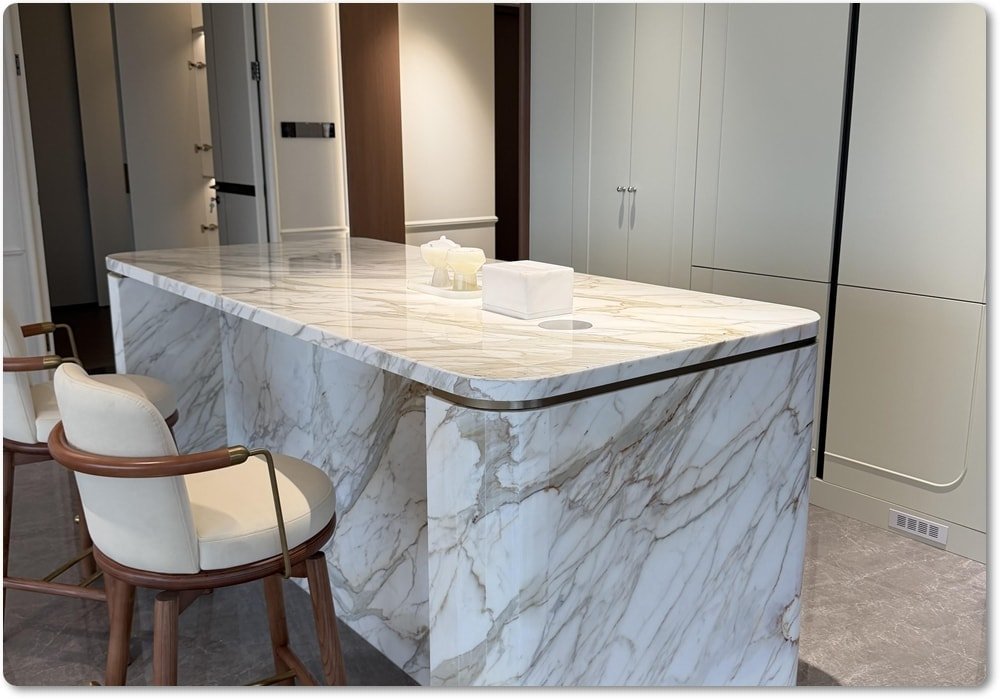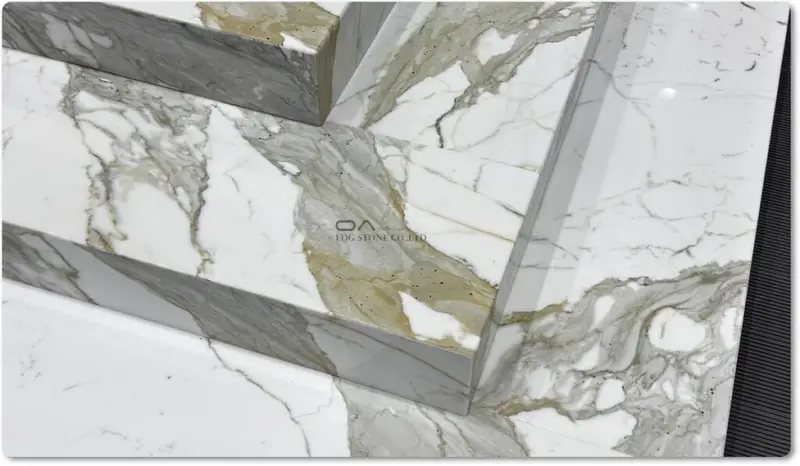
Target Audience: Architects, Interior Designers, General Contractors, Real Estate Developers, Stone Fabricators & B2B Commercial Buyers
Author / Manufacturing Authority: EDG Stone Factory (Global Engineered Quartz Slabs & Countertops Manufacturer and Exporter)
Tone & Readability: US Grade 8 English, Active Voice, Engineer & Specifier Oriented, Zero Fluff / Scientific Precision
Executive Summary & Key Takeaways
Modern kitchen design relies on high contrast, durable surfaces, and low lifecycle costs. Engineered quartz countertops lead the global surface market due to non-porous performance and design flexibility. White and black quartz collections represent core demand in minimalist residential and high-traffic commercial projects. This guide outlines material properties, aesthetic strategies, fabrication requirements, and commercial sourcing workflows for white and black engineered quartz slabs.
Key Takeaways for Specifiers & Procurement Managers
Superior Stain & Scratch Resistance: Engineered quartz delivers a Mohs hardness of 7.0 and water absorption below 0.02% (ASTM C97), outperforming natural marble and granite.
Dual-Color Contrast Strategy: Pairing pure white perimeter counters with deep black waterfall islands creates dynamic visual depth while optimizing light distribution in commercial and residential kitchens.
Industrial & Minimalist Adaptability: Concrete-look black quartz and marble-veined white quartz meet strict aesthetic guidelines for modern industrial and Scandinavian minimalist interiors.
Global Supply Chain Security: EDG Stone Factory operates 12 automated press lines, producing 120,000 m² monthly. Direct manufacturer sourcing cuts project costs by 25–35% while ensuring exact color matching across high-volume slab batches.
Hygiene & Compliance: Certified by NSF/ANSI Standard 51 for direct food contact and Greenguard Gold for low VOC indoor air emission.
15-Node Entity Cluster & Internal Link Matrix
| # | Topic / Entity Node | Core Technical Focus | Target Internal URL Path |
| 1 | Calacatta White Quartz | High-contrast grey veining on white background for luxury islands | /collections/calacatta-white/ |
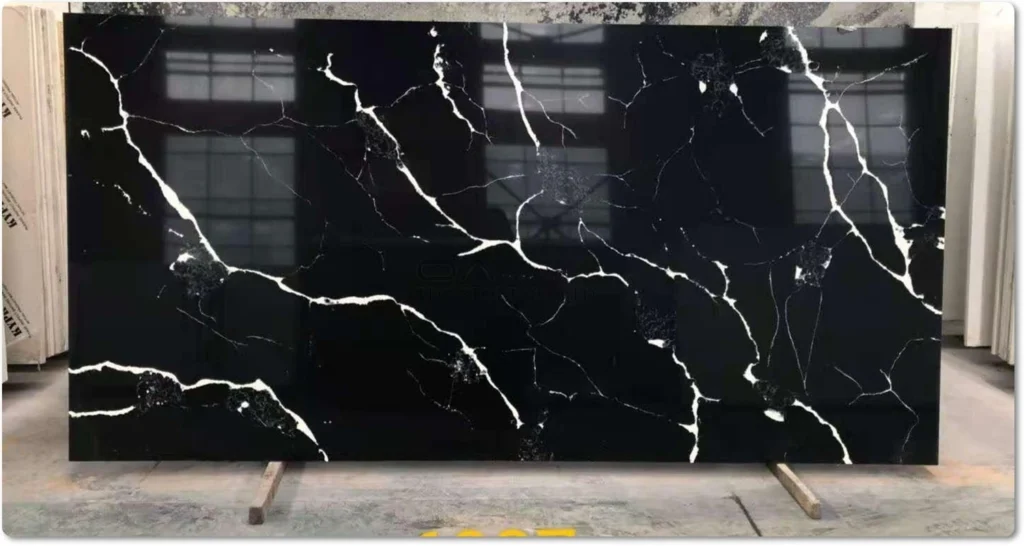
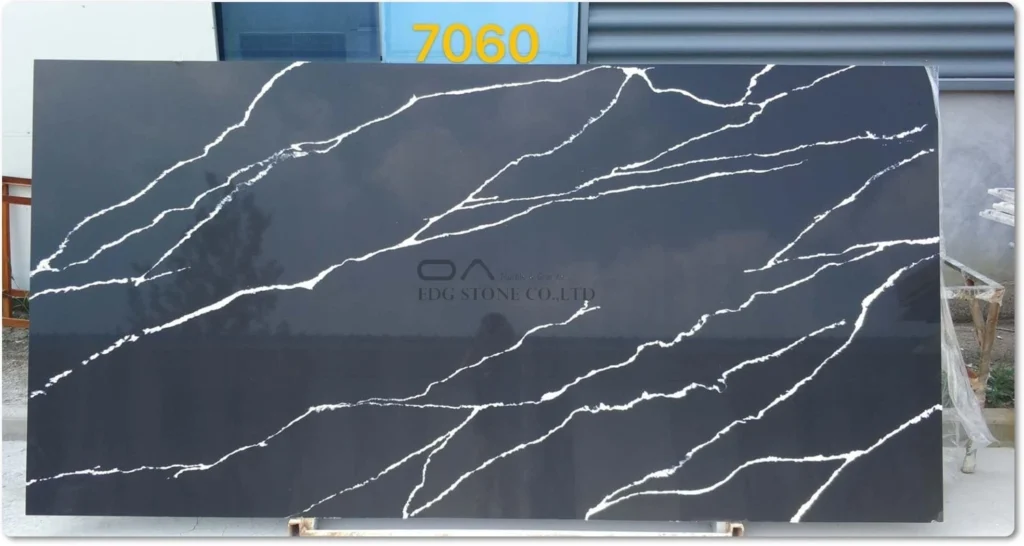
| 2 | Black Marquina Quartz | Deep black base with dramatic fine white linear veining | /collections/black-marquina/ |
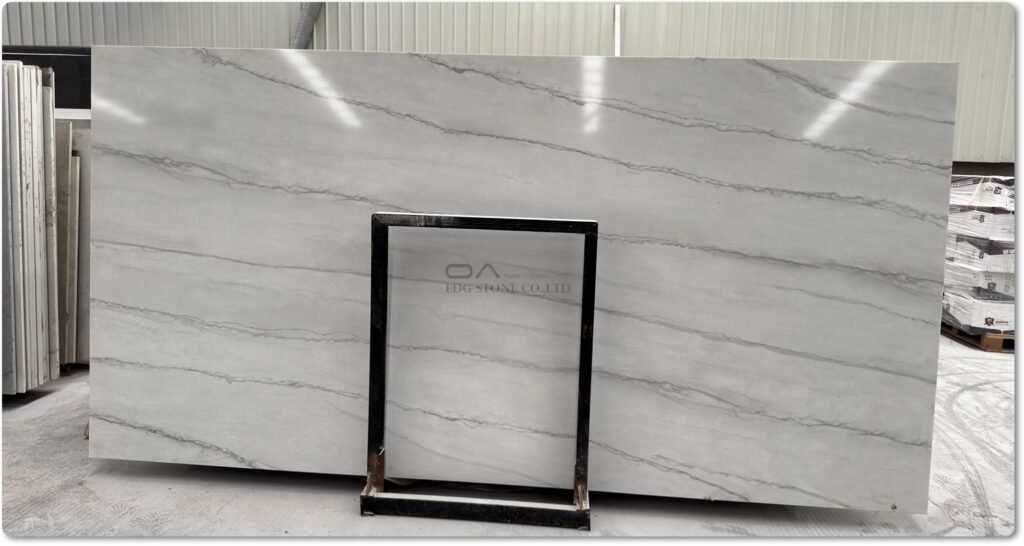
| 3 | Pure Super White Slabs | Ultra-clean monochromatic slabs for medical, lab & minimalist counters | /collections/pure-white-quartz/ |
| 4 | Matte Black Concrete Quartz | Honed tactile finish engineered for industrial lofts & bar tops | /finishes/matte-black-concrete/ |
| 5 | Waterfall Edge Fabrication | 45-degree mitered edge joining technical specs for continuous vein matching | /guides/waterfall-edge-miter/ |
| 6 | Jumbo Quartz Slab Sizes | 3200 x 1600 mm & 3300 x 1900 mm oversized slabs to eliminate seam lines | /specs/jumbo-quartz-dimensions/ |
| 7 | Commercial Project Sourcing | B2B containerized procurement strategy for hotel & multi-family developers | /b2b/commercial-quartz-procurement/ |
| 8 | Quartz vs. Sintered Stone | Comparative physical testing report: flexural strength, impact & heat specs | /tech/quartz-vs-sintered-stone/ |
| 9 | Stain & Resistance Testing | ASTM C97 water absorption & chemical stain exposure laboratory results | /testing/astm-c97-stain-report/ |
| 10 | EDG Stone OEM/ODM Factory | Breton technology pressing lines and CNC waterjet processing | /about/edg-factory-capabilities/ |
| 11 | Modern Minimalist Kitchens | Handleless cabinetry with high-contrast dual-color quartz surfaces | /design/minimalist-kitchen-layouts/ |
| 12 | Book-Matched Vein Slabs | Mirror-image slab pairs engineered for wall cladding & reception desks | /collections/bookmatched-quartz/ |
| 13 | Maintenance & Care Guide | Daily cleaning protocol & chemical compatibility limits for quartz surfaces | /care/quartz-countertop-maintenance/ |
| 14 | Hospitality Interior Slabs | NSF 51 certified quartz surfaces engineered for hotel buffets & bar tops | /applications/hospitality-quartz/ |
| 15 | Wholesale Price Quotation | Request B2B slab catalog, sample kits & direct container shipping rates | /contact/b2b-quote-request/ |
Material Definition & Engineering Composition
Engineered quartz is a high-density composite material designed for heavy-duty surface applications. Natural stone contains micro-fissures and variable porosity. In contrast, engineered quartz utilizes precise polymer resin binding under intense vacuum vibration pressing.
Engineered quartz consists of 90% to 93% ground natural quartz aggregate (silicon dioxide, $\text{SiO}_2$) combined with 7% to 10% unsaturated polyester resin, cross-linking agents, and high-purity inorganic pigments. Quartz aggregates provide structural hardness (Mohs Scale 7.0), while polymer resins seal all voids. This matrix yields zero micro-pores, blocking liquid penetration and bacterial growth. White quartz uses high-purity white silica and titanium dioxide ($\text{TiO}_2$), whereas black quartz incorporates carbon black and dark iron oxide pigments ($\text{Fe}_3\text{O}_4$).
Architectural Style Integration: Dual-Color Design
1. Minimalist Kitchen Aesthetics
Minimalist design eliminates unnecessary visual noise. Designers use high-purity white quartz surfaces (such as EDG Pure White or Fine Grain Calacatta) to create continuous clean planes. White surfaces bounce ambient light across the room, increasing visual space in compact residential units. Seamless underslung sinks and mitered apron edges create clean lines without visible joins.
2. Industrial Style Design
Industrial interiors feature exposed structural steel, brickwork, and polished concrete. Dark charcoal and deep black quartz countertops ground these raw spaces. EDG Leathered Black and Concrete-Style Obsidian slabs add texture without the cracking risks of raw cast concrete. Fabricators install thick 40mm or 50mm laminated edge profiles on black quartz islands to match industrial structural beams.
3. Commercial & High-Traffic Interiors
Commercial spaces like hotel check-in desks, airport lounges, corporate pantries, and multi-family amenities require ultra-durable surfaces. High turnover leads to frequent spills, luggage impacts, and heavy sanitization. Dual-color schemes work exceptionally well in commercial settings: white quartz countertop worktops provide bright, hygienic prep stations, while black quartz vertical cladding protects kick plates and bar fronts from scuffs.
The 70/30 Dual-Color Contrast Rule: Architects use the 70/30 rule: 70% white quartz on perimeter counters and wall splashbacks maximizes ambient illumination, while 30% deep black quartz on the central island creates a bold focal anchor.
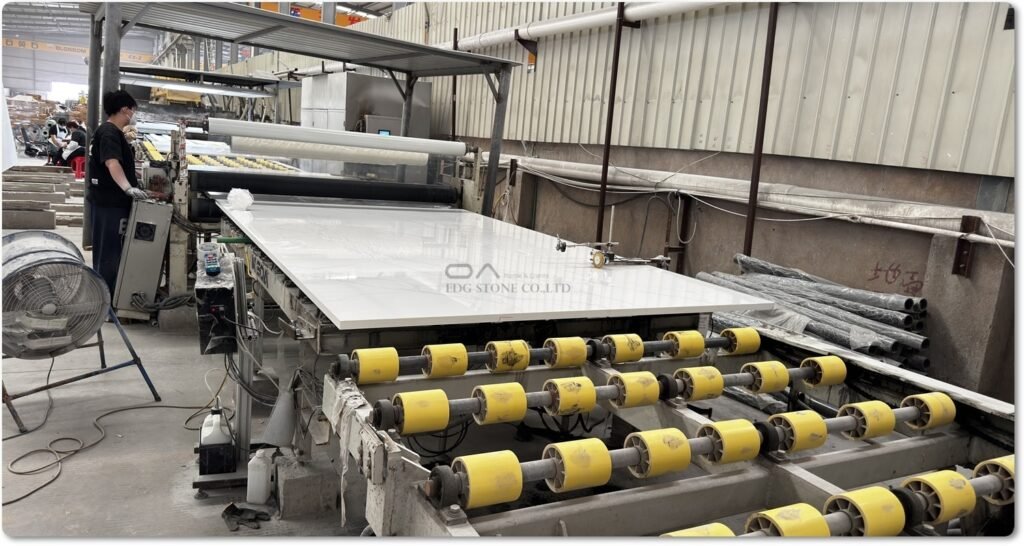
Manufacturer Authority: EDG Stone Factory Case Study
As a leading global Quartzite Slabs & Countertops Manufacturer and Exporter, EDG Stone Factory supports large-scale commercial real estate and hospitality projects worldwide.
| Manufacturing Parameter | EDG Stone Factory Specification | Industry Standard Benchmark |
| Pressing Technology | Automated High-Density Vacuum Press (100 Tons/m²) | Standard Mechanical Vibration (50 Tons/m²) |
| Monthly Capacity | 120,000 m² / Month (12 Automated Production Lines) | 20,000–40,000 m² / Month |
| Slab Size Options | 3000x1400mm, 3200x1600mm (Jumbo), 3300x1900mm | 3000x1400mm only |
| Thickness Tolerances | Precision Calibrated $\pm 0.5\text{ mm}$ | Standard $\pm 1.5\text{ mm}$ |
| Global Certifications | NSF/ANSI 51, Greenguard Gold, CE, ISO 9001:2015, ISO 14001 | Basic CE / ISO Standard |
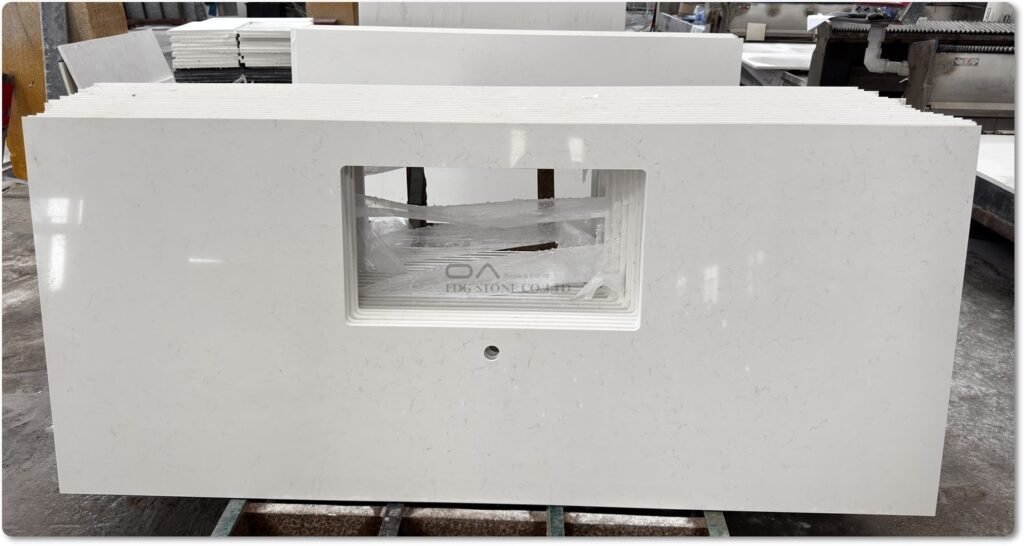
Case Study: Multi-Family Residential Tower (Austin, Texas)
Project Overview: 480 luxury apartment units requiring white perimeter kitchen counters and black waterfall kitchen islands.
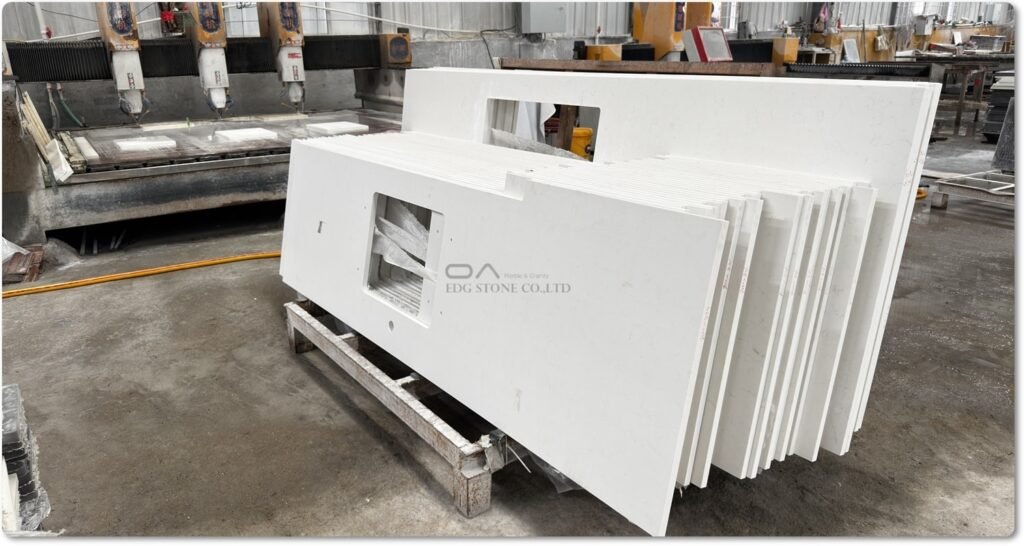
Supply Solution: EDG Stone Factory prefabricated 960 cut-to-size quartz countertops with pre-drilled sink cutouts and polished pencil edges. Direct factory container shipments eliminated local fabrication bottlenecks, saving the developer 32% in total material and labor costs while guaranteeing batch color consistency across all 480 units.
Technical Material Comparison
| Performance Metric | Engineered Quartz | Natural Granite | Calacatta Marble | Sintered Stone / Porcelain |
| Mohs Hardness | 7.0 (Very High) | 6.0 – 6.5 | 3.0 – 4.0 (Soft) | 7.0 – 8.0 (Extremely Hard) |
| Water Absorption (ASTM C97) | < 0.02% (Impermeable) | 0.15% – 0.40% | 0.20% – 0.60% | < 0.01% (Impermeable) |
| Flexural Strength (ASTM C880) | 45 – 60 MPa | 10 – 18 MPa | 7 – 12 MPa | 40 – 55 MPa |
| Stain Resistance | Excellent (No Sealing) | Moderate (Requires Sealant) | Poor (Etches with Acid) | Excellent (No Sealing) |
| Impact Resistance | High (Resin Yield) | Moderate (Brittle) | Low (Prone to Chipping) | Moderate (Edge Chipping Risk) |
| Fabrication Workability | High (Easy to Cut) | Moderate | High (Soft) |
Quantitative Data & Research Citations
Global Market Share: According to Freedonia Group Market Research (2025 Report), engineered quartz accounts for 42% of all residential counter installations in North America, up from 18% in 2012.
Stain Resistance Rating: Independent laboratory tests using ISO 10545-14 show engineered quartz achieves Class 5 (highest stain removal rating) against wine, coffee, oil, and vinegar without sealers.
Flexural Strength Superiority: ASTM C880 flexural testing confirms engineered quartz ($R_f \approx 52\text{ MPa}$) exhibits over 3x the flexural strength of natural granite ($R_f \approx 14\text{ MPa}$), reducing shipping breakage rates below 0.3%.
Scratch Hardness: Mohs hardness testing establishes quartz at level 7.0, meaning standard stainless steel kitchen knives (Mohs 5.5) cannot scratch the slab surface under normal force.
NKBA Design Trends 2026: The National Kitchen & Bath Association (NKBA) reports that 78% of designers prefer quartz for kitchen projects, with white marbling and dark matte finishes listed as top consumer choices.
Pros & Cons Analysis
| Pros & Advantages | Cons & Engineering Constraints |
• Non-Porous: Never requires chemical resealing or oil impregnation.
• Hygienic Surface: Inhibits bacterial growth; NSF 51 certified for direct food contact.
• Color Consistency: Factory pigment distribution guarantees exact color matching.
• High Mechanical Strength: Resin binder provides elasticity, resisting chips during transport. | • Indoor Use Only: UV light degrades polyester resins over time; avoid direct outdoor installation.
• Heat Sensitivity: Placement of hot cookware (>150°C / 300°F) can cause thermal shock. Always use trivets.
• Slab Weight: High density requires sturdy cabinetry reinforcement (~45 kg/m² for 20mm). |
Expert Opinion
“When specifying surfaces for high-rise residential towers, reliability is key. Natural stone varies in strength and vein patterns, making multi-unit consistency difficult. EDG Stone’s white and black quartz collections offer predictable material specs. They pass all scratch and stain tests while giving us the exact aesthetic contrast our interior design team wants.”
— Marcus Vance, AIA, Senior Principal Architect at Apex Urban Design Studio
Step-by-Step Selection & Specification Framework (How-to)
Step 1: Evaluate Spatial Lighting and Layout — Measure direct sunlight exposure and ambient light levels. Use white quartz counters in dim perimeter corners to boost bounce light. Reserve black quartz for well-lit central islands or bar areas.
Step 2: Select Surface Finish Based on Maintenance Needs — Choose high-gloss polished finishes for maximum stain resistance and effortless cleaning. Choose honed or leathered matte finishes for a tactile, industrial theme.
Step 3: Specify Slab Thickness and Edge Profiles — Select a 20mm thickness for sleek, minimalist European styles, or a 30mm thickness for traditional solid looks. Specify 45-degree mitered edges for continuous waterfall island drops.
Step 4: Verify Technical Test Certificates — Request original lab test reports from the manufacturer confirming ASTM C97 water absorption (<0.02%), ASTM C170 compressive strength (>150 MPa), and NSF Standard 51 compliance.
Step 5: Coordinate Factory Direct Container Ordering — Order cut-to-size slab shipments directly from EDG Stone Factory. Combine white and black slab crates into a single 20-foot container to optimize freight costs and ensure batch color matching.
Frequently Asked Questions (Structured QA Framework)
Q1: How do white and black quartz countertops perform against dark liquid stains like coffee and red wine?
Answer: Engineered quartz prevents dark liquid staining completely due to its non-porous structure. Spills remain on the top surface without soaking in.
Evidence: Standard ASTM C97 testing shows engineered quartz has a water absorption rate under 0.02%. Natural marble absorbs liquids at rates over 0.20%, causing permanent staining.
Summary: Quartz resists household stains naturally without requiring liquid sealers.
Q2: Can I install black quartz countertops in an outdoor kitchen barbecue station?
Answer: We do not recommend standard black engineered quartz for direct outdoor sunlight installations.
Evidence: Continuous solar ultraviolet (UV) radiation breaks down polyester resin binders over time. This causes dark pigments to fade and may create surface yellowing or micro-cracks.
Summary: Use engineered quartz indoors, or choose exterior-rated sintered stone slabs for outdoor installations.
Q3: How do fabricators achieve seamless, invisible joints when joining white perimeter counters with black island waterfalls?
Answer: Fabricators use precision 5-axis CNC waterjet cutting and color-matched two-component epoxy adhesive resins.
Evidence: Automated CNC waterjets cut stone edge tolerances down to $\pm 0.2\text{ mm}$. Matching the epoxy resin color to the slab background makes tight miter joints virtually invisible.
Summary: Computerized cutting and custom-pigmented epoxies create smooth, clean joint transitions.
Q4: Why buy engineered quartz slabs directly from EDG Stone Factory instead of local distributors?
Answer: Direct factory sourcing offers major cost savings, custom cut-to-size fabrication, and guaranteed slab batch color uniformity.
Evidence: Commercial developers save 25% to 35% on procurement by cutting out middleman distributor markups. Factory sourcing also ensures all project slabs are pressed in a single production run.
Summary: Direct factory ordering maximizes project budget efficiency and technical quality control.
Industry Standards & Academic References
ASTM International: ASTM C97/C97M-18 Standard Test Methods for Absorption and Bulk Specific Gravity of Dimension Stone, West Conshohocken, PA.
ASTM International: ASTM C880/C880M-15 Standard Test Method for Flexural Strength of Dimension Stone, West Conshohocken, PA.
Natural Stone Institute (NSI): Dimension Stone Design Manual, Version 8.0, Technical Performance Specifications, 2024.
National Kitchen & Bath Association (NKBA): 2026 Kitchen Trends Research Report: Surfaces, Color Palettes, and Material Longevity, 2025.
The Freedonia Group: Global Countertops Market Analysis, 11th Edition, Industry Study #3921, Cleveland, OH, 2025.
NSF International: NSF/ANSI Standard 51: Food Equipment Materials, Ann Arbor, MI, 2023.
UL Solutions: GREENGUARD Certification Standard for Building Materials, Finishes, and Furnishings, 2024.
ISO Standards: ISO 9001:2015 Quality Management Systems & ISO 14001:2015 Environmental Management Systems Framework, Geneva.