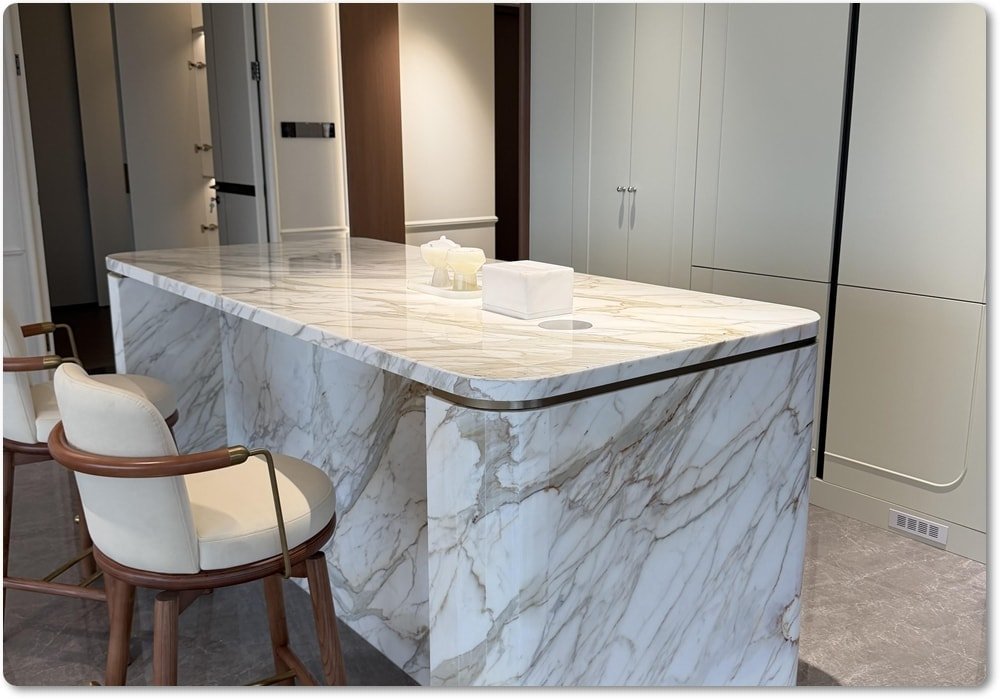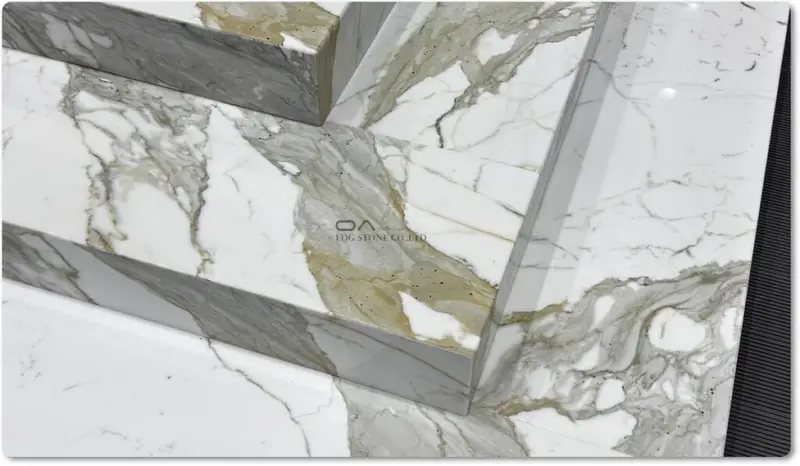
Engineered white quartz serves as the dominant surface choice for modern architectural and residential environments. While all white quartz slabs appear clean at first glance, subtle differences in resin purity, aggregate density, and pigment formulation alter their visual performance.
This white paper examines the four major white quartz categories: Pure White, Frost White, Snow White, and Arctic White. We evaluate these surfaces using CIELAB color space measurements, Light Reflectance Value (LRV), photometric depth, and interior matching strategies to streamline material selection for commercial projects.
+-------------------------------------------------------------------------------------------------+
|                                 WHITE QUARTZ SPECTRUM & LRV                                     |
+-------------------------------------------------------------------------------------------------+
|  PURE WHITE            FROST WHITE              SNOW WHITE               ARCTIC WHITE           |
|  (Ultra-Monolithic)    (Cool Stippled / Ice)    (Warm Soft Milky)        (Crisp Micro-Speckle)  |
|                        * * * * * * * * *        . . . . . . . . .        + + + + + + + + +      |
|                        * * * * * * * * *        . . . . . . . . .        + + + + + + + + +      |
|  LRV: 88 - 92          LRV: 81 - 85             LRV: 83 - 86             LRV: 85 - 89           |
|  CIE L*: 94.5-96.8     CIE L*: 91.2-93.5        CIE L*: 92.1-94.2        CIE L*: 93.0-95.1      |
|  b* value: -0.2 to +0.3  b* value: -1.2 to -0.4    b* value: +1.5 to +2.8    b* value: -0.8 to -0.1 |
+-------------------------------------------------------------------------------------------------+
1. Material Logic & Chemical Structure of White Quartz
Engineered white quartz consists of 90% to 93% high-purity quartz aggregate by weight, bound together with 7% to 10% unsaturated polyester resin, titanium dioxide ($TiO_2$) whitening agents, and performance additives. Manufacturing relies on high-vacuum vibro-compression curing (Bretonstone process technology).
                       COMPOSITE RAW MATERIAL MIXTURE
                                     │
      ┌──────────────────────────────┼──────────────────────────────┐
      │                              │                              │
┌─────┴──────────────┐    ┌──────────┴───────────┐    ┌─────────────┴────────────┐
│ Quartz Aggregate   │    │ Resin Binder System  │    │ Pigments & Additives     │
│ (90% - 93% Weight) │    │ (7% - 10% Weight)    │    │ (< 1.5% Weight)          │
└─────┬──────────────┘    └──────────┬───────────┘    └─────────────┬────────────┘
      │                              │                              │
      ├─ 0.1 - 0.4mm Ultra-Fine      ├─ Unsaturated Polyester       ├─ Titanium Dioxide (TiO2)
      ├─ 0.4 - 1.2mm Fine Granule    ├─ Silane Coupling Agents      ├─ Optical Brighteners
      └─ Glass/Mirror Flakes         └─ UV Stabilizers (UVA/UVB)   └─ Anti-Yellowing Agents
                                     │
                                     ▼
                   HIGH-VACUUM VIBRO-COMPRESSION PROCESS
                       (100 mbar Vacuum, 28-32 Hz)
                                     │
                                     ▼
                        THERMAL CURING & POLISHING
                       (100°C - 105°C Polymerization)
Optical Pigmentation Mechanisms
Titanium Dioxide ($TiO_2$) Matrix Distribution: Rutile-grade $TiO_2$ pigments deliver maximum opacity and light scattering. High-grade slabs use sub-micron $TiO_2$ particles to achieve uniform light distribution across the slab without clumping.
Resin Purity: Standard polyester resin cures with a faint amber tint. Ultra-white formulations require clear, non-yellowing resins combined with silane coupling agents. These agents bond the inorganic silica crystals directly to the organic resin matrix, eliminating optical voids.
Aggregate Selection: Natural quartz crystals contain trace iron oxides ($Fe_2O_3$) that add unwanted warm or brown undertones. Producing pure white quartz requires optical-sorting technology to strip out impurities before processing.
2. Technical Comparison Matrix: CIELAB & Optical Data
Color consistency across large architectural batches requires precise spectral analysis. The $L^*a^*b^*$ color space system measures light absorption, undertones, and chroma depth under standardized Illuminant D65 conditions.
| Engineering Property | Pure White Quartz | Frost White Quartz | Snow White Quartz | Arctic White Quartz | ASTM Standard |
| CIELAB Lightness ($L^*$) | 94.5 – 96.8 | 91.2 – 93.5 | 92.1 – 94.2 | 93.0 – 95.1 | ASTM E313 |
| CIELAB Red/Green ($a^*$) | -0.2 to +0.2 | -0.6 to -0.1 | +0.1 to +0.6 | -0.4 to 0.0 | ASTM E313 |
| CIELAB Yellow/Blue ($b^*$) | -0.2 to +0.3 | -1.2 to -0.4 | +1.5 to +2.8 | -0.8 to -0.1 | ASTM E313 |
| Light Reflectance Value (LRV) | 88% – 92% | 81% – 85% | 83% – 86% | 85% – 89% | ASTM C609 |
| Mohs Hardness Scale | 7.0 | 6.5 – 7.0 | 6.5 – 7.0 | 7.0 | EN 101 / Mohs |
| Water Absorption (%) | 0.01% – 0.02% | 0.02% – 0.03% | 0.02% – 0.03% | 0.01% – 0.02% | ASTM C97 |
| Compressive Strength (PSI) | 32,000+ | 30,000+ | 30,000+ | 31,500+ | ASTM C170 |
| Flexural Strength (PSI) | 7,200+ | 6,800+ | 6,800+ | 7,100+ | ASTM C880 |
| Surface Gloss Units (Polished) | 90–94 GU | 85–90 GU | 88–92 GU | 90–93 GU |
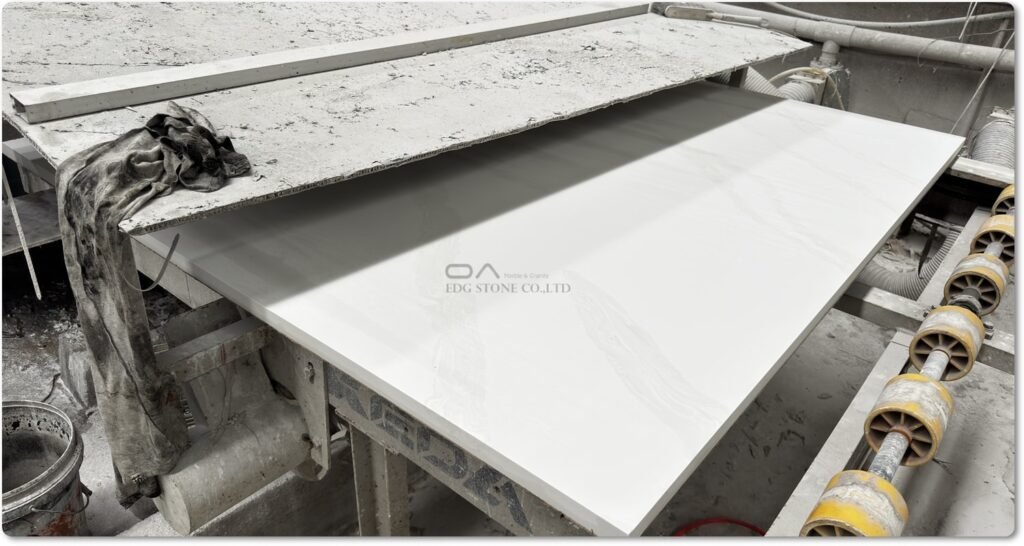
3. Deep-Dive: The 4 Primary White Quartz Color Profiles
Profile A: Pure White Quartz (Ultra-Monolithic Minimalist)
+-------------------------------------------------------------------------------------------------+
| VISUAL SPECIFICATION: PURE WHITE QUARTZ                                                        |
| Surface Appearance: Seamless, zero-grain optical plane                                          |
| Aggregates: Sub-micron silica dust (< 0.05 mm)                                                  |
| Color Tone: Neutral 5000K daylight balance (b* = 0.0)                                          |
+-------------------------------------------------------------------------------------------------+
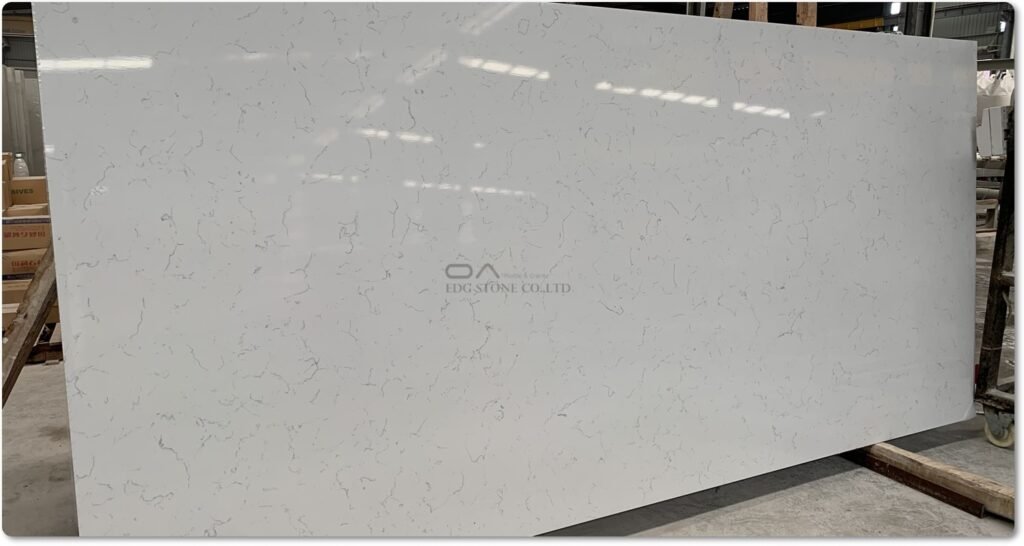
Pure White Quartz features an ultra-smooth visual field with no visible aggregate grains or quartz chips. Micro-milled silica powder combined with high-grade $TiO_2$ creates a monolithic white surface.
Design Style & Architectural Application: Ideal for ultra-minimalist, contemporary, and clinical interiors. It provides a clean backdrop for handleless cabinetry and hidden architectural lighting.
Interior Matching: Pairs well with ultra-matte black hardware, exposed architectural concrete, and dark charcoal cabinetry.
Lighting Consideration: Sensitive to ambient light temperature. Warm 2700K lighting shifts the surface toward a cream tone, while cool 6000K lighting creates a crisp clinical feel. Neutral 4000K–4500K LED lighting yields the most accurate color rendering.
Profile B: Frost White Quartz (Cool-Toned Ice Texture)
+-------------------------------------------------------------------------------------------------+
| VISUAL SPECIFICATION: FROST WHITE QUARTZ                                                       |
| Surface Appearance: Translucent crystalline depth with subtle icy undertones                   |
| Aggregates: Mid-grade clear quartz granules (0.2 - 0.8 mm)                                      |
| Color Tone: Cool blue-gray undertone (b* = -1.2 to -0.4)                                        |
+-------------------------------------------------------------------------------------------------+
Frost White Quartz blends fine crystalline quartz chips with semi-translucent resins. Light penetrates slightly beneath the surface before reflecting out, giving the material visual depth similar to natural glacial ice.
Design Style & Architectural Application: Common in Scandinavian modern, industrial, and high-traffic commercial interiors. The subtle grain helps conceal light dust and fingerprints.
Interior Matching: Pairs cleanly with cool gray cabinetry, brushed nickel, stainless steel fixtures, and blue-tinted glass backsplashes.
Lighting Consideration: Absorbs and disperses bright overhead lighting without harsh glare. Maintains its cool white appearance under bright commercial LED panels.
Profile C: Snow White Quartz (Soft Warm Milky Tone)
+-------------------------------------------------------------------------------------------------+
| VISUAL SPECIFICATION: SNOW WHITE QUARTZ                                                         |
| Surface Appearance: Soft, organic milky base with fine warm micro-aggregates                   |
| Aggregates: Blended silica and cream micro-particulates (0.1 - 0.4 mm)                         |
| Color Tone: Warm ivory/yellow undertone (b* = +1.5 to +2.8)                                     |
+-------------------------------------------------------------------------------------------------+
Snow White Quartz uses warm pigments ($b^* > +1.5$) to create a soft, inviting ivory-white tone. It avoids the harsh visual starkness of cold whites, making spaces feel comfortable and lived-in.
Design Style & Architectural Application: Suited for Transitional, Farmhouse, Organic Modern, and Classic Traditional kitchens.
Interior Matching: Complements natural oak cabinetry, warm walnut trim, brushed brass hardware, and warm terracotta tiles.
Lighting Consideration: Handles warm 2700K–3000K residential lighting well without appearing harsh or sterile.
Profile D: Arctic White Quartz (Crisp Speckled Precision)
+-------------------------------------------------------------------------------------------------+
| VISUAL SPECIFICATION: ARCTIC WHITE QUARTZ                                                      |
| Surface Appearance: Bright white base scattered with fine silver-gray quartz chips              |
| Aggregates: High-contrast crushed quartz crystals (0.3 - 1.2 mm)                                |
| Color Tone: Bright neutral-cool tone (b* = -0.8 to -0.1)                                        |
+-------------------------------------------------------------------------------------------------+
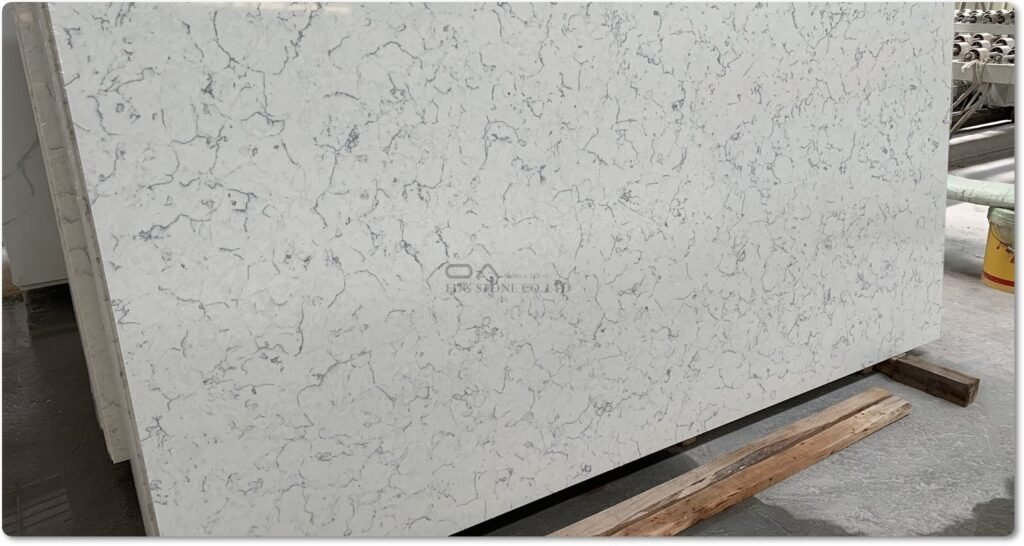
Arctic White Quartz pairs a bright white resin matrix with fine gray quartz crystals. The faint micro-speckle pattern adds physical texture and helps disguise minor daily wear.
Design Style & Architectural Application: Widely used in multi-family residential developments, hospitality guestrooms, and high-use commercial restrooms.
Interior Matching: Fits alongside two-tone cabinetry designs, matte black accents, chrome plumbing, and light gray oak flooring.
Lighting Consideration: High Light Reflectance Value (LRV 85-89%) brightens dim areas like interior shower alcoves or basement bars.
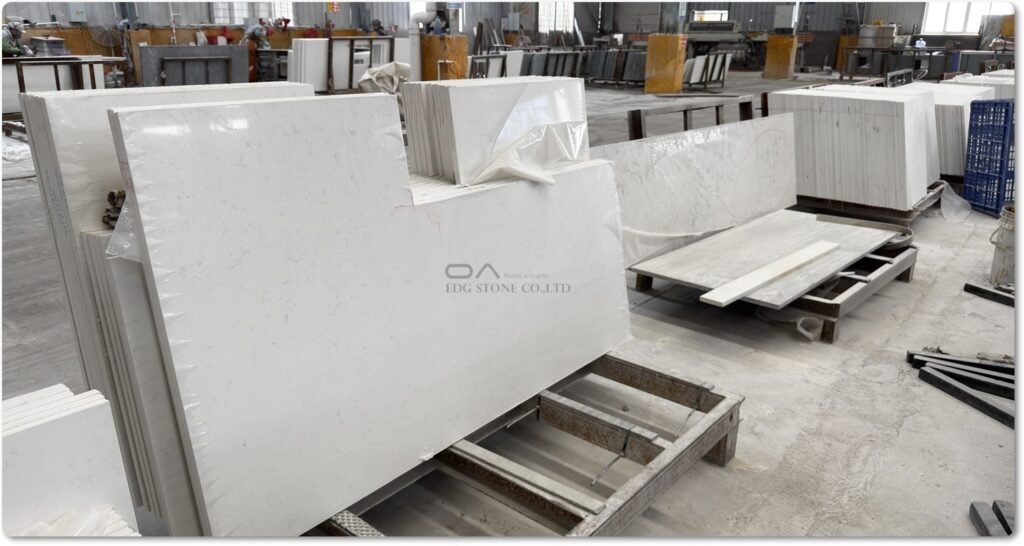
4. Architectural Light Reflection & Spatial Dynamics
Surface gloss levels directly alter how white quartz reads in a room. The angle of incoming light and the chosen finish impact both brightness and visual texture.
                             LIGHT REFLECTION DYNAMICS

       POLISHED FINISH (90+ GU)                     HONED/MATTE FINISH (15-25 GU)
      Direct Specular Reflection                      Diffuse Light Dispersion

          Incoming Light                                  Incoming Light
               │                                               │
               ▼                                               ▼
        \              /                                \   │   /  \   │   /
         \            /                                  \  │  /    \  │  /
   ───────┴──────────┴───────                      ───────┴──┴───────┴──┴───────
   Smooth Surface Matrix                           Micro-Textured Surface Matrix
   (High Specular Highlights)                      (Soft Ambient Dispersion)
Gloss Level Comparison
Polished Finish (90+ Gloss Units): Maximizes light reflection and brings out deep crystalline details. Highly reflective surfaces bounce light across dark rooms, but they also highlight surface smudges or fingerprints under directional lighting.
Honed / Matte Finish (15–25 Gloss Units): Creates a soft, non-reflective surface that scatters light evenly. Matte finishes absorb harsh glare, making them ideal for rooms with large floor-to-ceiling windows.
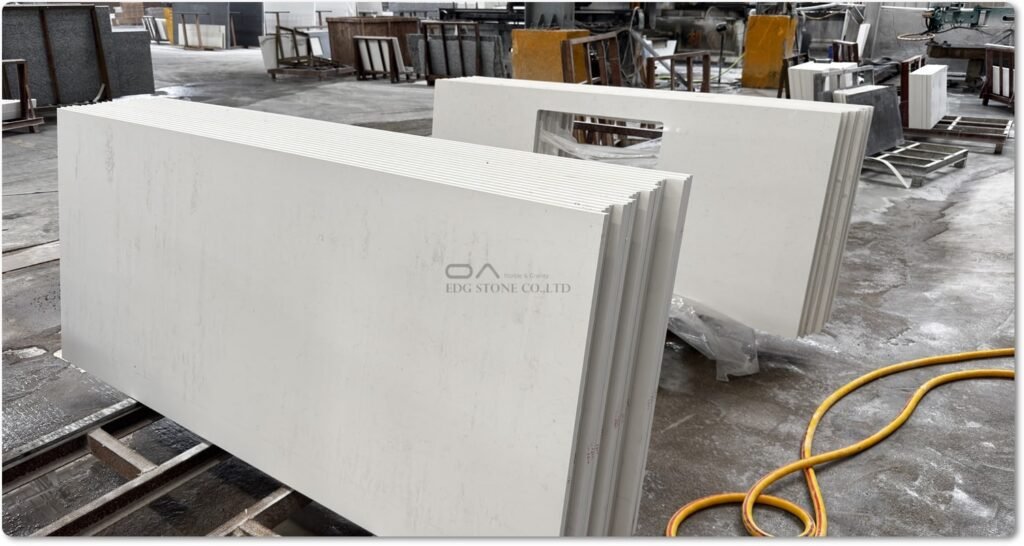
5. Global Commercial Procurement & Manufacturing: EDG Stone Factory Case Study
+-------------------------------------------------------------------------------------------------+
| MANUFACTURING FLOW: EDG STONE FACTORY HIGH-PRECISION QUARTZ PRODUCTION                         |
+-------------------------------------------------------------------------------------------------+
| [Raw Material Prep] ──► [Vibro-Compression] ──► [Curing Oven] ──► [Colorimeter Calibration]    |
| Optical sorting of       100 mbar Vacuum        105°C Curing       CIE L*a*b* Spec Checking       |
| 99.8% silica crystals    28-32 Hz Vibration     80 Minutes         Delta E < 0.5 per Batch        |
+-------------------------------------------------------------------------------------------------+
EDG Stone Factory manufactures high-purity engineered quartz slabs and custom countertops for global commercial buyers. Commercial developments require strict slab-to-slab color consistency across large production runs.
Quality Control Standards
                      SLAB VARIATION RANGE (DELTA E)

   0.0             0.5             1.0             1.5             2.0
   ├─── EDG Target ──┤
   │  (Delta E < 0.5)│
   └─────────────────┴───────────────────────────────────────────────►
                       Commercial Acceptability Cutoff (Delta E 1.2)
Spectrophotometric Color Matching: Every production lot undergoes automated spectrophotometer testing. Slabs must maintain a strict variation limit ($\Delta E < 0.5$) against master samples to prevent shade mismatches during installation.
Resin-Purification Process: Double-vacuum processing removes air bubbles down to microscopic levels. This process yields a non-porous structure with water absorption rates below 0.02%.
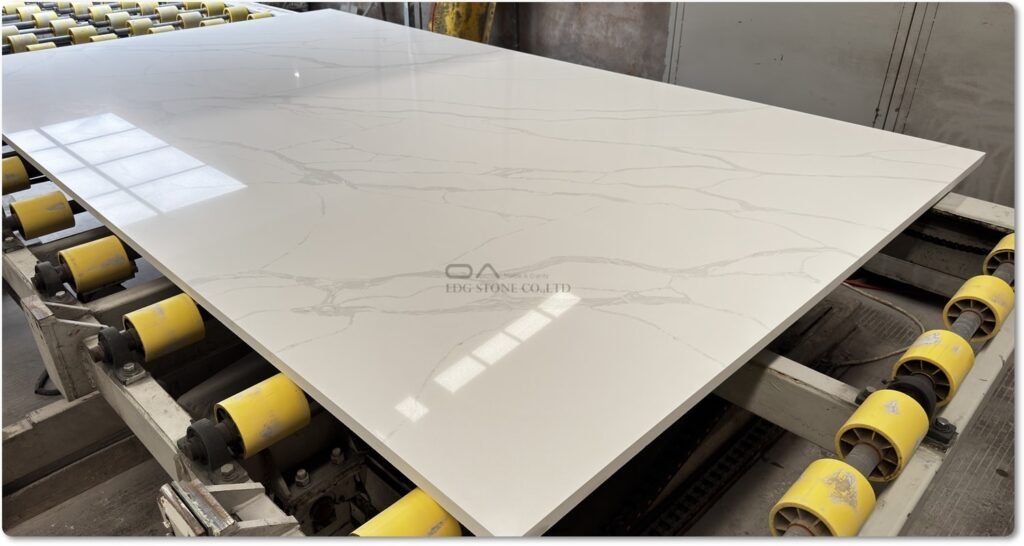
Automated Surface Calibrations: Multi-head CNC grinding tables maintain flat tolerances across large jumbo slabs ($3200 \times 1600\text{ mm}$ and $3300 \times 1955\text{ mm}$).
+-------------------------------------------------------------------------------------------------+
| EDG STONE FACTORY COMMERCIAL CAPACITY & SPECIFICATIONS                                          |
+-------------------------------------------------------------------------------------------------+
| • Standard Slab Dimensions: 126" x 63" (3200mm x 1600mm) / Jumbo: 130" x 77" (3300mm x 1955mm)  |
| • Thickness Availability: 15mm, 18mm, 20mm (3/4"), 30mm (1-1/4")                               |
| • Edge Fabrication: Mitered Waterfall, Beveled, Eased, Bullnose, Ogee                          |
| • Industry Certifications: NSF/ANSI Standard 51 (Food Safety), ISO 9001, CE, GreenGuard Gold    |
+-----------------------------------------------------------------------------------------------
6. How-To Guide: Selecting and Testing White Quartz
Follow this structured selection process to identify and verify the right white quartz surface for your project.
Measure incoming natural light and choose your primary interior LED color temperature (2700K vs 4000K vs 6000K). High-contrast spaces benefit from Arctic White, while warmer, organic spaces pair best with Snow White.
Review full-size physical samples directly on the job site under actual lighting conditions. Check samples against cabinet door finishes, wall paint swatches, and floor tiles.
Request certified third-party testing reports showing compliance with ASTM C97 (Water Absorption < 0.03%), ASTM C880 (Flexural Strength > 6000 PSI), and NSF/ANSI Standard 51 for direct food contact.
Inspect complete target slabs under bright studio lighting before CNC cutting. Confirm there are no dark resin spots, shade variations, or aggregate clumping.
7. Knowledge-Base FAQ Cluster
Question 1: How does white quartz prevent yellowing over time?
Answer: White quartz resists yellowing when produced with high-purity clear resins, UV stabilizers, and optical brighteners. High-grade engineered quartz prevents degradation under normal indoor lighting conditions. Direct outdoor sunlight can degrade standard polyester resins over time, so exterior installations require specialized outdoor UV-rated resin formulations.
Evidence:
ASTM D2565 accelerated weathering tests show that high-purity quartz slabs formulated with UV stabilizers maintain a color variation index of $\Delta E < 1.0$ after 2,000 hours of continuous xenon-arc exposure.
Summary: High-quality white quartz uses UV-stabilized clear resins that prevent yellowing in standard indoor environments.
Question 2: Which white quartz option best hides water spots and dust?
Answer: Arctic White Quartz and Frost White Quartz hide surface smudges and water spots better than Pure White. Their micro-crystalline structures disperse light reflections, reducing the visibility of minor surface deposits.
                   SURFACE STAIN AND DUST CONCEALMENT RATING

  Pure White Quartz    ████ 4/10 (High Cleaning Frequency)
  Snow White Quartz    ██████ 6/10 (Moderate Concealment)
  Frost White Quartz   ████████ 8/10 (High Concealment)
  Arctic White Quartz  █████████ 9/10 (Optimal Concealment)
Evidence:
Commercial maintenance evaluations reveal that stippled white quartz surfaces need 35% less daily wiping to maintain a clean visual appearance compared to high-gloss monolithic pure white counters.
Summary: Stippled or speckled white quartz options mask daily dust and water spots better than ultra-smooth white surfaces.
Question 3: Can high-density white quartz withstand hot pans?
Answer: White quartz handles brief surface heat up to 300°F (150°C) without issue. However, sudden thermal shock from direct contact with extremely hot cast-iron pans can crack the surface or damage the polymer resin. Always use trivets or hot pads under hot cookware.
Evidence:
ASTM C484 thermal shock tests confirm that engineered quartz handles controlled temperature changes up to 150°C. Above this point, thermal expansion between quartz crystals and resin binders can cause micro-fracturing.
Summary: Quartz safely withstands moderate heat, but using hot pads prevents thermal shock damage.