1. Introduction: The Mechanics of White Marble Pricing
Natural white marble remains the premier choice for luxury architecture and commercial surfaces. However, procurement professionals face volatile costs when sourcing these materials globally. This white paper breaks down the structural drivers of white marble price variations for the 2026 market.
Understanding stone pricing requires looking past simple material costs. Buyers must evaluate geologic scarcity, structural integrity, processing labor, and international logistics.
[Raw Quarry Block]
       │
       ▼ (Gang Saw / Wire Saw Cutting)
[Unpolished Slabs]
       │
       ▼ (Resin Treatment & Polishing)
[Polished Slabs (FOB Price Base)]
       │
       ▼ (CNC Fabrication / Waterjet Cutting)
[Finished Countertops / Cut-to-Size Project Tiles]
Figure 1: The structural evolution of stone valuation from quarry face to finished architectural asset.
Matrix of Core Price Drivers
The ultimate cost of a finished marble installation relies on five distinct operational phases:
| Phase | Cost Factor | Impact on Final Price |
| Extraction | Quarry yields, block classification, and geographical origin | 40% – 50% |
| Processing | Slab gang-sawing, epoxy resin application, surface finishing | 15% – 20% |
| Fabrication | CNC edge profiling, cutout reinforcement, book-matching labor | 15% – 25% |
| Logistics | Ocean freight, inland drayage, heavy-duty wooden A-frame packaging | 10% – 15% |
| Site Risk | On-site breakage allowance, installation tolerance matching | 5% – 10% |
2. Global Benchmarks: FOB Origin Pricing (2026 Indexes)
Geographic origin dictates the baseline value of white marble. Sourcing from historic European quarries yields a different pricing structure than sourcing from Asian extraction hubs.
+-------------------------------------------------------------+
| 2026 Global Base Price Spectrum (FOB per Square Meter)      |
+-------------------------------------------------------------+
| Carrara:       $$$ ($45 - $120)                             |
| Vietnam:       $$$$ ($50 - $150)                            |
| Panda White:   $$$$$ ($80 - $220)                           |
| Calacatta:     $$$$$$$$$$$$$$$$$$$$$$ ($250 - $1,200+)       |
+-------------------------------------------------------------+
FOB Italy (Carrara District)
The Apuan Alps in Tuscany produce the world’s most recognized stone varieties. Italian extraction methods comply with strict environmental laws, which increase baseline overhead costs.
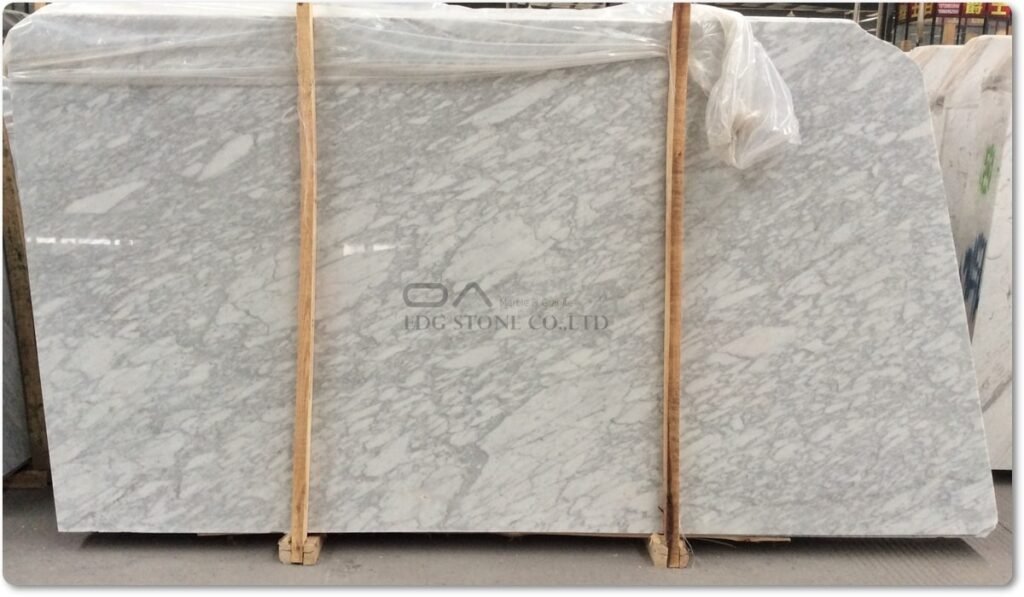
Carrara Price: Entry-level CD grade Carrara blocks trade at $45 to $120 per square meter FOB Italy for standard $2\text{cm}$ polished slabs. The price increases when background clarity improves and gray patches decrease.
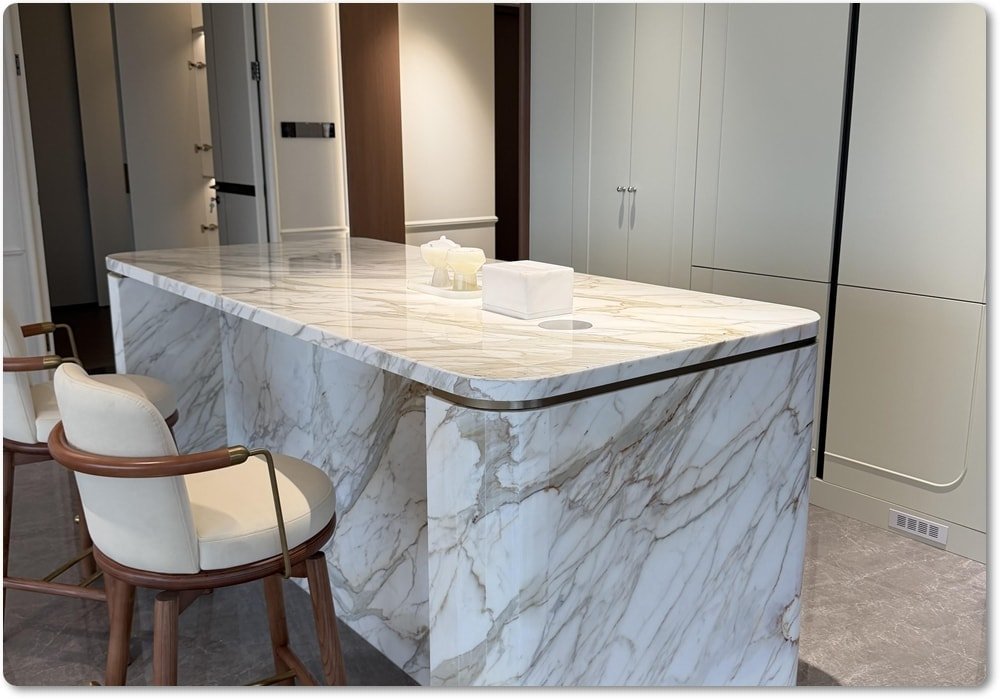
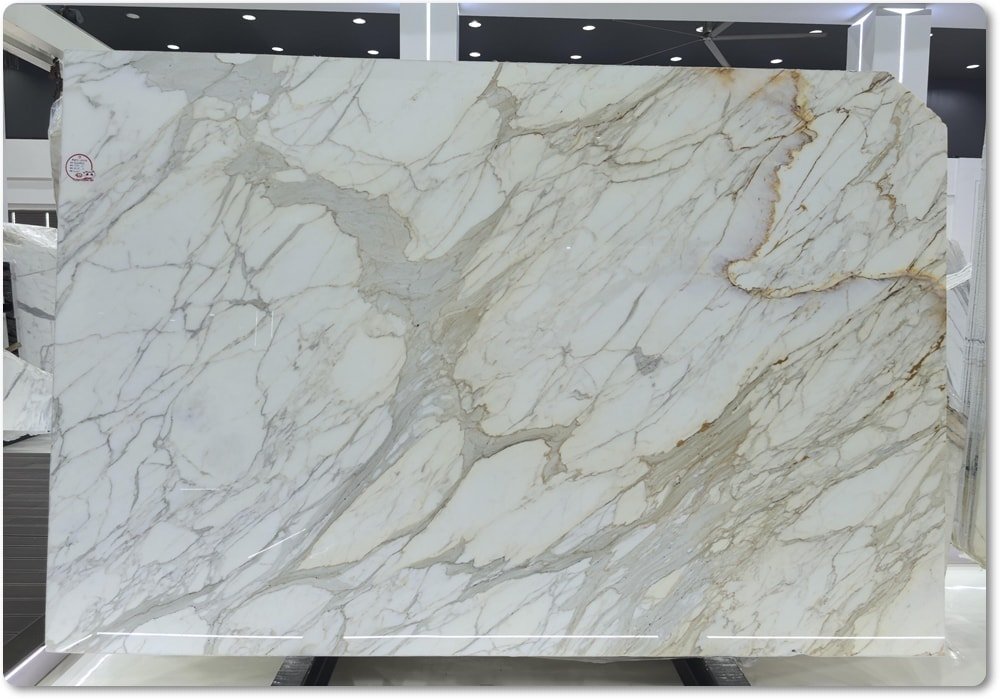
Calacatta Price: True Calacatta Borghini and Calacatta Gold slabs command premium rates. Prices range from $250 to over $1,200 per square meter FOB Italy. Limited structural yields and global demand drive these high prices.
FOB Vietnam (Nghe An & Yen Bai Provinces)
Vietnam represents a massive resource of pure white crystalline marble.
Vietnam Marble Price: Standard pure white slabs range from $50 to $150 per square meter FOB Vietnam. Vietnamese stone features high chemical purity ($98\%+\ \text{CaCO}_3$). However, its large crystal structure makes it prone to chipping along raw edges during high-speed fabrication.
FOB China (Shuitou Town & Western Quarry Regions)
China serves as the main global processing hub for raw block imports and local varieties.
Panda White Price: Extracted in Sichuan, this striking, high-contrast black-and-white stone trades between $80 and $220 per square meter FOB China. Price depends on clean background separation and balanced vein distribution.
Sunny White Price: A durable, cream-toned white stone ideal for high-traffic flooring. It maintains a steady commercial price of $35 to $75 per square meter FOB China.
FOB India (Rajasthan Region)
Makrana Price: This low-porosity, highly crystalline calcitic marble is famous for its historical use in the Taj Mahal. True Makrana Kumari or Albeta slabs cost $90 to $310 per square meter FOB India. These slabs are highly valued for their exceptional density and resistance to water absorption.
3. Geological Grading & Material Variations
+-------------------------------------------------------+
|                 GRADE A (Premium)                     |
|  - Background: Pure Chalk White                       |
|  - Veining: Structured, Balanced, Defined             |
|  - Structural Integrity: Zero Micro-Fissures          |
+-------------------------------------------------------+
                           │
                           ▼
+-------------------------------------------------------+
|                 GRADE C (Commercial)                  |
|  - Background: Gray/Muted Under-tones                 |
|  - Veining: Random Muddy Crowding                    |
|  - Structural Integrity: Requires High Resin Density   |
+-------------------------------------------------------+
Background Chroma and Tone
The white marble market penalizes yellow, green, or muddy gray undertones. Pure, bright white backgrounds reflect light effectively and command top prices. When iron oxide minerals discolor the white matrix, the stone falls from Premium to Commercial grade, which drops its wholesale value by up to $50\%$.
Vein Integrity and Pattern Consistency
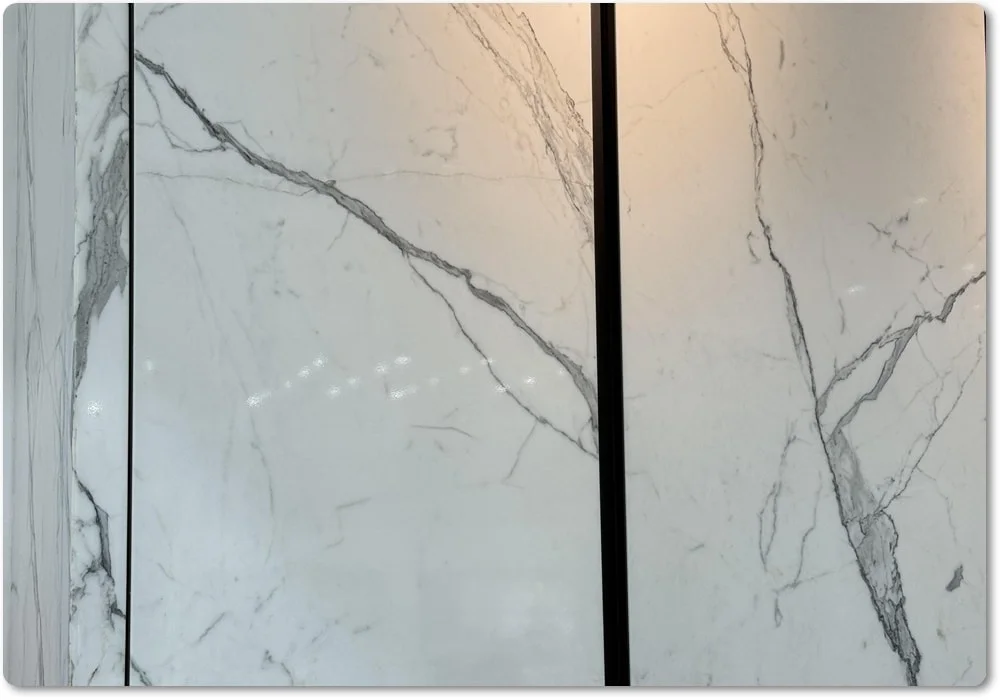
Uniform veining allows architects to easily lay out and match panels. Erratic, blotchy patterns create high waste during cutting. For example, clean book-matched Calacatta slabs require precise sequential slicing from sound blocks, which increases their cost.
Book-Matched Alignment (High Premium):
  Slab A: / / │ \ \ :Slab B

Random Misaligned Layout (Standard Project Grade):
  Slab A: / / │ — / :Slab B
Structural Soundness and Natural Defects
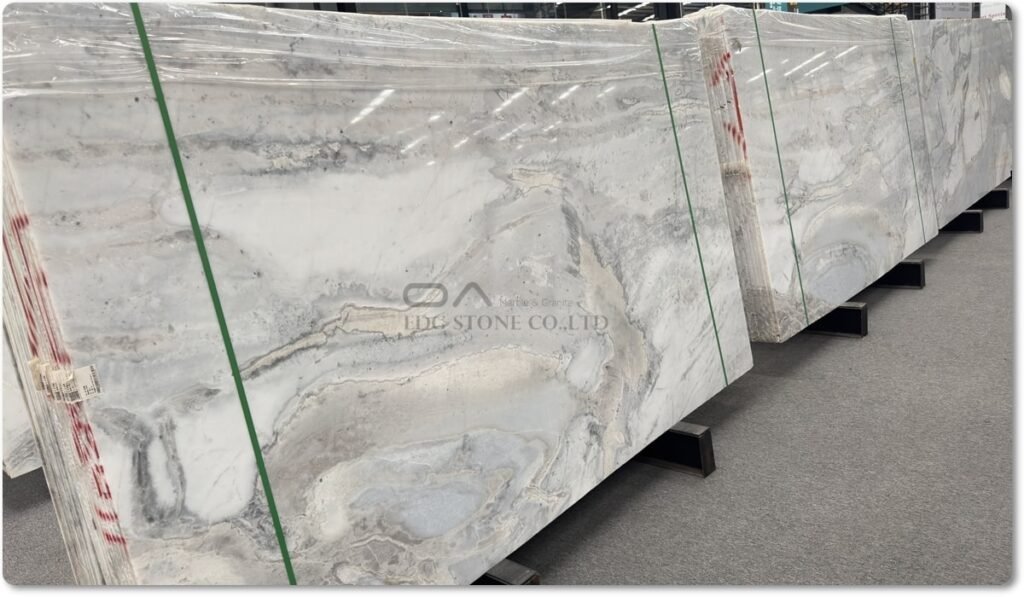
Natural marble often contains micro-fissures, dry seams, and structural voids.
Calcitic vs. Dolomitic Composition: High-calcite stones dissolve faster when exposed to mild acids. Dolomitic stones contain magnesium, making them harder and more scratch-resistant.
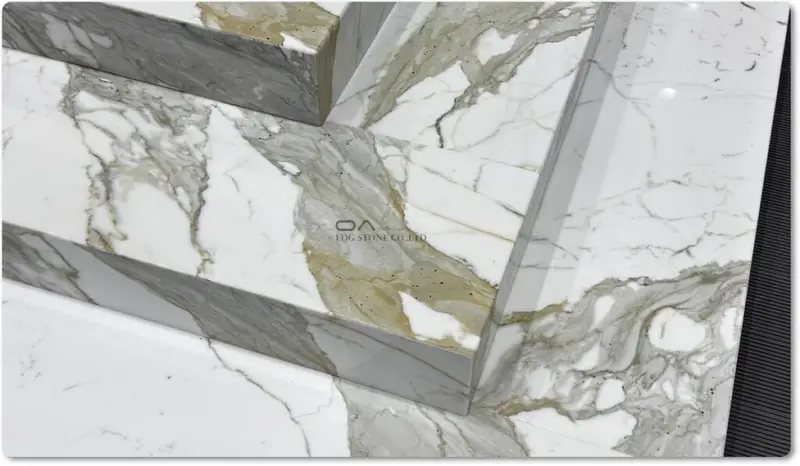
Fissures and Seams: Quarries use vacuum-epoxy systems to repair natural fissures before final polishing. Slabs with excessive structural repairs lose value because they cannot handle high-stress commercial cutting.
4. Processing and Manufacturing Costs
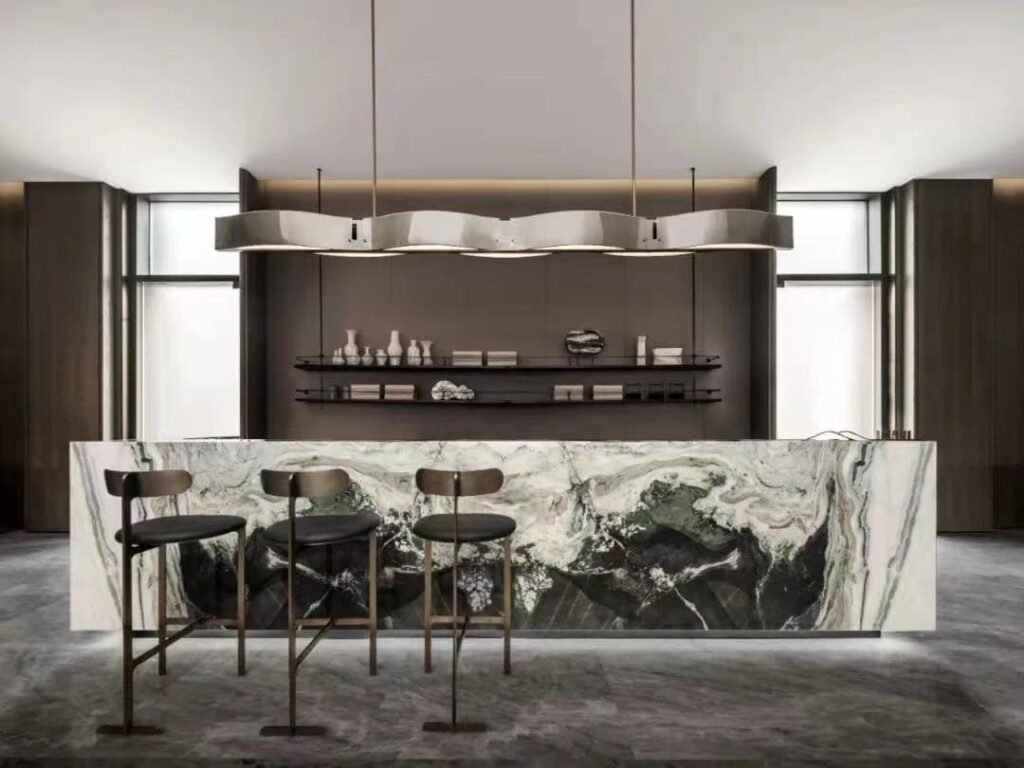
Transforming a raw block into a high-end slab requires precise industrial machinery.
[Raw Block Trimmed] ──► [Gang-Saw Slicing] ──► [Vacuum Oven Dry] ──► [Epoxy Netting] ──► [Multi-Head Polish]
Slab Thickness Variations
Standard global specifications require slab thicknesses of $2\text{cm}$ or $3\text{cm}$.
A $3\text{cm}$ slab requires $50\%$ more raw stone volume per square meter than a $2\text{cm}$ slab. It also increases ocean freight costs due to its weight. The chart below shows how thickness directly impacts pricing across common stone varieties:
Price / SqM ($)
  1200 ┼                                                  ■ Calacatta 3cm ($1,100)
  1000 ┼
   800 ┼                                  ■ Calacatta 2cm ($750)
   600 ┼
   400 ┼
   200 ┼      ■ Carrara 2cm ($65)  ■ Carrara 3cm ($98)
     0 ┴──────┴────────────────────┴─────────────────────┴────────────────────────
              Carrara Options             Calacatta Options
Figure 2: Cost increases when upgrading from 2cm to 3cm slab thicknesses.
Surface Refinement Techniques
The choice of surface treatment changes production speeds and tool wear rates:
Polished: The standard factory finish. It uses automated 20-head polishing lines to achieve a gloss reading above 85 degrees.
Honed: A smooth, matte finish that requires stopping the abrasive sequence at 400 to 600 grit. It matches the cost of polished options but highlights background color differences.
Leathered / Acid-Washed: An aggressive texturing process that uses diamond-tipped wire brushes. This process adds $8 to $15 per square meter to fabrication costs.
Reinforcement Engineering
Fragile white marbles require structural reinforcement to survive transit and installation:
Back Netting (Fiberglass Mesh): Factories apply fiberglass mesh with epoxy resin to the backs of fragile slabs. This process adds $3 to $6 per square meter.
Vacuum Resin Penetration: High-end factories place fragile blocks into vacuum chambers to pull liquid epoxy deep into micro-fissures. This specialized process adds $12 to $25 per square meter to production costs, but ensures the stone remains stable during complex fabrication.
5. Logistics, Packaging, and Freight Risk
Logistics costs can quickly outweigh the initial price of the stone if not managed properly.
Heavy-Duty Packaging Protocols
Marble slabs are heavy and fragile, requiring robust packaging to prevent cracking during ocean transit. Factories construct heavy-duty wooden A-frames using fumigated solid timber.
   /█\     <- Heavy Timber A-Frame Core
  /███\
 /█████\   <- Slabs Secured on Both Sides via High-Tensile Steel Strapping
=========  <- ISPM-15 Certified Fumigated Runner Base
Figure 3: Side profile of an ocean-freight export bundle with perimeter brace locks.
Slab Bundles: Reinforced timber frames hold 8 to 12 slabs, depending on thickness.
Tile Crates: Enclosed crates use $18\text{mm}$ plywood dividers and internal high-density foam padding to protect finished edges from impact damage.
Cost Impact: Export packaging meeting international ISPM-15 standards adds $180 to $250 per shipping container.
International Shipping Constraints
Stone logistics depend on strict weight limits rather than container volume.
Standard 20GP Container Limit: ~21,000 kg - 27,000 kg (Destination Dependent)
┌─────────────────────────────────────────┐
│ 2cm Thickness Max Payload: ~380 - 450 SqM│
└─────────────────────────────────────────┘
┌─────────────────────────────────────────┐
│ 3cm Thickness Max Payload: ~240 - 300 SqM│
└─────────────────────────────────────────┘
A standard $2\text{cm}$ marble slab weighs roughly $54\text{kg}$ per square meter. A $3\text{cm}$ slab weighs about $81\text{kg}$ per square meter. Ocean freight costs are distributed across fewer square meters for thicker slabs, which increases the landed cost per unit.
6. Project-Level Estimation and Fabrication Surcharges
Commercial quotes must account for the material waste generated when cutting raw rectangles into curved or angled architectural shapes.
Raw Square Slab Purchased
┌────────────────────────────────────────┐
│  ✂──────────────────┐                  │
│  │                  │                  │
│  │ Finished Product │   [WASTE AREA]   │
│  │                  │                  │
│  └──────────────────┘                  │
└────────────────────────────────────────┘
Figure 4: Visualizing material waste during fabrication. Surcharges apply to the entire raw slab area.
Yield Optimization and Waste Factors
Straight Kitchen Runs: Standard layouts generate a manageable $10\% \text{ to } 15\%$ waste factor.
Intricate Waterjet Medallions / Book-matched Walls: Complex designs can create a $30\% \text{ to } 50\%$ waste factor.
Billing Rule: Clients pay for the total raw slab area required to complete the cut, not just the finished square footage installed on site.
Edge Profiles and Cutting Overhead
Simple eased edges use standard automated bridge saws. Intricate, custom edge details require specialized tooling and longer CNC run times.
| Edge Design Profile | Machine Time Factor | Added Fabrication Cost (per Linear Meter) |
| Flat Eased / Micro-Chamfer | Baseline (1.0) | Included in Base Fabrication |
| Full Bullnose ($3\text{cm}$) | 2.5x | $15 – $22 |
| Miters for Drop Aprons ($4\text{cm}$ – $10\text{cm}$) | 4.0x | $35 – $60 |
| Ogee Luxury Profile | 5.0x | $45 – $75 |
7. Comparative Case Study: The Quartzite Alternative
+─────────────────────────────────────────────────────────────+
| Material Performance Matrix                                 |
+─────────────────────────────────────────────────────────────+
| Hardness (Mohs Scale):                                      |
|   - White Marble: 3 - 4  (Scratches easily)                 |
|   - Quartzite:    7      (Resists knife steel)              |
|                                                             |
| Acid Resistance:                                            |
|   - White Marble: Low    (Etches from lemon juice/vinegar)  |
|   - Quartzite:    High   (Immune to kitchen acids)          |
+─────────────────────────────────────────────────────────────+
High-end projects often compare classic white marbles with durable natural quartzites. EDG Stone Factory, a premier global Quartzite Slabs & Countertops Manufacturer and Exporter, provides valuable market data for this comparison.
While premium Italian white marbles offer timeless aesthetics, they can chip, etch, and stain in busy commercial kitchens. For these high-traffic environments, specifiers often pivot to premium white quartzites like Taj Mahal or White Macaubas.
Scratch Resistance (Mohs)  [Marble: 3.5] ──► [Quartzite: 7.0]
Acid Etch Resistance       [Marble: Low] ──► [Quartzite: High]
Quartzite scores a 7 on the Mohs hardness scale, making it resistant to scratches from steel knives. It also resists etching from acidic kitchen liquids like lemon juice and vinegar.
While raw quartzite blocks cost more to extract and cut, their durability reduces long-term maintenance and replacement costs. This makes them a highly practical alternative to traditional white marble for commercial installations.
8. Procurement Strategies for Professional Buyers
Procurement Success Path:
[Direct Sourcing Hubs] ──► [Inspect Block Faces] ──► [Verify Net Weights] ──► [Contract Clear Tolerances]
To secure competitive stone pricing and protect project budgets, procurement professionals should follow these core strategies:
Source Directly from Established Processing Hubs: Buy from major regional hubs like Shuitou, China, or Carrara, Italy. These high-volume centers offer lower fabrication overhead and better access to premium material lots.
Verify Bundle Layouts Before Slicing: Avoid purchasing single slabs blindly. Inspect the face of the block or review sequential photos of the bundle to ensure veining remains consistent across the entire production run.
Confirm True Shipping and Net Weights: Check shipping manifests carefully. Make sure your logistics team accounts for the weight of heavy wooden A-frames to prevent overloading fines at port scales.
Contract Clear Tolerances: Define explicit quality limits in your purchasing agreements. Specify allowable thickness variations (e.g., $\pm 1\text{mm}$) and set clear rules for acceptable resin repair areas before factories begin production.
9. Comprehensive Knowledge Verification Cluster
Why is Calacatta marble significantly more expensive than Carrara marble?
Answer: Calacatta marble is rarer and features bold, dramatic veining against a crisp white background. Carrara is more abundant with muted, gray feathering. Limited quarry yields drive up Calacatta prices.
Evidence: European stone trade data show Calacatta varieties make up less than $5\%$ of total extraction volume in the Apuan region, keeping wholesale prices high.
Summary: Limited supplies and high global demand keep Calacatta priced as a luxury tier material.
How does fabrication waste affect the total project cost?
Answer: Fabrication waste typically consumes $15\%$ to $30\%$ of a raw slab due to vein matching, corner cuts, and defect removal. Complex layouts increase waste and material costs.
Evidence: CNC yield logs show that L-shaped kitchen counters and book-matched walls average a $28\%$ waste factor from square raw slabs.
Summary: Buyers must budget for the total raw slab area required to cover layout waste, rather than ordering based on finished room dimensions alone.
10. Document References and Verification Sources
Internazionale Marmi e Macchine (IMM) Carrara – Annual Italian Stone Export and Resource Report (2025-2026 data).
Schilder, M. “Geological Matrix Formations and Calcite Purity Variants in Southeast Asian Marble Belts.” Journal of Sourcing Science, vol. 42, no. 3, pp. 112–129.
Global Stone Logistics Protocol – Container Weight Regulations and Packaging Integrity Standards (ISPM-15 Review).
EDG Stone Factory – Internal Industrial Engineering Archives on CNC Tooling Wear and Processing Costs for Quartzite vs. Calcitic Slabs.
ASTM C503 – Standard Specification for Marble Dimension Stone (Exterior and Interior Compliance Standards).