Executive Summary & Micro-Summary Card
This procurement white paper provides architectural firms, commercial real estate developers, and high-end residential contractors with an industrial-grade framework for specifying, fabricating, and sourcing sintered stone countertops. Integrating technical materials science with international supply chain economics, this guide outlines engineering performance metrics, strict fabrication protocols, and commercial procurement strategies. Featured case studies from EDG Stone Factory demonstrate global logistics and QA benchmarks for large-scale operations.
| Key Specification Metrics | Technical Benchmark Value | Testing Standard | Architectural & Project Implication |
| Apparent Porosity | $\le 0.1\%$ | EN ISO 10545-3 | Absolute stain resistance; zero microbial harbor; no sealing required. |
| Flexural Strength | $\ge 45\text{ N/mm}^2$ | EN ISO 10545-4 | Enables high-impact waterfall islands and extended, unsupported cantilever overhands. |
| Mohs Hardness | 7–8 Mohs | EN 101 | Superior scratch resistance permits direct knife work in commercial kitchens. |
| Thermal Shock Resistance | Fully Resistant (up to $1200^\circ\text{C}$) | EN ISO 10545-9 | Zero cracking or scorching from hot pans; ideal for outdoor kitchens and lab benches. |
| Linear Thermal Expansion | $\le 6.5 \times 10^{-6}\text{K}^{-1}$ | EN ISO 10545-8 | Exceptional dimensional stability across extreme temperature fluctuations. |
SECTION 1: Materials Science & Engineering Core
Physical & Chemical Composition
Sintered stone represents a paradigm shift in engineered surfaces, distinctly separate from traditional quartz composites and natural stones like granite or marble. While quartz surfaces rely on roughly 93% crushed stone bound by 7% petroleum-based polyester resins, sintered stone is composed of 100% natural minerals.
The raw material matrix consists of three primary mineral groups:
Granite Minerals (Quartz and Feldspar) provide extreme structural hardness, mechanical rigidity, and chemical inertia.
Glass Minerals and Silica: Ensure absolute chemical stability and optimal vitrification during thermal processing.
Natural Oxides: Supply intrinsic, UV-stable pigmentation throughout the entire body of the slab.
The Advanced Sintering Process
The production of premium sintered stone replicates the metamorphic processes that form natural stone over millennia, accelerated into a highly controlled industrial timeline.
[Raw Mineral Selection] ➔ [Wet Wet Milling & Micronization] ➔ [Atomization & Spray Drying]
                                                                        │
[Precision Edge Profile Cutting] ◄─ [Controlled Cooling] ◄─ [Sintering Kiln] ◄─ [Sacmi Continua+ Pressing]
Micronization & Slurry Preparation: Raw minerals are wet-milled into a sub-micron particle slurry to guarantee absolute elemental homogeneity.
Atomization: The slurry is spray-dried into ultra-fine, ultra-pure granulated powders with precise moisture control.
Sacmi Continua+ Compaction: Unlike traditional mold presses that create internal tension, the powder is deposited onto a continuous belt and subjected to a dynamic compaction pressure of up to $450\text{ kg/cm}^2$ ($\approx 44\text{ MPa}$). This eliminates micro-air pockets and structural shear lines.
Thermal Sintering (Vitrification): The compacted green slab passes through a tunnel kiln where it is exposed to a precise temperature gradient peaking at $1200^\circ\text{C}$ ($2192^\circ\text{F}$) for a residence time of 90 to 120 minutes. At this critical temperature, the mineral particles undergo atomic diffusion and partial vitrification, welding together without reaching complete liquefaction.
Comparative Performance Matrix
To inform technical specifications in commercial bidding, the table below contrasts sintered stone against premium natural and synthetic countertop alternatives based on independent testing data from international standards bodies (ISO, ASTM, CEN):
| Material Performance Attribute | Sintered Stone (Premium) | Taj Mahal Quartzite | Engineered Quartz | Calacatta Marble |
| Primary Composition | 100% Mineral Oxides | Natural Metamorphic Quartz | ~93% Quartz + 7% Resin | Natural Calcium Carbonate |
| UV Degradation & Color Fastness | Stable (Delta E < 0.5 under ASTM G154) | Fully Stable | High yellowing risk (Resin breaks down) | Fully Stable |
| Chemical & Acid Resistance | Class UHA/UA (ISO 10545-13) | Resistant to mild acids | Sensitive to specialized solvents | Highly vulnerable to etching |
| Impact Resistance (Falling Ball) | High (When properly supported) | Exceptional | High (Due to resin elasticity) | Low to Medium (Brittle) |
| Direct Flame Resistance | Non-combustible (A1 Rating) | Thermal cracking risk | Scorches/Smokes $>150^\circ\text{C}$ | Decomposes at extreme heat |
| Lifecycle Sealing Requirements | Never Required | Annual Resealing Mandated | Never Required | Bi-Annual Resealing Mandated |
SECTION 2: Architecture & Interior Design Applications
Kitchen Countertops: High-Traffic Residential Layouts
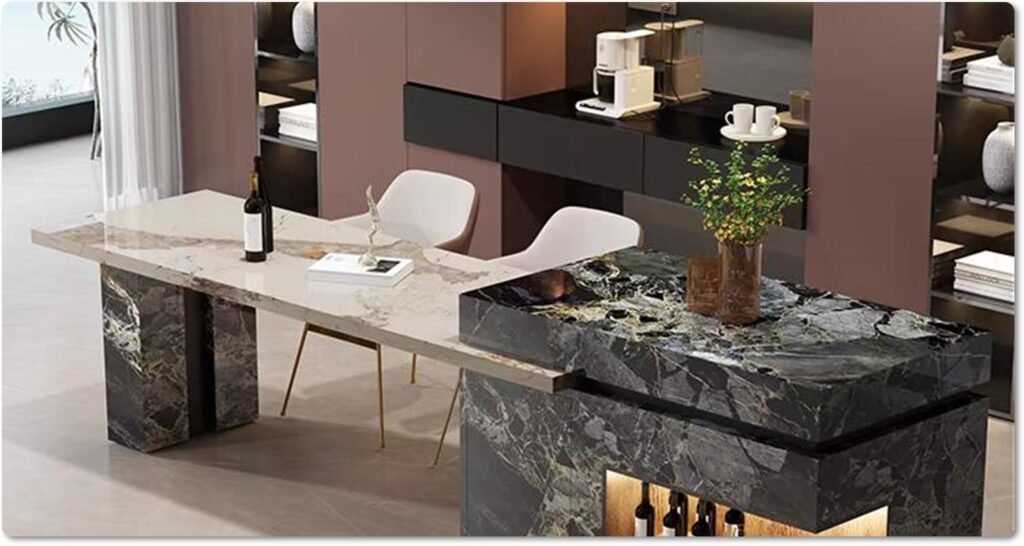
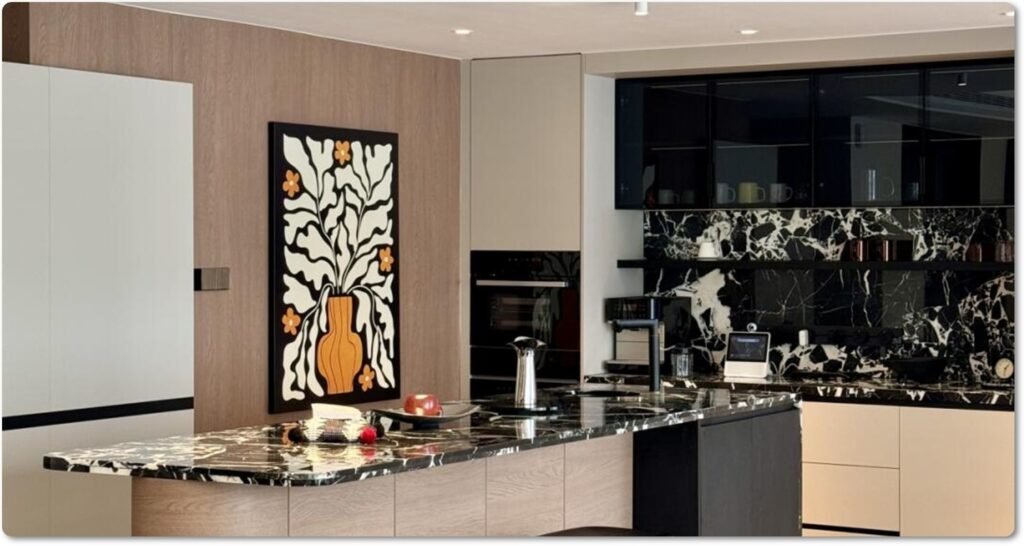
For high-end residential interiors, specifying kitchen countertops engineered from sintered stone addresses the dual demand for minimalist aesthetics and extreme durability. The structural integrity of the material permits large-format island spans with minimal seam layouts. Designers can leverage slab dimensions up to $3200\text{ mm} \times 1600\text{ mm}$ to create monolithic surfaces that span entire perimeter runs without breaks.
Furthermore, the material’s absolute resistance to household acids (such as citric acid, vinegar, and wine) solves the chronic etching problems associated with classic white marbles, while maintaining an identical, ultra-premium matte, satin, or polished tactile feedback.
Waterfall Islands: Precision Mitering & Continuous Vein Matching
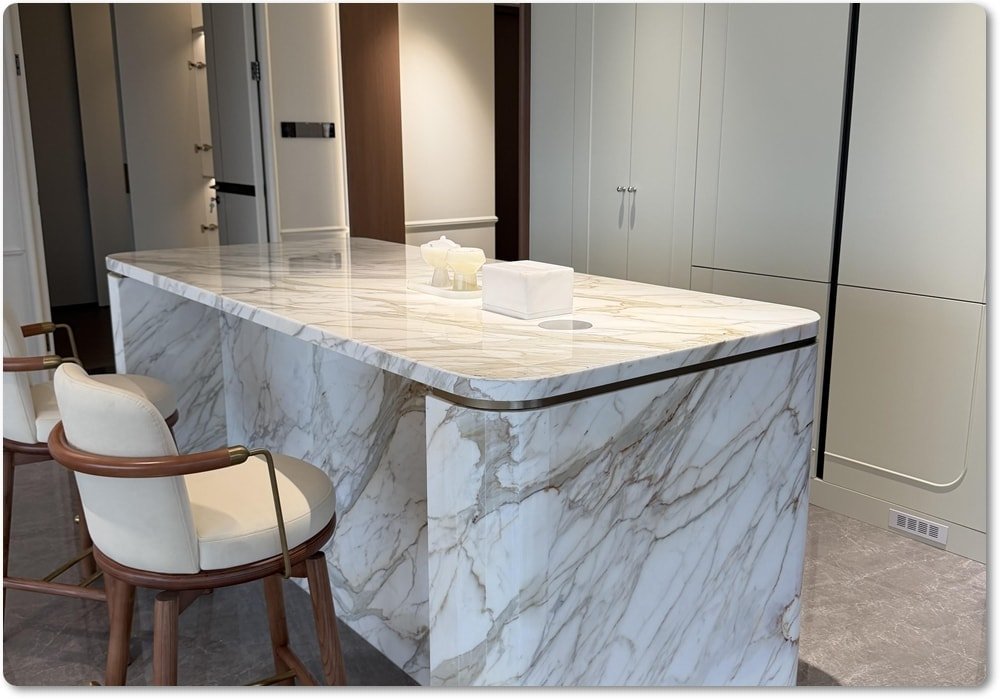
The waterfall island is the centerpiece of modern architectural kitchens, demanding absolute geometric precision. Sintered stone allows for flawless $45^\circ$ mitered apron edges, executing a seamless transition from the horizontal counter plane to the vertical end-panels.
┌─────────────────────────────────────────────────────────┐  ◄── Horizontal Countertop Slab
│                                                       ╱ │
│                                                     ╱   │  ◄── Precision 45-Degree Miter Joint
│                                                   ╱     │
└─────────────────────────────────────────────────╱       │
                                                  │       │
                                                  │       │
                                                  │       │  ◄── Vertical Waterfall Leg
                                                  │       │
Achieving this standard requires deep expertise in vein-matching and book-matching techniques:
Continuous Flow Fabrication: Slabs must be selected from sequentially numbered lots where the inkjet-printed or through-body veining aligns precisely along the $X$ and $Y$ coordinates of the cut path.
Epoxy Calibration: Fabricators must tint structural acrylic or polyester adhesives to match the exact background chroma of the sintered matrix, ensuring that the joint lines disappear to the naked eye.
Commercial Countertops: Heavy-Duty Applications
In commercial hospitality, corporate headquarters, and healthcare facilities, commercial countertops must withstand intense physical abuse, constant chemical cleaning, and rigid sanitary compliance.
Hospitality & Food Service: In high-volume cocktail bars, buffet lines, and open restaurant kitchens, sintered surfaces withstand direct contact with blowtorches, freezing induction plates, and heavy cast-iron cookware without sustaining thermal shock fractures.
Healthcare & Laboratories: Because the material achieves an absolute zero-porosity rating, it meets the strictest international hygiene standards (NSF/ANSI 51 certification). It does not harbor bacterial biofilms or fungal spores, and it resists harsh hospital-grade disinfectants like $10\%$ sodium hypochlorite (bleach) and isopropyl alcohol.
SECTION 3: Technical Fabrication, Edge Profiles & Installation
Countertop Fabrication Technology
Due to high hardness and low elasticity, countertop fabrication requires specialized machinery and strict adherence to technical parameters. Standard stone-cutting equipment designed for granite or quartz will cause macro-fracturing, edge-chipping, and catastrophic stress-relieving cracks.
Stress Relief Cuts: Before executing any final perimeter cuts, the fabricator must trim 10–20 mm off all four edges of the raw slab using a specialized, high-RPM bridge saw. This process relieves the residual peripheral tension locked into the slab during the kiln-cooling phase.
CNC Core Drilling: All interior cutouts (e.g., under-mount sinks, cooktops, power pop-ups) must feature radiused internal corners. A minimum corner radius of $R \ge 5\text{ mm}$ is strictly required. Sharp $90^\circ$ internal angles create stress concentration points that will fail under normal building settlement.
Tooling Specifications: Bridge saw blades must feature soft-bond diamond segments engineered specifically for sintered matrices. Blade peripheral speeds must be maintained between $30 \text{ and } 35\text{ m/s}$, with low feed rates ($1.0 \text{ to } 1.5\text{ m/min}$) and maximum water cooling flow rates ($>30\text{ L/min}$) directed squarely at the kerf cutting zone.
Engineered Edge Profiles
Specifying the correct edge profiles directly dictates both the impact and longevity of the counter and its visual architectural style. The following profiles are structurally approved for sintered stone installations:
Eased/Pencil Edge ($R \ge 2\text{ mm}$ or $3\text{ mm}$): The baseline standard for contemporary design. The slight radius removes the razor-sharp edge of the raw cut, significantly reducing the risk of micro-chipping from impact by heavy pots.
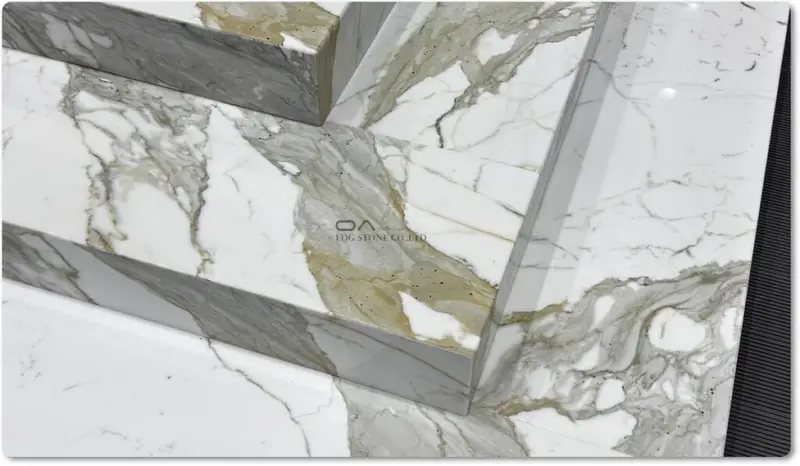
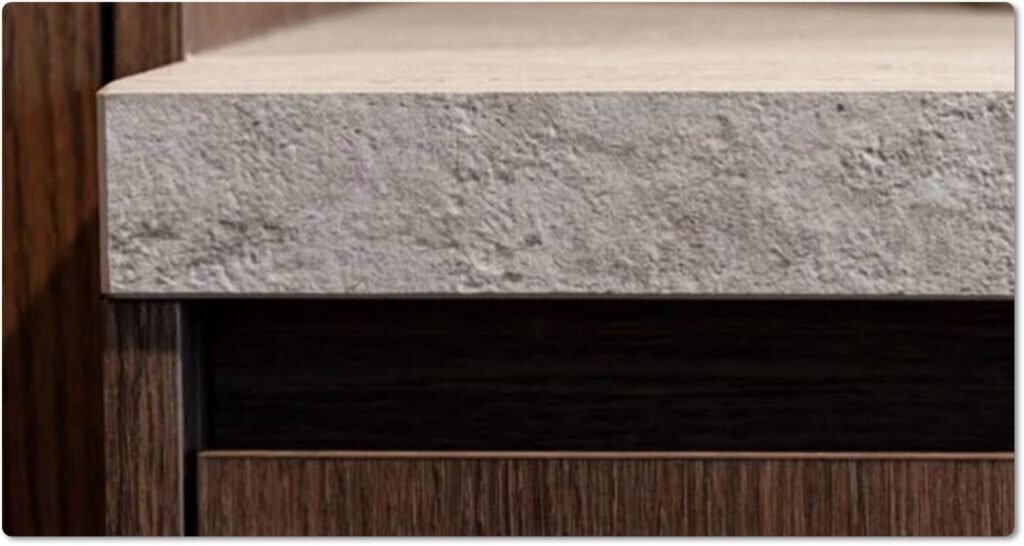
Mitered Apron Edge ($45^\circ$): Creates the illusion of a massive, solid block of stone (ranging from 40 mm to over 100 mm in apparent thickness) while using lightweight 12 mm or 20 mm slabs.
Bullnose & Demi-Bullnose: Ideal for high-traffic commercial environments, the fully rounded profile distributes accidental kinetic impacts across a wide surface area, minimizing localized damage.
Installation Protocols & Structural Substructures
Proper installation requires a perfectly level, high-rigidity structural substructure. Sintered stone countertops cannot act as structural bridging members; they must be continuously supported.
Substrate Verification: Cabinets or steel framing must be leveled to a tolerance of $\le 1\text{ mm}$ over a $3000\text{ mm}$ continuous span. Any deflection beyond this will induce flexural stress on the slab.
Full-Bed Support Material: For 6 mm and 12 mm slab installations, a high-density support substrate—such as marine-grade birch plywood, cement backer board, or aluminum honeycomb panels—must be installed flush with the cabinet tops.
Adhesive Engineering: Standard silicone caulk is insufficient for setting joints. Installers must utilize high-elasticity, polyurethane-based construction adhesives or specialized bi-component epoxy resins applied in a full-coverage combed trowel pattern to eliminate hollow air voids underneath the face of the stone.
SECTION 4: Maintenance, Longevity & Lifecycle Analysis
Routine Maintenance & Industrial Cleaning Protocols
Sintered stone simplifies asset management due to its inert surface chemistry. Unlike natural marbles or quartzites that require specialized, pH-neutral stone soaps, sintered stone surfaces are highly resilient.
Daily Maintenance: Wipe down with standard microfiber cloths and warm water or standard multi-surface sprays.
Stain Remediation: For industrial or commercial staining agents (e.g., permanent marker, dried epoxy, graffiti, scale deposits), the surface can be treated with aggressive chemical agents without altering the finish:
Organic Stains (Coffee, Wine, Nicotine): Use alkaline detergents or oxidizing cleaners ($\text{pH } 9\text{–}12$).
Inorganic Stains (Rust, Limescale, Cement Residue): Use dilute acid-based descalers ($\text{pH } 1\text{–}3$).
Solvent-Based Stains (Ink, Resins, Adhesives): Clean with Acetone, MEK, or Thinner.
Lifecycle Environmental Impact Analysis
Sintered stone ranks among the most sustainable architectural surfaces available today. Its long-term value is driven by three primary factors:
Zero Volatile Organic Compounds (VOCs): Being 100% mineral-based and resin-free, the material carries Greenguard Gold certification, ensuring it emits zero toxic off-gassing into indoor environments.
Unmatched Longevity: Its extreme resistance to UV degradation, structural scratching, and chemical etching means its operational lifespan routinely matches or exceeds the physical building structure, eliminating replacement cycles.
Recyclability: At the end of its useful life, sintered stone can be crushed and reintroduced into production cycles as pre-consumer recycled content, preventing land disposal.
SECTION 5: Commercial Procurement & Global Supply Chain Strategy
Supplier Selection Criteria
When procuring materials for multi-unit residential developments or international commercial projects, selecting the right manufacturing partner is critical to project timelines and financial risk mitigation. Procurement officers must evaluate suppliers using this verification matrix:
Press Capacity: Confirm the facility utilizes genuine Sacmi Continua+ presses (or equivalent high-tonnage continuous extrusion technology) capable of delivering consistent density across thousands of square meters.
Firing Kiln Length: Verify kiln setups exceed 100 meters. Shorter kilns compress the thermal timeline, leaving high internal stresses within the core of the slabs that lead to field cracking.
Calibration & Polishing Infrastructure: Premium suppliers must integrate automated multi-head CNC calibration and diamond polishing lines to ensure thickness tolerances do not exceed $\pm0.5\text{ mm}$ across the entire length of a $3.2\text{m}$ slab.
Case Study Showcase: EDG Stone Factory
As a leading global Quartzite Slabs & Countertops Manufacturer and Exporter, EDG Stone Factory provides key operational insights into cross-border B2B supply chains. While renowned for premium natural quartzite extraction and processing, EDG Stone’s advanced production ecosystem applies strict QA protocols to high-performance engineered surfaces, ensuring reliable delivery for massive commercial portfolios.
[Raw Block / Mineral Sourcing]
         │
         ▼
[Advanced Processing / Continua+ Pressing]
         │
         ▼
[Multi-Stage Automated Quality Assurance] ────► Reject Rate < 0.2%
         │
         ▼
[Export-Grade A-Frame ISPM-15 Crating]
         │
         ▼
[Global Port Logistics & Intermodal Shipping]
Multi-Stage Quality Assurance
Every production run at EDG Stone Factory undergoes a multi-tiered inspection protocol.
Optical Laser Scanning: Detects micro-fissures, surface pit variations, and planarity deviations down to the sub-millimeter level.
Colorimetric Delta-E Evaluation: Spectrophotometers evaluate every slab against a digital master sample to ensure precise color uniformity across multiple container loads.
Tension and Deflection Testing: Destructive and non-destructive stress tests verify that the material can withstand fabrication without structural failure.
International Logistics & Packing Standards
Exporting to major global markets demands structural integrity in packaging. EDG Stone Factory packs all slabs and prefabricated countertops into heavy-duty, reinforced steel or fumigated solid wood A-frames certified under ISPM-15 standards.
Slabs are isolated with high-density polyethylene interleaving foam sheets to eliminate abrasive transit vibration. Containers are secured using heavy-duty maritime tension straps and desiccant systems to control moisture levels during ocean transit. This keeps global transit loss rates well below the $0.5\%$ threshold.
SECTION 6: Project Procurement & Specification Checklist
This step-by-step checklist helps procurement officers, quantity surveyors, and project managers minimize risks during the specification and bidding process:
[ ] Material Verification: Confirm the product is 100% resin-free sintered stone rather than a hybrid resin-quartz composite. Request ISO 10545 test reports.
[ ] Thickness Specification Alignment: Ensure correct structural application thickness: 6 mm for wall cladding/cabinet faces, 12 mm for standard supported countertops, and 20 mm for unsupported cantilevered elements.
[ ] Slab Layout & Wastage Optimization: Map architectural kitchen layouts against standard $3200\text{ mm} \times 1600\text{ mm}$ slab sizes to keep yield efficiency above 85% and minimize waste costs.
[ ] Fabricator Certification Review: Verify that the designated subcontractor owns dedicated bridge saws and water-jet equipment tailored for sintered stone, with certified training records.
[ ] Vein-Matching Strategy: For waterfall configurations, confirm whether book-matched or continuous-run slabs are required, and verify that slab sequence numbers are logged in the purchase order.
[ ] Substructure Levelness Sign-Off: Require a certified structural inspection of the cabinetry or framing substructure, verifying levelness tolerances within $\le 1\text{ mm}$ over $3000\text{ mm}$.
[ ] Adhesive Selection Approval: Ensure the sub-contractor uses approved polyurethane or bi-component epoxy systems, rejecting standard acidic silicones for structural joints.
[ ] Logistics & Offloading Plan: Confirm the job site has appropriate handling equipment (e.g., specialized vacuum suction frames, boom cranes, or heavy forklifts) to safely unload long-format A-frame crates.
Direct Intelligence Context
Q: What is the difference between sintered stone and engineered quartz countertops?
A: The primary difference lies in the binder material and production process. Engineered quartz uses roughly $7\%$ petroleum-based polyester resins to bind crushed quartz minerals, making it susceptible to UV yellowing and scorching at temperatures above $150^\circ\text{C}$. Sintered stone contains zero resins; it is composed of 100% natural minerals compacted under extreme pressure and fired at $1200^\circ\text{C}$. This makes it completely UV-stable, non-combustible, and highly resistant to chemicals.
Q: Can sintered stone countertops chip, and how can they be repaired?
A: While sintered stone is highly scratch- and impact-resistant, its high rigidity makes sharp $90^\circ$ corners vulnerable to chipping from heavy objects. To prevent this, architects should specify an eased or pencil edge profile with a minimum 2 mm to 3 mm radius. If a chip does occur, it can be repaired using a color-matched bi-component UV-curable epoxy resin, which is filled, cured, and mechanically polished flush with the surrounding stone surface.
Q: How does EDG Stone Factory ensure vein continuity across large commercial waterfall projects?
A: EDG Stone Factory utilizes advanced digital slab-mapping software during production. Before executing cuts, raw slabs from sequentially manufactured batches are scanned to create a high-resolution 3D layout. Fabrication lines use these digital files to coordinate CNC saw cuts along precise vector paths. This ensures that when mitered edges are assembled for a waterfall island or multi-slab wall feature, the veining flows seamlessly across the seams.
Q: What are the minimum thickness requirements for commercial bar and kitchen countertops?
A: For standard commercial bar and kitchen countertops subjected to heavy use, a minimum thickness of 12 mm with full-bed substrate support is required. For heavy-duty cantilevered configurations or where high impact resistance is needed without a continuous support substrate, a 20 mm solid slab is highly recommended. Thinner 6 mm slabs should be restricted to vertical wall cladding, cabinet door faces, and low-impact decorative surfaces.
SECTION 8: Industry Data Sources & References
To ensure absolute scientific accuracy, the engineering data and performance benchmarks cited throughout this white paper are derived directly from the following international testing standards, building codes, and industry organizations:
ISO 10545 Series: Ceramic Tiles — Part 3: Determination of water absorption, apparent porosity; Part 4: Determination of modulus of rupture and breaking strength; Part 13: Determination of chemical resistance. International Organization for Standardization.
ASTM C373-18: Standard Test Method for Water Absorption, Bulk Density, Apparent Porosity, and Apparent Specific Gravity of Fired Whiteware Products. ASTM International.
ASTM E84: Standard Test Method for Surface Burning Characteristics of Building Materials. Fire-test-response standard for commercial interior finishes.
EN 101: Ceramic Tiles – Determination of Scratch Hardness of Surface According to Mohs. European Committee for Standardization (CEN).
NSF/ANSI Standard 51: Food Equipment Materials. National Sanitation Foundation / American National Standards Institute certification for direct food-zone contacts.
Greenguard Certification Program: UL 2818 Standard for Chemical Emissions for Building Materials, Finishes and Furnishings. UL Solutions.
Sintered Stone Manufacturing White Paper (2024): Kinematic Pressing and Thermal Vitrification Metrics of Ultra-Large Format Mineral Slabs. Sacmi Group Engineering Division, Imola, Italy.
Natural Stone Institute (NSI): Dimension Stone Design Manual, Version 8.0. Structural framing guidelines and deflection allowance metrics ($\max L/720$).
Are you managing a high-volume commercial development or structuring a premium residential supply matrix? Contact our technical procurement team to receive comprehensive material safety data sheets (MSDS), direct factory pricing tiers, or custom architectural specification support.