1. Introduction — why are Taj Mahal slabs trending for vertical design?
Interior design increasingly uses large-format natural stone to create impactful, long-lasting statements. Taj Mahal quartzite — prized for a creamy-white field with soft gold and rust veining — has become a favored alternative to Calacatta marble where designers want the marble aesthetic but need greater surface durability and heat resistance. This article walks through practical applications of Taj Mahal slabs for accent walls and interior cladding, the recommended engineering and installation methods, finishing and maintenance, procurement phrasing to capture trade buyers, and the regulatory context shaping fabrication practices.
2. Why Taj Mahal stone slabs for accent walls & cladding?
Aesthetic strengths
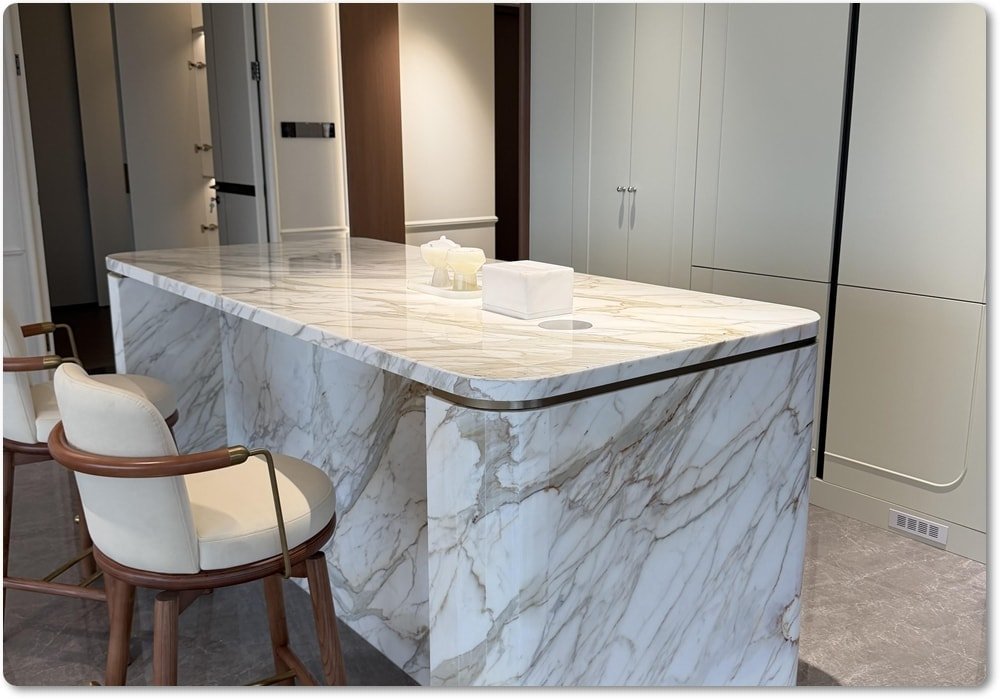
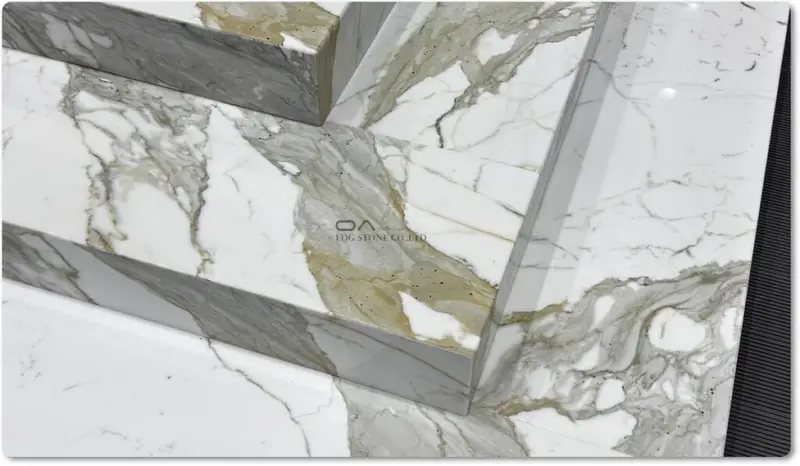
Taj Mahal quartzite delivers a soft, luxurious palette: warm ivory grounds interrupted by delicate gold veins that can be book-matched for mirror-symmetric drama. For interiors seeking a calm, high-end feel, Taj Mahal offers a neutral yet characterful backdrop that pairs with many furniture and cabinet palettes.
Functional advantages for vertical use
Unlike many marbles, quartzite is denser and typically more scratch- and heat-resistant, making it suitable for fireplace surrounds and adjacent areas near stoves or ovens. Its hardness also helps resist the wear that vertical surfaces endure in commercial lobbies and retail environments. Nonetheless, vertical use demands correct fixing: stone is heavy, and panels must be supported to resist gravity loads, vibrations, and potential thermal movement.
When to choose the Taj Mahal over alternatives?
Choose Taj Mahal when the visual objective is marble-like luxury with better durability than Carrara/Calacatta marble. For maintenance-free, non-porous surfaces, engineered quartz may be preferable, but quartzite’s natural texture and heat tolerance often justify its selection for feature walls and areas where authenticity matters.
3. Typical interior applications (feature walls & vertical cladding scenarios)
Living rooms & TV/media walls
Large Taj Mahal panels, book-matched across the TV wall, create a seamless focal point. Incorporate recessed channels for media wiring and plan ventilation behind in-wall electronics to avoid heat concentration against adhesive joints. Use concealed mechanical anchors combined with adhesive bedding for redundancy in high-value installs.
Fireplace surrounds & hearth walls
Quartzite’s heat tolerance makes it suitable for fireplace surrounds when installed with non-combustible backing and appropriate clearance to combustion sources. Specify non-combustible subframes and consult local code for required air gaps and hearth materials.
Bathroom wet walls & full-height shower cladding
Seamless, grout-minimized Taj Mahal panels are visually stunning in bathrooms. Use cementitious backer boards or specialist waterproofing substrates and ensure sealant joints at perimeters and penetrations. For wet areas, prefer full-bedding adhesives and back-buttering to maximize contact and prevent movement.
Hotel lobbies, reception desks & commercial branding
In high-traffic hospitality spaces, Taj Mahal provides luxe branding. For tall panels, use stainless steel subframes and clip systems enabling controlled thermal movement and independent drainage behind ventilated rainscreens where appropriate.
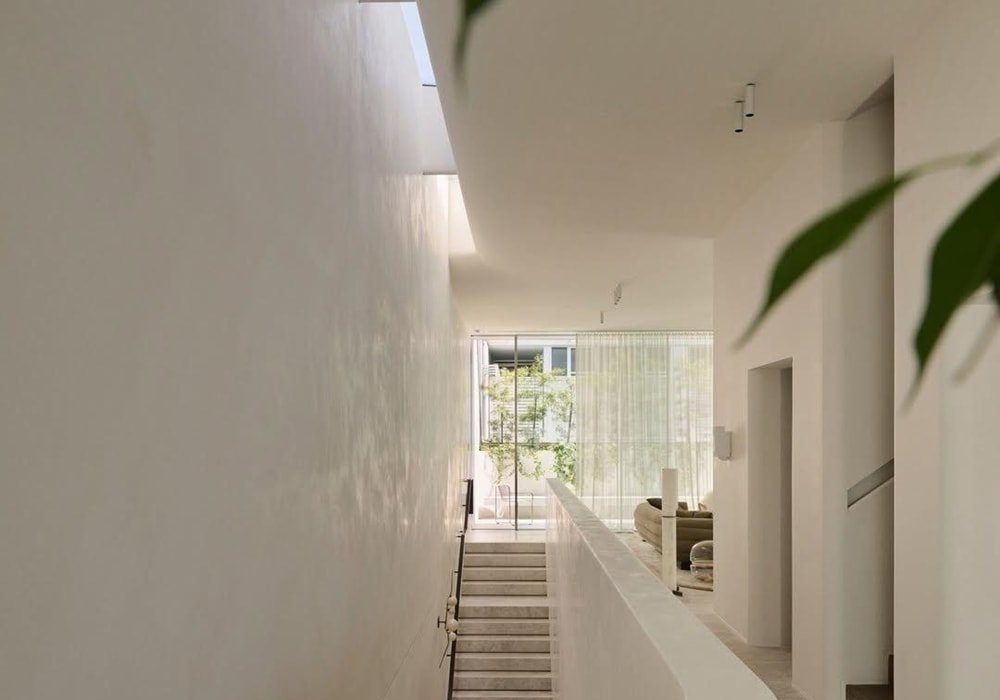
4. Fabrication & fixing systems for vertical stone cladding
Mechanical anchoring & subframing
Dimension stone anchors, pins, and adjustable brackets attached to structural frames provide long-term security for large panels. Engineers specify anchor spacing and embedding based on panel size, weight, and seismic/wind loads for commercial settings. The Natural Stone Institute’s anchoring bulletins are a core industry reference for mechanical systems.
Bonded adhesive systems & full-bedding
Interior vertical panels are often installed using epoxy or cementitious adhesives with full back-buttering to maximize bond area; some guides recommend verifying 100% contact for exterior vertical surfaces and similarly diligent backing for interior wet areas. Adhesive systems must be compatible with substrate and stone finish; installers should remove test panels periodically during installation to verify adhesion.
Clip & ventilated systems for premium installs
Where thermal movement, drainage, or future serviceability is required, clip systems attached to stainless steel rails let each panel move independently while ensuring positive retention. These systems are commonly used in commercial projects and high-end residential installs where precision and durability are required.
5. Panel size, slab thickness, and edge treatment for vertical use
Thickness & lamination strategies
Standard slab thicknesses for interior cladding are 2 cm and 3 cm. For larger vertical surfaces or thin profiles, fabricators commonly laminate multiple slabs or affix a structural backer (fiberglass or steel) to prevent flex and reduce the risk of cracking during handling and installation. Thicker panels reduce the need for auxiliary reinforcing but increase weight and anchor requirements.
Edge finishing for vertical aesthetics
Finishes such as polished, honed, and leathered alter the visual depth and tactile feel. Leathered finishes soften reflectivity, reducing glare on vertical surfaces and adding depth to veining—popular for sophisticated hospitality projects. Edge treatments on visible panel edges should be precise, with transitions planned to neighboring materials.
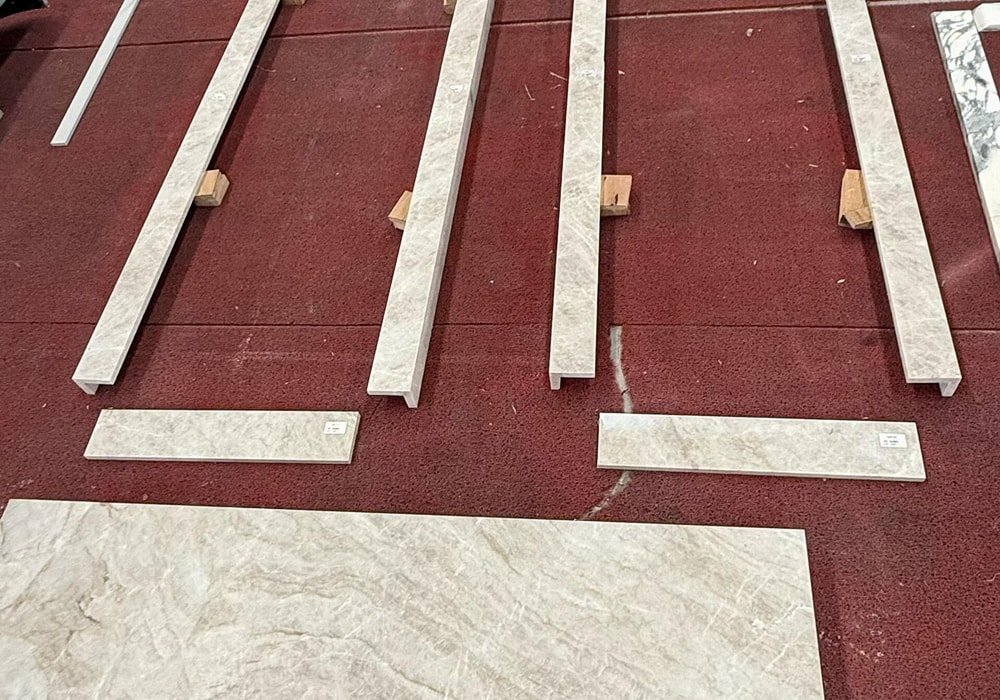
6. Substrate preparation & moisture/thermal considerations
Choosing the right substrate
For dry interior walls, well-secured gypsum board with engineered studs may suffice if loads are transferred correctly and anchors align with structural framing. For wet areas and fireplaces, cement backer boards, cementitious render, or metal framing with appropriate waterproofing are preferred. Always ensure substrate flatness and rigidity to minimize stress on the stone.
Movement joints & thermal spacing
Although indoor environments have limited thermal swing, long expanses of stone still require movement joints to avoid hairline cracks. Plan joint width and placement around openings and between materials; use flexible sealants with compatible adhesion to both stone and adjacent substrates.
7. Sealing, maintenance & cleaning protocols for vertical stone
Sealer selection & frequency
Penetrating sealers are commonly recommended for quartzite to reduce staining and ease cleaning; industry guidance suggests annual to biennial resealing depending on product and exposure. Vertical surfaces often show less staining risk than countertops, but sealers still help prevent soap scum residues and water marks in bathrooms. Test a small area and follow the sealer manufacturer’s recoat schedule.
Cleaning & touch-up
Use pH-neutral stone cleaners for daily maintenance; avoid acidic or abrasive cleaners that damage polish or leather finishes. For chips or seam separation, professional stone repair using color-matched epoxy or resin is widely used to restore looks with minimal visual trace.
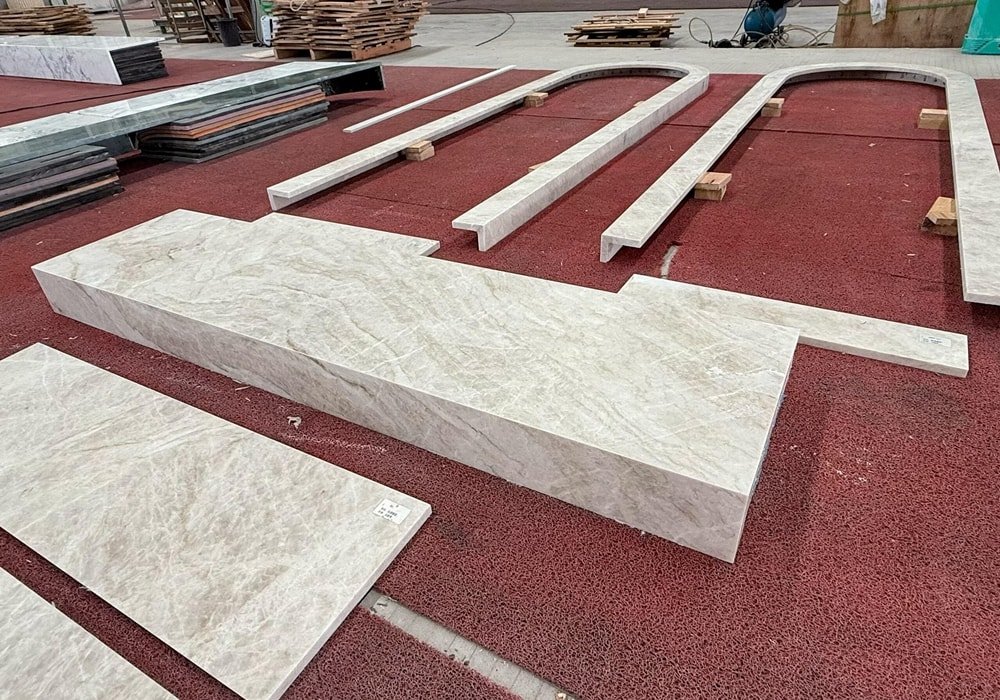
8. Design considerations: lighting, book-matching, grout joints, and transitions
Lighting to amplify veining and texture
Strategic uplighting or concealed LED strips accentuate veining and create depth on large Taj Mahal panels. Backlit book-matched panels can turn translucency into drama; however, quartzite is not as translucent as onyx, so backlighting effects are subtle and should be tested on slab samples.
Book-matching and waterjet inlays
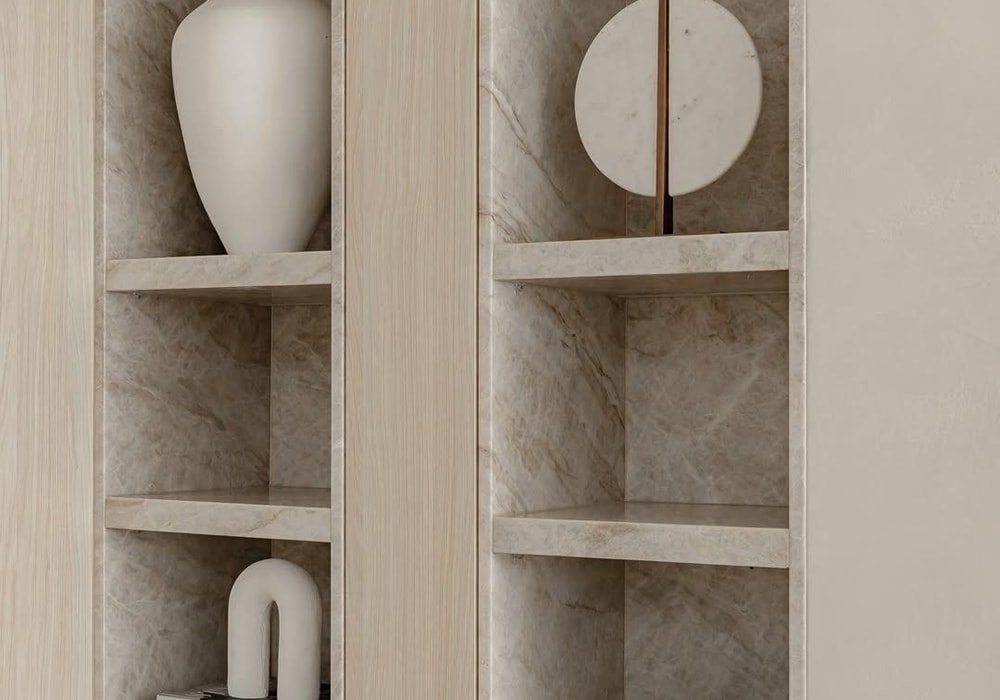
Bookmatching (mirroring adjacent slabs) elevates a feature wall into a symmetrical artwork. Waterjet-cut inlays or negative-space shelving integrated into book-matched panels give bespoke results but require careful slab selection and precise fabrication.
Seam minimization and transitions
Plan seam locations to align with furniture or architectural joints. Use minimal grout widths and matching epoxy joints for nearly invisible seams on polished stone. When transitioning to wood, metal, or plaster, use reveal profiles to prevent differential movement from stressing the stone.
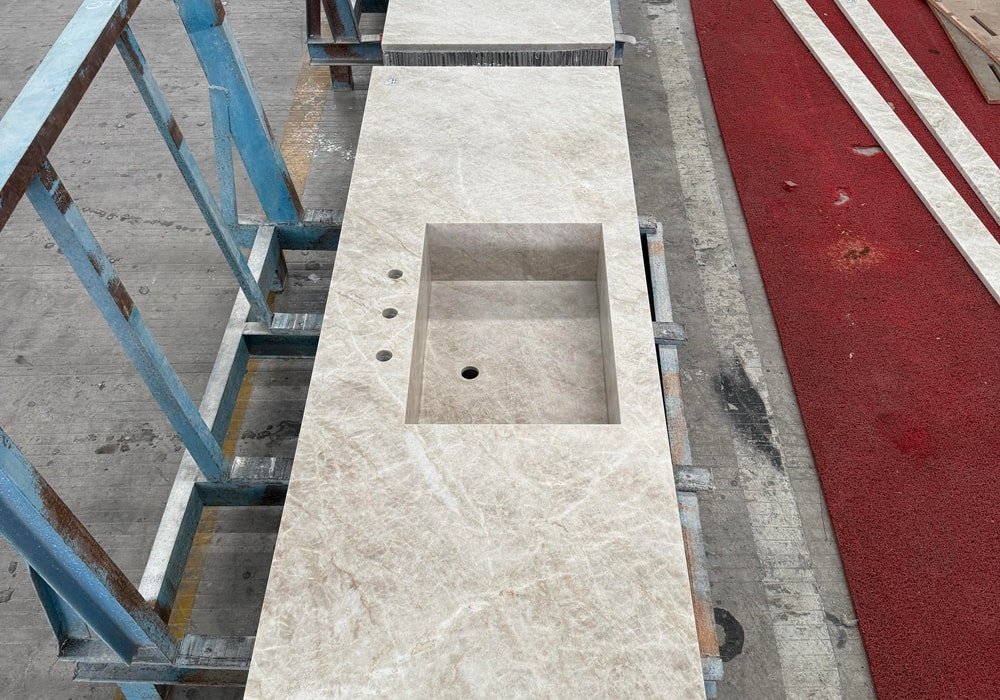
9. Color palettes & finishes: what pairs with Taj Mahal
Cabinet and furniture colors that complement the Taj Mahal
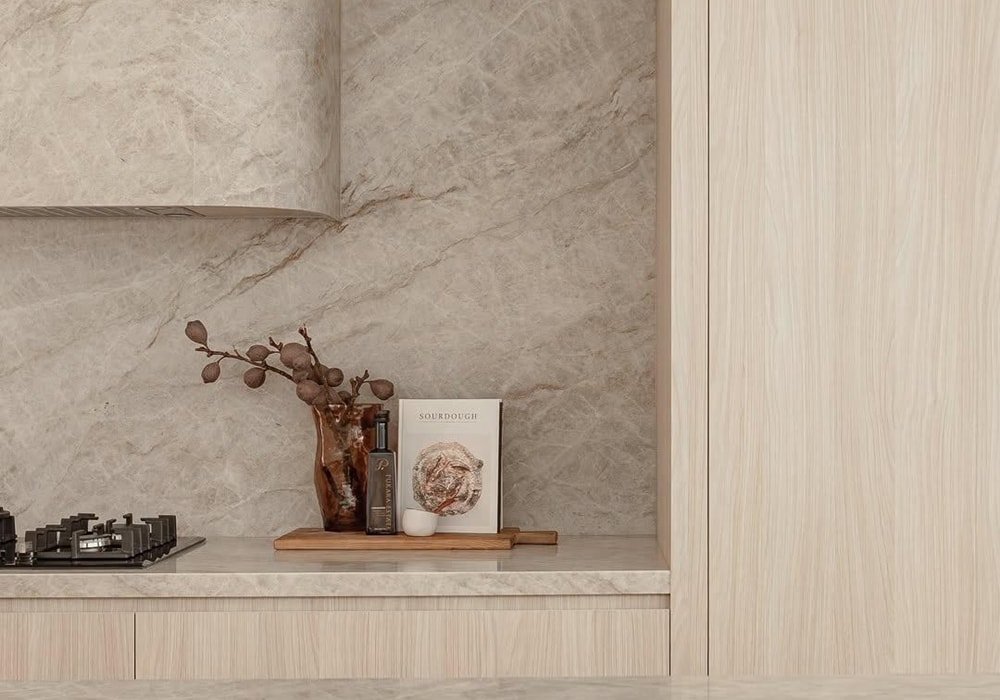
Taj Mahal’s warm ivory base works beautifully with warm wood tones (walnut, oak), soft greys, muted blues, and deep navy or matte black for contrast. For modern minimalism, pair the leathered Taj Mahal with matte black cabinetry; for classic vibes, choose medium-warm wood and brass hardware. Provide sample boards to clients to validate choices under actual site lighting.
Finish effects on perceived color
A leathered finish deepens veining and reduces surface reflectance, making colors appear richer; polished finishes are brighter and can make adjacent colors pop more. Choose a finish to match the mood and lighting conditions.
10. Case studies / inspirational scenarios (short)
Residential living-room feature wall
Project: Book-matched Taj Mahal panels spanning a 4-meter living wall with concealed shelving and integrated linear fireplace. Method: 3 cm slabs laminated and mechanically pinned to steel subframe; groutless seams, recessed lighting. Result: seamless, gallery-like focal wall.
Boutique hotel lobby
Project: Double-height reception wall clad with 2 cm Taj Mahal laminated to aluminum honeycomb backing, clipped to stainless steel rails. Method: ventilated cavity for humidity control, perimeter movement joints. Result: iconic arrival statement with manageable maintenance.
Luxury bathroom wet wall
Project: Full-height shower wall using honed Taj Mahal with waterproof membrane and full-bedding adhesive. Method: 10–12 mm gaps sealed with color-matched flexible sealant. Result: spa-like continuity with minimal grout lines.
(Each case includes slab selection, fixing method, and maintenance notes for handover.)
11. Sustainability, supply-chain, cost & procurement (manufacturer/factory/wholesale)
Cost drivers & procurement phrasing
Costs for cladding projects hinge on slab grade, book-matching needs, panel size, ancillaries (backing, anchors), and labor. Use buy-intent phrases on procurement pages: “Taj Mahal quartzite cladding manufacturer wholesale slabs”, “buy Taj Mahal vertical cladding factory direct price per panel”, and “Taj Mahal book-matched feature wall supplier near me” to capture both consumer and B2B traffic.
Traceability & quarry sustainability
Ask suppliers for quarry origin documentation and environmental management practices. Traceable supply chains and third-party sustainability certifications are increasingly important to architects and procurement teams.
12. Regulations, workplace safety, and industry trends affecting fabrication & choice
Silica, engineered stone, and regulator action
Regulatory scrutiny around respirable crystalline silica has led to focused enforcement and policy changes in multiple jurisdictions. While natural stone like quartzite is not free from silica hazards during cutting, many regulatory actions have targeted engineered stone due to higher silica concentrations and documented silicosis cases among fabricators. Fabricators must adopt wet-cutting, extraction, and respiratory controls, and designers should favor fabricators with published safety practices. Recent enforcement initiatives by OSHA and national bans or import controls in some countries underline how worker-safety policy can affect material selection and supply-chain decisions.
Design & market trends
Demand for natural textures, large-format panels, and book-matched statements continues. At the same time, digital tools and AI-driven material selectors favor pages with structured data—hence the micro-summary and FAQ JSON-LD blocks included below to increase SGE and snippet visibility.
13. Risk management and warranty: what specifiers should require
Documentation to request
Slab maps noting fissures and runout areas.
Fabricator QC and handling protocols.
Engineered subframe calculations (for panels >2.5 m height).
Adhesive and sealant product data sheets and warranties.
Post-installation maintenance schedule.
Insurance & sign-off
Require the engineer’s sign-off for tall or public-cladding installations and ensure warranty covers adhesive failure, seam separation, and installation workmanship for a defined period.
14. Cost estimate matrix & sample BOM for a 10 m² accent wall
Example cost breakdown (indicative)
Material (Taj Mahal slabs, book-matching premium): 40–55% of budget.
Fabrication (cutting, polishing/leathering, lamination): 20–30%.
Fixings/subframe & anchors: 10–15%.
Labor & installation: 10–20%.
Sealants, adhesives & finishing: 3–5%.
Actual prices vary by geography and project complexity—request factory quotes and compare manufacturer/factory wholesale pricing when buying for multiple projects.
15. Practical specification checklist (12-point)
Slab grade and origin confirmed.
Book-matching requirement specified.
Panel thickness & lamination specified.
Edge finish and profile are detailed.
Subframe/anchor type noted and engineered.
Adhesive type & full-bedding requirement included.
Movement joint locations marked.
Waterproofing method (wet areas) specified.
Lighting & service access designed.
Sealer product & maintenance schedule defined.
Warranty & QC documentation requested.
Fabricator silica-safety practices confirmed.

Ultra Compact Facade Panels: The Complete Guide to High-Performance Building Facades
Discover Ultra Compact Facade Panels for ventilated facades, exterior wall cladding and large architectural projects. EDG Stone offers customized wholesale solutions.
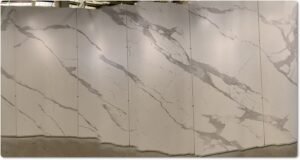
Ultra Compact Wall Panels: The Complete Guide for Modern Interior and Commercial Projects
Discover Ultra Compact Wall Panels from EDG Stone. Explore ultra thin wall panels, lightweight surfaces, waterproof wall panels, 3D wall panels and wholesale solutions.
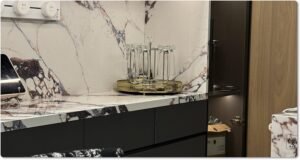
Ultra Compact Slabs for Outdoor Kitchens: The Complete 2026 Guide
Discover why ultra compact slabs are ideal for outdoor kitchens. Compare ultra compact countertops, designs, thicknesses, fabrication, and wholesale solutions.
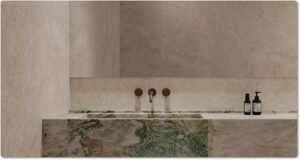
Ultra Compact Bathroom Vanity Tops: The Complete Design and Buying Guide 2026
Discover Ultra Compact Bathroom Vanity Tops for modern bathrooms, apartments and hotels. Explore ultra slim, ultra thin and custom vanity solutions from EDG Stone.
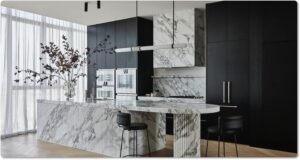
Ultra Compact Kitchen Countertops: The Complete 2026 Guide to Materials, Prices, Quartz Comparison and Buying Trends
Discover ultra compact kitchen countertops, prices, brands, trends and comparisons with quartz. Learn how to choose high-performance ultracompact surfaces from EDG Stone.
16. FAQ — Google-style hot questions
Q1: Can Taj Mahal quartzite be used as a full-height interior cladding?
Yes. Taj Mahal can be used as full-height interior cladding when panels are specified correctly (thickness, lamination, backing) and fixed with mechanical anchors or full-bedding adhesives; engineered subframes and movement joints are essential for tall installations. Always confirm structural engineer sign-off for double-height walls or public spaces.
Q2: What fixing method is safest for a large Taj Mahal feature wall?
A combined approach—mechanical anchors to carry gravity loads plus a fully back-buttered adhesive bed for shear—offers redundancy and long-term security. For high-end commercial projects, stainless steel clip systems on a ventilated rail are common to allow controlled movement and drainage.
Q3: Is the leathered Taj Mahal better than the polished one for vertical use?
Leathered finishes reduce glare and emphasize texture, making them an excellent choice for large vertical surfaces where diffuse light is preferred; polished finishes create a reflective, luxurious look but can show fingerprints and reflections. Choose a finish based on lighting, desired mood, and maintenance preferences.
Q4: How should I quote a Taj Mahal cladding job?
Include slab allowance (wastage for bookmatching), fabrication (cutting, finishing, lamination), subframe and anchor costs, adhesives and sealants, labor, scaffolding or rigging for large panels, and a contingency for hidden substrate remediation. Provide a clear scope so supplier/manufacturer quotes are comparable.
Q5: What cabinet colors go best with white Taj Mahal quartzite?
Warm wood tones (walnut, teak), soft greys, deep navy, and matte black create an elegant contrast with Taj Mahal’s warm veins; brass hardware complements the gold highlights. Always test sample boards under actual site lighting before finalizing finishes.
Semantic Closure: Taj Mahal Cladding — How it works, why it matters, what to specify, options, and critical considerations
How: Install Taj Mahal panels using the correct mix of mechanical anchors and adhesive full-bedding or ventilated clip systems. For tall or heavy panels, specify engineered stainless-steel rails and confirm anchor capacities with a structural engineer.
Why: Taj Mahal combines marble-like aesthetics with the strength and heat resistance of quartzite—ideal for feature walls where visual continuity and longevity matter. Its textural finishes (polished, honed, leathered) allow designers to control glare and tactility.
What to specify: slab grade/origin, book-match requirement, slab thickness or lamination, fixing system (anchors + adhesive vs ventilated clips), movement joints, and maintenance plan. Oblige fabricators to provide slab maps and QC documentation.
Options: For wet areas, use cement boards + full-bedding adhesives; for commercial double-height walls, use ventilated clip rails; for seamless indoor features,s use laminated slabs with concealed mechanical backup. Consider a leathered surface for reduced glare.
Considerations: Monitor silica-related fabrication regulations and favor fabricators who employ wet cutting, extraction, and respiratory controls. Factor lifecycle cost—slab premium plus fabrication and subframe cost—into procurement decisions, and include a warranty that covers adhesive failure and installation workmanship.
18. Conclusion & Call-to-Action
Taj Mahal quartzite is a powerful design tool for interior accent walls and vertical cladding: it blends classic marble aesthetics with the practical advantages of quartzite when specified and installed correctly. To maximize success, pair bold visual treatments (book-matching, integrated lighting) with engineered fixing systems and a detailed maintenance plan. For architects and specifiers, request slab maps, fabrication QC, engineered anchor designs, and factory or wholesale pricing if sourcing multiple projects. Contact EDG Stone or your preferred manufacturer/factory to request samples, technical data sheets, and a project quote.