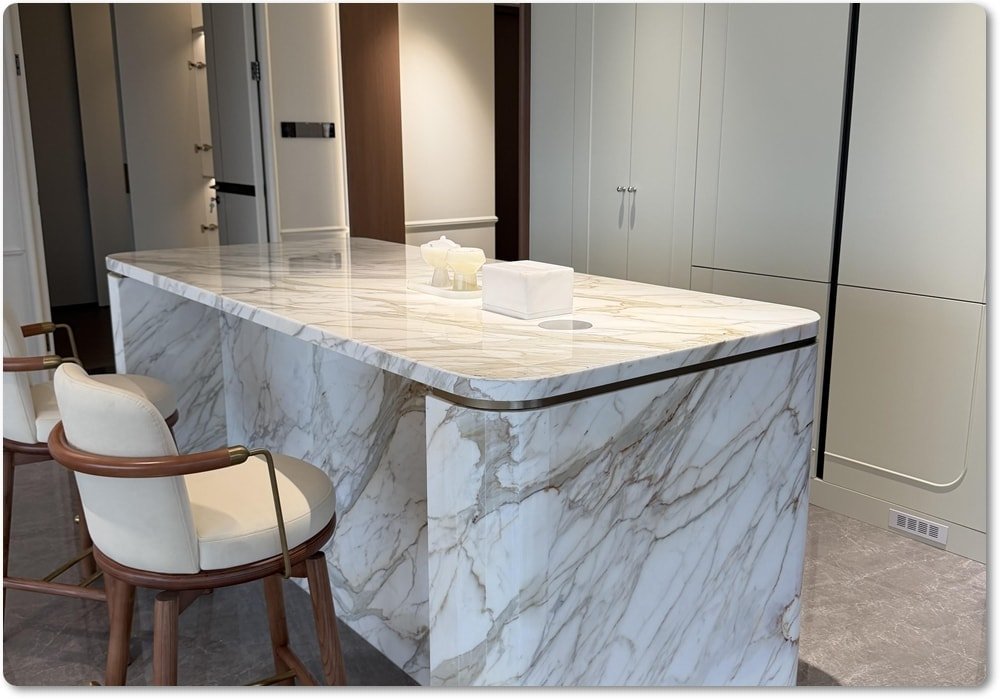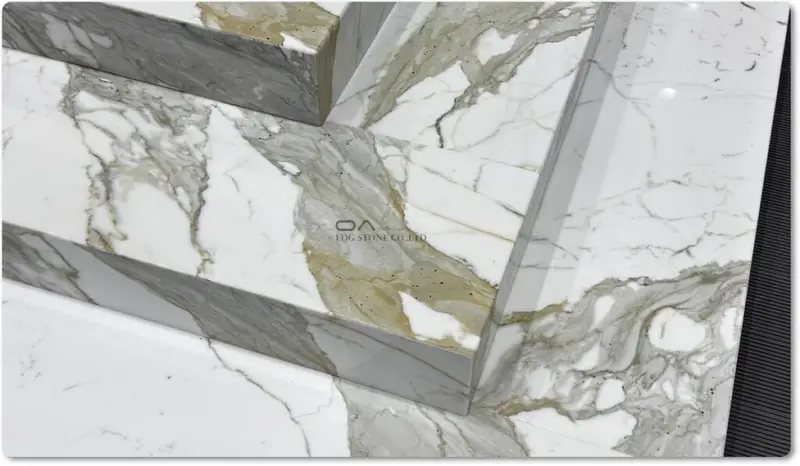
Quick Summary: The Art of Seamless Quartzite
Core Concept: Taj Mahal Quartzite is a metamorphic rock valued for its marble-like beauty and granite-like durability (Mohs 7). However, its complex veining makes seam hiding a challenge.
Technical Solution: Minimizing seams requires advanced fabrication techniques, including vacuum-assisted leveling, custom epoxy tinting, and “European Miter” edges for waterfall designs.
Manufacturer Insight: Sourcing from an experienced Wholesale Taj Mahal quartzite slabs manufacturer like EDG Stone ensures access to larger, book-matched slabs that reduce the necessity for visible joints in standard kitchen layouts.
Trend Verdict: Is Taj Mahal quartzite outdated? No. It remains a top-tier choice for 2025/2026 due to its neutral palette and resistance to etching.
When homeowners and designers envision a dream kitchen, they often picture a continuous, flowing surface of natural stone. However, the reality of geology and logistics means that unless your kitchen island is small, you will likely face the challenge of seams.
Taj Mahal Quartzite has cemented its place as the “Holy Grail” of kitchen countertops. It offers the creamy, sophisticated elegance of white marble without the fragility. Yet, working with this dense material requires specific expertise. A poor seam can ruin the aesthetic of a $10,000 slab, appearing like a scar across a masterpiece.
At EDG Stone, we believe that the difference between a “good” kitchen and a “breathtaking” one lies in the fabrication details. This guide explores the technical nuances of slab seaming, maintenance, and design pairings to help you achieve a flawless look.
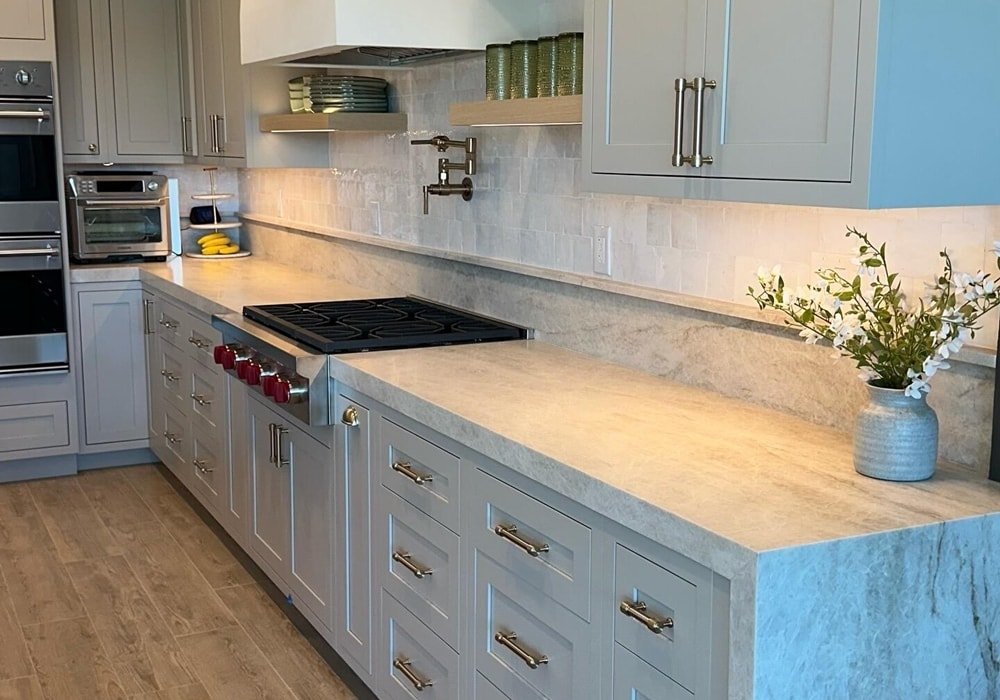
The Geology and Aesthetic Appeal: Why Taj Mahal Quartzite?
To understand how to hide seams, one must first understand the material. Taj Mahal is not granite, nor is it a soft marble. It is a true quartzite—sandstone that has been metamorphosed under intense heat and pressure.
Distinguishing Quartzite from Granite and Marble
There is often confusion in the market where soft dolomites are mislabeled as “soft quartzite.” True Taj Mahal white quartzite ranks around a 7 on the Mohs scale of mineral hardness, making it harder than glass and granite.
Durability: It is highly resistant to scratching and etching (chemical burns from acids like lemon juice), unlike marble.
Workability: Because it is so dense, cutting it requires specialized diamond blades and water-jet technology to prevent chipping at the seam edges.
This density is a double-edged sword. While it provides incredible longevity for Taj Mahal quartzite countertops, it makes the fabrication process slower and more demanding. A factory or fabricator must use high-RPM equipment to ensure the edges meant for seaming are perfectly straight.
Finishes Matter: Polished vs. Leathered vs. Honed
The surface finish plays a significant psychological and visual role in how seams are perceived.
Polished: The classic, glossy finish. It reflects light, which can sometimes highlight a seam if the adhesive isn’t perfectly flush.
Honed: A matte finish that offers a softer feel. Honed Taj Mahal quartzite countertops are forgiving, but the lack of reflection can make color variations at the seam more apparent.
Leathered: Textural and tactile. Taj Mahal leathered Quartzite is increasingly popular in 2025. The slight texture camouflages seams effectively because the eye is distracted by the surface undulations rather than seeking a straight line.
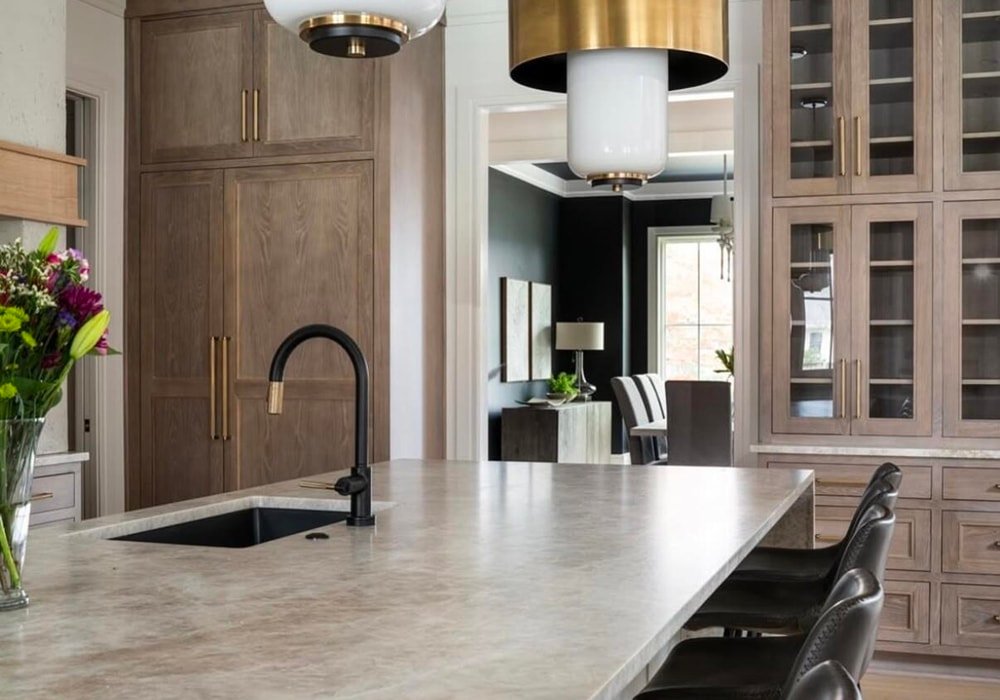
The Art of Layout: Strategic Planning to Minimize Seams
The best seam is the one you never have to make. Minimizing seams starts long before the stone is cut—it begins with the slab selection and digital layout.
Analyzing Slab Sizes and Kitchen Dimensions
Standard Taj Mahal slab sizes generally range from 115″ x 65″ to 128″ x 76″.
Kitchen Islands: If your island is 10 feet (120 inches) long, you might just fit it on a single jumbo slab. However, if your design calls for a 12-foot island, a seam is inevitable.
Strategic Placement: Experienced fabricators will place seams at the sink or cooktop cutouts. This minimizes the length of the visible seam. A seam that is only 4 inches long at the front and back of a sink is far less offensive than a 30-inch seam running through the middle of a prep area.
Flow Matching and Vein Continuation
When a seam is necessary, “Flow Matching” is critical. This is where pictures of Taj Mahal quartzite countertops often differ from reality—in photos, the best ones look seamless because the veins continue across the joint.
Bookmatching: Purchasing two sequential slabs from the block (mirror images) allows for a butterfly effect where the veins meet perfectly.
Digital Templating: At EDG Stone, we utilize digital slab smithing technology. We overlay the kitchen template onto the digitized slab image, allowing the client to see exactly where the veins will match (or clash) before a single cut is made. This is essential for Taj Mahal quartzite seams, as the subtle amber and gold veins need to align to maintain visual integrity.
Advanced Fabrication: Seaming Techniques for “Invisible” Joints
Current industry standards (referenced by the Natural Stone Institute) dictate that a visible seam should be no wider than 1/16 of an inch. However, high-end luxury fabrication aims for even tighter tolerances.
Epoxy Color Theory and Texture Mimicry
The adhesive used to join the slabs is not just glue; it is a cosmetic filler.
Custom Tinting: Taj Mahal is translucent. A standard white epoxy will look like a stark white line, and a clear epoxy may show the dark substrate. Fabricators must hand-mix epoxy to match the background color of the stone (usually a creamy beige or soft gray).
Particulate Matching: For Taj Mahal leathered Quartzite, artisans may mix in fine stone dust or particulates into the epoxy to mimic the stone’s natural crystal structure, ensuring the seam doesn’t look like a strip of plastic.
European Mitering vs. Standard Seams
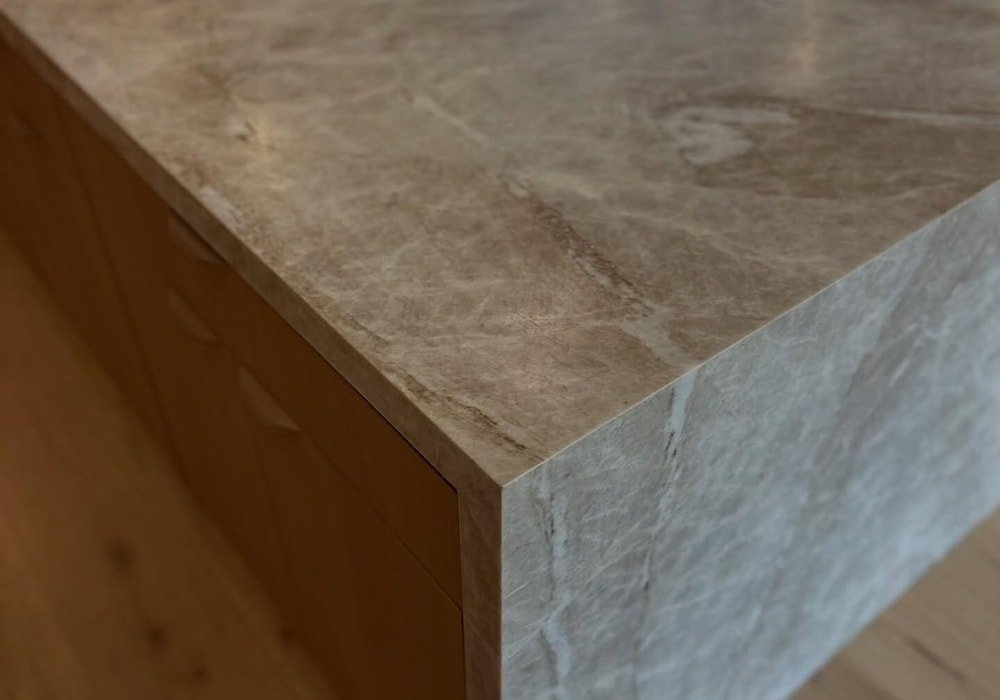
For the ultra-modern look, especially on waterfall islands (where the stone flows down the side of the cabinet), the “European Miter” is the gold standard.
The Technique: The stone is cut at a precise 45-degree angle. When joined, the seam is located at the very corner edge, making it virtually invisible.
Waterfall Application: This technique allows the veining to “flow” over the edge, creating a solid block appearance. This is highly sought after in kitchens with Taj Mahal quartzite countertops.
Design Harmony: Cabinets, Backsplash, and Colors
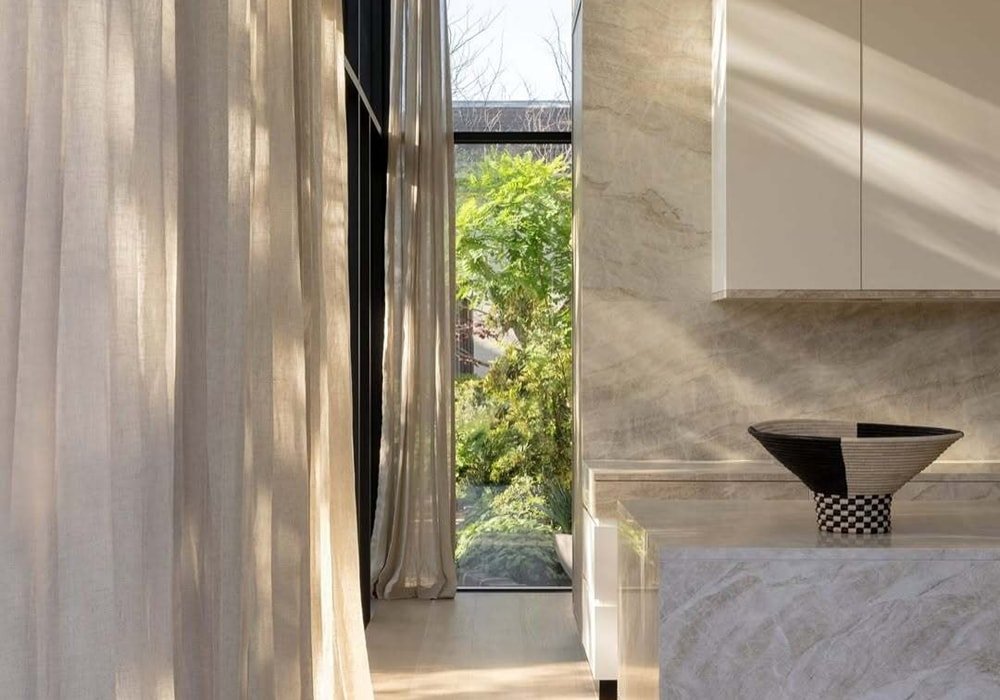
Taj Mahal is the “chameleon” of natural stone. Its neutral background allows it to adapt to various design styles, from rustic to ultra-modern.
Cabinet Color Pairings
Taj Mahal quartzite countertops with white cabinets: This is the most requested combination. The warm undertones of the quartzite prevent the white kitchen from feeling too sterile or “hospital-like.” It adds a layer of organic warmth.
Taj Mahal quartzite countertops with cherry cabinets: As design trends shift back toward natural woods, Taj Mahal is the perfect bridge. The amber veins in the stone pick up the reddish/brown hues of cherry or walnut wood, creating a cohesive look.
What color goes with Taj Mahal quartzite countertops? Beyond wood and white, consider Greige (gray-beige), Navy Blue (for contrast), or Forest Green.
Backsplash Selection Guide
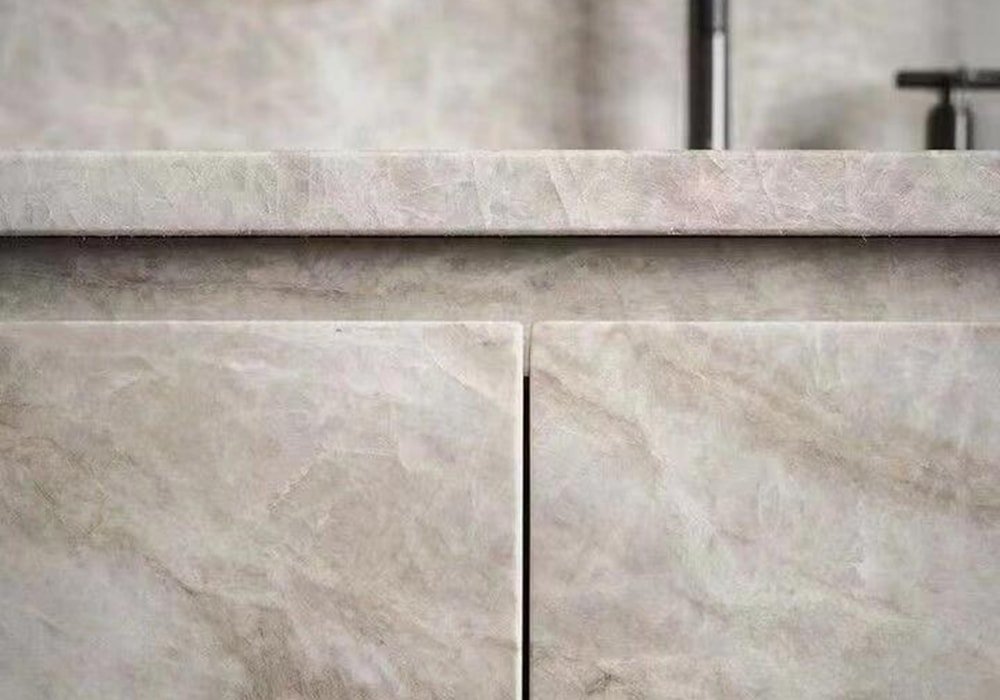
Full Height Splash: For the most luxurious look, use the same slab on the wall. Taj Mahal quartzite countertops and backsplash cut from the same block eliminate grout lines and create a gallery-like focal point.
Tile Pairing: If using tile, what backsplash goes with Taj Mahal quartzite countertops? Avoid busy mosaics. The stone has movement, so the tile should be quiet. A handmade Zellige tile in cream or a simple glass subway tile works best.
Cost Analysis: Pricing, Value, and Sourcing
Understanding the investment is crucial for homeowners and contractors.
Understanding the Price Factors
Taj Mahal quartzite countertops price per square foot typically ranges from $95 to $220 installed, depending on your region and the complexity of the job.
Material Cost: It is a premium stone, quarried primarily in Brazil.
Fabrication Cost: Because it is harder than granite, it wears out diamond blades faster and takes longer to cut and polish. You are paying for the labor intensity.
Sourcing Strategies: Manufacturer Direct vs. Retail
For large projects, hotels, or multi-unit developments, buying retail is inefficient.
EDG Stone’s natural stone factory capabilities allow for direct sourcing.
Wholesale Taj Mahal quartzite slabs manufacturer: Purchasing directly minimizes the middleman markups.
Shop deals on Taj Mahal quartzite countertops: Look for “remnants” for smaller vanity projects, but for a full kitchen, ensure you buy slabs from the same bundle to avoid color variation.
Direct import Taj Mahal quartzite from the factory: This is an option for designers or builders needing multiple bundles, ensuring consistent quality and lower per-square-foot costs.
Care and Maintenance: Protecting Your Investment
Despite its hardness, Taj Mahal quartzite care is necessary to keep it looking pristine for decades.
Sealing and Daily Cleaning
Sealing: While less porous than granite, it is not non-porous. A high-quality impregnating sealer should be applied upon installation and re-applied every 1-3 years.
Cleaning: For Taj Mahal quartzite maintenance, avoid abrasive scrubbers. pH-neutral soap and warm water are sufficient.
Staining: Taj Mahal quartzite staining is rare if sealed properly, but oil left to sit for days can penetrate. Wipe up spills promptly.
Addressing Common Myths
Myth: It etches like marble. Fact: The true Taj Mahal does not etch. If your stone etches, it is likely a mislabeled dolomite.
Myth: It creates radiation. Fact: Granite and Quartzite emit negligible background radiation, safe for all home uses.
FAQ: Common Questions About Taj Mahal Quartzite
Q: Does Taj Mahal quartzite have visible seams? A: Yes, like all natural stone, Taj Mahal quartzite will have seams if the counter run exceeds the slab size (typically 10 feet). However, because of its light color and complex veining, skilled fabricators can make seams nearly invisible using color-matched epoxy, vacuum leveling, and strategic vein matching (bookmatching).
Q: Is Taj Mahal quartzite more expensive than granite? A: Generally, yes. Taj Mahal quartzite is considered a luxury stone. Its price per square foot is typically higher than standard granite due to its rarity, import costs from Brazil, and the difficulty of fabrication, which requires specialized diamond tooling.
Q: What backsplash goes best with Taj Mahal quartzite? A: The best backsplash is often a continuation of the Taj Mahal stone itself (full-height backsplash) for a seamless look. If choosing tile, opt for neutral, solid colors like creamy white Zellige tiles or glass subway tiles. Avoid busy patterns that compete with the quartzite’s veining.
Q: Does leathered Taj Mahal quartzite stain easily? A: No, leathered finishes are actually quite practical. While the texture adds depth, the stone remains dense and resistant to staining if properly sealed. In fact, a leathered finish can hide water spots, fingerprints, and crumbs better than a high-gloss polished finish.
Q: Is Taj Mahal quartzite hard to maintain? A: Taj Mahal quartzite is very low maintenance compared to marble. It requires sealing once every 12-18 months and simple cleaning with soap and water. It is highly resistant to heat and scratching, making it one of the most durable options for busy kitchens.
In-Depth Insight: The EDG Stone Fabrication Advantage
Why Choose Factory Direct Fabrication?
- 🔍 Visual Continuity (The Look): Sourcing from a custom cut Taj Mahal quartzite countertops supplier ensures you get access to “Grand” or “Jumbo” slabs. This allows for fewer seams in large islands, maintaining the prestigious, marble-like aesthetic that defines the stone.
- 🛡️ Precision Engineering (The How): Advanced CNC machinery and waterjet cutting used in factory settings allow for tolerances tighter than 1/16 inch. This is crucial for hard quartzite, where manual cutting often results in micro-chipping.
- 💰 Value Proposition (The Cost): By utilizing Direct import Taj Mahal quartzite factory prices, developers and homeowners can reallocate budget from retail markups to higher-grade stone selection or upgraded edge profiles (like laminated or mitered edges).
- 📈 Future-Proofing (The Trend): As we move into 2026, the trend is shifting towards “Quiet Luxury.” Honed Taj Mahal quartzite countertops fit this perfectly. Ensuring your fabricator understands how to seal and finish honed surfaces is vital for long-term satisfaction.
Bottom Line:
Taj Mahal Quartzite represents the perfect intersection of art and engineering. Minimizing seams isn’t just about glue; it’s about the strategic selection of large-format slabs and the utilization of precision cutting technology found at dedicated stone manufacturers.
References
Natural Stone Institute (MIA+BSI) – Standards for stone installation and seam tolerances.
Geological Society of America – Metamorphic rock classifications and Mohs hardness scale data.
ASTM International – ASTM C119 Standard Terminology Relating to Dimension Stone.
Architectural Digest – Trends in kitchen countertops and natural stone usage (2024-2025).
Houzz Industry Reports – Kitchen Trends Study: Material popularity and homeowner preferences.
Stone World Magazine – Technical articles on fabricating hard quartzites and diamond tooling.
National Kitchen & Bath Association (NKBA) – Design guidelines for kitchen island sizing and clearances.
Use Natural Stone – Education on the differences between quartzite, granite, and marble.