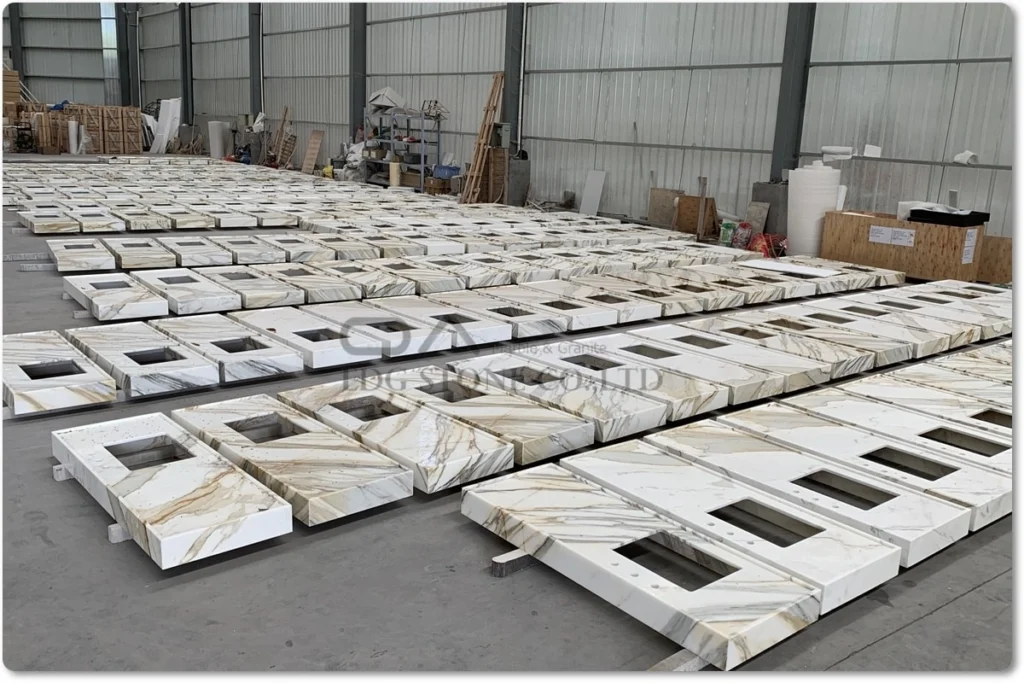
Quick Summary: White Quartz Countertops Procurement in 2026
Introduction: Why White Quartz Countertops Still Matter in 2026
White quartz countertops have evolved from a simple alternative to natural stone into one of the most important categories in the global countertop and interior-surfaces market.
For homeowners, designers, contractors, kitchen manufacturers, hospitality companies, property developers, and stone distributors, white quartz provides a combination of visual consistency, fabrication efficiency, relatively low maintenance, and broad design compatibility.
However, procurement in 2026 is becoming more complicated.
Buyers are increasingly required to consider:
- Product consistency
- Environmental requirements
- Indoor-air-quality considerations
- Silica-related workplace regulations
- Product certification
- Factory quality control
- Import tariffs and logistics
- Thickness and dimensional tolerances
- Veining consistency
- Warranty conditions
- Fabrication requirements
- Total landed cost
This means that quartz procurement is no longer simply a question of finding the lowest price per slab.
For professional buyers, the more important question is:
Which white quartz manufacturer can consistently deliver the required appearance, technical performance, documentation, packaging, and supply capacity at an acceptable total landed cost?
This 2026 procurement guide explains how to answer that question.
1. White Quartz Countertops Market Direction in 2026
1.1 From “White Countertop” to “Engineered Surface System”
The white quartz category has become significantly more sophisticated.
Earlier generations of white quartz were often dominated by relatively uniform colors such as:
- Pure white
- Arctic white
- Snow white
- Polar white
- Cloud white
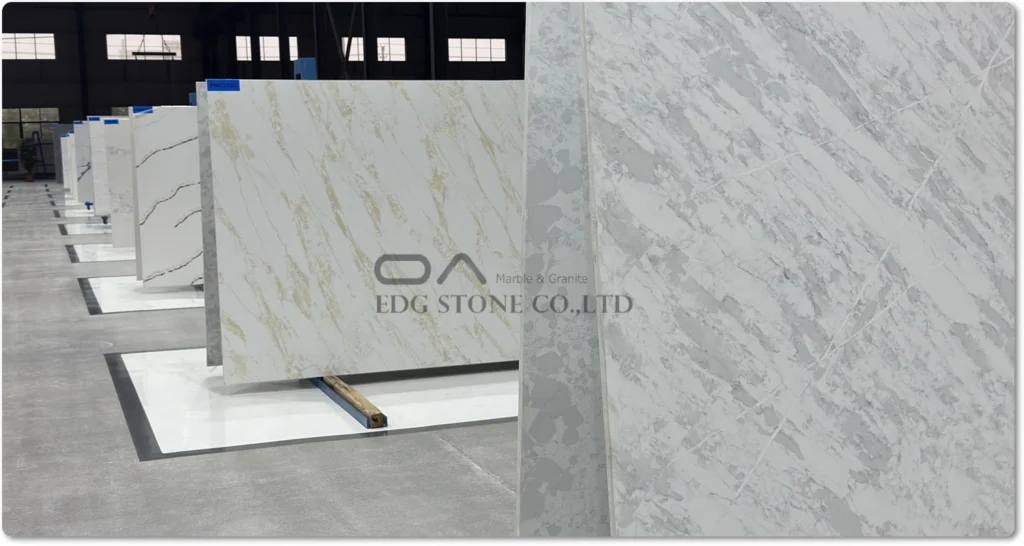
The market has increasingly shifted toward more natural-looking surfaces, including:
- White quartz with soft gray veins
- Calacatta-style quartz
- Carrara-inspired quartz
- White quartz with gold veining
- Concrete-inspired white quartz
- Warm white quartz
- Cream-white quartz
- Matte white quartz
- Honed white quartz
- Large-format bookmatch-style quartz designs
This reflects a broader interior-design movement toward natural-stone aesthetics combined with engineered-material consistency.
1.2 Why Older Search Terms Still Matter
Searches such as white quartz 2024, white quartz countertops 2024, and white quartz countertop trends 2024 remain valuable from an SEO perspective because users frequently research historical trends before making a purchasing decision.
For an updated procurement strategy, however, buyers should use 2024 trends as a baseline rather than assuming they represent the 2026 market.
The central transition has been:
2024: clean white + marble imitation
2025: warmer whites + natural veining + textured finishes
2026: natural-stone visual language + engineered consistency + sustainability/compliance + project-specific customization
2. White Quartz Countertop Trends 2024–2026
2.1 Calacatta-Inspired White Quartz
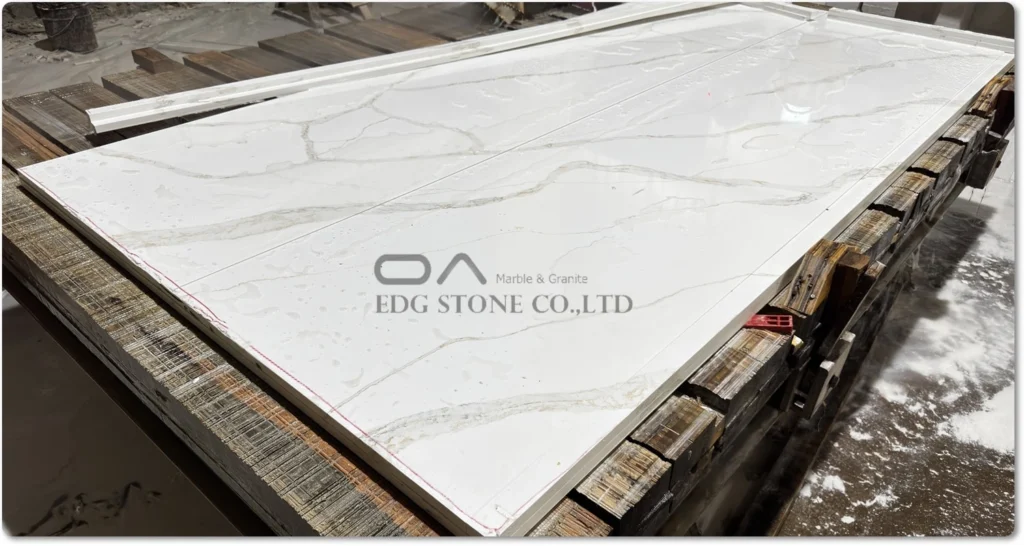
Calacatta-style quartz continues to attract designers because it combines a white background with dramatic veining.
Typical patterns include:
- Gray veins
- Gold veins
- Taupe veins
- Warm gray veins
- Multi-directional veining
For large residential kitchens and hospitality projects, buyers should pay particular attention to vein continuity.
A slab may look attractive on its own but perform poorly in a project if the pattern cannot be coordinated across multiple slabs.
2.2 Warm White Quartz
Pure cold white is no longer the only mainstream option.
Warm whites containing subtle cream, beige, or ivory undertones can coordinate more naturally with:
- Natural oak
- Walnut
- Brass
- Bronze
- Beige cabinetry
- Warm gray flooring
- Natural stone
- Soft neutral interiors
2.3 Matte and Honed Surfaces
Polished white quartz remains highly popular, but honed and matte finishes are gaining attention in contemporary interiors.
These finishes can create a softer visual effect and may reduce the highly reflective appearance associated with traditional polished quartz.
However, buyers should not assume that every matte finish has identical stain resistance or cleaning performance.
Finish testing should be part of commercial procurement.
2.4 Large-Format Applications
Large-format slabs can reduce the number of joints in countertops and wall applications.
For procurement teams, this creates additional requirements around:
- Slab dimensions
- Flatness
- Edge damage
- Container loading
- Crating
- Handling equipment
- Fabrication capacity
Large slabs may therefore provide design advantages while simultaneously increasing logistical complexity.
3. What Is White Quartz?
3.1 Engineered Quartz vs Natural Quartz
Commercial quartz countertops are generally engineered products rather than slabs of naturally occurring quartzite.
A typical engineered quartz product consists of mineral aggregates combined with a binding system and pigments/additives, followed by forming, curing, calibration, finishing, and quality-control processes.
The exact formulation varies by manufacturer.
Therefore, procurement teams should avoid evaluating products only by the percentage of quartz claimed in marketing materials.
A professional evaluation should consider the entire material system.
3.2 How Is White Quartz Manufactured?
A simplified manufacturing workflow is:
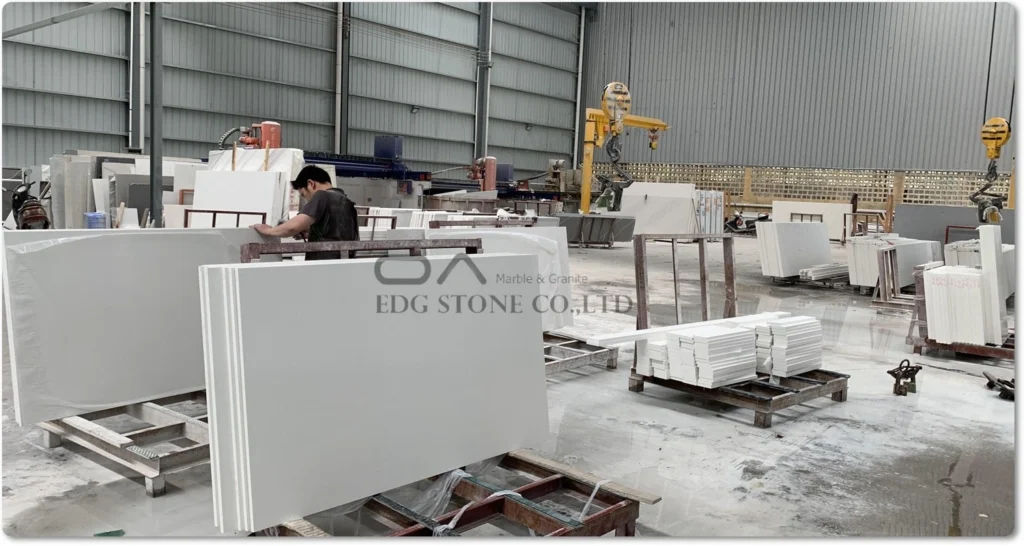
Raw materials → Mixing → Pigmentation → Vacuum forming/pressing → Curing → Slab calibration → Polishing/finishing → Inspection → Cutting/packing → Export
The quality of each stage affects final performance.
For example:
- Poor raw-material control can create color variation.
- Inconsistent mixing can affect visual uniformity.
- Poor vacuum forming can increase internal defects.
- Inaccurate calibration can create thickness variation.
- Poor polishing can create gloss inconsistency.
- Weak packaging can result in edge damage during shipping.
This is why procurement should evaluate the factory manufacturing system, not simply the finished sample.
4. White Quartz Countertops Pros and Cons
4.1 Advantages of White Quartz
The major advantages include:
Consistent Appearance
Compared with many natural stones, engineered quartz can provide greater control over color and pattern consistency.
Low Routine Maintenance
Quartz countertops are generally easier to maintain than porous natural stones that require periodic sealing.
Broad Design Selection
Manufacturers can create many visual styles, including marble-inspired patterns.
Fabrication Efficiency
Professional stone fabricators are familiar with quartz cutting, polishing, edging, drilling, and installation.
Commercial Scalability
A qualified manufacturer can produce multiple slabs with relatively controlled color and pattern specifications.
4.2 Potential Disadvantages
Professional buyers should also understand limitations.
Heat Sensitivity
Quartz should not automatically be treated as heat-proof. Excessive localized heat can damage the resin/binder system or surface.
Fabrication Dust
Cutting and processing engineered stone can generate respirable crystalline silica-containing dust. Appropriate occupational controls are therefore critical.
Color Batch Variation
Even engineered materials can exhibit differences between production batches.
Resin-Related Performance
Different manufacturers use different formulations and manufacturing technologies.
Outdoor Limitations
Not every quartz product is suitable for prolonged outdoor exposure.
UV Exposure
Some formulations may experience color changes when exposed to prolonged ultraviolet radiation.
The correct approach is therefore not to ask:
“Is quartz good or bad?”
Instead, ask:
“Is this specific quartz formulation suitable for this specific application?”
5. White Quartz Countertops Pricing: What Buyers Should Actually Compare
5.1 Why There Is No Single White Quartz Price
Searches for white quartz countertops pricing are common because buyers want a simple price-per-square-foot answer.
In professional procurement, however, pricing varies according to:
- Thickness
- Slab size
- Color
- Pattern complexity
- Veining technology
- Finish
- Order quantity
- Packaging
- Inspection requirements
- Country of origin
- Incoterms
- Freight
- Insurance
- Import duties/tariffs
- Local handling
- Fabrication
- Installation
Consequently, a factory quote is only one component of the final project cost.
5.2 FOB vs Landed Cost
For international procurement, buyers should calculate:
Total Landed Cost = Product Cost + Packaging + Inland Freight + Ocean Freight + Insurance + Duties/Tariffs + Port Charges + Customs + Local Delivery + Inspection + Other Applicable Costs
A supplier offering a lower FOB price may not necessarily provide the lower final project cost.
5.3 Wholesale Procurement
For wholesale buyers, price negotiation should normally consider:
- Annual volume
- Container quantity
- SKU count
- Repeat-order frequency
- Payment terms
- Packaging requirements
- Private-label requirements
- Exclusive colors
- Quality standards
- Claim procedures
The most effective negotiation is therefore based on a complete procurement specification, rather than simply asking:
“What is your lowest price?”
6. How to Choose a White Quartz Manufacturer
6.1 Manufacturer vs Trading Company
One of the most important procurement decisions is whether to purchase directly from a manufacturer or through a trading company.
A qualified manufacturer may provide:
- Direct production control
- Better customization
- Factory QC
- Technical support
- Production scheduling
- Better traceability
- Faster problem resolution
- More transparent manufacturing information
However, not every company calling itself a “factory” necessarily controls all manufacturing processes.
Therefore, buyers should verify:
- Factory location
- Production equipment
- Production capacity
- QC process
- Export history
- Product certifications
- Reference projects
- Packaging system
- Batch traceability
- Technical documentation
6.2 White Quartz Factory Audit Checklist
A professional factory audit should examine:
Production
- Raw-material storage
- Mixing system
- Forming equipment
- Curing system
- Calibration
- Polishing
- Edge processing
- Inspection
Quality Control
- Incoming-material inspection
- In-process inspection
- Final inspection
- Thickness testing
- Flatness testing
- Color comparison
- Surface inspection
- Packaging inspection
Export Capability
- Container loading
- Export packaging
- Wooden crates
- Moisture protection
- Edge protection
- Slab separators
- Shipping documentation
7. White Quartz Quality Inspection Checklist
7.1 Visual Inspection
Check:
- Color consistency
- Surface uniformity
- Vein distribution
- Pinholes
- Cracks
- Chipping
- Scratches
- Contamination
- Gloss consistency
- Edge condition
7.2 Dimensional Inspection
Measure:
- Length
- Width
- Thickness
- Diagonal
- Flatness
- Edge straightness
For large commercial orders, dimensional tolerance should be agreed before production.
7.3 Performance Testing
Depending on the application and project requirements, buyers may request testing related to:
- Water absorption
- Stain resistance
- Chemical resistance
- Abrasion resistance
- Flexural strength
- Impact resistance
- Thermal performance
- Surface hardness
Specify the exact testing standard in the purchase contract.
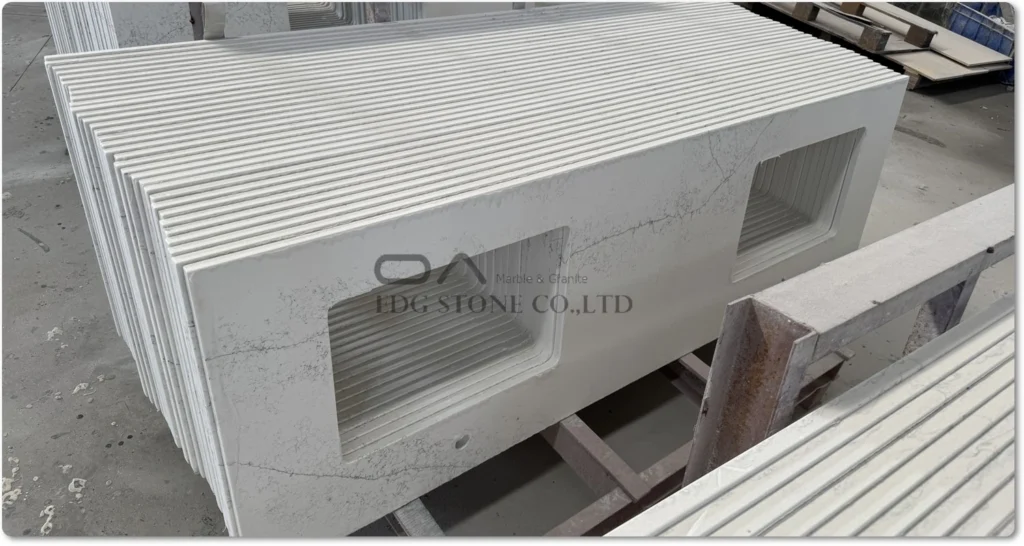
8. Quartz Procurement for Commercial Projects
8.1 Hotels
Hotel projects may require:
- Bathroom vanity tops
- Guestroom countertops
- Reception counters
- Public-area countertops
- Bar tops
- Feature walls
- Furniture components
Consistency becomes especially important when hundreds of rooms use the same surface.
8.2 Multifamily Projects
Apartment developments often prioritize:
- Cost control
- Repeatability
- Installation efficiency
- Delivery schedules
- Standardized colors
- Replacement availability
For these projects, procurement teams should consider the supplier’s ability to reproduce the same SKU over multiple production cycles.
8.3 Retail and Commercial Interiors
Retail projects may prioritize design uniqueness.
This can make:
- Custom colors
- Large slabs
- Vein matching
- Bookmatch effects
- Special finishes
more important than simply selecting the lowest-cost standard SKU.
9. How EDG Stone Approaches White Quartz Procurement
9.1 From Product Supplier to Project-Oriented Stone Partner
For professional buyers, EDG Stone can position white quartz procurement around the complete supply chain rather than simply selling individual slabs.
A project-oriented process can include:
Product selection → Sample approval → Technical confirmation → Quotation → Production → QC → Packaging → Shipping → Delivery → After-sales support
This approach is particularly important for B2B buyers because the biggest procurement risk is often not the initial sample.
The larger risk is whether the supplier can reproduce the approved specification at commercial scale.
9.2 Sample Approval
Before mass production, buyers should approve a clearly identified reference sample.
The approval should record:
- Product code
- Color
- Finish
- Thickness
- Slab dimensions
- Vein characteristics
- Surface requirements
- Packaging requirements
- Acceptable tolerance
9.3 Production QC
For larger orders, buyers should consider:
- Pre-production inspection
- During-production inspection
- Pre-shipment inspection
- Container loading inspection
This creates a documented quality-control chain.
10. White Quartz Regulations and Compliance Direction in 2026
10.1 Silica Exposure Is a Major Industry Issue
One of the most important changes affecting the engineered-stone industry is increasing regulatory attention to respirable crystalline silica exposure.
This is particularly important for:
- Stone fabricators
- Countertop installers
- Cutting operations
- Polishing operations
- Construction companies
- Factory workers
In the United States, OSHA has established requirements addressing occupational exposure to respirable crystalline silica in construction and general industry.
The procurement implication is important:
A countertop material purchase should consider not only the finished product but also the occupational safety requirements associated with fabrication and installation.
Buyers should request appropriate technical documentation and ensure downstream fabrication follows applicable local occupational-safety rules.
10.2 California Regulatory Considerations
California has additional workplace-safety requirements and enforcement considerations.
For companies purchasing quartz countertops for projects in California, procurement teams should verify applicable requirements with the relevant regulatory authorities and qualified safety professionals.
10.3 Global Regulatory Direction
The broader direction of the industry is toward:
- Greater material transparency
- Worker safety
- Product documentation
- Environmental responsibility
- Traceability
- Lower-emission manufacturing
- Responsible sourcing
- Improved fabrication safety
This means compliance will increasingly become part of supplier qualification.
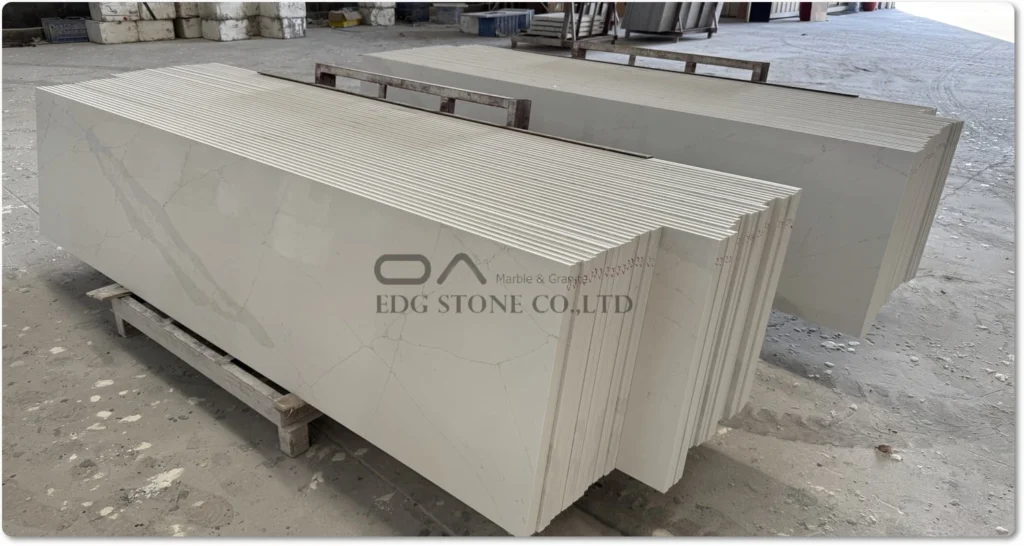
11. Sustainability and the Future of Quartz Procurement
11.1 Sustainability Is Becoming a Procurement Criterion
Commercial developers and architects increasingly evaluate products according to broader environmental criteria.
Potential procurement questions include:
- What is the recycled content?
- What manufacturing process is used?
- What certifications are available?
- What emissions documentation exists?
- How is packaging handled?
- Can environmental product documentation be provided?
- What is the expected service life?
Not every project requires every document.
However, professional suppliers should be prepared to provide relevant technical and environmental documentation where applicable.
11.2 The Future of White Quartz
The white quartz category is likely to continue moving toward:
Natural appearance + engineered consistency + safer fabrication + environmental documentation + digital procurement
This combination will become increasingly important for architects, developers, contractors, distributors, and international buyers.
12. White Quartz Manufacturer, Factory or Wholesale Supplier: Which Should You Choose?
12.1 Choose a Manufacturer When You Need
- Large quantities
- Custom colors
- Custom patterns
- Private-label products
- Consistent production
- Factory-level pricing
- Technical documentation
- Long-term supply
12.2 Choose a Wholesale Supplier When You Need
- Multiple brands
- Smaller mixed orders
- Faster product selection
- Multiple material categories
- Local inventory
12.3 Best Practice for Large Projects
For large projects, a hybrid strategy can be effective:
Manufacturer → Primary supply
Local distributor/fabricator → Local service
This can balance factory pricing with local fabrication and installation capabilities.
13. White Quartz Procurement Process: Step-by-Step
Step 1: Define the Application
Determine whether the material is intended for:
- Kitchen countertops
- Bathroom vanities
- Hotel rooms
- Reception desks
- Commercial interiors
- Furniture
- Wall applications
Step 2: Define Technical Specifications
Specify:
- Thickness
- Slab size
- Finish
- Color
- Vein pattern
- Edge requirements
- Surface requirements
Step 3: Request Samples
Request physical samples before placing a large order.
Step 4: Compare Manufacturers
Compare at least several qualified suppliers according to:
- Price
- Quality
- Capacity
- Certifications
- Lead time
- Packaging
- Export experience
Step 5: Approve a Master Sample
Create one controlled reference sample.
Step 6: Confirm Production
Confirm:
- Quantity
- SKU
- Production schedule
- Packaging
- Inspection
- Shipping terms
Step 7: Conduct QC
Use documented inspection criteria.
Step 8: Confirm Container Loading
Check:
- Crate condition
- Slab protection
- Loading sequence
- Container condition
- Quantity
- Product labels
Step 9: Calculate Landed Cost
Do not compare suppliers only on factory quotations.
Step 10: Evaluate the Supplier After Delivery
Record:
- Quality
- Damage rate
- Delivery accuracy
- Documentation
- Claim response
- Repeat-order consistency
This information should become part of your supplier-performance database.
14. Common White Quartz Procurement Mistakes
14.1 Choosing Only by Price
The lowest quote may result in:
- Higher breakage
- More color variation
- More fabrication waste
- More claims
- Higher replacement costs
14.2 Approving Only One Small Sample
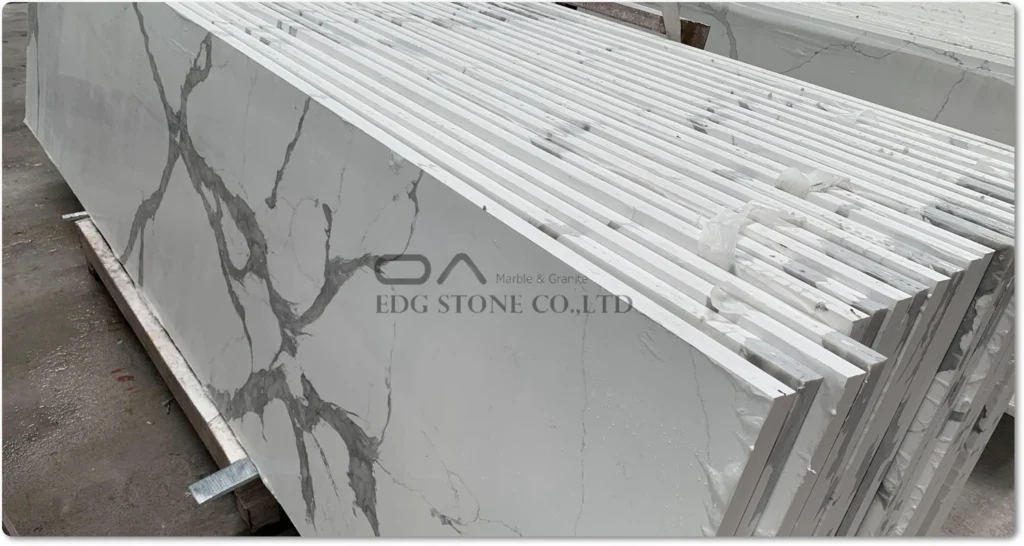
A small sample cannot always demonstrate slab-scale vein distribution.
For veined products, buyers should request full-slab images or production samples when possible.
14.3 Ignoring Packaging
Quartz slabs can be damaged during transportation if packaging is inadequate.
14.4 Not Defining Color Tolerance
“White” is not a sufficient commercial specification.
A project should establish what degree of variation is acceptable.
14.5 Ignoring Future Reorders
For multifamily and hospitality projects, replacement slabs may be needed months or years later.
Supplier continuity should therefore be considered during the initial purchase.
15. 2026 White Quartz Procurement Decision Matrix
| Procurement Factor | Recommended Priority | Why It Matters |
|---|---|---|
| Product consistency | Very High | Controls project appearance |
| Factory QC | Very High | Reduces claims and defects |
| Total landed cost | Very High | Determines real procurement cost |
| Production capacity | High | Critical for large projects |
| Slab dimensions | High | Affects fabrication yield |
| Packaging | High | Reduces transportation damage |
| Certification/documentation | High | Supports compliance and specification |
| Vein consistency | High | Important for premium designs |
| Lead time | High | Protects project schedule |
| Factory communication | High | Reduces specification errors |
| Price | High | Important but not the only factor |
| Sustainability data | Medium–High | Increasingly important for commercial projects |
| After-sales service | High | Reduces project risk |
16. FAQ: White Quartz Countertops Procurement 2026
What is the average price of white quartz countertops?
The final price depends on product quality, thickness, slab dimensions, design, manufacturer, order quantity, fabrication, transportation, tariffs, and installation. International buyers should compare total landed cost rather than factory price alone.
What are the pros and cons of white quartz countertops?
White quartz offers consistent appearance, relatively low routine maintenance, broad design options, and good fabrication familiarity. Potential limitations include heat sensitivity, fabrication dust exposure, possible batch variation, UV limitations for certain products, and formulation differences between manufacturers.
How do I choose a white quartz countertop manufacturer?
Evaluate manufacturing capability, quality-control procedures, production capacity, technical documentation, export experience, packaging, certifications, sample consistency, lead time, and after-sales support. A factory audit or third-party inspection can provide additional confidence.
Is white quartz better than natural marble?
Neither material is universally better. White quartz generally offers engineered consistency and easier routine maintenance, while natural marble provides genuine geological variation and a unique natural appearance. The appropriate choice depends on design, application, maintenance expectations, budget, and project requirements.
Is quartz procurement changing in 2026?
Yes. Professional procurement is increasingly influenced by worker-safety regulations, silica exposure controls, sustainability requirements, product documentation, supply-chain transparency, logistics costs, and total landed cost. Buyers should evaluate both material performance and supplier compliance capabilities.
17. Semantic Closure: Why, How, What, Options and Considerations for White Quartz Procurement
What is the core value of white quartz countertops?
White quartz countertops provide a controlled combination of engineered appearance, design flexibility, relatively low routine maintenance, fabrication familiarity, and commercial scalability. Their primary value for professional procurement is not simply aesthetics; it is the ability to reproduce a specified surface across multiple slabs and projects with controlled manufacturing processes.
Why are white quartz countertops still popular in 2026?
White remains a highly adaptable surface color because it works with many interior styles. Modern white quartz increasingly combines white backgrounds with natural-looking gray, beige, taupe, or gold veining, allowing manufacturers to reproduce the visual language of natural marble while maintaining engineered-material consistency.
How should buyers procure white quartz?
Buyers should begin with application requirements, define technical specifications, request samples, qualify manufacturers, approve a master sample, confirm production and packaging standards, conduct quality inspection, calculate total landed cost, and evaluate supplier performance after delivery. This process reduces the risk of selecting a supplier based solely on a low initial quotation.
What are the main procurement options?
Buyers can purchase through a direct manufacturer, wholesale supplier, distributor, or local fabricator. Direct factory procurement is generally more suitable for larger volumes, customization, private-label programs, and long-term supply relationships. Distributors may be more appropriate for smaller orders, mixed products, or local inventory requirements.
What should buyers consider before ordering?
Buyers should consider slab dimensions, thickness, color consistency, vein distribution, finish, surface performance, fabrication requirements, packaging, logistics, tariffs, certifications, worker-safety considerations, environmental documentation, warranty terms, replacement availability, and long-term supply continuity.
What is the most important lesson for 2026 quartz procurement?
The lowest factory price does not necessarily represent the lowest procurement cost. The best supplier is the one that provides an acceptable combination of product quality, production consistency, technical documentation, compliance, packaging, logistics, communication, and total landed cost.
Conclusion: How to Build a Lower-Risk White Quartz Procurement Strategy in 2026
White quartz countertops remain a strategically important surface category for residential and commercial projects.
However, the procurement environment has changed.
Professional buyers increasingly need to evaluate more than color and price. They need to understand manufacturing quality, slab consistency, fabrication requirements, supply-chain risk, worker safety, regulations, documentation, sustainability, logistics, and total landed cost.
For importers, distributors, developers, contractors, architects, hospitality companies, and retailers, a successful procurement strategy should therefore follow five principles:
Specify → Qualify → Test → Inspect → Evaluate
First, specify exactly what you need.
Second, qualify the manufacturer rather than accepting marketing claims.
Third, test samples and approve a controlled reference.
Fourth, inspect production and shipment.
Fifth, evaluate the supplier based on actual project performance.
EDG Stone can use this procurement-oriented approach to differentiate itself from commodity quartz suppliers by presenting not only products, but also manufacturing capability, quality control, technical knowledge, project experience, export packaging, and professional B2B support.
In 2026, the strongest white quartz supplier will not necessarily be the company offering the cheapest slab.
It will be the supplier capable of delivering consistent material, predictable quality, reliable documentation, competitive total cost, and scalable project support.
That is the foundation of professional quartz procurement.