1. Executive Summary & Industry Outlook
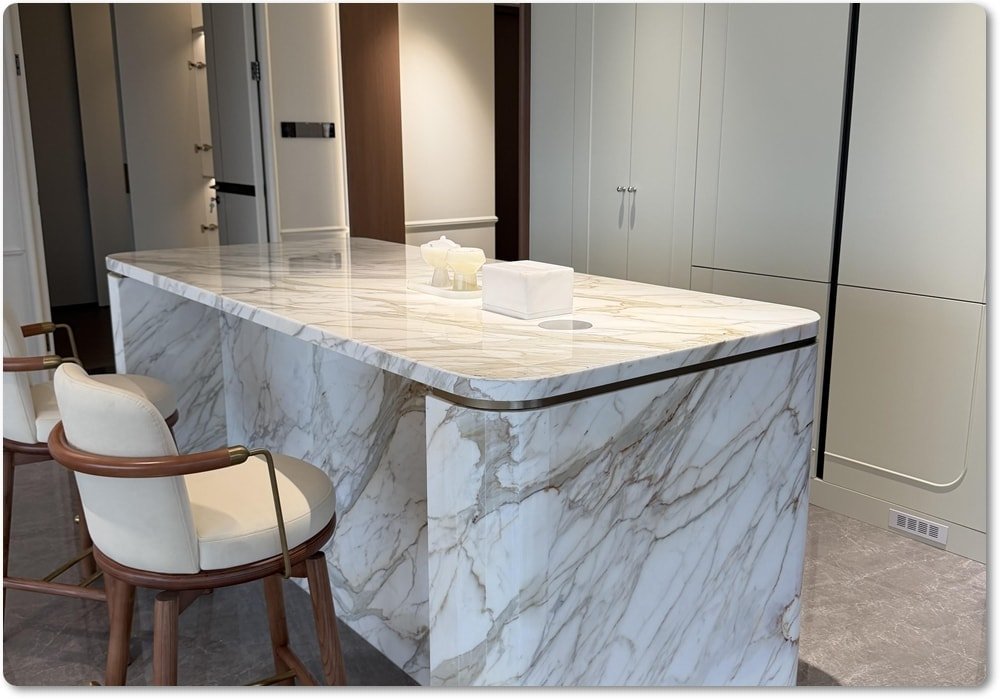
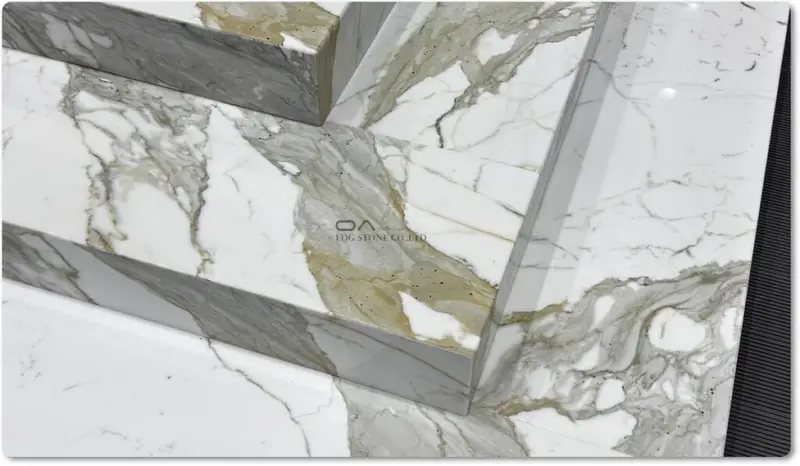
The global demand for natural stone continues to rise. Sourcing managers, architects, and developers require reliable materials for high-value projects. White marble remains the premier choice for luxury residential and commercial developments.
[Global Quarry Sourcing]
       │
       ▼
[White Marble Factory (Processing & Calibration)]
       │
       ▼
[Strict QC & Dry-Lay Inspection]
       │
       ▼
[Seaworthy Packaging & Fumigated Crates]
       │
       ▼
[Global Export & Port Logistics (EDG Stone Factory)]
Choosing a qualified White Marble Supplier directly impacts project margins, installation timelines, and aesthetic outcomes. This whitepaper establishes a scientific, engineering-focused framework for evaluating suppliers, assessing White Marble Factory capabilities, and verifying quality control (QC) protocols.
2. Global White Marble Material Science & Classification
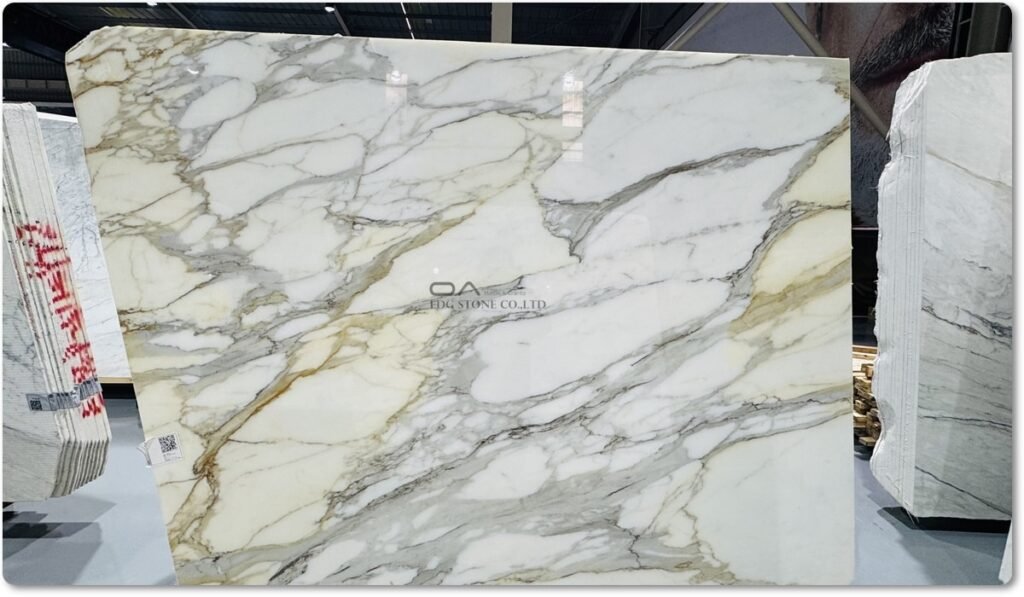
White marble is a metamorphic rock. It forms when limestone undergoes intense heat and pressure over millions of years. This process recrystallizes the calcium carbonate ($CaCO_3$), creating a dense network of calcite crystals.
Limestone (Sedimentary CaCO3) + Heat & Pressure ──> Marble (Metamorphic Calcite Matrix)
2.1 Geological Origin and Characteristics
Different quarries produce distinct geological profiles. Sourcing managers must understand these differences to match the stone with the project’s physical and aesthetic requirements.
| Marble Variety | Geological Origin | Dominant Mineral Composition | Primary Aesthetic Features | Common Application |
| Carrara White | Apuan Alps, Italy | Calcite ($>99\%$) | Warm white to light gray background with soft, feathery gray veins | Residential flooring, vanity tops, and large-scale commercial tiling |
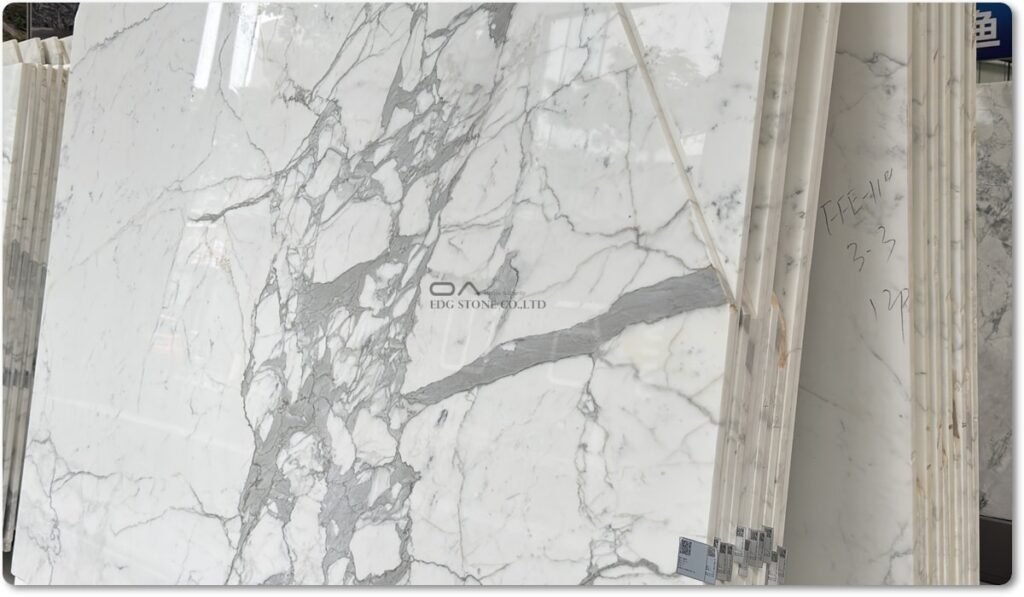
| Calacatta White | Carrara Region, Italy | Calcite, traces of Pyrite | Bold, dramatic gray and gold veins on a stark, crisp white background | High-end feature walls, bookmatched lobby floors, luxury countertops |
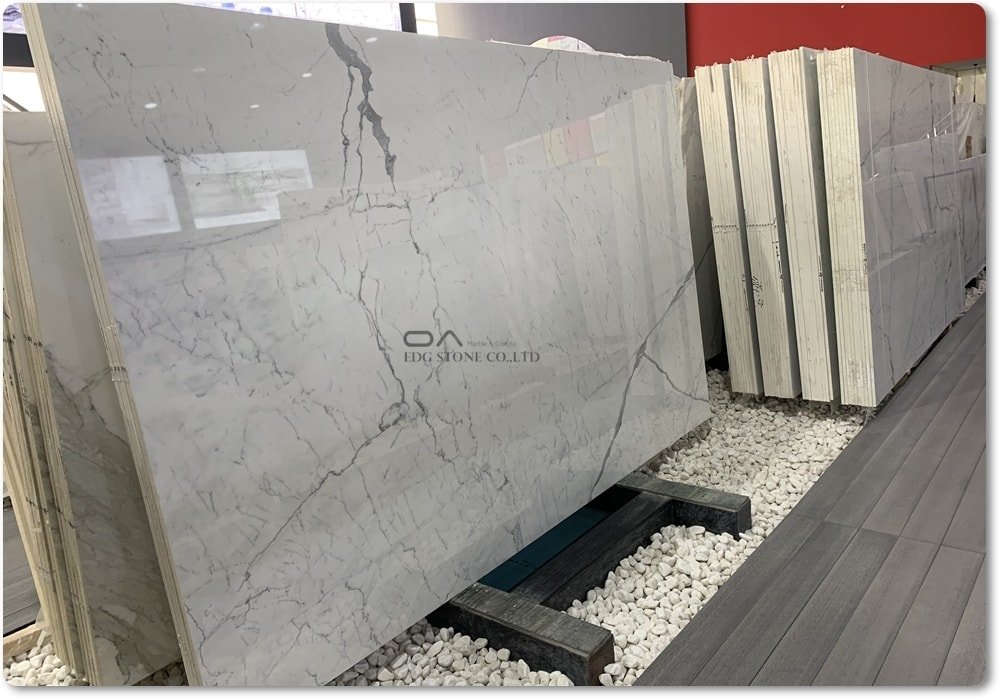
| Statuary White | Apuan Alps, Italy | Calcite, high purity | Heavy, distinct dark gray veins cutting across a brilliant white background | Custom carvings, reception desks, high-profile focal points |
| Volakas White | Drama, Greece | Dolomitic Calcite | Diagonal veins ranging from light gray to purple-brown on a cloudy white background | Interior wall cladding, bathroom flooring, mosaic tile production |
| Thassos White | Thassos Island, Greece | Pure Metamorphic Dolomite | Crystallized, snow-white appearance with minimal to no visible veins | Clean minimalist floors, luxury bathroom wet areas, exterior trim |
2.2 Key Physical and Mechanical Properties (ASTM Standards)
Engineers and architects must verify physical properties using ASTM (American Society for Testing and Materials) standards. A premium White Marble Supplier must provide certified test reports for every batch.
ASTM C97 (Density & Water Absorption) ──> ASTM C170 (Compressive Strength) ──> ASTM C880 (Flexural Strength)
Water Absorption (ASTM C97): High water absorption leads to staining and freeze-thaw damage. Premium white marble must show water absorption values below 0.15%.
Density (ASTM C97): High-density marbles resist wear and impact. The minimum density for structural marble is 2,560 kg/m³ ($160\text{ lbs/ft}^3$).
Compressive Strength (ASTM C170): This metric measures the load-bearing capacity. Slabs must withstand a minimum of 52 MPa ($7,500\text{ psi}$).
Flexural Strength (ASTM C880): This test determines bending strength, which is critical for overhanging countertops and large-format cladding. The minimum standard is 7.0 MPa ($1,000\text{ psi}$).
3. Inside a Professional White Marble Factory: Production Workflows
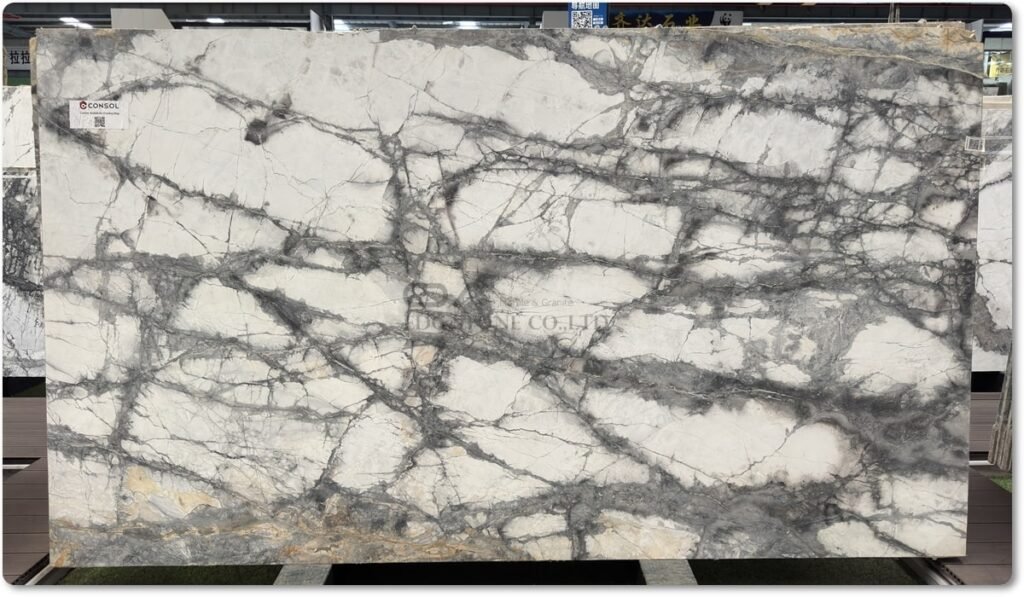
A state-of-the-art White Marble Factory relies on advanced machinery and standardized workflows to transform raw blocks into high-precision slabs and custom-cut tiles.
[Raw Block Selection] ──> [Gang Saw / Wire Saw Cutting] ──> [Vacuum Resin Treatment]
                                                                     │
[Final Inspection] ──> [Water-Jet/Bridge Saw Cutting] ──> [Polishing & Calibration]
3.1 Block Selection and Preparation
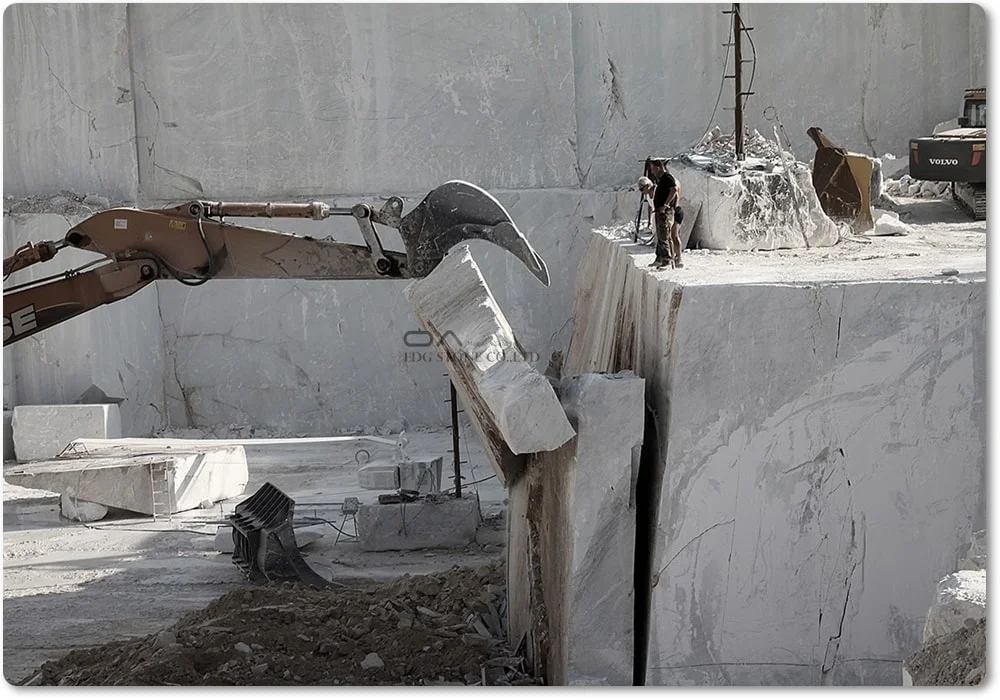
The production process begins at the quarry face. Factory block buyers inspect raw blocks for structural integrity, micro-fissures, and color consistency.
Block Inspection Checklist:
1. Ultrasonic Testing for Internal Fissures (Detects hidden structural flaws)
2. Grain Pattern and Veining Direction Alignment (Ensures predictable slab yield)
3. Dimensional Squareness (Optimizes gang saw cutting efficiency)
3.2 Primary Slicing: Gang Saws and Multi-Wire Machines
Once approved, the factory transports blocks to the cutting workshop.
Diamond Gang Saws: These machines use parallel steel blades fitted with diamond segments. They slice large blocks into standard $20\text{mm}$ or $30\text{mm}$ slabs. This traditional process takes 8 to 12 hours per block.
Multi-Wire Saws: Modern factories use diamond wire loops running at high speeds. This technology reduces cutting times to under 3 hours, minimizes kerf loss (material wasted during cutting), and produces a smoother surface finish.
3.3 Vacuum Epoxy Resin Treatment (The Strengthening Phase)
Natural white marble often contains micro-fissures or “dry lines.” High-end factories apply a specialized treatment:
Dehydration: Slabs pass through a drying kiln to remove all moisture.
Vacuum Epoxy Application: Technicians apply premium, UV-resistant epoxy resin (often water-clear polyurethane or epoxy formulations) under vacuum pressure. This pressure forces the resin deep into microscopic voids.
Curing and Reinforcement: Slabs cure in temperature-controlled racks. Many factories apply a high-tensile fiberglass mesh backing to fragile marbles like Calacatta or Volakas to prevent breakage during transport.
3.4 Calibration, Polishing, and Final Fabrication
Calibration: Multi-head grinding lines level the slabs to a uniform thickness, maintaining a strict tolerance of $\pm0.5\text{mm}$.
Polishing: Computerized slab polishing lines use a sequence of progressively finer abrasive heads (from 50-grit to 3000-grit) to achieve a mirror finish with a gloss rating above 90%.
CNC & Water-Jet Cutting: For project-specific orders, 5-axis CNC machines and water-jet cutters shape slabs into precise countertops, staircases, or intricate patterns with tolerances under $0.2\text{mm}$.
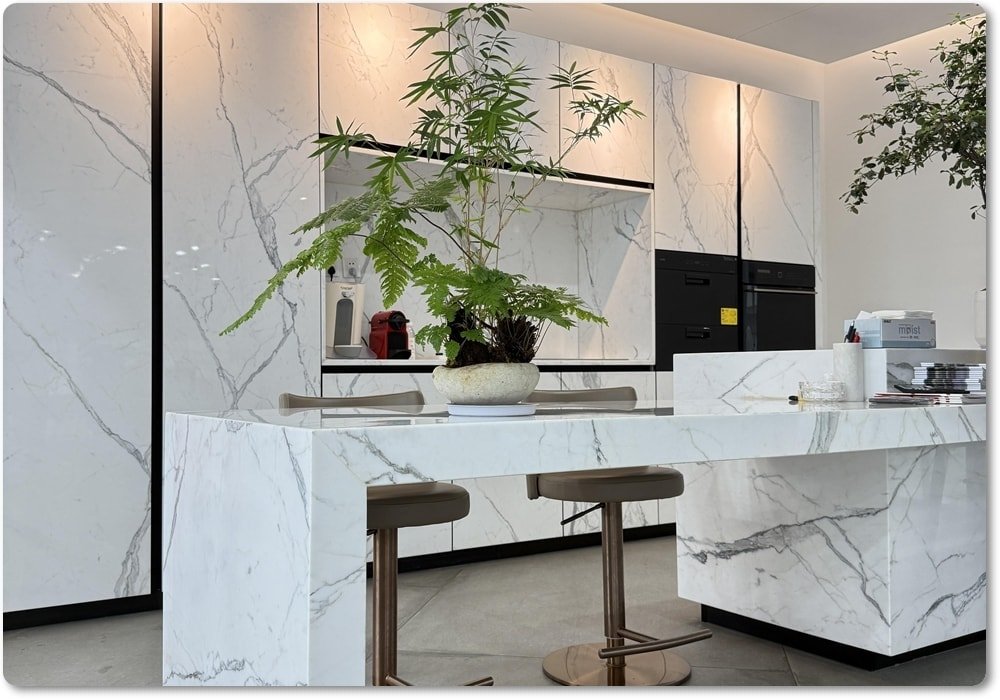
4. Crucial Evaluation Standards for Selecting a White Marble Supplier
Global procurement managers must look beyond unit prices to evaluate operational capabilities. Use this checklist to assess potential partners.
                          [Supplier Evaluation Matrix]
                                       │
         ┌─────────────────────────────┼─────────────────────────────┐
         ▼                             ▼                             ▼
[Production Capacity]          [Technical Competence]       [OEM & Customization]
- Annual output > 200,000m²   - 5-Axis CNC Machining        - Match shop drawings
- Large inventory blocks      - 3D Modeling (BIM/CAD)       - Custom edge profiles
4.1 Production Capacity and Quarry Agreements
A reliable supplier must guarantee a steady material supply. Interruptions during a major construction project can cause expensive delays.
Direct Quarry Sourcing Agreements: Verify if the supplier owns the quarry or holds exclusive offtake agreements. Direct access ensures stable color consistency and uninterrupted delivery.
Slab Stock Inventory: A top-tier factory maintains an active inventory of at least 10,000 square meters of slabs and over 500 raw blocks to handle sudden surges in demand.
Annual Output Capacity: Ensure the factory’s annual production exceeds 200,000 square meters of processed stone.
4.2 Technical Competence and Machining Capabilities
High-end commercial projects require precise fabrication. Your supplier must operate modern machinery:
5-Axis CNC Machining Centers: These machines cut complex curves, sink cutouts, and edge profiles with perfect accuracy.
Intelligent Water-Jet Machinery: Necessary for executing complex floor patterns, medallions, and custom architectural details.
Digital Slab Scanning Technology: The factory must scan and catalog individual slabs, allowing designers to plan digital dry-lays and bookmatched layouts before shipping.
4.3 OEM and Customization Services
Global buyers rely heavily on OEM (Original Equipment Manufacturer) capabilities. The supplier must transform architectural drawings into finished products:
Shop Drawing Redrafting: An in-house engineering team should convert CAD drawings into detailed cutting lists and production tickets.
Custom Edge Profiles: The factory must master various edge details, including laminated bullnose, mitered aprons, ogee, and eased edges.
Pre-seal and Treatment: The supplier should offer pre-installation sealing services using premium penetrating sealers to protect marble against water, oil, and acid stains during construction.
5. Strict Quality Control (QC) & Inspection Processes
Quality control is the defining factor of a premier White Marble Supplier. Cheap suppliers often skip these steps, resulting in inconsistent sizing, warpage, and color variations.
                             [The QC Pipeline]
                                     │
    ┌────────────────────────────────┼────────────────────────────────┐
    ▼                                ▼                                ▼
[Block Inspection]          [Dry-Lay Inspection]             [Technical Check]
- Ultrasonic sound          - Color grouping                 - Thickness (±0.5mm)
- Surface crack mapping     - Vein mapping & continuity      - Gloss level (>90%)
- Calcite purity analysis   - Pre-numbering for assembly     - Flatness (max 0.2mm warp)
5.1 Step-by-Step QC Protocol
Step 1: Raw Block Inspection
Ultrasonic Testing: Inspectors use ultrasound waves to identify internal cracks and structural voids before cutting.
Dimension and Shape Check: Ensures blocks are squared off to maximize cutting yield and minimize waste.
Step 2: In-Line Production Inspection
Thickness Verification: Technicians measure slabs at multiple points using digital calipers to maintain a tolerance of $\pm0.5\text{mm}$.
Flatness Testing: Slabs are measured with straightedges and feeler gauges to ensure warpage does not exceed $0.2\text{mm}$ across the entire surface.
Gloss Level Testing: Inspectors use a calibrated gloss meter to verify the polish. Premium white marble must achieve a gloss rating of 90 to 95 degrees.
Step 3: Dry-Lay Inspection (Critical for Projects)
Dry-laying involves laying out finished tiles or slabs on the factory floor in their final installation pattern. This step is vital for white marble projects due to natural variations in veining.
Color Grouping: Inspectors sort slabs into strict shade categories (e.g., A-grade pure white, B-grade with light gray undertones).
Vein Matching: Technicians lay out slabs to ensure seamless transitions and flowing vein patterns across floors and walls.
Pre-Numbering: Once approved, the factory marks each piece with its exact grid coordinates on the back. This simplifies installation on-site.
Typical Dry-Lay Layout Plan:
+-------------------+-------------------+-------------------+
|  Tile A1 (Row 1)  |  Tile A2 (Row 1)  |  Tile A3 (Row 1)  |
|  [Vein Flow --->] |  [Vein Flow --->] |  [Vein Flow --->] |
+-------------------+-------------------+-------------------+
|  Tile B1 (Row 2)  |  Tile B2 (Row 2)  |  Tile B3 (Row 2)  |
|  [Vein Flow --->] |  [Vein Flow --->] |  [Vein Flow --->] |
+-------------------+-------------------+-------------------+
6. International Packaging & Safe Logistics Standards
Marble is heavy, dense, and brittle. Poor Packaging and careless logistics can ruin months of precise factory work. High-quality exporters prioritize secure packing.
                     [Seaworthy Packaging Design]

        +───────────────────────────────────────────────+
        |  [Heavy-Duty Solid Wood Outer Frame]          |
        |  (ISPM-15 Heat-Treated & Fumigated)           |
        |                                               |
        |   +───────────────────────────────────────+   |
        |   |  [High-Density Polyethylene Foam]     |   |
        |   |                                       |   |
        |   |   +───────────────────────────────+   |   |
        |   |   |  [White Marble Slabs / Tiles] |   |   |
        |   |   |  (Polished Faces Together)     |   |   |
        |   |   +───────────────────────────────+   |   |
        |   +───────────────────────────────────────+   |
        |                                               |
        |  [Reinforced Steel Banding & Tie-downs]       |
        +───────────────────────────────────────────────+
6.1 Wooden Crate Fabrication Standards
ISPM-15 Compliance: All wooden crates and A-frames must undergo heat treatment or chemical fumigation. Slabs must carry the official IPPC stamp to clear customs.
Timber Quality: Slabs are secured in heavy-duty, solid wood frames. Factories avoid soft, green pine, which can warp or split under load.
Inner Protective Layers: High-density polyethylene (HDPE) foam sheets and plastic wrap separate polished marble faces to prevent scratching, abrasion, and moisture damage during transit.
6.2 Container Loading and Securing Mechanics
A-Frame Loading: Slabs are loaded face-to-face in pairs onto reinforced steel or heavy wood A-frames.
Weight Distribution: Technicians distribute the load evenly inside the container to prevent shifting during maritime transit.
Chocking and Lashing: Crews use high-tensile steel straps, wood blocks, and heavy-duty dunnage bags to secure frames to the container walls. Slabs must not move, even during rough sea conditions.
7. Case Study: How EDG Stone Factory Integrates Quarry Sourcing, Advanced Manufacturing, and Global Logistics
To understand how a top-tier manufacturer operates, let’s analyze EDG Stone Factory, a premier global Quartzite Slabs & Countertops Manufacturer and Exporter. They apply their advanced quartzite processing techniques directly to high-end white marble production.
                    [EDG Stone Factory Operations]
                                   │
      ┌────────────────────────────┼────────────────────────────┐
      ▼                            ▼                            ▼
[Sourcing Power]          [Fabrication Tech]           [Export Engineering]
- Direct quarry ties      - Multi-wire diamond saws   - Custom seaworthy A-frames
- Strict block selection  - Multi-head polishing lines - Full custom clearance support
7.1 Sourcing Power and Global Footprint
EDG Stone Factory maintains direct partnerships with premium quarries in Italy, Greece, and Brazil. This allows them to source the highest quality block reserves of Calacatta, Carrara, and Volakas. They select blocks based on purity and structural stability, ensuring consistent material quality for international projects.
7.2 State-of-the-Art Processing and Equipment
EDG Stone Factory processes delicate natural stones using advanced technology:
Multi-wire diamond saws cut clean slabs with precise thickness.
Advanced multi-head automated polishing lines deliver a consistent gloss rating across every batch.
An automated vacuum epoxy resin line strengthens slabs to prevent cracks during fabrication, transit, and installation.
7.3 Export Engineering and Customer-First Solutions
As a leading Exporter, EDG Stone Factory designs its packaging and logistics systems to protect materials during long ocean voyages. Their teams oversee every step of the process:
Custom seaworthy A-frames and heavy-duty wooden crates keep materials secure.
Professional loaders distribute weight evenly to prevent shipping damage.
Dedicated export coordinators manage all shipping documentation, ISPM-15 fumigation certificates, and customs clearance paperwork. This ensures smooth, hassle-free deliveries to major ports worldwide.
8. Topic Cluster & Internal Linking Architecture
To build search engine authority, your site should organize content into a structured topic cluster. This interconnects core topics, helps search engine crawlers index your pages, and provides a clear navigation path for users.
                  [Pillar Article: White Marble Buying Guide]
                                       │
      ┌────────────────────────────────┼────────────────────────────────┐
      ▼                                ▼                                ▼
[Material Selection]           [Supplier Operations]             [Application Details]
- Italian vs Greek Marble      - OEM Capabilities                - Slabs vs Pre-Cut Tiles
- Calacatta Grading            - Factory QC Checklists           - Commercial Installation
- Dolomite vs Calcite          - Packaging Standards             - Maintenance & Sealing
15 Interlinked Article Topics for Your Knowledge Base
Italian vs. Greek White Marble: A direct comparison of geological properties, aesthetic differences, and pricing for Carrara, Volakas, and Thassos marbles.
The Sourcing Manager’s Checklist: How to evaluate international stone suppliers, inspect factory credentials, and verify production capacities.
Decoding Calacatta Marble Grades: An in-house guide explaining why some Calacatta slabs cost three times more than others based on vein purity and background color.
Dolomitic vs. Calcitic Marbles: An engineering-focused breakdown of how chemical composition impacts stain resistance, hardness, and durability in high-traffic commercial spaces.
The OEM Advantage in Stone Fabrication: How direct factory fabrication reduces project costs, minimizes material waste, and ensures precise, pre-cut tile sizing.
Slab vs. Pre-Cut Tiles: A cost-benefit analysis for architects planning large-scale flooring and wall cladding installations.
Slab Resining Explained: A detailed look at how vacuum epoxy systems, fiber meshing, and UV-stable resins improve the structural integrity of natural stone.
The Art of Bookmatching: Step-by-step instructions for selecting, cutting, and installing consecutive marble slabs for mirror-image feature walls.
Understanding Marble ASTM Test Results: How to read and verify density, water absorption, and flexural strength certificates to ensure compliance with local building codes.
The Dry-Lay Inspection Process: Why laying out marble slabs at the factory is the most effective way to manage natural color variations and ensure consistent vein transitions.
Seaworthy Packaging Best Practices: An illustrated guide to A-frame construction, timber fumigation, and container securing techniques that prevent shipping damage.
Preventing Marble Staining and Etching: A practical guide to specifying penetrating sealers, protective coatings, and daily maintenance routines in commercial environments.
Specifying Marble for High-Traffic Floors: Selecting the right finishes (honed vs. polished), joint layouts, and sub-floor preparation steps for hotels and commercial lobbies.
How to Choose the Right Countertop Edge Profile: Design guidelines and fabrication tips for specifying mitered aprons, eased edges, and custom laminated bullnoses.
Importing Natural Stone Safely: A comprehensive breakdown of shipping incoterms, customs clearance steps, duty rates, and port logistics for commercial construction projects.
9. Comprehensive Q&A (Topic Cluster Strategy)
Question 1
How does dolomitic white marble differ from calcitic white marble in high-traffic flooring applications?
Answer
Dolomitic white marble contains high levels of calcium magnesium carbonate ($CaMg(CO_3)_2$), whereas calcitic marble is mostly pure calcium carbonate ($CaCO_3$). This chemical difference makes dolomitic marbles, like Greek Thassos, harder and denser. They resist scratching, acid etching, and moisture absorption better than softer calcitic options.
Evidence
According to geological tests, Thassos Dolomite marble has a Mohs hardness of 3.5 to 4.0, whereas standard Italian Carrara Calcitic marble has a Mohs hardness of 3.0. ASTM C97 tests show dolomitic marbles average water absorption rates below 0.08%, compared to 0.15% for typical calcitic varieties.
Summary
Dolomitic marbles are more durable, scratch-resistant, and stain-resistant. They are the ideal choice for high-traffic commercial floors and wet areas where durability is a priority.
Question 2
Why do leading stone factories apply fiberglass mesh backing to white marble slabs, and should it be removed before installation?
Answer
Factories apply high-strength fiberglass mesh to the back of fragile or heavily veined marble slabs using epoxy resin. This backing supports the slabs, protecting them from cracking or breaking during transport, handling, and cutting. Installers do not need to remove the mesh; it should remain in place to provide extra structural support.
Evidence
Tensile strength tests show that fiberglass mesh backing increases a slab’s break resistance by more than 40% during transport and fabrication. Modern thin-set mortars and stone adhesives are formulated to bond securely to epoxy-mesh backings.
Summary
Fiberglass mesh backing reinforces fragile marble slabs during shipping and fabrication. Keep the backing intact during installation, and use high-quality polymer-modified thin-set mortar to ensure a strong bond.
Question 3
What are the main causes of color staining in white marble, and how can factories prevent it before shipping?
Answer
White marble is a porous, alkaline material. It stains when it absorbs moisture, oils, rust, or acidic liquids into its crystalline structure. Factories prevent this by drying slabs completely, treating them with premium, solvent-based penetrating sealers, and packing them using non-staining, vapor-permeable materials.
Evidence
Testing shows that untreated white marble can stain within 15 minutes of contact with acidic liquids like coffee or red wine. Slabs treated with professional fluoro-chemical penetrating sealers resist staining for up to 72 hours, allowing cleanup before the liquid penetrates the stone.
Summary
Porous white marble absorbs liquids easily. Factories protect the stone during shipping and installation by applying advanced penetrating sealers and using dry, moisture-free packaging.
Question 4
How does a professional factory dry-lay inspection reduce project installation errors and material waste?
Answer
A dry-lay inspection involves laying out cut-to-size tiles or slabs on the factory floor in their planned design pattern. This allows technicians to match vein directions, group similar color shades, and pre-number each piece. This step ensures consistent transitions and eliminates unexpected color clashes or veining breaks on-site.
Evidence
Project data shows that skipping the dry-lay step can lead to an on-site installation rejection rate of up to 15% due to mismatched patterns. Conducting a pre-shipment dry-lay reduces on-site material waste and adjustment cuts to under 2%.
Summary
Dry-lay inspections verify vein matching and color consistency across all panels before shipping. This process reduces on-site installation errors, avoids delays, and cuts down on material waste.
Question 5
What are the standard international packaging requirements for exporting heavy white marble slabs?
Answer
International standards require heavy marble slabs to be secured on solid wood A-frames or inside closed crates. All wood packaging must comply with ISPM-15 regulations, meaning it must undergo heat treatment or chemical fumigation and carry the IPPC stamp. Slabs must be separated by high-density foam padding and tightly bound with high-tensile steel banding.
Evidence
International shipping regulations and marine insurance policies require compliance with ISPM-15 to prevent the spread of forest pests. Shipping data show that using reinforced A-frames and high-density foam inserts reduces product breakage rates during transport to under 0.5%.
Summary
Exported marble must be packed in fumigated, ISPM-15-compliant wood crates and secured with steel straps and protective foam. This ensures structural safety, meets customs requirements, and protects the stone during transit.