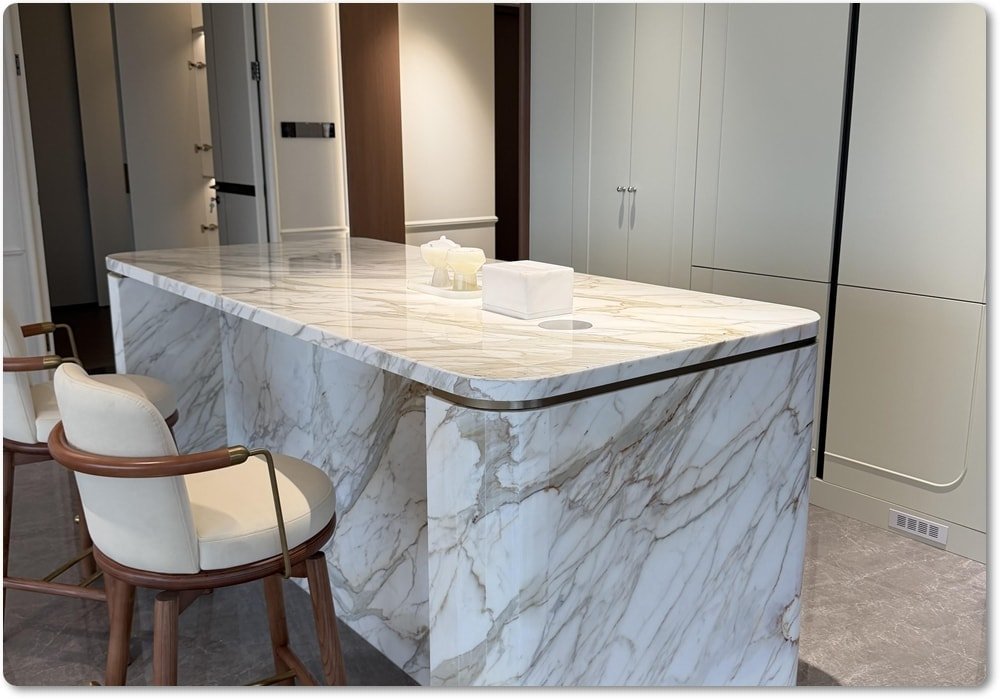
Introduction — What this guide delivers?
Stone stair treads and baseboards are architectural elements where aesthetics meet structure and safety. This article equips architects, specifiers, fabricators, contractors, and purchasing teams with practical, production-grade details for designing, fabricating, installing, specifying, and procuring custom stone stairs and stone baseboards for interiors and façades.
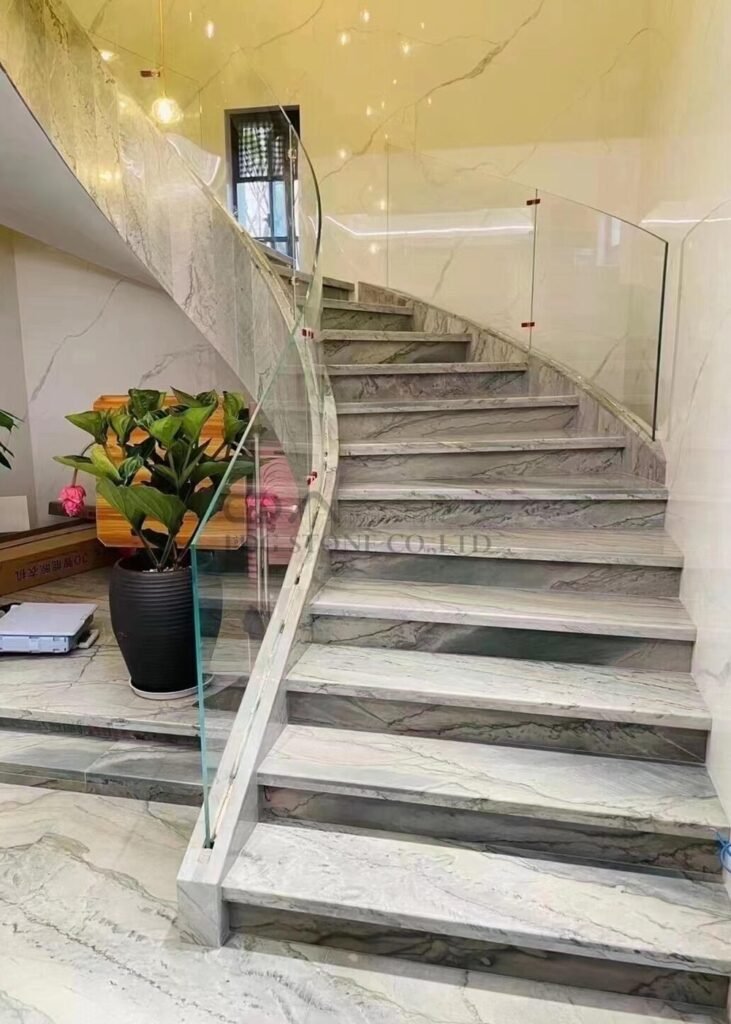
Design Principles for Stone Stairs and Façades
Design begins with user function: is the stair for private residential use, high-traffic commercial lobbies, or an exterior public entry? Each use case has different priorities for durability, slip resistance, edge detail, and maintenance. Key human-factors like riser uniformity, tread depth, and nosing geometry determine safety; technical factors such as stone thickness, backing, and support details determine durability and long-term performance.
Primary objectives: safety, durability, and aesthetic integration.
Start by locking in riser/tread geometry and handrail interface, then finalise the stone type and finish.
Consider the visual rhythm across the stair run (veneer direction, bookmatching, veining continuity) and balance it with practical tolerances for fabrication and site variation.
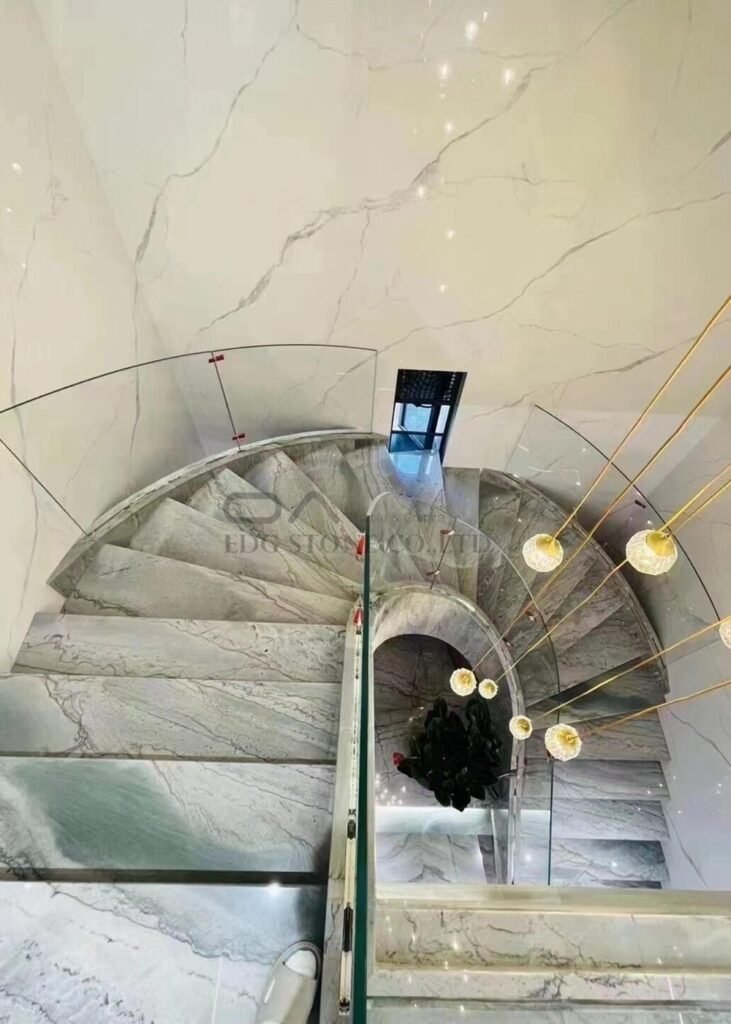
Material Selection: Marble, Granite, Limestone, Quartzite, Engineered Stone
Selecting material is a tradeoff between appearance, hardness, weathering behavior, and cost.
Marble
Marble offers premium veining and an elegant surface suitable for high-end interiors. It polishes to a high gloss, but it is softer and more acid-sensitive than granites and quartzites. Use honed or leathered marble finishes on stairs to reduce polish-induced slipperiness, and limit use to low-to-medium traffic interior applications.
Granite
Granite is a go-to for durable stair treads. It has high compressive strength and excellent abrasion resistance. Granites are available in a wide color palette; choose a consistent slab quality and verify machinability for complex edge profiles.
Limestone & Sandstone
Limestone and certain sandstones provide a warm, traditional aesthetic suitable for restoration and heritage façades. These materials are softer and can abrade faster; specify thicker sections or protective finishes when used on stairs.
Quartzite & Engineered Stone
Quartzite is a natural stone with a marble-like appearance and very high hardness, making it excellent for heavy-use stairs where a light look is desired. Engineered stone provides consistent color and minimal porosity; it is often used indoors where uniformity and reduced maintenance are priorities.
Practical rule: For exterior treads, prefer dense, low-porosity stones and textured finishes; for interior public stairs, choose granite or quartzite with an appropriate anti-slip finish.
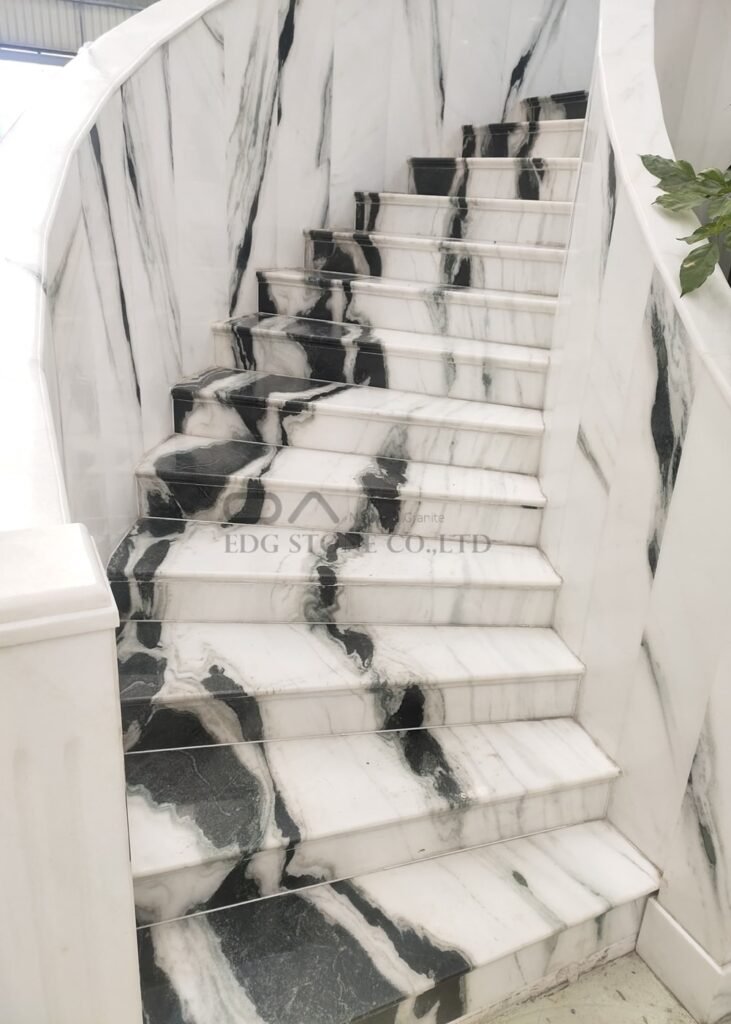
Fabrication: Edge Profiles, Nosing, Joints, and Tolerances
Fabrication establishes the look and the tactile qualities of the stair edge — the nosing is both a safety element and an aesthetic signature.
Edge Profiles
Common profiles include:
Square / Eased — clean contemporary look, requires a tiny eased radius to prevent sharpness.
Bullnose — a rounded face that is comfortable and forgiving.
Bevel / Chamfer — transitional details for modern looks.
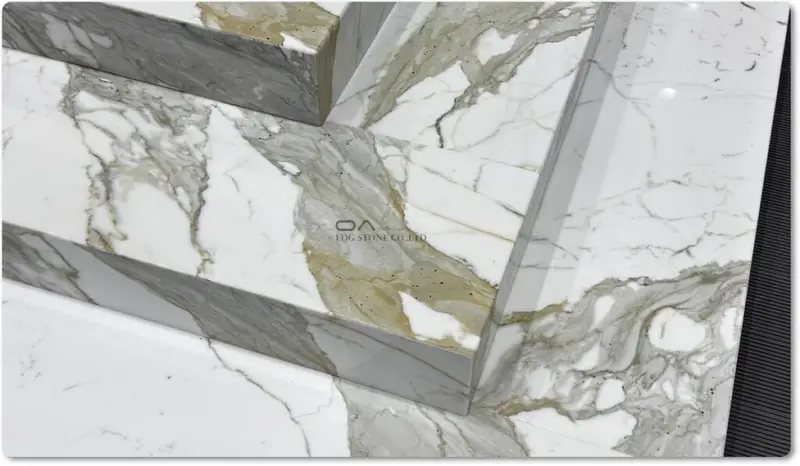
Mitered thick edge — for waterfall or thick-edge illusions; requires exact mitre joins and structural backing.
Nosing geometry and comfort
Nosing projection and radius influence foot placement and perceived tread depth. Keep nosing radii small enough to provide a secure surface for the toe while avoiding sharp corners. When designing nosing projection, check local accessibility and building code tolerances.
Joints and adhesives
Interior treads are commonly full-bed with a cementitious adhesive and tight joints finished with color-matched epoxy or cement grout. Exterior installations should use flexible, low-modulus sealants at movement joints and allow drain and flashing details to protect the substrate.
Critical tolerances
Riser uniformity should be held to a maximum deviation of 1/4″ across a flight to prevent trip hazards.
Fabrication flatness: aim for 1–2 mm tolerance across the visible face to prevent rocking.
Edge seams and miter joins must be matched to ±0.5 mm for seamless visual continuity.
Surface Finishes & Slip Resistance — testing and practical guidance
Finish choice is the single most important factor for stair safety under wet or contaminated conditions.
Polished surfaces are visually striking but have the lowest wet-slip performance and are rarely recommended for public stairs.
Honed surfaces reduce reflectivity and offer modest improvement in traction.
Leathered / Brushed finishes provide tactile interest and improved wet traction for interiors.
Flamed, sandblasted, or shot-blasted surfaces are commonly used on exterior treads to boost grip.
Modern practice emphasizes validated testing over anecdote. Use recognized test methods that measure dynamic wet traction (pendulum testers or equivalent) rather than static coefficient measurements alone. For public or commercial installations, set minimum testing thresholds and require slip-resistance test reports with the supply package.

Installation Best Practices — substrate, anchors, waterproofing, and movement
Installation is where well-designed and well-fabricated components perform or fail.
Substrate preparation
Ensure a rigid and level substrate (concrete, steel framing with proper stringer detail) to prevent point loading and deflection.
For full-bed installations, slope and screed behind the stone must be consistent and fully cured.
Anchoring systems
Use mechanical anchors (stainless steel inserts, angle brackets) for heavy external treads and concealed supports where structural loads or cantilevered conditions exist.
Combine mechanical anchoring with flexible bedding to accommodate thermal movement and prevent stress concentration.
Waterproofing and flashing
External stairs require careful flashing where steps abut walls and at junctions with landings to prevent water ingress into the building envelope.
Provide drainage slots or weeps where applicable; design the interface with adjacent paving and handrail posts to prevent pooling.
Movement joints
Insert expansion joints at recommended intervals and at material transition points. Use compatible compressible fillers and sealers to maintain performance and appearance.
Codes, Standards & Regulatory Requirements
Compliance is essential for occupant safety and procurement acceptance. Refer to these recognized authorities when preparing specifications and submittals:
International Code Council — publishes the International Building Code (IBC) and related guidance on stair dimensions and guardrail requirements.
Occupational Safety and Health Administration — issues workplace stairway safety standards focused on uniformity and clearances.
Natural Stone Institute — provides material testing guidance and best-practice fabrication and installation documents.
National Floor Safety Institute — sets recommendations for slip resistance thresholds and testing methods.
When specifying stone products for international projects, confirm local adoption of regional standards (such as national building codes, European EN standards, or other country-level regulatory frameworks). For projects exporting materials, ensure supplier documentation and declared performance meet buyer jurisdiction requirements.
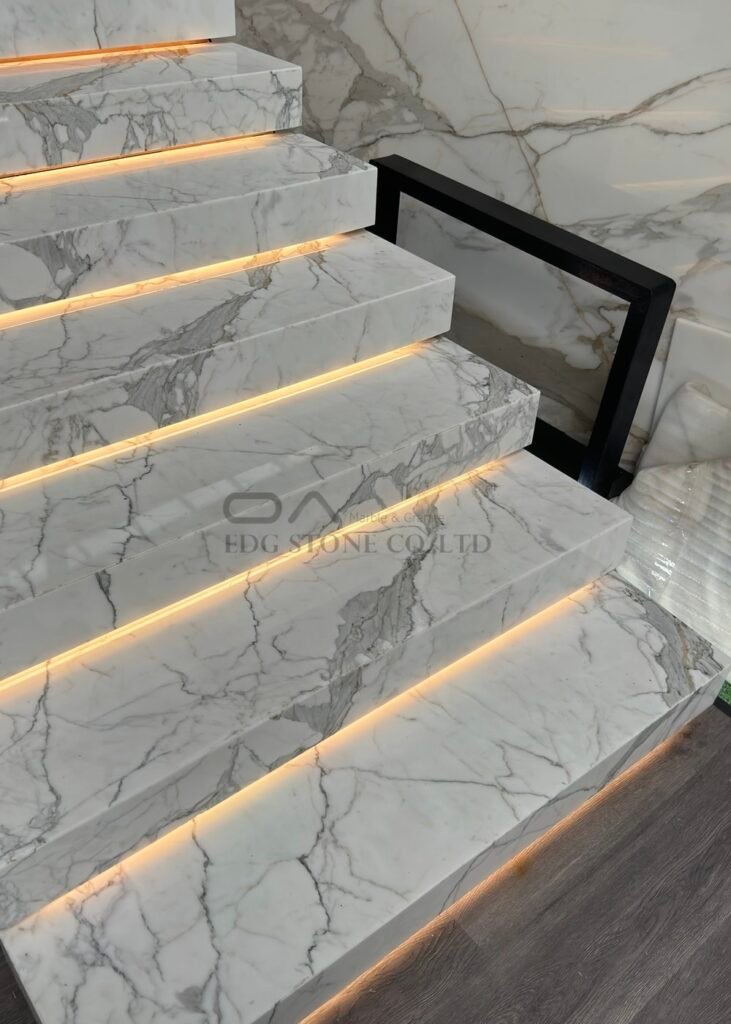
Sustainability, Sourcing & Chain-of-Custody
Sustainability is now a procurement requirement on many commercial projects. Key actions for specifiers and buyers:
Request source documentation from quarries and processing plants (origin, processing energy, waste handling).
Ask for chain-of-custody records and any available carbon or life-cycle assessment data.
Prefer suppliers with documented environmental management systems and transparent supply chains, especially for projects with green building or procurement mandates.
Reducing transport distances, using recycled stone content where appropriate, and choosing durable, low-maintenance finishes can meaningfully reduce lifecycle impact.
Procurement, Pricing & Buyer-Intent Keywords
To make your product pages and RFQs convert, include clear buyer-intent language and technical detail:
Suggested long-tail commercial keywords to include on product/spec pages and metadata:
granite stair treads manufacturer factory,
buy marble stair treads wholesale,
custom stone stair nosing factory near me,
natural stone steps ideas supplier,
engineered stone stair tread manufacturer bulk.
Supply rich product data: slab sizes, thickness options, edge profile codes, finish codes, test certificates for slip resistance, lead times, minimum order quantities, and shipping/packing details.
Maintenance, Lifecycle & Warranty
Provide clear maintenance instructions with the product:
Routine cleaning: neutral pH cleaners and microfiber mops; avoid abrasive pads and acidic cleaners on calcareous stones.
Resealing frequency: varies by stone porosity; higher-traffic exterior treads usually require more frequent inspection and maintenance.
Warranty: clearly define visible defects, permitted natural variation, and exclusions (e.g., misuse, exposure to aggressive chemicals, freeze-thaw in regions without proper detailing).
Well-spec’ed granite and quartzite treads can be expected to provide decades of service with proper maintenance; softer stones will show wear and may be better suited to low-impact environments.
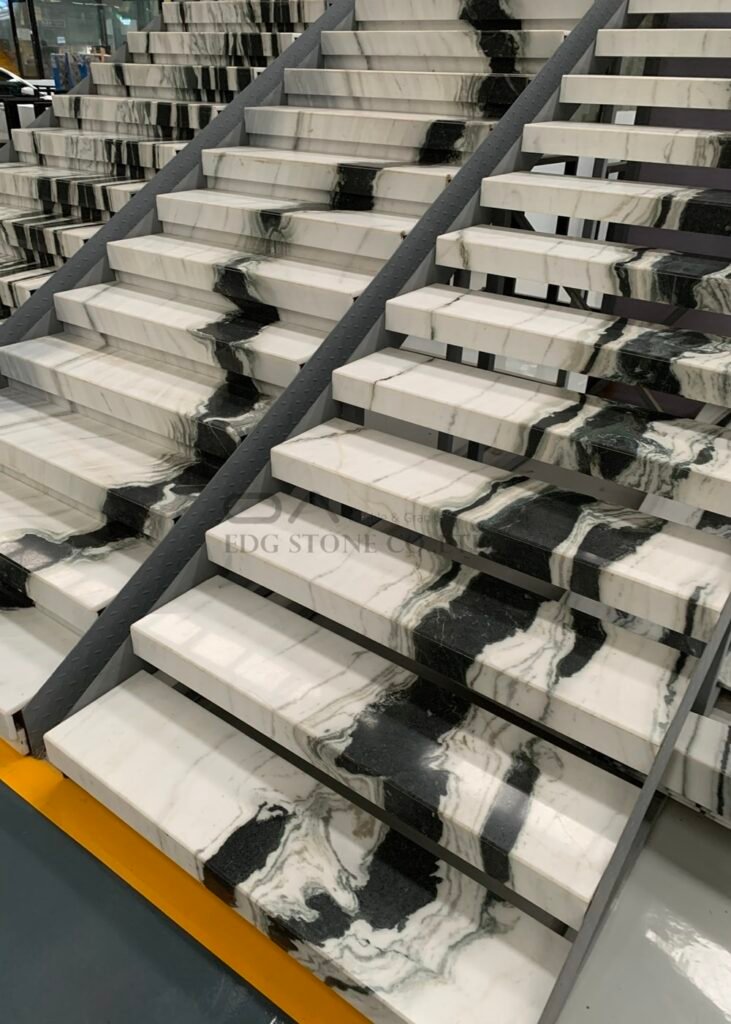
Example Specification Excerpt & Case Snapshot
Specification excerpt (interior granite tread): 20 mm honed granite, factory eased square nosing 25 mm radius, full-bed mortar installation with polymer-modified adhesive, pendulum wet test report PLV ≥ 36, riser/tread uniformity ≤ 6 mm across the flight.
Case snapshot: A commercial lobby renovation replaced worn concrete treads with honed quartzite. By specifying mechanical anchors, matching shop-fit templates, and a textured finish, the owner reported reduced maintenance calls and improved guest satisfaction. The combined structural and finish detailing prevented edge chipping and improved longevity.
FAQ — Top 5 Google-style questions and answers
Q1: What stone is best for stair treads in high-traffic commercial lobbies?
A1: Dense granite or quartzite treads with honed or textured finishes are typically best for high-traffic lobbies because they combine abrasion resistance with improved wet traction. Polished surfaces, while attractive, are not usually recommended for wet or high-traffic public zones.
Q2: How deep should a stair tread be for safety and comfort?
A2: A comfortable and code-conventional stair tread depth for many jurisdictions is around 11 inches (nominal) with risers kept uniform across the flight; always verify local building code adoption and accessibility requirements because exact numeric limits can vary by jurisdiction.
Q3: How do I improve slip resistance on natural stone stairs?
A3: Choose textured finishes such as flamed, sandblasted, or leathered surfaces, and validate performance through recognized dynamic wet traction testing. Additionally, provide drainage, slope, and anti-slip inserts at critical areas to reduce the risk of standing water.
Q4: What fabrication details matter most for preventing edge chipping and failure?
A4: Proper support (birdsmouth seats, continuous bedding or mechanical brackets), correct edge profiles sized for the stone thickness, and overlapping mechanical anchors or backing for long or cantilevered treads are essential. Tight fabrication tolerances and quality control during shop-fit templates also reduce on-site rework and edge failures.
Q5: Do stone stair treads require special documentation for international projects?
A5: Yes—international projects often require documented material performance, declared test results for slip resistance and strength, and sometimes chain-of-custody or conformity declarations. For projects in certain regions, specific product performance declarations or marking regimes may be required by local regulations.
Reference (author, article title, source) — authoritative & concise (no links)
International Code Council — “International Building Code” — International Code Council.
Occupational Safety and Health Administration — “Stairways and Ladders” — U.S. Department of Labor.
National Floor Safety Institute — “Best Practices for Slip Resistance” — NFSI.
ASTM Committee on Stone — “ASTM Standards for Natural Dimension Stone” — ASTM International.
European Committee for Standardization — “EN 12057: Slabs for floors and stairs” — CEN.
Construction Products Regulation guidance — “CE Marking and Construction Products” — European Union Publications.
BRE (Building Research Establishment) — “Life cycle and sustainability guidance for building stone” — BRE.
Independent laboratory technical bulletin — “Pendulum wet testing and interpretation” — Technical Testing Laboratory.
Industry case study — “Hotel lobby stone restoration and specification outcomes” — Independent Design & Build Journal.