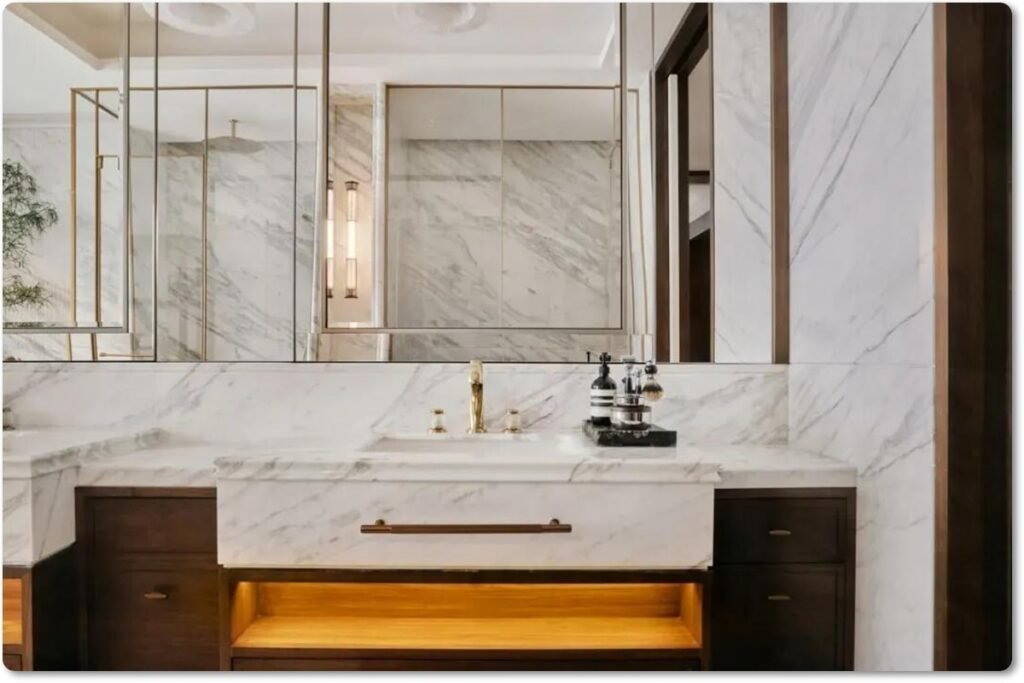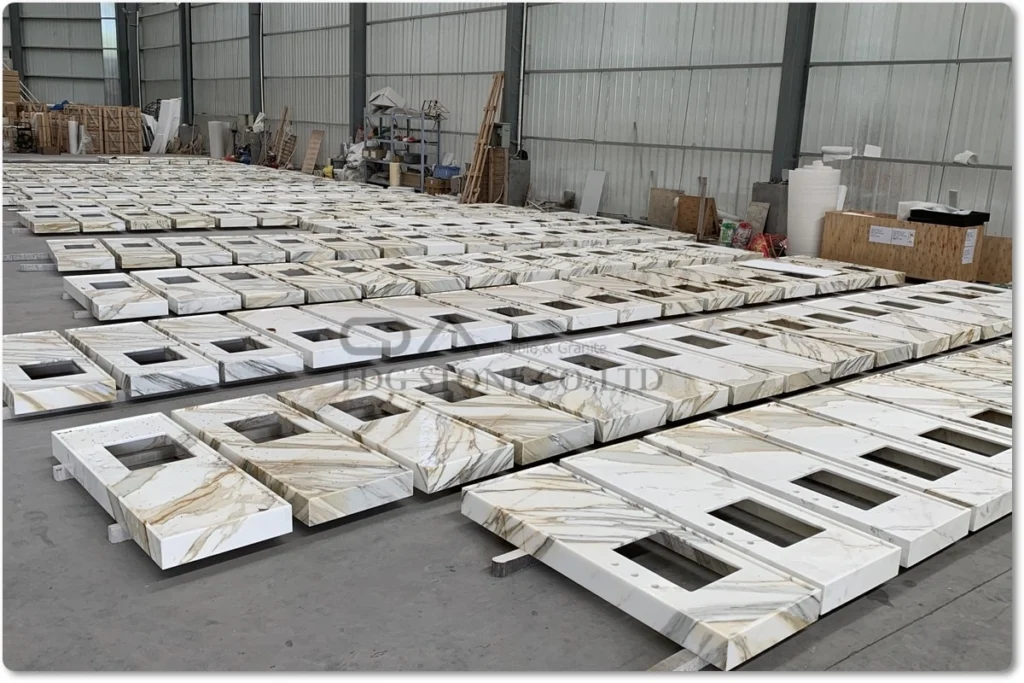
Outdoor marble countertops are often specified for luxury villas, garden kitchens, poolside entertaining areas, outdoor bars, and architectural landscape projects. Their natural veining, distinctive mineral patterns, and potential for custom fabrication make them attractive to designers seeking a premium alternative to conventional outdoor countertop materials.
However, visual suitability and technical suitability are two different decisions.
A marble that performs satisfactorily in a sheltered outdoor kitchen may be inappropriate for an exposed installation in a freezing climate. Similarly, a stone that meets a project’s strength requirements may still develop staining, surface etching, or appearance changes under actual service conditions.
For importers and project buyers, the most reliable procurement strategy is to evaluate the stone, environment, fabrication details, installation system, and maintenance plan as one integrated specification.
This guide explains how to assess outdoor marble countertops, select suitable surface finishes, identify structural and weather-related risks, request meaningful supplier documentation, and prepare an actionable request for quotation (RFQ).
1. Executive Summary: Procurement Conclusions and Intended Applications
1.1 The central procurement decision
The question is not simply whether marble can be used outdoors. The more useful question is:
Can this particular marble, fabricated to these dimensions and installed using this support system, perform acceptably under the project’s expected environmental conditions?
A reliable assessment considers five connected factors:
Material performance: Water absorption, density, flexural strength, visible discontinuities, mineral composition, and other relevant properties.
Environmental exposure: Rainfall, humidity, sunlight, salt exposure, pollution, temperature range, and freezing conditions.
Surface and fabrication: Polished, honed, or textured finishes; edge profiles; cutouts; repairs; and protective treatments.
Installation engineering: Support spacing, substrate stability, joints, drainage, movement accommodation, and loading.
Operation and maintenance: Cleaning methods, food and beverage exposure, resealing where appropriate, and acceptable appearance changes.
No universal stone specification can replace a project-specific evaluation.
1.2 Which outdoor applications deserve consideration?
| Application | Main exposure concerns | Procurement priority |
|---|---|---|
| Covered outdoor kitchen | Humidity, occasional rain, cooking spills | Moisture behavior, staining, heat-related details, and support |
| Fully exposed garden kitchen | Rain, sunlight, temperature changes | Material testing, drainage, surface durability, and maintenance |
| Outdoor kitchen island | Cantilevers, concentrated loads, cutouts | Flexural performance, slab thickness, support design, and fabrication quality |
| Poolside counter | Water, cleaning chemicals, possible chlorinated splash | Chemical compatibility, moisture management, and finish selection |
| Coastal outdoor bar | Salt-laden moisture, sunlight, rain | Environmental exposure assessment, corrosion-resistant supports, and maintenance |
| Cold-climate outdoor kitchen | Repeated freezing and thawing when wet | Freeze-thaw evaluation, drainage, and weather-resistant installation details |
| Decorative garden counter | Weathering and appearance changes | Color stability, staining, surface texture, and maintenance expectations |
These categories are starting points, not automatic approvals. The actual exposure conditions and intended service requirements must be confirmed for each project.
1.3 Who should use this guide?
This white paper is intended for businesses that purchase, specify, fabricate, install, or distribute natural stone countertops, including:
Outdoor kitchen manufacturers and cabinet companies.
Natural stone importers, wholesalers, and distributors.
Marble countertop fabricators and installation contractors.
Architects, landscape designers, and interior design firms.
Luxury villa and residential development companies.
Outdoor furniture brands and private-label product manufacturers.
Hospitality and commercial construction procurement teams.
The goal is to help these buyers move from selecting an attractive stone sample to establishing a documented, technically defensible procurement specification.
2. Scope and Definitions: Understanding Outdoor Marble Countertops
2.1 What are natural marble countertops?
Natural marble is a dimension stone formed primarily through the metamorphism of carbonate-rich rocks. Its mineral composition, grain structure, veins, accessory minerals, and geological history influence its appearance and physical behavior.
Commercially available marble can vary substantially in:
Mineral composition and grain structure.
Water absorption and pore characteristics.
Density and strength.
Vein orientation and continuity.
Natural fissures and other discontinuities.
Sensitivity to acids and certain cleaning products.
Response to moisture, temperature changes, and surface treatments.
Two commercially marketed marble varieties should not be assumed to have identical performance merely because they share a similar color or trade name.
Likewise, different blocks or production lots of the same commercial material may display meaningful natural variation.
2.2 What qualifies as an outdoor countertop?
For procurement purposes, an outdoor countertop is a horizontal or near-horizontal fabricated stone surface intended for use outside a fully enclosed, climate-controlled interior.
Its exposure can range from a sheltered covered terrace to a fully exposed installation subject to rain, direct sunlight, wind-driven moisture, and seasonal temperature extremes.
The distinction matters because a roof does not necessarily eliminate moisture exposure. Wind-driven rain, condensation, splashing, and water trapped beneath the slab can remain relevant.
2.3 Outdoor use is not one standardized exposure category
A useful specification should describe the actual environment instead of using the word “outdoor” alone.
For example:
A covered kitchen in a mild, dry climate.
An uncovered island in a region with heavy seasonal rainfall.
A coastal countertop exposed to salt-laden air.
A garden bar exposed to repeated freezing and thawing.
A poolside countertop frequently exposed to treated water and cleaning chemicals.
Each scenario creates different evaluation priorities.
2.4 Related terms buyers should distinguish
Water absorption describes water uptake measured under a defined test procedure. It does not independently establish resistance to every form of weathering.
Flexural strength describes resistance to bending under specified test conditions. It is relevant to countertop spans and support design but is not, by itself, a complete structural design calculation.
Surface finish describes the final surface texture and appearance, such as polished, honed, brushed, or another specified treatment.
Sealer refers to a protective treatment intended to modify surface or near-surface behavior. Its performance depends on the product, substrate, application, and exposure conditions.
Freeze-thaw resistance concerns the material’s ability to withstand relevant freezing and thawing exposure without unacceptable deterioration. A suitable assessment must reflect the expected service environment.
Acceptance criteria are the agreed requirements against which a specific order is inspected and accepted.
These definitions help prevent a common procurement error: treating a single material property, finish name, or marketing claim as proof of complete outdoor suitability.
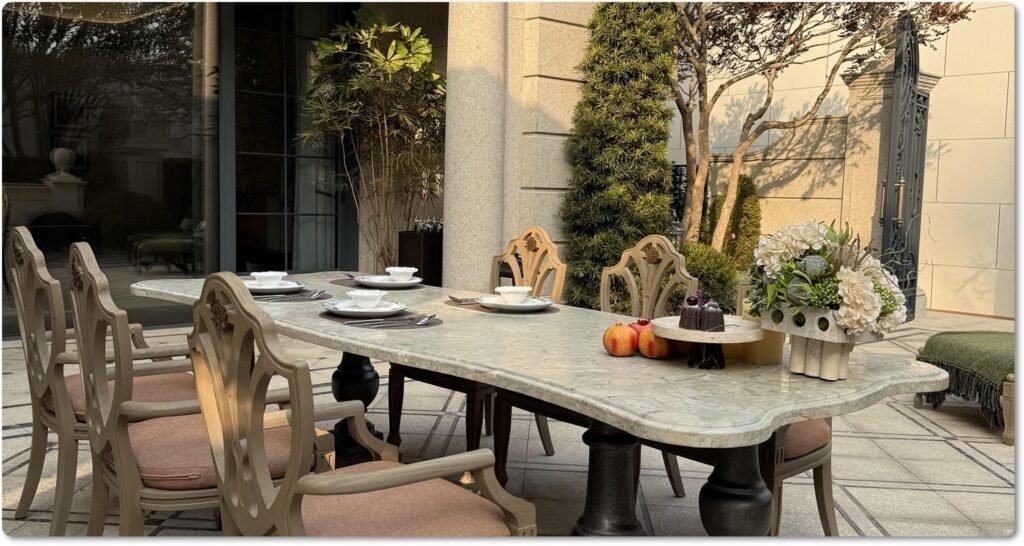
3. Technical Evaluation: Material Performance, Weather Exposure, and Installation
3.1 Can natural marble countertops be used outdoors?
Yes, selected natural marble materials can be considered for selected outdoor countertop applications, provided that the material and installation are appropriate for the intended exposure.
However, this is a conditional conclusion rather than a universal endorsement.
The suitability assessment should begin with the actual stone variety and the project’s expected environmental conditions.
Material selection factors
Buyers should request information about:
Commercial material name and, where available, geological identification.
Representative slab photographs and physical samples.
Water absorption and bulk specific gravity.
Flexural strength and other mechanical properties relevant to the design.
Visible fissures, veins, repairs, and filled areas.
Surface-finish options and their intended performance.
Available information about weathering or relevant durability testing.
Results should be reviewed in context. A laboratory measurement obtained from one specimen does not automatically describe every slab in a shipment or every material sold under the same commercial name.
Why geological variation matters?
Marble is a natural material, not a factory-produced substance with perfectly uniform internal structure.
Veins, mineral concentrations, grain boundaries, fissures, and localized repairs can affect appearance and, in some cases, performance.
For a large outdoor island, the selected slab should therefore be evaluated not only for color consistency but also for the location of discontinuities relative to sink cutouts, cooktop openings, unsupported spans, and edges.
Procurement principle: Approve the actual material and its documented characteristics before committing to a large outdoor countertop order.
3.2 Rain, moisture, and water absorption
Water exposure is one of the first issues to evaluate when specifying outdoor marble countertops.
Natural stone can absorb water through interconnected pores and other accessible pathways. The amount and rate of uptake vary by material.
Repeated wetting and drying can influence appearance, contribute to staining, and affect the performance of some treatments or installation materials.
What water absorption testing tells buyers?
ASTM C97/C97M, Standard Test Methods for Absorption and Bulk Specific Gravity of Dimension Stone, provides a recognized method for measuring water absorption and bulk specific gravity. ASTM published a C97/C97M-26 edition in 2026; the applicable edition should be confirmed when the project specification is issued.
The test can help buyers compare materials and understand one aspect of their physical properties. It does not, by itself, prove resistance to prolonged outdoor weathering, freeze-thaw exposure, staining, or every installation condition.
When reviewing test data, ask:
Which material and sample were tested?
Which test method and edition were used?
What absorption result was reported?
Was the sample representative of the proposed production material?
Are additional tests required by the project’s climate or design?
A numerical result should always be interpreted against the actual project requirements rather than an invented universal pass/fail threshold.
Moisture management extends beyond the stone
Even a material with favorable absorption characteristics can experience problems if water remains trapped around the installation.
Relevant design measures may include:
A suitable slope or drainage arrangement where required.
Correctly designed joints and interfaces.
Prevention of persistent water accumulation beneath the countertop.
Compatible adhesives, sealants, and supporting materials.
Protection of vulnerable edges and cutouts.
Appropriate detailing around walls, cabinets, sinks, and appliances.
The installer or project designer should confirm the drainage strategy for the complete assembly.
3.3 UV exposure, temperature changes, and thermal cycling
Outdoor countertops may experience direct sunlight, high surface temperatures, cool nighttime conditions, and repeated temperature fluctuations.
These conditions can affect the complete countertop assembly, including the stone, adhesives, sealants, cabinetry, metal supports, and adjacent materials.
Potential material-related effects
Depending on the stone and its mineral composition, environmental exposure may contribute to:
Gradual appearance changes.
Changes associated with moisture movement.
Deterioration of certain veins, repairs, or localized discontinuities.
Surface-treatment performance changes.
Differences in movement between stone and supporting materials.
UV exposure should not automatically be treated as proof that every marble will discolor. The actual risk depends on the specific material, any applied treatment, contamination, and surrounding components.
Similarly, thermal expansion and contraction are assembly-level considerations, not merely a question of whether the stone feels hot in the sun.
What should project buyers specify?
Document the expected environmental conditions, including:
Approximate seasonal temperature range.
Direct-sunlight exposure and orientation.
Whether the installation is roofed or fully exposed.
Expected frequency of wetting and drying.
Nearby heat sources, grills, and appliances.
Requirements for joints and movement accommodation.
Where the countertop is large, spans multiple support units, or interfaces with materials having different movement characteristics, the designer should establish appropriate detailing.
Do not invent a universal allowable temperature range for marble countertops. Establish requirements based on the selected material, test evidence, installation system, and actual site conditions.
3.4 Freeze-thaw conditions: What changes in cold climates?
Freeze-thaw exposure deserves special attention when a stone can become wet and then experience freezing temperatures.
Water within accessible pores or discontinuities can create damaging stresses during freezing, depending on the material’s pore structure, saturation, temperature history, and other conditions.
Repeated cycles may contribute to cracking, surface deterioration, scaling, or weakening of vulnerable areas. The extent of risk varies by stone and exposure.
When is additional evaluation necessary?
Consider a specific freeze-thaw assessment when the project involves:
Repeated seasonal freezing and thawing.
Frequent rain or snow followed by freezing conditions.
Persistent moisture around the countertop or its supports.
Poor drainage or water-trapping details.
Exposed edges, joints, or cutouts that can retain water.
A project specification that expressly requires freeze-thaw performance.
The appropriate test method and acceptance criteria should be determined by the project team based on the intended use and applicable specifications.
ASTM C97/C97M water absorption results can inform material comparison, but they are not a substitute for a relevant freeze-thaw evaluation where one is needed.
Installation considerations for freezing environments
A technically appropriate stone can still be compromised by poor detailing.
The installation should address water evacuation, compatible supporting materials, joints, movement, and exposure of vulnerable interfaces.
In severe climates, the design team should consider whether the selected material is appropriate for the intended exposure at all. A different stone or countertop material may be the more defensible choice.
3.5 Polished vs. honed vs. textured finishes
Surface finish affects appearance, cleaning, light reflection, and how scratches or wear become visible. It should be selected according to the intended use rather than appearance alone.
| Finish | Appearance | Potential advantages | Key considerations |
|---|---|---|---|
| Polished | Glossy, reflective surface | Strong color depth and visual contrast; often straightforward to wipe clean | Etching, scratches, water marks, and surface wear may become conspicuous |
| Honed | Matte or low-sheen surface | Subdued appearance; can suit contemporary and natural landscape designs | May show oils or darkening; appearance can change with use |
| Brushed or textured | Tactile, less reflective surface | Can create a more natural visual character | Cleaning may be more difficult; dirt can collect in surface texture |
| Other mechanically finished surfaces | Depends on the process | Allows project-specific appearance and tactile characteristics | Performance must be evaluated for the actual finish and material |
These are general observations, not guaranteed performance outcomes. The behavior of a finish depends on the stone itself and the specific finishing process.
Does a honed finish prevent etching?
No. Honing changes the surface appearance and may make some marks less visually prominent, but it does not eliminate the underlying chemical susceptibility of carbonate-rich marble.
Acidic substances can react with susceptible minerals, potentially producing dull spots or surface texture changes.
Is a textured finish always safer outdoors?
Not necessarily.
Slip resistance is primarily a concern for surfaces people walk on, while countertop selection involves different considerations. Nevertheless, textured countertops may be harder to clean and can retain food residue, dust, or other contaminants.
For an outdoor kitchen, evaluate hygiene, cleanability, expected food preparation, and appearance alongside the desired texture.
A practical finish-approval process
Before production, obtain a representative sample showing the proposed stone and finish.
Evaluate it under conditions resembling the intended application. If appearance retention or stain resistance is important, agree on suitable testing or a documented evaluation procedure.
Approve the finish in writing, including its expected visual characteristics and acceptable natural variation.

3.6 Staining, etching, and surface maintenance
Marble countertops used outdoors may encounter cooking oils, wine, citrus juice, sauces, grease, soil, leaf tannins, sunscreen, and cleaning chemicals.
These contaminants do not all behave in the same way.
Staining occurs when a substance discolors the stone or enters accessible pores or discontinuities.
Etching is a chemical alteration of a susceptible mineral surface. It may appear as dullness, loss of polish, or a change in texture.
Weathering refers more broadly to changes caused by environmental exposure over time.
A penetrating sealer may help reduce the uptake of certain staining substances, depending on the product and stone. It should not be represented as a universal barrier against acids, scratches, heat, or weather-related deterioration.
Maintenance recommendations
Develop a maintenance plan based on the selected marble and the product manufacturer’s instructions.
A typical plan may include:
Remove food spills promptly.
Clean with a compatible, non-abrasive product.
Avoid acidic cleaners unless the stone and treatment manufacturer explicitly confirms suitability.
Do not assume that a stronger chemical cleaner is better.
Inspect joints, edges, and exposed interfaces periodically.
Reapply a sealer only when appropriate for the stone and treatment system.
Record any changes in appearance and investigate persistent moisture or drainage problems.
For commercial projects, maintenance instructions should be included in the handover documentation.
The buyer should also establish whether normal patina, minor surface marks, or changes in sheen are acceptable under the intended service conditions.
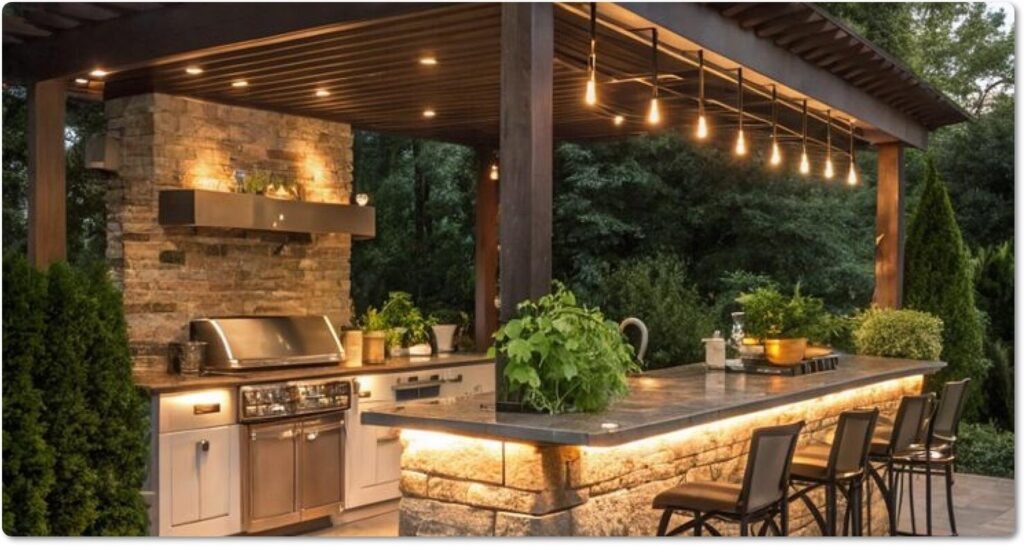
3.7 Outdoor kitchen islands and BBQ countertops
Outdoor kitchen islands combine aesthetic requirements with practical fabrication and structural considerations.
Typical features include sink openings, barbecue cutouts, appliance housings, waterfall ends, seating overhangs, integrated storage, and long unsupported spans.
Each feature can affect the design.
Cutouts and vulnerable areas
Cutouts create internal corners and reduce the continuous cross-section of the slab. Their geometry, location, and surrounding support can influence stress concentration.
Potential risk factors include:
Sharp internal corners.
Cutouts positioned close to slab edges.
Large openings with limited surrounding material.
Natural discontinuities near the opening.
Inadequate support around the cutout.
Damage introduced during handling or installation.
The fabricator and project designer should establish appropriate cutout geometry, edge treatment, reinforcement where applicable, and support requirements.
Do not assume that a standard countertop detail is suitable for every marble or slab thickness.
BBQ and appliance interfaces
The countertop must be coordinated with the appliance manufacturer’s installation requirements.
Relevant issues include:
Appliance clearances.
Heat exposure at adjacent stone and cabinetry.
Ventilation requirements.
Movement between the countertop and appliance housing.
Sealant compatibility.
Water entry around openings.
Access for maintenance and replacement.
The stone fabricator should not independently establish appliance safety clearances without the applicable appliance documentation.
Overhangs and seating areas
A long overhang may create bending stresses that are not adequately addressed by considering stone thickness alone.
The required support depends on material properties, slab geometry, load assumptions, edge conditions, and support arrangement.
Where the countertop is large, heavily loaded, or unusually configured, the responsible designer should verify the structural details.
3.8 Substrate, support, and drainage design
Countertop performance depends on the complete installed assembly, not just the stone slab.
The supporting cabinet, frame, substrate, adhesive, mechanical fixings, joints, and adjacent construction must work together.
Support and load transfer
The design should consider:
Slab dimensions and thickness.
Material flexural properties.
Support spacing.
Unsupported spans and overhangs.
Sink and appliance openings.
Concentrated loads.
Handling and installation loads.
Long-term stability of the supporting structure.
A supplier’s strength report is useful technical evidence, but it does not replace project-specific engineering.
ASTM C880/C880M-25, Standard Test Method for Flexural Strength of Dimension Stone, provides a method for determining flexural strength. The standard recognizes that test orientation and, where relevant, wet test conditions can matter.
For the actual countertop design, the responsible professional should determine which properties, orientations, conditions, and design factors are necessary.
Drainage and water control
Horizontal outdoor surfaces should be detailed so that water does not remain trapped where it can be reasonably avoided.
The required slope, if any, depends on the design, drainage route, appliance interfaces, and intended use.
Do not apply a generic slope value to every countertop without checking the project requirements. Some food preparation surfaces, built-in appliances, and architectural details impose specific dimensional or functional constraints.
Adhesives, sealants, and interfaces
Use products compatible with the stone, substrate, environmental exposure, and installation method.
Confirm whether moisture, UV exposure, temperature variation, or chemical contact affects the selected product.
Compatibility should be checked with the relevant manufacturers. This is especially important where the installation combines natural stone, metal supports, engineered panels, wood-based cabinetry, and outdoor-rated adhesives.
3.9 Material testing and project-specific evaluation
Testing should answer a defined procurement or design question.
It is not sufficient to collect a generic certificate without checking what was tested and whether the result applies to the intended application.
Relevant test methods
The following ASTM methods may be relevant to the evaluation of dimension stone. Their applicability should be established for the specific material and project.
| Standard | Test or scope | Potential procurement use |
|---|---|---|
| ASTM C97/C97M-26 | Absorption and bulk specific gravity of dimension stone | Understanding water absorption and comparing material characteristics |
| ASTM C880/C880M-25 | Flexural strength of dimension stone | Evaluating bending-related material properties |
| ASTM C99/C99M-25 | Modulus of rupture of dimension stone | Evaluating another specified measure of flexural behavior |
| ASTM C119-26 | Terminology relating to dimension stone | Supporting consistent technical terminology |
Always confirm the latest applicable edition and contractual requirements when preparing a formal specification. The editions shown here are referenced as of October 2026 where verified; they should not be treated as a substitute for checking the standards register when a purchase order is issued.
Important: These methods do not collectively constitute an automatic certification that a marble is suitable for every outdoor countertop application.
A project involving freeze-thaw exposure, repeated wetting, chemical contact, or other unusual conditions may require additional evaluation using a method selected for that exposure.
How to interpret laboratory results?
Ask the laboratory or supplier to identify:
The exact material tested.
The sample source and identification.
The test method and edition.
The conditioning and test conditions.
The measured result and units.
The number of specimens, where reported.
Any limitations on interpretation.
Whether the results represent the proposed production material.
For flexural testing, consider whether the direction of loading relative to relevant stone features matters. Wet-condition testing may also be pertinent to some applications.
Why one test result cannot represent every marble?
A report for one stone variety cannot automatically be applied to another merely because the materials have similar colors, commercial names, or visual patterns.
Likewise, a test result for one slab or sample does not establish that every slab in a later production lot is identical.
Testing should therefore be linked to material identification, production control, and the actual acceptance criteria.
4. Procurement Checklist: How to Specify Outdoor Marble Countertops?
A procurement checklist helps buyers turn broad design intentions into verifiable requirements.
Step 1: Define the environment
Record the installation location, whether the countertop is covered, the expected temperature range, rainfall and humidity conditions, freeze-thaw exposure, sunlight, and proximity to pools or coastal environments.
Identify any unusual exposure to cleaning chemicals, de-icing products, or other contaminants.
Step 2: Define the application
Specify whether the product is a BBQ countertop, outdoor kitchen island, bar top, garden counter, poolside surface, or another application.
Identify sink and appliance openings, overhangs, seams, support locations, and interfaces with adjacent materials.
Step 3: Identify the exact stone
Request the commercial material name, representative photographs, available material identification, and information about the proposed production lot.
Do not approve material solely from a small image or a generic product name.
Step 4: Establish performance requirements
Determine which material properties require documented results.
These may include water absorption, bulk specific gravity, flexural strength, or additional exposure-specific testing.
Specify acceptance criteria before testing or production wherever practical.
Step 5: Approve the finish
Confirm the finish, edge profile, expected appearance, acceptable natural variation, and treatment requirements.
Where relevant, evaluate sample behavior under representative staining or cleaning conditions.
Step 6: Confirm the installation design
Obtain or review drawings showing dimensions, support arrangement, cutouts, overhangs, joints, drainage, and appliance interfaces.
Assign responsibility for structural verification and final installation approval.
Step 7: Confirm fabrication requirements
Specify dimensional tolerances, edge details, cutout dimensions, corner radii where applicable, surface quality, repairs, and inspection requirements.
Agree on how visible natural features and any permitted repairs will be assessed.
Step 8: Review the maintenance plan
Confirm recommended cleaning products, stain management, sealer requirements if applicable, and the expected maintenance frequency.
Do not rely on vague promises such as “maintenance-free” or “weatherproof.”
Step 9: Approve the production reference
Retain approved samples, photographs, drawings, technical documents, and written acceptance criteria.
For larger projects, establish a process for resolving material variation and nonconformities before shipment.
Step 10: Complete the final inspection
Inspect the finished countertop against the approved specification.
Check dimensions, finish, edges, cutouts, visible defects, repairs, packaging, and identification.
For export projects, also confirm the packing method, protection of vulnerable edges, handling requirements, and shipment documentation.
5. Cost and Risk Factors: What Influences the Total Project Cost?
The purchase price of an outdoor marble countertop is only one component of the overall project cost.
A more useful evaluation considers the fabricated product, supporting system, installation, maintenance, and risks associated with inappropriate material selection.
5.1 Material cost
The stone’s commercial value may depend on its rarity, color, veining, block availability, slab dimensions, thickness, surface finish, and visual consistency.
Premium materials may require additional selection work to achieve the intended appearance across multiple countertop sections.
For outdoor applications, the least expensive material is not necessarily the lowest-cost solution over the intended service life.
5.2 Fabrication cost
Fabrication requirements may include:
Cutting to project dimensions.
Edge profiling and polishing.
Sink and BBQ cutouts.
Drainage or appliance-related details.
Mitered edges and waterfall ends.
Additional inspection or sample approval.
Custom crating and export packaging.
Complex cutouts and narrow sections can increase fabrication time and handling risk.
5.3 Testing and technical review
Testing costs depend on the material, test method, laboratory, specimen requirements, and project specification.
Additional evaluation may be justified where the material will face repeated freezing and thawing, prolonged wetting, or other demanding exposure conditions.
The buyer should establish who pays for testing, who selects the laboratory, and how the results will affect approval.
5.4 Installation and support costs
The supporting frame, substrate, adhesives, sealants, mechanical connections, and installation labor can materially affect the total cost.
Long spans, large overhangs, heavy slabs, unusual cutouts, or challenging site access may require additional engineering, fabrication, or handling measures.
5.5 Maintenance and replacement risk
Maintenance expenses may include cleaning products, inspections, appropriate resealing, repairs, and potential replacement.
The cost implications of staining, etching, cracking, or moisture-related deterioration depend on the severity of the problem, the repair method, and the project’s service requirements.
A realistic comparison should distinguish between routine maintenance, cosmetic changes, repairable defects, and structural failure.
5.6 Risk-adjusted procurement
For a commercial project, evaluate cost alongside the likelihood and consequences of failure.
A useful framework is:
Total evaluated project cost = Material + Fabrication + Testing + Support system + Installation + Logistics + Expected maintenance and repair costs.
This is a planning framework, not a market-price estimate or a prediction of actual lifecycle expenditure.
Do not insert assumed savings or lifespan figures without supporting evidence.
Where performance uncertainty is significant, the project team should compare the cost of additional testing with the potential consequences of selecting an unsuitable material.
6. Supplier Evaluation: What Should a Marble Countertops Supplier Provide?
Selecting an outdoor marble countertops supplier requires more than confirming that the company can supply a particular color or thickness.
The supplier should be able to explain the material’s known characteristics, provide relevant documentation where available, communicate fabrication limitations, and coordinate the information required for project evaluation.
6.1 Material identification and traceability
Ask for the commercial material name, available quarry or source information, representative photographs, slab identification where applicable, and details of the proposed production material.
Confirm how the supplier will communicate natural variation between samples and delivered slabs.
6.2 Technical documentation
Request relevant laboratory reports and confirm that they apply to the proposed material.
Where the supplier does not have a particular test report, ask whether representative testing can be arranged.
A responsible supplier should distinguish between verified test results, general material knowledge, and recommendations that still require project-specific engineering.
6.3 Fabrication capability
For custom outdoor countertops, confirm experience with:
Precision cutting and dimensional control.
Edge profiling and finishing.
Sink and appliance cutouts.
Complex countertop geometries.
Surface inspection and defect reporting.
Custom protective packaging.
Export handling and shipment coordination.
Ask for sample fabrication details or production photographs where appropriate.
6.4 Quality control and acceptance
Agree on the inspection procedure before production.
A written specification should address dimensions, finish, natural variation, repairs, visible defects, cutouts, edge condition, and packing.
For larger projects, establish whether approval is based on a sample, photographs, a first article, or an inspection of the actual finished pieces.
6.5 Communication and technical coordination
An experienced supplier should ask about the installation environment instead of immediately promising that a stone is suitable for all outdoor conditions.
The buyer should be prepared to provide:
Installation location.
Expected climate and exposure.
Dimensions and thickness.
Drawings and cutout details.
Support and overhang requirements.
Finish preferences.
Required standards and acceptance criteria.
Project quantity and delivery schedule.
6.6 Manufacturer, factory, wholesaler, or distributor?
Different supply models may be appropriate for different buyers.
| Supplier type | Potential advantage | What buyers should verify |
|---|---|---|
| Marble countertops manufacturer | Direct fabrication coordination and production communication | Actual fabrication capabilities, quality control, and traceability |
| Marble countertops factory | Potentially direct access to production and custom processing | Which processes are performed in-house and which are outsourced |
| Marble countertops wholesaler | Material selection and consolidated purchasing | Stock availability, batch consistency, and fabrication arrangements |
| Marble countertops distributor | Local logistics or established regional supply channels | Technical support, lead times, and responsibility for defects |
| Custom fabrication supplier | Project-specific sizing and processing | Engineering coordination, dimensional control, and installation interfaces |
A company’s commercial title does not prove its technical competence. Evaluate documented capabilities and project-specific support.
7. Practical RFQ Template: Outdoor Marble Countertops
The following template can be copied into an email or procurement document.
7.1 Project information
Project name:
[Enter project name]
Installation location:
[City, region, and country]
Application:
[Outdoor kitchen / BBQ island / garden bar / poolside counter / other]
Exposure conditions:
[Covered or exposed; rainfall; humidity; direct sunlight; seasonal temperature range; freeze-thaw exposure; coastal or poolside conditions]
Required delivery date:
[Enter date]
Project quantity:
[Number of pieces and total approximate area]
7.2 Material and finish requirements
Preferred marble:
[Commercial material name or reference images]
Alternative materials permitted:
[Yes / No; describe acceptable alternatives]
Required thickness:
[Enter specified thickness]
Surface finish:
[Polished / honed / brushed / textured / other]
Edge profile:
[Specify profile]
Appearance requirements:
[Color range, veining, visual matching, and acceptable natural variation]
Surface treatment:
[Specify requirements, if any, subject to material compatibility]
7.3 Fabrication details
Overall dimensions:
[Attach dimensioned drawings]
Sink cutouts:
[Quantity, dimensions, and location]
BBQ or appliance cutouts:
[Quantity, dimensions, and appliance information]
Overhangs:
[Dimensions and support details]
Joints and seams:
[Locations and finish requirements]
Drainage details:
[Describe design requirements]
Support system:
[Cabinet, frame, substrate, or other supporting arrangement]
7.4 Technical documentation
Please identify which of the following are available or can be arranged:
Water absorption and bulk specific gravity results.
Flexural strength or other relevant mechanical test results.
Additional testing required by the specified environmental exposure.
Material identification and sample traceability.
Fabrication drawings and dimensional inspection records.
Surface-treatment product information and application instructions.
Recommended cleaning and maintenance instructions.
For each report, identify the material tested, method and edition, test conditions, result, and relevant limitations.
7.5 Quality and acceptance requirements
Dimensional tolerances:
[Specify agreed values]
Surface acceptance criteria:
[Define acceptable natural features, repairs, marks, and defects]
Edge and cutout requirements:
[Specify geometry and finish]
Sample approval:
[Physical sample / photographs / first-article approval / other]
Pre-shipment inspection:
[Required / not required; define procedure]
Packaging:
[Crate design, edge protection, labeling, and handling requirements]
7.6 Commercial information
Please provide:
Unit price and total quotation.
Fabrication charges.
Sample and testing costs, if applicable.
Packaging and export preparation costs.
Production lead time.
Shipping terms and estimated dispatch schedule.
Payment terms.
Warranty terms and exclusions.
Available technical documents.
Any material or installation limitations identified during your review.
Supplier response requested: Please explain whether the proposed material is appropriate for the described exposure, what evidence supports the recommendation, what additional evaluation may be necessary, and which design decisions must be confirmed by the project team.
8. Frequently Asked Questions: Outdoor Marble Countertops
FAQ 1: Can marble countertops be used outdoors?
Yes, selected marble materials may be suitable for selected outdoor applications. Suitability depends on the actual stone, environmental exposure, finish, installation system, and maintenance plan. A material should not be approved solely because it is natural stone or has a high strength value.
FAQ 2: Are natural marble countertops waterproof?
No. Natural marble should not automatically be considered waterproof. Water absorption varies by material, and joints, cutouts, edges, and installation interfaces can provide additional pathways for moisture. Appropriate drainage and compatible installation details are important.
FAQ 3: What is the best finish for outdoor marble countertops?
There is no universally best finish. Polished marble offers a reflective appearance, honed marble creates a lower-sheen surface, and textured finishes provide a different visual and tactile character. The correct choice depends on cleaning requirements, appearance expectations, the actual stone, and project exposure.
FAQ 4: Can outdoor marble countertops withstand freezing temperatures?
That cannot be established from the material name alone. Where stone may become wet and repeatedly freeze, evaluate its suitability for the actual exposure. Relevant testing, drainage, water management, and installation details may be necessary.
FAQ 5: How do I choose a reliable outdoor marble countertops supplier?
Request material identification, representative samples, relevant test reports, fabrication details, dimensional acceptance criteria, packaging information, and maintenance guidance. A reliable supplier should explain known limitations and distinguish verified evidence from assumptions that require further evaluation.
9. References: Standards and Technical Sources
The following sources provide a starting point for technical specification and material evaluation. The applicability of each standard depends on the project, material, jurisdiction, and contractual requirements.
ASTM International. ASTM C97/C97M-26 — Standard Test Methods for Absorption and Bulk Specific Gravity of Dimension Stone. Published in 2026. Relevant to the measurement of water absorption and bulk specific gravity. Confirm the current edition when issuing the project specification.
ASTM International. ASTM C880/C880M-25 — Standard Test Method for Flexural Strength of Dimension Stone. Published in 2025. Relevant to flexural testing, including consideration of loading orientation and wet-condition testing where applicable.
ASTM International. ASTM C99/C99M-25 — Standard Test Method for Modulus of Rupture of Dimension Stone. Published in 2025. Relevant to the specified evaluation of flexural behavior in dimension stone.
ASTM International. ASTM C119-26 — Standard Terminology Relating to Dimension Stone. Published in 2026. Relevant to consistent terminology for dimension-stone specifications.
ASTM International. ASTM C1527/C1527M-23 — Standard Specification for Travertine Dimension Stone. This specification concerns travertine, not all marble. It may be relevant to a separate travertine material selection, but its requirements should not be transferred automatically to marble.
Standards-use note
The cited standards serve different purposes. A test method explains how a property is measured; it does not necessarily establish a universal acceptance threshold or certify a finished countertop for outdoor use.
The project specification should identify the applicable methods, required results, acceptance criteria, and responsible parties. Additional exposure-specific evaluation may be necessary for freeze-thaw conditions, prolonged moisture, chemical exposure, or unusual structural configurations.
No test result for one marble variety should be generalized to every natural marble countertop.
10. EDG Stone CTA: Request a Project-Specific Outdoor Marble Assessment
Outdoor Marble Countertops: Start With Your Project Requirements
Planning an outdoor kitchen, luxury villa, BBQ island, garden bar, or custom architectural countertop?
EDG Stone welcomes project inquiries for custom natural stone countertops and fabricated stone products. The first step is to understand your intended application and identify the information needed to evaluate a suitable material.
Instead of assuming that every marble is appropriate for outdoor use, we encourage buyers to share the actual installation requirements so that material selection and fabrication can be discussed in context.
What to Send for an Initial Assessment
Please provide:
Installation location: City, region, and country.
Climate and exposure: Covered or exposed installation, expected rainfall, temperature range, sunlight, and freeze-thaw conditions where relevant.
Application: Outdoor kitchen, BBQ countertop, island, garden bar, poolside counter, or another use.
Dimensions: Length, depth, thickness, overhangs, and required number of pieces.
Drawings: Dimensioned plans, elevations, cutout details, and available support information.
Material preferences: Marble name, reference photographs, preferred color, and surface finish.
Project quantity: Estimated number of units or total area.
Technical requirements: Applicable standards, testing, inspection, and acceptance criteria.
Delivery information: Destination and target schedule.
How the Discussion Can Proceed
Review the proposed application and environmental exposure.
Identify candidate materials for further evaluation.
Review available material information and determine whether additional testing is needed.
Discuss custom fabrication, dimensions, cutouts, edges, and packaging.
Clarify the information required for quotation and project approval.
Material suitability remains dependent on the actual stone, supporting evidence, and project design. Final structural and installation decisions should be confirmed by the responsible design and installation professionals.
Request a Project-Specific Outdoor Marble Assessment.
Share your installation location, climate conditions, dimensions, and design drawings to begin a technical discussion about custom outdoor marble countertops with EDG Stone.
Semantic Closure: How to Specify Outdoor Marble Countertops With Confidence?
What Determines Whether Outdoor Marble Is a Suitable Choice?
The performance of outdoor marble countertops depends on the relationship between the material, the environment, the fabrication details, and the installed assembly. Natural stone’s geological origin does not, by itself, determine weather resistance. Buyers should assess material characteristics, relevant test evidence, exposure conditions, and installation requirements together.
Why Should Buyers Evaluate the Complete Countertop System?
A countertop can be affected by more than the stone itself. Water accumulation, incompatible installation products, inadequate support, concentrated loads, cutouts, and movement between adjacent materials can introduce risks that material testing alone cannot resolve. A complete specification should therefore address both stone properties and assembly design.
What Are the Main Options for Surface Selection?
Polished, honed, and textured finishes offer different visual and maintenance characteristics. None is automatically the best choice for every outdoor application. The appropriate finish should be selected using representative samples, cleaning requirements, appearance expectations, and the performance of the actual material.
Which Considerations Become More Important in Demanding Climates?
In environments with repeated freezing and thawing, prolonged wetting, strong temperature fluctuations, or coastal exposure, buyers should pay closer attention to moisture behavior, durability evidence, drainage, joints, and compatible supporting materials. Additional testing or an alternative material may be necessary when the available evidence does not adequately address the intended conditions.
What Should a Marble Countertops Supplier Contribute?
A qualified supplier should help identify the proposed material, provide available technical information, explain fabrication capabilities, document agreed acceptance criteria, and communicate known limitations. The buyer should provide the installation location, environmental conditions, dimensions, and design drawings so that the discussion addresses the actual project rather than a generic product description.
What Is the Most Defensible Procurement Strategy?
The strongest approach is to define the exposure, identify the material, establish acceptance criteria, review relevant test data, approve representative samples, coordinate installation details, and document maintenance expectations before production. This process supports more informed purchasing decisions without promising that every marble will perform identically in every outdoor environment.
For outdoor kitchen manufacturers, landscape designers, contractors, and commercial procurement teams, the objective is not simply to purchase an attractive slab. It is to specify a stone countertop whose known characteristics, fabrication, installation, and maintenance requirements are appropriate for its intended use.
EDG Stone invites project buyers to submit installation details, climate information, dimensions, and drawings for a project-specific discussion about custom outdoor marble countertops.