1. Executive Summary: Choosing the Right Stone Furniture Manufacturing Model
Stone furniture offers furniture brands an opportunity to differentiate their collections through natural materials, distinctive patterns, sculptural forms, and custom dimensions. However, developing a commercially successful stone furniture product requires more than choosing a marble color and asking a factory to manufacture it.
The buyer must establish who owns the design, who is responsible for engineering, how natural stone variation will be approved, how prototypes will be evaluated, and which party bears the cost of design changes.
The distinction between OEM and ODM provides a useful starting point.
OEM is generally the better fit when a brand already owns or controls a product design and needs a manufacturing partner to turn it into a repeatable physical product.
ODM is generally the better fit when a brand wants to select, adapt, or develop a product using a manufacturer’s existing designs and engineering capabilities.
Hybrid OEM/ODM is often the most practical approach when a buyer supplies the design direction while the manufacturer develops the production drawings, optimizes construction, and fabricates the finished stone components.
For example, a furniture brand might provide the concept for a travertine coffee table, including its dimensions, visual references, and target retail positioning. A stone furniture manufacturer may then recommend a practical stone thickness, refine the base structure, develop CNC machining details, prepare production drawings, and manufacture a prototype.
The result is a collaborative development project rather than a simple transaction.
Who should use this guide?
This white paper is designed for:
Furniture brands launching private-label stone furniture collections.
Interior design brands seeking exclusive tables, consoles, vanities, or decorative pieces.
Importers and wholesalers sourcing custom stone furniture from overseas manufacturers.
Retailers expanding from standard furniture into natural stone products.
Hospitality buyers developing furniture for hotels, restaurants, serviced apartments, and luxury residences.
Product developers who need to translate sketches or 3D concepts into manufacturable products.
Procurement conclusion: Before requesting a production quotation, determine whether you are buying an existing product, adapting an existing design, commissioning a new design, or outsourcing the manufacture of a design you already own. This decision determines the necessary documentation, development costs, intellectual-property terms, and production responsibilities.
2. Scope and Definitions: What OEM and ODM Mean in Stone Furniture?
2.1 What is stone furniture OEM?
Stone furniture OEM refers to a manufacturing arrangement in which a manufacturer produces furniture according to specifications provided or approved by the buyer.
The buyer may provide:
Fully dimensioned engineering drawings.
CAD files or 3D models.
A physical reference sample.
Stone species, color requirements, and finish specifications.
Hardware, base, and assembly requirements.
Packaging, branding, and labeling instructions.
The manufacturer’s responsibilities may include material procurement, cutting, CNC machining, edge processing, polishing, fabrication, inspection, packing, and shipment.
The exact division of responsibility must be defined in the contract. OEM does not automatically mean that the buyer owns every design right, nor does it automatically transfer all manufacturing know-how to the buyer.
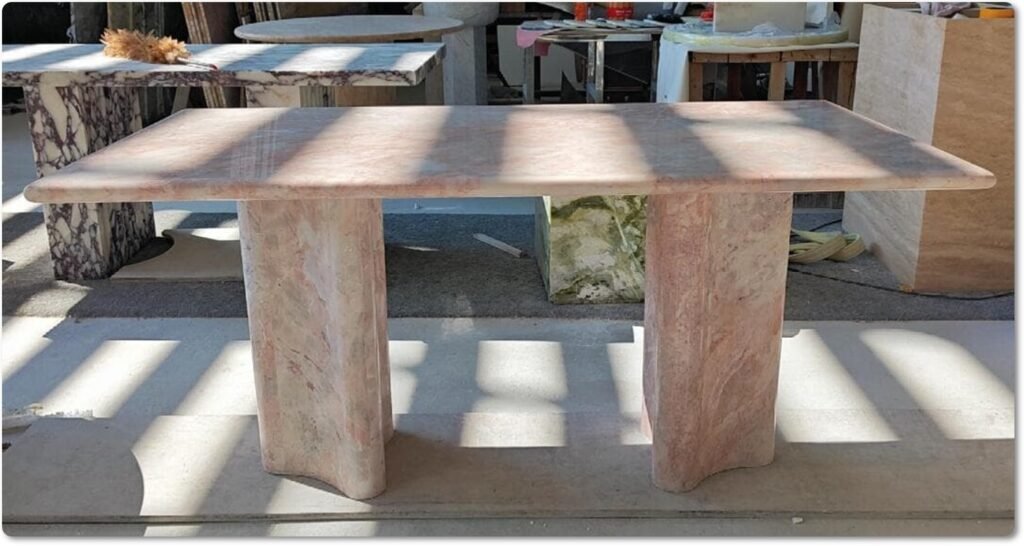
Example: A furniture brand has developed a proprietary rectangular marble dining table with a specific leg geometry. It supplies the approved drawings and specifications to a stone furniture factory, which manufactures the table under the brand’s label.
2.2 What is stone furniture ODM?
Stone furniture ODM refers to a manufacturing arrangement in which the manufacturer contributes an existing design, product platform, or product-development capability.
The buyer may select an existing product and request changes to dimensions, stone material, finish, packaging, or branding. Alternatively, the manufacturer may develop a new design in collaboration with the buyer.
An ODM arrangement may include:
Selection from an existing product collection.
Modification of an existing table or console design.
Development of new dimensions or material combinations.
Engineering and prototype production.
Private-label branding and packaging.
Commercialization under agreed licensing or exclusivity terms.
Example: An importer selects an existing travertine side table from a manufacturer’s design collection, changes the height and finish, adds its own brand label, and orders the product in wholesale quantities.
The buyer should confirm whether the original design is exclusive, non-exclusive, licensed, or available to other customers.
2.3 OEM vs. ODM: A practical comparison
| Evaluation factor | OEM | ODM |
|---|---|---|
| Starting point | Buyer-supplied design or specification | Manufacturer’s existing design or development capability |
| Design responsibility | Primarily buyer-defined, with manufacturing engineering agreed separately | Shared or manufacturer-led, depending on the agreement |
| Product modification | Based on approved buyer requirements | Usually built around an existing design or platform |
| Development work | Can be limited if the design is production-ready | May include adaptation, engineering and prototype development |
| Initial cost | Depends on drawing completeness, tooling and complexity | Depends on design fees, adaptation and sampling |
| Intellectual property | Ownership and manufacturing rights must be agreed | Existing design rights and new-development rights must be distinguished |
| Private label | Possible | Possible |
| Exclusivity | Contract-dependent | Contract-dependent; particularly important for existing designs |
| Best suited to | Established proprietary products | Brands testing collections or seeking design-development support |
These are commercial conventions, not universal legal definitions. The signed agreement and applicable law determine the actual rights and responsibilities.
2.4 Existing style modification vs. fully customized manufacturing
A common sourcing mistake is to treat every customized product as a completely new design.
In practice, stone furniture projects fall along a spectrum.
Level 1 — Standard product with private labeling
The buyer selects an existing model and changes the logo, packaging, carton label, or product identification.
Level 2 — Cosmetic or material customization
The buyer changes the marble color, travertine selection, finish, edge profile,e or metal color while retaining the main geometry.
Level 3 — Dimensional modification
The buyer changes the height, width, length, tabletop thickness, ss or base proportions. This may require new drawings and a reassessment of stability, weight, material yield, and packaging.
Level 4 — Engineering modification
The buyer changes the leg structure, joint configuration, support points, hardware, assembly method or component interfaces.
Level 5 — Fully custom product development
The buyer commissions a new product based on sketches, mood boards, 3D concepts or a functional brief. The project may require design development, engineering review, prototypes and multiple approval stages.
The higher the level of modification, the more important it becomes to establish design ownership, development fees, revision limits and acceptance criteria before work begins.
2.5 Product scope and material boundaries
Stone furniture can include:
Marble coffee tables, dining tables and side tables.
Travertine consoles, benches and decorative furniture.
Granite tables and heavy-duty furniture components.
Quartzite tabletops and custom furniture surfaces.
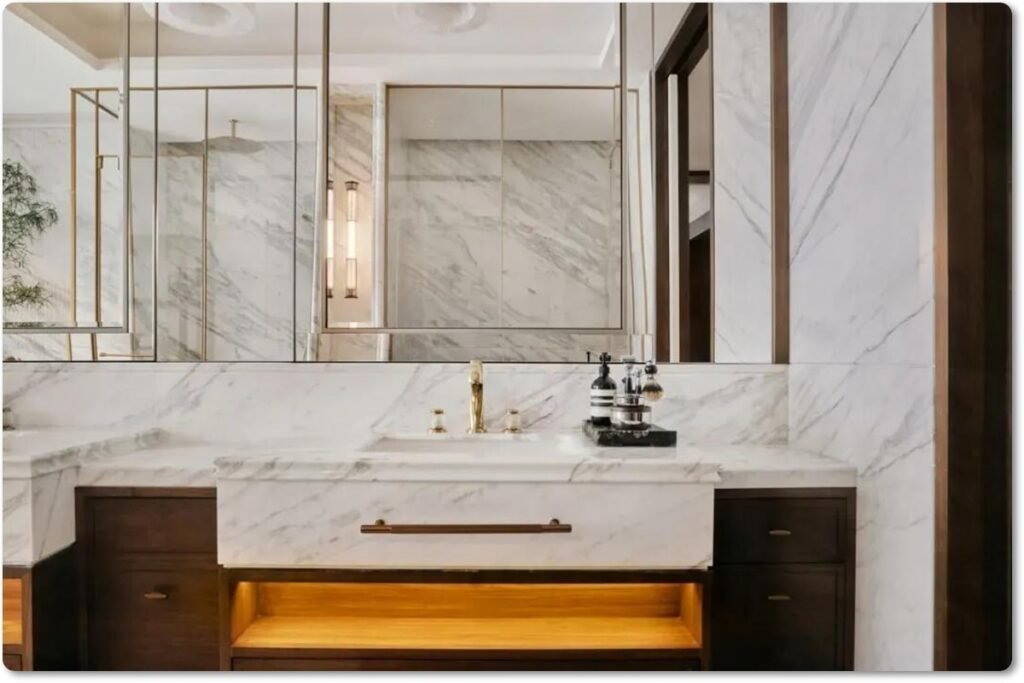
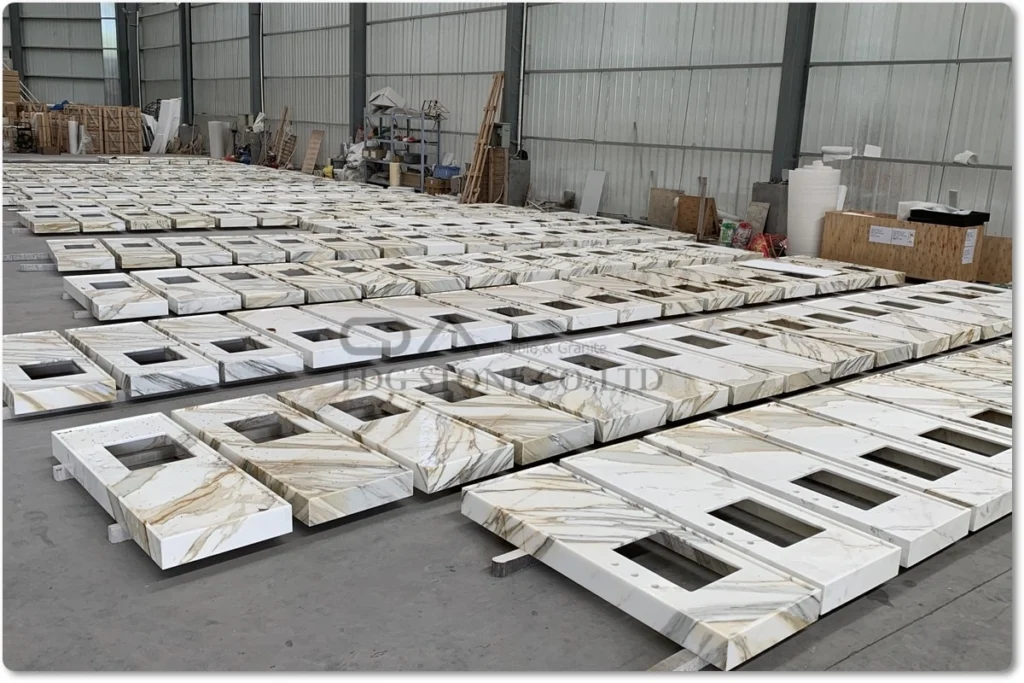
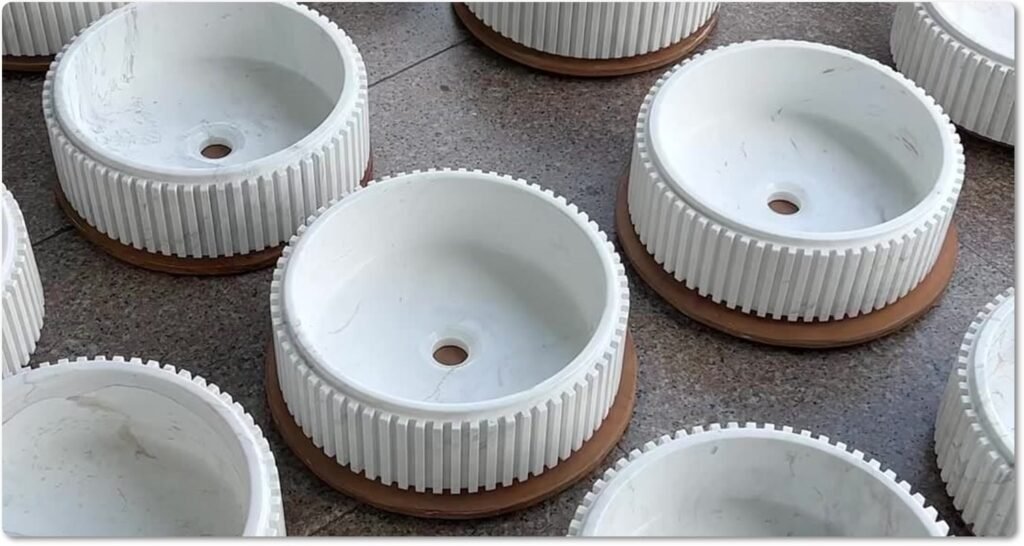
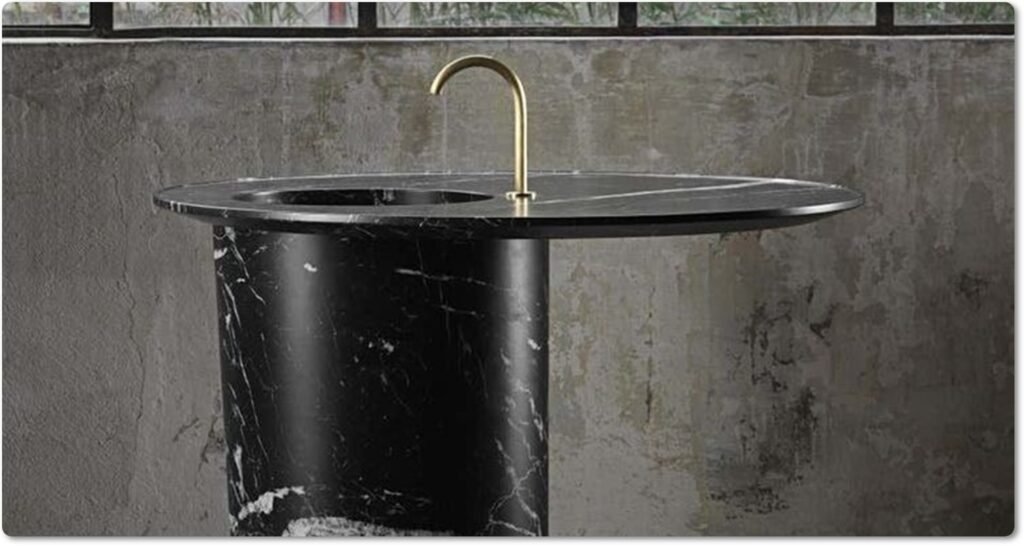
Stone vanity tops, bathroom furniture and integrated basins.
Stone-and-metal or stone-and-wood furniture.
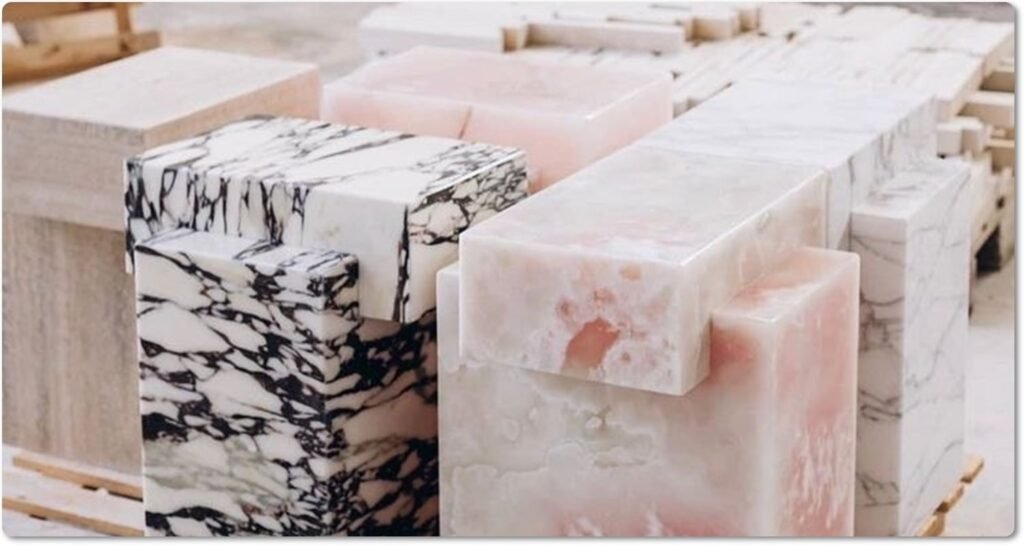
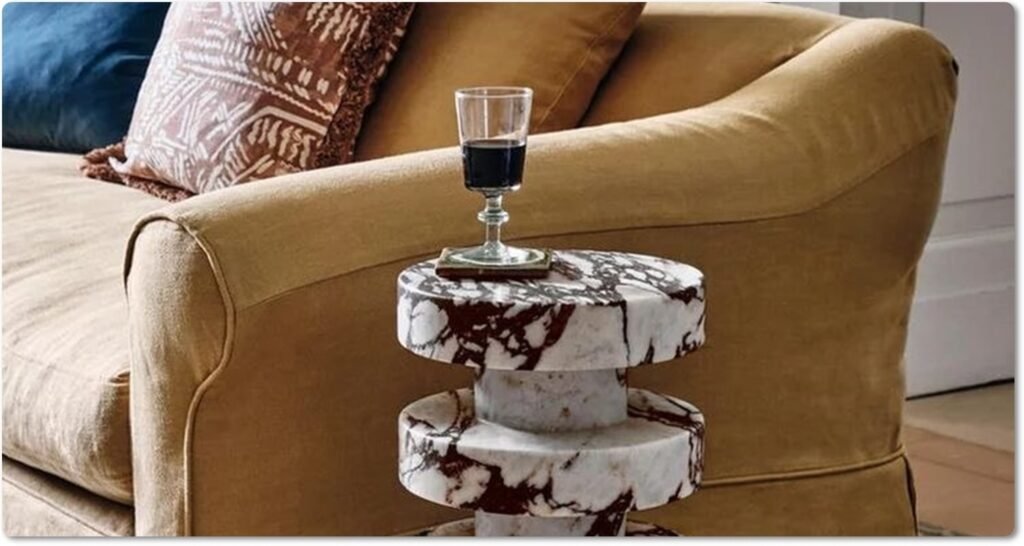
Sculptural stone stools, pedestals, plinths and display units.
Natural stone, engineered quartz and porcelain or sintered surfaces should not be treated as interchangeable materials. They differ in composition, fabrication requirements, joining methods and relevant performance considerations.
For products combining stone with metal, wood, glass or engineered components, the procurement specification should address the entire assembly rather than evaluating the stone component alone.
3. Technical Evaluation: From Design Files to a Production-Ready Product
3.1 Drawing and file submission requirements
A rendering can communicate the appearance of a product, but it is rarely sufficient for accurate manufacturing.
A production-ready submission should include dimensioned drawings and clear material and construction specifications.
Recommended file package
| File or document | Recommended format | Purpose |
|---|---|---|
| General arrangement drawing | PDF, DWG or DXF | Defines overall dimensions and configuration |
| Component drawings | PDF, DWG or DXF | Defines individual parts and machining details |
| 3D model | STEP or another mutually agreed CAD format | Communicates geometry and interfaces |
| Visual reference | JPG, PNG or PDF | Communicates appearance and design intent |
| Material specification | PDF, spreadsheet or approved sample schedule | Defines stone and non-stone materials |
| Finish specification | PDF or annotated drawing | Defines surface and edge finishes |
| Assembly instructions | Explains joining, hardware and installation | |
| Packaging specification | PDF or drawing | Defines protection, supports and carton or crate configuration |
| Branding artwork | Vector artwork or high-resolution approved file | Defines logos, labels and printed materials |
| Revision register | Spreadsheet or document | Records approved file versions and changes |
The preferred format depends on the manufacturer’s software and production process. Buyers should confirm compatibility before submitting files.
Minimum drawing information
At a minimum, specify:
Overall length, width, and height.
Thickness of each stone component.
Edge profile and radius or chamfer requirements.
Cutouts, grooves, holes, and recesses.
Joint locations and visible seam requirements.
Support points and connection details.
Hardware specifications and assembly access.
Surface finish and edge finish.
Dimensional tolerances and inspection methods.
Critical visual features and acceptable variation.
A drawing should also identify which dimensions are critical to assembly or function and which are primarily aesthetic.
3.2 Natural stone selection and pattern approval
Natural stone is a variable material. Even within a commercially recognized color or stone name, individual slabs can differ in veining, mineral distribution, background tone, and pattern direction.
Consequently, a product name alone does not define a complete material specification.
The buyer should approve:
Stone type and commercially identified material.
Background color range.
Veining direction and visual intensity.
Permitted natural features and filled areas.
Visible fissures, veins or inclusions where relevant.
Surface finish and edge appearance.
Bookmatching or pattern alignment, if applicable.
Acceptable variation between components and production batches.
Material approval hierarchy
A practical approval sequence is:
Stage 1: Reference images. Use images to establish the preferred visual direction, not as a guarantee of exact material reproduction.
Stage 2: Representative sample. Approve a physical sample or clearly documented reference showing the material and finish.
Stage 3: Production slab approval. Where visual consistency is commercially important, approve the actual slab or a representative set of production slabs before cutting.
Stage 4: Component layout approval. Review how veining and color variation will appear across the assembled furniture.
Stage 5: Finished prototype approval. Confirm the final appearance after machining, edge processing, and finishing.
For a veined marble dining table, the approval process should explicitly state whether vein direction, slab selection, and the relative positions of components are critical requirements.
The buyer should also define how substitutions are handled if the originally approved slab becomes unavailable or proves unsuitable during fabrication.
3.3 Surface finishes, edges and workmanship
Surface finish changes both appearance and practical maintenance requirements.
Typical options include:
Polished.
Honed or matte.
Brushed or textured, where suitable for the selected material.
Leathered or other specialized finishes, subject to material compatibility.
A buyer should avoid relying on terms such as “matte” or “premium finish” without defining the expected appearance.
Instead, document the agreed reference sample, finish consistency, visible scratch acceptance, edge treatment, and any required surface protection.
For edges, specify whether the product uses a straight edge, eased edge, bevel, bullnose, mitered profile, or another custom detail. For mitred stone edges, the drawings should identify the joint geometry, visible seam expectations, and any reinforcement requirements.
A stone finish should be evaluated in the context of the intended application. A polished surface suitable for a decorative console may not be the preferred choice for every outdoor or high-use environment.
3.4 Structure, stability and assembly
Stone is heavy, and the structural behavior of a furniture assembly depends on more than the strength of the stone itself.
Key considerations include:
Overall mass and center of gravity.
Support spacing and load distribution.
Stone thickness and geometry.
Overhangs and unsupported spans.
Joint design and adhesive compatibility.
Metal or wood frame stiffness.
Fixings, inserts and mechanical connections.
Transport vibration and handling loads.
Assembly tolerances and installation access.
A large stone tabletop supported by a narrow base may require engineering review even if the stone itself is suitable for the application.
For tall consoles, pedestal tables and cantilevered designs, buyers should request an appropriate stability and structural assessment. The test method and acceptance criteria should reflect the intended use, target market, and product configuration.
Do not assume that a tabletop’s nominal thickness alone establishes its structural suitability.
3.5 Prototype approval and first-article inspection
A prototype is a decision point, not merely a display sample.
A useful process separates three types of approval:
Visual approval: Color, pattern, proportions, finish, edges, joints and branding.
Technical approval: Dimensions, assembly, stability, hardware, component interfaces and functional performance.
Commercial approval: Final specification, cost, packaging, production schedule and applicable quality requirements.
Once the prototype is approved, the manufacturer should identify the corresponding drawing revision, material reference, finish reference and approved deviations.
If a prototype is approved with a temporary modification, that exception should be recorded. Otherwise, production staff may reasonably interpret the approved sample as the required standard.
3.6 Quality control and repeatability
Repeat-order consistency is particularly important for furniture brands building collections over multiple seasons.
A quality plan should define:
Incoming material inspection.
Dimensional inspection during fabrication.
Edge and surface inspection.
Assembly and stability checks.
Branding and label verification.
Packaging inspection.
Final inspection and defect classification.
Records retained for future orders.
ISO 9001 is a quality management system standard, not a product-specific guarantee that a particular table will meet every requirement. As of October 2026, ISO lists ISO 9001:2026 as its published sixth edition, dated September 2026; buyers should verify certificate validity and transition arrangements rather than assuming that a supplier’s older certificate proves compliance with the new edition. Official ISO 9001 information
4. Procurement Checklist: Starting an OEM/ODM Project
Use the following checklist before requesting a final quotation or authorizing prototype production.
4.1 OEM/ODM project initiation checklist
Define the product category and intended application.
Identify the target market and applicable safety requirements.
Confirm whether the project is OEM, ODM, or a hybrid.
Establish the ownership or licensing status of the initial design.
Submit dimensioned drawings and available 3D files.
Identify critical dimensions and required tolerances.
Specify the stone material and acceptable visual variation.
Define the surface finish and edge profile.
Confirm the supporting structure, hardware, and assembly method.
Define prototype quantity and approval stages.
Confirm sample fees, tooling fees, and development charges.
Set the number of included design revisions.
Approve the product code and drawing revision system.
Define logo placement, packaging, labeling and carton marks.
Confirm inspection procedures and defect acceptance criteria.
Agree on lead-time milestones and change-control procedures.
Establish repeat-order material and quality controls.
Confirm shipping configuration, packing method and delivery terms.
4.2 A recommended approval workflow
Concept Brief → Feasibility Review → Preliminary Quotation → Engineering Drawings → Material and Finish Approval → Prototype → Technical and Visual Inspection → Final Specification Freeze → Production → Final QC → Packaging and Shipment
The sequence can be adjusted to fit the product. However, production should not begin on the assumption that an unfinished drawing, unapproved stone slab, or unresolved design change is acceptable.
4.3 Design revision control
Every approved product should have a unique product code and a controlled revision identifier.
For example:
Product code:
EDG-SF-001Drawing revision:
REV-AApproved material reference:
MAT-01Finish reference:
FIN-02Packaging specification:
PKG-01
These identifiers are illustrative and should be replaced by the buyer’s actual system.
If a buyer changes the table height after the prototype is approved, the manufacturer should assess whether the change affects the base proportions, material cutting plan, stability, packaging or price.
The updated drawing should be issued under a new revision, with the previous version marked as superseded.
4.4 Production change-control requirements
Before accepting a design change, document:
What changed and why.
Which drawings and components are affected.
Whether existing materials can still be used.
Whether new tooling or a new prototype is required.
The revised unit cost and any additional charges.
The effect on production and delivery dates.
The required reinspection or reapproval.
The effective order or batch to which the change applies.
This procedure protects both the buyer and the manufacturer from disputes over undocumented changes.
5. Cost and Risk Factors: What Determines OEM/ODM Pricing?
A reliable quotation should explain the commercial consequences of the selected design, material,l and order structure. Comparing only the unit price can hide substantial differences in development scope and repeat-order risk.
5.1 Main cost components
| Cost component | Typical cost drivers |
|---|---|
| Design and engineering | Drawing development, CAD modeling, engineering review and revisions |
| Prototype production | Material, machining, assembly, finishing and sample handling |
| Stone material | Stone type, slab selection, thickness, yield and visual requirements |
| Fabrication | Cutting, CNC machining, waterjet processing, edge work and polishing |
| Supporting components | Metal frames, wood elements, hardware, adhesives and fittings |
| Tooling and fixtures | Dedicated jigs, fixtures, molds or special production aids where required |
| Branding | Logo engraving, labels, printed materials and customized packaging |
| Quality assurance | Inspection, testing, documentation and any third-party verification |
| Packaging | Protective materials, custom crates, cartons and internal supports |
| Logistics | Domestic transport, export handling, freight, insurance and destination charges |
Not every project requires every cost item. The quotation should identify which costs are included in the unit price and which are separately charged.
5.2 Sample fees and tooling costs
A prototype may cost more per unit than a production item because setup, engineering, ng and material preparation are spread across a small quantity.
Before placing a sample order, ask the manufacturer to separate:
Non-recurring design or engineering fees.
Prototype material and fabrication costs.
Dedicated tooling or fixture costs.
Packaging and sample delivery.
Any credit or refund arrangement against a later production order.
Do not assume that sample charges will automatically be refunded or that tooling ownership transfers to the buyer when the tooling has been paid for.
For each dedicated tool, fixture or production aid, establish who owns it, who maintains it, where it is stored and whether the manufacturer can use it for other customers.
5.3 How do design changes affect cost and lead time?
A late-stage design change can have a disproportionate effect on a stone furniture project.
Material utilization: Increasing a tabletop’s dimensions may require a different slab layout, increase waste, or make the originally selected slab unsuitable.
Machining: A revised edge profile or new cutout may require different CNC programming, tooling,g or finishing steps.
Structural engineering: Changing a base or support position may require reassessment of load distribution, stability, and connections.
Production scheduling: Revisions can interrupt work already planned or require new material procurement.
Quality risk: If obsolete drawings remain in circulation, different components may be manufactured to different versions of the design.
Packaging: Increasing product size or weight can change crate dimensions, handling requirements, ts and shipment planning.
A responsible manufacturer should explain these effects before proceeding rather than treating every change as a minor adjustment.
5.4 Material yield and natural stone variation
Material yield is affected by slab dimensions, defects, vein direction, part geometry, cutting kerf, edge finishing, ing and the buyer’s visual selection criteria.
A design that requires continuous veining across multiple pieces may consume more material than a design that accepts natural variation.
For instance, a bookmatched tabletop may require a specific slab layout and matching sequence. This should be quoted separately from a standard tabletop that allows broader variation.
Ask the supplier to clarify whether the quotation assumes:
Standard material selection.
Buyer-approved slab selection.
Pattern matching.
Bookmatching.
Reserved material for repeat orders.
Replacement material for defects or breakage.
Exact material yield should be established from the actual slab dimensions and approved cutting plan, not from a generic percentage presented as universally applicable.
5.5 Repeat-order consistency and supply risk
Natural stone cannot be guaranteed to look identical across all future batches. Even where the same commercial stone name is used, the material may exhibit visual differences.
To reduce risk, brands can:
Approve and record representative slabs.
Maintain physical or photographic reference standards.
Record supplier and material identification details.
Agree on acceptable color and pattern variation.
Reserve material where commercially feasible.
Request fresh approval when a substitute batch is necessary.
Inspect the first finished items of each new production batch.
The buyer should distinguish between repeatable manufacturing quality and perfectly identical natural stone appearance. The first can be controlled through processes and specifications; the second may be impossible to guarantee for naturally variable materials.
5.6 Intellectual property and exclusivity risks
A private-label agreement does not, by itself, establish ownership of the underlying product design.
The contract should address:
Pre-existing designs owned by either party.
New drawings, 3D models and engineering files.
Ownership or licensing of commissioned design work.
Permitted manufacturing and commercial use.
Territorial, channel or customer exclusivity.
Restrictions on resale or reproduction.
Confidentiality and disclosure of technical files.
Ownership and use of tooling, fixtures and prototypes.
Rights to use photographs and project images.
In the United States, copyright ownership and transfers are governed by applicable law, and commissioned work does not automatically qualify as a “work made for hire” in every situation. See the U.S. Copyright Office’s explanation of copyright ownership. Buyers should obtain jurisdiction-specific legal advice for important exclusivity or intellectual-property arrangements.
5.7 Regulatory and market-access considerations
OEM/ODM buyers should identify product-specific obligations before approving the final design.
For products placed on the EU market, Regulation (EU) 2023/988, the General Product Safety Regulation (GPSR), has applied since 13 December 2024. It establishes general product safety obligations, including requirements relevant to risk assessment, traceability and online product offers. Its application depends on the product and applicable sector-specific legislation. Official consolidated GPSR text
The EU’s Ecodesign for Sustainable Products Regulation, Regulation (EU) 2024/1781, establishes a framework for product-specific ecodesign measures and Digital Product Passports. A buyer should not assume that every stone furniture product already requires a Digital Product Passport; applicability depends on the relevant product rules and implementation measures. Official regulation
For the United States and other markets, identify the applicable furniture safety, chemical, labeling, packaging, and import requirements for the specific product and sales channel. Requirements can differ for residential furniture, commercial furniture, children’s products, and products incorporating electrical components.
6. Supplier Evaluation: How to Select a Stone Furniture OEM/ODM Manufacturer?
A supplier should be evaluated on its ability to execute the complete project, not simply on whether it can provide attractive product photographs.
6.1 Manufacturing capability
Request evidence relevant to the product, including:
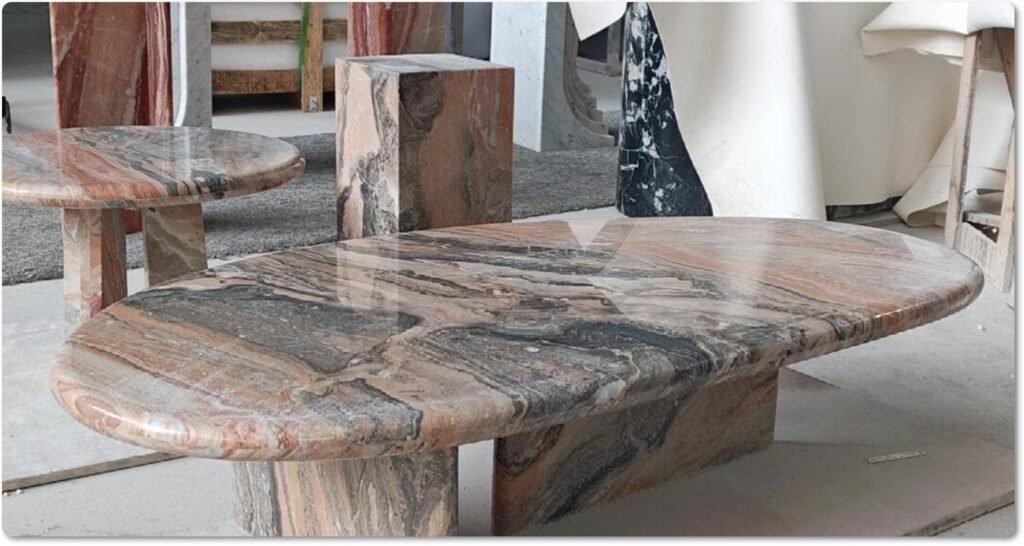
Examples of comparable stone furniture projects.
Photographs of machining, finishing and assembly.
Available cutting and CNC capabilities.
Evidence of edge processing and finishing quality.
Methods for fabricating stone-to-metal or stone-to-wood assemblies.
Procedures for material selection and approval.
Inspection records or sample quality reports.
Packaging specifications and shipment photographs.
A supplier’s actual capability should be verified for the processes required by your project. Do not assume that every supplier performs all manufacturing steps in-house.
6.2 Engineering and development support
Ask whether the supplier can:
Review the manufacturability of buyer-supplied drawings.
Identify potential issues with thin edges, overhangs, or unsupported spans.
Develop production drawings from concept references.
Propose feasible joint and assembly details.
Provide material and finish samples.
Produce a prototype for evaluation.
Maintain controlled drawing revisions.
Investigate defects and implement corrective actions.
For a fully custom product, these capabilities can be more commercially important than a low initial quotation.
6.3 Communication and project management
The supplier should be able to identify the person responsible for each development stage.
A practical project structure assigns ownership for:
| Workstream | Responsible party to identify |
|---|---|
| Product brief | Buyer and product developer |
| Design and IP approval | Buyer or designated rights holder |
| Engineering review | Manufacturer’s technical team or agreed specialist |
| Material approval | Buyer and manufacturer |
| Prototype inspection | Buyer, manufacturer or appointed inspector |
| Production scheduling | Manufacturer’s production coordinator |
| Quality approval | Agreed quality representative |
| Packaging and shipping | Manufacturer and logistics parties, as contracted |
The purpose is to prevent decisions from being lost between sales, design, production,n and quality teams.
6.4 Supplier evidence checklist
Before placing a significant order, request:
Business and manufacturing information.
Comparable product references.
A written quotation with clearly stated assumptions.
A prototype and approval plan.
A documented quality-control process.
A packaging proposal.
An estimated production schedule with milestones.
Written IP, confidentiality and exclusivity terms where relevant.
Confirmation of applicable certifications or test reports, if required.
A repeat-order procedure for material, drawings and finished-product consistency.
Certification claims should be checked against the issuing body and the scope of the certificate. A management-system certificate should not be presented as proof that every product complies with every destination-market regulation.
7. Practical RFQ Template: Stone Furniture OEM/ODM Project
The following template can be copied into an email or sourcing form to help manufacturers prepare comparable quotations.
7.1 Copy-and-send RFQ
Subject: RFQ — Custom Stone Furniture OEM/ODM Manufacturing Project
Dear Sales and Product Development Team,
We are seeking a manufacturing partner for a custom stone furniture project. Please review the following requirements and advise on feasibility, development costs, production pricing, and estimated lead time.
A. Buyer and brand information
Company name:
Brand name:
Website:
Contact person:
Destination country:
Intended sales channels:
Target launch date:
B. Product information
Product name and category:
Product code:
OEM, ODM, or hybrid:
Intended application:
Estimated initial order quantity:
Estimated annual demand, if known:
Target unit price or budget range:
C. Design and technical files
General arrangement drawing attached: Yes / No
Dimensioned CAD files attached: Yes / No
3D model attached: Yes / No
Reference photographs attached: Yes / No
Physical reference sample available: Yes / No
Critical dimensions:
Required tolerances:
Assembly and hardware requirements:
Special structural or stability requirements:
D. Stone and finish requirements
Stone type:
Commercial material name:
Preferred color and pattern:
Required thickness:
Surface finish:
Edge profile:
Vein direction or bookmatching requirements:
Acceptable natural variation:
Material substitution policy:
Sample or slab approval requirements:
E. Branding and packaging
Private-label brand:
Logo placement:
Logo application method:
Product identification code:
Carton or crate labeling:
Packaging artwork:
Required assembly instructions:
Destination-market warnings or documentation:
Packaging and drop/handling test requirements, if applicable:
F. Development and commercial requirements
Prototype quantity:
Required prototype deadline:
Number of design revisions included:
Engineering or development fee:
Tooling or fixture fee:
Unit price by order quantity:
Minimum order quantity, if applicable:
Production lead time after final approval:
Sample charge and shipping cost:
Payment terms:
Shipping terms:
Quotation validity:
G. Quality and approval
Material inspection method:
Dimensional inspection requirements:
Visual acceptance criteria:
Structural or stability assessment:
Final inspection requirements:
Defect classification:
Required reports or certificates:
Warranty and corrective-action procedure:
Repeat-order control method:
H. Intellectual property
Ownership of existing design:
Ownership of new drawings and 3D files:
Permitted use of the design:
Exclusivity requested:
Territory and sales-channel scope:
Tooling ownership:
Confidentiality requirements:
Please identify any missing information, manufacturing constraints, risks,isks or alternative specifications that could improve manufacturability without compromising the intended appearance.
Please also separate one-time development costs from recurring unit costs and identify all assumptions affecting the quotation.
Best regards,
[Name]
[Company]
[Contact Information]
7.2 Drawing submission checklist
Before sending the RFQ, confirm that your technical package includes the following:
| Requirement | Complete? |
|---|---|
| Overall product dimensions | Yes / No |
| Individual component dimensions | Yes / No |
| Stone thickness and edge profile | Yes / No |
| Cutouts, grooves and holes | Yes / No |
| Base, support and connection details | Yes / No |
| Surface and edge finish references | Yes / No |
| Material and pattern approval requirements | Yes / No |
| Critical tolerances | Yes / No |
| Assembly and installation instructions | Yes / No |
| Branding and packaging requirements | Yes / No |
| File revision and approval status | Yes / No |
If some fields are unknown, state that they require manufacturer input. A preliminary RFQ can be useful without complete engineering drawings, provided that the quotation is identified as preliminary and the outstanding assumptions are documented.
7.3 Recommended quotation comparison method
When comparing two or more suppliers, evaluate the total project rather than the unit price alone.
A useful comparison includes:
Development scope and revision allowance.
Sample cost and approval timeline.
Stone quality and material-selection method.
Engineering and assembly feasibility.
Unit price at comparable quantities.
Packaging specification.
Quality documentation.
IP and exclusivity terms.
Production capacity and lead-time assumptions.
Repeat-order controls and communication quality.
A lower unit price may not represent a lower total cost if the quotation excludes design development, uses a less specific material approval process, or leaves packaging and inspection requirements unresolved.
8. Frequently Asked Questions
8.1 What is the difference between stone furniture OEM and ODM?
OEM generally involves manufacturing according to buyer-defined designs and specifications. ODM generally involves using or adapting a manufacturer’s existing design or product-development capability. In both models, the parties should explicitly define design responsibility, IP ownership, engineering scope, and production requirements.
8.2 Can a stone furniture manufacturer customize an existing product?
Yes. Depending on the design and the manufacturer’s capabilities, customization may include dimensions, stone type, surface finish, edge profile, supporting structure, hardware, logo, labels,s and packaging. Structural changes should be reviewed separately because they may affect stability, material usage, production cost, st and lead time.
8.3 What files should I provide to a stone furniture OEM factory?
Ideally, provide dimensioned PDF drawings, editable CAD files, a compatible 3D model where available, material and finish specifications, reference images, assembly details and packaging requirements. A visual rendering alone may be sufficient for an initial feasibility discussion but is usually insufficient for a final production quotation.
8.4 How much does custom stone furniture OEM/ODM development cost?
There is no universal price. Cost depends on product complexity, material, prototype requirements, machining, engineering work, tooling, packaging, ing and order quantity. Request a breakdown separating one-time development charges from recurring manufacturing costs, and confirm whether sample or tooling fees are refundable or creditable against a production order.
8.5 Can I sell ODM stone furniture under my own brand exclusively?
Potentially, but exclusivity must be negotiated and documented. Specify the protected design, geographic territory, sales channels, duration, permitted modifications, existing design rights,ghts and the consequences of a breach. A private-label arrangement alone does not automatically give the buyer exclusive ownership of the product design.
9. References and Technical Resources
The following primary sources and standards are useful starting points for product development, quality management and market-access planning.
ISO 9001:2026 — Quality management systems — Requirements. International Organization for Standardization, sixth edition, published September 2026. Consult the official ISO listing for the current edition, transition information and scope. ISO 9001
Regulation (EU) 2023/988 — General Product Safety Regulation. European Parliament and Council, 10 May 2023; applicable from 13 December 2024. Relevant to general product safety and traceability obligations for products within its scope. EUR-Lex consolidated text
Regulation (EU) 2024/1781 — Ecodesign for Sustainable Products Regulation. European Parliament and Council, 13 June 2024. Establishes a framework for product-specific ecodesign requirements and Digital Product Passports. Specific requirements depend on applicable delegated acts and product scope. EUR-Lex official text
U.S. Copyright Office — Copyright Ownership and Transfer, Title 17, Chapter 2. A primary legal resource for understanding initial ownership and copyright transfers under U.S. law. Official legal text
ASTM C97/C97M — Standard Test Methods for Absorption and Bulk Specific Gravity of Dimension Stone. Consult the current ASTM catalog for the applicable edition and test scope when evaluating relevant dimension-stone properties.
ASTM C503/C503M — Standard Specification for Marble Dimension Stone. Consult the current ASTM catalog to determine the relevant material specification, edition, and applicability to the selected stone.
Applicable destination-market product standards and legislation. Identify the requirements relevant to the finished furniture assembly, its intended use, market and distribution channel. The applicability of any specific test or standard should be confirmed rather than assumed.
Important technical note: Standards may be revised, withdrawn or replaced. Confirm the edition in force when the contract is signed and specify the required edition in the purchase order where relevant. Material test standards do not automatically establish the structural safety of a completed furniture assembly.
10. EDG Stone CTA: Develop Your Private-Label Stone Furniture Collection
Turn your stone furniture concept into a manufacturable product
For furniture brands, interior design studios, importers and distributors, the right manufacturing partnership begins with a clear product brief and a transparent development process.
EDG Stone invites B2B buyers to discuss stone furniture concepts, material selection, custom dimensions, fabrication requirements, and export packaging for potential OEM/ODM projects.
Whether you have a finished CAD drawing or only an initial product concept, your inquiry should identify the intended product, target material, dimensions, estimated quantity, and desired delivery schedule.
Recommended next steps:
Prepare your product brief and available technical files.
Identify whether you need OEM production, adaptation,n or full product development.
Request a feasibility review and preliminary quotation.
Confirm prototype, material approval, and intellectual-property arrangements before production.
Explore EDG Stone: https://www.edgstone.com/
Suggested website CTA button: Request a Custom Stone Furniture OEM/ODM Quote
Suggested inquiry form title: Develop Your Private-Label Stone Furniture
Suggested inquiry form fields: Name, company, business email, destination market, product category, OEM/ODM requirement, stone material, estimated quantity, target price, required delivery date, and drawing/file upload.
Project feasibility, production capabilities, minimum quantities, development costs, lead times, and available materials should be confirmed individually for each inquiry. Product development and manufacturing terms are subject to written agreement.