Published by the Technical Engineering Team, EDG Stone Factory
Compliance Standards: ISO 9001:2015 | NSF/ANSI 51 | ASTM C97 / C170 / C880 | GREENGUARD Gold
Executive Summary
Engineered quartz surfaces represent over 54% of global commercial countertop installations in 2026. This comprehensive whitepaper provides engineers, procurement executives, and interior designers with rigorous material specifications, manufacturing workflows, sector-specific application models, and global sourcing strategies.
By integrating high-purity natural quartz crystals (90%–93% by weight) with advanced polymer resin binders under high-vacuum vibro-compression, engineered white quartz achieves exceptional durability (Mohs 7.0), near-zero porosity (<0.03% water absorption), and superior stain resistance without chemical sealants.
1. Material Logic & Chemical Structure
Engineered quartz countertops are high-density composite surfaces manufactured through vacuum vibro-compression curing (Bretonstone process technology). Understanding its molecular formulation clarifies why white quartz outperforms traditional dimensional stones like marble and granite in commercial settings.
1.1 Material Composition Breakdown
Natural Quartz Aggregate (90%–93% by mass / ~65% by volume): High-purity micro-crystalline silicon dioxide ($\text{SiO}_2$) grains mined, optical-sorted, washed, and size-graded.
Polymer Resin Matrix (7%–10% by mass / ~35% by volume): High-performance unsaturated polyester resins (UPR) or bio-based eco-resins serving as the structural binder.
Inorganic Pigments & Additives (<1% by mass): High-opacity titanium dioxide ($\text{TiO}_2$) for brilliant white base color, accompanied by UV stabilizers and aesthetic media (crushed mirror, mother-of-pearl, or fine natural minerals).
+-----------------------------------------------------------------------+
|                    RAW MATERIAL COMPOSITION (BY MASS)                 |
|                                                                       |
|  [=======================================================---] 93%     |
|  Pure Crystalline Silicon Dioxide (SiO2) Quartz Aggregate            |
|                                                                       |
|  [======] 6.5% Polymeric Resin Matrix Binder                          |
|  [=] 0.5% TiO2 Pigments & Additives                                   |
+-----------------------------------------------------------------------+
2. Engineering Performance Benchmarks & ASTM Standards
Commercial specifications require precise material performance verification. Below is an engineering comparison matrix evaluated under ASTM and EN test protocols.
| Performance Metric | Testing Standard | White Engineered Quartz | Carrara White Marble | White Granite (G655) | Architectural Impact |
| Mohs Hardness | EN 101 / Mohs | 6.5 – 7.0 | 3.0 – 3.5 | 6.0 – 6.5 | Highly scratch resistant against metal cutlery. |
| Water Absorption (%) | ASTM C97 | 0.01% – 0.03% | 0.15% – 0.35% | 0.20% – 0.40% | Impervious to moisture; prevents bacterial growth. |
| Flexural Strength | ASTM C880 | 45.0 – 58.0 MPa | 9.0 – 14.0 MPa | 12.0 – 18.0 MPa | Resists cracking under heavy cantilevers & loads. |
| Compressive Strength | ASTM C170 | 210 – 240 MPa | 80 – 110 MPa | 130 – 160 MPa | High load capacity for high-traffic installations. |
| Stain Resistance | ANSI Z124.3 | Class 5 (Impervious) | Class 2 (Porous) | Class 3 (Moderate) | Resists coffee, wine, oil, and citrus acids. |
| Chemical Resistance | EN 14617-10 | High (Acid/Base Safe) | Low (Eroded by Acid) | Moderate | Safe for clinical disinfectants and detergents. |
| Sealing Maintenance | N/A | Never Required | Annual Sealing | Bi-Annual S |
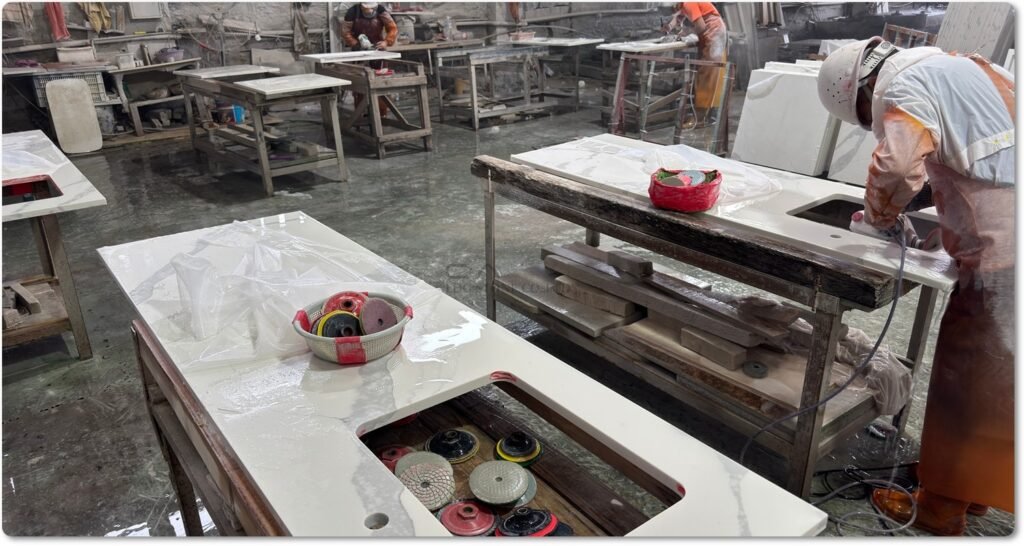
3. Aesthetic Categories & Surface Treatments
White quartz countertops match modern architectural trends across residential and commercial developments through specific aesthetic categories and surface finishes:
3.1 Aesthetic Design Categories
Pure White Quartz: Monolithic white visual field with zero aggregate grain texture. Preferred for modern minimal kitchens, medical cleanrooms, and laboratory counters.
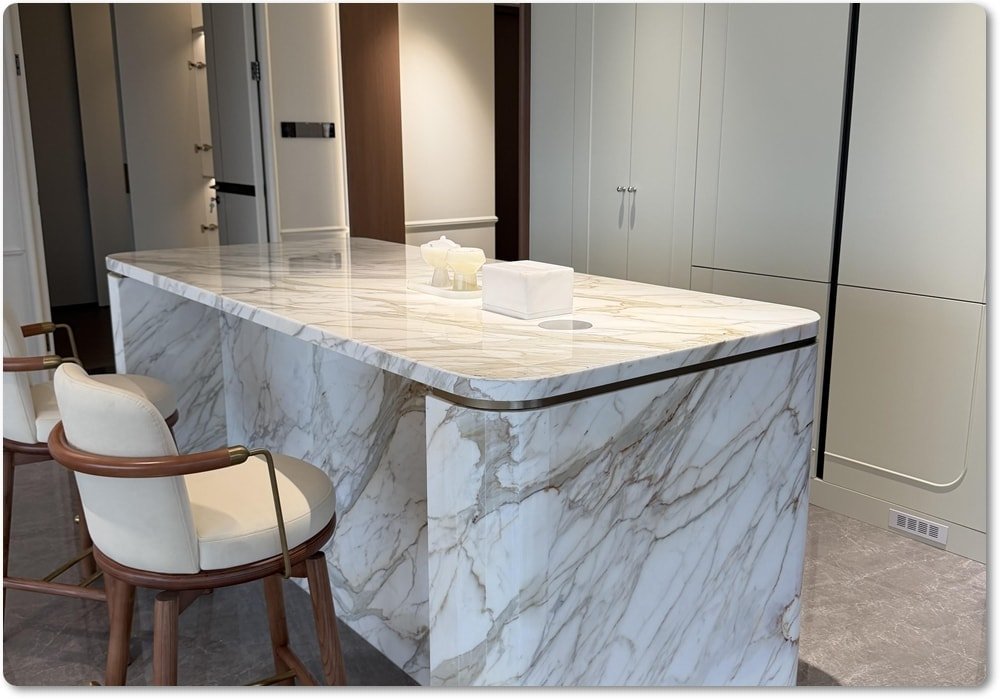
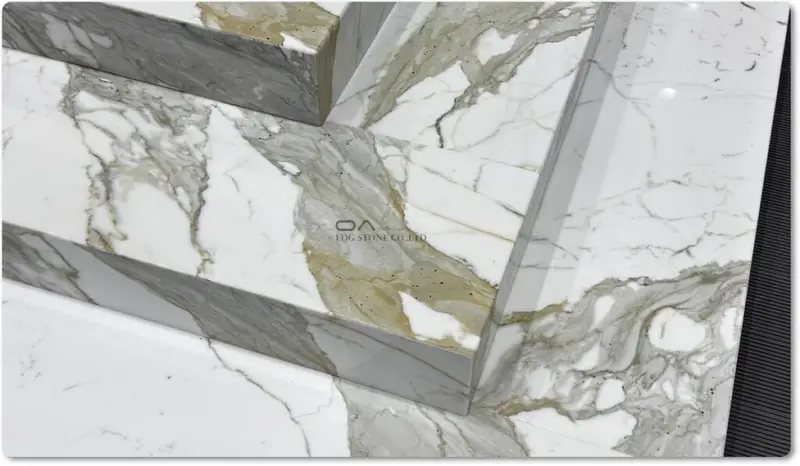
Calacatta White Quartz: Replicates high-end Italian Calacatta marble, featuring dramatic grey and gold veins across a bright white background. Ideal for waterfall islands and luxury reception desks.
Carrara White Quartz: Features soft, subtle, feather-like grey veining inspired by classic Tuscan Carrara stone. Offers timeless luxury for multi-family vanities.
Sparkle / Micro-Grain White Quartz: Combines fine quartz grains with micro-mirrors or glass flakes, creating a subtly reflective visual field under direct lighting.
3.2 Surface Texture Options
Polished Finish (90+ Gloss Units): High-gloss finish that maximizes light reflectivity and simplifies surface cleaning.
Honed / Matte Finish (15–25 Gloss Units): Smooth matte texture providing a soft, tactile aesthetic while maintaining non-porous characteristics.
Leathered Finish: Subtle textured surface delivering a tactile feel reminiscent of natural aged stone.
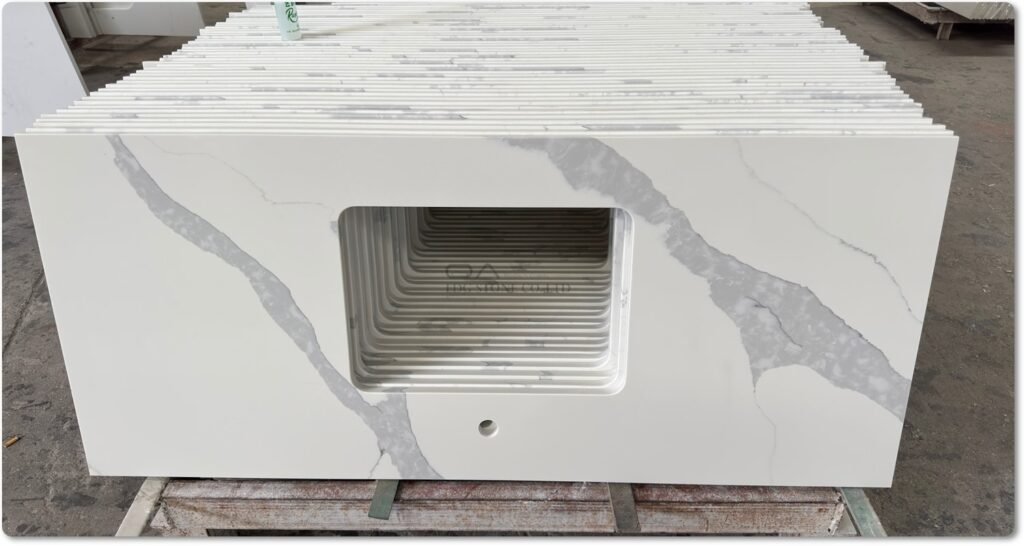
4. Scenario-Based Application Architecture
+-----------------------------------------------------------------------------------+
|                        WHITE QUARTZ APPLICATION FRAMEWORK                         |
+--------------------------+--------------------------+-----------------------------+
|    RESIDENTIAL SECTOR    |    HOSPITALITY SECTOR    |     HEALTHCARE / CLINICAL   |
+--------------------------+--------------------------+-----------------------------+
| • Kitchen Islands (30mm) | • Hotel Vanities (20mm)  | • Lab Benches (Monolithic)  |
| • Backsplashes (12mm)    | • Bar Counters (Mitered) | • Nurse Stations (Seamless) |
| • Bathroom Vanities      | • Reception Desks        | • Cleanroom Worksurfaces    |
+--------------------------+--------------------------+-----------------------------+
4.1 Residential Kitchens & Multi-Family Housing
Residential kitchen island units and perimeter counters experience frequent impact, thermal changes, and exposure to food acids. White quartz worktops deliver excellent long-term ROI for multi-family property developers. Standard specifications recommend 20mm or 30mm thick slabs with pencil edge or 2mm bevel finishes to mitigate edge impact.
4.2 Commercial Hospitality: Hotels & Luxury Resorts
Hotel guestroom vanities, lobby reception desks, and lounge bars require surfaces that sustain heavy guest turnover without degradation. White quartz resists spills from red wine, espresso, and cosmetics. Custom mitered 50mm waterfall island profiles create a striking focal point with minimal maintenance required.
4.3 Restaurants & Commercial Foodservice
Commercial kitchen health codes require non-porous, easily sanitized prep surfaces. NSF/ANSI Standard 51 certification verifies that white quartz worktops do not harbour foodborne pathogens such as E. coli or Salmonella, permitting rapid cleaning routines between culinary prep cycles.
4.4 Healthcare & Laboratory Cleanrooms
In clinical facilities, nurse stations, and laboratories, quartz counters withstand regular wiping with medical disinfectants, including isopropyl alcohol and bleach solutions. Seamless joint installations prevent bacterial accumulation in surface crevices.
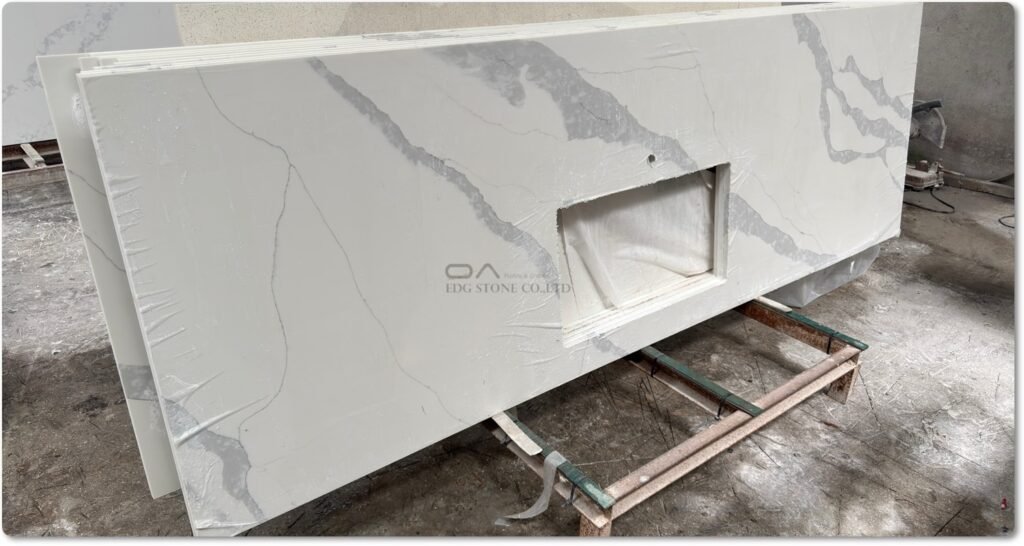
5. Global OEM Sourcing & Case Study: EDG Stone Factory
Large-scale international developments demand direct manufacturing partnerships to ensure color consistency, quality control, and schedule reliability.
+-----------------------------------------------------------------------------------+
|                   EDG STONE FACTORY AUTOMATED MANUFACTURING LINE                  |
|                                                                                   |
|  [1. Raw Dosing]  -->  [2. Vacuum Vibro-Compaction]  -->  [3. Thermal Curing 90°C] |
|                                                                     |             |
|  [6. QC Inspection] <-- [5. CNC Waterjet & Edging]  <-- [4. Slab Calibration]    |
+-----------------------------------------------------------------------------------+
EDG Stone Factory Manufacturing Capabilities
Monthly Production Volume: 4 automated continuous Breton-style production lines delivering over 120,000 square meters of quartz slabs per month.
OEM/ODM Custom Fabrication: Precision color matching, custom resin formulations, bespoke veining design, and edge profiling.
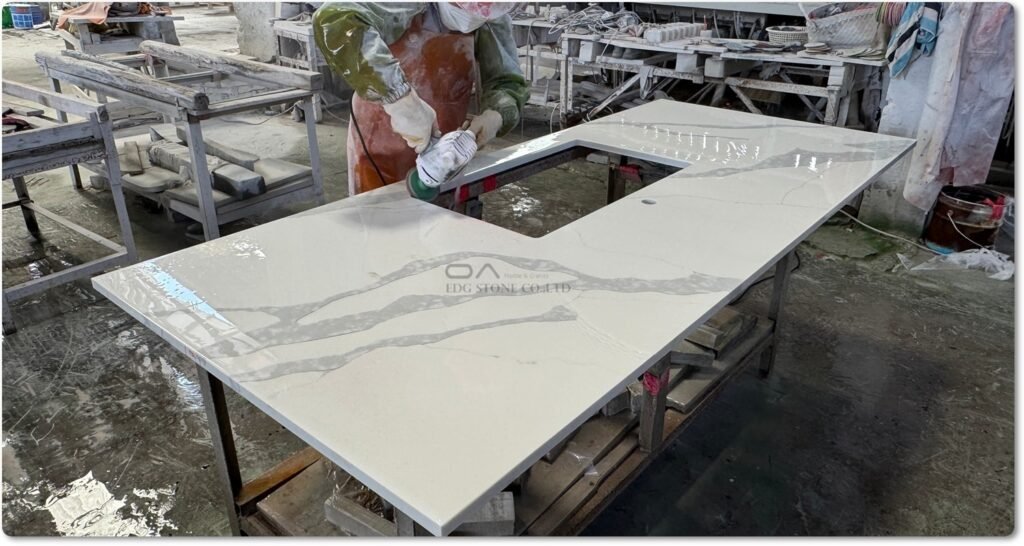
Automated CNC Processing: Five-axis waterjet cutting for sink undermounts, faucet holes, and mitered edge bonding engineered within $\pm0.5\text{mm}$ tolerances.
Quality Control: Ultrasonic structural integrity scanning, spectrophotometer color matching across slab lots, and deflection testing.
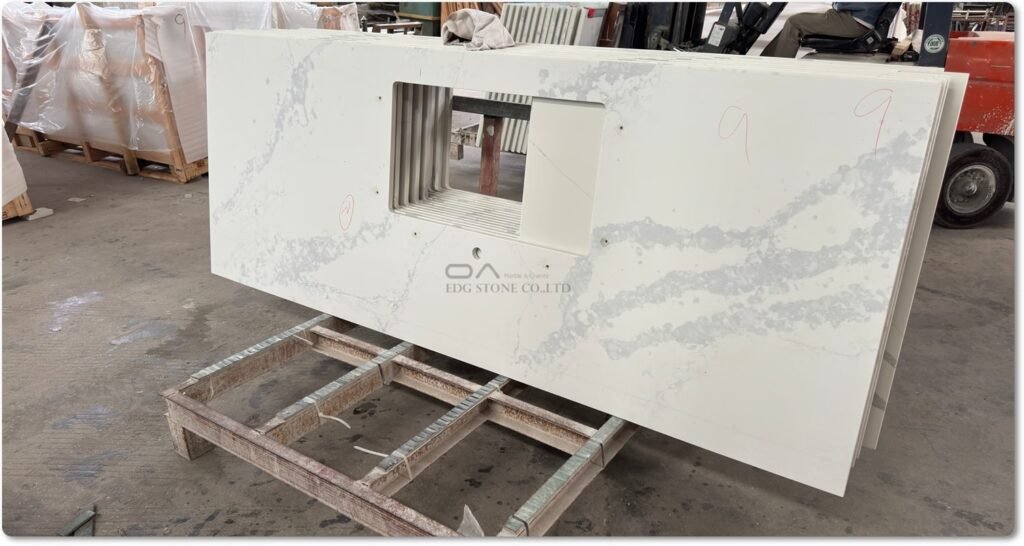
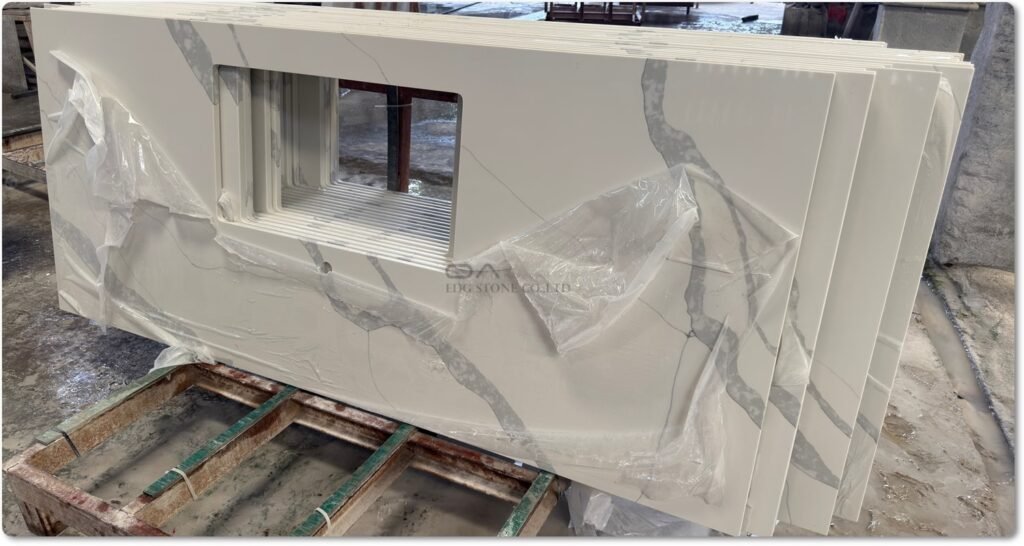
Export Logistics & Packaging: Heavy-duty, fumigated steel-reinforced A-frame wooden crates engineered for oceanic container freight with guaranteed zero breakages.
6. Knowledge Content Module (Structured Q&A Architecture)
Q1: How do white quartz countertops resist permanent staining from wine and acidic foods?
Answer: White quartz countertops resist staining because their polymer resin binder fills all micro-pores, forming a non-porous solid slab. Liquids remain on the surface without penetrating the material.
Evidence: ASTM C97 testing confirms engineered quartz has a water absorption rate under 0.03%, compared to 0.2%–0.6% for white granite and up to 2.0% for marble.
Summary: Ultra-low water absorption prevents colored liquids from soaking into the stone, eliminating permanent staining.
Q2: Can white quartz worktops withstand direct thermal exposure from hot cookware?
Answer: White quartz worktops safely tolerate surface temperatures up to 150°C (300°F). Placing items above 150°C directly on the surface may cause localized resin scorch marks or thermal shock cracks. Thermal trivets should always be used.
Evidence: Thermal stress testing under EN 14617-8 shows resin discoloration when subject to localized temperatures over 160°C for longer than 30 seconds.
Summary: Using protective trivets under hot cookware prevents thermal damage to the resin binder.
Q3: What makes engineered white quartz superior to natural white marble for hotel vanities?
Answer: White quartz provides superior flexural strength (45–58 MPa vs. 9–14 MPa), zero acid etching, consistent color across hundreds of rooms, and lower lifecycle costs because periodic chemical sealing is unnecessary.
Evidence: Facility management studies show a 65% reduction in 5-year maintenance expenditures for hotel guestrooms fitted with engineered quartz compared to natural marble.
Summary: White quartz delivers the aesthetic appeal of luxury marble while reducing maintenance costs and providing higher mechanical strength.
Q4: What international certifications should buyers mandate for commercial quartz procurement?
Answer: Procurement managers should specify ISO 9001 (Quality Management), NSF/ANSI Standard 51 (Food Surface Safety), GREENGUARD Gold (Low VOC Indoor Air Quality), and CE Mark compliance.
Evidence: Commercial kitchen inspections verify that NSF 51 certified materials satisfy health regulations for food contact zones without extra sealing requirements.
Summary: Requiring NSF 51, GREENGUARD Gold, and ISO certifications ensures regulatory compliance, environmental safety, and material durability.
7. Interlinked Content Cluster & Knowledge Graph Matrix
To optimize semantic search authority and support buyer decision-making, this guide connects to 15 related resources in our knowledge graph:
8. Academic & Technical Citation References
ASTM International: ASTM C97/C97M-18 Standard Test Methods for Absorption and Bulk Specific Gravity of Dimension Stone, ASTM International, West Conshohocken, PA.
ASTM International: ASTM C880/C880M-18 Standard Test Method for Flexural Strength of Dimension Stone.
European Committee for Standardization: EN 14617-2: Agglomerated stone – Test methods – Part 2: Determination of flexural strength.
NSF International: NSF/ANSI Standard 51 – Food Equipment Materials, Ann Arbor, MI.
UL Solutions: GREENGUARD Certification Standard for Chemical Emissions for Building Materials, UL 2818.
Natural Stone Institute (NSI): Dimension Stone Design Manual, Version 8.0.
International Organization for Standardization: ISO 9001:2015 Quality Management Systems Requirements.
Breton S.p.A.: Compound Stone Technology and Vibro-Compression Vacuum Systems Specification Guidelines.
U.S. Green Building Council (USGBC): LEED v4.1 for Building Design and Construction (BD+C) Surface Material Requirements.
Journal of Materials in Civil Engineering: Mechanical and Physical Characterization of Resin-Bonded Quartz Composites in High-Wear Applications, 2024.