Executive Summary
Natural stone remains a primary material choice for high-traffic commercial environments. White granite stone stands out due to its balance of aesthetic brightness, mechanical strength, and chemical stability.
This whitepaper details the structural properties, surface finishing options, slip-resistance standards, and commercial installation methods for white granite flooring. It provides architectural engineers, facility managers, and procurement officers with actionable, data-driven specifications for large-scale developments.
       [Raw Granite Block Extraction]
                    │
                    ▼
       [Primary Sawing & Slabs]
                    │
                    ▼
     ┌──────────────┴──────────────┐
     ▼                             ▼
[Mechanical Surface Finish]   [Thermal Surface Finish]
 (Polished / Bush-Hammered)       (Flamed Finish)
     │                             │
     └──────────────┬──────────────┘
                    ▼
      [Resin / Sealer Treatment]
                    │
                    ▼
    [Quality & Slip Resistance QA/QC]
1. Material Composition and Mechanical Durability
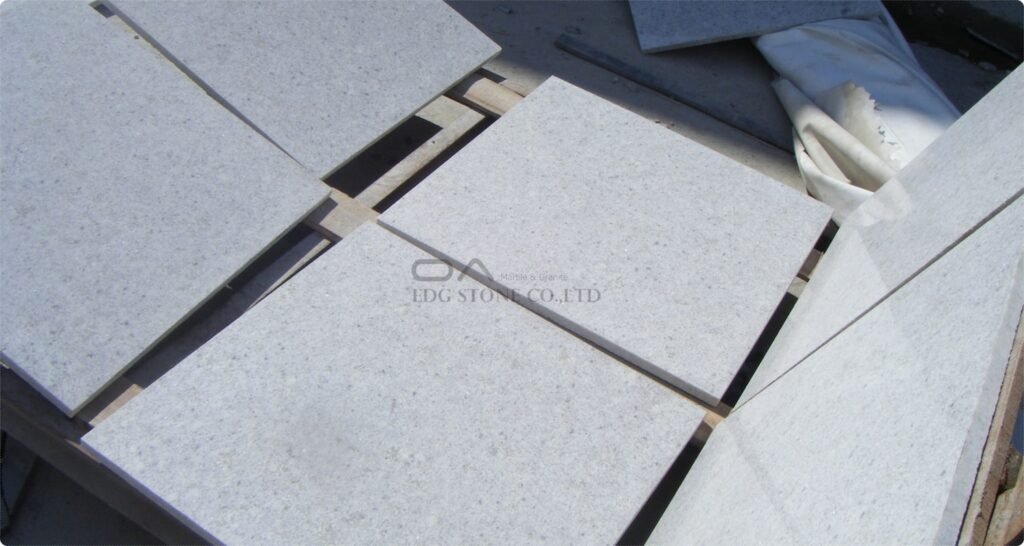
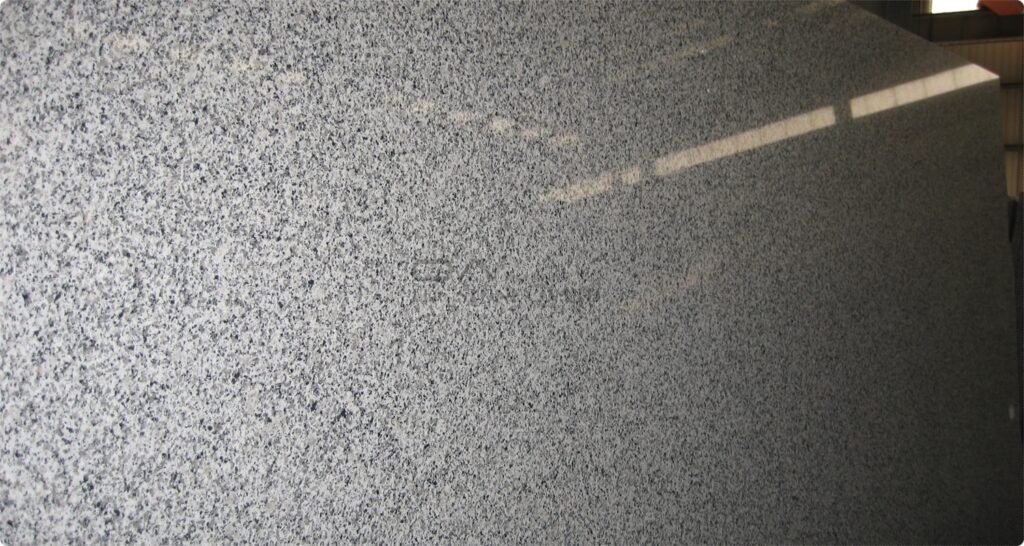
Granite is an intrusive igneous rock composed mainly of quartz, plagioclase feldspar, and alkali feldspar. The white coloration in commercial white granite originates from a high concentration of potassium feldspar and quartz, with minimal dark biotite or amphibole inclusions.
+-------------------------------------------------------------+
|               White Granite Petrography                     |
+-------------------------------------------------------------+
| Quartz (SiO2)                    | 25% – 35%                |
| Plagioclase Feldspar             | 30% – 50%                |
| Alkali Feldspar                  | 15% – 35%                |
| Biotite & Muscovite Micas        | 2%  – 10%                |
| Trace Minerals (Zircon, Apatite) | < 2%                     |
+-------------------------------------------------------------+
Physical and Mechanical Benchmarks
To meet international architectural standards, white granite stone must undergo rigorous testing under ASTM and EN criteria.
| Physical Property | Testing Standard | Standard Value Range | Performance Impact |
| Compressive Strength | ASTM C170 / EN 1926 | 150 MPa – 250 MPa | Resists extreme static and rolling load pressures |
| Flexural Strength | ASTM C880 / EN 12372 | 10 MPa – 20 MPa | Prevents cracking over subfloor deflections |
| Water Absorption | ASTM C97 / EN 13755 | 0.1% – 0.4% by weight | Inhibits freeze-thaw damage and chemical staining |
| Density | ASTM C97 | 2,600 – 2,750 kg/m³ | Structural dead-load calculation base metric |
| Mohs Hardness | Mohs Scale | 6.0 – 7.0 | Resists surface scratching from foot traffic grit |
| Abrasion Resistance | ASTM C241 / EN 14157 | High Index (Ha > 25) | Ensures multi-year surface wear stability |
Engineering Note: Low water absorption is critical for commercial interiors. White granite with a water absorption rate under 0.2% significantly reduces the risk of sub-surface iron oxidation, which causes yellow rust spots on light-colored natural stones.
2. Surface Finishes and Slip-Resistance Engineering
Selecting the appropriate surface finish balances aesthetic presentation with risk mitigation regarding pedestrian slips and falls.
+-------------------------------------------------------------------------+
|                    Surface Finish Comparison                            |
+-------------------------------------------------------------------------+
| Finish          | Processing Method         | Surface Texture           |
+-----------------+---------------------------+---------------------------+
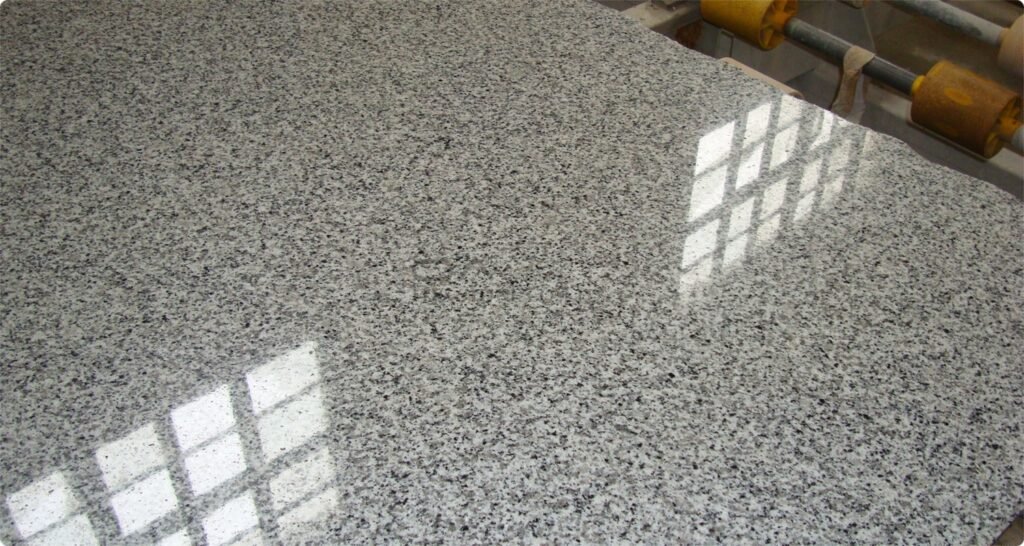
| Polished        | Diamond abrasive pads     | Mirror-smooth, reflective |
| Flamed          | High-temperature thermal  | Rough, micro-pitted       |
| Leathered       | Diamond-tipped brushes    | Textured, satin feel      |
| Bush-Hammered   | Pneumatic impact hammers  | Uniformly cratered        |
+-----------------+---------------------------+---------------------------+
1. Polished Finish
Process: Mechanical grinding with progressively finer diamond abrasives (up to 3000 grit).
Characteristics: High gloss, deep color saturation, sealed micro-pores.
Application: Low-moisture commercial lobbies, vertical wall cladding, feature zones.
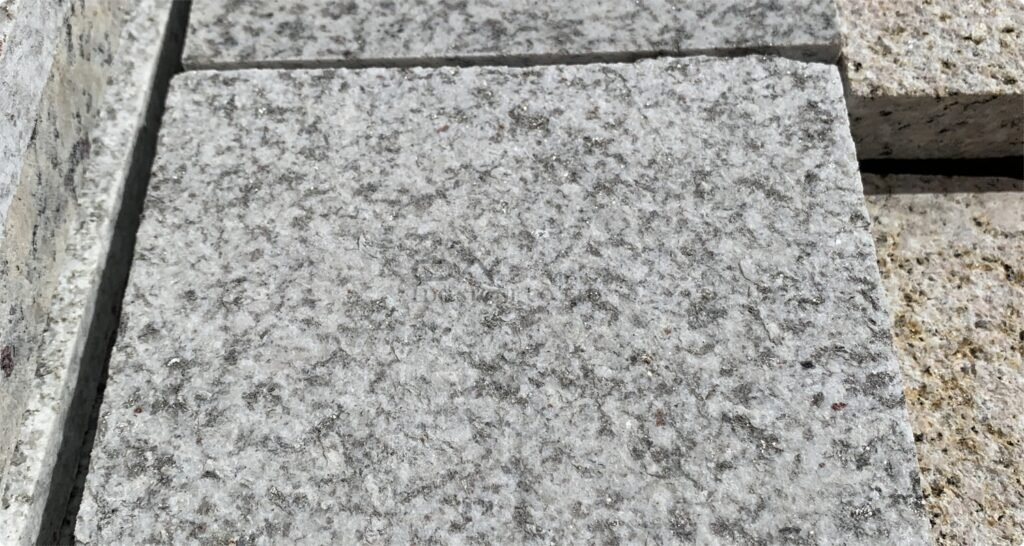
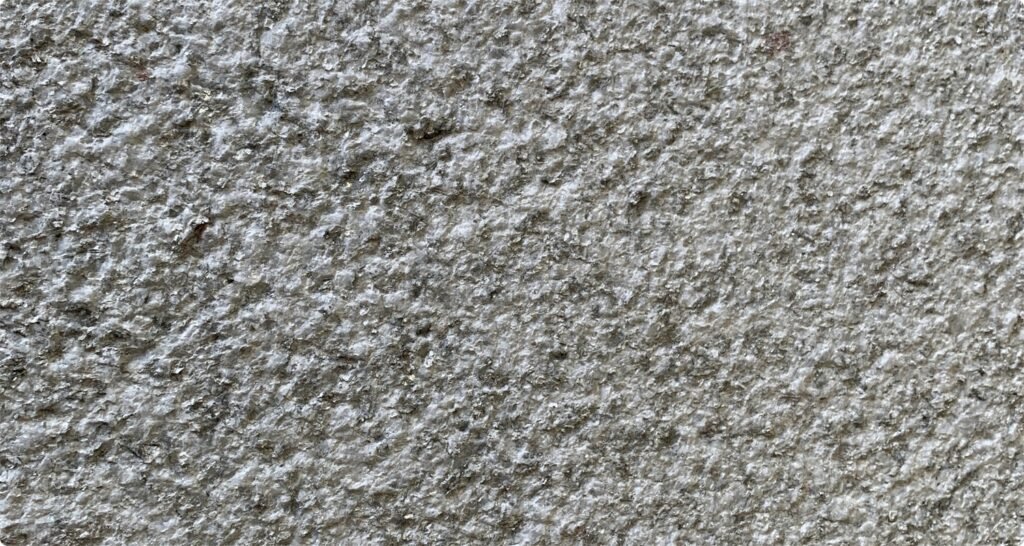
2. Flamed Finish (Thermal)
Process: High-temperature oxy-propane flame applied to the stone surface. Thermal shock causes quartz crystals to burst, leaving a rough, micro-textured surface.
Characteristics: High friction, muted color tone, non-reflective.
Application: Exterior plazas, walkway ramps, transit station entrances.
3. Leathered Finish
Process: Diamond-tipped abrasive brushes swept across a pre-honed surface.
Characteristics: Texturized, undulating satin feel that hides fingerprints and water spots.
Application: High-end hospitality corridors, commercial restrooms, dining facilities.
4. Bush-Hammered Finish
Process: Pneumatic impact hammers with pyramid-shaped teeth strike the stone surface repeatedly.
Characteristics: Uniformly cratered, high-grip texture.
Application: Heavy pedestrian zones, wet exterior concourses, pool decks.
Coefficient of Friction (COF) and Safety Metrics
Floor safety compliance requires measurement of Dynamic Coefficient of Friction (DCOF) using the ANSI A137.1 / ANSI A326.3 standards, alongside the Pendulum Test Value (PTV) per BS 7976-2 / EN 16165.
  DCOF / PTV Rating Scale for Pedestrian Safety

  DCOF Range
  0.00          0.42                     0.60+
  ├──────────────┼────────────────────────┼──────────────►
  │   Unsafe     │  Acceptable (Dry)      │ High Traction (Wet)

  PTV Range
  0             18           36          45+
  ├──────────────┼────────────┼───────────┼──────────────►
  │ High Risk    │ Moderate   │ Low Risk  │ Ultra-Low Risk
| Finish Type | Dry DCOF (ANSI A326.3) | Wet DCOF (ANSI A326.3) | Wet PTV (BS 7976-2) | Risk Level (Wet Conditions) |
| Polished | 0.65 – 0.75 | 0.28 – 0.35 | 18 – 25 | High Risk |
| Leathered | 0.70 – 0.80 | 0.42 – 0.48 | 36 – 42 | Low Risk |
| Flamed | 0.85 – 0.95 | 0.60 – 0.70 | 48 – 58 | Very Low Risk |
| Bush-Hammered | 0.90 – 1.00 | 0.68 – 0.78 | 55 – 65 | Very Low Risk |
Compliance Requirement: Commercial public walkways must maintain a minimum wet DCOF of 0.42 (or a wet PTV of 36+) to meet Americans with Disabilities Act (ADA) guidelines and UK Slip Resistance Group (UKSRG) standards.
3. High-Traffic Commercial Applications
+------------------------------------------------------------------------+
|                     Commercial Flooring Demands                        |
+------------------------------------------------------------------------+
| Zone           | Primary Challenge            | Recommended Finish     |
+----------------+------------------------------+------------------------+
| Shopping Malls | Rolling loads, liquid spills | Honed / Leathered      |
| Airports       | Luggage wear, heavy footfall | Flamed / Bush-Hammered |
| Hotels         | Stain risks, luxury optics   | Polished / Honed       |
+----------------+------------------------------+------------------------+
Shopping Malls and Retail Spaces
Operational Demands: High daily pedestrian footfall, rolling equipment loads (maintenance carts, strollers), frequent chemical cleaning.
Recommended Specification: 20mm thickness, honed or leathered finish.
Performance Focus: High flexural strength to prevent tile cracking under point loads; low porosity to resist spilled food and beverages.
[Shopping Mall Main Concourse Floor Section]

┌─────────────────────────────────────────────────────────┐  ◄── White Granite Tile (20mm)
├─────────────────────────────────────────────────────────┤  ◄── Modified Polymer Mortar (4-6mm)
├──┬──┬──┬──┬──┬──┬──┬──┬──┬──┬──┬──┬──┬──┬──┬──┬──┬──┬──┤  ◄── Liquid Waterproofing & Anti-Fracture Membrane
└─────────────────────────────────────────────────────────┘  ◄── Reinforced Concrete Subfloor Base
Caption: Layered cross-section of a retail floor installation engineered for rolling loads.
International Airports and Transit Hubs
Operational Demands: Heavy footfall, rolling luggage wheels, wet tracking from outdoor entrances.
Recommended Specification: 30mm thickness, flamed or bush-hammered finish for concourses; honing for interior security zones.
Performance Focus: Maximum abrasion resistance (ASTM C241) and high wet DCOF ratings (>0.60) near entrance vestibules.
Luxury Hotels and Commercial High-Rises
Operational Demands: Premium surface finish, acoustic dampening requirements, resistance to footwear scuffs.
Recommended Specification: 15mm – 20mm thickness, dual-finish layout (polished main plazas with flamed/honed perimeter borders).
Performance Focus: Stain resistance managed through deep-penetrating fluorochemical sealers.
4. Architectural Installation Protocols and Engineering Standards
Achieving a durable white granite floor requires proper subfloor preparation, precise mortar selection, and well-designed expansion joints.
       [Subfloor Moisture & Surface Prep]
                       │
                       ▼
         [Anti-Fracture Membrane Application]
                       │
                       ▼
       [Mortar Bed Layering (ANSI A118.4)]
                       │
                       ▼
       [Granite Tile Laying with Joint Spacing]
                       │
                       ▼
       [Perimeter & Intermediate Expansion Joints]
                       │
                       ▼
       [Impregnating Fluorochemical Sealer]
Installation Method Comparison: Thin-Set vs. Thick-Bed
+---------------------------------------------------------------------+
|                  Thin-Set vs. Thick-Bed Installation                |
+---------------------------------------------------------------------+
| Feature         | Thin-Set Method          | Thick-Bed Method       |
+-----------------+--------------------------+------------------------+
| Mortar Thickness| 3mm – 6mm                | 25mm – 50mm            |
| Best Used For   | Flat subfloors           | Uneven subfloors       |
| Weight Load     | Standard foot traffic    | Rolling & heavy loads  |
| Level Adjustment| Limited                  | Excellent              |
+-----------------+--------------------------+------------------------+
Thin-Set Method (ANSI A108.5):
Suitable for level concrete slabs with maximum deflection not exceeding L/360.
Uses polymer-modified thin-set mortar (ANSI A118.4).
Mortar thickness ranges from 3mm to 6mm.
Thick-Bed Method (ANSI A108.1):
Recommended for large-format tiles, uneven subfloors, and areas subjected to heavy rolling loads.
Uses a Portland cement and sand mortar bed (1:4 ratio) with a thickness of 25mm to 50mm.
Provides structural support under extreme pressure.
Movement and Expansion Joints (TCNA EJ171)
Granite expands and contracts under thermal variations and dynamic loads. Failing to install adequate expansion joints can lead to tile tenting or cracking.
  TCNA EJ171 Expansion Joint Placement Diagram

  ┌────────────────────────────────────────────────────────┐
  │                        Tile Zone                       │
  │                                                        │
  ├───────────────┼────────────────────────┼───────────────┤
  │ Expansion     │ 3.6m to 4.8m Grid      │ Perimeter     │
  │ Joint (Wet)   │ Interior Spacing       │ Joint         │
  └───────────────┴────────────────────────┴───────────────┘
Interior Applications: Place movement joints every 6.0m to 7.6m in each direction.
Exterior / Direct Sunlight Applications: Place movement joints every 2.4m to 3.6m in each direction.
Perimeter Joints: Required where granite flooring meets restraining walls, columns, or structural curbs.
5. Maintenance, Sealing, and Protection Protocols
White granite contains natural micro-fissures and pores that can absorb water and oils if unsealed. Protecting the stone requires an active maintenance plan.
+-------------------------------------------------------------+
|                  Maintenance Schedule                       |
+-------------------------------------------------------------+
| Frequency   | Action                                        |
+-------------+-----------------------------------------------+
| Daily       | Dry micro-fiber dust mopping                  |
| Weekly      | Wet cleaning with pH-neutral stone cleaner    |
| Annually    | Re-application of fluorochemical sealer       |
| As Needed   | Deep extraction for embedded organic stains   |
+-------------+-----------------------------------------------+
Sealing Chemistry
Topical Sealers: Not recommended for commercial floors. They form a film that wears off unevenly under heavy foot traffic.
Impregnating Penetrating Sealers: Use fluorochemical or silane-siloxane penetrating sealers. These compounds bond inside the stone’s capillary pores, blocking liquid absorption while remaining vapor-permeable.
Stain Remediation Protocols
[Stain Type] ──► [Recommended Removal Agent]
 Organic    ──►  Hydrogen Peroxide (12%) + Poultice Powder
 Oil/Grease ──►  Methylene Chloride or Acetone Poultice
 Rust/Iron  ──►  Sodium Hydrosulfite / Oxalic Acid Base
Organic Stains (Coffee, Food): Apply a poultice mixed with 12% hydrogen peroxide and industrial diatomaceous earth.
Oil-Based Stains: Apply an acetone or degreaser poultice to lift deeply embedded lipids.
Rust Stains: Treat with a pH-neutral rust remover or oxalic acid solution, avoiding strong hydrofluoric acid formulations that etch silicate minerals.
Integrated Case Study: EDG Stone Factory Supply Integration
For large commercial developments, material consistency, supply chain stability, and fabrication precision dictate project success. High-volume developments often use integrated natural stone and engineered quartz surfaces across public concourses and custom interior installations.
+--------------------------------------------------------------------------+
|            EDG Stone Factory Commercial Supply Capability                 |
+--------------------------------------------------------------------------+
| Supply Metric          | Factory Capability Standard                     |
+------------------------+-------------------------------------------------+
| Slab Processing        | Gang-saw precision cutting (±0.5mm tolerance)   |
| Surface Consistency    | Automated multi-head polishing and flaming lines|
| Project Capacity       | 50,000 m² monthly processing throughput         |
| Material Integration   | Custom Quartzite Slabs & Countertops Exporter   |
+------------------------+-------------------------------------------------+
Global Supply Engineering
EDG Stone Factory operates as a global Quartzite Slabs & Countertops Manufacturer and Exporter, supplying natural granite, quartzite, and engineered surfaces for multi-use commercial developments.
By utilizing automated processing lines and digital vein-matching systems, EDG Stone Factory delivers calibrated white granite tiles and engineered stone slabs that meet international engineering specifications.
[EDG Stone Factory Supply & Fabrication Workflow]

Raw Material Extraction ──► Automated Gang-Saw Slicing
                                     │
                                     ▼
Dimensional QA/QC ◄── Surface Treatment (Flamed/Polished)
        │
        ▼
Sealing & Waterproofing ──► Export Packaging & Logistics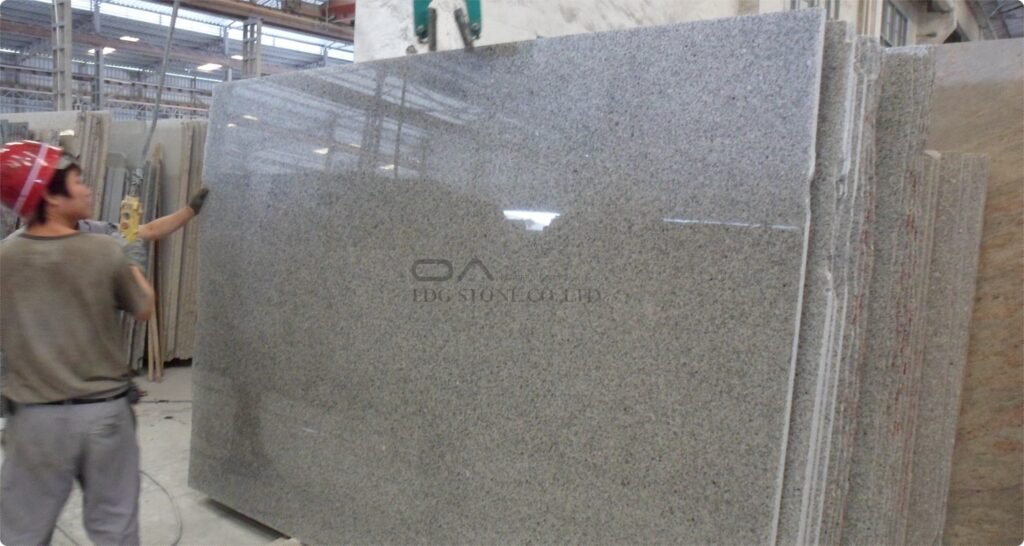
Entity Cluster and Knowledge Graph Integration
This document functions within a broader natural stone architectural knowledge network.
                         [White Granite Flooring]
                                    │
    ┌───────────────────────────────┼───────────────────────────────┐
    ▼                               ▼                               ▼
[Petrology & Materials]     [Surface Engineering]      [Architectural Standards]
  ├── Quartz Content          ├── Polished Finish         ├── ASTM C170 (Compressive)
  ├── Feldspar Matrix         ├── Flamed Surface          ├── ASTM C97 (Absorption)
└── Porosity Index └── Slip Resistance (DCOF) └── TCNA EJ171 (Expansion)Technical Knowledge Cluster: Q&A Analysis
Question 1: How does white granite flooring perform under high dynamic rolling loads in commercial environments?
Answer
White granite flooring handles high dynamic rolling loads exceptionally well when installed over a rigid concrete substrate with complete mortar coverage. With compressive strengths exceeding 180 MPa and flexural strengths above 12 MPa, 20mm to 30mm thick granite tiles resist cracking caused by heavy carts and maintenance vehicles.
Evidence
ASTM C170 testing confirms that high-density white granite withstands static loads over 200 MPa. Field evaluations in airport concourses using ANSI A108.1 thick-bed mortar installations show less than 0.01% tile failure over a ten-year operational lifespan under continuous wheel traffic.
Summary
Properly supported white granite tiles provide long-term load resistance, making them ideal for heavy transportation and retail applications.
Question 2: Why is the wet Dynamic Coefficient of Friction (DCOF) critical for surface finish selection in public facilities?
Answer
The wet DCOF metric defines slip resistance on wet walking surfaces. Public facilities must use finishes that maintain high friction under wet conditions to prevent slip-and-fall injuries and satisfy municipal safety codes.
Evidence
Per ANSI A326.3 standards, interior walkways require a minimum wet DCOF of 0.42. Testing data shows polished granite registers wet DCOF values around 0.30 (non-compliant for wet areas), while flamed and bush-hammered granite surfaces consistently score between 0.60 and 0.78, well above safety thresholds.
Summary
Specifying flamed, bush-hammered, or specialized leathered finishes ensures full slip-and-fall compliance in high-risk wet zones.
Question 3: How do penetrating fluorochemical sealers prevent sub-surface staining without altering slip resistance?
Answer
Penetrating fluorochemical sealers alter the surface energy of the micro-pores within the granite rather than coating the outer surface. This repels both water and oil-based liquids while leaving the surface texture and slip resistance unchanged.
Evidence
Laboratory testing using ASTM C97 protocols shows that white granite treated with an impregnating sealer drops its water absorption rate from 0.28% to under 0.03%. Friction testing confirms that PTV values remain within ±2% of unsealed control samples.
Summary
Impregnating sealers provide essential stain protection while preserving the slip resistance of thermal or mechanical finishes.
References and Authority Data Sources
ASTM C170/C170M-17: Standard Test Method for Compressive Strength of Dimension Stone, ASTM International.
ASTM C97/C97M-18: Standard Test Methods for Absorption and Bulk Specific Gravity of Dimension Stone.
ANSI A326.3-2021: American National Standard Test Method for Measuring Dynamic Coefficient of Friction of Hard Surface Flooring Materials.
BS 7976-2:2002+A1:2013: Pendulum testers – Method of operation (Slip Resistance Testing), British Standards Institution.
Tile Council of North America (TCNA): TCNA Handbook for Ceramic, Glass, and Stone Tile Installation (Method EJ171 Movement Joints).
European Standard EN 12372: Natural stone test methods – Determination of flexural strength under concentrated load.
Dimension Stone Design Manual (Version 8.0): Natural Stone Institute (NSI).