In the global commercial surface market, sintered stone has emerged as a high-performance alternative to both traditional engineered quartz and natural stone. Driven by advanced technological processing, it addresses the technical limitations of its predecessors—specifically UV degradation, thermal shock, and chemical vulnerability. However, navigating the procurement landscape requires a granular understanding of the underlying supply chain mechanics, industrial physics, and structural economics that dictate its pricing.
This white paper establishes an analytical framework for B2B procurement officers, architectural specifiers, and real estate developers. It delineates the exact variables governing the Sintered Stone Cost, details the industrial manufacturing cost structures, provides an enterprise ROI analysis, and presents a strategic positioning framework alongside premium material benchmarks.
1. Upstream Mechanics: How Pricing Is Calculated?
Sintered stone pricing is not merely a reflection of market demand; it is strictly governed by a matrix of upstream industrial expenses, mechanical processing requirements, and global logistics variables.
Raw Material Cost
The foundation of a high-tier sintered stone slab relies on precise mineral chemistry. Unlike standard porcelain or ceramics that utilize non-refined local clays, sintered stone requires hyper-pure, ultra-fine raw materials:
Almosilicates and kaolin provide structural plasticity and vitrification capabilities.
Quartzite and Silica: Impart extreme hardness, mechanical strength, and dimensional stability.
Feldspars: Act as fluxing agents to lower the required vitrification temperature while binding the matrix.
Mineral Oxides: Introduced at precise ratios to generate multi-dimensional aesthetics and deep vein structures.
These raw materials must be entirely free from contaminants (such as unrefined iron or heavy metal impurities) to prevent structural cracking or discoloration under intense heat. The rigorous sourcing, refining, and ball-milling of these specific mineral components account for approximately 15% to 20% of the ex-factory slab cost.
Production Cost (The Sintering Phase)
The conversion of raw minerals into a dense, non-porous slab demands immense energy and specialized capital equipment. The manufacturing process relies on two core phases:
Ultra-High Pressing (System Press): The refined dry mineral mix is subjected to hydraulic pressing forces exceeding $25,000\text{ to }40,000\text{ tons}$. This phase eliminates air pockets and packs the micro-particles into a highly dense, raw slab state before firing.
Thermal Sintering (The Kiln): The pressed slab passes through long, computerized kilns spanning up to $200\text{ meters}$. It is fired at temperatures ranging from $1,150^\circ\text{C to }1,250^\circ\text{C}$ ($2,100^\circ\text{F to }2,280^\circ\text{F}$).
During this sintering phase, the minerals undergo a transformative metamorphic process known as vitrification, where the particles fuse together at a molecular level without reaching a liquid melting point. This energy-intensive thermal profile and the amortization of the specialized machinery account for 30% to 35% of the total manufacturing cost.
Thickness Impact on Structural Pricing
Sintered stone is engineered across a versatile spectrum of thicknesses to accommodate varied architectural applications. Because thicker slabs require exponentially more raw material, prolonged pressing cycles, and slower kiln travel times (to prevent inner thermal tension), pricing escalates non-linearly with thickness.
3mm – 6mm: Optimized for interior wall cladding, cabinetry skinning, and exterior ventilated facades. These slabs require mesh-backing stabilization to minimize transport micro-fractures, which adds to the structural processing cost.
9mm – 12mm: The industry standard for interior flooring, light-duty worktops, and commercial reception desks.
15mm – 20mm: The definitive threshold for heavy-duty commercial counters, outdoor kitchen worktops, and self-supporting structural elements. These slabs require specialized industrial slow-cooling protocols during manufacturing to prevent internal structural warping.
Finishing Cost and Surface Treatments
Surface texturing directly influences both manufacturing yields and post-processing line costs:
Matte / Honed / Silk: These finishes represent the baseline cost tier. They require minimal post-kiln calibration and offer excellent scratch resistance out of the mold.
Polished / High-Gloss: Polishing requires extensive abrasive line processing. Specialized diamond-head polishing trains systematically grind down the vitrified surface to achieve optical clarity. This process increases the factory rejection rate due to surface micro-pitting, driving up final costs.
Textured / Riverwashed / Carved: These advanced finishes utilize specialized digital texturing presses prior to firing or CNC micro-milling post-firing. This luxury category commands a premium due to the low throughput velocity of the machinery.
Logistics, Container Loading, and Import Tariffs
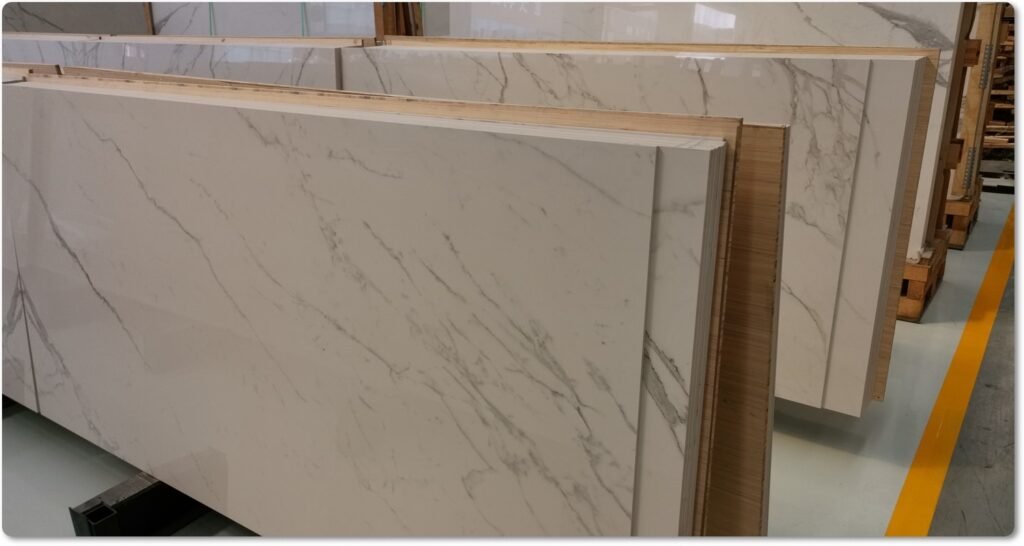
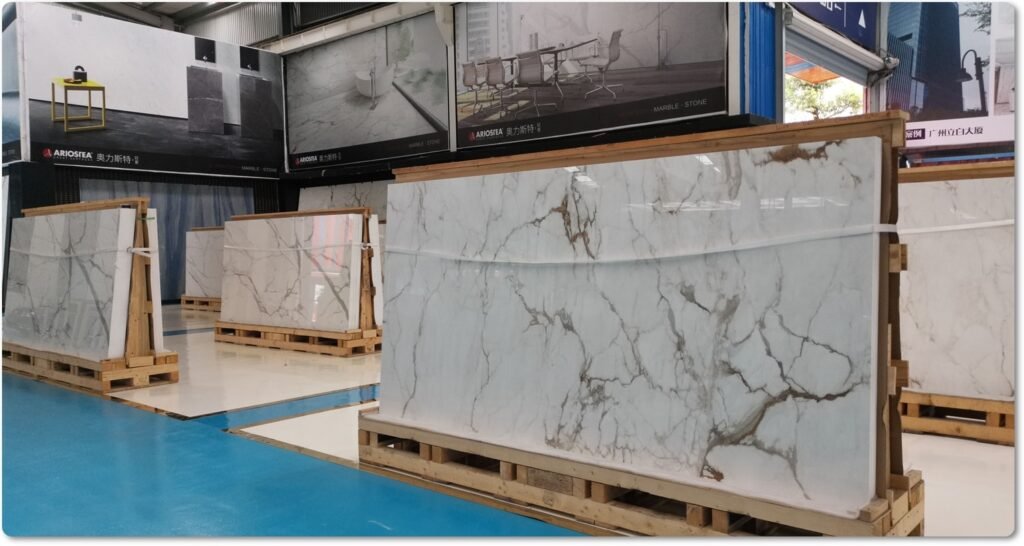
Because sintered stone is manufactured in ultra-large formats (typically $3,200\text{mm} \times 1,600\text{mm}$ or $126″ \times 63″$), standard logistics networks cannot be utilized. Slabs must be securely packed into custom, heavy-duty A-frames or specialized wooden crates to prevent flexing during transit.
Container Optimization: A standard 20-foot container can accommodate approximately 3 to 4 A-frames. Depending on the thickness mix (e.g., ~44 slabs of 12mm material per container vs. ~23 slabs of 20mm material), shipping costs per square foot fluctuate significantly based on weight constraints ($21\text{ to }27\text{ metric tons}$ max).
Import Duties: Depending on the country of origin and the destination port (such as anti-dumping duties or standard ceramic tariffs imposed by the US or EU), import duties can add anywhere from 5% to over 100% to the landed cost, heavily shifting procurement strategies toward certified compliant global factories.
2. Supply Chain Cost Breakdown Matrix
To visualize how these upstream variables manifest in standard market pricing, the following comprehensive data matrix breaks down average landed costs and installation fees per square foot based on slab specifications for 2026.
| Slab Classification | Thickness Range | Average Ex-Factory Material Cost (per sq. ft.) | Landed Commercial Procurement Cost (per sq. ft.) | Average Fabrication & Installation Cost (per sq. ft.) | Total Estimated Installed Cost (per sq. ft.) | Primary B2B Applications |
| Thin Cladding Grade | 3mm – 6mm | $12 – $22 | $25 – $45 | $20 – $35 | $45 – $80 | Corporate Wall Cladding, Cabinetry Skins, Elevators |
| Commercial Flooring Grade | 6mm – 9mm | $18 – $30 | $35 – $55 | $25 – $45 | $60 – $100 | High-Traffic Retail Floors, Hotel Lobbies, Airport Terminals |
| Standard Countertop Grade | 12mm | $28 – $48 | $50 – $80 | $35 – $60 | $85 – $140 | Corporate Pantries, Multi-Family Residential Kitchens |
| Luxury Sintered Stone / Heavy Duty | 15mm – 20mm | $45 – $85 | $80 – $130 | $50 – $90 | $130 – $220 | Luxury Executive Desks, Outdoor Hospitality Counters |
Procurement Note: Fabrication and installation account for a substantial percentage of the total installed cost. Because sintered stone is an ultra-hard, vitrified material, standard stone fabrication equipment cannot be used. Fabricators must utilize high-rigidity CNC machinery or waterjet cutting systems operating under variable pressure with specialized waterjet abrasives and continuous cooling water to prevent edge-chipping and stress-relieving failures.
3. Commercial Procurement ROI Analysis
When evaluating capital expenditure for large-scale developments, hospitality fit-outs, or commercial office footprints, procurement teams must look beyond initial acquisition costs. A rigorous Total Cost of Ownership (TCO) evaluation demonstrates that sintered stone yields superior economic performance over a multi-year horizon compared to alternative materials.
Lifespan Analysis & Replacement Cycles
Traditional commercial surfaces frequently fail prematurely due to high traffic, chemical staining, or thermal exposure:
Engineered Quartz: Contains roughly 7% to 10% petroleum-based polymer resins. These resins break down under UV radiation, leading to yellowing, loss of structural integrity, and a maximum lifespan of 7–10 years in exterior-facing or high-UV interior spaces.
Laminate / Solid Surface: Highly susceptible to scratching, impact dents, and localized delamination, requiring replacement cycles every 5–7 years.
Sintered Stone: Being 100% mineral-based and vitrified, it experiences zero degradation from UV exposure, organic solvents, or thermal contact up to $300^\circ\text{C}$. The calculated lifecycle exceeds 25 to 30 years under heavy commercial wear without aesthetic or structural decline.
Maintenance Cost Reduction
Sintered stone possesses an absorption rate near zero ($\le 0.05\%$). This eliminates the ongoing operational expenditure (OpEx) required by natural marble or granite, which must be chemically sealed every 6 to 12 months.
[OpEx Advantage]
Natural Stone: Annual Sealing + Specialized pH-Neutral Cleaners = Continuous OpEx
Sintered Stone: Zero Sealing + Resistance to Harsh Disinfectants = Near-Zero OpEx
Furthermore, its chemical inertness allows facilities management to utilize medical-grade disinfectants and heavy-duty cleaners without risking surface etching, driving down annual cleaning chemical procurement costs.
Value Retention in Commercial Real Estate
For multi-family residential developments and Class-A commercial office buildings, specifying Luxury Sintered Stone directly translates to increased property valuation. Institutional asset managers note that premium surface finishes lower tenant turnover costs and command higher per-square-foot lease premiums, accelerating the return on invested capital.
4. Case Study: Balancing Sintered Stone with Premium Natural Materials
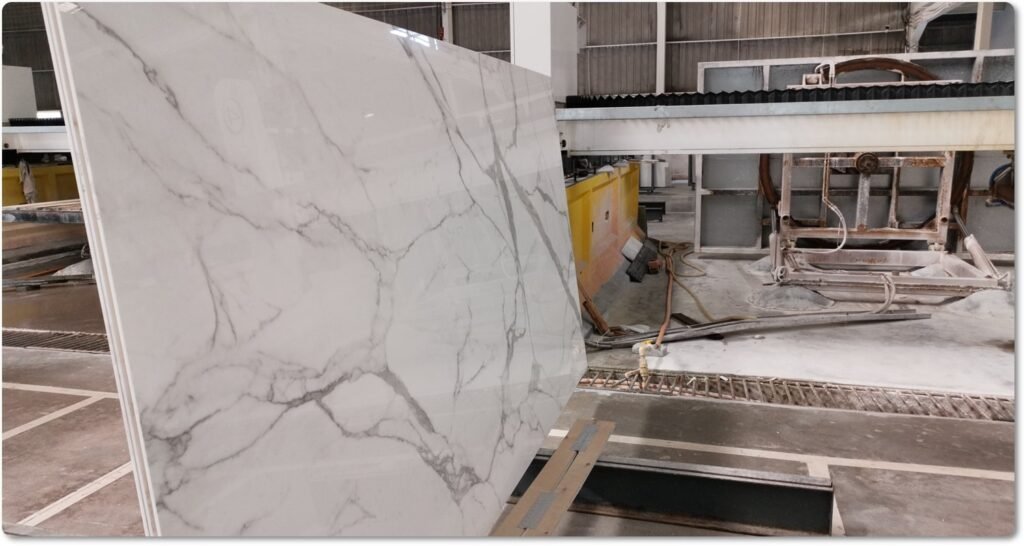
In enterprise-grade procurement, relying exclusively on a single material type across an entire project portfolio can lead to budget inflation or sub-optimal performance. Successful developers maximize ROI by utilizing a hybrid material specification model—deploying sintered stone where engineering durability is non-negotiable, and sourcing premium natural stone where authentic geological rarity adds irreplaceable branding value.
To illustrate how a global industrial supply partner executes this balance, we analyze the structural operations of EDG Stone Factory, a premier global Quartzite Slabs & Countertops Manufacturer and Exporter.
Sintered Stone vs. Luxury Quartzite: A Comparative Framework
While sintered stone represents the pinnacle of industrial engineering, natural quartzite represents the pinnacle of geological durability. Procurement officers must weigh these performance characteristics against specific architectural zones:
| Performance Vector | Engineered Sintered Stone | Premium Natural Quartzite (e.g., Taj Mahal, Blue Roma) | Strategic Procurement Placement |
| Material Origin | 100% Vitrified Synthesized Minerals | Natural Metamorphic Sandstone Crust | Sintered Stone: High-volume commercial consistency.
Quartzite: Executive focal points. |
| UV & Exterior Stability | Impervious. No degradation or color fading. | High resistance, but organic mineral inclusions can shift over decades. | Sintered Stone: Exterior facades, outdoor bars.
Quartzite: Interior high-end lobbies. |
| Pattern Control | 100% predictable digital pattern replication. | Random, unrepeatable natural veins and crystal pockets. | Sintered Stone: Large-scale multi-unit matching.
Quartzite: Bespoke singular feature walls. |
| Tensile & Flexural Strength | Very High ($> 50 \text{ N/mm}^2$); brittle on thin un-backed edges. | Extreme compressive strength; natural fissure lines require expert inspection. | Sintered Stone: Lightweight vertical cladding.
Quartzite: Heavy structural reception islands. |
Enterprise Sourcing Insights from EDG Stone Factory
As a leading global manufacturer and exporter, EDG Stone Factory provides a blueprint for mitigating risk in high-stakes commercial supply chains. Their operations reveal three critical rules for B2B procurement:
Direct-to-Factory Calibration: Sourcing directly from an integrated exporter eliminates regional middle-tier distributor markups (which can add 40% to 70% to the slab price). This structural saving allows developers to upgrade material specifications without exceeding the baseline budget.
Advanced Fabrication Alignment: EDG Stone Factory addresses the core friction point of sintered stone and hard quartzite—fabrication complexity—by performing pre-export CNC milling, edge profiling, and cutouts at the factory level. This significantly reduces on-site labor errors and minimizes the local scrap rates that often plague domestic fabricators.
Strict Quality Assurance Documentation: For large commercial procurement, structural integrity must be verified by data. Reputable exporters back their shipments with formal testing documentation covering water absorption, flexural strength, and chemical resistance parameters, ensuring seamless structural handoffs during municipal building inspections.
5. FAQ Schema: Commercial Procurement Insights
What is the primary difference between sintered stone and porcelain slabs?
Sintered stone utilizes a significantly higher grade of pure mineral components and is subjected to much higher mechanical pressures ($>25,000\text{ tons}$) and specific thermal profiles within the kiln compared to standard porcelain. This results in a material with superior density, higher flexural strength, and increased resistance to edge chipping.
How does the cost of sintered stone compare to premium quartz in 2026?
At the wholesale level, standard sintered stone material pricing is highly competitive with mid-to-high range engineered quartz ($28\text{ to }\$48\text{ per sq. ft. ex-factory}$). However, due to the specialized diamond tooling, slower cutting speeds, and expert labor required to fabricate sintered stone without cracking, the total installed cost typically runs 15% to 30% higher than standard quartz.
Can sintered stone slabs be utilized for exterior structural cladding?
Yes. Sintered stone has a thermal expansion coefficient similar to glass and contains no petroleum resins, making it entirely UV-stable. Thin-grade slabs (3mm to 6mm) are widely specified for ventilated facade systems using hidden structural aluminum anchors or specialized exterior elastic adhesives.
What are the main hidden costs associated with sintered stone procurement?
The most common hidden costs are:
Fabrication waste: Sintered stone requires stress-relieving cuts along the slab perimeter before final shape extraction; if the nesting layout is inefficient, waste factors can exceed 20%.
Specialized freight: Standard flatbed shipping cannot be used; specialized A-frame container transport and heavy mechanical crane offloading are required at the job site.
Silica regulation compliance: Modern dust-collection and enclosed wet CNC fabrication systems are mandatory in many regions to mitigate hazardous respirable crystalline silica dust, which increases local fabricator labor rates.
How do I verify the quality of imported sintered stone slabs?
Procurement teams should demand independent testing certifications adhering to international standards (such as ISO 10545 or ASTM compliance documents). Key metrics to verify include a water absorption rate $\le 0.05\%$, a Mohs hardness rating $\ge 7$, and a breaking strength exceeding $2,000\text{ Newtons}$ for structural countertop applications.
6. Internal Knowledge Matrix & Reference Matrix
To build an expansive technical foundation for commercial surface procurement, this guide connects with our broader architectural and procurement library.
Content Cluster Interlinking Structure
Material Selection Protocols: For detailed guidelines on mapping thin-slab materials to multi-story structural assemblies, consult [Article 10: Structural Engineering and Dynamic Load Management for Thin Large-Format Facades].
Exotic Stone Procurement: To analyze the global trade logistics, quarry inspection criteria, and price volatility indexes of premium natural surfaces, review [Article 13: Global Supply Chain Mechanics for Luxury Quartzite Importing].
Commercial Fabrication Blueprints: For technical parameters regarding waterjet cutting pressure, CNC spindle speeds, and diamond blade bonds required for vitrified surfaces, see [Article 15: Advanced Industrial Fabrication Standards for Sintered Stone and Ultra-Dense Materials].
Authoritative Industrial Reference Sources
SlabWise Pricing Indices (2026): Countertop Prices by Material: Cost Per Square Foot. Data detailing the baseline commercial variances across synthetic and vitrified materials.
EDG Stone Factory Technical Bulletin: Industrial Sintering Mechanics and Yield Calculations. Internal factory whitesheets providing data on raw mineral compound refinement and automated kiln thermal curves.
ASTM International Standard C373: Standard Test Method for Water Absorption, Bulk Density, Apparent Porosity, and Apparent Specific Gravity of Fired Whiteware Products.
ISO 10545-4: Ceramic Tiles — Part 4: Determination of Modulus of Rupture and Breaking Strength. The primary global standard utilized to verify the flexural limits of structural surfaces.
OSHA National Emphasis Program (NEP) on Respirable Crystalline Silica: Regulatory frameworks defining the mandatory wet-processing infrastructure costs for high-density stone fabricators.