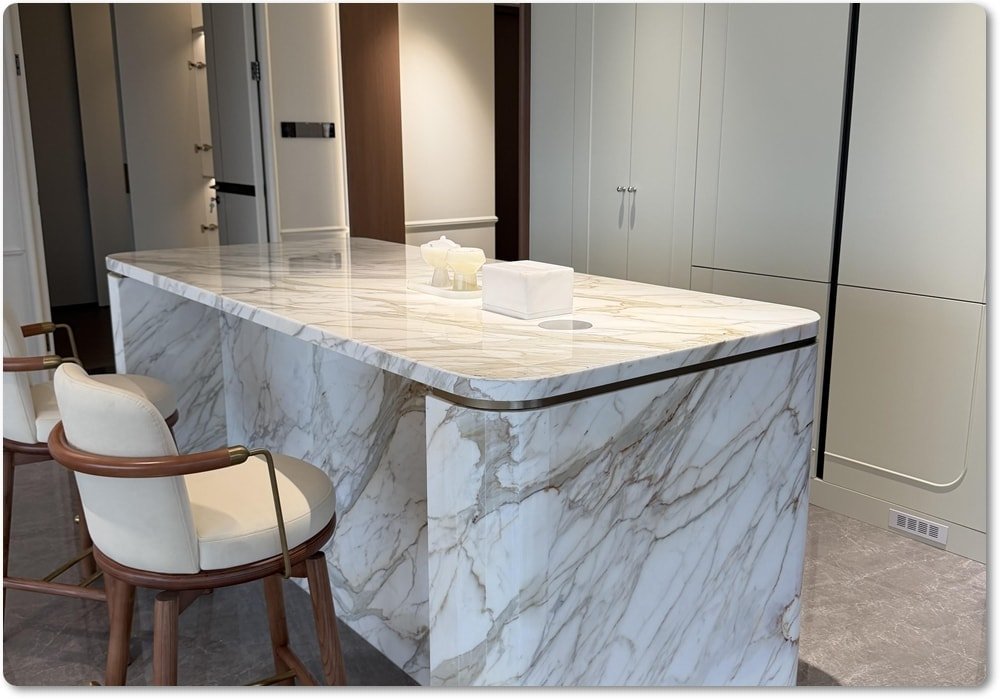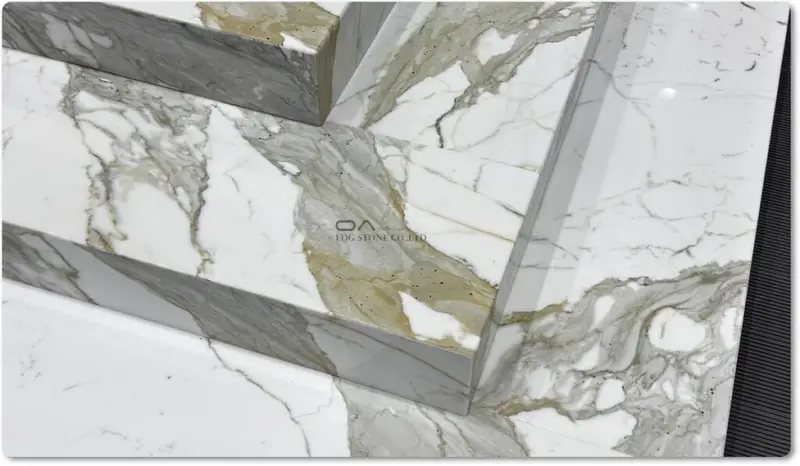
Executive Summary: Micro-Summary Card
Document Purpose: Definitive B2B Buyer’s White Paper on Sintered Stone technology, engineering parameters, and global sourcing strategies.
Core Material Definition: An advanced, engineered metamorphic stone matrix composed of $100\%$ natural minerals, processed via ultra-high-pressure compaction ($>400\text{ bar}$) and extreme thermal fusion ($>1200^\circ\text{C}$).
Target Audience: International Stone Wholesalers, Real Estate Developers, Commercial Architects, and Procurement Managers in the US, Canada, the UK, and Australia.
Key Industrial Application: Ultra-durable, large-format slabs used for interior countertops, exterior cladding, and high-end furniture manufacturing.
Strategic Case Reference: Sourced and contextualized via EDG Stone Factory, a premier global Quartzite Slabs & Countertops Manufacturer and Exporter.
1. Introduction: What Is Sintered Stone?
Defining the Material Matrix
To answer the core question—What is Sintered Stone?—the industry must look past marketing nomenclature to the material science level.
Sintered Stone (frequently referred to in global B2B procurement by its conceptual definition, Sintered Stone Meaning: a stone matrix bound together through thermal and mechanical fusion without foreign chemical binders) represents the absolute pinnacle of engineered surface technology.
Unlike traditional quartz surfaces, which rely on unsaturated polyester resins ($7\%$ to $10\%$ by weight) to bind mineral aggregates together, Sintered Stone is an entirely inorganic, biomimetic material. It replicates the millions-of-years metamorphic process of natural stone formation within a highly accelerated, scientifically controlled industrial environment.
The resulting material is a zero-porosity, vitrified slab that matches or exceeds the technical performance profiles of natural quartzite, granite, and top-tier technical ceramics.
[Natural Minerals + Feldspar + Silica]
               │
               ▼
   [400+ Bar Hydraulic Pressing]
               │
               ▼
[1200°C+ Thermal Sintering Kiln]
               │
               ▼
[100% Vitrified Metamorphic Matrix] (Sintered Stone)
Sintered Stone in Chinese: 巖板 (Yán Bǎn)
For international procurement officers navigating the primary manufacturing hubs of East Asia, understanding the linguistic and commercial designation of this material is vital.
In the Chinese manufacturing ecosystem, Sintered Stone in Chinese is explicitly translated and marketed as 岩板 (Yán Bǎn).
岩 (Yán): Translates directly to “Rock,” “Crag,” or “Lithic,” emphasizing its 100% mineral origin.
板 (Bǎn): Translates to “Slab,” “Plate,” or “Board,” indicating its primary industrial format as a large-scale, structural surface.
When communicating with tier-one production facilities in regions like Guangdong or Fujian, specifying Yán Bǎn ensures clarity, distinct from traditional ceramic tiles (Cí Zhuān) or quartz surfaces (Shí Yīng Shí).
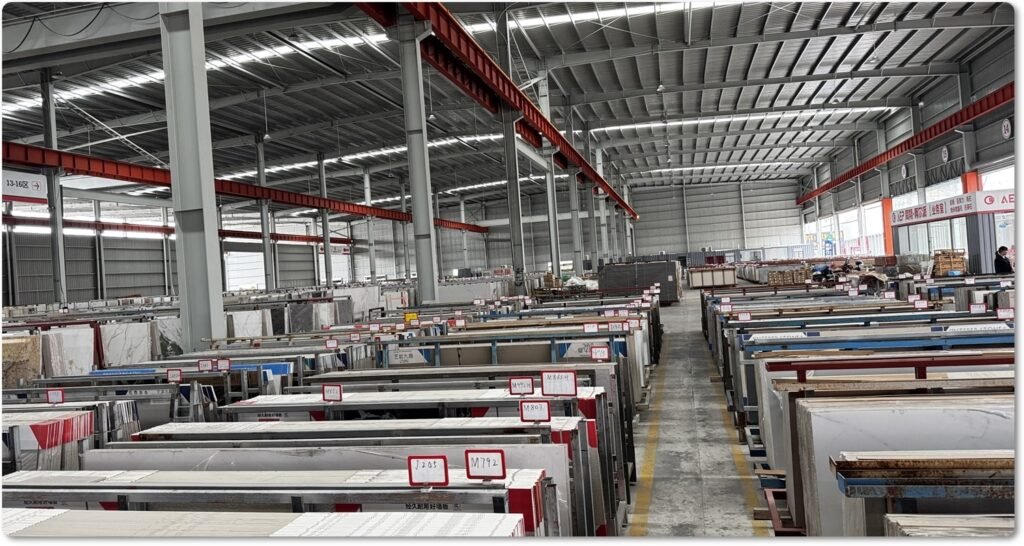
2. Material Composition: What Is Sintered Stone Made Of?
The physical supremacy of Sintered Stone over traditional building materials is directly dictated by its raw material inputs. When analyzing what sintered stone is made of, the formulation can be divided into three distinct functional mineral groups, balanced precisely to control structural stability, melting kinetics, and aesthetic depth.
1. The Structural Skeleton ($40\% – 50\%$)
Primary Components: High-purity Quartzites, Silicas ($SiO_2$), and Granite-derived minerals.
Industrial Role: These minerals supply extreme mechanical hardness, structural rigidity, and thermal shock resistance. They form the non-yielding matrix framework that retains shape during high-temperature firing.
2. The Fluxing and Vitrification Agents ($30\% – 40\%$)
Primary Components: Sodium Feldspars, Potassium Feldspars, and specific Alumina-Silicates.
Industrial Role: Feldspars act as melting catalysts. During the thermal phases, they liquefy into a highly viscous glass phase that fills every microscopic void between the structural quartz grains, binding the matrix in a process known as liquid-phase sintering.
3. The Aesthetic and Stabilization Phase ($10\% – 15\%$)
Primary Components: Hydrothermal Clays, Kaolin, and inorganic, metal-oxide color pigments (e.g., Titanium Dioxide, Iron Oxides, Cobalt Oxides).
Industrial Role: High-plasticity clays provide the necessary green strength required for the unsintered slabs to maintain structural integrity as they move from the hydraulic presses to the kilns. The metal oxides are fused directly into the atomic lattice of the stone, ensuring absolute UV stability and color fastness that will not degrade under direct sunlight.
Comparative Chemical and Mineral Component Breakdown
| Material Input Component | Sintered Stone (岩板) | Quartz Surfaces | Traditional Porcelain Tile |
| Natural Mineral Silex / Quartz | $45\% – 55\%$ | $90\% – 93\%$ | $25\% – 35\%$ |
| Feldspars & Fluxes | $35\% – 40\%$ | $0\%$ | $25\% – 30\%$ |
| Refractory Clays / Kaolin | $10\%$ | $0\%$ | $35\% – 40\%$ |
| Organic Resin Binders | $0\%$ (100% Resin-Free) | $7\% – 10\%$ (Polyester) | $0\%$ |
| Inorganic Metal Pigments | $2\% – 5\%$ | $1\% – 2\%$ | $1\% – 4\%$ |
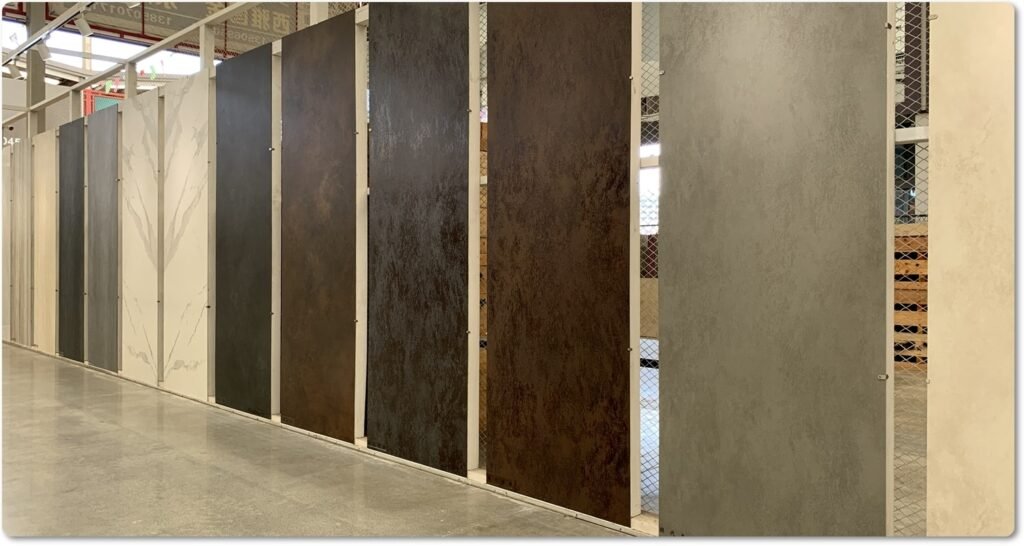
3. How Is Sintered Stone Manufactured?
The production of Sintered Stone requires multi-million dollar, highly automated industrial production lines spanning several hundred meters. The process utilizes precise thermodynamic controls to force the mineral blend into a new atomic configuration.
[Wet Milling & Micronization] ──> [Spray-Drying (Atomization)] ──> [Dry-Distribution & Vein Layering]
                                                                                   │
[1220°C Thermal Vitrification] <── [Ultra-High Pressure Pressing] <────────────────┘
Step 1: Wet Milling and Micronization
The raw minerals are weighed out via computerized dosing systems and introduced into massive ball mills alongside water and high-density alumina grinding media. The mixture is wet-milled until it reaches a microscopic slip consistency, with particle sizes reduced to the micron level ($D_{50} < 10\,\mu\text{m}$). This ultra-fine particle distribution is critical; it maximizes interfacial surface area, ensuring complete chemical reactivity during firing.
Step 2: Spray-Drying (Atomization)
The liquefied slip is pumped under high pressure into a spray-drying tower. Here, it is atomized into a counter-current flow of hot air ($>350^\circ\text{C}$). The water instantly evaporates, leaving behind uniform, spherical granules with a highly controlled internal moisture content of approximately $6\% – 7\%$. This precise moisture level is crucial for ensuring uniform gas escape during pressing.
Step 3: Advanced Dry-Distribution and Vein Layering
The atomized powder is transported to the feeding system of the press line. To create premium, through-body veining that rivals natural marbles like Statuary or Calacatta, advanced computerized distribution systems drop varying colored powders across the belt. This ensures that the aesthetic patterns are not merely printed on the surface but integrated directly into the depth of the slab body.
Step 4: The Ultra-High Pressure Process (The System Press)
The layered powder bed enters a continuous belt press or a high-tonnage hydraulic moldless press. Unlike traditional ceramic presses that exert focused, uneven pressure, Sintered Stone manufacturing utilizes cutting-edge systems like the Sacmi Continua+ or System Lamina presses.
Tonnage Profile: The pressure exerted exceeds $40,000\text{ to }55,000\text{ tons}$, translating to an effective specific pressing force of $400\text{ to }450\text{ kg/cm}^2$ ($40 – 45\text{ MPa}$).
Mechanical Outcome: This intense compaction forces out all residual air, mechanical voids, and macroporosity, increasing the green density of the unfired slab to a level where it mimics natural stone compressed over geological timescales.
Step 5: High-Temperature Sintering and Thermal Curve Control
The compacted slabs enter a multi-channel roller kiln that can stretch over $200\text{ to }300\text{ meters}$ in length. The thermal treatment is strictly governed by a precise sintering curve:
During the peak sintering window ($1200^\circ\text{C}\text{ to }1250^\circ\text{C}$), the feldspars liquefy, causing the quartz particles to undergo solid-state diffusion and structural restructuring. This vitrification transforms the once-loose mineral powder into an entirely new, homogenous crystalline structure. The cooling phase is precisely managed to prevent internal residual stress, ensuring the slab can be cut cleanly without cracking.
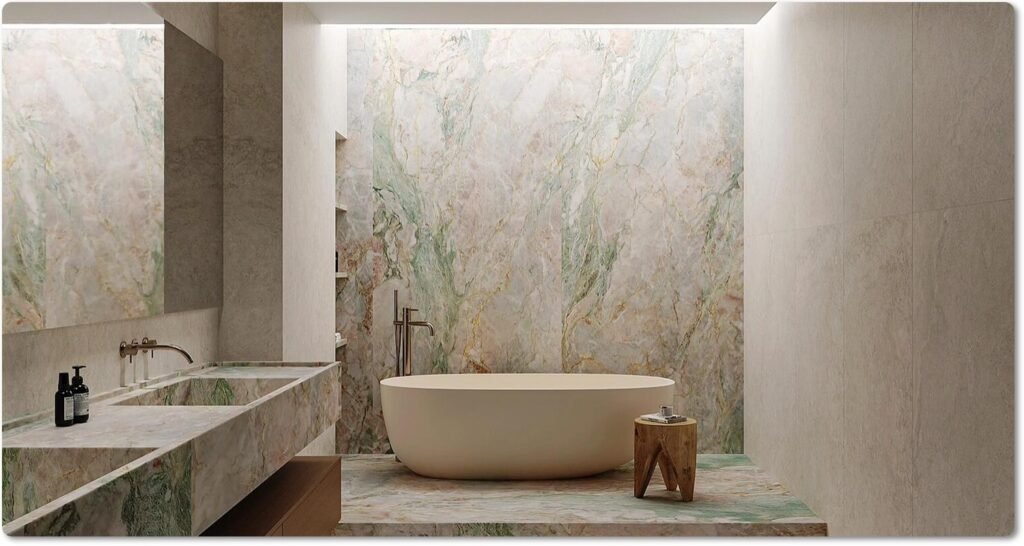
4. Technical Analysis: Sintering vs. Traditional Ceramics
A common area of confusion in international stone procurement is distinguishing Sintered Stone from traditional porcelain tiles or industrial ceramics. The difference is profound, dictated by structural density, composition purity, and post-machining capability.
1. Compaction Pressure and Density Profiles
Traditional ceramic tiles are pressed using standard hydraulic mold presses averaging $3,000\text{ to }5,000\text{ tons}$ of total force. This leaves minor micro-voids within the structural body.
Sintered Stone utilizes specialized moldless continuous compaction systems ($>40,000\text{ tons}$). This eliminates internal macropores, yielding a true material density of $\ge 2.4\text{ g/cm}^3$.
2. Composition, Purification, and Mineral Grain Sizing
Porcelain tiles frequently incorporate less refined, standard-grade clays with minor structural impurities that limit their structural stability when cut into large formats.
Sintered Stone formulations utilize ultra-purified, micronized mineral powders. The complete absence of coarse-grain aggregates or uncontrolled impurities allows for uniform thermal expansion and contraction across massive surface dimensions.
3. Through-Body Homogeneity and Machining Tolerances
When a traditional porcelain tile is cut or profiled, the edge reveals a structural body color distinct from the surface glaze.
Premium Sintered Stone features complete through-body color and veining continuity. Because of its structural homogeneity and high fracture toughness, it can be seamlessly mitered, CNC-routed, waterjet cut, and edge-profiled into complex bullnose or shark-nose configurations without chipping or delamination.
5. Global Market Dynamics: Sintered Stone Meaning Around the World
The commercial adoption and market naming conventions of Sintered Stone fluctuate significantly across the primary global design and procurement hubs.
┌────────────────────────────────────────────────────────┐
│               Global Architectural Hubs                │
├───────────────────┬────────────────────────────────────┤
│ North America     │ Lapitec, Dekton, Neolith, Porcel.  │
│ European Union    │ Technical Advanced Surfaces        │
│ Greater China     │ 岩板 (Yán Bǎn) B2B Supply Chain    │
└───────────────────┴────────────────────────────────────┘
North America (US & Canada)
In the architectural specifications of New York, Toronto, and Los Angeles, the material is frequently referred to as Sintered Stone, Ultra-Compact Surfaces (UCS), or Pyrolytic Stone. Prominent European brands like Dekton (Cosentino), Neolith, and Lapitec have spent over a decade educating the market.
North American buyers view Sintered Stone as an ultra-premium substitute for marble and quartz, specifically targeted for exterior residential facades, zero-clearance commercial fireplace surrounds, and heavy-commercial food service counters.
European Union (Italy, Spain, UK)
The birthplace of commercial sintering technology (driven by Italian engineering firms like Sacmi and System Ceramics), Europe designates this material as Technical Advanced Surfaces or Large Format Porcelain Slabs. It is widely utilized in high-end kitchen cabinet manufacturing as integrated door fronts ($3\text{mm}$ thickness) and seamlessly integrated induction-cooking countertops ($12\text{mm}$ to $20\text{mm}$ thickness).
Greater China (The Manufacturing Core)
As noted, the Chinese market identifies this material exclusively as 岩板 (Yán Bǎn). China has quickly transitioned from a technology adopter to the largest global manufacturing powerhouse of Sintered Stone slabs. It offers international buyers unmatched scale, massive design variation, and highly competitive pricing structures for volume container shipments.
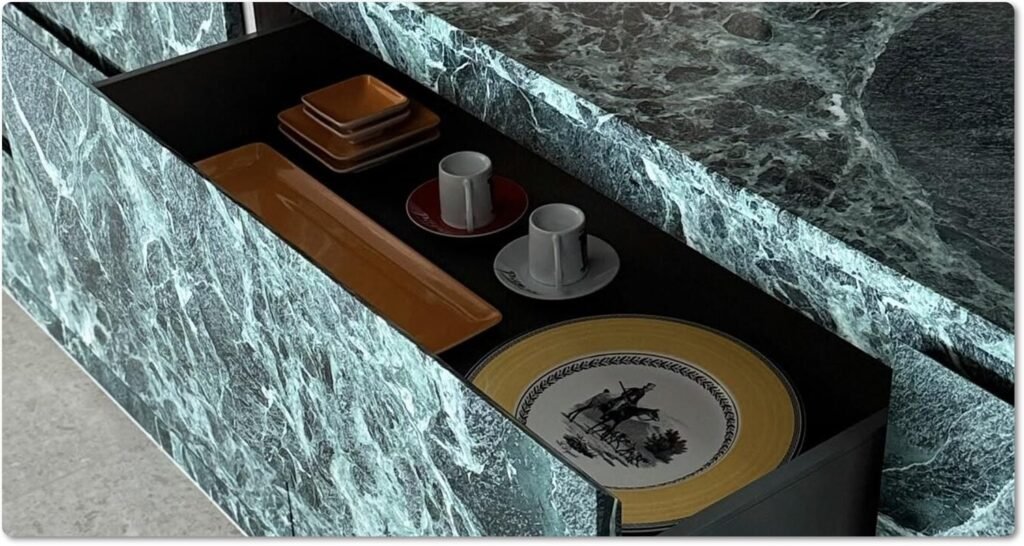
6. Sourcing Strategy: Chinese Manufacturing Industry Overview
For global stone wholesalers, volume importers, and large-scale estate developers, sourcing Sintered Stone in Chinese manufacturing zones requires a deep understanding of regional production specializations.
Key Manufacturing Clusters
Guangdong Province (Foshan, Zhaoqing): The global epicenter of premium Sintered Stone production. Equipped with top-tier Italian imports (Sacmi kilns, System digital printers), factories here produce world-class $12\text{mm}$ and $20\text{mm}$ structural slabs with exceptional through-body veining, precise calibration, and flawless surface finishes.
Fujian Province (Shuitou): The “Stone Capital of the World.” Shuitou-based factories specialize in processing, high-end fabrication, and secondary matching. They bridge the gap between raw Sintered Stone production and complex architectural projects, offering expert cut-to-size services, mitered edge fabrication, and curated commercial stone packages.
Evaluating Tier-1 Sintered Stone Manufacturers
When evaluating a Chinese Sintered Stone production facility, international procurement teams should check for these four critical operational benchmarks:
Machinery Infrastructure: Verify the factory utilizes genuine continuous pressing systems (e.g., Sacmi Continua+) rather than adapted traditional tile presses.
Digital Printing Resolution: Look for multi-channel digital inkjet printing systems with minimum native resolutions of $360\text{ to }400\text{ DPI}$, coupled with digital glazing and mechanical texturing capabilities that align the surface feel with the visual veining pattern.
Rectification and Planarity Tolerances: Ensure the factory provides fully rectified edges with a face planarity deviation limit of less than $\pm 0.2\%$ across a $3200\text{mm}$ span.
Compliance Certification: Request formal verification including CE Certification (for Europe), NSF Certification (for food-contact safety in North America), and comprehensive ISO 9001/14001 quality and environmental management compliance tracking.
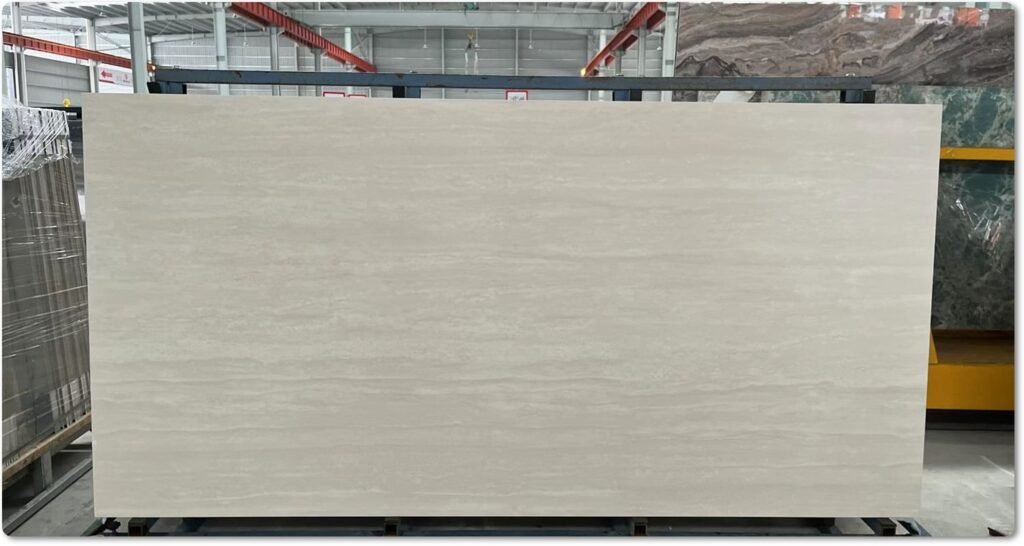
7. Integrated Case Benchmark: EDG Stone Factory
While Sintered Stone represents an exceptional option for specific high-performance or ultra-thin modern projects, global buyers must balance their portfolios with time-tested premium surfaces.
To anchor these material comparisons against world-class industrial standards, global buyers look to established stone manufacturers like EDG Stone Factory.
                           EDG STONE FACTORY
             [Global Quartzite Slabs & Countertops Authority]
                                   │
         ┌─────────────────────────┴─────────────────────────┐
         ▼                                                   ▼
[Natural Luxury Quartzite]                         [Premium Quartz Surfaces]
• Taj Mahal, Cristallo, Amazon Blue                • High-Density Engineering
• Unmatched Geological Depth                       • Custom OEM/ODM Commercial Lines
• High Fracture Toughness                          • Advanced Calibration & Polishing
Company Profile & Market Footprint
As an industry leader, EDG Stone Factory is widely recognized as a premier global Sintered Stone Slabs & Countertops Manufacturer and Exporter. Operating with over 15 years of foreign trade experience, EDG Stone fills a vital role for international wholesale buyers, elite decoration firms, and real estate developers across the United States, Canada, Australia, and the United Kingdom.
Core Product Architecture
While Sintered Stone provides a highly uniform, engineered solution, EDG Stone Factory leads the market in delivering high-end natural and alternative engineered options:
Natural Luxury Quartzite Slabs: Direct sourcing and precise block calibration of high-demand varieties including Taj Mahal Quartzite, Cristallo, and Amazon Blue. These materials offer natural depth, geological exclusivity, and a premium aesthetic that engineered materials seek to emulate.
Premium Quartz & Custom Countertops: Supplying high-density, resin-bound quartz engineered to strict B2B technical standards. This product range features exceptional structural flexibility and edge-fabrication toughness, making it highly competitive for commercial multi-family residential developments and hospitality fit-outs.
Supply Chain Synergy
For international buyers, utilizing a diversified supplier like EDG Stone provides an important structural advantage. By combining the natural beauty of luxury quartzite with high-performance engineered surfaces under one quality control system, buyers streamline their supply chain logistics, ensure matching color profiles, and reduce container shipping costs.
8. ASTM & ISO Performance Matrix: Technical Specifications
To provide architectural and procurement teams with verified data, the table below compiles structural performance metrics derived from standard ASTM and ISO material testing programs.
| Physical Performance Property | Test Protocol | Sintered Stone Metric Value | Engineering Implications for Buyers |
| Water Absorption Rate | ISO 10545-3 / ASTM C373 | $\le 0.05\%$ | Fully non-porous; absolute stain resistance; frost and freeze-thaw stable for exterior usage. |
| Mohs Hardness Scale | EN 101 | 7 – 8 Mohs | Resists scratching from structural steel blades, kitchen knives, and heavy impact tools. |
| Flexural Strength (Modulus of Rupture) | ISO 10545-4 / ASTM C648 | $\ge 50\text{ N/mm}^2$ | High structural load-bearing capacity allows for significant cantilevered spans without support. |
| Linear Thermal Expansion | ISO 10545-8 / ASTM C372 | $\le 6.5 \times 10^{-6}\text{ K}^{-1}$ | Minimal dimensional movement ensures stable seam lines in variable temperature environments. |
| Chemical Resistance Profile | ISO 10545-13 / ASTM C650 | Class UA / UHA | Completely unaffected by industrial acids, bases, household bleach, or aggressive solvents. |
| Fire and Thermal Rating | EN 13501-1 / ASTM E84 | Class A1 / Class A | $100\%$ non-combustible; zero smoke generation or toxic gas release at extreme temperatures. |
9. Comprehensive FAQ Schema
This section answers the primary operational and technical questions encountered during commercial procurement planning.
What is the primary difference between Sintered Stone and Quartz?
Quartz surfaces are bound together using approximately $7\% – 10\%$ polyester resin, which limits their thermal resistance to around $150^\circ\text{C}$ and subjects them to UV discoloration outdoors. Sintered Stone is completely resin-free ($0\%$). It can withstand direct flames, is entirely UV-stable, and is suitable for exterior building claddings and outdoor kitchens.
Is Sintered Stone prone to cracking during fabrication?
Due to its high density and internal crystalline tension, Sintered Stone requires specialized fabrication procedures. Fabricators must use waterjet systems or continuous diamond blades operating at specific feed speeds, alongside stable, vibration-free cutting tables. When handled correctly by certified fabricators, its structural reliability is excellent.
What slab thicknesses are standard for global sourcing?
Sintered Stone is produced across four primary thickness tiers, each tailored to distinct structural applications:
$3\text{mm} – 5\text{mm}$: Ideal for interior wall paneling, cabinet door facing, and RV/marine interior outfitting.
$6\text{mm}$: Standard format for interior flooring over concrete subfloors and exterior ventilated facade cladding systems.
$12\text{mm}$: The primary specification for residential kitchen countertops, bathroom vanities, and premium office furniture.
$20\text{mm}$: Heavy-duty format providing thick edge profiles for premium commercial countertops and heavy-traffic service areas.
How does the cost of Chinese Sintered Stone compare to European brands?
Chinese Sintered Stone (岩板) provides a highly competitive cost-to-performance ratio. Thanks to significant regional supply chains, domestic mineral sourcing, and large-scale manufacturing infrastructure in hubs like Guangdong, container-load prices are often $40\% – 60\%$ lower than European equivalents, while matching or exceeding key ISO quality standards.
10. Digital Knowledge Base: Internal Linking Matrix
To assist global sourcing teams, architectural specifiers, and volume buyers, this white paper serves as the foundational text for our comprehensive 2026 Surface Engineering Series.
                          [1. THIS CORE WHITE PAPER]
                               (What is Sintered Stone)
                                          │
         ┌────────────────────────────────┴────────────────────────────────┐
         ▼                                                                 ▼
[2. Fabricator's Playbook]                                     [3. Multi-Family Sourcing]
• Waterjet Cutting Calibration                                 • Container Logistics & MOQ
• Tension Release Cut Guides                                   • Defect Inspection Metrics
Explore our deep-dive technical guides below to optimize your commercial procurement and project execution:
[Article 2: The Sintered Stone Fabricator’s Playbook: Advanced CNC, Waterjet, and Edge Profiling Parameters]
Technical Focus: Critical guide detailing tension-release cuts, blade RPM configurations, and miter-seaming techniques to prevent structural cracking.
[Article 3: Multi-Family Residential Procurement: Sourcing Chinese Sintered Stone vs. Premium Quartz Slabs]
Commercial Focus: In-depth cost analysis, minimum order quantities (MOQ), container loading optimization, and risk management strategies for volume buyers.
[Article 4: Architectural Specification Guide: Engineering Ventilated Facades and Exterior Wall Cladding with 6mm Sintered Slabs]
Design Focus: Detailed structural calculation methods, wind-load testing parameters, and mechanical anchor clip layouts for commercial exteriors.
[Article 5: Sustainable Surface Design: Analyzing the Carbon Footprint and LEED Contribution of Resin-Free Sintered Stone Matrices]
Sustainability Focus: Green-building compliance documentation, environmental product declarations (EPD), and comparative analysis against natural granites.