Executive Summary
Quartzite slab sizing is not just a logistics issue; it is a design, yield, and risk-management variable. Quartzite is a metamorphic stone formed from sandstone, and because its commercial slab format is driven by quarry block size, factory equipment, and project requirements, there is no single universal “standard” slab dimension. In the market, however, large-format quartzite is commonly supplied in sizes such as 3 m × 2 m, while broader stone-industry references show jumbo slab trends clustering around roughly 65 in × 130 in, with exact dimensions varying by manufacturer. Larger slabs can reduce seams and increase design continuity, but they also change fabrication difficulty, handling risk, and yield strategy.
For buyers, fabricators, designers, and exporters, the right question is not “How big is a quartzite slab?” but “Which slab format gives the best usable yield for the planned application, while keeping seams, waste, support, and transport risk under control?” This whitepaper reorganizes the topic from fundamentals to application to procurement, so the reader can move from material selection to production planning with fewer assumptions and fewer expensive surprises.
1) Why does slab size matter before anyone starts cutting stone?
In stone procurement, slab size directly affects project cost because every inch of slab width and length influences how many seams are needed, how much waste is produced, and whether a project can be completed from one slab, two slabs, or a bookmatched pair. That matters especially in kitchen design, where NKBA planning guidance sets minimum clearances such as 42 in for one cook and 48 in for multiple cooks, 36 in for walkways, and 60 in between opposing arms in a U-shaped kitchen. Those room dimensions define the countertop footprint, which in turn defines slab selection.
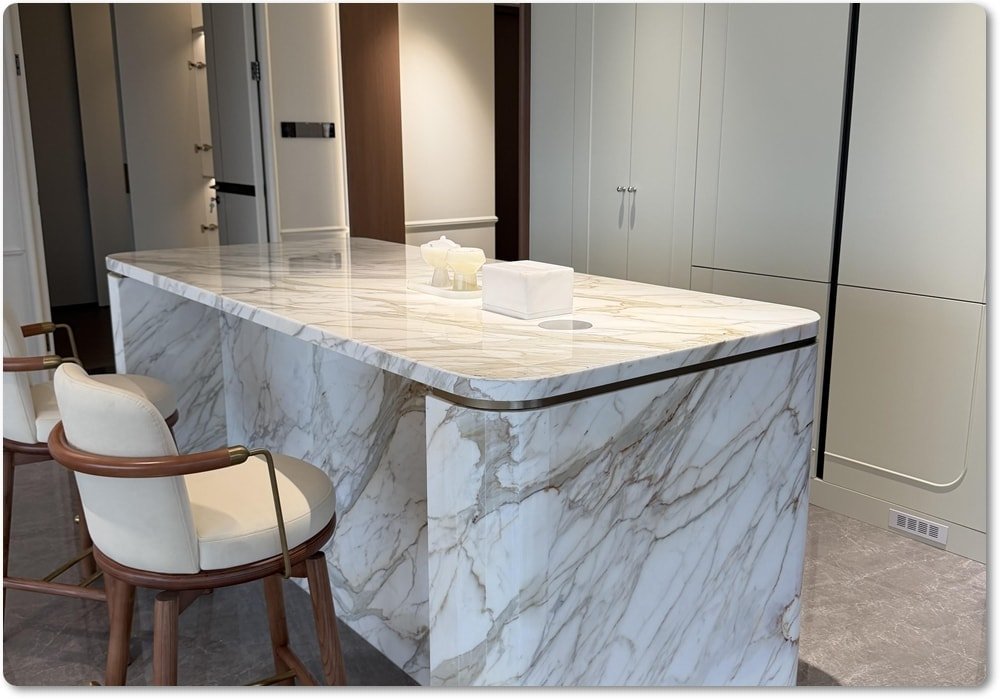
In practical terms, a larger slab can be the difference between a continuous waterfall island and an island that requires visible joints. It can also be the difference between efficient nesting and unusable remnants. Industry commentary consistently notes that larger slabs support bigger islands, fewer seams, and less waste in larger projects. That is why slab size should be selected after the room layout is locked, not before.
For quartzite specifically, that logic is even more important because the stone is valued for strength, density, hardness, abrasion resistance, and weathering durability. Still, those benefits do not remove the need for careful fabrication planning. Quartzite’s performance is excellent for countertops and other dimension-stone uses, yet the factory still has to manage seams, support, cutting, and handling, as with any other premium natural stone.
2) Standard quartzite slab dimensions: what “standard” really means
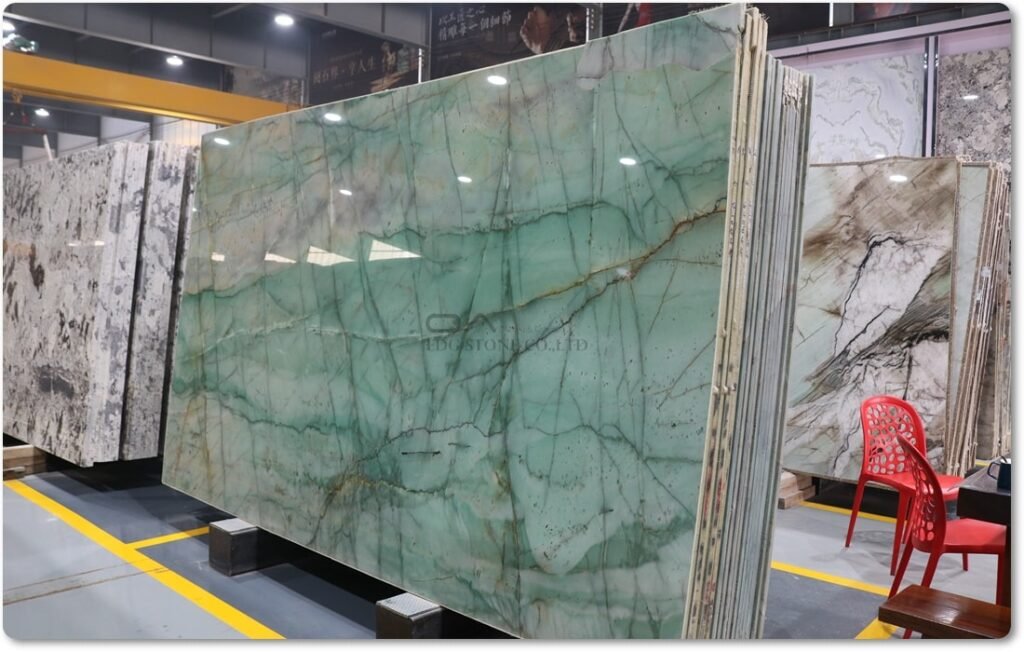
There is no single global standard for quartzite slab size. In the market, “standard” usually means the size a supplier commonly produces or stocks for a given quarry run, while “jumbo” means a larger format that provides more usable surface and fewer seams. A modern quartzite program may offer 3 m × 2 m slabs in both 2 cm and 3 cm thicknesses, and supplier listings also show quartzite slabs in 2 m × 3 m × 3 cm format. At the broader stone-industry level, jumbo slab discussions commonly reference approximately 65 in × 130 in versus standard sizes around 56 in × 120 in, but the exact measures can differ by manufacturer.
Commercial format logic
Commercial format should be understood in three layers:
First, the quarry and block yield determine the rough usable area. Second, the cutting line determines the final slab format. Third, the market determines whether a slab is sold as standard, jumbo, or special order. Because of that chain, two quartzite products with the same color family may arrive in different dimensions depending on the supplier, even when both are commercially acceptable.
For specification work, the safest rule is simple: never write “quartzite slab size” in a purchase order without requesting the actual cut sheet or slab map. The industry’s own technical references emphasize that project-specific installation details, tolerances, and seam planning need to be aligned with the actual material being supplied, not with a generic assumption.
Practical slab-size table
| Market format | Typical planning meaning | Procurement note |
|---|---|---|
| Standard slab | Baseline production size | Suitable for many vanities, smaller kitchens, and some backsplashes |
| Jumbo slab | Larger footprint with fewer seams | Better for islands, long runs, and large wall cladding |
| Custom block cut | Project-specific layout from selected block | Best for bookmatch, repeated vein control, and high-value projects |
The exact cut dimensions must always be confirmed with the supplier, because published examples show both 3 m × 2 m quartzite slabs and other jumbo formats, and the broader slab market is explicitly variable by manufacturer.
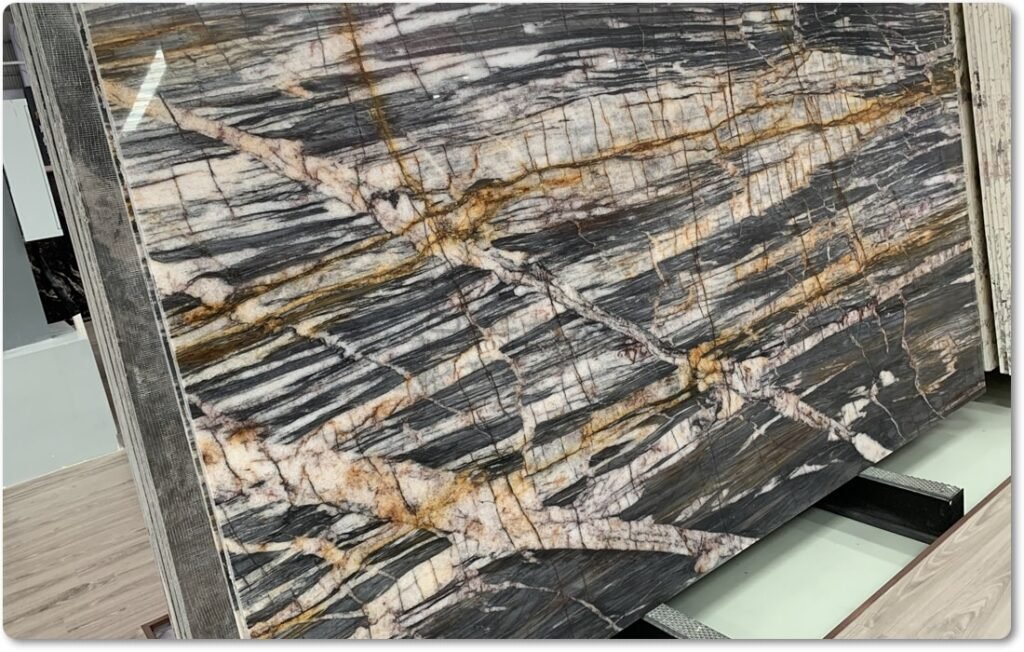
3) Quartzite thickness options: 2 cm, 3 cm, and thick custom formats
Quartzite programs commonly offer 2 cm and 3 cm slabs, and some suppliers publish those thicknesses alongside large-format dimensions. That matters because thickness affects not only appearance and edge profile, but also fabrication strategy, transport risk, and support requirements. In general, 2 cm material is more fabrication-sensitive and often needs more careful reinforcement planning, while 3 cm material is more substantial for exposed countertop edges and certain heavy-use applications.
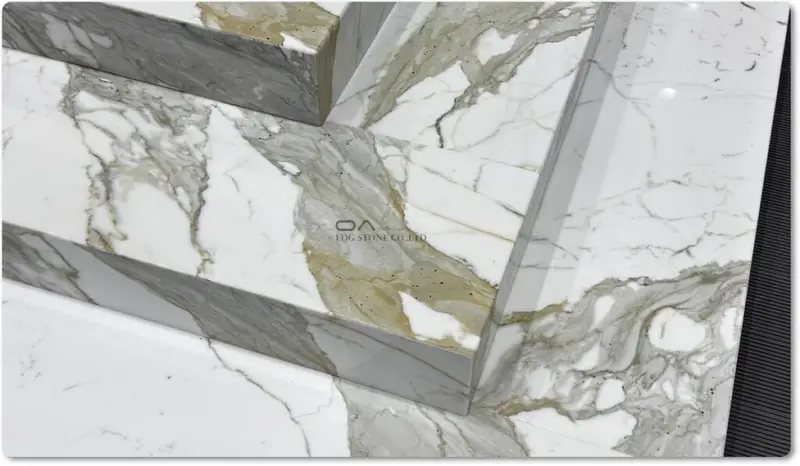
A thick custom format should not be treated as a visual upgrade only. It is a structural decision. The Natural Stone Institute’s installation standards explicitly cover seam placement, rodding sink cutouts, overhangs and cantilevers, resin-impregnated slabs, joint widths, and tolerances. That tells buyers and fabricators exactly where the real risk sits: not just in the look of the slab, but in how the slab behaves once it is cut, handled, and supported.
2 cm slabs
2 cm quartzite is often selected for vertical applications, backsplashes, some vanity projects, and thinner-profile design concepts. Its main advantage is lower material mass per slab area, but the tradeoff is that certain edge details and large spans may require more engineering attention. Because slab handling risk exists at any thickness, and because stone slabs can be extremely heavy, 2 cm material still demands disciplined shop and lifting procedures.
3 cm slabs
3 cm quartzite remains the most intuitive choice for many premium countertop projects because it provides a stronger visual edge presence and can simplify certain fabrication decisions. For waterfall islands and long continuous runs, 3 cm can reduce the need for mitered build-ups in some design intents, although actual support and seam planning still must be engineered to the project. Industry sources repeatedly note that larger slabs and thicker formats are favored because they reduce seams and support larger islands.
Thick custom formats
Custom thick formats belong in high-end residential, hospitality, and commercial settings where design continuity and durability are both critical. The right approach is not to choose the thickest slab available, but to define the exact application first: countertop, bar, vanity, cladding, wall feature, reception desk, or outdoor surface. Natural Stone Institute technical resources treat quartz-based stone as a material family with standards, tolerances, and reinforcement logic that must be matched to the application.
4) How to maximize material yield: use geometry, not guesswork
Yield is the percentage of slab area that becomes a useful installed product after cutting, seam planning, edge treatments, and approved remnant use. The simplest way to calculate it is:
Yield % = (usable finished area ÷ slab area) × 100
That formula is only the starting point. Real yield must also account for kerf, cutout waste, vein direction, mitered returns, sink openings, and breakage risk. A project that looks efficient on paper can become inefficient if the slab size does not match the room geometry or if the design includes waterfall returns and full-height backsplash pieces that compete for the same slab area. This is exactly why larger slabs matter in higher-value projects: they provide more continuous run length and often reduce waste.
A practical planning method
Start with the room, not the stone. Use the kitchen or bath dimensions to define the longest uninterrupted pieces first. NKBA guidance on aisle widths and walkways helps determine the room envelope, and that envelope determines whether the layout can be executed with one slab or whether the project should be split across two or more slabs.
Next, list the largest pieces in descending order: island top, waterfall sides, perimeter runs, backsplash strips, end panels, then remnants. This sequence matters because the largest pieces are the hardest to fit and the easiest to lose if the slab is not mapped correctly. When the large pieces are placed first, the remaining geometry becomes much easier to optimize. That is the core logic behind nesting layout optimization and digital slab mapping.
Example: one kitchen, three possible outcomes
Imagine a kitchen with a large island and a full-height backsplash. A 3 m × 2 m quartzite slab may be enough for a compact island without a waterfall, but the moment the design adds two waterfall sides and a backsplash, the same slab can become insufficient. At that point, the decision is no longer “beautiful or not,” but “how many slabs, where do seams land, and which pieces can be nested together without compromising appearance.” Because exact slab dimensions vary by manufacturer, this assessment must be done from the actual slab map, not from a catalog photo.
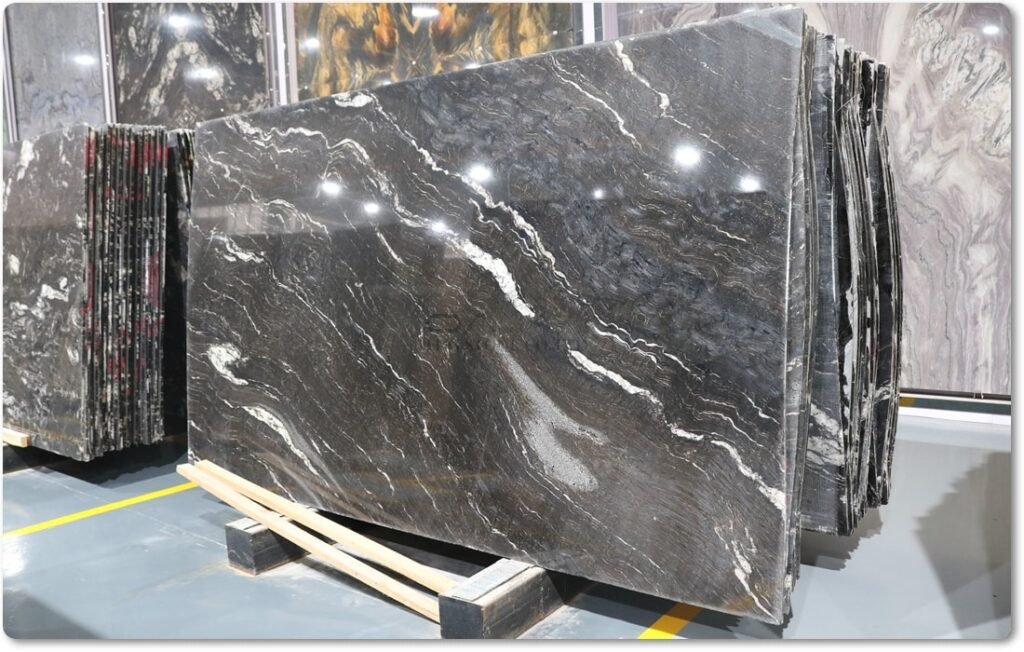
5) Yield by application: kitchen countertops, waterfall islands, and full-height backsplashes
Kitchen countertops
Kitchen countertops are the baseline application for quartzite because the material combines durability with high-end visual appeal. Industry sources and supplier programs explicitly position quartzite for countertops, waterfall islands, floors, and accent walls, with large-format slabs helping maintain visual continuity across long runs. For buyers, the key yield variable is whether the countertop run can be completed from one slab and whether cutouts can be positioned to preserve usable remnants.
Waterfall islands
Waterfall islands are where yield planning becomes decisive. A waterfall requires the top surface and the vertical drop to be cut from the same material family, often with vein continuity or mirrored flow. That means the island must be planned as a system, not as a single countertop. Larger slabs are especially valuable here because they reduce the number of seams and give the fabricator enough continuous length to maintain the visual language of the stone.
Full-height backsplashes
A full-height backsplash can dramatically improve design impact, but it also consumes large amounts of vertical slab area. If the backsplash is being matched to the countertop color and pattern, the question is not just coverage; it is pattern control. In quartzite projects with strong veining, a full-height backsplash may justify a larger slab even if the countertop alone would not. That is the point at which bookmatching or sequential slab selection becomes a real procurement decision.
Seam planning
Seam planning should always be treated as an engineering and visual decision. Natural Stone Institute installation standards specifically address seam placement and joint-width issues, and its technical Q&A notes that seams over dishwashers are not recommended. That is the kind of rule that should be embedded in every fabrication checklist, because a seam location that looks convenient on paper may be a weak point in service or an aesthetic problem in daily use.
6) Seam reduction strategies that actually work
The first strategy is to choose the right slab size in the first place. Larger slabs naturally reduce the number of seams needed, especially on larger islands and long kitchen runs. Stone industry reporting explicitly links larger slabs to fewer seams and reduced waste on larger projects.
The second strategy is to place seams where the geometry is most forgiving and where the material can be supported correctly. That usually means aligning seam decisions with cabinet breaks, support transitions, or visual interruptions rather than forcing seams into the center of the eye line. Natural Stone Institute standards exist precisely because seam placement is not a cosmetic detail; it is part of the structural and workmanship system.
The third strategy is to control fabrication conditions. Quartzite can present moisture-retention and fabrication challenges, and fabricators in the field report slower sawing, special blades, and more careful handling on some quartzites. That means seam quality depends not only on design, but on shop discipline, glue selection, dry-out time, and operator experience.
7) Bookmatching opportunities: when to use them and when to avoid them?
Bookmatching is most powerful when the vein structure is strong enough to create a deliberate mirror image and when the project has enough surface area to justify the extra planning. Quartzite’s visual strength makes it an excellent candidate for this type of presentation, especially on feature walls, reception areas, shower walls, and dramatic islands. MSI’s quartzite program explicitly shows large-format applications such as islands and full-height feature walls, which is exactly the type of application where bookmatching can elevate the final result.
Bookmatching should be decided before fabrication, not after. The slab pair must be selected from the same block sequence, photographed, approved, and mapped in advance. That way, the supplier, fabricator, and client are all working from the same visual target. A poorly planned bookmatch is worse than no bookmatch at all, because it creates expensive waste with weak visual payoff. The practical rule is simple: only bookmatch when the pattern, scale, and application justify the cost.
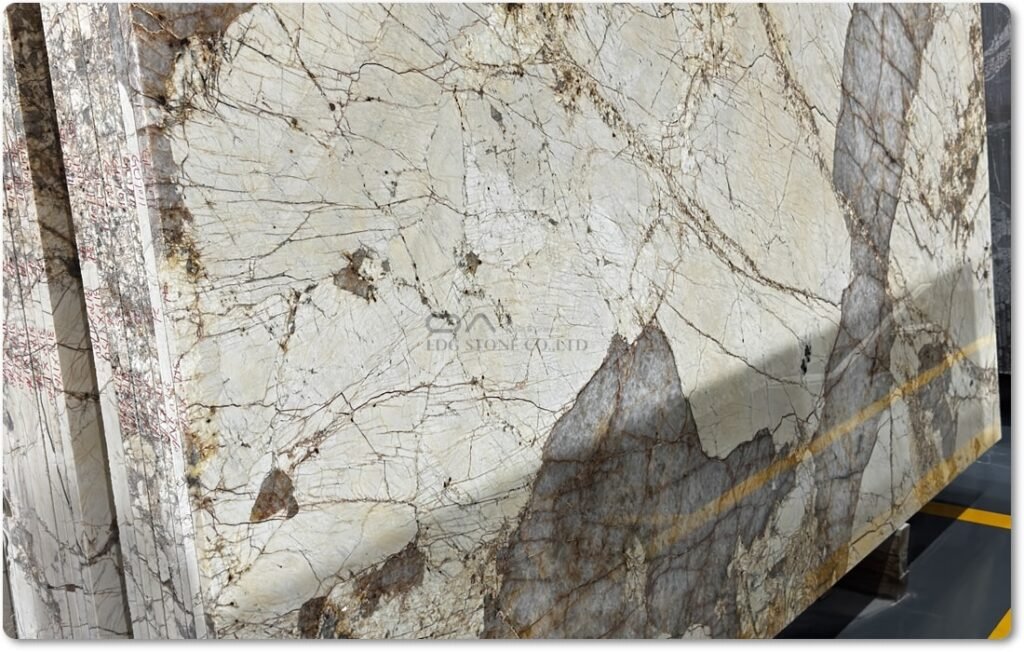
8) Waste reduction techniques: the difference between a good shop and a great one
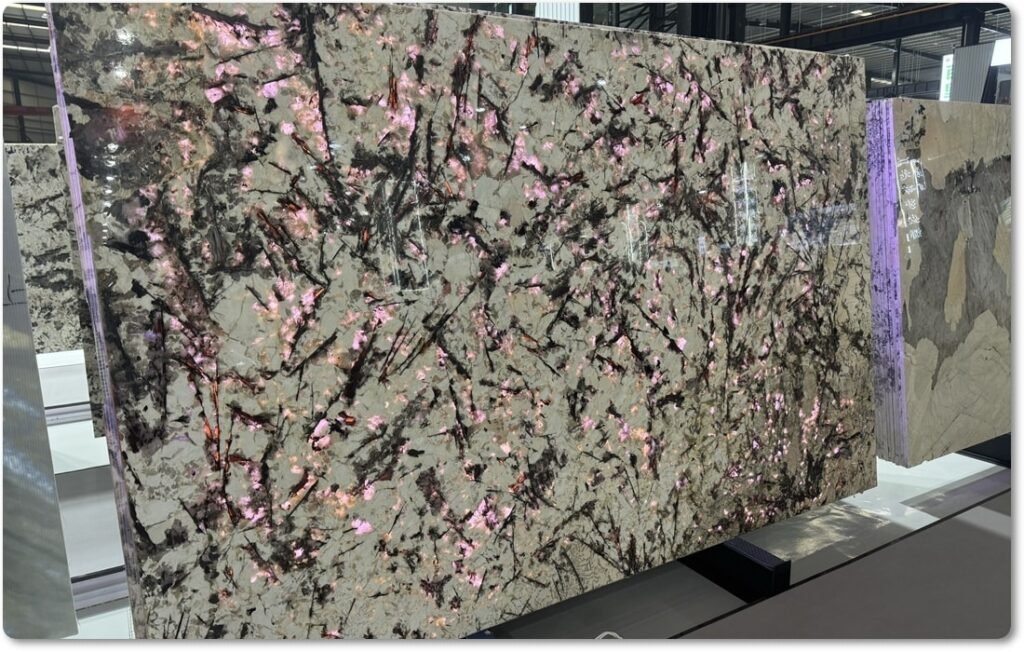
Waste reduction begins with slab mapping. The best planning sequence is: photograph the slab, mark the grain direction, place the largest pieces first, and then nest smaller strips and returns into the remaining geometry. Digital slab mapping is especially useful when the same quartzite color can arrive with meaningful pattern movement differences from slab to slab. Because quartzite is a natural material, the visual field is not uniform in the way a manufactured sheet material might be.
A second waste reduction tactic is to think in terms of remnant value. Offcuts from a quartzite project can often be used for vanity tops, threshold pieces, shelves, or smaller wall features, but only if the buyer and fabricator planned for that value before cutting started. If remnants are not specified early, their practical value drops quickly. This is why large projects should be purchased with a remnant strategy, not just a square-footage strategy.
A third tactic is to align slab size to the room envelope from the start. NKBA planning guidance on aisles and walkways gives the project its usable boundaries, and that boundary should be matched against the slab area before the order is placed. This is where the yield discussion becomes commercial: the right slab size often lowers installed cost even if the material price per slab is higher, because labor, seam count, and waste all fall.
9) EDG Stone Factory case module: how a quartzite factory should translate slab size into buyer confidence
EDG Stone Factory case module — global quartzite slabs & countertops manufacturer and exporter.
In a whitepaper like this, the factory case module should not rely on invented output numbers. It should show the production logic that protects buyer confidence. For EDG Stone Factory, that logic should be presented in the same sequence used by serious buyers: block selection, slab inspection, size confirmation, thickness control, finish verification, nesting review, seam plan approval, packing, and export documentation. That is the process that converts raw stone into a reliably delivered project material. The Natural Stone Institute’s technical and safety resources reinforce exactly this type of disciplined workflow, including slab handling, silica safety, tolerances, and installation standards.
The case module should also make clear that quartzite is not a “one-size-fits-all” product. MSI’s quartzite catalog shows that the same material family may be offered in 2 cm and 3 cm thicknesses and in large-format slabs, while field reporting shows that quartzite fabrication can require slower cutting, special blades, and moisture management. For an exporter, that means the sales promise must be tied to the actual slab map and the production spec, not to a generic sample photo.
For a global buyer, the most valuable message from EDG Stone Factory should be this: production control is part of product value. A factory that can inspect slabs consistently, match size to project geometry, and reduce seam count does more than sell stone. It lowers total installed risk. That is the commercial advantage this whitepaper should communicate.
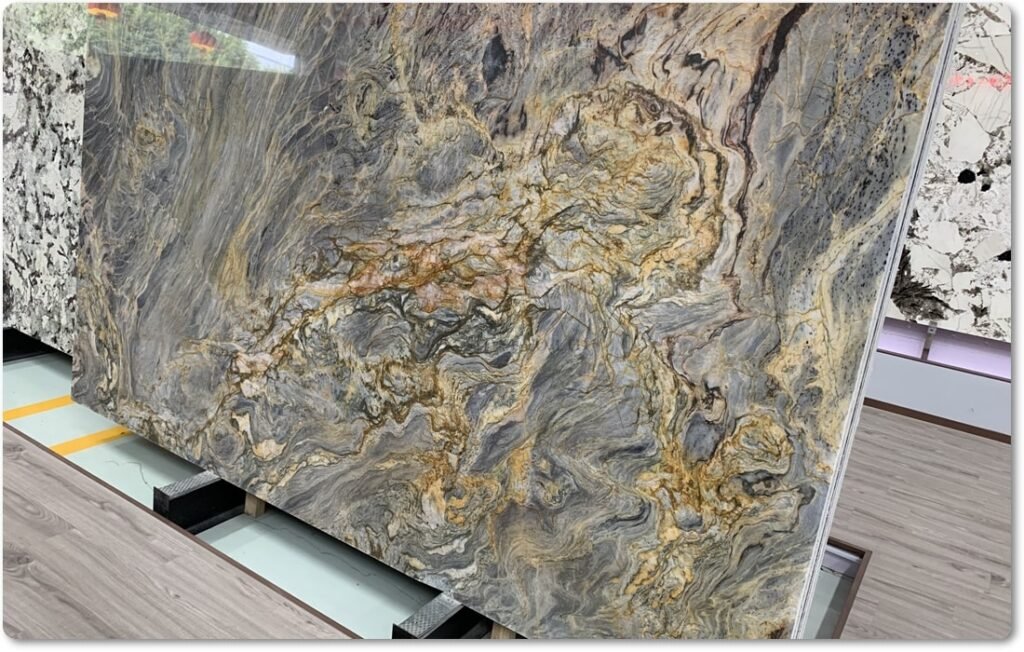
10) Size consistency controls: what to inspect before shipment?
Size consistency is not just a warehouse issue; it is a customer-experience issue. If a slab program claims a format, the buyer needs to verify actual length, width, thickness, surface finish, warp behavior, and visible consistency before packing. The Natural Stone Institute’s resources on quartz-based materials, tolerances, and installation standards exist because consistency affects both fabrication success and installation success.
A practical inspection sequence should include these checks: confirm slab dimensions against the cut list, confirm thickness across the slab, inspect for warpage and corner damage, confirm finish quality, and verify that the slab is suitable for its planned orientation. That last step matters because a slab that is acceptable for a backsplash may not be the best choice for a cantilevered island or a seam-critical waterfall return. The larger the slab, the more important flatness and handling become.
Safety cannot be separated from size consistency. Natural Stone Institute safety resources specifically cover silicosis prevention, safe slab handling, and exposure-control planning, while OSHA and CDC materials treat crystalline silica as a serious workplace hazard in stone fabrication. For a factory or exporter, that means quality control and worker safety belong in the same operational system.
11) Procurement conclusions: how buyers should choose the right quartzite slab size?
If the project is small and visually simple, a standard slab may be enough. If the project is large, seam-sensitive, or visually continuous, a jumbo format or custom block cut is usually the better business decision. That is especially true for large kitchen islands, feature walls, and applications where vein continuity matters. Industry reporting and supplier examples both show that larger formats reduce seams and support larger design spans.
Thickness should be selected by application, not by habit. 2 cm is suitable for many vertical or lighter-duty uses, while 3 cm often better supports premium horizontal surfaces. However, the final answer depends on support conditions, overhangs, seam locations, and project code requirements. Natural Stone Institute standards and NKBA planning guidance exist because these decisions have to be made in context, not in isolation.
The best procurement workflow is simple: define the room, define the slab size requirement, define the thickness, approve the actual slab map, and only then release the order. That sequence protects budget, schedule, and appearance. In a competitive market, the ability to connect geometry, yield, and production discipline is what separates a commodity sale from a professional supply program.
Internal link matrix for the quartzite cluster (15 articles)
| # | Supporting article | Suggested anchor text for this whitepaper | Link purpose |
|---|---|---|---|
| 1 | Quartzite Slabs 2026 Buyer Primer | quartzite slab size guide | Foundation topic |
| 2 | Quartzite vs Quartz: A Procurement Comparison | slab size and fabrication impact | Material comparison |
| 3 | Quartzite Slab Size Guide | this article | Core sizing reference |
| 4 | Quartzite Slab Quality Checklist | thickness and size inspection | QA and acceptance |
| 5 | Quartzite Slabs Export Guide 2026 | export-ready slab format | Logistics and compliance |
| 6 | Quartzite Slabs for Commercial Projects | large-format yield planning | Hospitality and multifamily |
| 7 | Quartzite Pricing and MOQ Strategy | slab size and total cost | Commercial buying |
| 8 | Quartzite Finish Selection Guide | polished, honed, brushed sizes | Surface selection |
| 9 | Quartzite Color and Vein Control Guide | bookmatching and slab mapping | Aesthetic planning |
| 10 | Quartzite Fabrication Tolerance Guide | seam placement and tolerances | Shop standards |
| 11 | Quartzite Kitchen Island Guide | waterfall and island yield | Residential application |
| 12 | Quartzite Bathroom Vanity Guide | compact format planning | Small-format application |
| 13 | Quartzite Backsplash and Wall Cladding Guide | full-height coverage planning | Vertical use |
| 14 | Quartzite Supplier Audit Playbook | slab inspection and controls | Vendor evaluation |
| 15 | Quartzite Shipping and Packing Guide | slab handling and breakage control | Export risk management |