Why Choose a Book-Matched Waterfall Island?
What is a waterfall countertop?
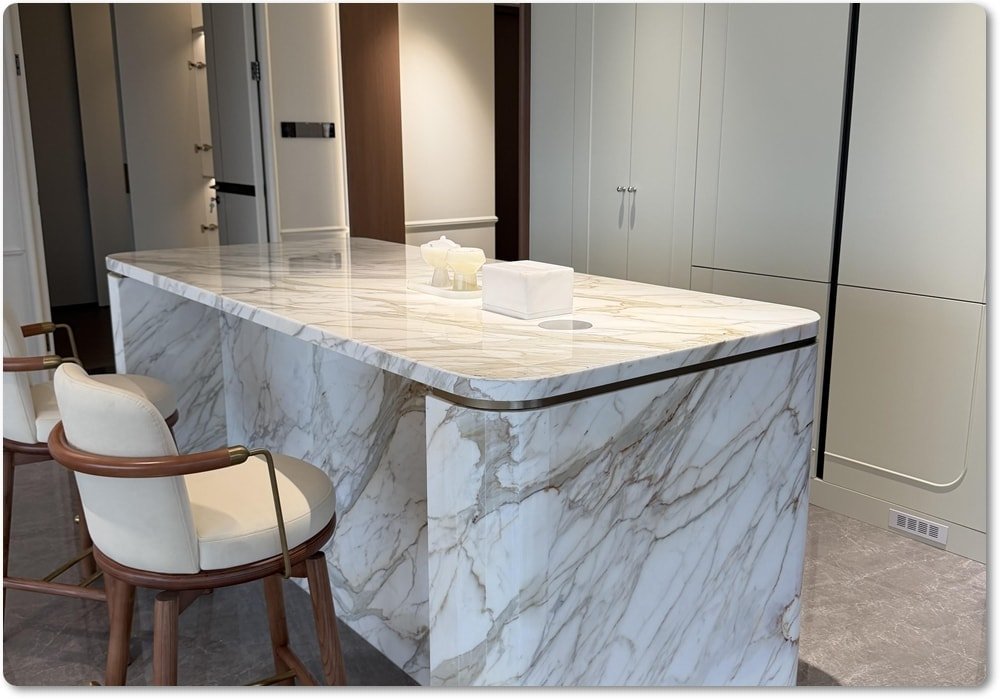
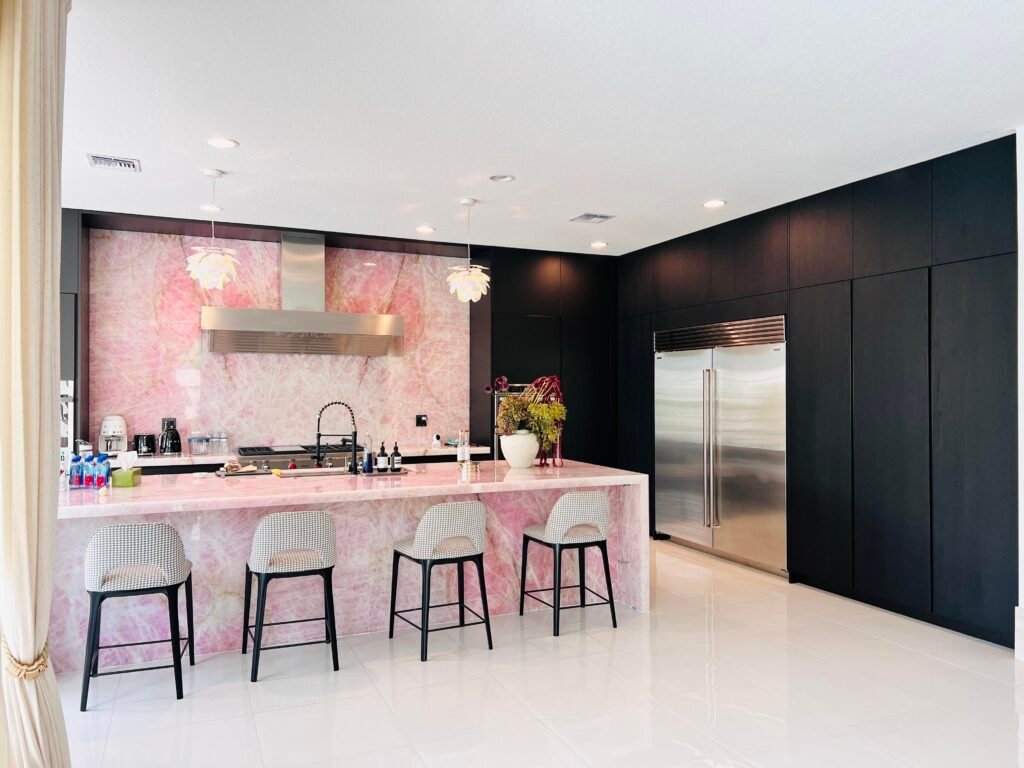
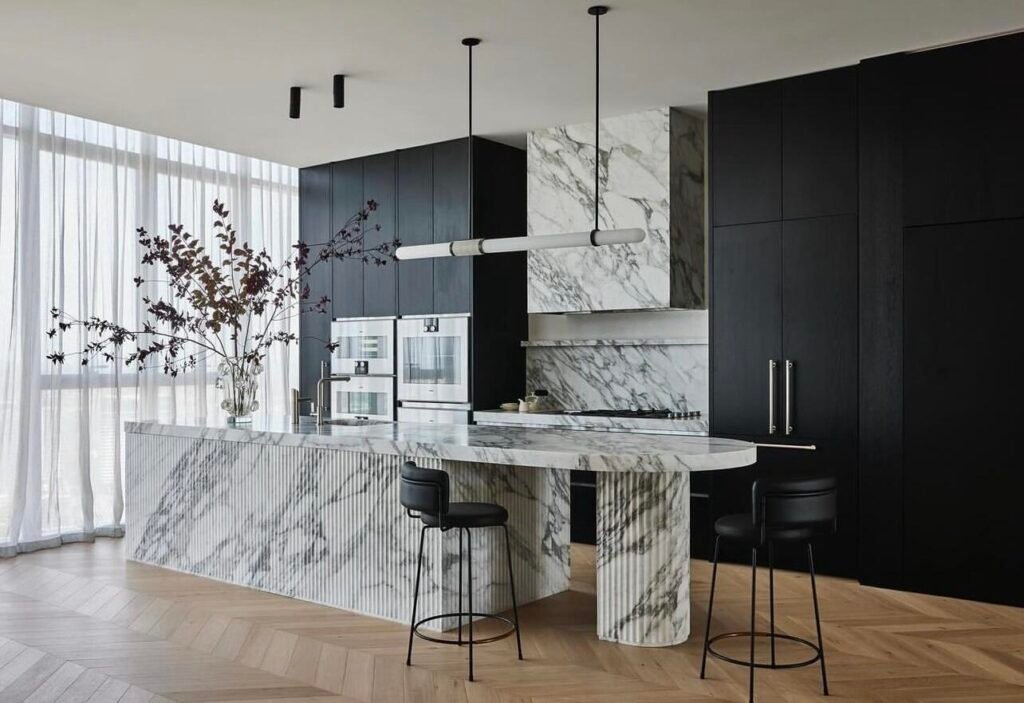
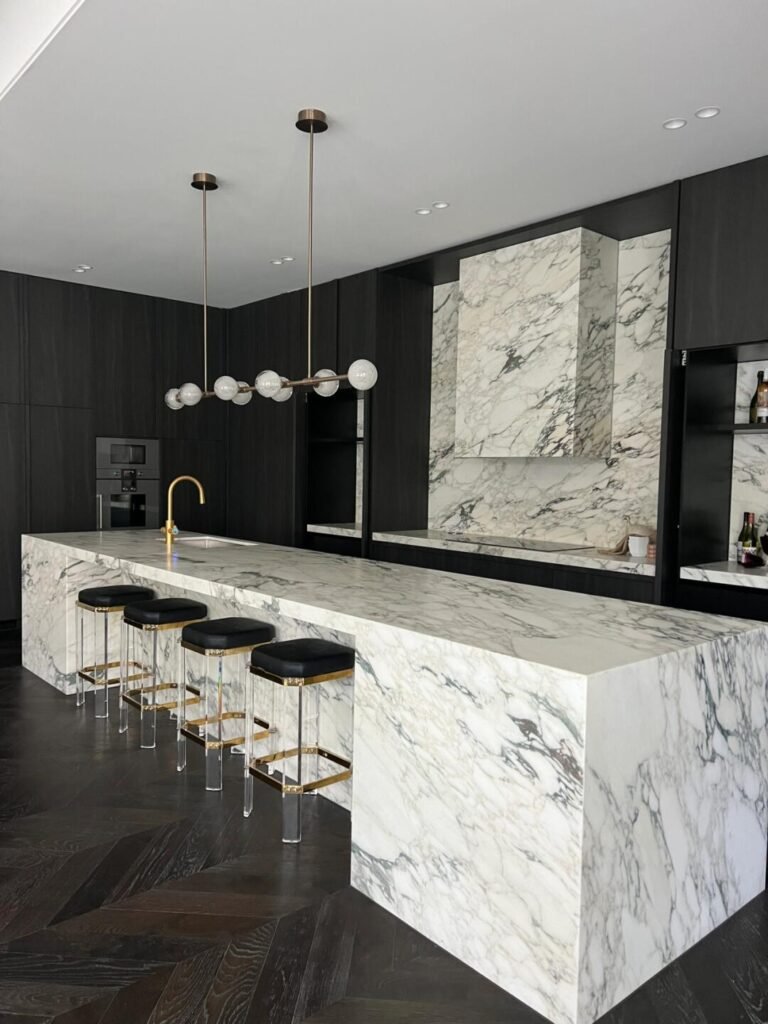
A waterfall countertop extends the horizontal plane of the island vertically down at one or more ends, creating a continuous vertical plane of material. When book-matched slabs are used, the vertical fall mirrors the top’s veining — producing a continuous, book-opened effect that reads as a single sculptural object.
What is book-matching and why does it matter?
Book-matching is the process of splitting a slab or adjacent slabs and arranging them so that the pattern on one slab mirrors the next, like opening a book. This creates dramatic, uninterrupted veining that emphasizes flow and symmetry — ideal for islands that serve as focal points in open plan kitchens. The technique amplifies visual continuity in waterfall islands and transforms slabs into architectural canvases. The Natural Stone Institute documents best practices and tolerances for book-matched installation and seam placement.
When is book-matching essential?
Book-matching is most compelling on large islands, center islands with seating on both sides, and in spaces where a single material must carry the visual weight of the room. For smaller islands, book-matching may still be used for a strong focal end or a dramatic breakfast bar.
Design Principles for an Integrated Waterfall Island
Composition & symmetry
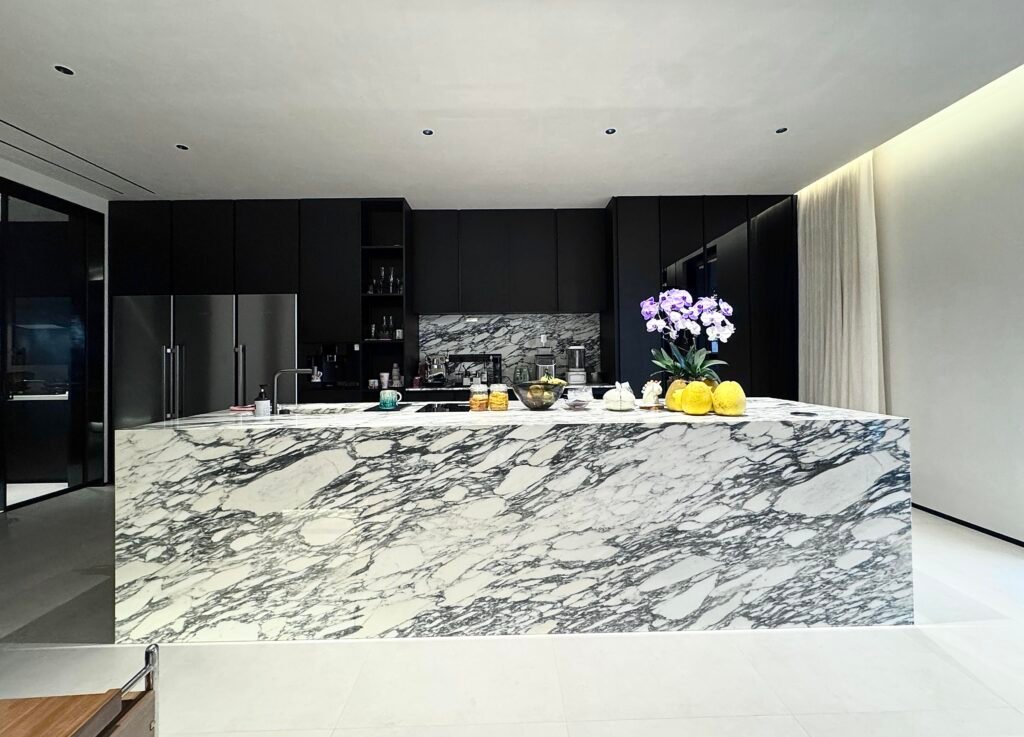
Successful book-matched islands center the primary vein(s) on the visual axis. Designers should create a layout mockup that shows where the seam(s) will sit in relation to sinks, cooktops, and seating. Symmetry does not mean strict mirroring in every case — deliberate asymmetry can be beautiful — but book-matching gives the option of perfect symmetry when desired.
Scale, proportion, and seating ergonomics
When adding seating on both sides, consider these rules: standard counter height (36 inches) for prep and seated dining at 30–36 inches for bar height seating. Overhangs for knee clearance typically range from 10–12 inches for table seating and 12–15 inches for bar seating with structural reinforcement. Plan stool placement so seams and joints occur away from primary sitting zones.
Edge profiles, sink placement, and appliance integration
Edge treatments (mitered waterfall, eased miter, laminated miter) affect perceived thickness and continuity. Mitred lamination (a structural, hidden seam that doubles the visible thickness) is popular for waterfall ends because it preserves vein continuity. Place sinks and cooktops centrally to avoid breaking the main visual line across the island.
Lighting & visual enhancement
Well-placed pendants, recessed downlights, and under-counter lighting enhance the three-dimensional quality of book-matched veining. Glossy polished finishes reflect light and dramatize pattern; honed or leather finishes create softer, tactile surfaces.
Choosing the Right Stone: Materials & Aesthetic Options
Natural stone choices (marble, quartzite, granite)
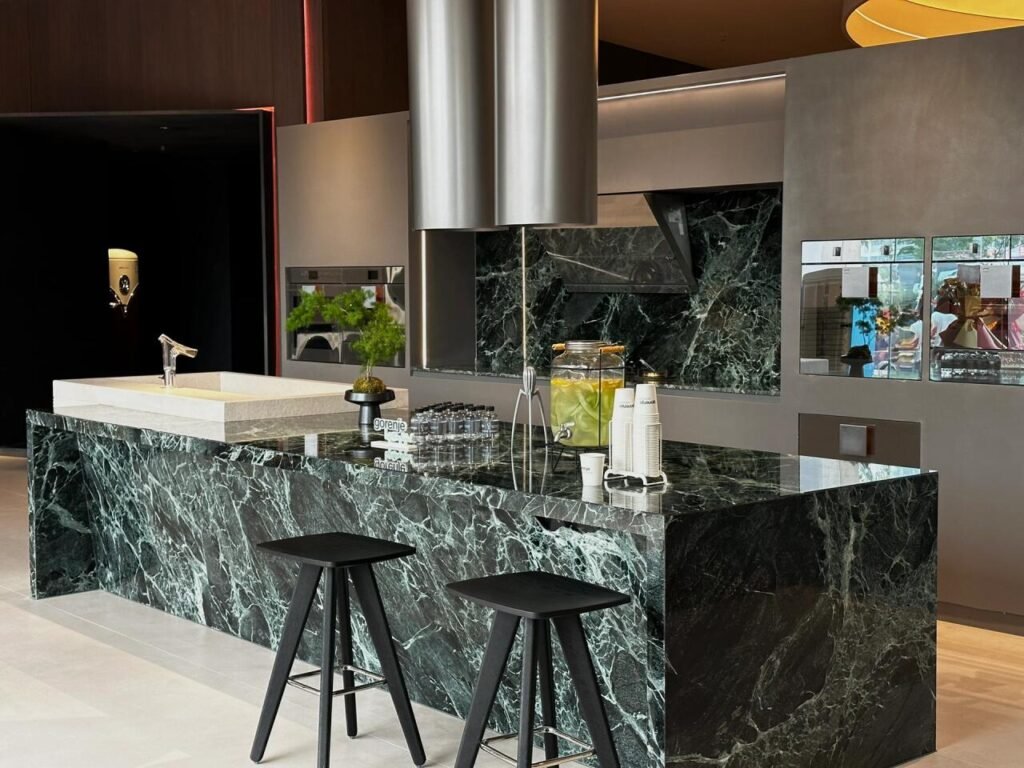
Marble: unparalleled veining and subtlety; vulnerable to etching and staining; often chosen for high-impact book-matched centers.
Quartzite: highly durable, can take a high polish; excellent for heavy-use islands with dramatic veining.
Granite: durable and available in wide color ranges; book-matching is less common because granites are typically more granular and less linear in veining.
Engineered stone & large-format sintered slabs
Modern engineered quartz and large-format sintered slabs can be manufactured with repeatable veining, and many manufacturers offer book-matchable pattern repeats. Engineered surfaces provide consistent color and easier maintenance; however, the “natural randomness” of some book-matched marbles can be hard to replicate. Engineered stone fabrication also introduces regulatory considerations because many engineered products have high silica content. Recent enforcement initiatives target engineered stone fabrication on silica exposure grounds.
Surface finishes and visual continuity
Polished finishes highlight veining; honed and leather finishes subdue reflection and provide a softer tactile effect. Choose finishes based on function (food prep vs. casual dining) and lighting conditions.
Slab sizes and yield
Book-matching requires slab pairs with matching vein orientation; this increases waste because edge-trim will remove the mate’s matching piece. When budgeting, account for yield loss — manufacturers and factory wholesalers often charge a book-matching premium for additional handling and waste.
Book-Matching Techniques & Fabrication Workflow
How are slabs prepared and paired?
Book-matching starts at the quarry or factory where slabs are numbered, selected, and mapped. The preferred faces are cut and labeled so the fabricator knows which piece pairs with its mate. Digital templates and scaled mockups are created to visualize vein continuity.
Layout planning: mockups and slab numbering
A digital mockup showing seam locations, sink placements, and edge profiles is essential. Many fabricators produce a high-resolution vein map and pre-approval images so designers and clients can confirm the final aesthetic.
Seam strategies and finishing
Seam strategy depends on vein alignment and location. Invisible seams use color-matched epoxy and skilled polishing; deliberate seams (accent seams) become a design feature. Scarf joints and mitered joints are commonly used in waterfall applications to maintain strength and continuity.
Templating & digital tech
Laser templating and 3D scanning reduce on-site surprises. Fabricators use CNC machinery for consistent edge profiles, and manual finishing ensures a perfect polish on seams.
Structural & Engineering Considerations
Substrate support & reinforcement
A waterfall island with seating on both sides often requires reinforced cabinetry, discrete steel frames, or hidden corbels. Cantilever spans greater than 8–12 inches usually need engineered support. Work with a structural engineer on larger spans or islands supporting heavy appliances.
Load-bearing for double-sided seating
Seating on both sides increases traffic, bump risk, and point loads (e.g., leaning). Ensure the island’s structure distributes load properly; consider steel-reinforced cores beneath slab joints, and avoid unsupported spans where people might sit or lean.
Handling and transport of oversized slabs
Large slabs demand specialized crates, L-bracing, forklifts, and experienced riggers. Oversized book-matched panels are heavier and more fragile in handling; plan site access, door sizes, and lift points in advance.
Installer checklist
Dry fit slabs and check vein alignment.
Confirm levelness and shim to specified tolerances.
Use structural adhesives and color-matched epoxies for seams.
Final polish seams after installation to ensure invisibility.
Fabrication Details: Edges, Seams & Finishes
Edge profile choices for waterfall treatment
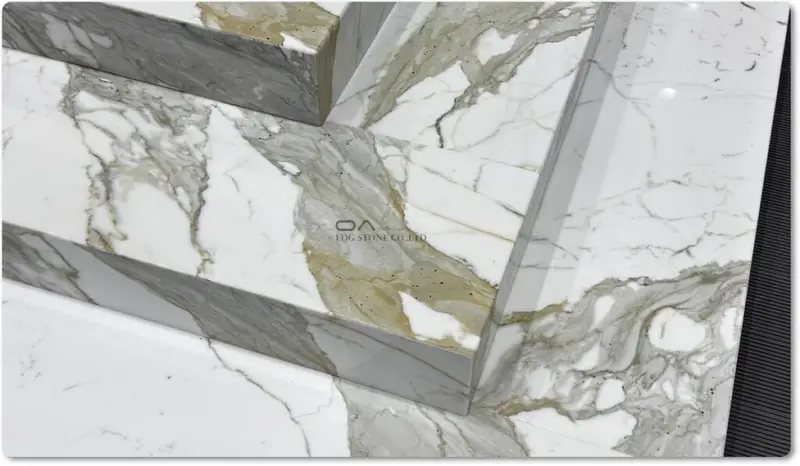
Popular options include: full mitered lamination (for a seamless 2-inch+ look), eased miter, or a simple eased edge with banding. Mitered lamination gives the illusion of a monolithic thickness and preserves visual flow.
Seam finishing for continuous veining
Seam techniques use color-matched epoxy and ultra-fine polishing. For book-matched veins, seam alignment is critical: even a 1–2 mm mismatch will be visible on linear vein patterns.
Integrating sinks and appliances
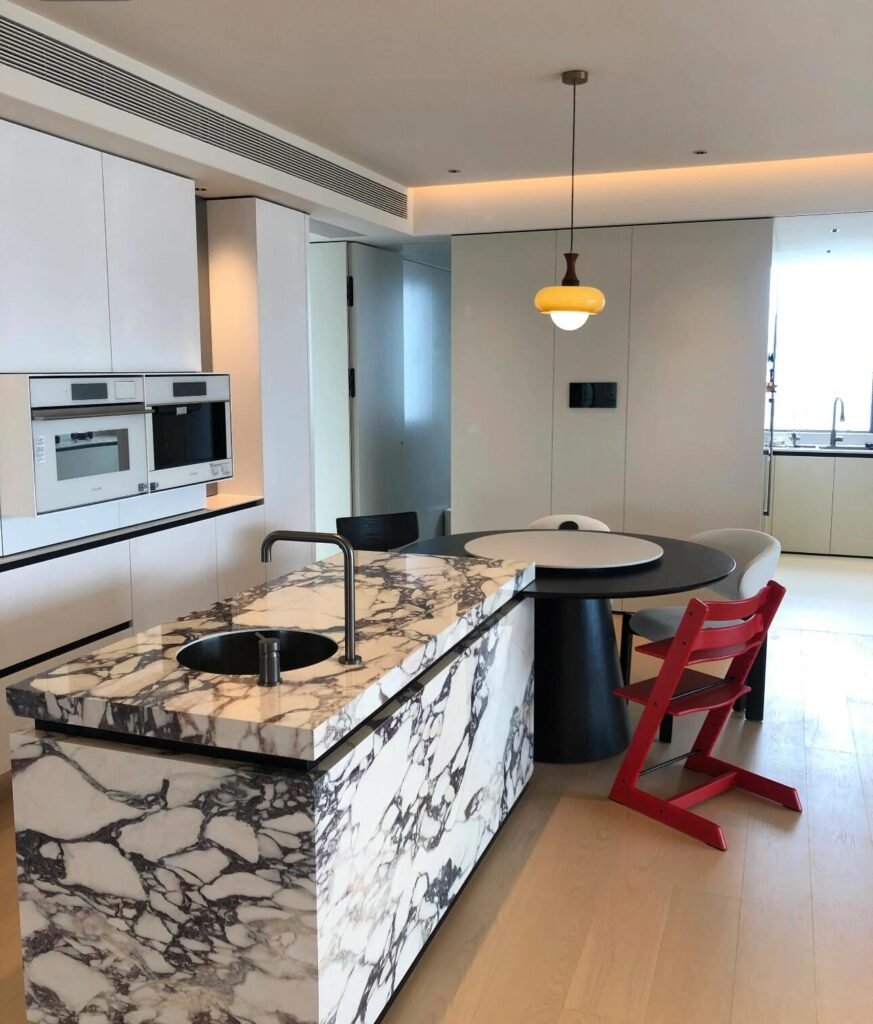
Under-mount sink integration requires precise cutouts to maintain vein flow around the aperture. Consider aligning sink rims with a vein break or using negative space design to preserve primary veins.
Protecting seating edges
Seating areas are high-traffic zones. Use edge protectors during construction, consider slightly rounded profiles for comfort, and in commercial settings, evaluate protective trims or durable finishes at lower edges.
Installation & Logistics — From Factory to Final Placement
Typical timeline
From slab selection to installation: 4–12 weeks depending on material, factory load, and shipping. Book-matching increases lead time because of slab pairing and mockup approvals.
Shipping & international logistics
Global shipping volatility affects delivery windows and costs; container and freight index volatility can change pricing and lead times quickly, so plan for contingency lead time and potential freight premiums. Industry freight indices and market reports demonstrate that container rates and routing disruptions remain material factors in procurement planning.
On-site installation sequence
Site confirmation and templating.
Crate removal and dry fitting.
Seam bonding and temporary bracing.
Final polishing and sealant application.
Common pitfalls
Wrongly matched slabs, poor seam alignment, insufficient support for cantilevers, and inadequate sealing at seating edges are the most common failures — each avoidable with careful planning and quality control.
Cost Drivers & Pricing Transparency
Primary cost factors
Material rarity (rare book-match slabs are premium).
Slab size and yield loss (book-matching increases waste).
Fabrication complexity (miters, seams, sink integration).
Shipping and logistics (container rates, insurance).
Compliance and safety protocols (dust control during fabrication can increase fabrication cost).
Pricing models
Some suppliers price by slab, others by square foot or linear foot, including fabrication. Book-matching typically carries a premium due to layout planning and yield loss. Ask manufacturers and wholesale factories for a breakdown: slab cost, fabrication, finishing, and logistics.
Estimating one-sided vs. both-sided waterfall
A double-sided waterfall often adds 25–50% to the material and fabrication cost compared to a single-sided waterfall, depending on slab width and whether a full book-match across both planes is required.
Maintenance, Durability & Long-Term Care
Stone-specific care
Marble requires more careful maintenance (acid sensitivity) than quartzite or granite. Engineered quartz is low-maintenance but may be sensitive to heat and harsh cleaners.
Sealers, cleaning, and seating protection
Use manufacturer-recommended sealers for natural stone and non-abrasive cleaners. For seating zones, consider discreet placemats, periodic re-sealing, and a soft buffer to prevent wear on waterfall edges.
Warranty & after-sales
Choose suppliers and manufacturers that provide written warranties for seams, finishes, and fabrication work. Factory-backed warranties and post-installation service reduce long-term risk.
Regulations, Sustainability & Compliance (Industry Direction)
Silica & worker safety
Cutting, grinding, and polishing stone — especially engineered stone — can create respirable crystalline silica dust, which is hazardous and regulated. OSHA requires employers to limit worker exposure under the respirable crystalline silica standards and has increased enforcement initiatives focused on engineered stone fabrication. Complying with silica rules affects fabrication method choices and increases the importance of wet cutting, dust extraction, and controlled environments.
Chemical regulations & REACH considerations
In Europe, REACH restrictions and substance registration requirements influence the use of certain resins, pigments, and chemical additives in engineered materials. Buyers sourcing internationally should confirm supplier compliance with chemical regulations and request digital safety data sheets when required. ECHA maintains guidance and substance information relevant for procurement teams.
Traceability & sustainability expectations
Sustainable procurement increasingly requires chain-of-custody documentation: quarry rehabilitation, worker health records, and embodied carbon estimates. Manufacturers that expose inventory plus compliance data help buyers meet green procurement criteria and regulatory disclosure.
Case Studies & Design Inspirations
Case A — Double-sided Waterfall Island with Integrated Seating
A bespoke island used two book-matched slabs to create an uninterrupted flow across the top and both waterfalls. Careful reinforcement allowed for a 14-inch overhang on both sides. The result: a focal piece that increased perceived value and improved buyer satisfaction.
Case B — Single-side Waterfall with Breakfast Bar
A single waterfall end paired with integrated seating produced similar drama with lower material cost and easier logistics — an effective compromise when slab width or budget is constrained.

FAQ (Google Hot-Search Style)
Q1. What is a waterfall countertop, and what makes a book-matched waterfall different?
A waterfall countertop extends vertically over the edge to the floor; a book-matched waterfall uses paired slab faces so veining is mirrored across the top and vertical drop, producing continuous, mirror-flowing patterns. Book-matching elevates the waterfall from a construction detail to an architectural statement with visual continuity.
Q2. How much does a waterfall island cost (one side vs both sides)?
Costs vary by material and fabrication complexity. Expect material and fabrication premiums for book-matched installations; a double-sided waterfall typically adds a significant percentage (often 25–50% or more) compared to a single-sided waterfall due to additional slab area, waste, and handling. Ask manufacturers for a detailed breakdown: slab, fabrication, delivery, and installation.
Q3. Can engineered quartz be book-matched like natural stone?
Yes — many engineered quartz and sintered slab manufacturers produce large-format sheets with repeatable vein patterns that can be book-matched. Engineered materials often simplify matching but require confirmation of pattern repeats and slab orientation before fabrication.
Q4. How do fabricators handle seams on large book-matched islands?
Fabricators use color-matched epoxy, precise CNC cutting, and post-installation polishing. Seams are often planned in low-contrast areas or aligned with design features; for visible veins, seam alignment is executed to the millimeter to maintain flow.
Q5. How long does the project take from slab selection to installation?
Typical timelines range from 4 to 12 weeks, impacted by slab availability, book-matching requirements, fabrication backlog, custom templating, and shipping. Allow extra time for large, book-matched panels and international shipping contingencies.