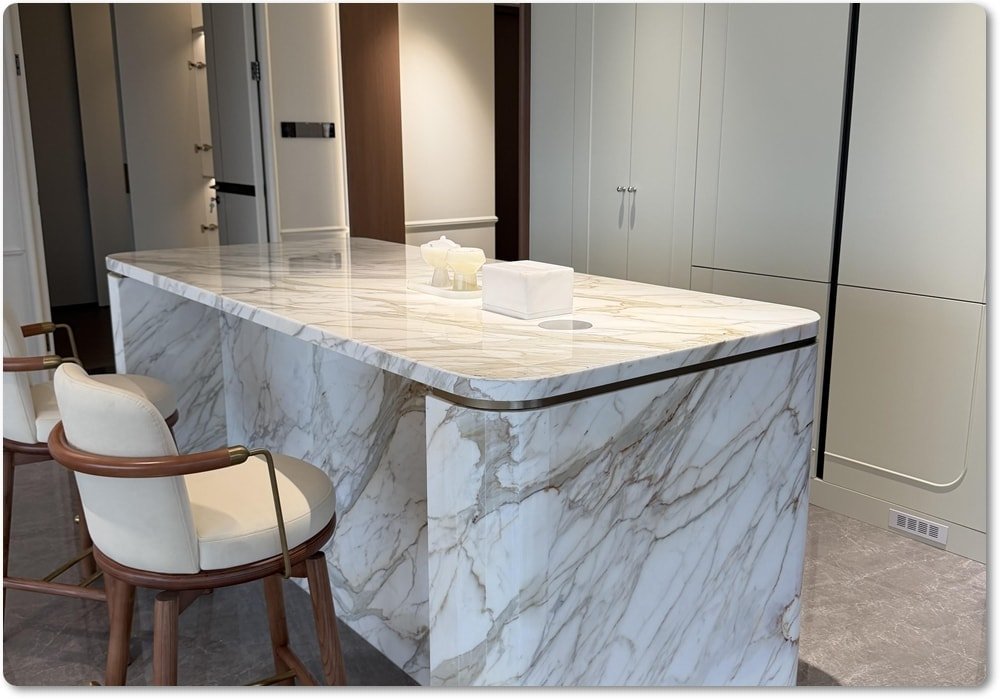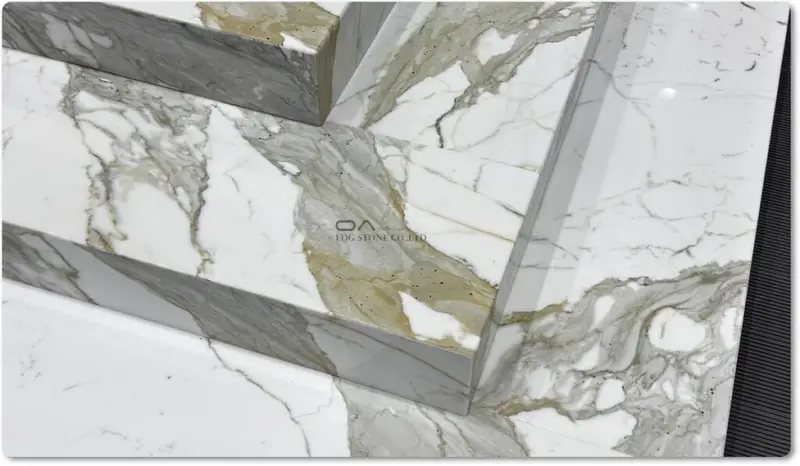
Dreaming Green Marble Slabs — Quick Summary
1. What is Dreaming Green?
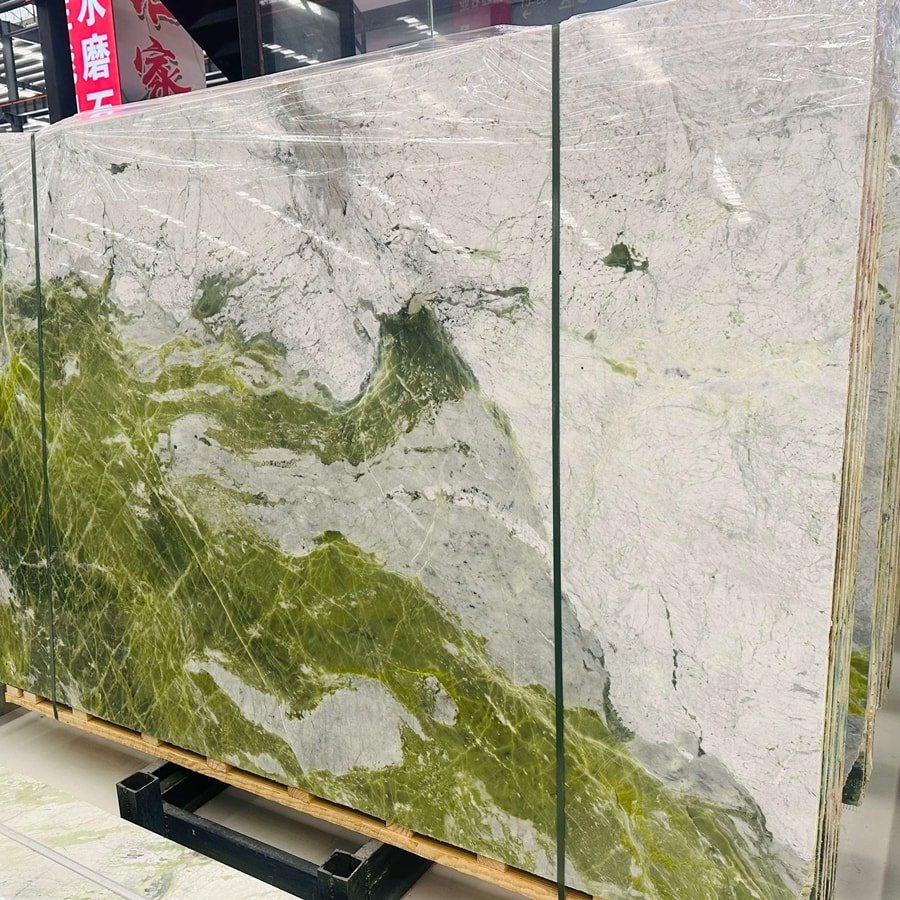
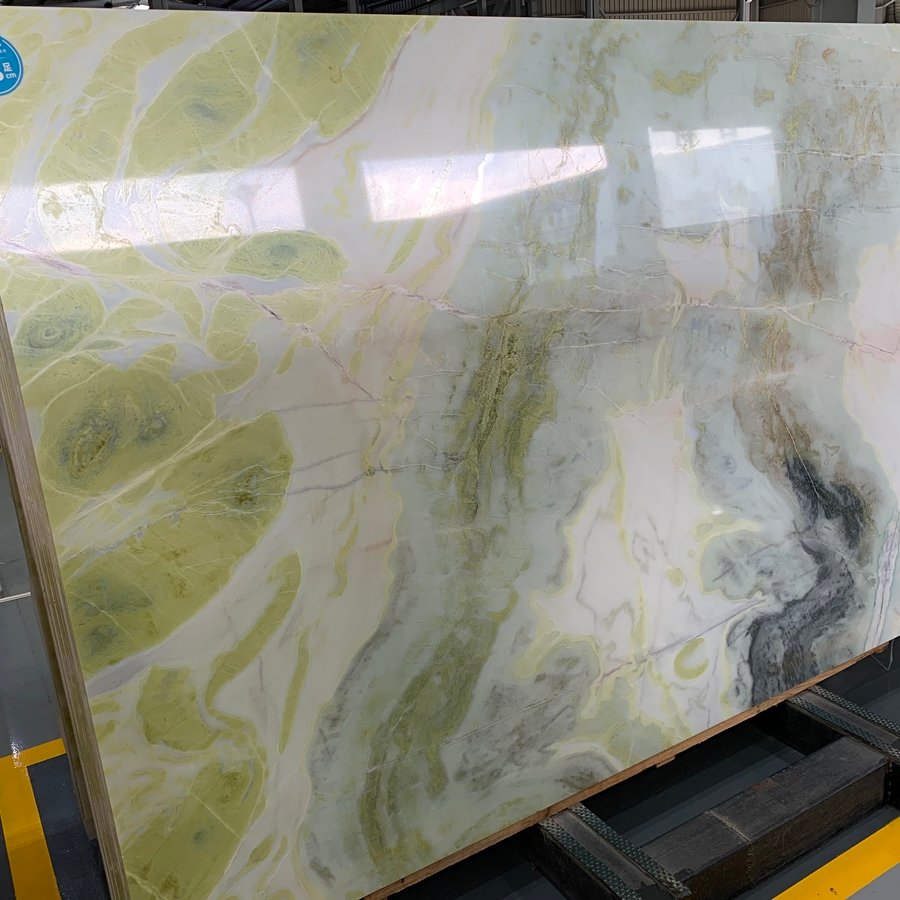
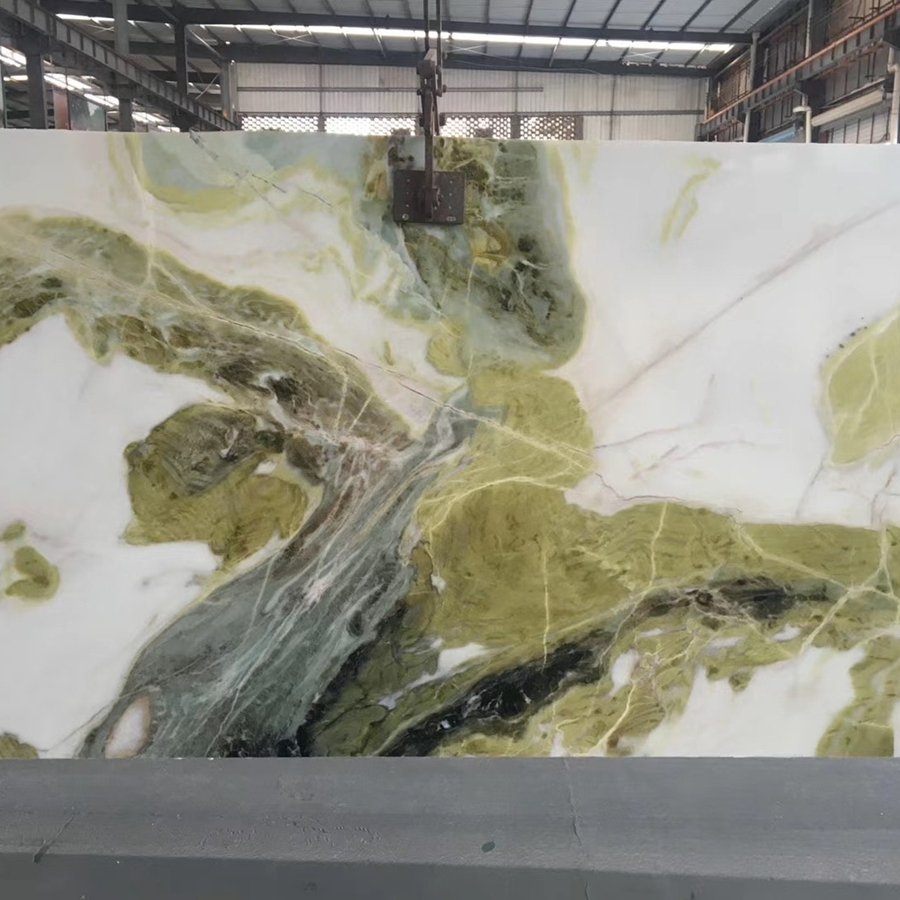
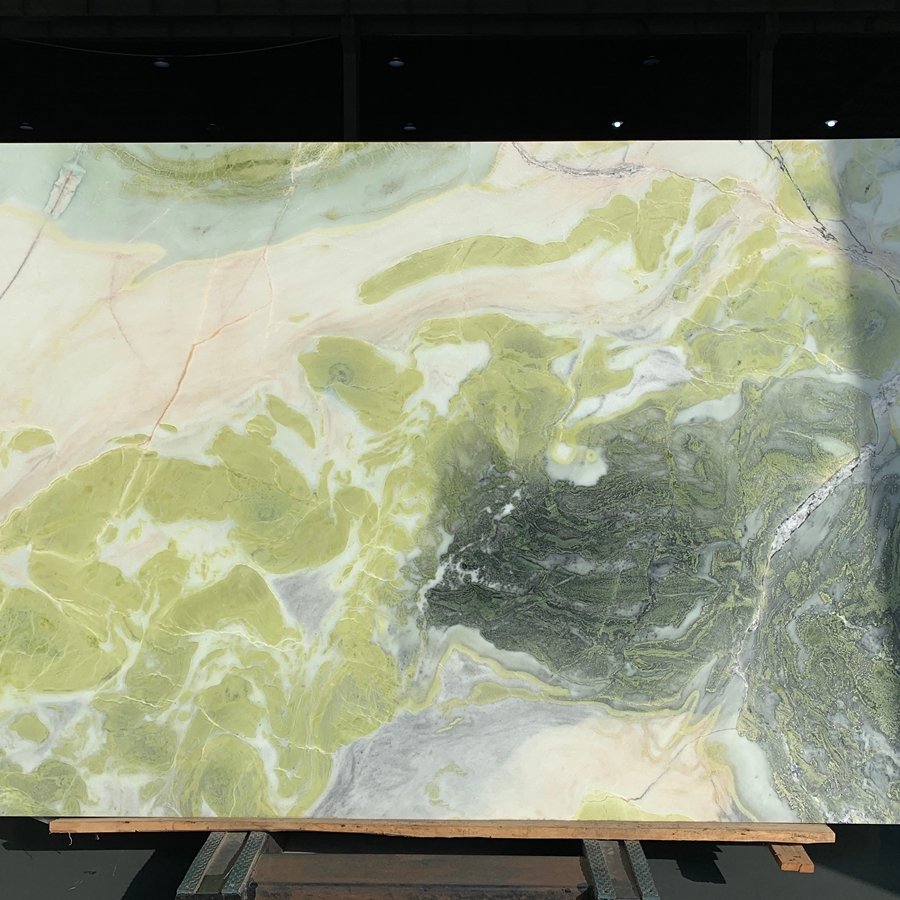
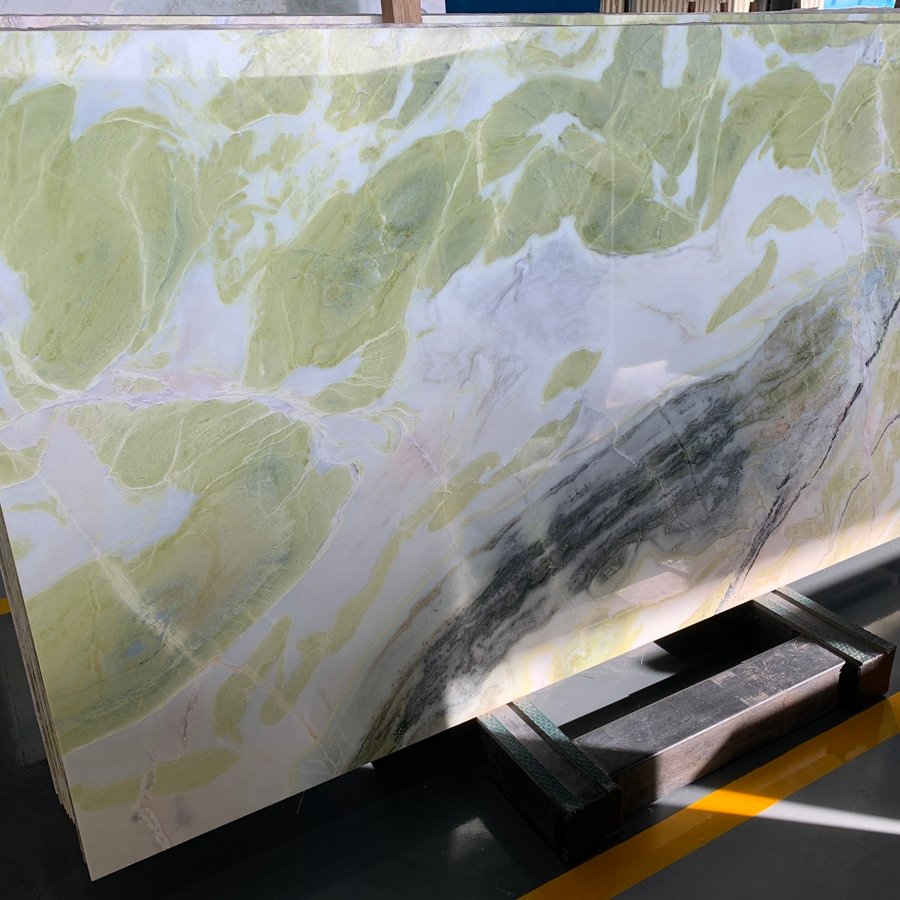
“Dreaming Green” is a trade name commonly used by suppliers for a family of green natural stones — offered as both marble and quartzite, depending on the quarry and finish. Visuals range from pale, soft lime-greens to deeper jade/dark-green slabs often accented by cream, gold, or darker veining. Suppliers list both polished marble slabs and Dreaming Green quartzite slabs (leathered or polished) as separate SKUs in catalogs and showrooms.
2. Visual characteristics, finishes, and typical uses
Color & pattern: gradients of green (lime → jade → deep green) with veins or flecks of white, gold, or gray; variations between slabs are normal — each slab is unique.
Finishes: polished (high gloss), honed (matte), leathered/brush (textured, popular on quartzite), and cut-to-size for furniture and tile. Many suppliers advertise a “Dreaming Green Polished 3/4”” option for countertop fabrication.
Typical applications: luxury kitchen islands and countertops, bathroom vanities, fireplace surrounds, statement wall cladding, and furniture tops. Quartzite variants are preferred where higher abrasion/resistance is required (cooktops, heavy traffic).
3. Quarry & commercial origin notes (marble vs quartzite)
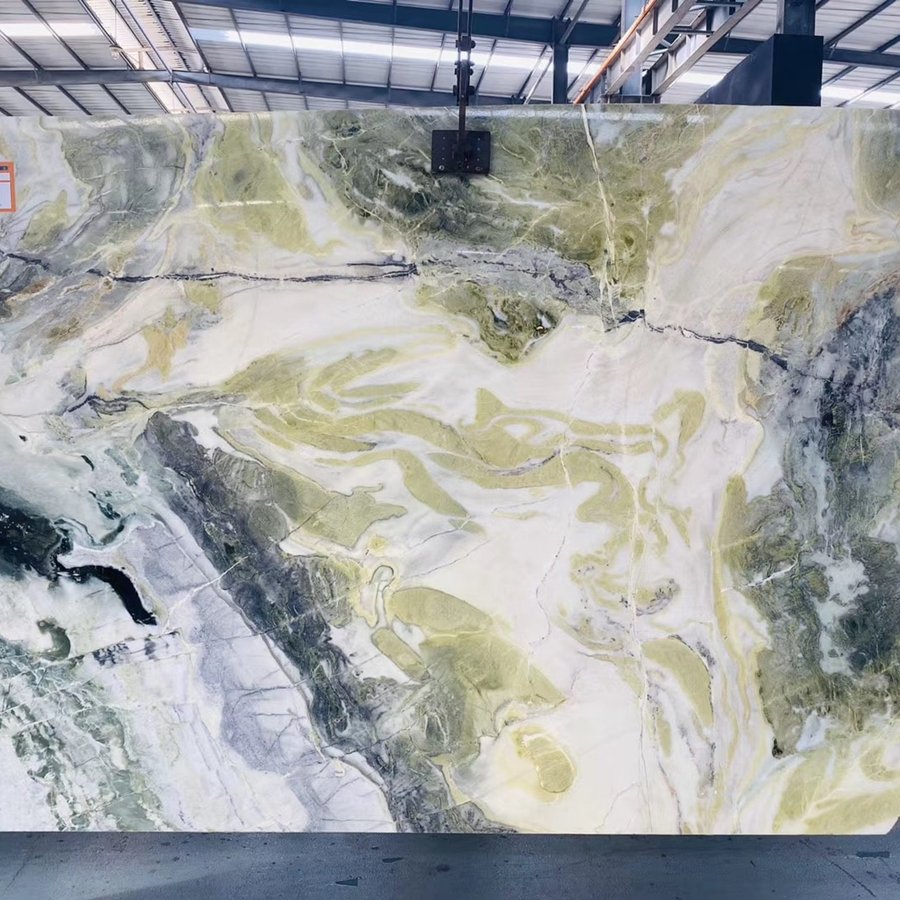
Where it comes from: Dreaming Green material appears in trade inventories from multiple countries (China is a frequent source for a “Dreaming Green” marble in supplier catalogs; alternative quartzite variants may be sourced elsewhere). Always verify the supplier’s country-of-origin on a per-slab basis.
Marble vs quartzite difference: marble is metamorphosed limestone (softer, more porous), while quartzite is metamorphosed sandstone with higher silica content (harder, more scratch- and acid-resistant). Choose quartzite where durability matters; choose marble when the softer, more honed aesthetic is primary.
4. Slab sizes, yield, book-matching, and QC tips
Typical slab sizes & thickness: standard trade slabs commonly 2–3 cm (20–30 mm) or 3/4″ / 1.25″ for specific markets; dimensions and yields vary by block and quarry. Ask suppliers for exact dimensions (length × width) for each listed slab.
Yield & selection: natural green stones can have variability and occasional “ice cracks” or inclusions — insist on slab photos and video, grade definitions (A/B/C), and pre-selection for book-matching.
Book-matching: high-impact applications (lobby walls, large vanities) often use book-matched pairs — reserve matching slabs early to avoid changes in pattern/stock.
5. Price drivers — what determines factory vs wholesale price?
Primary factors:
Material type (marble vs quartzite): Quartzite usually commands higher factory prices due to its hardness and processing difficulty.
Color rarity & pattern scale: vivid greens and large continuous vein patterns are premium.
Yield & slab quality: blocks with fewer fractures yield more usable slabs — limited yield increases per-slab cost.
Finishes & custom work: leathering, anti-stain treatments, and custom edge profiles add fabrication cost.
Channel: buying factory-direct or from a manufacturer reduces middleman markup; buying through wholesalers/distributors can add convenience but also markup.
Logistics & tariffs: sea freight, duties, and crate costs affect landed cost; consolidation of containers helps reduce per-slab shipping cost.
Practical tip: request a factory price list (FOB) and compare landed cost (FOB + freight + duty + local fabrication + installation) — sometimes a slightly higher FOB from a local supplier results in lower total project cost.
6. How to buy direct from a factory/manufacturer — step-by-step checklist?
Ask for slab inventory with high-resolution photos and video.
Request origin & chain-of-custody: country of origin, quarry name, block ID.
Request grade & defect notes (A/B/C) and any book-matched pairs.
Ask for finish options & tolerances (polish level, honed grit, leather method).
Verify worker safety & environmental docs (silica control plan, wastewater management, quarry rehabilitation if available).
Negotiate MOQ and payment terms; ask about slab hold policies and pre-shipment inspection (photos + third-party inspection if needed).
Confirm packaging & shipping (A-frame crates, blocking, protective film).
Request a sample or a small cut piece to verify color/finish before full production.
7. Fabrication, transport & silica safety (regulatory outlook)
Fabrication notes: Use properly rated diamond tooling and wet cutting where possible for marble; quartzite may blunt tooling faster and require more frequent tool changes. Reinforce slabs with mesh/epoxy if fractures are present.
Worker safety — respirable crystalline silica (RCS): cutting, grinding, and polishing stone generates respirable crystalline silica. In the U.S., OSHA’s respirable crystalline silica standards apply and require employers to implement exposure controls, written exposure plans, and medical surveillance where required. OSHA provides standards and guidance for general industry and construction. Recent enforcement initiatives are targeting stone fabrication workplaces to reduce RCS risk.
What buyers should ask their fabricators: for a written silica exposure control plan, records of training, evidence of wet cutting/local exhaust use, and respirator programs if applicable. Suppliers that can show compliance reduce project risk and are more likely to pass public procurement checks.
8. Market data & sustainability/procurement trends that affect price and demand
Market size & growth: the global natural stone market is large and various industry reports show differing totals depending on scope — for example, Grand View Research estimated the natural stone market at roughly USD 10.17 billion in 2024 (projected growth to 2030), while IMARC and other large reports report higher totals (e.g., IMARC citing ~USD 40.4 billion in 2024 for some market definitions). Use these as directional indicators for demand and investment appetite.
Procurement & sustainability: public procurement and large institutional buyers (especially in the EU) increasingly require environmental documentation — EU Ecolabel and Green Public Procurement (GPP) criteria for hard coverings promote material efficiency, reduced quarrying impacts, and the reuse/recycling of processing waste. Suppliers that can provide EPDs, evidence of process-waste reuse, energy management, and quarry rehabilitation are better positioned for large public projects.
Implication: factories that invest in documented sustainability practices and worker safety will find easier access to large tenders and will be more trusted by global buyers — this trend is accelerating across Europe and other major markets.
9. Maintenance, sealing & lifecycle guidance
Sealing: green marbles typically benefit from a penetrating sealer on countertops and high-use surfaces; quartzite is less porous but still benefits in some applications. Test sealer compatibility on a sample.
Daily care: pH-neutral cleaners; avoid acid cleaners on marble (they etch).
Repair & re-polish: marble can be re-polished and restored — consider lifecycle cost vs. engineered stone for busy commercial spaces.
10. Purchase-intent long-tail keywords (3–5)
Dreaming Green marble slab manufacturer, factory direct price
Buy Dreaming Green marble slabs wholesale fromthe factory
Dreaming Green quartzite slabs factory price polished 3/4”
Dreaming Green polished marble countertops wholesale supplier
12. FAQ — Google hot search style (5 Q&As)
Q1: What is Dreaming Green marble, and is it natural or engineered?
A1: Dreaming Green is a trade name used for natural green stones — offered as both marble and quartzite, depending on quarry source. Check your supplier’s product sheet to confirm whether the SKU is natural marble or quartzite.
Q2: Can I buy Dreaming Green slabs directly from a factory at wholesale price?
A2: Yes. Many manufacturers and exporters list Dreaming Green slabs in their catalogs. Buying factory-direct reduces middleman markup—request slab photos, origin documentation, and pre-shipment inspection.
Q3: Which finish is best for Dreaming Green countertops — polished, honed, or leathered?
A3: Polished gives a high gloss and color depth (good for islands); honed reduces reflection and is practical for bathrooms; leathered (common on quartzite) provides texture and hides wear — choose based on aesthetic and functional needs.
Q4: Are there safety concerns about cutting Dreaming Green stone in a fabrication shop?
A4: Yes — fabrication releases respirable crystalline silica (RCS). Fabricators should follow OSHA silica standards, use wet cutting/local exhaust, and provide medical surveillance/training where required. Buyers should request evidence of compliance.
Q5: How should I maintain and seal Dreaming Green marble countertops?
A5: Use a penetrating sealer suitable for the stone type, clean with pH-neutral cleaners, avoid acids on marble, and re-seal annually or as recommended by the sealer manufacturer.
Semantic Closure — How / Why / What / Options / Considerations</h2>
How (quick playbook): Source Dreaming Green via factory catalogs — request slab photos/video, origin & block ID, finishing options (polished/honed/leathered), EPDs or environmental statements when available, and written silica control procedures from your chosen fabricator. Reserve book-matched slabs early for large projects.
Why (value proposition): Dreaming Green gives rare green pigments and luxurious veining that upscale interiors and hospitality projects crave; it can be a signature material that increases perceived value and creates memorable spaces.
What (technical expectations): Expect slab variability and occasional inclusions/ice cracks; quartzite options are mechanically tougher (higher silica content) while marble variants polish with a softer luster. Confirm thickness and tolerance for countertops (commonly 2–3 cm or 3/4”).
Options (practical):
Factory direct: lowest markup, needs stronger due diligence and inspection rights.
Wholesale distributor: faster local supply, less paper-trail risk, and pay a moderate markup.
Engineered alternatives: choose when budget/lead-time precludes natural slabs; the tradeoff is loss of unique natural veining.
Considerations (detailed):
Safety & compliance: RCS control is non-negotiable; verify wet cutting, extraction, and training.
Sustainability & procurement: EU buyers increasingly expect environmental documentation (EU Ecolabel/GPP criteria) — ask for EPDs and process-waste reuse plans if bidding for public projects.
Total landed cost: calculate FOB + freight + duty + local fabrication + installation — sometimes slightly higher FOB from a compliant, nearer supplier is cheaper end-to-end.