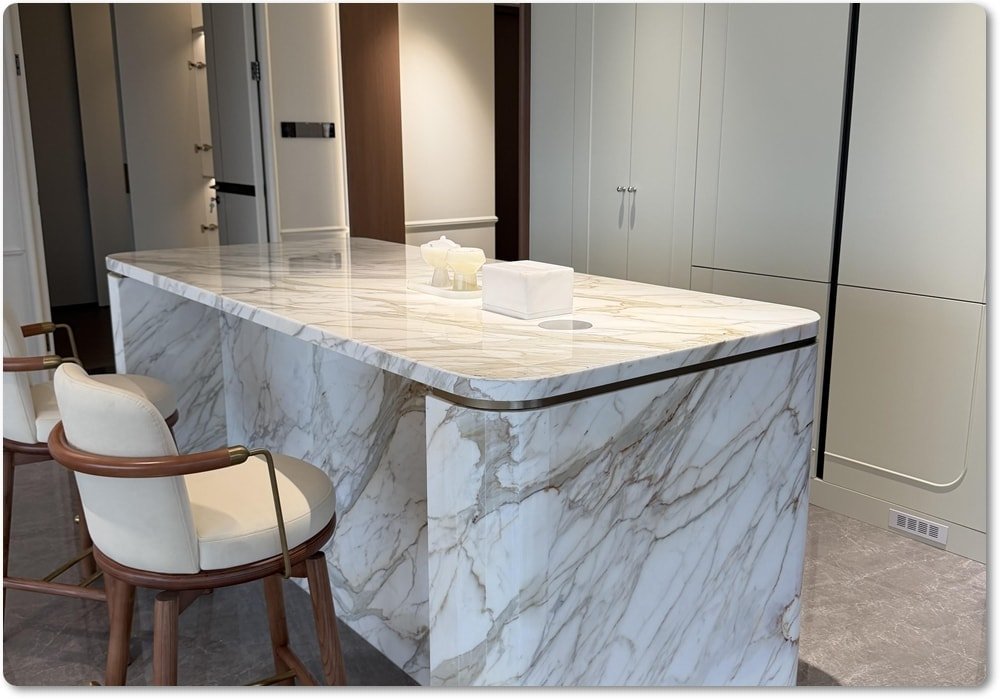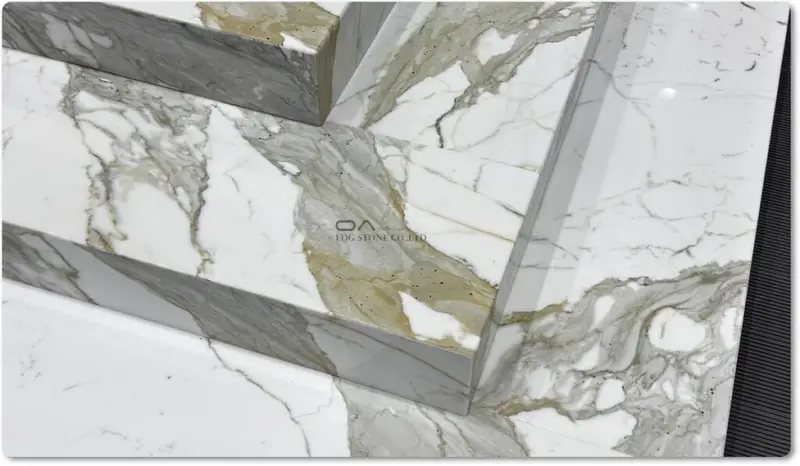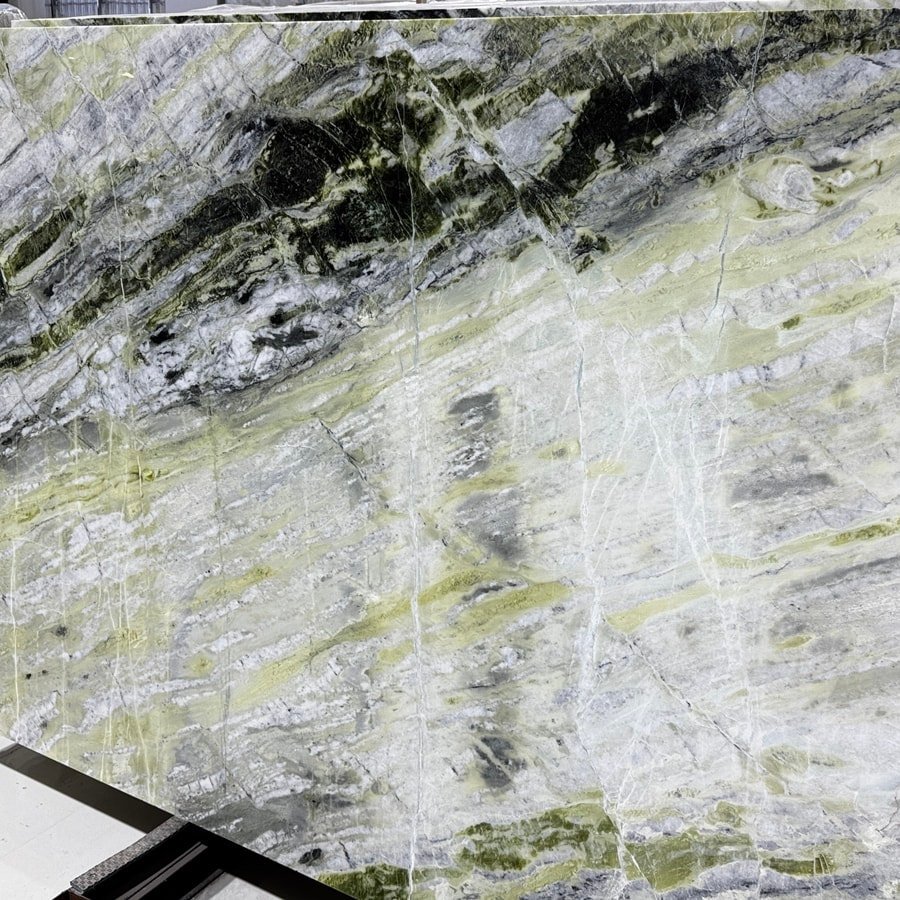
What is Prague Green Marble?
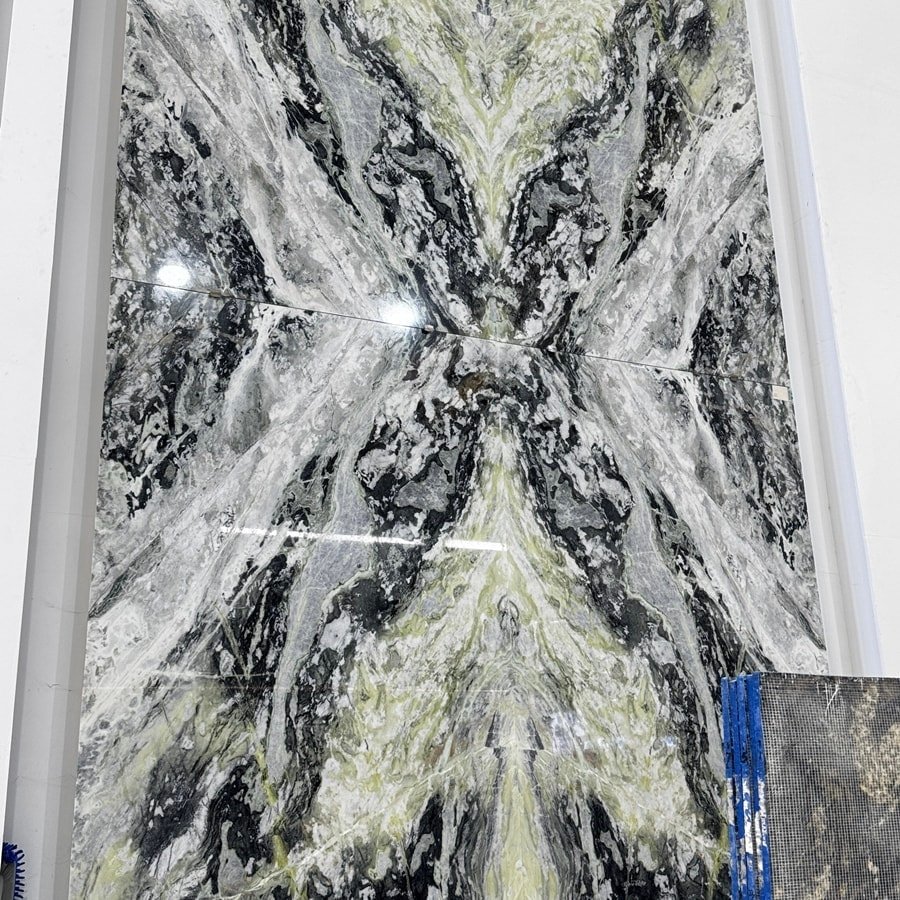
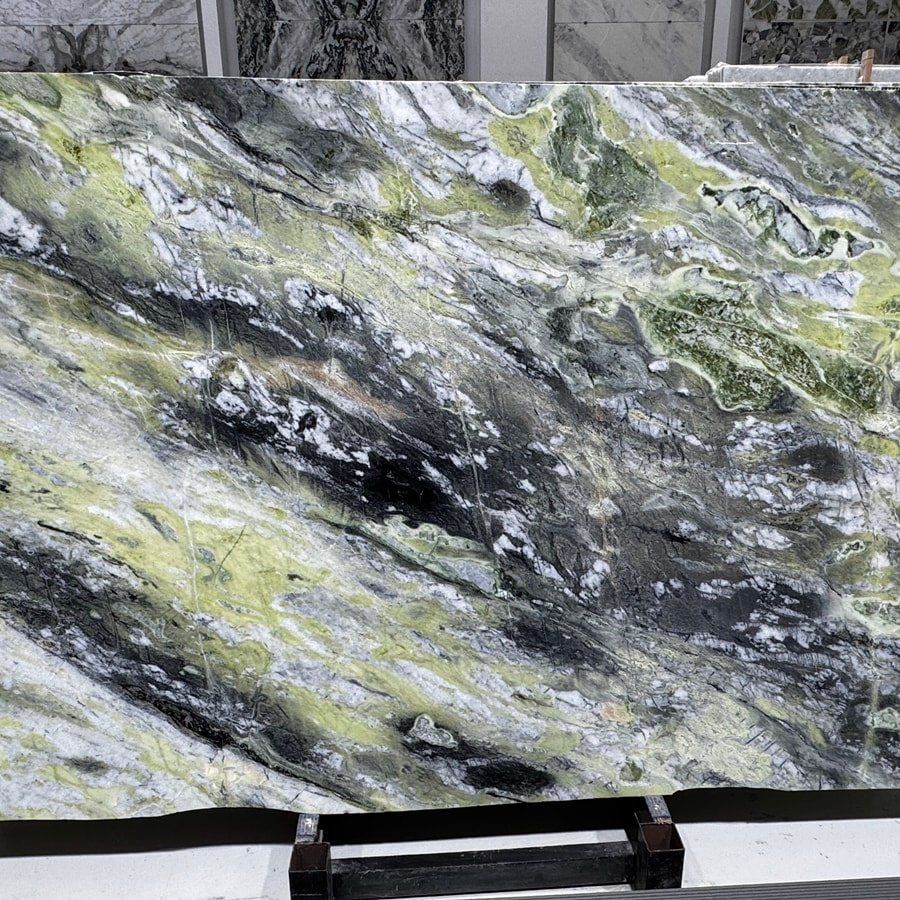
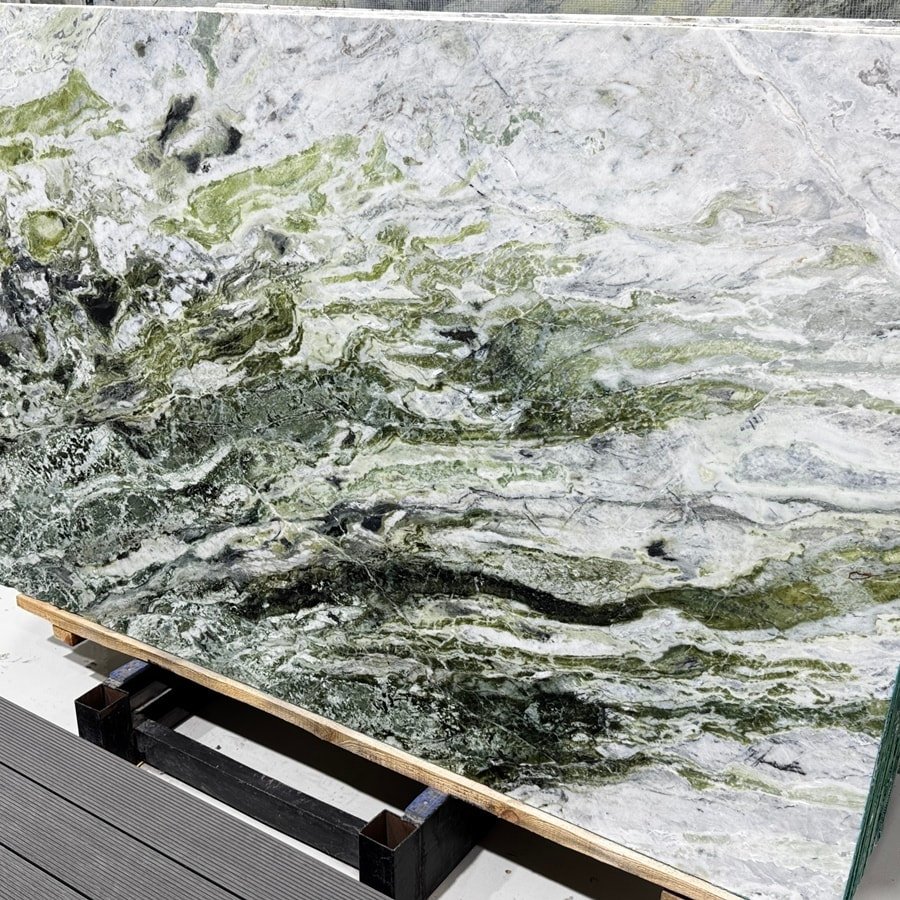
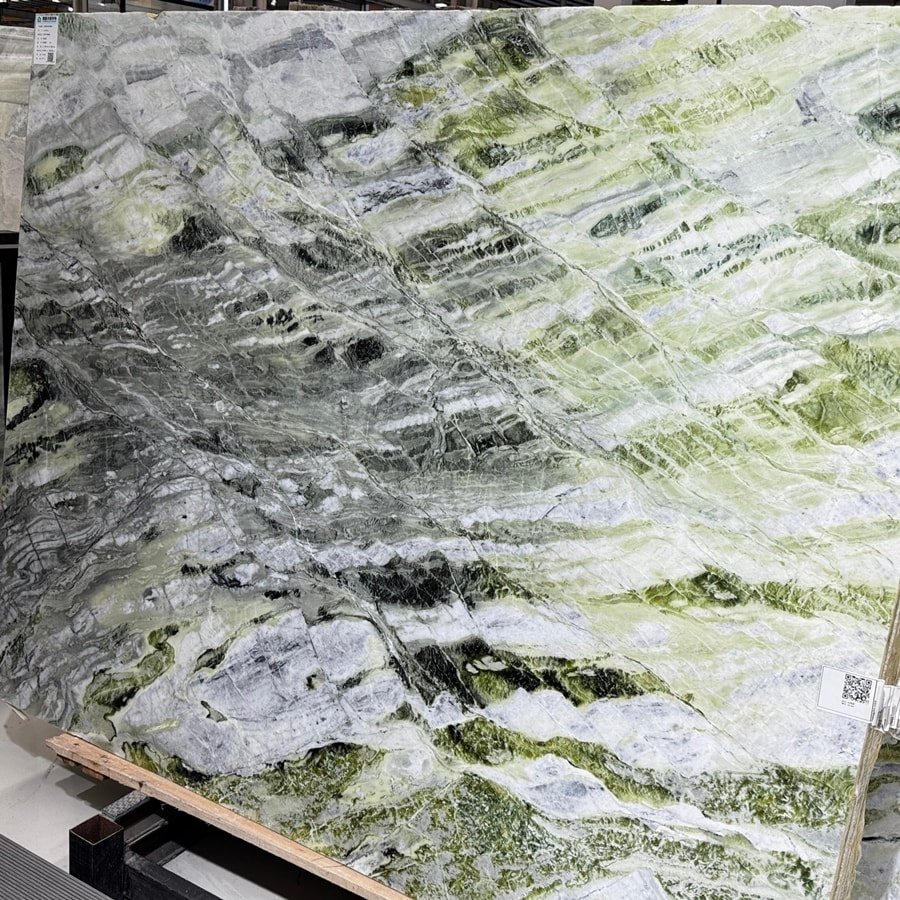
“Prague Green” is a trade name used in the market to describe visually striking green marbles (calcitic/metamorphic) with veins, clouds, and patterning ranging from soft mossy tones to vivid jade/emerald streaks. The name is a commercial label rather than a guarantee of geological origin. Many Chinese quarries and finishing factories now supply Prague Green-style slabs, tiles, and bookmatched panel sets for global export — from standard 2 cm tiles to heavy-duty 3 cm island slabs. Examples of Chinese suppliers and listings (Alibaba, StoneContact, EDG Stone) confirm that China is an active producer and processor for this material.
Material basics (typical ranges)
Composition: mostly calcite or calcite-rich metamorphosed limestone with accessory minerals that create green tones.
Typical slab sizes: standard commercial slab ~270×160 cm (varies by quarry/factory); thicknesses commonly 18–20 mm (2 cm) and 30 mm (3 cm).
Physical behavior: soft-to-moderate surface hardness (marble range), polishable to high gloss, susceptible to acid etch and scratching compared with silicate stones (granite, quartzite).
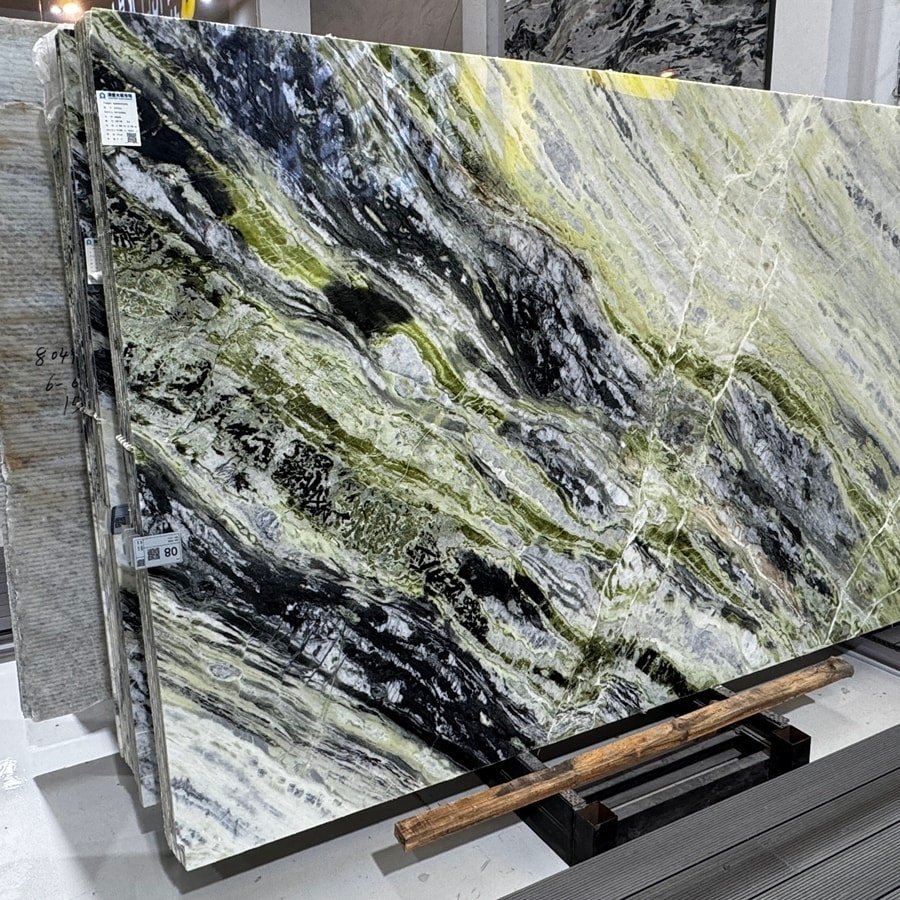
Visual character & why designers love Prague Green
Prague Green’s appeal is visual drama: saturated green fields blended with veins of white, cream, gold, or darker mineral accents. In large slabs, veins can be arranged for bookmatching (mirror symmetry) to create continuous murals on lobby walls or waterfall islands — a signature move for hotels, boutiques, and luxury residences.
Design uses where green marble performs spectacularly:
Feature waterfall islands — dramatic island faces and tops that become photographic centerpieces.
Bookmatched reception walls & elevator lobbies — continuous flow across panels.
Luxury bathrooms — vanity tops and shower walls where vertical panels are less vulnerable than counters.
Backlit thin-slab panels (if slab exhibits translucency) for bars, feature walls, and front desks.
Chinese marble vs Italian marble: practical differences for buyers
When your RFP reads “Prague Green,” you’re buying a look more than a single origin. The buyer’s decision between Chinese-processed marble and Italian quarry stone usually hinges on:
Availability & lead time: China offers large processing capacity and quick slab/tile production runs with many factories publishing stock lists and slab photos. Italy tends to be associated with specific quarry names (e.g., Carrara) and limited runs for particular vein qualities.
Price & MOQ: Chinese factory/wholesale channels frequently offer competitive CIF or FOB pricing and lower MOQs for slab lots, which is attractive to exporters and importers. Italian high-end marbles can command premium pricing for rare slabs and tight visual quotas.
Pattern / aesthetic “signature”: Italian marbles often have long heritage and widely recognized visual signatures; Chinese-origin stones may offer bolder, more varied color ranges and sometimes less subtle patterning depending on the block. Visual sample and slab-scan review are essential.
Perceived provenance & specification risk: For blue-chip projects, clients may insist on European provenance and certification. For many commercial and residential projects, Chinese slabs that meet physical and compliance specs are accepted when provenance is documented.
Where does Prague Green work best — technical guidance?
Because Prague Green is typically calcitic, select uses that exploit beauty and minimize abrasion exposure:
Best: vertical cladding, feature walls, vanity surrounds, reception desks, backlit panels, accent islands (low-prep usage).
Caution: heavy-use kitchen countertops, exterior paving in freeze-thaw zones, high-traffic commercial flooring.
Finishes & safety: polished finish for show surfaces; honed or satin for floors and wet areas (improves slip performance and hides micro-scratches). For shower floors and steps, choose honed finishes and anti-slip tile options or textured strips.
Fabrication tips:
Insist on full-slab high-resolution scanning/photography before purchase.
Request resin impregnation or stabilization certificates if slabs have natural fissures.
Use a 3 cm slab thickness for islands and long unsupported spans; 2 cm may be laminated/backed for cladding or lighter counters.
Pricing signals & green marble tile price examples
Green marble tile prices vary widely by species, thickness, finish, and supplier. Retail tile examples show wide ranges — from budget green tiles around $10–$25 / sq.ft. to premium bookmatched slabs costing substantially more once fabrication, shipping, and customs are included. For example, Empress/green marble tiles on the established U.S. vendors list at approx $10.50 / sq.ft. (retail) for certain green tiles — but slab wholesale/factory-case pricing from China will be different and subject to volume discounts. Always ask suppliers for an itemized FOB/EXW/FOB quotation, including slab yield and cutting waste assumptions.
Sourcing Prague Green in China — wholesale & factory buying checklist
If you’re buying Prague Green slabs from China (factory or wholesale), follow this checklist:
Request slab-level photos and high-resolution scans (include slab dimensions and vein map).
Specify thickness up front — 3 cm for islands/counters; 2 cm for cladding where laminated backing will be used.
Ask for QA test reports — water absorption, flexural strength, and any resin impregnation certificate.
Obtain packing & export specs — wooden crates, crate counts per container, anti-moisture packing.
Request provenance & environmental compliance docs — quarry permits or processing facility environmental measures if required by project specs.
Negotiate sample slabs and CIF/FOB factory pricing for container lots; clarify lead times and inspection windows.
Installation & grout — what color grout for marble tile?
Grout color decisions affect the final visual impression:
Match to the dominant tone (for seamless look): choose grout that closely matches the background/vein tone (e.g., light beige, cream, or subtle grey) for classic, continuous surfaces. Many designers choose light grey or off-white for green/white marbles to blend veins and preserve calm surfaces.
Choose darker grout for high-traffic areas or where maintenance is a concern — darker grouts hide dirt better.
Sanded vs unsanded grout: For narrow joints (<1/8″), use unsanded grout (less abrasive on polished stone). For wider joints, use sanded and sealed grout afterwards; cement-based grouts typically need sealing.
Tip: perform a mock-up tile area with two grout options and photograph under room lighting before final selection.
Cleaning — can you use “The Pink Stuff” on marble tiles?
Short answer: No — don’t use The Pink Stuff on marble. The product’s manufacturer advises against using it on granite or marble; it contains mild abrasives (quartz) and active oxygen agents, which can scratch or etch polished marble surfaces. Independent consumer guidance also warns that abrasive household pastes can damage stone finishes. Use pH-neutral stone cleaners recommended for natural marble.
Safe cleaning routine: pH-neutral stone cleaner, soft microfiber cloths, immediate spill cleanup (acidic liquids cause etching), periodic professional resealing.
Procurement risk management & logistics
Slab variances: natural stone varies slab-to-slab. Purchase sufficient matched slabs to cover the visible area plus 10–20% extra for cuts and defects (project dependent).
Inspection & acceptance: carry out pre-shipment inspection or use third-party QC at the factory — check slab IDs, thickness, polish, and packaging.
Customs & documentation: ask suppliers for correct HS codes, COO (country of origin) declarations, and test certificates required by your target market (e.g., radiological test for EU projects if asked). Trade data and recent reports show China remains a major exporter of worked stone even as revenue and tonnage fluctuated in recent years — keep an eye on trade indices and freight rates.
Sustainability & circularity — what progressive buyers ask for
Large institutional clients now request: quarry environmental management plans, water recycling at polishing plants, and remnant reuse policies. Ask factories whether they recycle slurry water, use dust control, and can supply reclaimed or remnant slabs for small furniture elements to minimize embodied carbon.
Quick case idea (how Prague Green can create marketing value)
A luxury hotel used bookmatched Prague Green panels behind the reception and on the concierge desk. Professional slab selection and resin stabilization produced two continuous murals that became the hotel’s hero imagery for PR — the marble became a visual brand asset for social media and editorial coverage.
FAQ
Q1: What is Prague Green marble?
A: A market name for green marble with variegated veins — available as slabs and tiles; many suppliers, including Chinese factories, produce Prague Green-style stone.
Q2: Is Prague Green suitable for kitchen countertops?
A: It can be used, but because marble is susceptible to etching and scratching, many designers use Prague Green for accent islands and backsplashes, reserving tougher materials for heavy prep areas.
Q3: Can I clean marble tiles with “The Pink Stuff”?
A: No — the manufacturer and independent advisors advise against The Pink Stuff on granite and marble because of abrasives; use a pH-neutral stone cleaner.
Q4: What thickness should I buy for slabs (2 cm or 3 cm)?
A: 3 cm is recommended for islands and long counters; 2 cm is acceptable for cladding and lighter counters if properly backed or laminated.
Q5: Do I need radiological tests for stone imports to the EU?
A: The EU has increased focus on natural radioactivity in construction products; for sensitive projects, ask suppliers for radiological testing and harmonized-test reports.
Semantic Closed-Loop Content Block — How / Why / What / Options / Considerations
How to use Prague Green effectively
Use it where vertical or semi-horizontal visibility maximizes its decorative power: bookmatched walls, waterfall islands (visual accents), vanity walls, and reception fronts. For countertops that will see heavy prep, pair Prague Green with a harder worktop or delineate prep zones.
Why choose China-sourced Prague Green?
China offers wide processing capacity and competitive factory/wholesale pricing, fast slab inventory turnover, and many finishing centers that can produce 2 cm tiles up to 3 cm structural slabs and bookmatched panels. Buyers who need volume and competitive FOB/CIF pricing often source from reputable Chinese factories — but always require slab photos, QA tests, and export documentation.
What compliance & tests to require
Ask for water absorption, flexural strength (if flooring), slip testing (for wet floors), and radiological screening when projects are in regulated jurisdictions (EU focus). Require resin-stabilization certificates for fissured slabs and independent third-party test reports to reduce acceptance risk.
Options & trade-offs (detailed)
Option A — 3 cm polished slab (premium): best for structural islands and low-maintenance vertical features; higher cost, lower installation risk.
Option B — 2 cm laminated slab (economy): lower material cost, requires excellent substrate and bonding; suitable for cladding.
Option C — Thin panel backlit (resin-stabilized): spectacular visual effect for bar fronts and decorative screens; requires resin transparency and careful LED engineering.
Considerations for procurement & lifecycle
Total project cost = stone + fabrication + shipping + installation + maintenance (resealing & occasional repolishing). Plan for slab overage (~10–20%), QC inspections, and lifecycle maintenance budgeting. For sustainability, prioritize factories with water recycling and remnant-use policies.