Introduction
When you are planning a bathroom remodel, one small decision can change the budget, the schedule, and even the installation risk: should you buy bathroom vanity tops only or a bathroom vanity top with sink? The right answer depends on whether you are replacing an existing top, reusing plumbing, or building a bathroom from scratch. In NKBA’s bath planning guidelines, vanity and lavatory dimensions are tied to user fit, and sink/vanity placement needs to work within the real conditions of the room, not just the product catalog.
For homeowners, the choice is usually about flexibility versus convenience. For contractors and project buyers, it is about how much field work can be removed from the job. A top-only purchase gives more freedom. A with-sink purchase gives more standardization.
Two Purchasing Models, Two Very Different Workflows
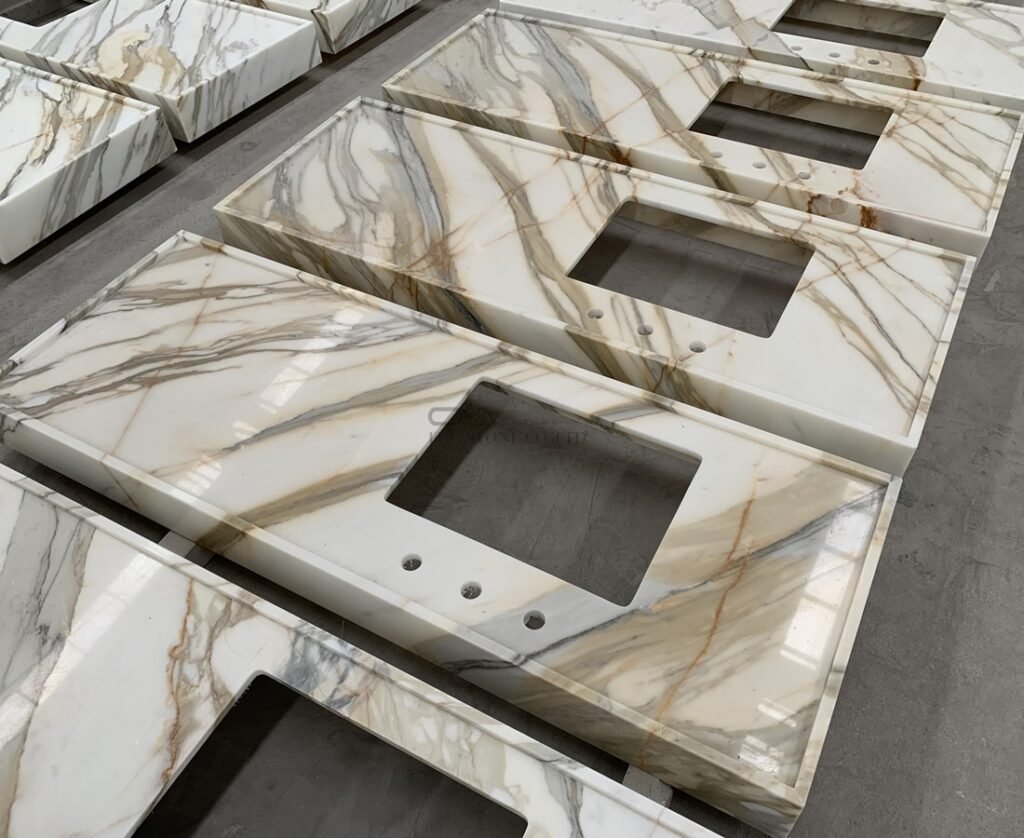
Vanity Tops Only
A vanity top only means you are buying the countertop surface without a sink attached. In practice, this is the more flexible option because you can keep an existing sink, choose a different sink style, or replace only the worn surface while leaving the cabinet and plumbing largely in place. Retail installation guides show that a top-only replacement usually starts with measuring the old top, disconnecting water and plumbing, lifting off the existing surface, and then fitting the new countertop back into the same footprint.
This option is especially useful when the existing sink is still in good condition or when the plumbing layout is already correct. It also makes sense when you want a specific sink type, such as vessel, drop-in, or undermount, instead of being limited by a preconfigured assembly.
Vanity Tops with Sink
A vanity top with sink is a more turnkey solution. The sink is already paired with the top, so the job has fewer compatibility decisions and fewer field-fit steps. Retail and manufacturer guidance consistently describe this format as more convenient, more standardized, and easier to install because the sink and top are designed to work together. Integrated and preassembled options also reduce the seam count around the basin, which supports easier day-to-day maintenance.
This is why with-sink systems are often preferred in new construction, multifamily projects, hospitality, and commercial bathrooms. The more units you build, the more valuable consistency becomes.

Cost and Installation: What Really Changes?
The price difference is not only the material itself. It is also the amount of labor, coordination, and on-site adjustment required. A top-only solution can save money when the existing sink and plumbing are reusable, because you avoid a full sink swap and reduce installation steps. A with-sink solution can cost more up front, but it often reduces installation complexity and lowers the chance of fit issues on site.
| Option | Material Cost | Installation Complexity | Best Fit |
|---|---|---|---|
| Vanity tops only | Lower to moderate | Medium | Remodels, sink reuse, custom layouts |
| Vanity tops with sink | Moderate to higher | Lower | New builds, batch projects, standardization |
A useful rule is simple: if the current sink and plumbing are staying, top-only often wins. If the bathroom is being built, replicated, or standardized, a sink often wins. NKBA’s guidance on vanity height and lavatory placement also reinforces the point that bathroom elements should be coordinated as a system, not selected in isolation.
Best Use Cases by Project Type
1) Renovation Projects
For a renovation, especially a light or mid-level remodel, vanity tops only is usually the smarter choice. You keep more of the existing bathroom infrastructure, avoid unnecessary plumbing changes, and reduce the number of variables during installation. That is why top-only is often the preferred path in refresh projects where the cabinet and sink are still functional.
2) New Bathroom Projects
For a new bathroom, vanity tops with a sink are usually the cleaner solution. There is no need to preserve an old sink, and a preconfigured top reduces the number of decisions during procurement and installation. In standard bathroom planning, fixture coordination matters, and starting with an integrated or matched system makes that coordination easier.
3) Commercial and Multifamily Projects
For apartments, hotels, dorms, and other repeat-build projects, a sink is often the best operational choice. Standardized units make ordering easier, reduce installation variation, and speed up turnover. When you need the same result across many bathrooms, repeatability matters more than single-unit flexibility.
A Simple Decision Model
Use this decision logic:
If your answer is “yes” to any of these, top-only is worth serious consideration:
You are reusing the existing sink; the plumbing location is fixed; the cabinet stays; you want a custom sink choice; or you are trying to keep renovation waste and labor down.
If your answer is “yes” to any of these, with sink is usually the better purchase:
You want a ready-to-install package; you are building multiple bathrooms; you want fewer compatibility issues; or you want a more standardized result with less field work.

Illustrative Case Study: 100-Unit Apartment Refresh
Imagine a 100-unit apartment refresh where the cabinets are still usable, the plumbing locations are unchanged, and the existing sinks are in acceptable condition. In that case, a top-only strategy lets the team replace the visible surface while keeping the rest of the system in place. The main advantage is workflow efficiency: less demolition, fewer plumbing adjustments, and fewer on-site decisions. That is exactly the kind of project where top-only can outperform a full sink swap. This is an illustrative scenario, not a fixed market claim.
Now imagine the same project with worn sinks, inconsistent cutouts, and varied plumbing conditions across units. At that point, a with-sink standard package becomes easier to manage because it reduces variation and makes the install sequence more repeatable. That is why integrated or preassembled vanity systems are attractive in larger rollout projects.
Buying Tip: Match the Product to the Room, Not Just the Catalog
NKBA’s planning guidance notes that vanity height can vary from 32 to 43 inches, depending on the user, which is a reminder that bathroom buying is about fit, not just appearance. Wayfair’s replacement guide also notes that common vanity widths are typically 30/36 inches for small baths, 42/48 inches for medium baths, and 60/72 inches for larger baths. Before deciding between top-only and with-sink, confirm the vanity size, sink style, and plumbing alignment.
Conclusion
The right choice is usually easy once the project type is clear:
If the goal is a small renovation, choose vanity tops only.
If the goal is a new bathroom or a repeat build, choose vanity tops with a sink.
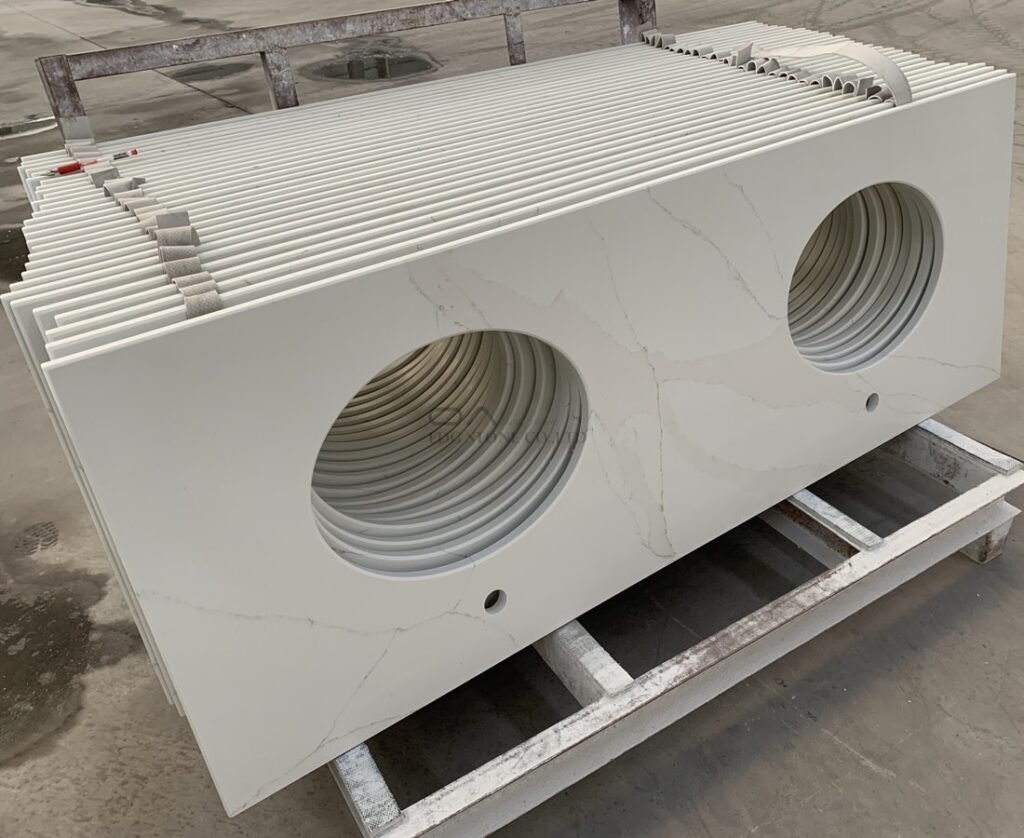
If the goal is a custom project, buy from a factory partner that can coordinate dimensions, cutouts, and sink matching from the start.
In short, top-only gives you flexibility, while with-sink gives you speed and consistency. For many remodels, top-only is the better value. For many new-build and commercial projects, with-sink is the better system.