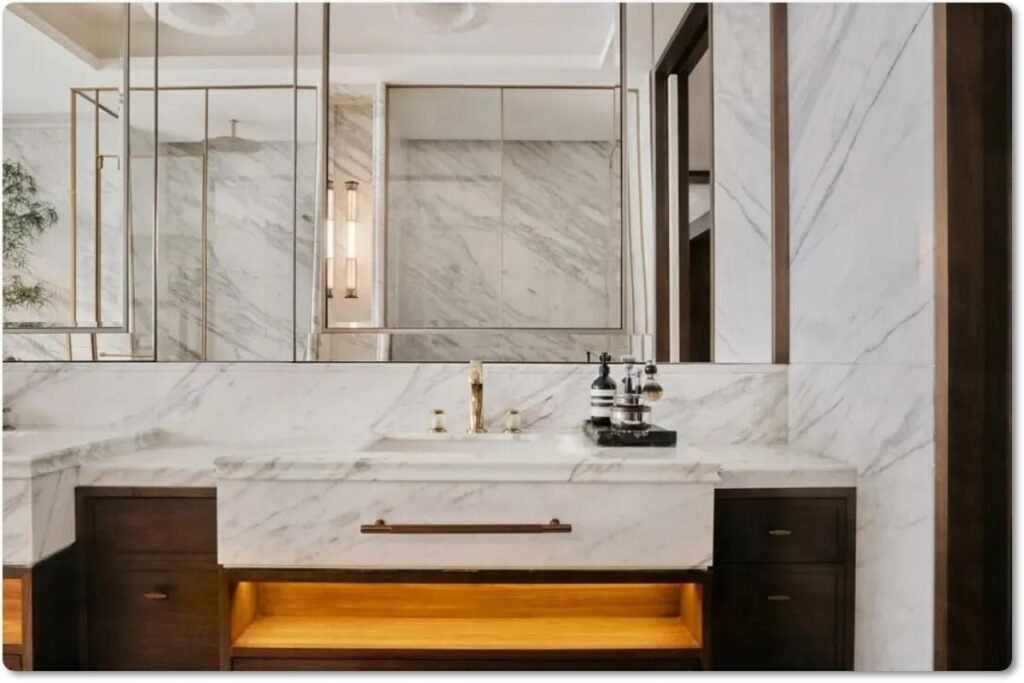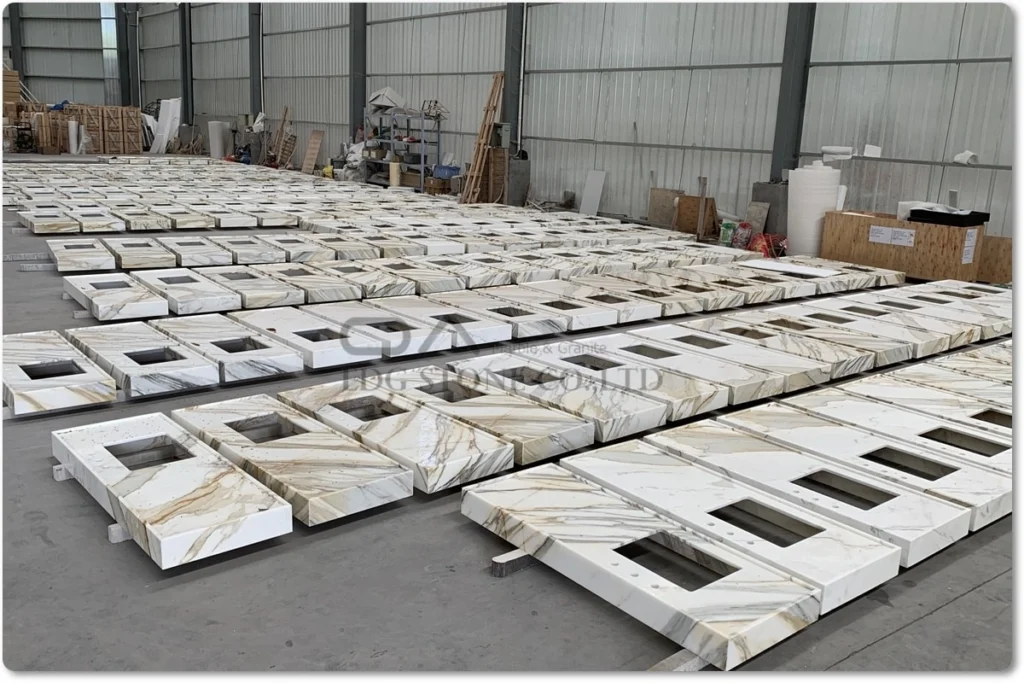
The question “quartz vs quartzite” is one of the most common searches in the countertop and natural stone industry. The confusion is understandable: the two names sound almost identical, both can contain large amounts of quartz, and both are widely used for kitchen countertops, bathroom vanities, islands, commercial interiors, and hospitality projects.
However, quartz and quartzite are not the same material.
Quartz is a mineral. Quartzite is a natural metamorphic rock. In the countertop market, “quartz” usually refers to engineered quartz, a manufactured surface created by combining mineral aggregates with binders, pigments, and other ingredients.
Quartzite, by contrast, begins as quartz-rich sandstone and is transformed by heat, pressure, and geological processes. The U.S. Geological Survey defines quartzite as a metamorphic rock consisting mainly of quartz and formed through recrystallization of sandstone or chert.
For buyers comparing quartz vs quartzite countertops, the decision therefore involves more than appearance. Cost, staining, durability, heat resistance, maintenance, fabrication, sourcing, availability, and regulatory considerations all matter.
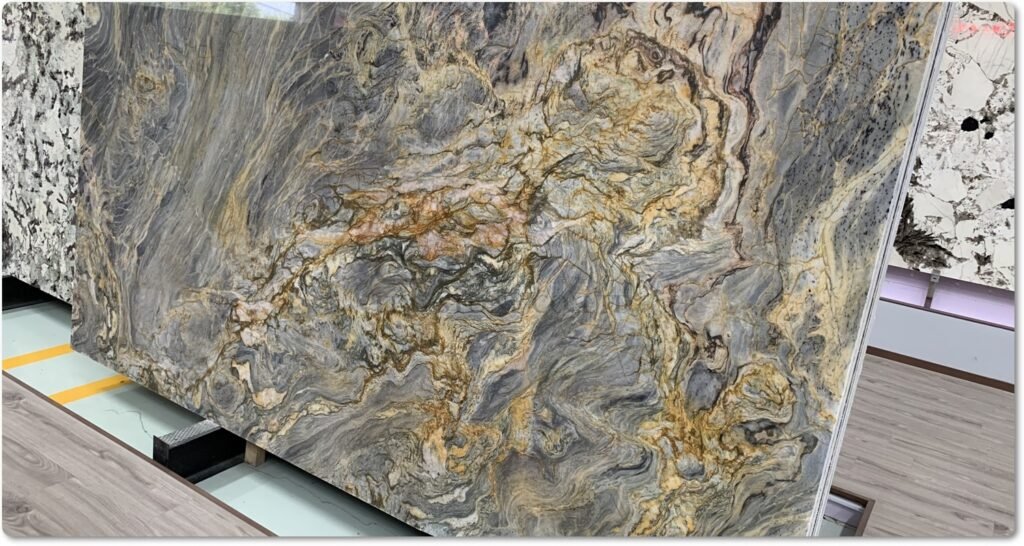
What Is the Difference Between Quartz and Quartzite?
The simplest answer is:
Engineered quartz is manufactured; quartzite is natural stone.
Quartz: Engineered Countertop Material
Commercial countertop quartz is generally an engineered material. Manufacturers combine mineral aggregates with binders, pigments, and other components to create slabs with controlled thickness, color, pattern, and performance characteristics.
This manufacturing process allows producers to develop highly consistent collections, including white quartz, Calacatta-inspired quartz, Carrara-style quartz, concrete-look quartz, and other contemporary designs.
For distributors and commercial buyers, this consistency can be valuable because multiple projects can use visually similar slabs.
Quartzite: Natural Metamorphic Rock
Quartzite is fundamentally different.
According to the USGS, quartzite forms when quartz-rich sandstone or chert undergoes metamorphism and recrystallization.
This geological process produces a dense, hard natural stone with distinctive mineral structures and natural variation.
That is why two quartzite slabs from the same quarry may not look identical.
Quartz vs Quartzite Geology
The geological distinction can be summarized as follows:
| Characteristic | Engineered Quartz | Natural Quartzite |
|---|---|---|
| Origin | Manufactured | Natural geological formation |
| Classification | Engineered stone | Metamorphic rock |
| Main mineral component | Quartz/mineral aggregate varies by product | Primarily quartz |
| Pattern | Designed/manufactured | Naturally formed |
| Color consistency | Generally high | Naturally variable |
| Slab variation | Relatively predictable | Often significant |
| Manufacturing required | Yes | Quarrying + fabrication |
| Sealing | Usually product-dependent and generally not required | Often recommended |
| Natural stone character | Limited | High |
This distinction is important when discussing natural quartz vs quartzite.
Natural quartz is a mineral, while quartzite is a rock composed predominantly of quartz.
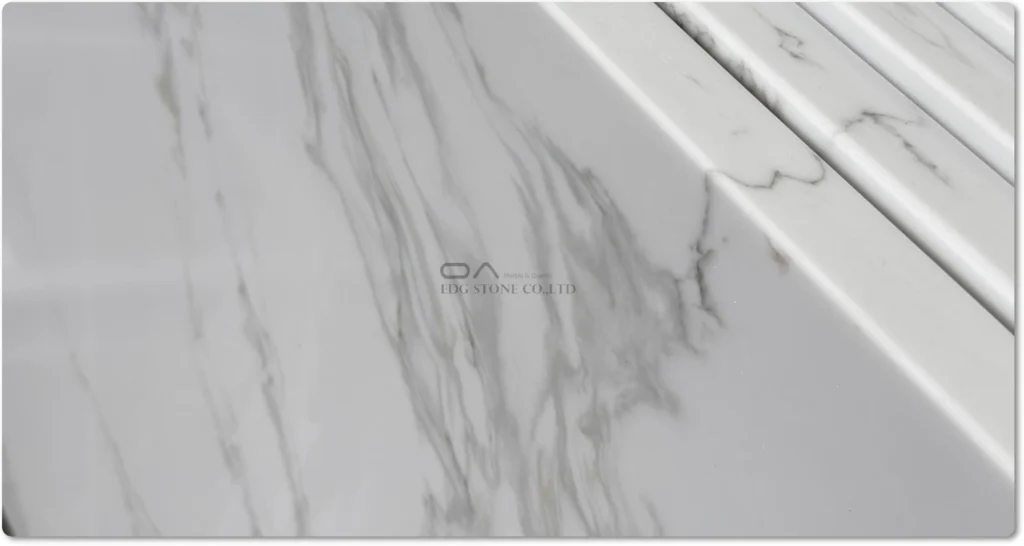
Quartz vs Quartzite Countertops: Which Is Better?
There is no universal winner.
The better material depends on the project.
Quartz Is Usually Better When You Want:
- Consistent color
- Predictable patterns
- Low routine maintenance
- Easy specification across multiple projects
- Contemporary engineered designs
- Large-scale commercial consistency
- A surface that generally does not require routine sealing
Quartzite Is Usually Better When You Want:
- Genuine natural stone
- Unique slab patterns
- Natural mineral variation
- High hardness
- Strong heat resistance
- Premium architectural character
- Natural-stone authenticity
- A luxury stone aesthetic
For a homeowner choosing a kitchen island, quartz may be attractive because of its consistency and easy maintenance.
For a luxury hotel, custom residence, or high-end architectural project where the slab itself is part of the design statement, quartzite can offer a more distinctive visual result.
Quartz vs Quartzite Durability
One of the most important comparisons is quartz vs quartzite durability.
Both can perform extremely well in demanding countertop applications, but their performance characteristics are different.
Engineered Quartz Durability
Engineered quartz is designed as a countertop surface and is generally resistant to everyday scratching, staining, and household wear.
Its controlled manufacturing process allows manufacturers to engineer consistent physical characteristics.
However, engineered quartz should not automatically be considered indestructible.
Excessive heat, impact, improper fabrication, aggressive chemicals, and inappropriate installation can still cause problems.
Quartzite Durability
Quartzite is naturally dense and hard.
Because quartzite is formed through metamorphism, its mineral grains have been recrystallized and tightly bonded. Some quartzite varieties can provide excellent resistance to scratching and abrasion.
The exact performance, however, depends on the individual stone.
Not every stone sold commercially as “quartzite” has identical mineralogy or performance. Some stones marketed as quartzite may contain significant amounts of other minerals and can behave differently during fabrication or use.
Which Is More Durable?
For practical countertop selection:
Quartz: excellent everyday durability with predictable performance.
Quartzite: excellent natural-stone durability, often with superior heat resistance, but requiring more attention to stone selection, sealing, and maintenance.
Therefore, the correct question is not simply “Which lasts longer?”
A better question is:
Which material provides the right combination of durability, maintenance, appearance, fabrication requirements, and cost for the project?
Quartz vs Quartzite Staining
The search “quartz vs quartzite staining” is particularly important for kitchens.
Does Quartz Stain?
Engineered quartz is generally highly resistant to everyday staining because its surface is nonporous or very low-porosity depending on the specific product.
Coffee, wine, cooking oils, and common kitchen substances are therefore generally easier to clean from a properly maintained quartz countertop.
However, stain resistance does not mean chemical immunity.
Strong solvents, aggressive chemicals, prolonged exposure to certain substances, and excessive heat can damage the surface.
Does Quartzite Stain?
Quartzite is a natural stone and can have some degree of porosity.
Therefore, certain quartzite surfaces may benefit from professional sealing.
The effectiveness and frequency of sealing depend on:
- Stone mineralogy
- Porosity
- Surface finish
- Sealer technology
- Kitchen usage
- Cleaning practices
A correctly selected and properly sealed quartzite countertop can perform very well in kitchens.
Quartz vs Quartzite Staining Verdict
If your highest priority is easy stain resistance with minimal maintenance, engineered quartz is generally the simpler choice.
If your highest priority is natural stone appearance and geological uniqueness, quartzite may be worth the additional maintenance considerations.
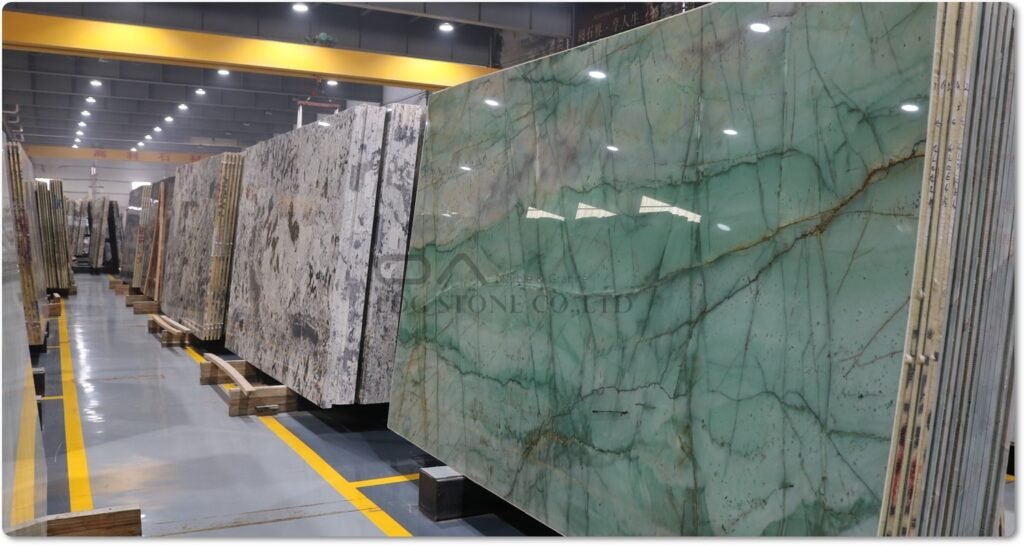
Quartz vs Quartzite Pros and Cons
Quartz Pros
- Consistent appearance
- Wide design range
- Low routine maintenance
- Strong stain resistance
- Predictable slab production
- Suitable for many residential and commercial applications
- Easy to specify across large projects
Quartz Cons
- Manufactured rather than naturally formed
- Heat exposure can be a concern
- Pattern repetition may be noticeable
- Fabrication generates crystalline silica dust
- Regulatory requirements surrounding engineered stone are becoming increasingly important
Quartzite Pros
- Natural stone
- Unique slab patterns
- High hardness
- Excellent durability
- Strong heat resistance
- Premium architectural appearance
- Natural variation
Quartzite Cons
- Often more expensive
- Slab availability can be limited
- Natural variation makes exact matching difficult
- Some varieties require sealing
- Fabrication still generates respirable crystalline silica when stone is cut, ground, or polished
Quartz vs Quartzite vs Granite vs Marble
For many buyers, the real comparison is not simply quartz vs quartzite.
It is:
Quartz vs quartzite vs granite vs marble.
Quartz vs Quartzite vs Granite vs Marble Comparison
| Factor | Quartz | Quartzite | Granite | Marble |
| Origin | Engineered | Natural metamorphic | Natural igneous | Natural metamorphic |
| Appearance | Highly consistent | Natural variation | Natural variation | Strong veining/variation |
| Stain resistance | High | Good with proper sealing | Good with sealing | More sensitive |
| Scratch resistance | High | Very high | High | Moderate |
| Heat resistance | Good but manufacturer-dependent | Excellent | Excellent | Excellent |
| Maintenance | Low | Low to moderate | Moderate | Moderate to high |
| Sealing | Usually not required | Often recommended | Usually recommended | Usually recommended |
| Design consistency | Excellent | Variable | Variable | Variable |
| Luxury appeal | High | Very high | High | Very high |
| Typical cost | $$–$$$ | $$$–$$$$ | $$–$$$ | $$–$$$$ |
These are broad market comparisons rather than universal specifications. Actual performance and pricing depend on the individual material, thickness, finish, fabrication, region, and supplier.
Quartz vs Quartzite vs Granite: Which Should You Choose?
Choose Quartz When:
You prioritize:
- Low maintenance
- Consistent design
- Predictable procurement
- Contemporary aesthetics
- Easy cleaning
- Large commercial quantities
Choose Quartzite When:
You prioritize:
- Natural stone
- High-end aesthetics
- Unique slabs
- Heat resistance
- Natural variation
- Luxury residential or hospitality design
Choose Granite When:
You want:
- Natural stone
- Strong durability
- A broad selection of colors
- Excellent heat resistance
- Competitive natural-stone pricing
Granite remains an important countertop material because it combines durability with wide geological variety.
Quartz vs Quartzite vs Marble
Marble deserves a separate comparison because it occupies a different position in interior design.
Marble is prized for its veining, depth, and timeless architectural appearance.
However, marble is generally more susceptible to scratching and acid etching than quartzite or granite.
Therefore:
Quartz: practical and consistent.
Quartzite: natural, hard, and premium.
Marble: exceptionally aesthetic and architectural, but more maintenance-sensitive.
For a busy family kitchen, quartz or quartzite may be more practical.
For a luxury bathroom, feature wall, fireplace, hotel lobby, or statement island, marble can remain an excellent design choice.
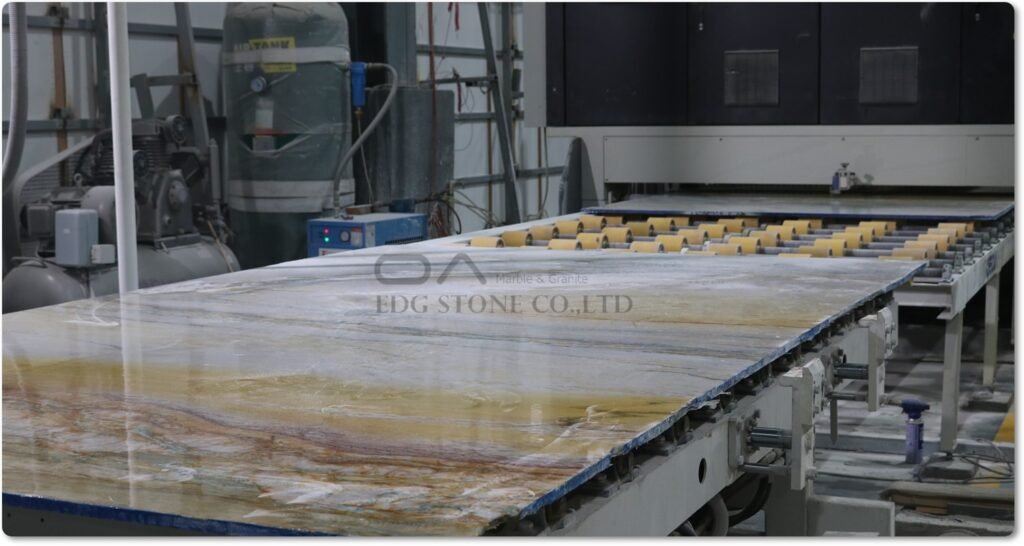
Quartz vs Quartzite Cost: Which Is More Expensive?
The question “Quartz vs quartzite cost” does not have one fixed answer.
Countertop pricing depends on:
- Slab grade
- Brand
- Quarry
- Thickness
- Surface finish
- Edge profile
- Slab size
- Pattern complexity
- Fabrication
- Sink cutouts
- Installation
- Transportation
- Region
- Project volume
Quartz Countertop Cost
Engineered quartz often provides relatively predictable procurement because manufacturers can produce standardized collections.
This can be advantageous for:
- Builders
- Kitchen companies
- Distributors
- Retailers
- Hospitality contractors
- Multi-unit residential projects
Quartzite Countertop Cost
Quartzite can cost more when the material is rare, visually desirable, difficult to quarry, or highly sought after.
Premium quartzites such as Taj Mahal-style materials can command significant prices because of demand, quarry characteristics, slab quality, and fabrication complexity.
Quartz vs Quartzite Countertops Cost
A useful purchasing principle is:
Material cost is only one component of total countertop cost.
The final budget may include:
Slab + fabrication + edge processing + cutouts + reinforcement + finishing + packaging + shipping + installation.
For wholesale buyers, the delivered cost can therefore matter more than the quoted slab price.
Taj Mahal Quartz vs Quartzite
“Taj Mahal quartz” and “Taj Mahal quartzite” are frequently confused.
In the natural stone market, Taj Mahal is commonly associated with a quartzite material, while manufacturers also produce engineered quartz designs inspired by the same visual language.
The distinction is important.
Taj Mahal Quartzite
Natural Taj Mahal quartzite offers:
- Natural mineral variation
- Authentic stone movement
- Unique slab structure
- Premium natural-stone character
Taj Mahal-Inspired Engineered Quartz
Engineered quartz can reproduce similar visual characteristics with:
- Controlled veining
- Consistent color
- Reproducible designs
- Easier large-project specification
Taj Mahal Quartz vs Quartzite Cost
Do not compare the names alone.
When evaluating cost, confirm:
- Is it natural quartzite?
- Is it engineered quartz?
- What is the slab thickness?
- What is the grade?
- What is the finish?
- What is the country of origin?
- Is fabrication included?
- What is the delivered cost?
This prevents one of the most common procurement mistakes in the stone industry: comparing materials based on marketing names rather than actual material composition.
Engineered Quartz vs Quartzite: Fabrication Considerations
One important issue is often overlooked in online comparisons.
Both engineered quartz and quartzite can generate respirable crystalline silica dust during fabrication.
OSHA identifies cutting, sawing, grinding, drilling, polishing, and similar operations as potential sources of respirable crystalline silica exposure. OSHA’s countertop guidance specifically addresses natural and engineered stone fabrication and installation.
Under OSHA’s general-industry silica standard, the permissible exposure limit is 50 μg/m³ as an 8-hour time-weighted average, with an action level of 25 μg/m³.
Therefore, professional fabrication should prioritize:
- Wet cutting
- Dust extraction
- Local exhaust ventilation
- HEPA filtration where appropriate
- Exposure assessment
- Worker training
- Appropriate respiratory protection
- Written exposure-control procedures
OSHA specifically identifies water delivery systems, shrouded tools with HEPA vacuum systems, local exhaust ventilation, and other engineering controls as ways to reduce silica exposure.
Quartz Countertops and the Changing Regulatory Landscape
The global countertop industry is undergoing a major regulatory shift.
Australia implemented a nationwide prohibition on the manufacture, supply, processing, and installation of engineered-stone benchtops, panels, and slabs beginning July 1, 2024, and engineered-stone imports were prohibited beginning January 1, 2025.
The Australian definition focuses on artificial products containing at least 1% crystalline silica and created by combining natural stone materials with other constituents such as resins or pigments. Sintered stone and porcelain products without resin are excluded from that specific definition.
California is also moving toward tighter regulation. In May 2026, the California Occupational Safety and Health Standards Board voted to initiate a process toward prohibiting fabrication and installation of artificial stone products containing more than 1% crystalline silica. In July 2026, Cal/OSHA convened an advisory meeting concerning proposed emergency rulemaking on engineered stone countertops containing more than 1% crystalline silica.
For manufacturers, factories, wholesalers, fabricators, distributors, and importers, this means material selection is increasingly connected to regulatory compliance, worker safety, product composition, and market access.
The strategic implication is significant:
The future countertop market is likely to place greater emphasis on low-silica or silica-free alternatives, natural stone, porcelain, sintered stone, and manufacturing processes with stronger occupational-safety controls.
This does not mean every engineered quartz product is prohibited everywhere. Regulations differ by jurisdiction and can change. Buyers should verify the rules applicable to their market before importing, fabricating, or installing engineered stone.
Quartz vs Quartzite Rocks: Why the Terminology Causes Confusion
Searches such as “quartz vs quartzite rocks” often produce confusing results because quartz is a mineral while quartzite is a rock.
Think of the hierarchy like this:
Quartz = mineral
Quartzite = metamorphic rock composed mainly of quartz
Granite = igneous rock containing quartz and other minerals
Marble = metamorphic carbonate rock, commonly derived from limestone or dolostone
This distinction explains why saying “quartz rock” and “quartzite rock” interchangeably is scientifically inaccurate.
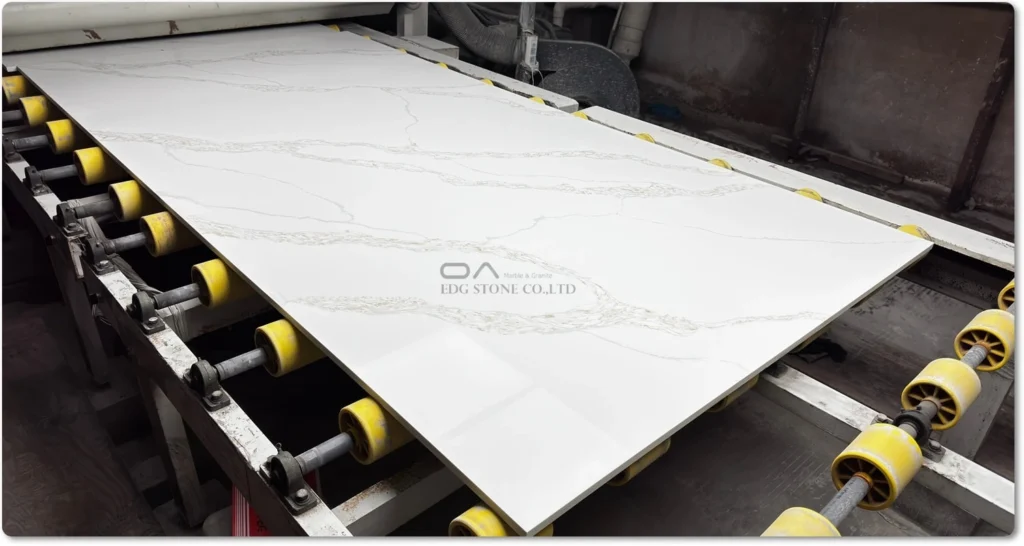
How to Choose Between Quartz and Quartzite
Consideration 1: Design
If you want predictable colors and patterns, engineered quartz provides strong advantages.
If you want natural geological variation, quartzite is more compelling.
Consideration 2: Maintenance
For low-maintenance kitchens, quartz is often easier.
For quartzite, ask the supplier about porosity and recommended sealing.
Consideration 3: Heat
If the countertop will be exposed to high temperatures, natural stone such as quartzite or granite may have an advantage.
Always follow the manufacturer’s or fabricator’s care instructions.
Consideration 4: Budget
Compare total installed cost, not simply slab price.
Consideration 5: Procurement
Commercial buyers should evaluate:
- Slab availability
- MOQ
- Production lead time
- Color consistency
- Batch variation
- Packaging
- Container loading
- QC documentation
- Fabrication support
- Replacement availability
Consideration 6: Regulation
If the product is engineered quartz or another manufactured stone containing crystalline silica, verify the regulations governing fabrication, installation, importation, and worker exposure in the destination market.
Buying Quartz or Quartzite Wholesale: What Should You Ask a Manufacturer?
For importers, distributors, retailers, builders, and stone contractors, purchasing decisions should go beyond asking for a price.
Questions for a Quartz Manufacturer
Ask:
- What is the exact product composition?
- What is the crystalline silica content?
- What certifications or technical documents are available?
- What slab thicknesses are available?
- What are the slab dimensions?
- What are the MOQ requirements?
- What is the production lead time?
- How is color consistency controlled?
- What QC procedures are used?
- What export markets are currently supplied?
Questions for a Quartzite Supplier or Factory
Ask:
- What is the quarry origin?
- Is the material commercially classified as quartzite?
- What is the slab thickness?
- What is the water absorption?
- What is the expected variation?
- Is resin treatment used?
- Is sealing recommended?
- What finishes are available?
- How are slabs packed for export?
- Can the supplier provide batch photographs and inspection records?
A professional quartzite manufacturer, natural stone factory, or wholesale supplier should be able to provide more than photographs and a price list.
Quartz vs Quartzite: A Practical Decision Matrix
| Your Priority | Recommended Material |
| Lowest routine maintenance | Quartz |
| Maximum natural variation | Quartzite |
| Consistent large-scale projects | Quartz |
| Luxury natural-stone appearance | Quartzite |
| Strong heat resistance | Quartzite |
| Predictable color matching | Quartz |
| Natural material authenticity | Quartzite |
| Easy procurement across repeated projects | Quartz |
| Unique statement island | Quartzite |
| Budget-sensitive natural stone | Granite may be worth considering |
| Classic veining | Marble or quartzite |
| Regulatory-sensitive engineered-stone market | Verify local rules; consider compliant alternatives |
What Do Buyers Say on Reddit About Quartz vs Quartzite?
Searches for “quartz vs quartzite Reddit” reflect a recurring consumer debate: homeowners often compare maintenance, staining, heat resistance, natural appearance, and cost.
However, Reddit discussions should be treated as anecdotal experience rather than technical certification.
A homeowner’s experience with one quartzite slab does not necessarily represent all quartzite.
Likewise, an experience with one quartz manufacturer does not represent every engineered quartz product.
For professional procurement, online discussions are useful for identifying questions, but technical specifications, testing data, fabrication guidance, and supplier documentation should be used for final decisions.
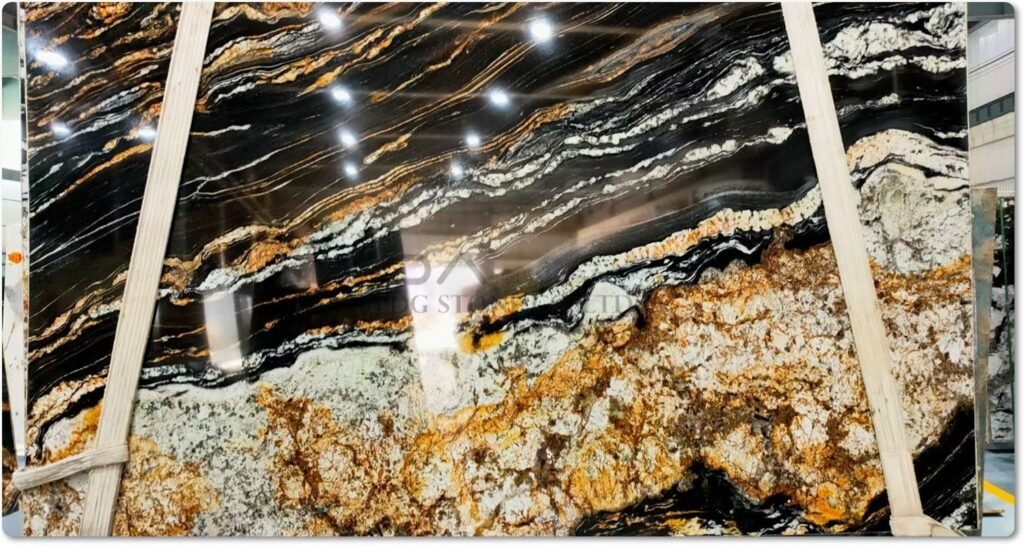
Quartz vs Quartzite: Final Verdict
The answer to quartz vs quartzite is not simply “which is better?”
It is:
Quartz is generally the stronger choice for consistency, low maintenance, predictable procurement, and engineered design flexibility. Quartzite is generally the stronger choice for natural-stone authenticity, unique slab movement, hardness, and premium architectural applications.
For residential kitchens, both can be excellent.
For luxury projects, quartzite can provide an exceptional natural focal point.
For large-scale commercial procurement, engineered quartz can offer significant consistency—but buyers must now pay closer attention to crystalline-silica regulations and market-specific restrictions.
For natural-stone wholesalers and importers, quartzite remains particularly attractive because its geological origin creates differentiation that engineered materials cannot perfectly reproduce.
The most important procurement principle is therefore:
Do not buy based only on the name “quartz,” “quartzite,” or a popular color name. Verify the material, technical properties, origin, fabrication requirements, regulatory status, and total delivered cost.
For professional stone sourcing, EDG Stone can evaluate quartz, quartzite, granite, marble, and other countertop materials according to project requirements, application, design, quantity, fabrication needs, and export-market considerations.
FAQ: Popular Google Questions About Quartz vs Quartzite
1. Is quartz better than quartzite for countertops?
Not necessarily. Quartz is generally easier to maintain and offers more consistent colors and patterns, while quartzite provides natural-stone character, high hardness, and strong heat resistance. The best option depends on the project’s priorities.
2. Is quartzite more expensive than quartz?
Often, premium quartzite costs more than standard engineered quartz, but there is no universal price difference. Slab grade, rarity, quarry, fabrication, thickness, finish, shipping, and installation all affect the final cost.
3. Does quartzite stain more than quartz?
Quartzite can be more susceptible to staining if it is porous and unsealed. Properly selected and sealed quartzite can perform very well. Engineered quartz generally offers more predictable stain resistance and lower routine maintenance.
4. Which is more durable, quartz or quartzite?
Both can be highly durable. Quartzite is a naturally hard metamorphic rock and generally performs extremely well against scratching and heat. Engineered quartz is specifically manufactured for countertop applications and provides consistent everyday performance.
5. Is Taj Mahal quartz actually quartzite?
“Taj Mahal” in the natural-stone market is commonly associated with quartzite, while engineered quartz manufacturers may produce Taj Mahal-inspired designs. Buyers should always verify whether the specific product is natural quartzite or engineered quartz rather than relying on the color name alone.
Semantic Insight: What Buyers Should Understand Before Choosing
Quartz vs Quartzite: What, Why, Options, and Key Considerations
What is the fundamental difference?
Quartz is a mineral, while quartzite is a natural metamorphic rock formed primarily through the recrystallization of quartz-rich sandstone or chert. In the countertop market, “quartz” usually means engineered quartz rather than naturally occurring quartz crystals.
Why does the difference matter?
The difference affects appearance, maintenance, fabrication, heat resistance, consistency, procurement, and regulatory considerations. Engineered quartz provides controlled production and consistent designs, while quartzite provides natural geological variation and a premium stone character.
What are the main options?
For countertop projects, buyers can compare engineered quartz, natural quartzite, granite, marble, porcelain, and sintered stone. The correct selection depends on design, performance requirements, budget, fabrication method, market regulations, and long-term maintenance expectations.
Which option is best for a low-maintenance kitchen?
Engineered quartz is often attractive for low-maintenance applications because of its consistent surface characteristics and stain resistance. Quartzite can also be an excellent kitchen surface when the specific stone is properly selected, fabricated, sealed, and maintained.
Which option is best for a luxury architectural project?
Natural quartzite can be especially compelling when the slab itself is intended to function as an architectural feature. Natural movement, mineral variation, bookmatching potential, and unique geological patterns can create visual characteristics that manufactured surfaces attempt to reproduce but cannot exactly duplicate.
What should professional buyers consider?
Professional buyers should evaluate material composition, technical data, slab dimensions, thickness, water absorption, finish, color variation, fabrication requirements, packaging, MOQ, lead time, quality control, documentation, total delivered cost, and destination-market regulations.
How is the market changing?
The countertop market is increasingly focused on crystalline-silica exposure, worker protection, responsible fabrication, and regulatory compliance. Australia has prohibited engineered-stone benchtops, panels, and slabs under its national framework, while California is advancing emergency rulemaking efforts concerning artificial stone products containing more than 1% crystalline silica.
What is the strategic buying conclusion?
The best countertop material is not determined by one specification. A professional decision should balance aesthetics, durability, maintenance, fabrication safety, regulatory requirements, supply reliability, and total project cost. For buyers sourcing internationally, a qualified manufacturer or wholesale supplier should provide transparent product information and support material selection before purchase.
The key takeaway is simple: quartz and quartzite may look similar, but they represent fundamentally different material categories. Understanding that distinction allows homeowners, designers, fabricators, distributors, and commercial procurement teams to make better technical and financial decisions.
Sources and Regulatory References
U.S. Geological Survey — Quartzite geological classification and metamorphic-rock information.
OSHA — Respirable Crystalline Silica standards and countertop fabrication guidance.
OSHA — Focused inspection initiative for engineered-stone fabrication and installation.
Safe Work Australia — Engineered-stone prohibition and crystalline-silica regulations.
California Department of Industrial Relations — 2026 engineered-stone emergency rulemaking process.