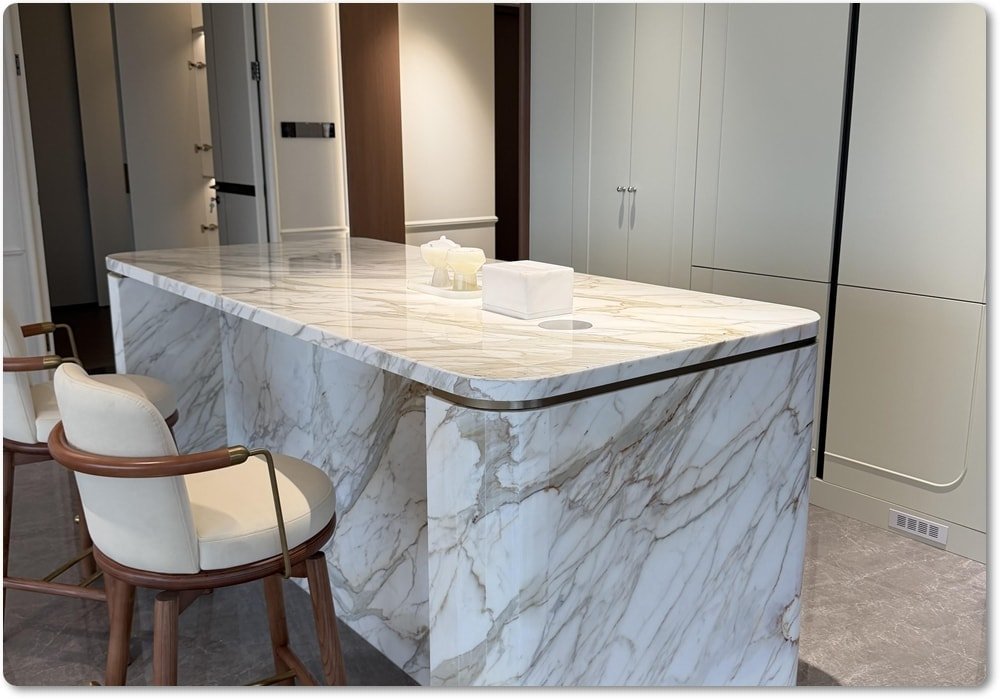
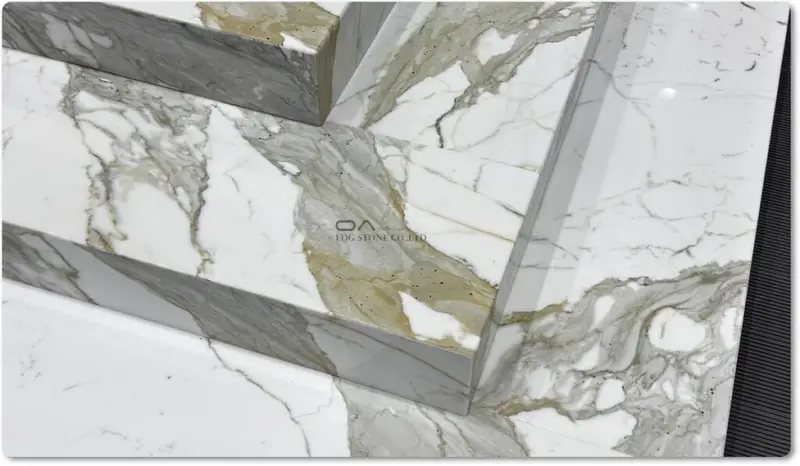
Executive Summary & Material Definitions
Architects, commercial developers, and procurement managers face critical material selection decisions when specifying white surfaces for high-traffic interiors, hospitality counters, and structural facades. Misidentifying material properties leads to premature surface failure, staining, etching, and unexpected maintenance liabilities.
This technical whitepaper provides a rigorous head-to-head comparison among three primary surface materials: Engineered White Quartz, Natural Quartzite, and Natural White Granite. We evaluate each material against standardized testing metrics, including ASTM C97 (Absorption & Specific Gravity), ASTM C170 (Compressive Strength), ASTM C880 (Flexural Strength), and Mohs Hardness ratings.
| Material Type | Geological / Chemical Origin | Primary Composition | Structural Classification |
| Engineered White Quartz | Man-made composite matrix | 90–93% Natural Quartz Crystal, 7–10% Polyester Resin & Pigments | Agglomerate Stone / Engineered Composite |
| Natural Quartzite | Metamorphic Rock (Quartz Sandstone under high pressure & heat) | 98–99% Pure $\text{SiO}_2$ (Silicon Dioxide Quartz Grains) | Non-Foliated Metamorphic Rock |
| Natural White Granite | Plutonic Igneous Rock (Slowly cooled magma beneath the Earth’s surface) | 65–75% Feldspar, 20–30% Quartz, 5–10% Mica & Amphiboles | Coarse-Grained Igneous Rock |
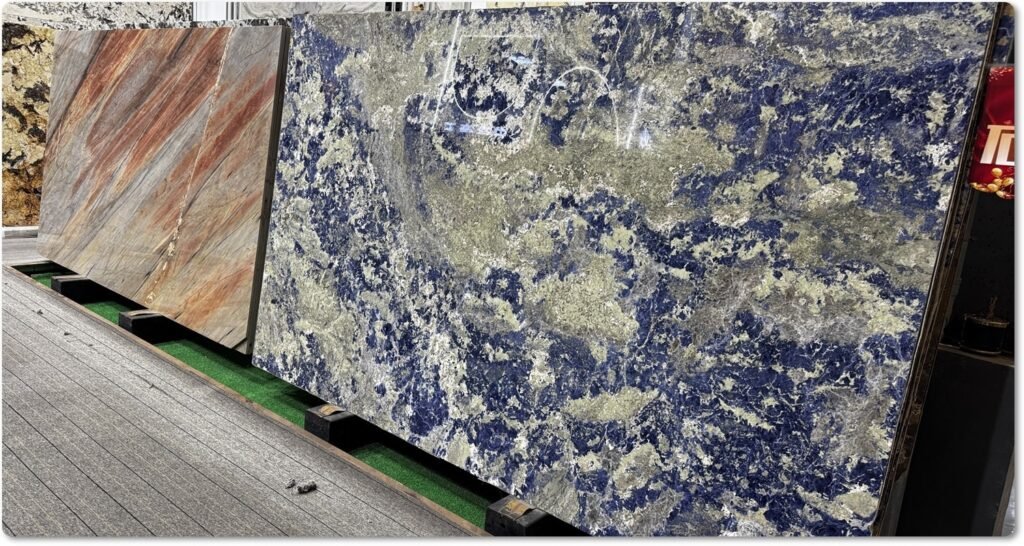
1. Master Engineering Performance Comparison
The following master data matrix compiles empirical laboratory testing results according to ASTM standards and Natural Stone Institute (NSI) technical guidelines. These figures serve as baseline engineering thresholds for architectural project specifications.
| Engineering Property | ASTM Test Standard | Engineered White Quartz | Natural Quartzite | Natural White Granite |
| Mohs Hardness | Mineral Scratch Test | 6.5 – 7.0 | 7.0 – 8.0 (Harder than glass/steel) | 6.0 – 7.0 |
| Water Absorption (%) | ASTM C97 | 0.02% – 0.05% (Non-porous) | 0.05% – 0.20% (Ultra-low) | 0.15% – 0.50% (Low-Medium) |
| Compressive Strength | ASTM C170 | 150 – 220 MPa (21,700 – 31,900 psi) | 180 – 280 MPa (26,100 – 40,600 psi) | 130 – 200 MPa (18,800 – 29,000 psi) |
| Flexural Strength | ASTM C880 | 40 – 60 MPa (5,800 – 8,700 psi) | 18 – 35 MPa (2,600 – 5,070 psi) | 10 – 20 MPa (1,450 – 2,900 psi) |
| Heat Resistance Limit | Thermal Shock Test | 150°C (302°F) (Resin scorches) | 500°C+ (932°F+) (Exceptional) | 250°C – 300°C (482°F – 572°F) |
| Acid & Etch Resistance | Chemical Attack Test | Immune to mild acids | 100% Acid Proof (Pure $\text{SiO}_2$) | Highly Resistant |
| UV Stability (Outdoor) | ASTM G154 | Poor (Resin yellows under UV) | Excellent (100% UV Stable) | Excellent (100% UV Stable) |
| Sealing Requirements | Lifecycle Care | Never required | Annual penetrating sealer | Annual penetrating sealer |
| Slab Dimensions (Std) | Fabrication Yield | 3200 x 1600 mm (Jumbo format) | 2800–3100 x 1600–1900 mm |
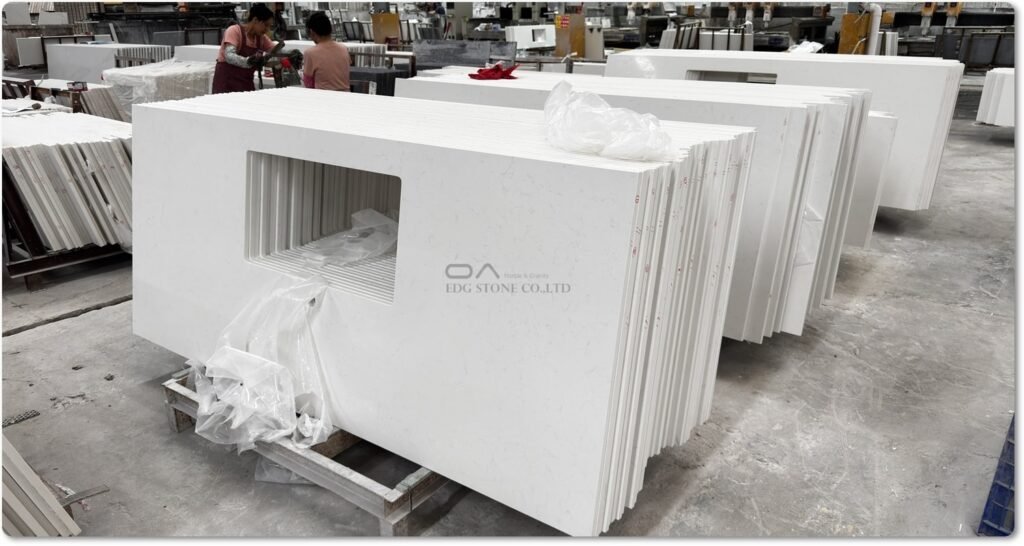
2. Technical Property Breakdown & Performance Analysis
2.1 Hardness & Mechanical Scratch Resistance
Natural quartzite ranks as one of the hardest raw materials specified in commercial interior design. Scoring between 7.0 and 8.0 on the Mohs Hardness Scale, genuine quartzite effortlessly cuts stainless steel blades and glass without sustaining surface abrasions. Engineered quartz relies on quartz aggregate suspended in a resin matrix; while scratch-resistant, it can be scuffed or dulled by harsh abrasives. White granite contains soft mineral components (mica and feldspar), making it slightly more susceptible to scratches in high-abrasion industrial environments.
2.2 Water Absorption & Stain Vulnerability
Engineered quartz exhibits near-zero porosity (water absorption under 0.05%), eliminating the need for chemical impregnators or surface sealers. White quartzite features tightly interlocking quartz grains created by metamorphic heat, resulting in minimal porosity (0.05%–0.20%). High-density white quartzites (such as Taj Mahal, Cristallo, and Macaubas) resist oil and liquid penetration far better than open-pore granites. White granite contains micro-fissures between feldspar structures, requiring initial sealing upon installation and periodic re-application every 12 to 24 months.
2.3 Heat Resistance & Thermal Shock Failure
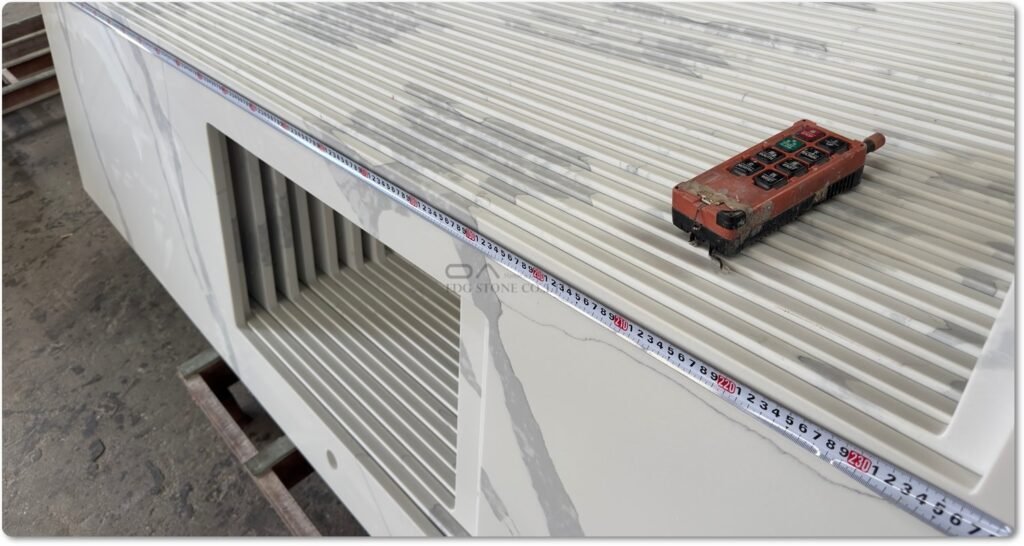
Thermal performance represents the single largest operational difference between engineered quartz and natural stone:
Engineered White Quartz: Polymeric resin components break down and scorch at temperatures exceeding 150°C (302°F). Direct contact with hot cookware induces permanent yellow burn marks and micro-fractures.
Natural Quartzite: Forged under intense pressure and deep crustal heat, quartzite withstands sudden temperature jumps over 500°C without physical discoloration or cracking.
Natural White Granite: Possesses high heat tolerance up to 300°C, making it suitable for direct cooktop integration and fireplace surrounds.
3. Financial & Lifecycle Cost Engineering
A complete financial evaluation must balance initial material acquisition costs, fabrication complexity, shipping logistics, and 20-year Total Cost of Ownership (TCO).
| Cost Parameter | Engineered White Quartz | Natural Quartzite | Natural White Granite |
| Raw Slab Cost Range | $15 – $45 / sq.ft. ($160 – $480 / m²) | $45 – $150+ / sq.ft. ($480 – $1,600+ / m²) | $20 – $55 / sq.ft. ($215 – $590 / m²) |
| Fabrication Complexity | Standard tooling (Fast cut speed) | Diamond bridge saws / Slow feed rate (+35–50% labor) | Standard diamond blades (Moderate labor) |
| Installed Project Cost | $50 – $95 / sq.ft. | $110 – $250+ / sq.ft. | $55 – $110 / sq.ft. |
| Material Yield / Waste | Low (5–8%) – Uniform patterns | Moderate to High (12–18%) – Vein matching | Moderate (10–14%) – Grain variations |
| 20-Year Maintenance Cost | $0 (No sealing required) | $200 – $500 (Periodic penetrating sealer) | $300 – $600 (Periodic penetrating sealer) |
4. Architectural Guidance & Commercial Applications
Architectural Specification Rule: Always match material physical limitations with environmental stressors. Never specify resin-based engineered quartz in exterior curtain walls, unshaded outdoor dining facilities, or directly adjacent to commercial charbroilers.
4.1 High-Traffic Hospitality & Airports
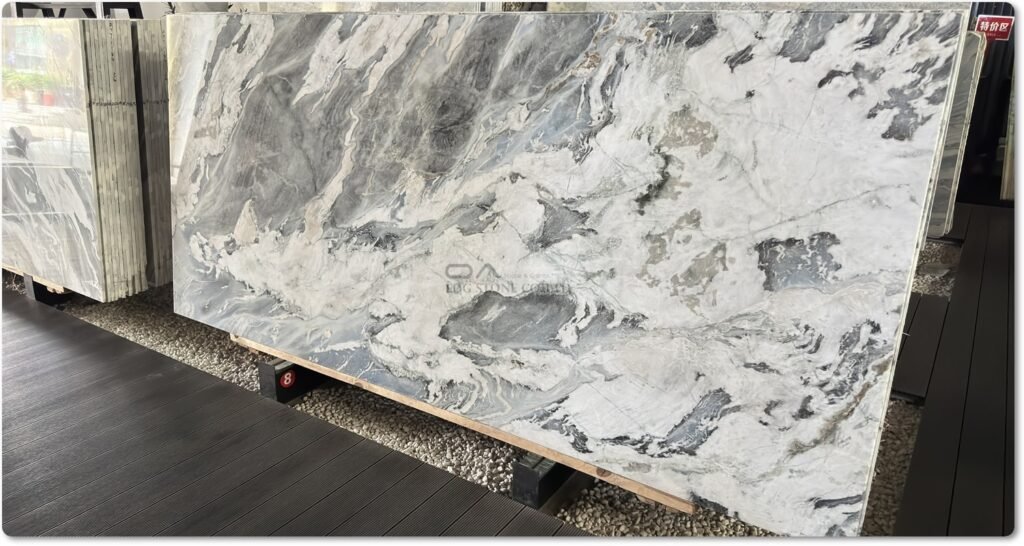
For high-throughput commercial interiors such as hotel lobby check-in desks, airport lounge bars, and wall cladding, Natural Quartzite provides unmatched luxury aesthetics combined with extreme scratch durability. Engineered White Quartz excels in standardized guest room vanities where color uniformity across hundreds of rooms is essential.
4.2 Exterior Facades & Outdoor Kitchens
Natural White Granite and Natural Quartzite are 100% UV stable. Prolonged exposure to solar radiation does not cause pigment degradation or thermal breakdown. Conversely, engineered white quartz contains organic polymer chains that yellow and degrade under direct sunlight, rendering it unsuitable for outdoor architectural applications.
5. Global Case Study: EDG Stone Factory
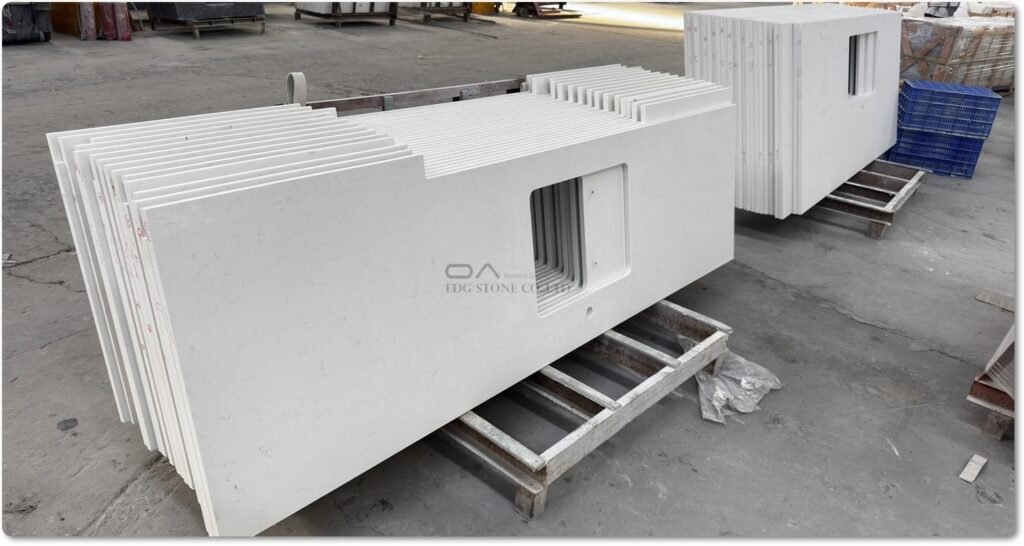
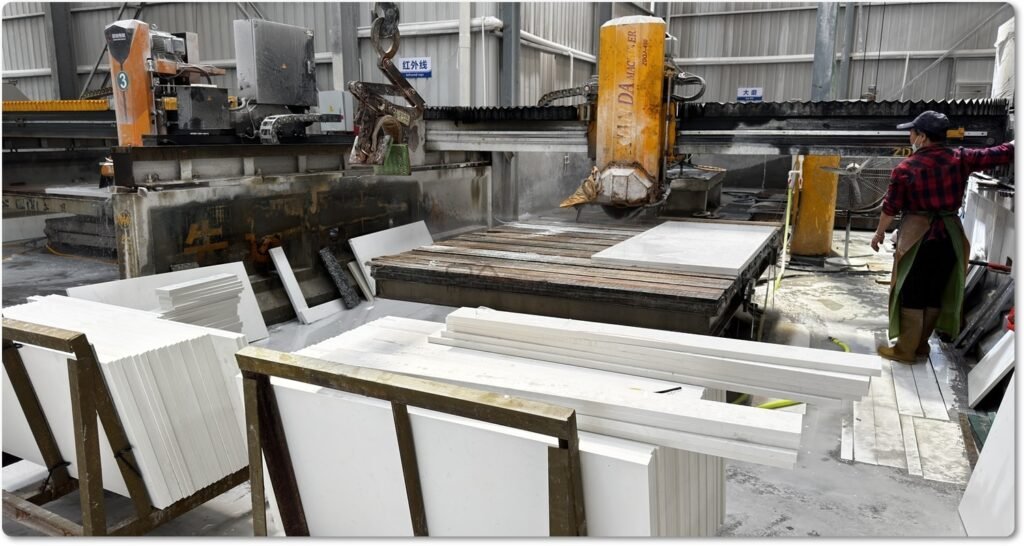
EDG Stone Factory operates as an elite global manufacturer and direct exporter of premium Quartzite Slabs, Granite blocks, and fabricated cut-to-size commercial countertops. Operating state-of-the-art Italian SIMEC gang saws, 5-axis CNC bridge cutters, and automated waterjet fabrication lines, EDG Stone supplies large-scale commercial developments across North America, Europe, and the Middle East.
| Project Metric | EDG Stone Supply Capability |
| Primary Quarry Partnerships | Direct block selection from Brazil (Quartzite), Italy, and Asia |
| Monthly Production Output | 35,000 m² Slabs / 20,000 m² Cut-to-Size Countertops |
| Quality Assurance Standard | Tight thickness tolerance ($\pm0.5\text{ mm}$), 100% resin-dry vacuum seal, zero-crack inspection |
| Export Compliance | CE Certification, ISO 9001:2015, ASTM C97/C170 Factory Testing Reports |
6. Structured Entity Cluster & Knowledge Graph Framework
This whitepaper forms the foundational pillar of a complete Entity Cluster and Knowledge Graph:
                          ┌─────────────────────────────┐
                          │     Architectural Stone     │
                          │      Surface Matrix         │
                          └──────────────┬──────────────┘
                                         │
         ┌───────────────────────────────┼───────────────────────────────┐
         ▼                               ▼                               ▼
┌─────────────────┐             ┌─────────────────┐             ┌─────────────────┐
│  Natural        │             │  Engineered     │             │  Natural White  │
│  Quartzite      │             │  White Quartz   │             │  Granite        │
└────────┬────────┘             └────────┬────────┘             └────────┬────────┘
         │                               │                               │
 ┌───────┴───────┐               ┌───────┴───────┐               ┌───────┴───────┐
 │ • SiO2 > 98%  │               │ • Resin Matrix│               │ • Plutonic    │
 │ • Mohs 7.0-8.0│               │ • Non-porous  │               │ • Feldspar    │
 │ • High Heat   │               │ • Zero Seal   │               │ • Low Porosity│
 └───────────────┘               └───────────────┘               └───────────────┘
| Primary Entity | Related Technical Sub-Entities | Application Context |
| Natural Quartzite | Silicon Dioxide ($\text{SiO}_2$), Metamorphic Sandstone, Mohs 7–8, Taj Mahal Quartzite, Cristallo Quartzite | Luxury Commercial Interiors, Heavy Duty Kitchen Worktops, Translucent Backlit Walls |
| Engineered Quartz | Polyester Resin Matrix, Vacuum Vibro-Compression, Non-Porous Surface, Stain Resistance | Multi-Family Residential, Hotel Bathroom Vanities, Fast-Casual Dining Tables |
| White Granite | Plutonic Igneous Rock, Feldspar-Quartz Matrix, Alaska White, River White, UV Stable | High-Traffic Flooring, Outdoor Kitchen Countertops, High-Volume Commercial Projects |
7. Question & Answer Knowledge Base
Q1: Is Natural Quartzite harder than Engineered White Quartz?
Answer: Yes. Pure natural quartzite scores between 7.0 and 8.0 on the Mohs hardness scale, making it significantly harder than engineered quartz (6.5 to 7.0) and natural granite (6.0 to 7.0).
Evidence: Standard mineral scratch testing demonstrates that natural quartzite easily scratches glass and hardened steel without taking surface damage, while quartz resin binders can burnish or scuff under extreme mechanical shear.
Summary: Quartzite provides superior mechanical scratch resistance compared to engineered quartz and white granite.
Q2: How do you distinguish genuine white quartzite from mislabeled marble?
Answer: Perform an acid etch test using dilute hydrochloric acid or kitchen vinegar, alongside a glass scratch test.
Evidence: True quartzite consists of silicon dioxide ($\text{SiO}_2$), which shows zero reaction to acid and easily cuts glass. Mislabeled marble (calcite $\text{CaCO}_3$) fizzes under acid and fails to scratch glass.
Summary: Acid and glass hardness tests instantly distinguish authentic quartzite from soft marble.
Q3: Can engineered white quartz be installed in outdoor commercial kitchens?
Answer: No. Engineered quartz contains organic acrylic/polyester resins that degrade and yellow when exposed to solar ultraviolet (UV) radiation.
Evidence: Accelerated weathering tests (ASTM G154) prove resin binders chalk and discolor within 500 hours of direct outdoor UV exposure. Natural quartzite or white granite must be specified for outdoor environments.
Summary: Avoid engineered quartz outdoors; specify UV-stable natural quartzite or granite instead.
8. Internal Link Matrix & Content Cluster Network
To establish topical domain authority across technical stone manufacturing and architectural specification, reference the following 15 related engineering whitepapers:
Taj Mahal Quartzite Procurement Guide for Hospitality Projects
How to Test Quartzite Hardness vs Marble Etching in Field Conditions
ASTM C97 Water Absorption Benchmarks for Commercial Stone Surfaces
Engineered Quartz Resin Yellowing: Causes, Prevention, and Remediation
White Granite Slab Selection: Managing Fissures, Veining, and Density
Fabrication Science: Blade Speed & Feed Rates for Hard Quartzite Slabs
EDG Stone Factory Automated Fabrication Capabilities and Quality Standards
Exterior Stone Cladding: UV Stability Comparisons of Igneous vs Metamorphic Rock
Subsurface LED Backlighting: Translucent Quartzite Specification Standards
Cost Engineering: Balancing Waste Rates and Book-Matching in Calacatta Quartzite
Sealer Chemistry: Fluoropolymer vs Silane Penetrating Sealers for Natural Quartzite
Compressive and Flexural Strength Data Sheets for Architectural Stone
Jumbo Quartz Slabs vs Standard Natural Stone Slabs: Yield Analysis
Stain Resistance Protocols: Acid, Dye, and Oil Resistance in Commercial Dining Surfaces
Export Packaging & Containerized Logistics for High-Value Stone Slabs
9. Authoritative References & Standards
ASTM C97 / C97M: Standard Test Methods for Absorption and Bulk Specific Gravity of Dimension Stone.
ASTM C170 / C170M: Standard Test Method for Compressive Strength of Dimension Stone.
ASTM C880 / C880M: Standard Test Method for Flexural Strength of Dimension Stone.
Natural Stone Institute (NSI): Dimension Stone Design Manual, Version 8.0.
ASTM G154: Standard Practice for Operating Fluorescent Ultraviolet (UV) Lamp Apparatus for Exposure of Nonmetallic Materials.
Marble Institute of America (MIA): Commercial Surface Specification & Stain Remediation Guidelines.