Geological Analysis, Global Supply Chain Engineering, and High-Yield Sourcing Strategies for Architects, Engineers, and Wholesalers
1. Executive Summary & Market Intelligence
White marble represents a premium category in the global natural stone market. This white paper analyzes the geological profiles, mechanical properties, and supply chain logistics of the world’s primary white marble reserves: Italy, Vietnam, India, Pakistan, and China.
Global demand for high-purity calcium carbonate ($CaCO_3$) metamorphic rocks continues to grow. Architects and structural engineers value these materials for their aesthetic brilliance, low porosity, and structural integrity. Understanding the specific physical properties of each quarry site allows commercial buyers to optimize procurement costs, reduce project waste, and prevent material failures in high-traffic applications.
+-----------------------------------------------------------------------+
|                       GLOBAL SUPPLY CHAIN OVERVIEW                    |
+-----------------------------------------------------------------------+
|                                                                       |
|  [Italy]     --> Premium Carrara/Calacatta (Luxury Residential)       |
|  [Vietnam]   --> Pure White/Sunny White (Large-scale Commercial)      |
|  [India]     --> Makrana White (High Density, Low Porosity Monuments) |
|  [Pakistan]  --> Ziarat White (High Pure Dolomite, Architectural)      |
|  [China]     --> Oriental White (Cost-effective Mass Infrastructure)   |
|                                                                       |
+-----------------------------------------------------------------------+
2. Global White Marble Geology & Quarry Profiles
Italy: The Apuan Alps Matrix (Carrara, Calacatta, Statuario)
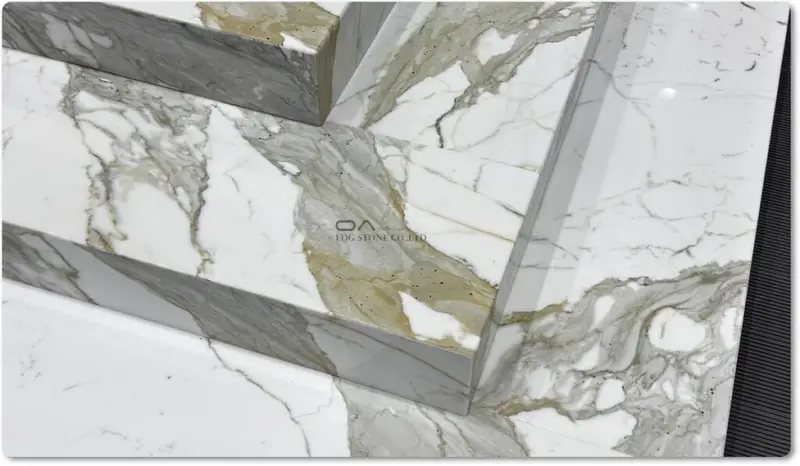
The Apuan Alps in Tuscany host the world’s most famous white marble deposits. Italian white marble formed during the Jurassic period through the regional metamorphism of marine limestone. This process removed organic impurities, creating a highly crystalline matrix of pure calcite.
Carrara White: Displays a soft, grayish-white background with fine, feathered veins.
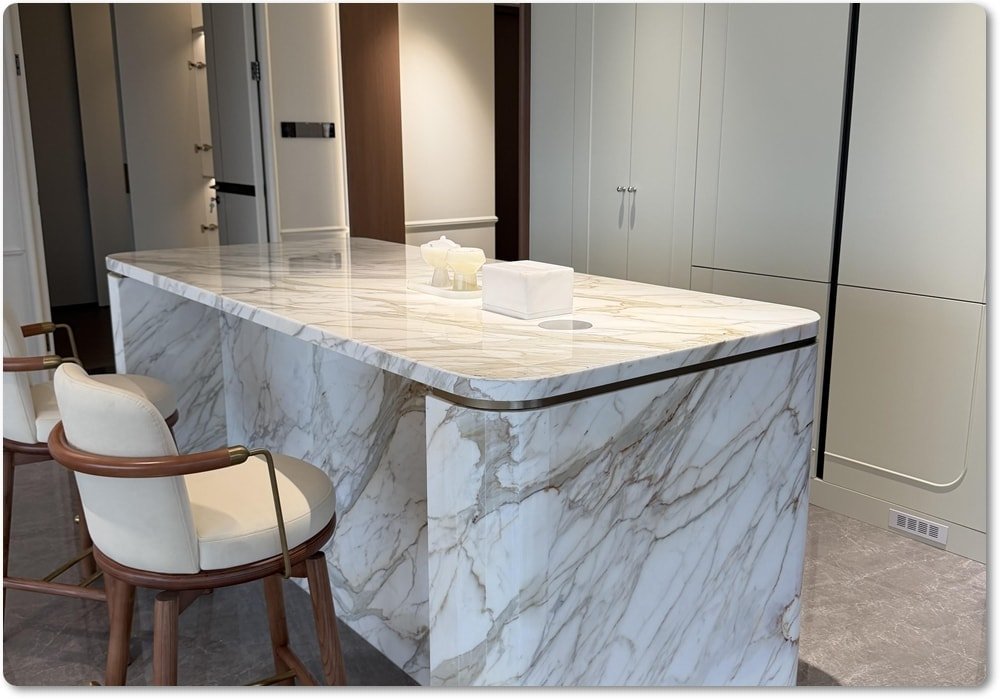
Calacatta: Features bold, dramatic gray veining against a stark white background.
Statuario: Offers a bright white field with thick, defined charcoal veins. This variety has the lowest production volume and the highest market value.
Vietnam: The Nghe An & Yen Bai Provinces (Vietnam Pure White, Sunny White)
Vietnam possesses some of the largest and highest-purity white marble deposits on Earth. Located primarily in the Luc Yen district of Yen Bai province and the Quy Hop district of Nghe An province, these formations are characterized by exceptionally large calcite crystal structures.
Vietnam Pure White: Contains up to 99.2% calcium carbonate ($CaCO_3$). It lacks veining, making it ideal for uniform, large-scale commercial flooring.
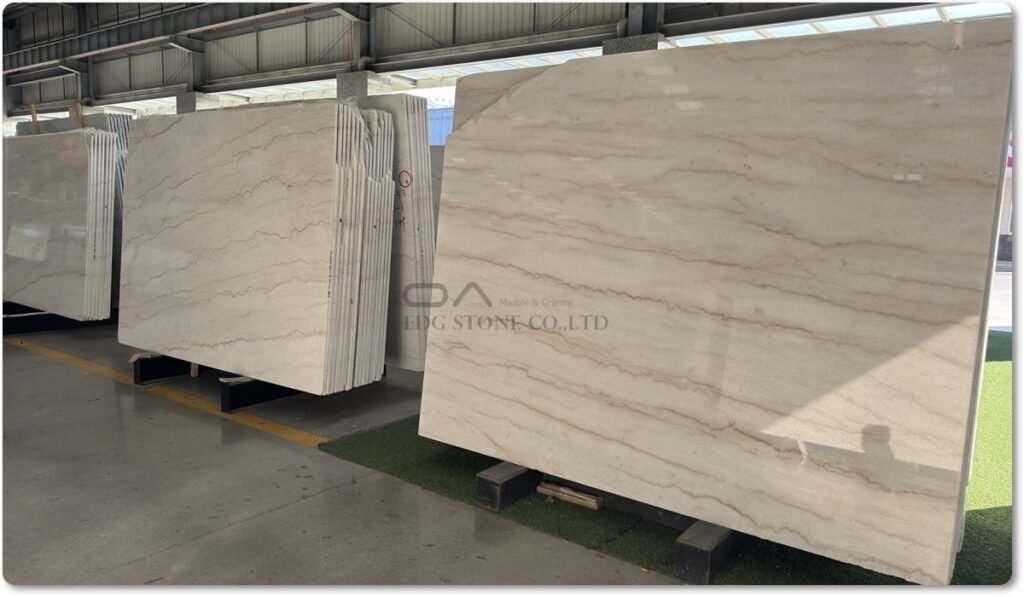
Sunny White: Displays a light cream to yellowish-white background with soft, golden-gray patterns. This variety offers excellent compressive strength for exterior claddings.
India: The Nagaur District of Rajasthan (Makrana White)
Makrana white marble is a geologically unique deposit classified as an older, highly recrystallized metamorphic rock from the Delhi Supergroup. It is famous for its historical use in the Taj Mahal.
Makrana Pure White: Features a calcitic matrix with exceptional density. It undergoes minimal water absorption, which prevents deep staining over decades of exposure.
Albeta & Dungri: Variations from the same region showing distinct grey or brown straight lines and interlocking grain structures.
Pakistan: The Balochistan & Khyber Pakhtunkhwa Reserves (Ziarat White, Sunny Grey)
Pakistan contains massive, under-exploited reserves of high-grade white marble. The most notable is Ziarat White, quarried in the rugged terrain of Balochistan.
Ziarat White: A bright, fine-grained dolomitic marble. It features a brilliant white body with subtle, rare green or grey lines. Its high mineral hardness demands precise diamond tooling during processing.
Pakistan White (Sunny Grey): Quarried in the northern regions, providing a more economical option with prominent grey clouds and shifts in tone.
China: The Sichuan & Guangxi Basins (Oriental White, Hanbaiyu)
China has scaled its extraction capabilities rapidly over the past three decades. The primary premium white varieties originate from Baoxing County in Sichuan Province and various deposits in Dangyang and Henan.
Oriental White (Sichuan): Often called the “Chinese Carrara,” it provides a milky white base with light grey or pale green veins.
Hanbaiyu (Beijing/Hebei): A classic structural marble used for historical imperial monuments. It is dense, easy to carve, and features a fine, jade-like texture.
3. Engineering & Material Properties Comparison
To select the correct material, structural engineers must analyze physical performance metrics. The table below lists the standard material properties for each primary country of origin based on ASTM and EN testing standards.
Table 1: Physical and Mechanical Properties of Major White Marbles
| Material Designation | Country of Origin | Bulk Density (g/cm3) | Water Absorption (%) | Compressive Strength (MPa) | Flexural Strength (MPa) | Mohs Hardness | Primary Mineral Composition |
| Carrara White | Italy | 2.71 | 0.12 | 120 | 11.5 | 3.0 | 99% Calcite |
| Vietnam Pure White | Vietnam | 2.85 | 0.08 | 135 | 14.2 | 3.5 | 99.2% Calcite |
| Makrana White | India | 2.73 | 0.05 | 115 | 15.0 | 3.2 | 98.5% Calcite |
| Ziarat White | Pakistan | 2.81 | 0.09 | 128 | 13.8 | 4.0 | Dolomitic Calcite |
| Oriental White | China | 2.68 | 0.18 | 110 | 10.2 | 3.0 | 97.8% Calcite |
Performance Analysis
Water Absorption: Makrana White and Vietnam Pure White show the lowest water absorption rates ($<0.10\%$). This makes them highly resistant to frost-thaw cycles and chemical staining in wet environments.
Compressive Strength: Vietnam Pure White delivers the highest compressive strength at 135 MPa. It withstands massive structural loads and heavy foot traffic in commercial lobbies.
Hardness: Ziarat White scores higher on the Mohs scale due to its dolomitic nature. It resists abrasions and deep scratches better than softer calcitic marbles.
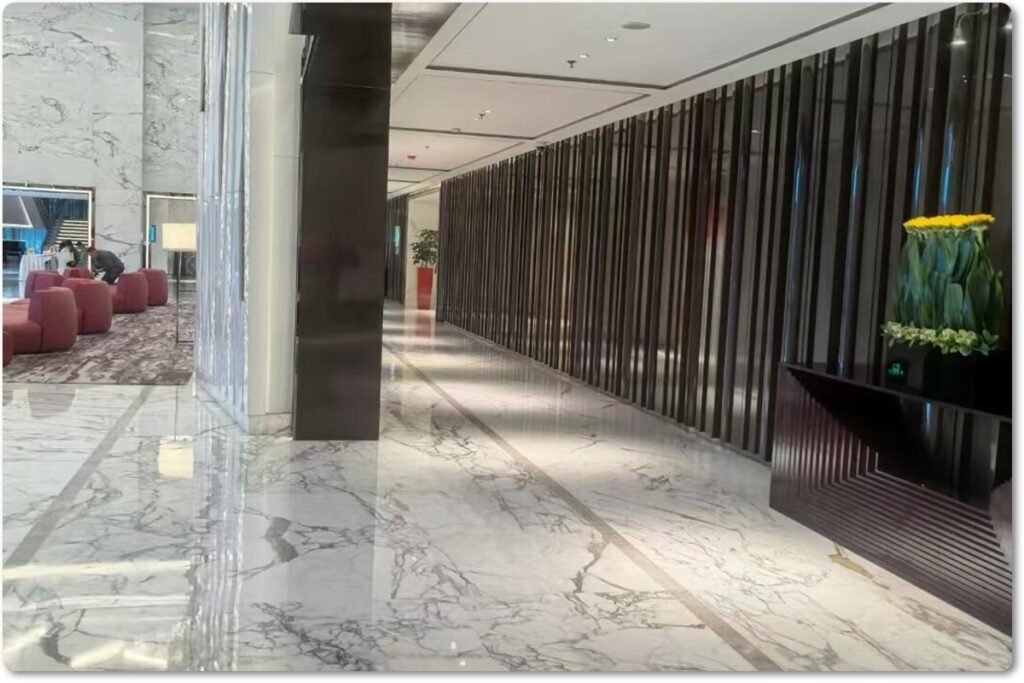
4. Architectural Selection Matrix & Commercial Processing
Architects select white marble varieties based on the specific aesthetic and physical demands of the application. The matrix below guides the selection process across major commercial use cases.
Table 2: Application Selection Matrix
| Architectural Application | Recommended Variety | Secondary Option | Surface Finish Selection | Engineering Justification |
| High-Traffic Flooring | Vietnam Pure White | Makrana White | Honed / High-Gloss Polished | Low porosity prevents liquid penetration; high compressive strength resists cracking under heavy foot traffic. |
| Exterior Facade Cladding | Sunny White (Vietnam) | Ziarat White | Sandblasted / Brushed / Bush-Hammered | High flexural strength resists wind loads and thermal expansion. |
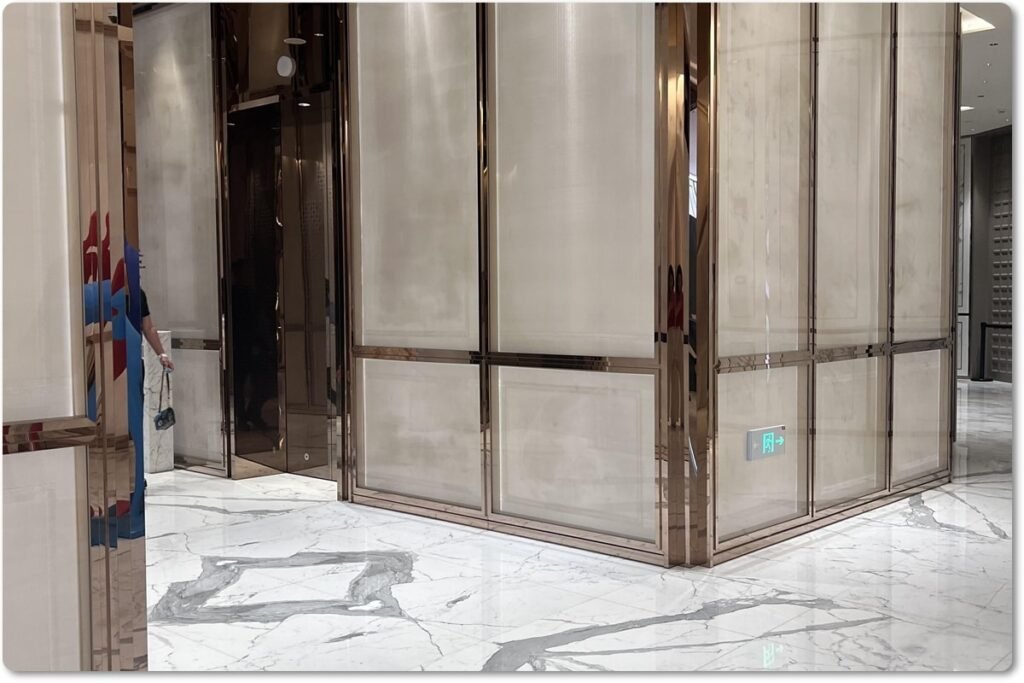
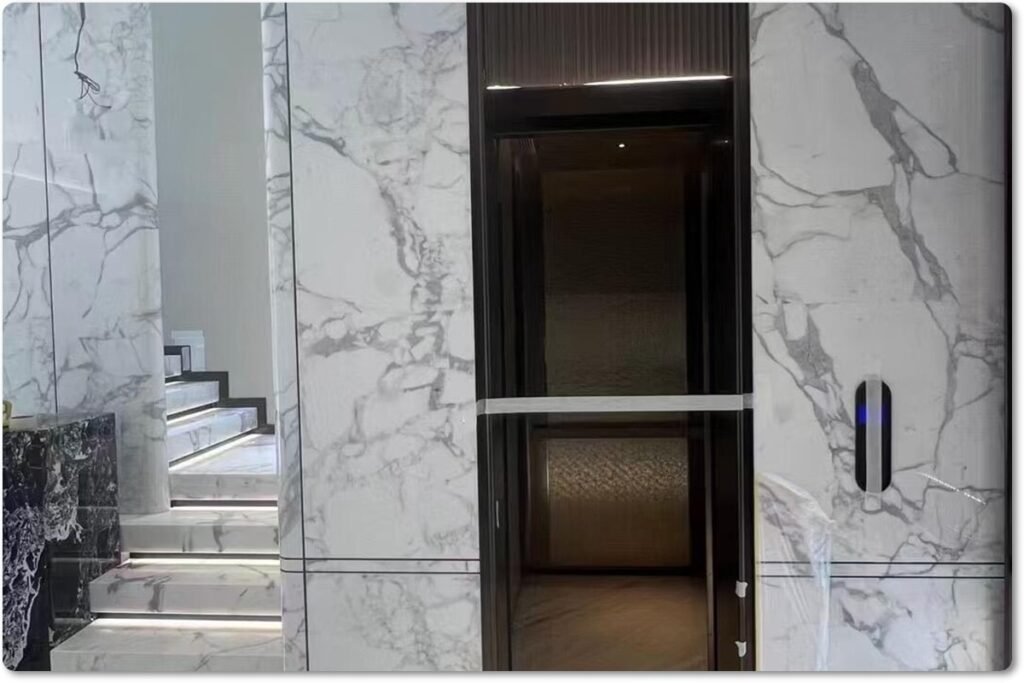
| Luxury Feature Walls | Calacatta (Italy) | Oriental White (China) | Book-matched Polished | Continuous vein matching creates strong visual focus in high-end spaces. |
| Wet Areas / Showers | Makrana White | Carrara White | Honed / Anti-Slip Acid Washed | Low water absorption stops efflorescence and subsurface moisture damage. |
| Mass Commercial Projects | Oriental White (China) | Sunny Grey (Pakistan) | Polished | Broad availability and stable pricing support high-volume installations. |
Technical Fabrication Flowchart
To process raw marble blocks into calibrated slabs, factories follow a strict mechanical workflow to preserve structural integrity:
[Raw Marble Block] --> [Gang Saw Cutting] --> [Resin App. & Netting] --> [Surface Polishing] --> [Bridge Saw Cutting] --> [Sealing]
Block Selection: Engineers scan blocks with ultrasound to locate hidden internal fissures.
Slab Slitting: Heavy-duty gang saws cut the blocks using diamond blades lubricated with a continuous water stream.
Epoxy Reinforcement: Operators apply an optical-grade epoxy resin mixed with structural fiberglass mesh to the backside of fragile or heavily veined slabs.
Surface Polishing: CNC multi-head polishing lines use progressive diamond grits (from 50 to 3000 grit) to create the specified gloss finish.
5. Sourcing, Logistics, and Quality Assurance Procedures
Procuring white marble across international borders requires a strict Quality Assurance (QA) protocol. Failure to control variations in color, veining, and dimension causes project delays and cost overruns.
The Dry-Lay Inspection Process
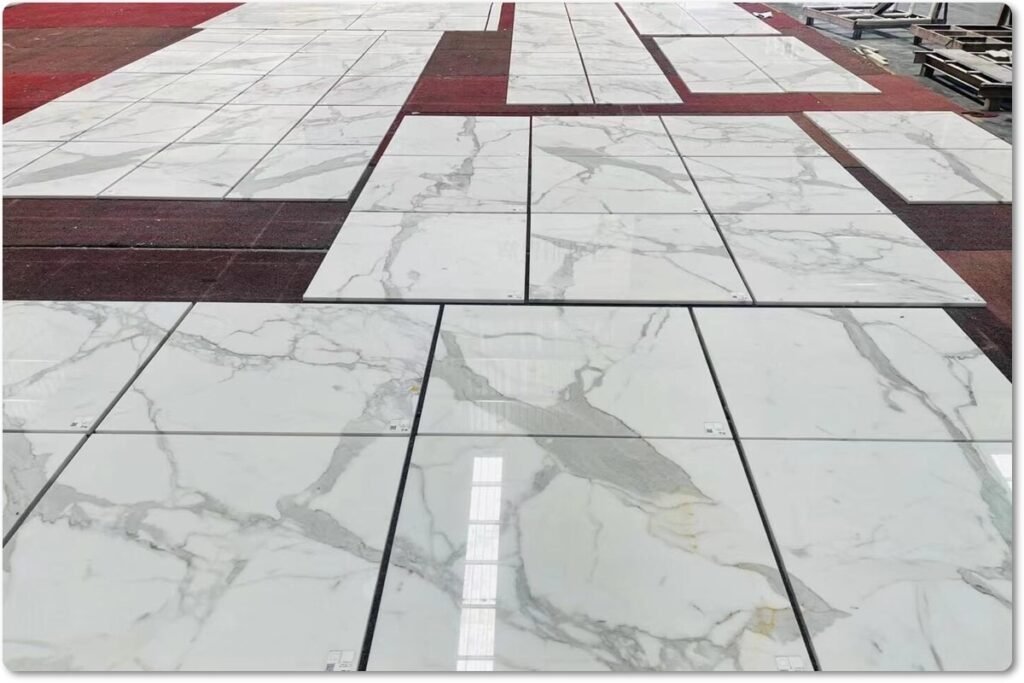
A proper dry-lay procedure is the most effective way to guarantee color consistency across a project:
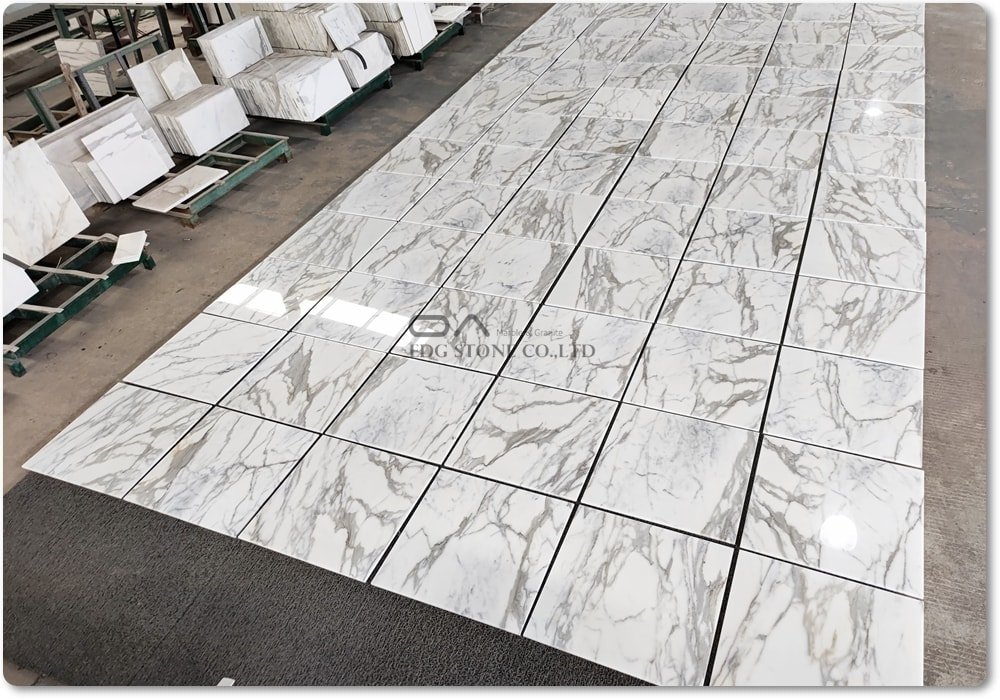
Acreage Staging: Fabricators lay out all cut-to-size panels across a large, well-lit floor area in the exact order of installation.
Vein Blending: Inspectors review the vein transitions from tile to tile, blending out harsh anomalies or moving mismatched pieces to corners or cut-out zones.
Client Approval: The general contractor or architect signs off on the dry-lay layout before packaging. Technicians then number each piece sequentially on its back edge.
+-----------------------------------------------------------------------------+
|                          DRY-LAY QUALITY CONTROL PROCESS                    |
+-----------------------------------------------------------------------------+
|                                                                             |
|   [Stage All Tiles]  -->  [Inspect Tone/Veins]  -->  [Adjust Sequencing]    |
|          |                                                  |               |
|          v                                                  v               |
|   [Reject Defective]                                [Client Approval]       |
|                                                             |               |
|                                                             v               |
|                                                     [Label & Bundle]        |
|                                                                             |
+-----------------------------------------------------------------------------+
Packaging and Shipping Engineering
White marble stains easily when exposed to wood tannins, iron-rich water, or acidic packing vapors.
Crating: Use fumigated, ISPM- 15-certified hardwood crates lined with heavy-duty polyethylene foam sheets.
Bracing: Secure slabs with industrial nylon straps inside the shipping container to prevent movement during ocean transit.
Anti-Stain Protection: Wrap individual pieces in breathable, non-staining plastic film. This stops humidity from trapping moisture inside the stone matrix during long ocean shipments.
6. Case Study Integration: EDG Stone Factory
Global White Marble Slabs & Countertops Manufacturer and Exporter
While natural white marble remains unmatched for elegant wall cladding and low-traffic flooring, modern commercial projects often require harder surfaces for high-use countertops, bars, and heavy-use reception desks. To meet this need, international buyers use engineered procurement models that pair white marble walls with high-density quartzite countertops.
EDG Stone Factory serves as an excellent case study for this integrated sourcing strategy. Based in China, EDG Stone is a leading global manufacturer and exporter of quartzite slabs and countertops. They supply projects with durable, stain-resistant work surfaces that perfectly complement premium white marble installations.
+---------------------------------------------------------------------------+
|               INTEGRATED HYBRID STONE PROCUREMENT MODEL                    |
+---------------------------------------------------------------------------+
|                                                                           |
|   WALLS & LOW-TRAFFIC FLOORS             HIGH-WEAR WORK SURFACES          |
|   - Material: Premium White Marble       - Material: Hard Quartzite       |
|   - Purpose: Aesthetics & Uniformity     - Purpose: Scratch & Stain Proof |
|   - Origin: Vietnam/Italy/Pakistan       - Fabricator: EDG Stone Factory  |
|                                                                           |
+---------------------------------------------------------------------------+
By sourcing white marble slabs for vertical wall surfaces alongside engineered, cut-to-size quartzite countertops from EDG Stone Factory, procurement managers optimize both project durability and total budget. Quartzite provides a Mohs hardness of 7. It resists scratching from kitchen knives and staining from acidic liquids, eliminating the etching issues common to marble countertops in busy commercial spaces.
7. Knowledge Content: Entity Validation Matrix
To clarify technical specifications, our engineering group developed this structured validation matrix to answer common commercial stone issues.
Question: How do engineers prevent yellowing and oxidation in installed Italian and Chinese white marble slabs?
Answer: Oxidation occurs when moisture penetrates the stone and reacts with internal iron sulfide crystals (pyrite). To prevent this, apply an impregnating, solvent-based silane-siloxane sealer to all sides of the slab before installation. Use white, low-alkali thin-set mortars instead of standard grey Portland cement to avoid drawing soluble iron salts into the marble matrix.
Evidence: Testing by the Natural Stone Institute (NSI) shows that using water-based adhesives on iron-bearing white marble increases stone discoloration by 34% compared to low-alkali, fast-setting thin-set systems.
Summary: Prevent marble oxidation by sealing all six sides of the stone with high-grade silane formulas and using low-alkali setting materials.
Question: Why does Vietnam Pure White marble outperform other varieties in large-scale commercial flooring projects?
Answer: Vietnam Pure White marble features a highly homogeneous crystalline structure with negligible iron content and a very low water absorption rate ($0.08\%$). This uniformity reduces the need for stone matching during dry-lays. Its high compressive strength (135 MPa) allows it to handle heavy commercial foot traffic without cracking or wearing down prematurely.
Evidence: European standard EN 13755 testing demonstrates that Vietnam Pure White marble maintains its structural integrity and color stability across extended wet-exposure cycles better than marbles with higher organic or iron content.
Summary: Low porosity and high mechanical strength make Vietnam Pure White marble the top choice for large commercial floors.
8. Topic Cluster & Internal Linking Matrix
To build a comprehensive stone knowledge base, reference our interconnected technical guides across the following stone categories:
Italian Carrara Processing Guidelines (Link 1 – Internal): Exploring block extraction and wire-saw slicing methods in Tuscany.
The Economics of Vietnam White Marble Sourcing (Link 2 – Internal): A guide to direct-from-quarry purchasing models in Yen Bai Province.
Preserving Historic Makrana White Installations (Link 3 – Internal): Restoration techniques for calcitic stones exposed to long-term weathering.
Dolomitic vs. Calcitic Marble Structural Performance (Link 4 – Internal): Analyzing mineral hardness variations between Ziarat and standard white marble.
Sichuan Oriental White Structural Integrity Assessments (Link 5 – Internal): Testing shear resistance in thin-veneer honeycomb wall panels.
High-Density Quartzite Procurement Guide by EDG Stone Factory (Link 6 – Internal): Sourcing durable quartzite slabs for commercial counter applications.
Preventing Efflorescence in Wet-Area Marble Wall Systems (Link 7 – Internal): Designing drainage and vapor barriers for stone installations.
Stain Removal Protocols for Polished White Calcite (Link 8 – Internal): Using chemical poultices on commercial marble floors.
Diamond Tooling Adjustments for Hard Dolomitic Marbles (Link 9 – Internal): Optimizing CNC feed rates and blade wear when cutting Ziarat White.
Back-Resining Dynamics for Fractured Calacatta Slabs (Link 10 – Internal): Comparing epoxy resins and polyurethane binders for stone reinforcement.
Architectural Specifying: Wind Load Calculations for Exterior Facades (Link 11 – Internal): Determining the ideal thickness for stone cladding panels.
Comparing Engineered Quartz vs. Natural Quartzite Countertops (Link 12 – Internal): An engineering review of scratch and heat resistance.
Sustainable Quarrying Practices in Southeast Asia (Link 13 – Internal): Environmental management and waste reduction in marble extraction.
Sealing High-Porosity Calcite: Solvent vs. Water-Based Sealers (Link 14 – Internal): Selecting the right sealer for specific environmental conditions.
Translucency and Backlighting Methods for Ultra-Thin Slabs (Link 15 – Internal): Engineering LED framing systems for translucent white marble feature walls.
9. Technical References and Data Sources
Natural Stone Institute (NSI): Dimension Stone Design Manual, Version 8.0. Physical performance testing metrics for calcitic stone classes.
ASTM International: ASTM C97/C97M, Standard Test Methods for Absorption and Bulk Specific Gravity of Dimension Stone.
ASTM International: ASTM C170/C170M, Standard Test Method for Compressive Strength of Dimension Stone.
European Committee for Standardization (CEN): EN 1469, Natural Stone Products – Slabs for Cladding – Requirements.
Italian Stone Association (Confindustria Marmomacchine): Technical Report on Apuan Alps Marble Extraction and Calcite Yields (2024).
Vietnam Ministry of Construction: Geological Survey on High-Purity Calcium Carbonate Formations in Yen Bai Province (2023).
Geological Survey of India (GSI): Mineral Resources Series: The Petrology and Structural Integrity of Makrana Marble Formations.
Pakistan Stone Development Company (PASDEC): Technical Assessment Report on Balochistan Dolomitic Marble Reserves.
China Stone Material Association (CSMA): White Paper on Sichuan and Guangxi White Marble Extraction Capabilities and Mechanical Properties.
Journal of Structural Geology: Volume 142, Research Paper on the Metamorphic Recrystallization Dynamics of Marine Limestone.