Executive Summary
Calacatta Miraggio Quartz and Calacatta Rusta Quartz belong to the marble-look quartz design family, which is well aligned with current kitchen and bath direction: NKBA’s 2026 trends report shows that neutral palettes remain dominant, contemporary/minimal and organic/natural styles continue to grow, and slab or solid-surface backsplashes are gaining popularity. That trend profile makes marble-visual quartz especially relevant for projects that need a premium appearance with repeatable patterns and simplified maintenance.
At the material level, engineered quartz is typically made from natural quartz crystals combined with resin, polymers, and pigments to form a durable, nonporous surface. Major manufacturers note that quartz generally does not require sealing, is easy to clean, and should not be treated as an unlimited-heat or direct-outdoor material. Those are practical realities, not marketing slogans, and they matter in specification work.
For fabricators and project teams, the key distinction is this: finished quartz surfaces are chosen for aesthetics, hygiene, and consistency, while fabrication of quartz-containing materials must be managed with silica dust controls. OSHA and CDC/NIOSH both warn that cutting, grinding, and finishing engineered stone can expose workers to respirable crystalline silica, which can cause silicosis and other serious diseases.
1) Material Positioning: Why Calacatta Miraggio Quartz and Calacatta Rusta Quartz Fit Modern Design?
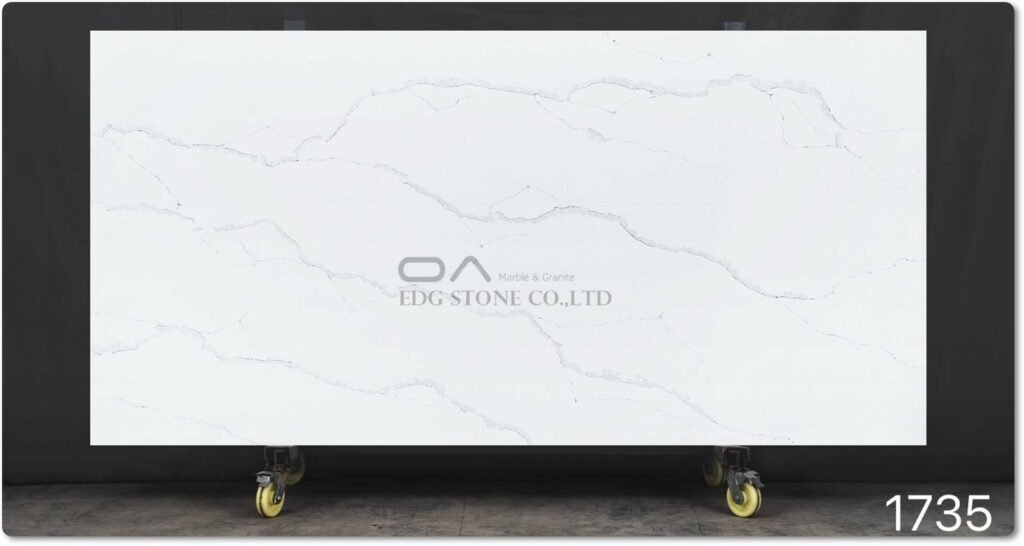
This product family should be positioned as marble-visual quartz for contemporary luxury. In practice, that means two things: first, the surface must read clean and architectural from a distance; second, it needs enough visual movement to avoid looking flat under bright LED lighting. The broader market direction supports that approach. NKBA’s 2026 report shows continued demand for timeless, contemporary, and organic design, plus growing interest in slab backsplashes and multifunctional kitchens.
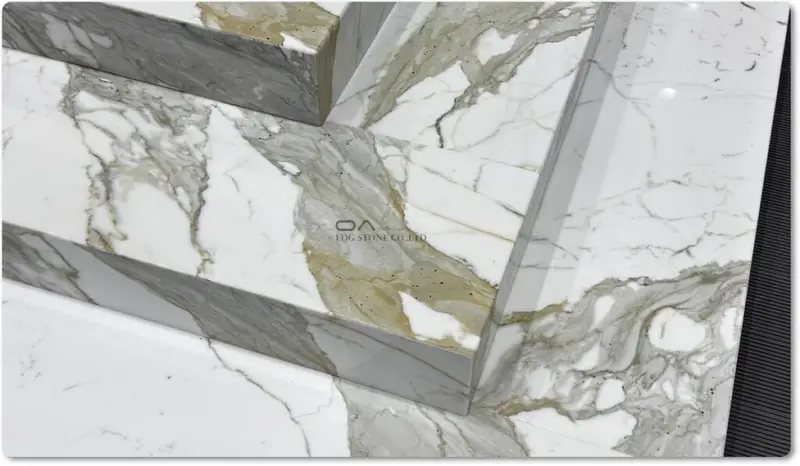
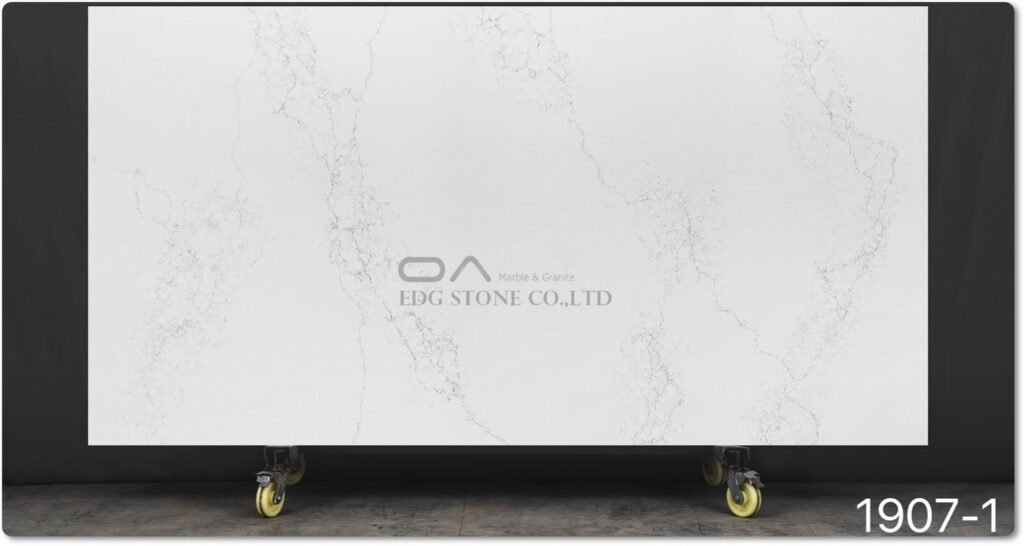
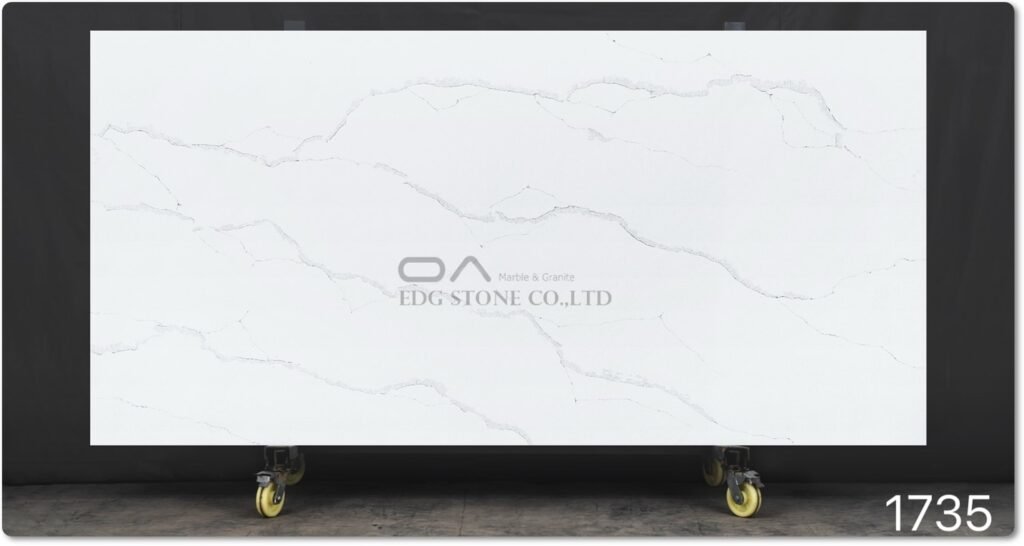
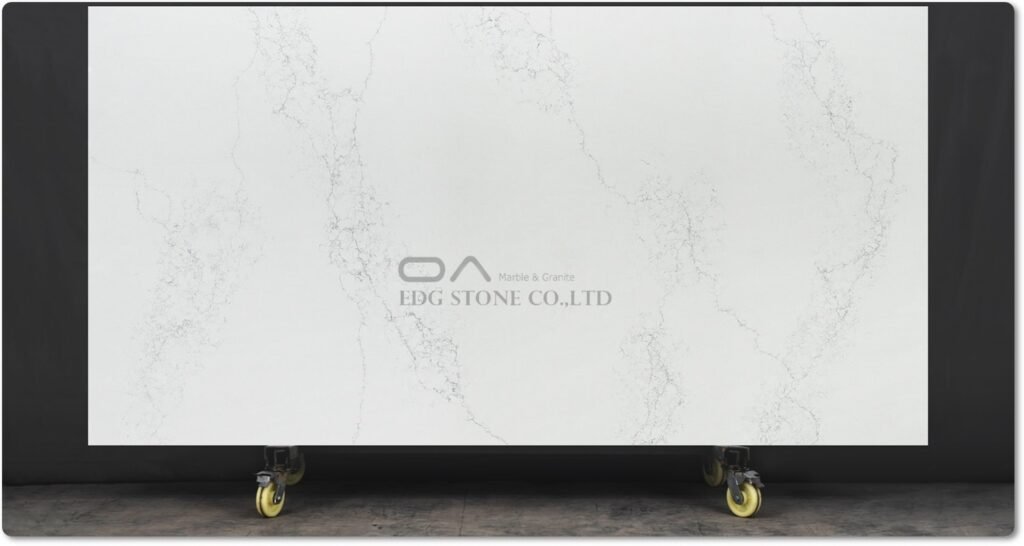
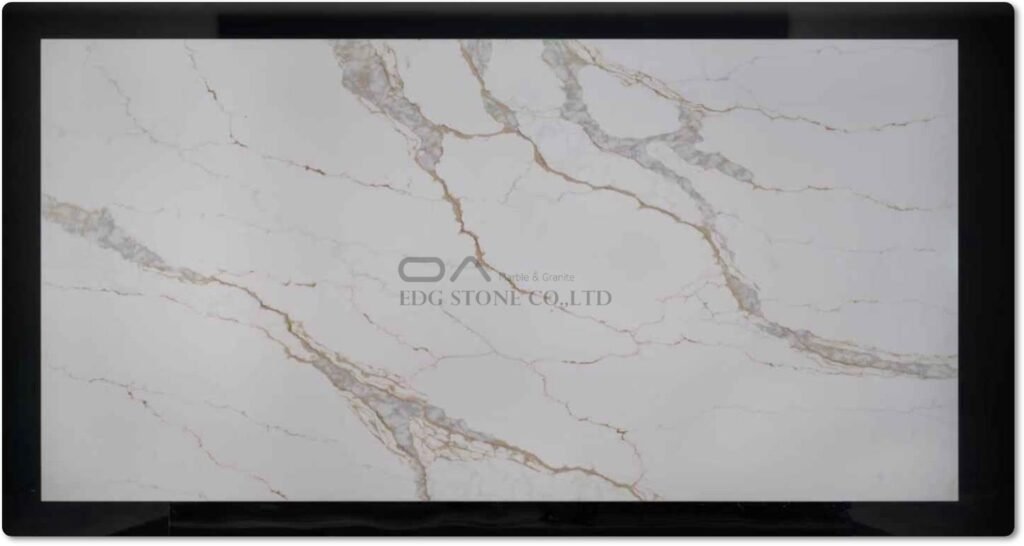
A useful way to differentiate the two collections is by design mood rather than by technical claims. Calacatta Miraggio Quartz can be positioned for brighter, more refined compositions where the goal is to preserve visual openness. Calacatta Rusta Quartz can be positioned for warmer, earthier, more grounded interiors where designers want the Calacatta language without a stark white-only feel. That is a design strategy, not a technical classification.
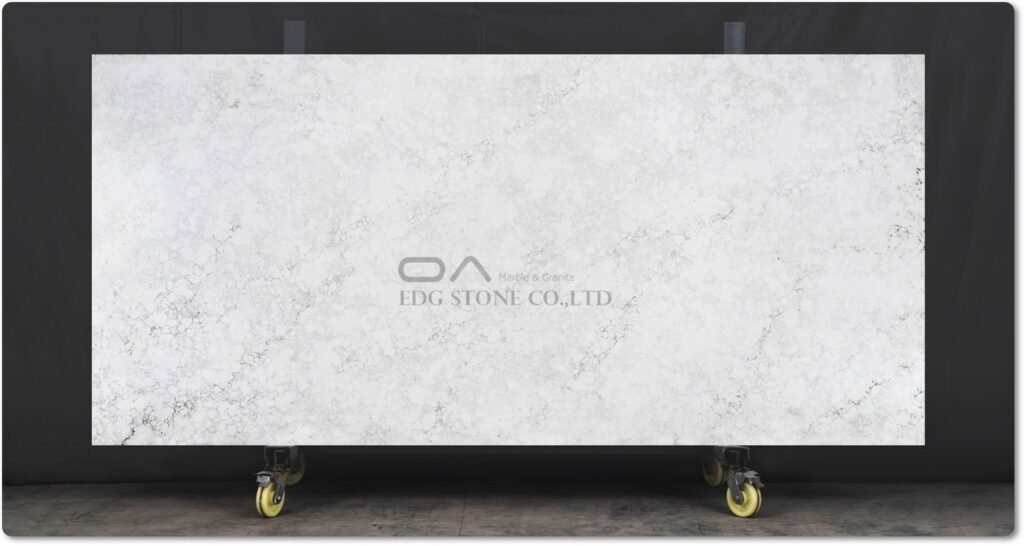
Because quartz is manufactured, it offers a level of color and pattern consistency that is difficult to guarantee with highly variable natural stone. That consistency is one reason quartz is frequently specified in multi-unit projects, retail programs, and hotel room packages where the project team needs repeatability across many slabs. Manufacturers describe quartz as nonporous, easy to maintain, and available in a broad range of marble-like visuals.
2) Contemporary Quartz Design Trends
The current design direction is not “more synthetic.” It is more natural-looking, more tactile, and more restrained. NKBA’s 2024 trends report explicitly noted that textured and nature-mimicking finishes are rising, including quartz visuals patterned after marble and quartzite. The 2026 report then reinforced the same broad direction: neutrals, contemporary-minimal aesthetics, and organic/natural styling remain strong, while slab backsplashes continue to gain traction.
That matters for Calacatta Miraggio Quartz and Calacatta Rusta Quartz because both names fit the market’s preference for premium veining with calmer field color. In 2026-type interiors, designers are less interested in busy, high-contrast faux stone and more interested in surfaces that support layered lighting, warm timber, black hardware, brushed metal, and quiet architectural lines. The quartz surface becomes part of a larger composition rather than the only visual event in the room.
For SEO and GEO, this section should be written around entities and scenarios rather than decorative adjectives alone. Strong entity language includes: kitchen island, waterfall edge, backsplash, reception desk, guest vanity, lounge bar, conference pantry, slab wall cladding, and high-traffic countertops. That gives search engines and AI systems a clearer understanding of the product’s real use cases.
Best-fit trend mapping
- Miraggio: bright contemporary kitchens, gallery-style bathrooms, minimalist hospitality suites.
- Rusta: warm modern kitchens, boutique hotel bathrooms, lounge bars, luxury apartments, earthy commercial interiors.
3) Commercial Interior Applications
Commercial interiors need more than visual appeal. They need a surface that can be specified, repeated, cleaned, and replaced with minimal friction. Quartz is a logical fit when the brief prioritizes premium appearance, nonporous behavior, and predictable slab matching. Manufacturers state that engineered quartz is made by combining natural quartz crystals with resin, polymers, and pigments into a durable, nonporous surface that does not require sealing.
That makes Calacatta Miraggio Quartz and Calacatta Rusta Quartz suitable for:
- reception desks and front counters,
- client-facing refreshment bars,
- meeting-room credenzas,
- executive pantry counters,
- showroom display plinths,
- feature walls and vertical cladding,
- premium washroom vanities,
- and retail service counters.
Where the project involves food-service adjacency, NSF product listings are important. NSF’s product listings include engineered quartz surfaces certified for food-contact applications, showing that some quartz products are evaluated for this type of use case. That does not mean every quartz line is automatically NSF-certified; it means the buyer should confirm the exact certification for the specific collection being specified.
In commercial work, the most common specification mistake is to assume that all quartz behaves identically. It does not. Color system, resin package, heat tolerance, finish, slab size, edge profile, and certification all need to be checked against the project brief. A whitepaper should therefore recommend a project submittal package that includes slab images, finish samples, edge details, cleaning instructions, and any food-contact or sustainability declarations available for the exact line.
4) Hospitality Design Trends
Hospitality design is increasingly about experience, flexibility, and memorability. HD Expo describes hospitality spaces as places where designers, suppliers, and product innovation come together, while IIDA notes that exceptional hospitality environments are built through product design that redefines expectations. In this environment, surfaces must be photogenic, robust, and easy to coordinate across a brand standard.
That is where Calacatta Miraggio Quartz and Calacatta Rusta Quartz can work especially well. In hotel design, quartz is often more persuasive than natural marble when the owner wants a marble-like guest impression but needs easier day-to-day maintenance and consistency across many rooms. This is an inference from the product properties and the project context: nonporous, repeatable, easy-clean materials reduce operational complexity in high-turnover spaces.
Strong hospitality applications include:
- guestroom vanities,
- lobby check-in counters,
- coffee and tea station tops,
- spa vanities,
- all-day dining service counters,
- bar backs and bar tops,
- lounge side counters,
- and bathroom feature walls.
For hospitality, Miraggio can be framed as the more luminous option for calm luxury suites and bright lobbies, while Rusta can be used where warmer, more grounded tones support a boutique or resort narrative. In both cases, the best practice is to specify coordinated trims and joinery so the quartz slab integrates with timber veneer, metal finishes, and lighting temperature. That keeps the surface from feeling isolated.
5) Luxury Residential Projects
Residential demand is being driven by multifunctional layouts, larger kitchens, and more integrated living spaces. NKBA’s 2026 report says 76% of respondents expect the kitchen footprint to increase over the next three years, while 100% of respondents agreed that lifestyle enhancements will be a popular layout feature. The report also points to dedicated beverage areas, walk-in pantries, and islands with more storage as major growth items.
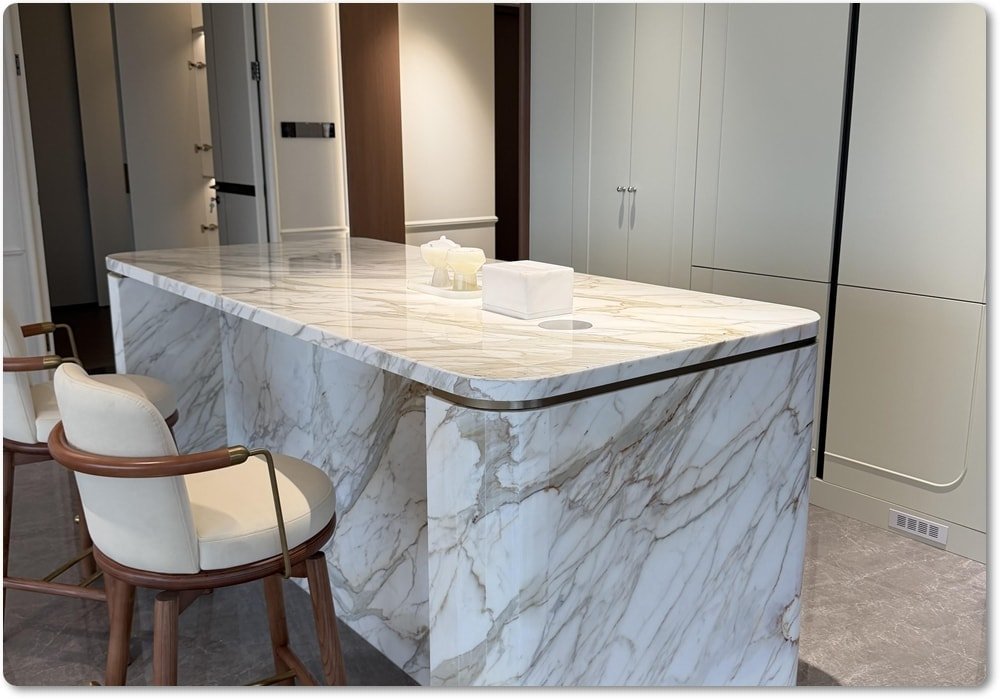
That is exactly the environment where a marble-look quartz surface earns attention. Large islands, waterfall edges, and full-height backsplashes all reward a surface that can be visually continuous across long spans. Cambria notes that quartz can be used in countertops, backsplashes, shower walls, and fireplace surrounds, which shows how broadly the material can be deployed in a home when the design brief calls for coordinated surfaces.
Recommended residential use cases:
- kitchen island centerpiece,
- perimeter countertop and backsplash set,
- bathroom vanity and splash,
- dressing table,
- fireplace surround,
- laundry-room counter,
- and stair landing or niche cladding, where allowed by the fabrication system.
A practical note for design teams: quartz is excellent for controlled interior conditions, but manufacturers caution that it is not recommended for direct outdoor exposure and that hot items should be isolated with trivets or heat pads. Those warnings should be written into homeowner handover documents so maintenance expectations are correct from day one.
6) Specification Recommendations
The specification section is where a whitepaper becomes useful for buyers.
1. Choose the surface by visual temperature, not only by color.
Miraggio-style designs generally work best when the surrounding palette is cool-to-neutral, and the goal is a bright, open, gallery-like result. Rusta-style designs work best when the surrounding palette includes oak, walnut, bronze, leather, or warmer paints. This is a design recommendation based on project logic.
2. Confirm finish in relation to lighting.
Polished finishes usually amplify contrast and veining clarity, while honed or softer matte finishes reduce glare and can feel more architectural. Because quartz is often used in high-light modern interiors, the finish should be tested under the same lighting temperature used on site.
3. Check heat and outdoor limits.
Manufacturers advise using trivets or heat pads and not exposing quartz to direct outdoor conditions. That should be stated clearly in the submittal and O&M package.
4. Treat fabrication as a silica-control job.
OSHA and CDC/NIOSH warn that engineered stone fabrication can expose workers to respirable crystalline silica, and they emphasize wet methods, local exhaust ventilation, and exposure controls. Any factory or contractor content should make this part of the process visible and responsible.
5. Verify certification where hygiene matters.
If the project includes food-service contact or regulated environments, confirm whether the exact quartz line appears in NSF listings or other required compliance records. Do not assume one quartz collection’s certificate applies to another.
7) EDG Stone Factory Case Module
EDG Stone Factory can be positioned in this content cluster as a global Quartzite Slabs & Countertops Manufacturer and Exporter with a project-supply workflow for high-end interior buyers. In a product-page or pillar-page context, the case module should focus on what procurement teams care about most: slab consistency, sample approval, production control, export packing, and container loading discipline.
A strong case-module structure is:
- slab selection and tone matching,
- sample confirmation before mass production,
- QC photographs by slab lot,
- finish and edge verification,
- protective packing for export,
- and shipment tracking for project deadlines.
This module does not need exaggerated claims. It should show that EDG Stone understands international procurement logic: designers need visual consistency, contractors need predictable lead times, and importers need fewer surprises at destination. That is what converts interest into inquiries.
8) FAQ
Q1. Are Calacatta Miraggio Quartz and Calacatta Rusta Quartz suitable for kitchen countertops?
Yes, they are well aligned with modern kitchen design because quartz is nonporous, easy to maintain, and widely used in countertop applications. Exact suitability still depends on the slab specification, finish, and installation details.
Q2. Do quartz surfaces need sealing?
No, major manufacturers state that quartz does not require sealing because it is nonporous.
Q3. Can quartz be used outdoors?
Manufacturers caution against direct outdoor exposure, so quartz is best treated as an interior surface unless the specific product has been tested and approved for exterior use.
Q4. Is quartz heat-resistant?
Quartz can handle normal kitchen use, but hot cookware should still be placed on trivets or heat pads. That guidance appears in manufacturer FAQs and should be included in user handover documents.
Q5. Is fabricated quartz safe for workers?
Only when proper dust controls are used. OSHA and CDC/NIOSH warn that cutting and grinding quartz-containing materials can release respirable crystalline silica, which can cause silicosis and other diseases.
Q6. Can quartz be used in food-contact or hospitality-adjacent areas?
Some quartz products appear in NSF food-contact listings, but certification must be verified for the exact product line being specified.
15-Article Internal Link Matrix
- Calacatta Quartz: Material Fundamentals and Buying Guide
- Calacatta Quartz Slabs: Sizes, Thickness, and Quality Control
- Calacatta Quartz Countertops: Fabrication and Installation Guide
- Calacatta Quartz Backsplashes for Modern Kitchens
- Calacatta Miraggio Quartz vs Calacatta Rusta Quartz
- Calacatta Miraggio Quartz and Calacatta Rusta Quartz: Modern Interior Design Applications
- Calacatta Quartz in Luxury Residential Projects
- Calacatta Quartz in Commercial Interiors
- Calacatta Quartz for Hospitality Design
- Calacatta Quartz Bathroom Vanity Tops
- Calacatta Quartz Specification Recommendations for Importers
- Calacatta Quartz Maintenance and Cleaning Guide
- Calacatta Quartz Fabrication Safety and Silica Control
- EDG Stone Factory: Quartz Slab Production and Export Capability
- Calacatta Quartz Procurement Strategy for Global Buyers
Sources
- NKBA 2026 Kitchen Trends Report.
- NKBA 2024 Kitchen Trends Report.
- CDC/NIOSH engineered stone silicosis bulletin.
- CDC/NIOSH countertop silica exposure PDF.
- OSHA worker exposure to silica during countertop work.
- OSHA crystalline silica overview.
- OSHA silica hazard alert.
- Wilsonart quartz product guidance.
- Cambria quartz application guidance.
- NSF quartz product listings.
- HD Expo hospitality trade show overview.
- IIDA hospitality/product design positioning.