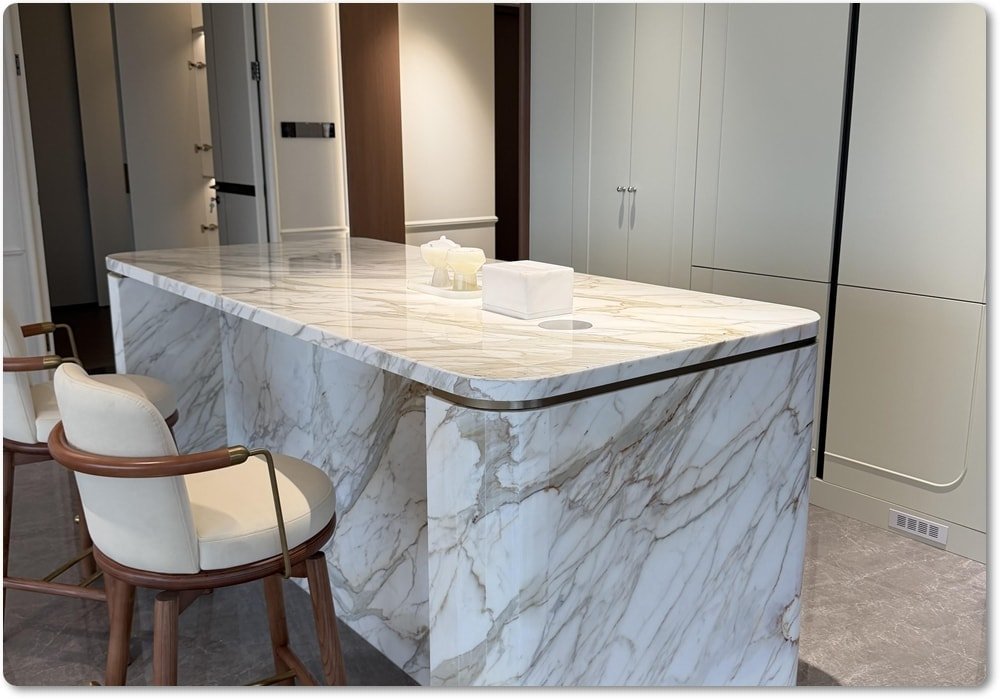
Executive Summary
Calacatta Quartz Countertops are typically purchased for the same reason commercial and residential buyers continue to choose engineered quartz: they combine a marble-inspired aesthetic with a format that is easier to standardize, fabricate, and maintain than many natural stones. Major quartz brands position their products for residential, commercial, and institutional use, and they consistently publish slab format options, thickness options, and care guidance to support procurement decisions. Cambria, Caesarstone, and Silestone all show that quartz countertop programs are built around predictable slab dimensions and multiple thicknesses, while Cambria explicitly notes that 2cm and 3cm countertop slabs must be supported.
For buyers evaluating a Calacatta Gold Quartz Countertop or Gold Calacatta Quartz Countertop, the real buying decision is rarely only about color. It is about slab yield, seam placement, thickness, edge build-up, island geometry, support structure, logistics, and long-term use in the target environment. In other words, the right slab is not the one that looks best in a sample photo; it is the one that can be fabricated efficiently and still meet the visual, structural, and budget requirements of the project. That is why this guide follows the procurement chain from slab selection to finished countertop delivery.
1. Understanding Countertop Specifications
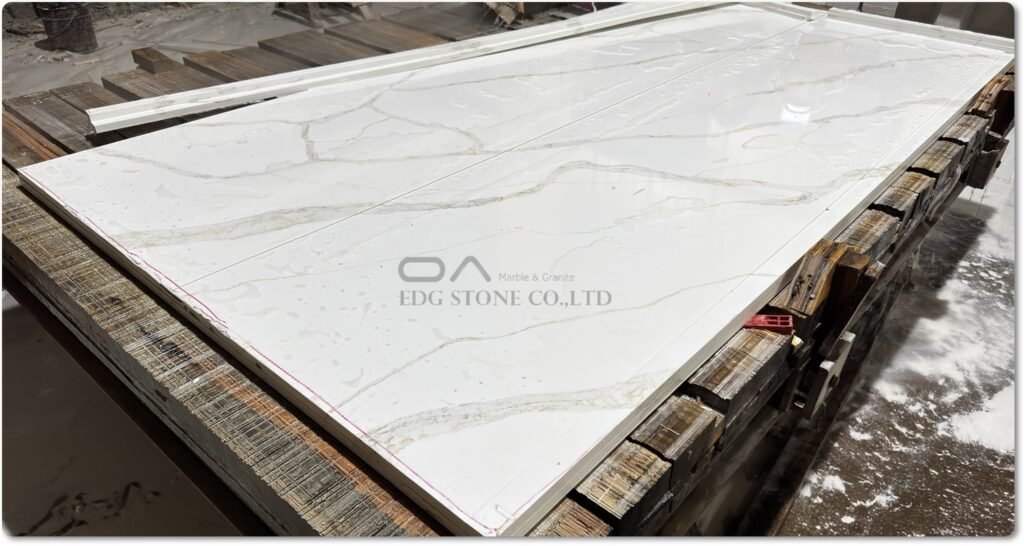
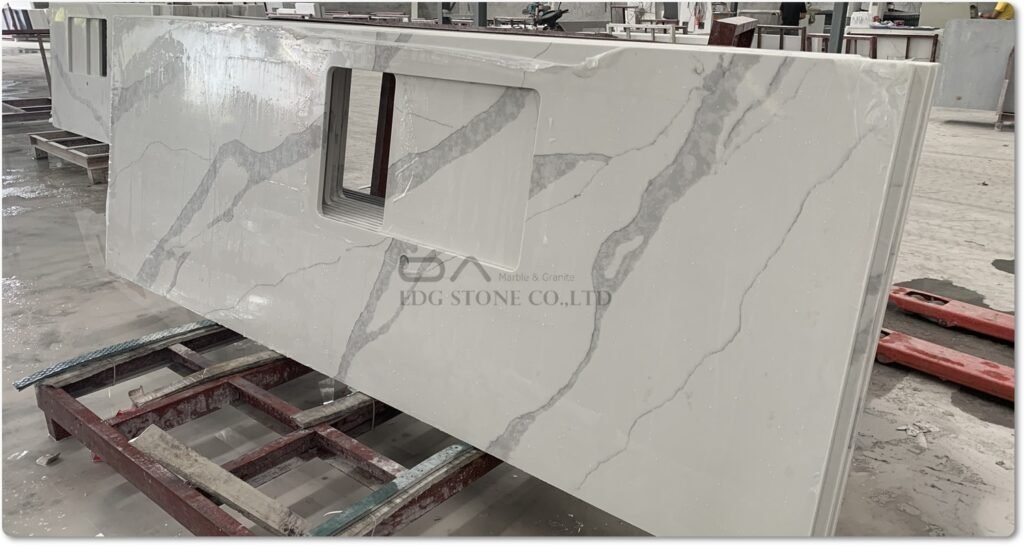
A professional countertop specification should never stop at the color name alone. For a Calacatta Quartz Countertop, the buyer should confirm five practical items before approving production: slab format, slab thickness, finish, edge profile, and fabrication constraints such as sink cut-outs, cooktop cut-outs, seam location, and overhang support. This is especially important for island projects, where one slab may need to cover a long, uninterrupted run, a waterfall end, or a bookmatched visual effect. Major manufacturers publish slab-format and thickness data for precisely this reason.
From a procurement standpoint, the most useful countertop spec sheet should answer the following questions clearly: Is the slab standard or jumbo? Is it 1cm, 2cm, 20mm, 3cm, or 30mm? Is the finish polished or matte? Is the veining directional? Can the fabricator bookmatch two slabs? What is the allowable edge detail? And what support is required under overhangs and islands? That checklist is not decorative; it is the difference between a smooth installation and a change-order-heavy project.
For commercial buyers, the specification should also include service conditions. Quartz surfaces are commonly positioned for easy cleaning and high-traffic use, and manufacturers market them for hospitality, workplace, healthcare, and institutional environments. That matters because a countertop in a hotel suite behaves differently from a countertop in a reception desk or a breakfast bar. Cambria, for example, highlights quartz reception desks for workplace, healthcare, and hospitality use, while Caesarstone describes its quartz surface as suitable for residential, commercial, and institutional buildings.
2. Standard Slab Sizes
Standard slab size is one of the most important cost drivers in Calacatta Quartz Countertops because it determines yield, seam placement, and how much waste a project will generate. Published manufacturer examples show that slab sizes vary by brand and format. Cambria lists a standard slab of 122 in x 55.5 in and a jumbo slab of 132 in x 65.5 in. Caesarstone publishes standard slabs around 120 in x 56.5 in and jumbo slabs around 131.5 in x 64.5 in. Silestone lists a standard format of 118.9 in x 55.1 in and a jumbo format of 126 in x 62.6 in.
That range matters because a buyer comparing two visually similar Calacatta options may actually be comparing different usable yields. A jumbo slab can reduce seams on a large kitchen island or a long perimeter run, but it can also affect freight, handling, shop processing, and carton/crate planning. The right choice is not automatically the largest slab available. It is the slab that best fits the project’s cut plan, transport constraints, and installation sequence.
A useful way to evaluate slab format is to map the countertop design into three zones: the primary visible zone, the hidden waste zone, and the seam-risk zone. The primary zone should be the visually cleanest section of the slab, especially for dramatic veining. The hidden zone can absorb minor pattern transitions. The seam-risk zone should be reserved for places where pattern continuity matters less, such as behind sinks, under appliance reveals, or at cabinet breaks. This is a fabrication strategy, not a design luxury.
3. Thickness Selection Guide
Quartz countertop thickness is not only a design decision; it is also a structural and logistics decision. Major manufacturers consistently publish multiple thickness options. Cambria offers 1cm, 2cm, and 3cm surfaces. Caesarstone publishes 1.3cm, 2cm, and 3cm options in its technical documentation, and Silestone lists 12mm, 20mm, and 30mm countertop guidance. Cambria further notes that 2cm and 3cm slabs used for countertops must be supported.
In practical procurement terms, thickness should be selected by use case:
For perimeter countertops, 2cm is often chosen when the project wants a lighter visual profile or when the fabrication shop will build up the edge to create the appearance of more mass.
For islands, 3cm can deliver a more substantial architectural look and may reduce the need for some edge build-up approaches.
For vertical applications, wall cladding, or low-load decorative uses, 1cm or 12mm can be suitable when the manufacturer allows it. Cambria explicitly identifies 1cm as suitable for surface finishes such as walls and fireplaces, while its 2cm and 3cm slabs are countertop-grade and require support.
For commercial procurement, thickness should also be matched to maintenance expectations and site traffic. A reception desk, breakfast bar, and healthcare counter do not need the same visual mass, but they do need the same discipline in support, edge finishing, and seam planning. This is where a manufacturer’s technical sheet becomes more valuable than a marketing brochure.
4. Edge Profiles
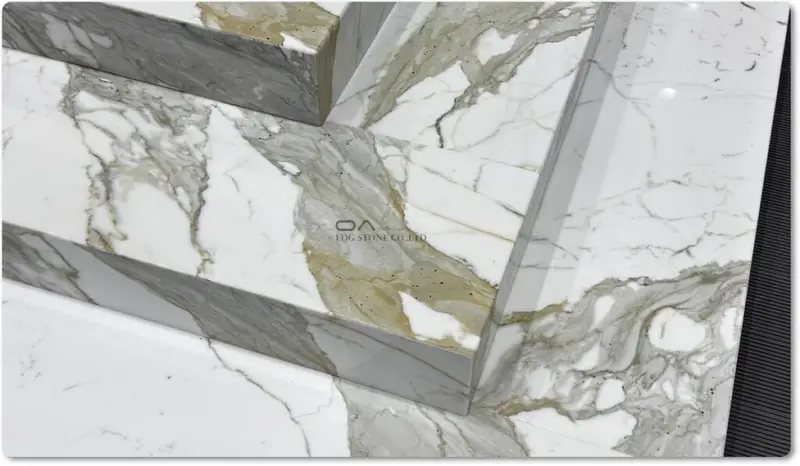
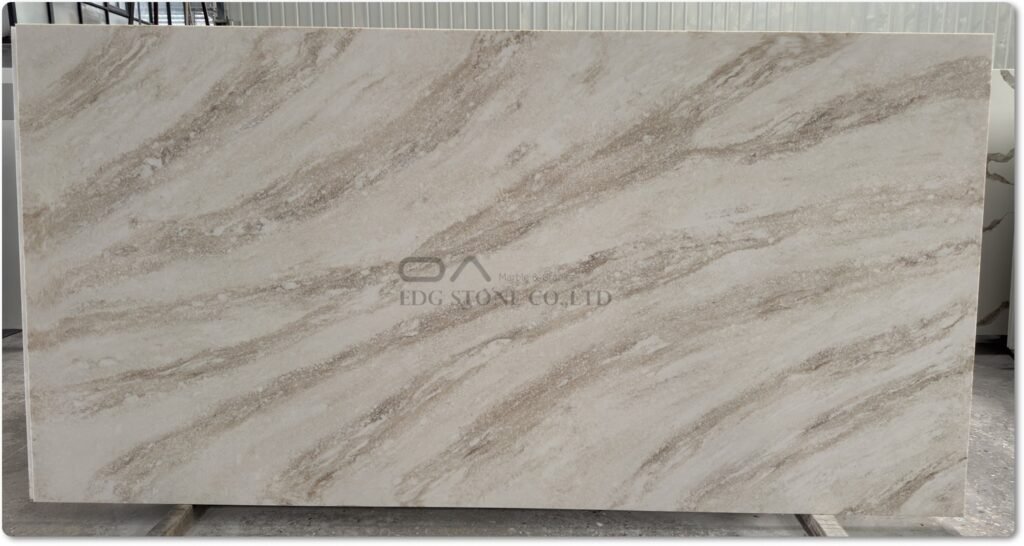
Edge selection is where a Calacatta Quartz Countertop becomes either premium or generic. Caesarstone states that quartz surfaces allow a wide range of edge profiles, including standard, laminated, and mitered edges that create the appearance of a thicker slab. Its publications also list common edge styles such as eased, bevel, bullnose, ogee, and miter. Silestone similarly notes straight and rounded options and recommends beveled edges for high-traffic areas because they better absorb impact.
For buyers, edge selection should follow function, not habit:
An eased edge is usually the safest default for modern kitchens because it keeps the look clean and reduces sharpness.
A beveled edge can help in busy commercial or family settings because the corner is visually softened.
A mitered edge is often used when the design calls for a thicker visual profile or a waterfall transition.
An ogee edge reads more traditional and should be used only when the overall design language supports it. Caesarstone notes that mitered edges are especially useful alongside waterfall designs.
The most important buying rule is consistency. If the project uses a dramatic Calacatta Gold Quartz Countertop with strong veining, the edge should not compete with the pattern. In most contemporary projects, a cleaner edge is the better business decision because it preserves the slab’s visual value.
5. Kitchen Island Design Trends
Kitchen islands continue to become more important as design focal points. The NKBA reports that islands are increasingly treated as a focal point and may use a different color cabinetry and/or countertop than the surrounding kitchen. NKBA also highlights easy-to-clean countertops in durable materials such as quartz as part of future kitchen demand. Houzz’s 2026 countertop trend coverage points to warm neutrals, quartzite-inspired looks, textured finishes, and striking island statements.
That trend is especially relevant for Calacatta Quartz Countertops because the Calacatta pattern sits in the sweet spot between calm and dramatic. It can be used as a quiet white field with subtle veining or as a high-contrast centerpiece with pronounced gold or grey movement. For buyers, the decision should be made by viewing the slab layout, not by looking only at a small sample chip. Major manufacturers explicitly recommend reviewing a full slab for pattern and shading decisions.
From a layout perspective, island design should be treated as a pattern-control exercise. The front edge, waterfall side, and seating side often have different visibility and different seam risk. A good island specification will identify the primary viewing angle first, then assign the most visually consistent slab area to that side. This is one of the most effective ways to elevate a kitchen without changing the material budget.
6. Commercial Project Applications
Commercial buyers often choose quartz because it can combine design consistency with practical maintenance behavior. Caesarstone describes quartz as suitable for residential, commercial, and institutional buildings, and Cambria positions quartz as a material for high-traffic commercial spaces such as restaurant kitchens, reception desks, healthcare settings, and education facilities. Cambria’s reception desk examples also show that quartz is used in workplace, hospitality, and healthcare environments where hygiene and appearance both matter.
For procurement teams, commercial application planning should be organized by exposure level:
Low-exposure zones include display counters, decorative bars, and guest-facing tables.
Medium-exposure zones include pantry areas, café counters, and office kitchen islands.
High-exposure zones include reception desks, healthcare check-in points, restaurant prep-adjacent counters, and education facilities.
This matters because the same Calacatta design can be specified differently depending on load, cleaning frequency, and public visibility. For example, a hotel lobby desk may benefit from a dramatic waterfall edge and a thicker visual profile, while a back-of-house pantry may need a simpler edge and a more efficient seam plan.
The commercial buyer should also consider documentation and warranty expectations. Caesarstone, for example, publishes a technical data manual and care guidance, while some brands also provide commercial warranty frameworks. That level of documentation is useful because commercial procurement needs more than beauty; it needs predictable lifecycle performance.
7. EDG Stone Factory Countertop Manufacturing Program
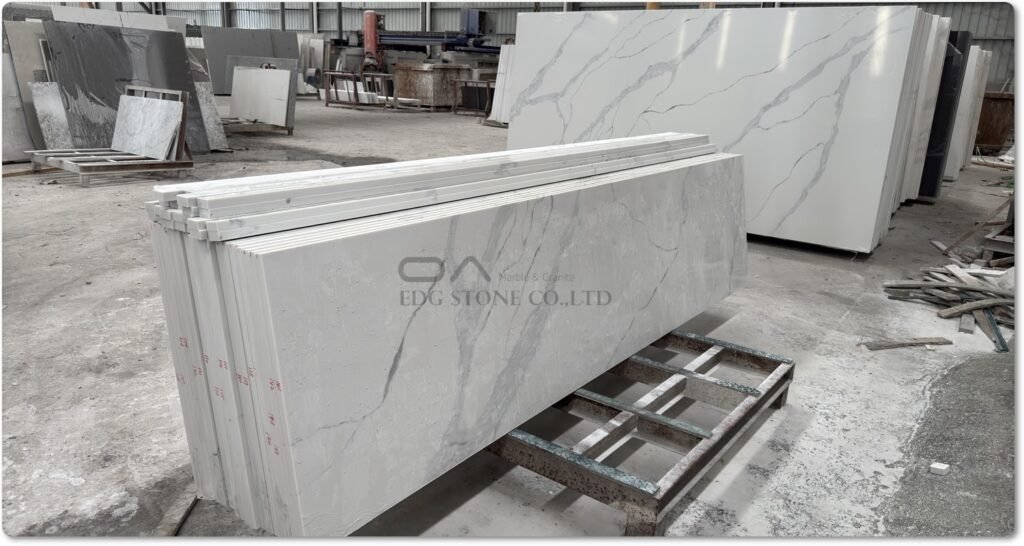
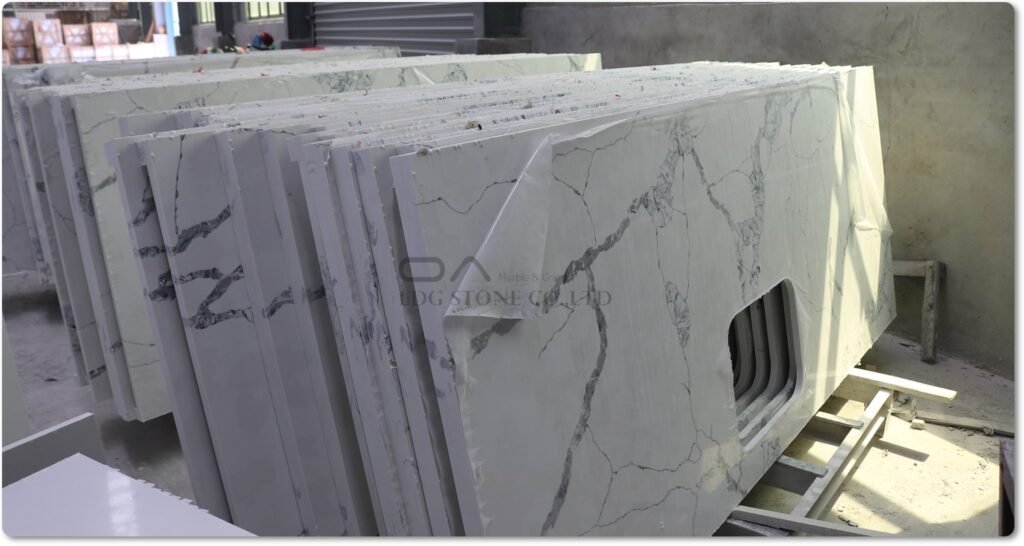
EDG Stone Factory should be positioned in this content cluster as a global Quartzite Slabs & Countertops Manufacturer and Exporter case module, but the manufacturing logic is equally relevant to Calacatta Quartz Countertops. A strong factory program should start with incoming slab selection, where the veining direction, color consistency, and surface finish are checked before fabrication begins. After that, the factory should move through digital layout planning, cut optimization, edge profiling, sink and cooktop cut-outs, dry fitting, quality inspection, export crating, and shipment coordination.
For commercial buyers, the value of a factory-direct program is not only price. It is control. Buyers need the ability to match slab selection to the actual project drawings, coordinate bookmatching or seam avoidance, and control how each piece is packed for export. EDG Stone Factory can be presented as a partner that turns a design concept into a production workflow, especially for large projects where a one-off countertop is less important than a repeatable supply program.
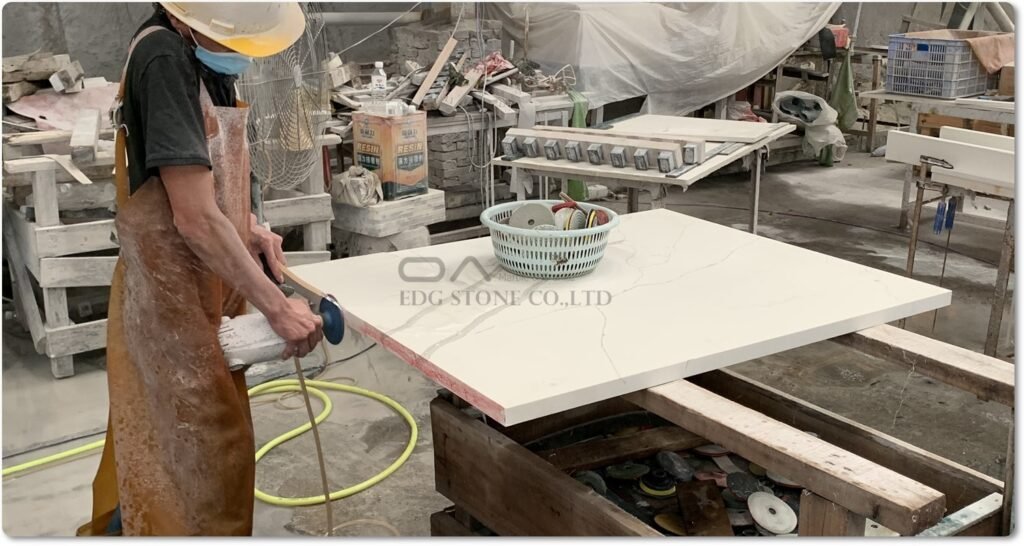
A serious manufacturing program must also include silica safety discipline. OSHA explains that crystalline silica is common in stone, concrete, mortar, and artificial stone products, and OSHA/NIOSH warn that countertop fabrication workers face exposure risks from respirable crystalline silica. NIOSH has also noted that engineered stone with high crystalline silica content can generate high respirable dust levels during fabrication tasks. That means wet methods, dust control, ventilation, and PPE are not optional extras; they are part of responsible production.
This safety point is not only a factory issue. It is a buyer trust issue. Commercial clients increasingly expect suppliers to understand occupational safety, fabrication consistency, and installation readiness. A manufacturer that can speak clearly about dust control, support requirements, packaging, and project documentation has a stronger procurement story than one that only sells a color name.
8. How to Buy Calacatta Quartz Countertops the Right Way?
For a commercial investigation, the buying process should be treated as a sequence of decisions rather than a single quotation request.
First, define the application. Is it a kitchen island, a hotel vanity, a restaurant counter, or a reception desk?
Second, define the visual goal. Do you want soft white movement, a bold gold vein, or a more restrained marble-like surface?
Third, choose the slab format that gives you the best yield and seam plan.
Fourth, choose the thickness based on structure and visual mass.
Fifth, lock the edge profile so the fabrication shop can quote correctly.
Sixth, confirm support requirements, especially for islands and overhangs.
Seventh, request a full fabrication drawing before production starts.
This sequence reduces risk because it aligns material choice with shop reality. Many countertop problems are not caused by bad stone; they are caused by a poor handoff between design intent and fabrication constraints. Manufacturers’ technical sheets are useful because they formalize those constraints before the project reaches the shop floor.
For large projects, buyers should also ask for a sample approval workflow, a slab photo approval step, and a packaging method statement. Those items are especially important when importing or exporting countertops because transport risk can be as important as fabrication risk.
9. Procurement Checklist Before You Approve the Order
Before approving a Calacatta Quartz Countertops order, confirm the following:
The slab format matches the project’s cut plan.
The thickness matches structural support and visual intent.
The edge profile matches the project style.
The slab photo or full-slab view has been approved.
The seam plan has been reviewed against sink, appliance, and waterfall locations.
The factory has confirmed support requirements for islands and overhangs.
The export crate or local packaging method protects corners and edges.
The care instructions are consistent with the installed environment.
This checklist is especially useful for commercial procurement because it helps purchasing teams, designers, and fabricators work from the same assumptions. That is how a specification becomes an actual finished countertop rather than just a beautiful sample board.
FAQ
1) Are Calacatta Quartz Countertops the same as natural marble?
No. In procurement terms, Calacatta quartz is typically an engineered quartz surface that is selected for a Calacatta-style marble look, not a natural marble slab. Quartz manufacturers market these products as engineered surfaces with marble-inspired design options and publish technical specifications, slab formats, and thicknesses for fabrication.
2) What slab size should I choose for a kitchen island?
Choose the slab size that gives you the best visual yield and the fewest seams. Brand examples show standard slabs around 118.9–122 inches long and jumbo slabs around 126–132 inches long, with width differences that can matter on large islands.
3) Is 2cm or 3cm better for quartz countertops?
Both are widely used. 2cm is often chosen for a lighter profile or when the edge will be built up, while 3cm gives a more substantial architectural look. Cambria, Caesarstone, and Silestone all publish both thickness families, and Cambria notes that countertop slabs must be supported.
4) Which edge profile is best for commercial projects?
For most commercial applications, an eased or beveled edge is the safest and most practical choice. Silestone specifically recommends beveled edges for high-traffic areas because they better absorb impact, while Caesarstone notes that mitered edges are often used for waterfall designs.
5) Can quartz countertops be used in hospitality and healthcare projects?
Yes. Manufacturer case studies and product positioning show quartz in workplace, hospitality, healthcare, restaurant, education, and institutional settings. Cambria and Caesarstone both publish commercial-use examples.
6) What should buyers know about fabrication safety?
Quartz and engineered stone fabrication can generate respirable crystalline silica dust, so wet methods, ventilation, and PPE are important. OSHA and NIOSH both emphasize silica exposure control for countertop workers.
15-Article Internal Link Matrix
This article works best as part of a 15-piece cluster that moves from fundamentals to procurement and then to application-specific buying intent.
| Article | Topic | Suggested Internal Link Role |
|---|---|---|
| 1 | Calacatta Quartz Material Fundamentals | Link here as the educational foundation |
| 2 | Calacatta Quartz Slab Sizes and Yield Planning | Link from slab-size discussion |
| 3 | Calacatta Quartz Thickness Comparison | Link from the thickness section |
| 4 | Calacatta Quartz Edge Profiles Guide | Link from the edge profile section |
| 5 | Calacatta Quartz Island Design Ideas | Link from the island trend section |
| 6 | Calacatta Quartz Kitchen Countertops Overview | Link from residential intent |
| 7 | Calacatta Quartz Countertops Buying Guide | This page |
| 8 | Calacatta Quartz for Hospitality Projects | Link from commercial applications |
| 9 | Calacatta Quartz for Office Reception Desks | Link from commercial applications |
| 10 | Calacatta Quartz for Hotel Suites and Vanities | Link from commercial applications |
| 11 | Calacatta Quartz Commercial Procurement Guide | Use as the next-step procurement article |
| 12 | Calacatta Quartz Manufacturing Process | Link from the manufacturing section |
| 13 | Calacatta Quartz Export Packaging and Logistics | Link from EDG case module |
| 14 | Calacatta Quartz Care and Maintenance Guide | Link from the FAQ and product care |
| 15 | Calacatta Quartz FAQ and Buyer Questions | Link from the FAQ section |